Showing posts with label fiction. Show all posts

Thursday, June 13, 2019

American Academy of Arts & Letters Ceremonial 2019 & Award

Six years ago, back in 2013, I blogged about attending the American Academy of Arts & Letters' annual Ceremonial award celebration. I was the guest of a friend and colleague, Dorothy Wang, who was a guest of an award-winner, the poet Joanna Klink, and though I had seen some of its award winners and awards I'd seen listed over the years, I had no idea about the organization or where it headquarters were located, let alone about its awards. In fact, I often mistook it for the American Academy of Arts & Sciences, which is located in Cambridge, not New York; they are two similar but distinct organizations. The latter encompasses the sciences and is more of a scholarly honors organization, while the latter primarily focuses, as its name suggests, on arts and letters.

Aububon Terrace (photo by C)
In my previous post, I gave a potted history of the AAAL:
It's an august institution too: a closed honor society of 250 members selected and elected by standing members without outside nomination, it grew out of the National Institute of Arts and Letters, founded in 1898, consisting eventually of 200 members, from which the American Academy of Arts and Letters, a smaller and more elite sub-organization of 50 of the most eminent figures in their fields, emerged in 1904. US President William Howard Taft signed a Congressional act that incorporated the Institute of Arts and Letters in 1907, and the Academy in 1916. In 1976 the two organizations merged, and in 1993, all 250 members merged into one entity now known as the American Academy of Arts and Letters.
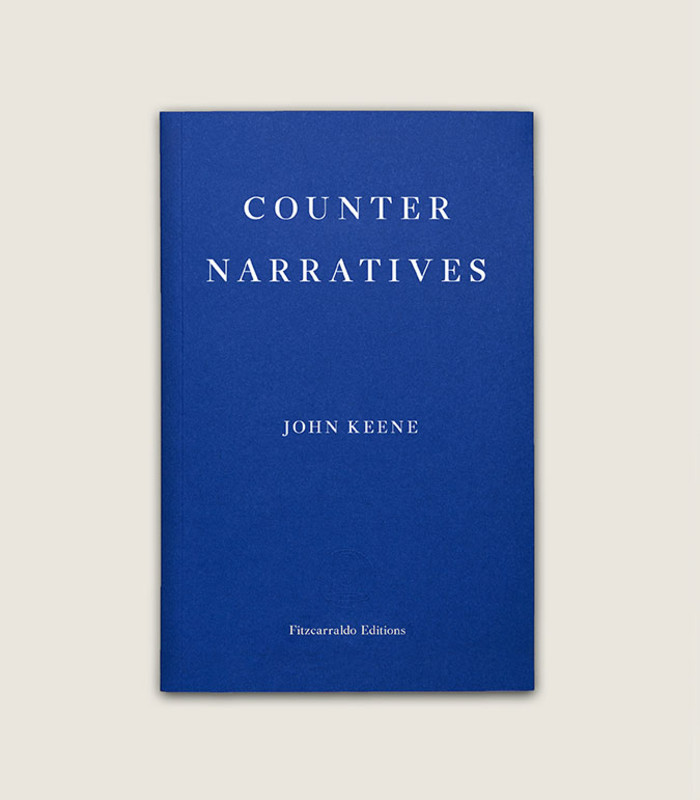
I also mentioned some of its members and the day's award-winners, a few like my former graduate school professor and thesis advisor E. L. Doctorow no longer with us, so won't recapitulate that earlier blog post, but I will say that uncanny pleasure of once again attending a Ceremonial up at Audubon Terrace in Washington Heights, this year, as a recipient, having received the Harold T. Vursell Award in Fiction. This award is given to a writer specifically based on the quality of their prose. (!) J's Theater readers will note my often baroque stylings (and typos, forgive me) here, and perhaps ponder why I was designated a recipient of this prize, but it was primarily for Counternarratives, in which my rhetorical and syntactic play was, I think it fair to say, at its most daring, and so I took the honor as an affirmation of what I attempted in that book, though I also think it's probably not wrong to suggest that all of my published books have in them some sort of experimentation when it comes to prose or verse, and that when it works, it is at least distinctive if nothing else.

As an award recipient, I was invited to a pre-Ceremonial reception and luncheon, which C attended with me, as did my New Directions editor and publisher, Barbara Epler, and I had the opportunity there to tell Jamaica Kincaid once again how much of a fan I was and am. Her prose, as well as her inventiveness as a storyteller and novelist, have been among many powerful influences on my own work. I also had the opportunity to chat with a few fellow award winners or new members, including poets Aracelis Girmay, fellow former Dark Room member Natasha TretheweyMarilyn Chin, Claudia Rankine, and Grace Schulman, and fiction writers Alice Hoffman, Lorrie Moore and my collegue Jayne Anne Phillips, who was elected to the AAAL a few years ago. After the luncheon, as before it, C and I viewed some of the art and literary materials, by members and recipients on display.

One of the more fascinating rooms featured the photos of all the prior and present members, lined up in rows in stall-like spaces. The original members were, unsurprisingly, all white men, a great many of them legendary names in American culture, which got me wondering who had not been a member yet produced work that today we hold in high esteem (F. Scott Fitzgerald, to name one, Ernest Hemingway to name another); on the other hand, many of the names would not register at all to contemporary sensibilities. At a certain point, a few white women's faces pop up, and then, slowly, the further we progressed into the 20th century, there were more white women, a few black writers, like W. E. B. DuBois (was he the first?) and Langston Hughes, and then black classical composers and jazz musicians, Asian American, Latinx, and Native American writers' portraits appear (see the photos below). The Academy's members still strongly reflect the upper reaches of the preponderantly New York-and-northeastern based world of architecture, visual arts, literature, and European-American art music, but the awardees have begun to diversify somewhat more, or so I was told. Certainly this year's winners were more racially and generationally diverse than I recall from 2013.

In one of the rooms featuring paintings
bequeathed by American Impressionist
F. Childe Hassam (photo by C)
One of the rooms in the American Academy
 headquarters  (photo by C)
Members and honorees assembling on stage
 (photo by C)
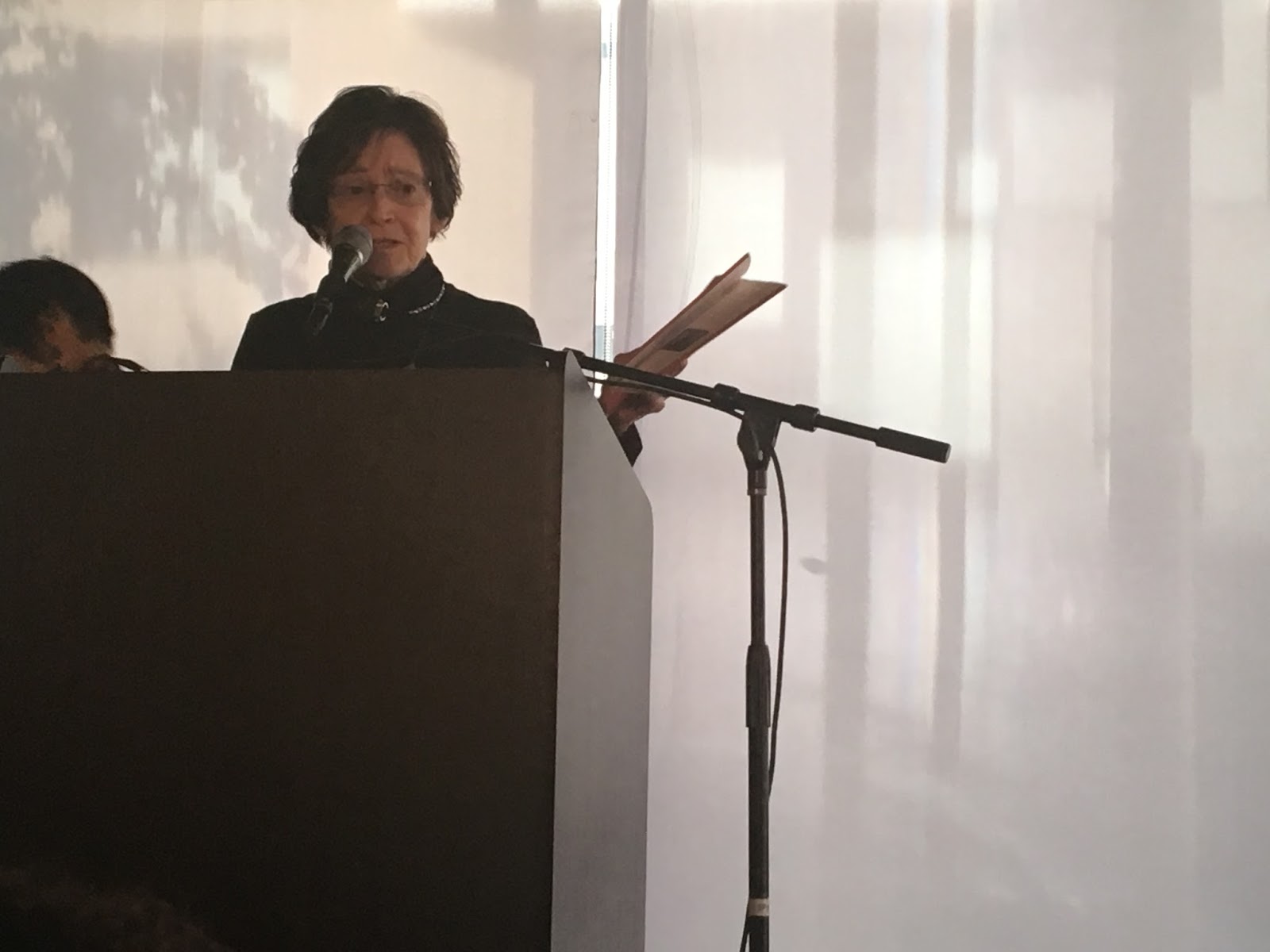
Once the Ceremonial began, I took my numbered seat on the stage, between Jamaica Kincaid and poet D. A. Powell, also a prize recipient; to his left sat our presenter and a member of the committee that selected us, poet Henri Cole. A row behind me sat Eileen Myles, among others. A number of illustrious members, like sculptors Martin Puryear and Richard Hunt, whom I mentioned in my prior post, and honorees like Meredith Monk and Thelma Golden, were seated in the front row.  This year's recipient of the Gold Medal for Literature, the Academy's highest honor, Toni Morrison, and the Gold Medal for Art, Lee Bontecou, were unable to attend, and so were fulsomely lauded by their presenters. One highlight of this year was the Blashfield Lecture by Pulitzer Prize-winning composer David Del Tredici, once a controversial figure in the American classical music world and now a venerable and venerated elder. Del Tredici's lecture, "The Task of Gayness," explored his coming into his own in his field, and out as a gay man, with humor and concision. Were he to write a memoir, I'd most certainly buy it.

A photo of me walking to receive
my award from Henri Cole (photo by C)
Receiving my award from Henri Cole
(Photo by C)
At the conclusion of the awards ceremony, which ran roughly an hour, another reception unfolded, on a bright and sunny but thankfully not hot afternoon, which afforded us an opportunity to speak with more writers, editors, artists, and others in attendance. It was, all in all, a lovely afternoon, and many thanks to the Academy jury for the award!

Wednesday, February 27, 2019

14th Blogiversary

Photo by Rachel Eliza Griffiths

Fourteen years ago, on February 27, 2005, I began blogging at J's Theater. I was regularly reading the blogs of friends and writers, artists, political commentators, and others I'd never met but felt a desire to be in conversation with, and so I started this blog. I viewed it as a creative and cultural space, with far less emphasis on politics and responsive to the news cycle--which has sped up incalculably more these days now that Facebook and Twitter have taken off--than it has assumed at various points. More than anything, however I wanted it to be a site where I could try thoughts and ideas out, imperfect as they might be, without the usual concern of perfection or even the struggle, customary as well, to get them into print. (My entire writing career has entailed a struggle to get my work into print.)

From writing about poetry and poets, like Jay Wright, as I did in my first post, to my life and experiences at the university (which has become a new university over the years I've blogged), to reviews of books and films, to snippets about Black history, art and culture, and history, art and culture over all, to translations from Portuguese, Spanish, French, and, I sometimes am amazed to admit, Dutch and German, to posts about rugby, track and field and other less popular (in the US imagination, at least) sports, my iPhone and iPad sketches, and on and on, J's Theater has provided an ideal space for me to explore, (mostly--haha!) pressure-free, as I see fit. It also has served as a site of documentation at times for cultural activities, and especially was so during my decade in Chicago, which wasn't even a decade ago but feels like a lifetime has passed between then and now.

I've repeatedly debated whether to keep blogging or to quit. One great frustration after the earliest years (2005-2008 or so) was the sharp drop off in comments, which were for a while replaced by spam, which disappeared (thanks, Blogger?), only to reappear in recent years with a vengeance. It thankfully is very easy to delete these days, but that requires its own dedicated attention. Far more pressing were my academic responsibilities, which have grown to include 12-month administrative duties that devour more mental space and energy than I ever imagined. I don't think it's any surprise that before this year, 2014, the first year I became a department chair (acting during that year) and 2017, just before my last sabbatical, saw the fewest posts. It was not for lack of interest, but time and vigor.

Not so long ago, we were told that blogging was dead. No one blogged, everyone had moved to YouTube, Facebook and Twitter. And Tumblr, which was and is a blogging platform that in essence mostly deprioritized words. (It also has banned not just pornography, but nudity in general, that's another matter.) And Instagram, which is all pictures (for the most part). And Snapchat, of course. Now there's Tiktok, and other walled gardens. One thing I loved and still do about blogging (though to its credit, Twitter also is almost fully public) via Blogger, WordPress and similar sites is that whatever you published was and remains visible to all; a private company does own this platform, but the blog remains more a public square-style venue than many other options out there. For good and ill, of course. The dazzlingly brilliant Kegur'o M, who continues to blog at Gukira: Without Predicates, is a stellar example of the good that can come from a blogger at the top of their game.

But that public aspect is one that I cherish, and one reason I hope to continue blogging. I also wish some of my old blogging friends, many listed on the blogroll to the right, and other bloggers I never interacted with but who've given up blogging, would start up again. No shade against Medium, but before ideas are fully polished, why not bounce them off readers on a blog? You can always--well, so far--revise as you go.

Tuesday, September 04, 2018

Maryanne Wolf on the Death of (and Ways to Protect) Deep Reading

When journalist Nicholas Carr’s The Shallows: What the Internet Is Doing to Our Brains appeared in 2010, I remember exchanging emails with Reggie H. and Lisa M. about it, reading numerous articles about it (including excerpts from the book) online, and eventually buying the book to dive fully into what he had to say. Overwhelmed at the time by my usual mountain of required reading it took me a while to get to it, but I did, and found his argument about the effects of the Internet on our brain and neural system quite persuasive. I even blogged a snippet from The Shallows at the end of that year. To quote Carr again:
The Net's cacophony of stimuli short-circuits both conscious and unconscious thought, preventing our minds from thinking either deeply or creatively. Our brains turn into simple signal-processing units, quickly shepherding information into consciousness and then back out again.
He was certainly on to something crucial about the various cognitive changed spurred by the US's increasing digital turn, and he wasn't alone in his assessment. Others like internet pioneer and guru Jaron Lanier took up related arguments about the effects not just of the net and our brains and nervous system, but the entire e-technological apparatus and its transformation of human sociality, economics, and our contemporary polity. Where Carr was alarmist--now proving to have been correct in his worries--Lanier was more measured, but in both cases, as with others who have written about the effects of the net, social media, etc., they were identifying the songs of more than one canary in the coal mine we're now deeply immersed in.

One very recent entry in this genre is Maryanne Wolf's Reader, Come Home (Harper Collins, 2018), which takes up some of the threads of her earlier books, Proust and the Squid (Harper Collins, 2011), and Tales of Literacy for the 21st Century (Oxford University Press, 2016), with a shift, as was the case with Carr, on online reading and its effects. Her earlier books explored the origins of human literacy and the challenges that our long human history of interacting with text faced as we moved into our current millennium, but now Wolf, Director of Center for Reading and Language Research at Tufts University, where she is Associate Professor of Child Development, and thus someone steeped in the current state of research on reading, is concerned with reading itself. As Laura Miller describes in her recent Slate review of the book, Wolf began to notice something about her own experience as a reader that I'd noted anecdotally with some of my students, beginning perhaps roughly 10 years ago and increasing among them to the point that I had to rethink my syllabus and approach to teaching: a waning ability to concentrate, and engage in sustained, "deep reading."

And it was not just my students: even for me, I have begun at times to feel a creeping distraction and impatience at any online text that was too long or complex ("tl;dr"), with a resulting desultory engagement in response. When it comes to expansive online texts, the feeling waxes. Skim, leap, surf: shift from one open page to another, one link to another, expect that the headline and the first few paragraphs will supply you with all you need to know. Earlier this year, as I had witnessed among my undergraduates, I even found myself struggling to get into novels, growing impatient after only a few pages, something I had never experienced befored. Wolf felt something similar, bemoaning her own inability to stick with a long, complex text, which is to say, a work not unlike a great deal of literature in a variety of genres written for hundreds of years. This was one of the central points Carr had broached back in 2010--as had Wolf, in turns out, in her 2011 Guardian essay "Will the speed of online thought deplete our analytic thought?", citing none other than Marshall McLuhan, who'd suggested that the medium was the "massage" and the message, that the technology would not only serve as a vessel but shape what it brought to us, and would shape our understanding of it.

In her new book, Wolf specifically recounts the experience of testing her capacity to "deep read" by returning to a novel she'd loved when she was younger, the very dense, multilayered Magister Ludi (The Glass Bead Game), German Nobel Laureate Hermann Hesse's 1943 futuristic magnum opus about a group of monk-like intellectuals who retire to a fictional European country known as Castalia, sequestered from most technology and economics, where they run a school for boys and engage in a complex, profoundly subtle form of play, the eponymous Glass Bead Game, that requires a lifetime of study and reflection to perfect. As she recounts, she tried repeatedly to begin it, but could not, yet it was not as if she could not read anything; online texts she sailed, or rather skimmed through. Hesse's novel, however, proved to be a tremendous struggle, and she temporarily set it aside. As an experiment, she set aside a period each day in which she would try again to read it, and, lo and behold, she began to find that after an extended period of struggle, she not only could get into Hesse's novel, but was carried away by it, her mind now in deep reading mode.

As note above, I have seen what Wolf is describing increasingly not just with my students and in my own recent reading habits, but with friends, one of whom admitted not to have read a novel by another writer in a while. The first person buys books of fiction and nonfiction, but when I ask if they have read them, the reply is, No. In terms of my own reading this spring and summer, I've had to force myself not to set the book aside after a few pages to check email or Twitter or look up something on Google, yet when I have stuck with the books. I get transported into the world of the work. This has been the case with novels and collections of short stories by Tayari Jones, Tommy Orange, Rachel Cusk, Uzodinma Iweala, Matthias Énard, Nafissa Thompson-Spires, Jamel Brinkley, Celeste Ng, and Beatriz Bracher, to name just a few of them, as well as various longer works I have blurbed or read for judging projects. I enjoyed every last one of them, but initially entering each was more difficult than it ever had been in the past.

So, you might say, Who cares if no one reads long or dense or long, dense works of fiction any more?  What happens if we lose the "cognitive patience" and focus that Wolf argues we may be losing? Hesse's writing and ways of thought may have reached their ends in terms of their possibility of connection--or, to put it more simply--relatability, with contemporary readers. (As someone with a propensity for for dense prose and serpentine syntax, this is not an idle concern.) Even if that's true, what Wolf--like Carr--shows, as prior studies have borne out, is that "deep reading," and the virtual engagement with narratives have powerful, beneficial cognitive effects. One is to foster a capacity for analysis, which texts by Hesse, or the authors I list above, or Marcel Proust, the subject of Wolf's first book, require. To put it another way, every complex work is a kind of detective story, leaving clues the reader must assemble to make sense of the work, even as we are relating it to and contextualizing it with what we already know. The second is a quite powerful feature of fiction writing in particular: empathy. When we enter the minds, perspectives, bodies, and experiences of others in fiction, we connect with them, even if briefly, and this shapes our own views in the wider world. It sounds like hocus-pocus, but it isn't. Literature's emotional power should never be underestimated. But the fact remains, even the simplest works of fiction--and nonfiction--are slow, or at least slower than tiled or laddering screens. You can skip a few sentences or flip a pages ahead but you've probably missed something important--that is, unless you're reading a book like Julio Cortázar's Hopscotch (Rayuela), where this is an integral feature of the novel.

Rather than categorically decrying digital reading, what Wolf suggests is that even if it is reshaping our brain and cognition, there is a way, particularly for those with children or teaching and working with them, to ensure that they learn and engage not only with screens, but with books, so that they don't lose the deep reading facility altogether. For adults, will power and a concerted effort to put digital devices away--and turn off TV screens--is probably the easier and best option. Cultivating this "bi-literate" brain is what Wolf is aiming for. How to do this will a challenge for the future, especially how many people cannot pull themselves away from their phones, especially younger ones. I tend to take a gentle approach with my students in terms of their in-class texting, urging them not to do so, but also recognizing that at times they may have a pressing issue they need to address. On the other hand, I also try to remind myself that I, like most people on this earth when I was in school from age 5 to roughly 32 or so, nearly a decade out of the classroom as part of that mix, made it through entire days without 1) ever picking up a telephone unless it was an emergency and 2) only talking about things on a screen, unless we were watching a video or TV program as part of our less, or doing something very specific on a computer required for class. How did we survive? I did, we did, and I place this thought in the forefront of my brain as I close my laptop, shut off my phone, and dive into another book--a novel, a collection of poetry, short stories or essays, a play. But I'll get to that as soon as I post and read a few Tweets, bookmark a YouTube video, watch a few Instagram stories, and look at one more article online....

Thursday, August 02, 2018

Quote: James Baldwin

James Baldwin (Associated Press)
"Until my father died I thought I could do something else. I had wanted to be a musician, thought of being a painter, thought of being an actor. This was all before I was nineteen. Given the conditions in this country to be a black writer was impossible. When I was young, people thought you were not so much wicked as sick, they gave up on you. My father didn’t think it was possible—he thought I’d get killed, get murdered. He said I was contesting the white man’s definitions, which was quite right. But I had also learned from my father what he thought of the white man’s definitions. He was a pious, very religious and in some ways a very beautiful man, and in some ways a terrible man. He died when his last child was born and I realized I had to make a jump—a leap. I’d been a preacher for three years, from age fourteen to seventeen. Those were three years which probably turned me to writing."
--James Baldwin (born on August 2, 1924), from "James Baldwin: The Art of Fiction, No. 78," interviewed by Jordan Elgrably, The Paris Review, Issue 91, Spring 1984.

Monday, June 04, 2018

*Essays On Hilda Hilst* Now Available


Thanks to the dedication of editors Adam Morris and Bruno Carvalho, Essays on Hilda Hilst: Between Brazil and World Literature, the first English-language scholarly volume dedicated to the work of one of Brazil's most singular and path-blazing authors, is now available for purchase. Published by Springer this month, the book opens with an insightful introduction about Hilst (1930-2004) and her relation to the category of "World Literature," by Morris, a gifted translator and scholar who produced an exceptional rendering of Hilst's 1986 novella Com os meus olhos de cão (With My Dog Eyes, Melville House, 2014), as well as works by Jõao Gilberto Noll, Beatriz Bracher, and other major contemporary Portuguese-language writers, and Carvalho, a Princeton professor of Spanish and Portuguese, whose scholarly interests span an array of topics and whose study Porous City: A Cultural History of Rio de Janeiro (2013), received the Brazilian Studies Association Robert Reis Book Award in 2014. Other essays in the volume explore different aspects of the late author's oeuvre, ranging from her plays (Tatiana Franca Rodrigues Zanirato), fiction (David William Foster), poetry (Alva Martinez Teixeiro), and broader theoretical, political and ideological readings (Deneval Siqueira Azevedo Filho, Eliane Robert Morães, Morris, and Nathanaël).

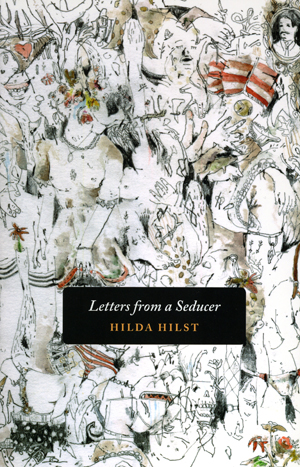
For my part, I contributed a revision of a talk I delivered in at the New York Public Library back in 2014, "Translating Brazil's Marquis de Sade," which explores the complexities of Hilst's Cartas de um Sedutor (Letters from a Seducer), for which Carvalho wrote the introduction, and the challenges I--and anyone--might face bringing it and her work in general into English. (In "Derelict of Duty, "Nathanaël also discusses some challenges faced co-translating Hilst's A obscena Madame D (The Obscene Madame D, Nightboat and A Bolha Editora, 2013). It is especially exciting to see this essay in print and in this volume, which I hope will serve as an enticing overview and introduction that I hope sparks more studies in English about Hilst, and spurs more translations of Hilst's work. I believe a translation of Hilst's Fluxo-Floema is on its way soon, and this year, Hilst's Of DeathMinimal Odes, translated by Laura Cesarco Eglin, will be published by co•im•press.

Please consider getting a copy of this volume, or at least suggesting your nearest library do so. And please, read Hilda Hilst!

Tuesday, April 03, 2018

Wilson Harris, Among the Ancestors

Sir Wilson Harris, with his final novel,
The Ghost of Memory (2006)
Such is life, so death comes calling. Sir Wilson Harris (1921-2018), the great Guyanese-British author whose fiction, poetry and essays form a singular, ever experimental whole, left the earthly plane on March 8. I only learned about his passing recently, when Chris Stackhouse shared the news. Oddly enough, I had been thinking about Wilson Harris quite a bit of late, as returned to several longstanding fictional projects, and would wade back into various works of his for knowledge and fortification. He was and remains one of the most important literary artists in my personal firmament. His imagination, daring and craft really were peerless, as was his exacting inner aesthetic compass, which led him to write over two dozen books, at a steady clip, and it is fair to say that none of them are easy, but ever last one offers multiple rewards.

Over the years, I have invoked his name and work many times on this blog, particularly in conjunction with the annual folly known as the Nobel Prize in Literature, an award that almost completely debased itself when its jury gave the prize to Bob Dylan, arguably the most decision amidst a host of recent ones, while literary pathblazers like Harris, John Ashbery, E. L. Doctorow, and countless others died overlooked. One post from 2006 focusing on Harris bore the title "Four Books," and his was the second I discussed. I will repeat it verbatim here, because everything I said then I still believe, with even stronger conviction:


Speaking of passing through strange mirrors, I recently reread Wilson Harris's Carnival (Faber Faber, 1985, out of print) for the graduate course I'm teaching. I realized upon finishing it once again that it must be one of the most difficult novels written in English in the last 25 (50? 75? more?) years. Though it only runs to 168 or so pages, it serves up prose so densely lyrical, disorienting, distancing, and taxing that I have to admit my reading strategy involved pausing, then rereading, then rereading again certain passages, even though I'd already read the novel several times in the past. My conviction remains that this is a work of manifest artistry that manages tosimultaneously embody multiple genres and modes while also functioning diegetically as an allegorical narrative. I also think it stages, from the level of syntax all the way up to the level of the plot, a very complex textual embodiment and performance of epic and ritual, as a revisionary "Carnival" site in prose (Carnival and the carnivalesque, masking/masqueing, transformation and metamorphosis, performance and performativity, trauma and recovery). In this work, Harris employs a relentlessly dialectic, fractal, negative capability in writing the social, economic, political, and spiritual "history" of Guyana, the Western epic tradition, the Diaspora and diasporas, society and the self. I also suggested to the class that though he was (and is) interested at the time in quantum theory, which is most evident in The Four Banks of the River of Space (yet operative, in terms of ways of reading time and space in Carnival and the carnival), he seems also to have anticipated string theory in this book, at least as I understand it from many articles and Brian Greene's and Lisa Randall's books on the topic (which isn't very well). Harris brain nevertheless strikes me as having been on the branes before almost anyone else--in the literary world, that is.

I again looked at Carnival last fall, as I was mentoring one of my brilliant graduate students, Simeon M., and shared, by reading aloud, Harris's opening to that novel, a series of passages that seem to take metaphysical flight as the eyes and voice box move from word to word. It is a remarkable performance, refined in that novel to sublimity, and for it alone Harris should have received every award under the sun. As these things go, of course, it did not work out that way, but he kept writing, and published right into his 80s. I have his final novel, The Mask of the Beggar, and though a late(r)/last work, it glimmers with his distinctive genius. In his work, Guyana, the Caribbean, black diasporic and mixed people of the new and old worlds, the spiritual and scientific, the metaphysical, the cross-cultural imagination, as he once put it, all take flight.

I never had the opportunity to meet Wilson Harris, but I did work with him quite pleasurably for a brief period in the early 1990s, when I was the managing editor of a literary journal that was planning to dedicate an issue to him. This involved written correspondence, and I noted then his graciousness and warmth, but also his exactitude when it came to how his work should appear and what we would include. What provided me with a lesson I had never gotten before was to see his edited manuscripts, and to note how, perhaps more so than any other author I had ever read, he distilled everything on the page down to an intoxicating brew.  Covering the typewritten text like a spiderweb, his penned cross-outs and substitutions suggested a continuous search for concision not with the aim of efficiency but of discursive precision was incredibly instructive. To put it another way, Harris was not in search just of the right word, but the combination of words through which the force of his narration, his ideas, the presence of the story, would resonate most fully. To give an example, here are two paragraphs from my quotation, back in 2011, of his Four Banks of the River of Space:

"The flute sings of an ancient riverbead one hundred fathoms deep, far below the Potaro River that runs to the Waterfall. Two rivers then. The visible Potaro runs to the Waterfall. The invisible stream of the river of the dead runs far below, far under our knees. The flute tells of the passage of the drowned river of the dead and the river of the living are one quantum stream possessed of four banks. We shall see!

"So deep, so far below, is the river of the dead that the sound of its stream may never be heard or visualized except when we clothe ourselves with the mask, with the ears of the dancer in the hill. Then the murmur of the buried stream comes up to us as if its source lies in the stars and it may only be heard when we are abnormally attentive to the mystery of creation and the voice of the flute within the lips of three drowned children.

Out of that interaction came an intermittent dialogue, and I made sure to send him my work as it appeared. He also did one of the kindest things an established writer can do when back in 1994, I sent him a copy of the manuscript of my first book Annotations, and, busy though he was--and though we had never met in person and only communicated via letter or electronic means--he sent back a one-page assessment that both summed up the novel in impressive form, affirmed what I was striving for, and provided me with my first blurb. It was a generous gesture, which he did not take lightly, and I will be forever grateful to him for doing so.

Theodore Wilson Harris was born in New Amsterdam, British Guiana, now Guyana, in 1921. He studied at Queen's College in Georgetown, Guyana, then worked as a surveyor in the country's interior, an experience that informed his work for the rest of his life. One can see the landscapes of his native country in his first novel, The Palace of the Peacock (1960), which made his reputation, and in one his late-career masterpieces, the beguiling, trenchant Jonestown (1996), which explores the US preacher Jim Jones' religious cult and its subsequent mass suicide that took place outside Guyana's capital. Harris took up a career as a writer and editor in the late 1940s, publishing poems and essays in journals such Kyl-over-Al, and emigrated to the UK 1959, primarily to foster and further his literary career.

Wilson Harris in 2006 (The Guardian)
The Palace of the Peacock also demonstrated his interest in an approach to narrative that broke down the strictures of realism, which he had linked in his critical work to the rise of colonialism, empire and the global slave system, in favor of storytelling which was more fluid in temporality, metaphorical and metonymic, speculative, oneiric, and philosophical. In as much as Harris took Guyana's multilayered history as his template, he also drew upon numerous European canonical texts, re(-en)visioning them so that his work entailed less of a rewriting and more of a dialogue with the prior texts. In this debut novel, the quest story leads to a profound reckoning for its characters but for the Caribbean novel, and Anglophone fiction, going forward. This was a new kind of mythic fiction, and Harris would, in all his subsequent work, demonstrate its numerous possibilities.

The Palace of the Peacock initiated what came to be known as the Guyana Quartet of novels, which appeared in rapid succession: The Far Journey of Oudin (1961), The Whole Armour (1962), and The Secret Ladder (1963). In each he explored aspects of Guyana's colonial history and present, while also delving into aspects of its indigenous past and the complex merger of cultures that opened up spaces within and beyond reality. The rainforest, the plantation, the bush, and the river become not just the sites where the novels unfolded, but chronotopes permitting an innovative mode of literary and critical exploration. Through the 1960s Harris would publish roughly a novel a year, the subsequent novels often centering on women protagonists grappling with various forms of loss, as the mythic component already present in the work moving ever more fully toward the forefront of the texts.

In the 1970s, his novels shifted to the UK and other points across the globe, including Mexico, but the revisionary conversation with Guyana's past and present, the Caribbean and Latin America, the African Diaspora and Amerindia's multiple currents, only deepened, as did his exploration of reality's multiplicities culminating in the remarkable Carnival trilogy of the 1980s, which includes the eponymous novel, as well as The Infinite Rehearsal (1987) and The Four Banks of the River of Space (1990). He was knighted by Queen Elizabeth II in 2010, and received a lifetime achievement award from the Anisfield-Wolf Foundation in 2014. His wife of many decades, Margaret, predeceased him in 2010. He leaves four children by his first wife, Cecily Carew, as well as his sister, grandchildren, and great-grandchildren.

Monday, March 12, 2018

AWP Presentation: Notes on Literary Style in Fiction

UPDATE: The full and corrected version of this essay is now up at LitHub, as "Elements of Literary Style." I'm keeping the introduction here, with one quote. Please check out the full version at LitHub, and many thanks again to Christian Kiefer, and to Jonny Diamond at LitHub, for agreeing to run the piece.

‡‡‡

Yesterday I mentioned that I would post my remarks for the AWP 2018 panel "Profundity as Purpose: Thoughts on Sentences, Vocabulary and Style," organized by writer and critic Christian Kiefer. Other panelists included Coffee House Press editor Caroline Casey; acclaimed writers Kim O'Neill and Christine Schutt. I should note that I slightly modified the introduction below when I read it aloud, and also read only a portion of the full set of notes, to which I added a few quotations, by panelists O'Neill and Schutt, based on their remarks and readings. Many thanks to Christian, Caroline, Kim, Christine, and everyone who attended the panel, which was held at 9 am on Saturday, and drew a full house. Many thanks to Christian and my fellow panelists, and to all who attended the event!

(I should also note that at the panel Caroline and I offered the name of some living authors whose styles exemplified what Christian, others on the panel, and I were talking about--ourselves included--but I decided not to list them here, because there are so many great fiction writers, and I do mention but a few of the many I admire and regularly read with enthusiasm in my notes. I encourage J's Theater readers to add names of distinctive living fiction stylists they admire in the comments, if you'd like, and I'll aim to post them at some point soon if there are more than a handful.)

Lastly, I also want to note another highlight of this year's AWP, which was attending the Jack Jones Literary Arts' welcome event at the Columbia Cafe in Tampa! Many thanks to Kima Jones and Allison Conner, and it was so much fun to meet everyone on Jack Jones' roster--which includes yours truly--and its fans!

‡‡‡

INTRODUCTION

I want to begin by thanking Christian for organizing this panel, and thank all of my fellow panelists for their thoughts on this topic, I initially thought I would write a short essay, but instead I decided to draft a series of provisional notes on the topic of literary style in fiction, interlaced with quotations on the topic by various writers of note. (You can find a number of these quotes online, as well as on the website "Some Literary Criticism Quotes," which is where I culled them.) Unless otherwise noted, however, the comments and thoughts are mine.

Two quotes:

Is there an ethics of style? How might we talk about it? What happens when we consider how one template for now-dominant literary styles, emphasizing craft and de-emphasizing politics, that are taught in many—most?—MFA and undergraduate programs, may have their possible origins in the US government-funded approaches instituted at Iowa and Stanford, as Eric Bennett argues us in his 2015 scholarly study Workshops of Empire: Stegner, Engle and American Creative Writing During the Cold War (University of Iowa Press)? Even setting this particular history to the side, as usually occurs in most creative writing programs, doesn’t every artistic act require some level of ethical inquiry? Are there styles and stylistic approaches we might label more ethical or less, and if so, why? Or might another way to speak of the ethics of style be to raise questions not just of historicity and genealogy, but also of the truth(fulness) of representations in relation to a given narrative? What role or roles do the larger social, political, economic, and cultural contexts hold in this line of questioning?

*

“In order to find his voice he must first have mastered style”

–A. Alvarez, The Writer’s Voice

*

Prose (fiction) should not be musical; this is the province of poetry. (“Poetry is music set to words” –Dennis O’Driscoll.) This is another dictum I have always worked under, and to some degree, because of my inner sensibility, against. Yet so much of the most memorable prose, not just poetry, appears to aspire to, as the old phrase goes, and often achieves the condition of music. What lines in prose fiction do you most readily recall? Even the ideas and statements that engrave themselves on your consciousness do so not just because of their aptness and timeliness, but because of how they were written, how they unfold, almost like lyrics or lyric, as prose.


Friday, November 10, 2017

Master Class on the Novella in Translation

Bolaño's Una novelita lumpen
At the beginning of September, the fall semester always looks endless to me, like a river whose mouth or delta lies beyond the horizon of the looming holidays. Once class begin, however, the weeks and months always race by more swiftly than I envision. By December, I find myself remarking how the term has slimmed down to final papers and exams, with the restorative winter break--that terminus--only weeks away. Even still, I always worry about overloading and wearing myself out, which I have come to realize is unavoidable. Beyond classes these days, there is everything else, which was always there, but even more so with each passing year.

I nevertheless had the idea that a mere month's worth of--four--classes on a free Wednesday alongside my usual teaching and advising load would not be unreasonable and a pleasant change of pace, and it turns out that it was. For four weeks from mid-October through the beginning of November, I taught a masterclass on the novella in translation to a small cadre of MFA students at Columbia University's School of the Arts, and once I properly figured out the commute, which required heading in the opposite direction from Newark, things ran quite smoothly.

Having not headed into Manhattan regularly during morning rush hour in 17 years, I was reminded that the PATH trains are usually reliable, if stuffed like a coffee vacuum pack, at that hour, and that the trip into the city is especially quick because it only requires a few stops to Christopher Street station, which once was my destination when I was a student at NYU (except when I taught in the East Village and in the winter, when I would take it further, to 9th Street) and again when I worked in SoHo in the late 1990s. From the Christopher St. PATH stop, I walked down the famous street, still mostly shuttered at 9 am, to the 1 Train at 7th Avenue, and then changed to the 2 to speed uptown, then back to the 1 to end up right outside Columbia's main gate on Broadway. Trips back to New Jersey (and usually the Rutgers campus for afternoon meetings) ran more leisurely in reverse.

Since we had only four weeks, so I assigned four novellas in translation:
  • Roberto Bolaño's 2005 mini-masterpiece A Little Lumpen Novelita, the last work of fiction he published in his lifetime, which was translated by Natasha Wimmer and published by New Directions in 2016;
  • Amélie Nothomb's 1993 novella Loving Sabotage, translated by Andrew Wilson and published by New Directions in 2003;
  • Yoko Ogawa's The Diving Pool: Three Novellas, originally published as three separate works, in 1990 and 1991, and translated by Stephen Snyder and published by Picador in 2008;
  • and Abdourahman A. Waberi's 2009 Passage of Tears, translated by David and Nicole Ball, and published by Seagull Books, 2011.
I had read all of these books before, the Waberi and Bolaño texts most recently, and the Nothomb not long after it appeared a little over a decade ago. I chose these texts with the aim of linguistic, aesthetic, and thematic diversity, among other goals, yet still ended up with two Francophone authors, writing from rather different perspectives, and three works in European languages. (Since I can read French and Spanish, though, I had a clearer sense of the translators' skills.) Of the four works, Bolaño's and Ogawa's were clearly labeled novelas (or "novelita"), while Nothomb's and Waberi's were issued as novels. All four are authors I admire, Bolaño especially so, and though I had taught his work before, I had never included fiction by any of the other authors, nor these four works, on my syllabi.

I'd chosen Waberi's text, I realized after the course had begun, in part as a provocation, because its length suggests that it might not fit the criteria. And what are they? I won't reprise the essay, based on a talk I gave last spring at Northwestern's annual spring Festival of Writing, that I revised and shared with my students to start the class, but some of the key characteristics I asked the students to think about were the novella's usually limited scope (more than a story, perhaps, but less than most novels) and concentrated effects, its unity of voice and plot, and its concision in narration. One of my students metaphorized, specifically apropos of Ogawa's work, the novella's narrative focus to a "tunnel." I thought this a brilliant insight, and thought it applied, in varying ways, to all four works. The students' assignments included in-class discussion and writing, response papers, and, as their final submission, a set of novella starters. Each student produced several that I hope they pursue, if not as novellas then, plumped out as novels.

They were to a person smart, engaged, and original in their thinking. I did not see any of their creative work, but nearly all were fiction writers, and I got a sense of what each of them was working on. It was a pleasure to experience thinking through the texts with them. Each novella offers different challenges in terms of how it works, and the class as a whole was more than up to the case, puzzling out as well other aspects of the texts. One of the students who read French was able to point out how much more ironic Nothomb's original was compared to the English (and how it riffed off a variety of works that Francophone readers would know, though Anglophones might not), while Waberi's French was a bit more formal in places, and less so in others.

Will they write a novella or novellas? I hope my proselytization was effective, though I did discuss, in the essay and the class, the US publishing industry's reluctance about the shorter long form. I also hope I might have sparked an interest in translation among some of them. I did leave the very brief course--like an "eyeblink," as one student put it--as encouraged as I always am when I finish a semester with my MFA (and other graduate, and undergraduate) students at Rutgers-Newark, about the future of American literature and writing. The hurdle, of course, is to get inventive, talented writers (of all ages and backgrounds) like these students and my Rutgers students and mentees, into print, and their work to readers. The sharp, gifted novella class cohort, I sincerely hope and trust, will be doing so before long.

Thursday, June 08, 2017

Quote: William Melvin Kelley

'


William Melvin Kelley (1937-2017: RIP), from "My Next to Last Hit by 'C. C. Johnson'," in Blacks at Harvard: A Documentary History of African-American Experience at Harvard and Radcliffe, edited by Werner Sollors, Caldwell Titcomb, and Thomas A. Underwood, with an introduction by Randall Kennedy, New York: New York University Press, 1993.

(I only learned recently, thanks to an email from Chris Stackhouse, that Kelley had passed away. One of the most inventive and productive--during the decade from 1960 through 1970, when his last book appeared--Black writers of his generation, and the author of four published novels and a collection of stories, he should be read much more regularly as part of the 20th century African American literary canon. You can read a 2012 interview with him here.)

Monday, May 22, 2017

10th Annual Writers' Festival at Northwestern


Remove the "10 Annual" portion of this blog post's title, and this could appear to be one of several I wrote during my decade at Northwestern University, including the one marking the fifth annual festival, my last while there, in 2012. In fact, I was there for the festival's creation in 2007. The Annual Writers' Festival arose from a desire to convene during one week and place in conversation distinguished authors from the three major creative genres, poetry, fiction and creative nonfiction, that we were teaching at the undergraduate and graduate levels. When I first taught at NU, each quarter roughly brought a visiting writer from a different genre. The major visiting writer to participate on his own as the undergraduate creative writing guest before the festival began was Junot Díaz, I believe, in the fall of 2007, right after his novel The Brief Wondrous Life of Oscar Wao was published, and just before it received the Pulitzer Prize and National Book Critics Circle Award. 

Cathy Park Hong reading her work
Bringing the visiting writers and literary events together meant that the students would be able to interact with them at the same time, and see them interact with each other. It also ensured maximization of our--faculty, staff, and student--resources. The festivals turned out to be a great success, and I can still remember some of the events as if they had occurred yesterday. Because of them, I had the pleasure of meeting and hearing Brigit Pegeen Kelly read before she passed away; observing George Saunders warmly share his bounty of wisdom with student; watching Nami Mun thrill a room of student writers; feeling my pique soar as David Shields threw down the gauntlet about fiction's supposed irrelevance; and immersing myself in ZZ Packer's novel-in-progress.

Sasha Hemon at his craft talk
It was thus a profound surprise and deep honor to be invited as one of this year's guests, along with two excellent writers, poet and critic Cathy Park Hong and fiction and nonfiction writer Aleksander (Sasha) Hemon, to participate in the tenth version of the festival. Returning for the festival meant that I would have the opportunity to see many former colleagues, creative writers, scholars and staff members, and also be in dialogue with and listen to Cathy and Sasha offer their thoughts and share their work. Since I knew how the schedule unfolded, I knew that I would need to read and be ready to discuss the work of the student writers, prepare a craft talk (on the novella, I decided, since the undergraduate fiction majors and minors were in the midst of writing them), be ready for a guided conversation, and give a reading.

Cathy talking about speculative poetics
Each of these turned out to be very enjoyable, and given that our festival ran concurrently with a scholarly conference--I even ran into one of its speakers, Philip Brian Harper, who teaches at NYU, twice while there!--and a reading that brought Zadie Smith to campus the same evening as my reading, the strong student and faculty attendance and participation were even more heartening. Some highlights for me were meeting the graduate and undergraduate students, seeing and hanging out with my former coworkers, taking notes as Cathy theorized and discussed what she described as "Speculative Poetics," and hearing Sasha read a powerful nonfiction piece spurred by the election of Donald Trump. It also felt uncanny at times to be walking around Evanston (and to be in O'Hare Airport, the scene of so many waking nightmares), which I had not set foot in five years but felt like I'd only been away from for a week at most. (I did get to see my cousin Raquel, her husband Walter, and their two adorable cats, so that was an added bonus of being back there.)

A clip from Cathy's talk, featuring a performance
by Latasha Natasha Nevada Diggs
I owe a debt of gratitude and offer my thanks to the English Department Undergraduate Program in Creative Writing, and all the other festival sponsors. (Thanks to the Evanston Literary Festival, which also listed our events.) Thanks to Jennifer, Averill, Brian, Eula, John, Juan, Rachel, Shauna, Rachel, and Reg, and everyone else who made the festival possible. Thanks also to Cathy and Sasha for their work and fellowship. I really appreciated getting an opportunity to meet and discuss writing by Tara, Sophie, Zoë, Mackenzie, Danny, and Troy. In addition, it was such a pleasure to also see Susannah, Brian, Helen, Harris, and Andrew, and to run into Jay, Jeff and Kate (who were leaving a dinner with...Phil Harper!). It was a great capstone to a long, full semester, and the best way to see Chicago again after a while away.

Here's a write-up by Maddie Burakoff in Northwestern's student newspaper, the Daily Northwestern. Chicago Magazine also picked the Writers Festival as the top arts and cultural event to do that week!

I was so involved I barely took pictures, so the ones above and below are the best of the lot.

One of our post-event dinners, in Evanston
A find, from one of Evanston's used
bookstores

Leafy, shady Evanston

Friday, April 14, 2017

Tyehimba Jess, Colson Whitehead Win Pulitzer Prizes

Tyehimba Jess
CONGRATULATIONS to poet and friend Tyehimba Jess, who was awarded the 2017 Pulitzer Prize in Poetry for his new collection Olio (Wave Press)! Winner of numerous awards, including a Whiting Foundation fellowship, Jess is a fellow NYU graduate and graduate fellow of Cave Canem. He is an associate professor at the CUNY College of Staten Island. His collection, for which he developed a new poetic form, the syncopated sonnet, explores the lives of a cavalcade of key 19th century African American artists and performers, many clustered around the minstrel tradition. The title, "Olio," is in fact a term for the variety acts in a minstrel show, a component of such performances that carried over into Vaudeville and burlesque. Jess's collection manages to be both formally and visually innovative, and historically and culturally humanizing, and underlines his standing as one of the major poets writing today.

Congratulations also to fiction writer Colson Whitehead, who received this year's Pulitzer Prize in Fiction for his novel The Underground Railroad (Doubleday), which I am teaching this spring in my undergraduate literature class on history and myth in contemporary African Diasporic fiction. Whitehead's novel takes the concept of the Underground Railroad and transforms it, using the speculative mode, into a narrative that manages both to capture the essence of the fugitive system and  signify on a range of ideological nodes in US history, including state-sanctioned white supremacy, Progressive-era eugenicism, and precarious liberalism's inability to safeguard black life. Throughout Whitehead's skill, at every level of his prose, gleams, and his protagonist, Cora, as well as numerous minor figures, are not easily forgotten.

Colson Whitehead
Other winners this year in the arts and letters category include Lynn Nottage in the Drama category for her play Sweat; Heather Ann Thompson in the history category for her study Blood in the Water: The Attica Prison Uprising of 1971 and Its Legacy (Pantheon); Hisham Matar in the Biography category for The Return: Fathers, Sons and the Land in Between (Random House); Matthew Desmond, in the General Nonfiction category, for Evicted: Poverty and Profit in the American City (Crown); and composer Yu Dun, in the music category, for Angel's Bone, a multimedia opera. In the news category, Hilton Als received a Pulitzer in Criticism for his reviews in The New Yorker.

Lynn Nottage
I may be wrong, but I believe this is the most Black--4!--Pulitzer Prize winners ever, and the most ever received by authors and journalists of color. I guess we'll see if this is but a temporary shift or a harbinger of the future. (One of the oddest selections, though, was Peggy Noonan, Ronald Reagan's former speechwriter and spinner of tissues of fantasy, in the Commentary selection. Perhaps this was supposed to reflect balance of some sort, but having read several of Noonan's columns this past year, I remain no less baffled than when I first heard the news.)

Noonan included, congratulations again to all this year's recipients, and please go out and buy of a copy of Olio, The Underground Railroad, and any of Als's books, and, before it closes and if you're in New York, catch Sweat! (I still have to myself.)

Monday, October 31, 2016

Photos: American Book Awards

Here a few photos from the 2016 American Book Awards ceremony, which was held at the San Francisco Jazz Center. The highlight of the event for me was meeting all of the other honorees--congratulations to ALL of them, those present and those unable to be there--and hearing the extraordinary, often deeply moving speeches. Thanks once again to the Before Columbus Foundation and its board, Justin Desmangles, Ishmael Reed, and everyone who makes the foundation, the awards, the event, and all the important work BCF does in the world possible! (All photos are by C (thank you!).)

With THE Beefeater,
in front of the Sir Francis Drake
Hotel, Union Square
C & I before the event 
Chatting with my Rutgers-Newark
colleague Lyra Monteiro 
Meeting ABA winner Jesús Salvador Treviño,
author of Return to Arroyo Grande 
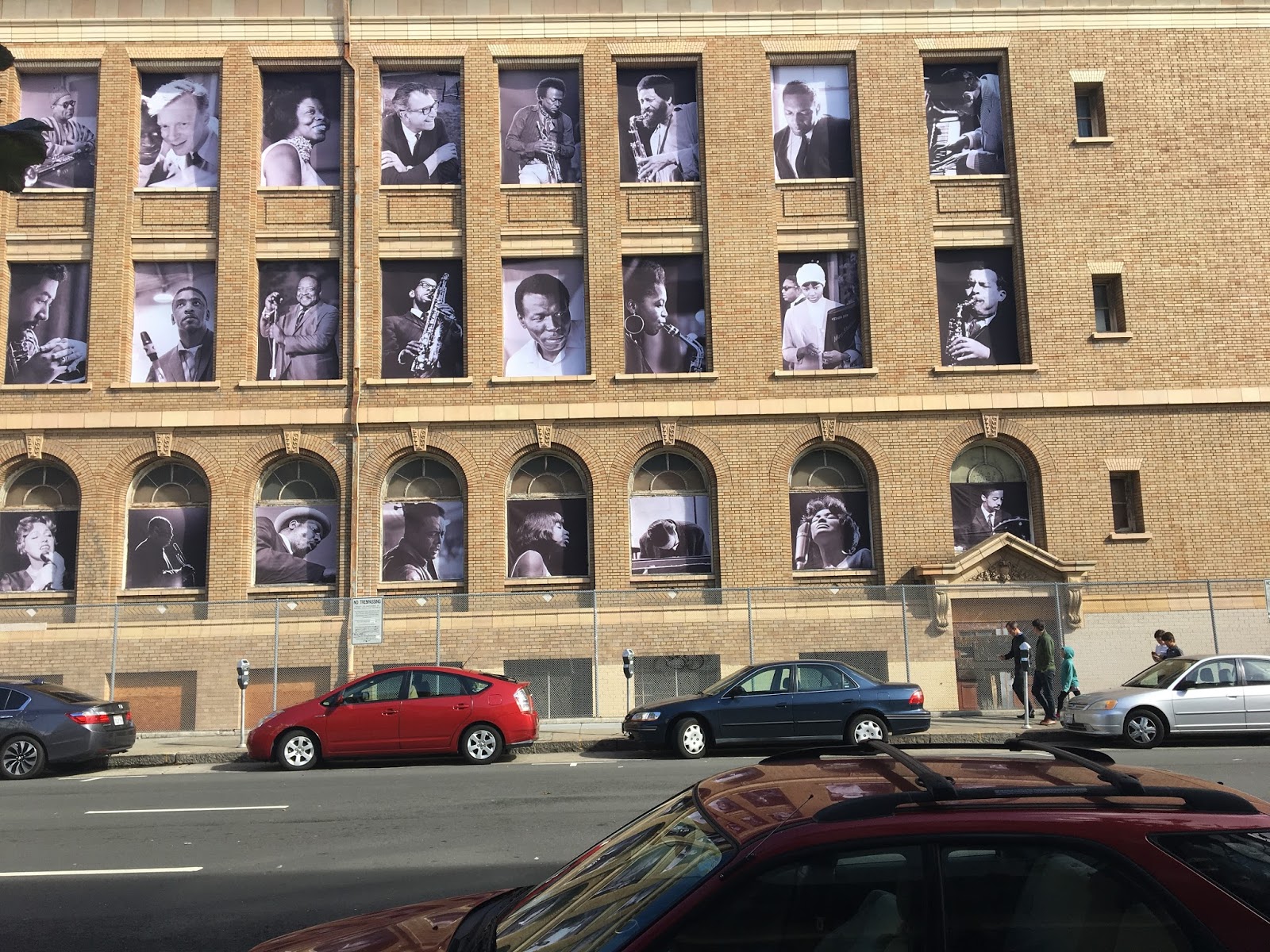
The façade of jazz greats across the
street from SFJazz Center 
Justin Desmangles, radio host, writer,
and MC for American Book Awards 
ABA winner Lauret Savoy, author of Trace:
Memory, History, Race, and the American Landscape
Poet Laura Da', author
of Tributaries and ABA winner
Jesús Salvador Treviño 
ABA winner Susan Muaddi Darraj, author
of Curious Land: Stories from Home 
ABA winner Deepa Iyer, author
of We Too Sing America:
South Asian, Arab, Muslim, and Sikh Immigrants
Shape Our Multiracial Future
Before Columbus Foundation and American
Book Awards founder Ishmael Reed,
introducing the Lowenfels Award for
Criticism, which went to Lyra Monteiro
and Nancy Isenberg
Lyra Monteiro, accepting her award
Washington University professor Bill Maxwell,
speaking after receiving his American Book
Award for his study F. B. Eyes: How J. Edgar Hoover's
Ghostreaders Framed African American Literature
Roxanne Dunbar-Ortiz, accepting ABAs for
Ned Sublette and Constance Sublette,
authors of The American Slave Coast: A History
of the Slave-Breeding Industry
The mother and sister of college student
Chiitaanibah Johnson, who received the
Andrew Hope Award for her activism
Lyra speaking and breaking it down
Yours truly, giving my speech
A group photo
Lyra and I