Showing posts with label black writing. Show all posts

Wednesday, December 22, 2021

First Reviews Are (Coming) In for Punks

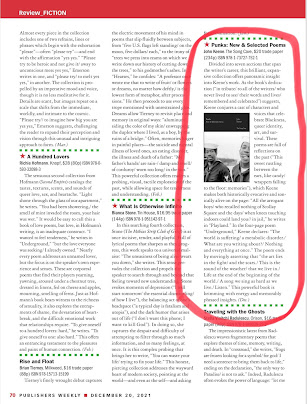
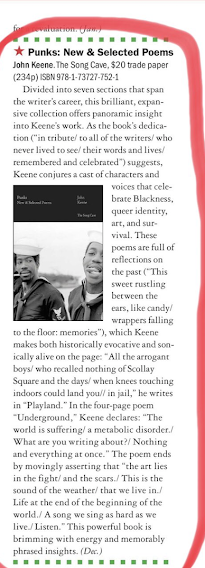
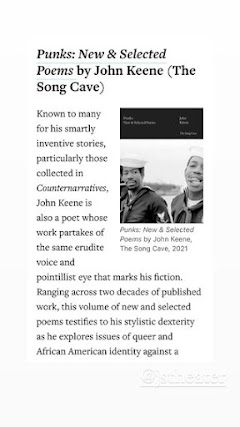
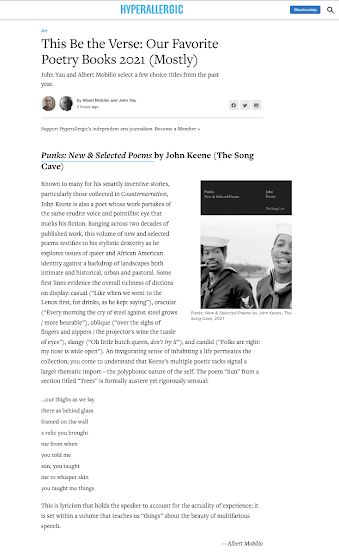
Punks has been out roughly two and a half weeks, but it has begun to receive some very good, thoughtful reviews. They include 


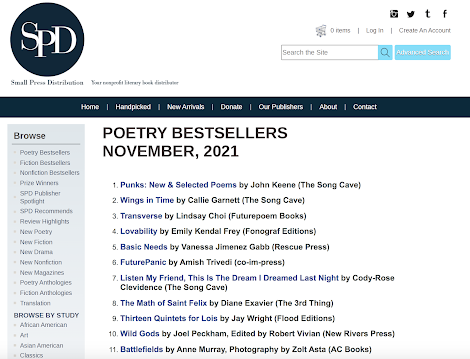
If you had asked me back in January or June what I thought might be the response, I'd probably have said I'd be happy if it sold through the first printing. This isn't false modesty but my earnest acknowledgement of the (years') long and arduous process it took for this book to make it into print. As it also turns out, however, it is Small Press Distributor's BEST SELLER for the month of November! Many thanks to all of the publications, reviewers and readers so far!


Please consider purchasing a copy ($20), from The Song Cave (it ships internationally too) or other retailers, and do recommend it to others if you think they might be interested and ask your local bookstores and libraries to order copies if you can! 


Thanks so much!

Thursday, August 02, 2018

Quote: James Baldwin

James Baldwin (Associated Press)
"Until my father died I thought I could do something else. I had wanted to be a musician, thought of being a painter, thought of being an actor. This was all before I was nineteen. Given the conditions in this country to be a black writer was impossible. When I was young, people thought you were not so much wicked as sick, they gave up on you. My father didn’t think it was possible—he thought I’d get killed, get murdered. He said I was contesting the white man’s definitions, which was quite right. But I had also learned from my father what he thought of the white man’s definitions. He was a pious, very religious and in some ways a very beautiful man, and in some ways a terrible man. He died when his last child was born and I realized I had to make a jump—a leap. I’d been a preacher for three years, from age fourteen to seventeen. Those were three years which probably turned me to writing."
--James Baldwin (born on August 2, 1924), from "James Baldwin: The Art of Fiction, No. 78," interviewed by Jordan Elgrably, The Paris Review, Issue 91, Spring 1984.

Wednesday, February 07, 2018

Tayari Jones' Novel Oprah's Book Club Pick + Elizabeth Alexander To Lead Mellon Foundation


A million congratulations to my Rutgers-Newark colleague Tayari Jones, on the publication of her new, fourth novel, An American Marriage, now out from Algonquin Books of Chapel Hill! Tayari's novel has been receiving rapturous reviews (Entertainment Weekly, LA Review of Books, New York Times Book ReviewSFGate, and USA Today, to name a few) since its appearance, as well as praise from readers on Amazon, Goodreads, and elsewhere. To add to the excellent news, Oprah Winfrey selected An American Marriage as her newest Oprah's Book Club pick, which she announced on CBS Morning News yesterday morning.

Tayari on CBS, as Oprah announces
her book as its newest Book Club selection

Oprah has said of the book, "I have to tell you, it is intriguing. It's a love story that also has a huge layer of suspense. And it's also so current and so really now that I could not put it down and I've already passed it on to lots of my friends and so I know – certainly believe – that you're gonna love it." On her website, Tayari, a writer of numerous gifts, offers a summation of An American Marriage:

Newlyweds, Celestial and Roy, are the embodiment of both the American Dream and the New South. He is a young executive and she is artist on the brink of an exciting career. They are settling into the routine of their life together, when they are ripped apart by circumstances neither could have imagined. Roy is arrested and sentenced to twelve years for a crime Celestial knows he didn’t commit. Though fiercely independent, Celestial finds herself bereft and unm oored, taking comfort in Andre, her childhood friend, and best man at their wedding. As Roy’s time in prison passes, she is unable to hold on to the love that has been her center. After five years, Roy’s conviction is suddenly overturned, and he returns to Atlanta ready to resume their life together.

I have had the pleasure of hearing Tayari describe the book as she was writing it over the last few years, and have now purchased my copy and intend to dive into it very soon! I also expect the praise to continue and prizes to shower this book too. CONGRATULATIONS AGAIN, TAYARI!

You can purchase a copy of An American Marriage here!

***

Elizabeth Alexander
Yesterday brought more good news: poet, scholar, critic, and generally extraordinary person Elizabeth Alexander has been named the next head of the Andrew W. Mellon Foundation! Elizabeth will assume the Mellon presidency in March 2018, replacing Earl Lewis, who has served since 2013. Currently she is the Wu Tsun Professor in the Humanities at Columbia University, and had served as Director of Creativity and Freed Expression at the Ford Foundation. Before this, she was the Frederick Iseman Professor and had previously held the post of Thomas Donnelley Professor and chaired the African American Studies Department at Yale University, where she taught for 15 years. At the Ford Foundation, Elizabeth "co-designed the Art for Justice Fund, a $100 million fund seeded by philanthropist Agnes Gund to transform the criminal justice system and all of its inequities through art and advocacy."

At Mellon, Elizabeth will preside over a foundation that has long been dedicated to work in the humanities and culture, particularly the liberal arts, from supporting scholarship to scholarly publication to the training and development of future educators, as well as considerable work in the museum world. It will be fascinating to see how her interests, as someone who has long promoted equality, social justice and civic participation in the arts and humanities intersects with Mellon's current agenda, and how she as its leader will guide and develop its focus. Inside Philanthropy offers five to consider in terms of Elizabeth's new tenure. Key will be defending not just the humanities, but universities and higher education in general, from those on the right and, to a different degree, from some critics on the far left. As Elizabeth notes, "The value of free expression, of arts and culture, is not something that’s always shouted from the rooftops, right now."

Elizabeth is one of the major American poets, serving as a Chancellor of the Academy of American Poets, as well as on the boards of the Pulitzer Prize and the African Poetry Book Fund. She also is a prolific author and critic. In 2009, she was President Barack Obama's first inaugural poet, her poem captured in the volume Praise Song for the Day. Her 2015 memoir The Light of the World, a powerful tribute to her late husband Ficre Ghebreyesus, which was a 2016 finalis for the Pulitzer Prize and the National Book Critics Circle Award. She is also the author of six books of poetry, including The Venus Hottentot, Body of Life, Antebellum Dream Book, American Sublime, and Crave Radiance: New and Selected Poems. She also has penned two collections of critical prose, The Black Interior and Power and Possibilities: Essays, Reviews and Interviews, as well as a book for children, with Marilyn Nelson, entitled Miss Crandall's School for Young Ladies and Little Misses of Color.

Congratulations to Mellon for making this superlative choice, and CONGRATULATIONS, ELIZABETH!

Wednesday, June 07, 2017

Brooksday: Gwendolyn Brooks Centennial + Poem

Gwendolyn Brooks (1917-2000)
One hundred years ago today, in Topeka, Kansas, Gwendolyn Elizabeth Brooks was born to Keziah Wims Brooks and David Anderson Brooks. Before she had turned a year old, her family moved to Chicago, specifically the South Side Bronzeville neighborhood, which became her lifelong home, and which she memorialized in a series of works including 1949's Annie Allen, which would make her first African American and first African American woman to win the Pulitzer Prize, in 1950, one many august honors.  From an early age, her mother, a teacher and concert-trained pianist, knew she possessed a gift for literature, and told her that she was going to be the "lady Paul Laurence Dunbar" (Wikipedia), and, like Dunbar, she has left a mark that continues to influence, her poetic gifts and her influence among successive generations of writers anchoring her reputation as one of the major figures in 20th century American and African American poetry and literature.

A number of organizations are celebrating the centennial of Brooks's life. One that has a wide array of events planned is Our Miss Brooks 100, which uses the name she liked to be known by, and which is the effort of local Chicago and national individuals and organizations. Through June 2018, Our Miss Brooks 100 will be sponsoring programs. They include:

  • January 1-December 31: Hands On Stanzas (which will bring poets into the Chicago-area schools for 20-week residencies) 
  • May 12-June 18: ETA Creative Arts Foundation presents "Among All This We Stand Like a Fine Brownstone by Vantile Whitfield", at eta Creative Arts fourth (4th) mainstage production (in Chicago) & repeating throughout the summer 
  • June 17: A Gwendolyn Brooks Trolley Tour, Lecture / Discussion, Literature, Guided Trolley Tour (in Chicago)
  • Nov. 18: Manual Cinema's Life of Gwendolyn Brooks, Evening performance (Poetry Foundation, Chicago)

On the Our Miss Brooks 100 site, you can find information about her life in Chicago, and links to articles about Gwendolyn Brooks, testimonies by poets, librarians and readers.

The Academy of American Poets site features a Centennial Celebration for Gwendolyn Brooks,  which includes her poetry, an interview with her, lesson plans for teachers, essays by noted poets, and archival audio material, including Brooks's 1983 reading at the Guggenheim Museum in New York City. I was quite fortunate enough to hear Miss Brooks read with then Poet Laureate Rita Dove in the early 1990s. The room was packed, and she and Dove, to no one's surprise, brought the house down again and again.

Below is one of the poems from one of her later collections, Blacks, "Boy Breaking Glass," which I reprint from the Poetry Foundation's website. In this poem, she provides a glimpse of the Chicago she lived, knew and captured in her distinctive style, while also underlining her psychological and social perceptiveness, and her deep humanity. Do check out the Centennial Celebration site, and if you have never listened to Miss Brooks, please click on the audio link there, or Google "Gwendolyn Brooks reading" to find more links.

Boy Breaking Glass

By Gwendolyn Brooks

To Marc Crawford
from whom the commission

Whose broken window is a cry of art   
(success, that winks aware
as elegance, as a treasonable faith)
is raw: is sonic: is old-eyed première.
Our beautiful flaw and terrible ornament.   
Our barbarous and metal little man.

“I shall create! If not a note, a hole.   
If not an overture, a desecration.”

Full of pepper and light
and Salt and night and cargoes.

“Don’t go down the plank
if you see there’s no extension.   
Each to his grief, each to
his loneliness and fidgety revenge.
Nobody knew where I was and now
                   I am no longer there.”

The only sanity is a cup of tea.   
The music is in minors.

Each one other
is having different weather.

“It was you, it was you who threw away my name!   
And this is everything I have for me.”

Who has not Congress, lobster, love, luau,   
the Regency Room, the Statue of Liberty,   
runs. A sloppy amalgamation.
A mistake.
A cliff.
A hymn, a snare, and an exceeding sun.

Gwendolyn Brooks, “Boy Breaking Glass,” from Blacks
(Chicago: Third World Press, 1987).
Reprinted by consent of Brooks Permissions.
Source: Blacks (1987)


Wednesday, October 26, 2016

Paul Beatty Wins Man Booker Prize


(Photo by John Phillips/Pool photo via AP)
Congratulations to Paul Beatty, winner of the 2016 Man Booker Prize, for his novel The Sellout! Paul is the first Americanever to receive this prize, which the Booker Prize organization opened up in 2014 to all novelists writing in English, and is the second black writer in a row to receive the award, after Marlon James, who received it for his volume A Brief History of Seven Killings, and the third over all, with Ben Okri, the first black writer to receive the Booker back in 1991 for The Famished Road. Paul's novel is a hard-hitting, sometimes harsh satire about the United States, American history, slavery, segregation, and racism, and hardly relents from its blistering opening pages to its conclusion. 

I first met Paul over 25 years ago when he was among the initial readers at the Dark Room Writers Collective. He had just published his first book of poems, Big Bank Take Little Bank, and had recently won the Nuyorican Poets Cafe poetry slam. Each of the poems in that has narrative force, but it wasn't until Paul published his acclaimed novel White Boy Shuffle (1996) that the world, I included, realized he was not only a poet of originality and talent but a fiction writer to reckon with. He has since published another volume of poetry, Joker Joker Deuce (1994), as well as two more novels, Tuff  (2000) and Slumberland (2008), and as befits a master of satire, he edited Hokum: An Anthology of African-American Humor, in 2006. 

Congratulations again to Paul, and a hat tip to the Man Booker Prize jury for its excellent and unanimous decision!

Tuesday, February 23, 2016

Sophia Nguyen on the Dark Room Writers Collective in Harvard Magazine

A few years ago, The New Yorker published an article, "The Dark Room Collective: Where Black Poetry Took Wing," about the Dark Room Collective that left a lot to be desired. Not only did it erase a good number of the members and participants, but it offered a sketchy overview of what the Dark Room was and achieved, in part because its ideological agenda was quite off-target. To put it another way, the ideological agenda it attempt to affix to the Dark Room was incorrect. Even the title was incorrect; "black poetry" had taken wing many times before the Dark Room's appearance, as the Dark Room's readings, awards and tributes more than made clear.

Other pieces about the organization--which I belonged to for many years-- are much better; in 1996, two years after the Dark Room's final reading series occurred in Boston, one of the Dark Room's most honored poets, Cornelius Eady, penned a brief piece with Kwaku Alston, "Reading Ahead," for The New Yorker that was much more on the mark, and in 2013, co-founder and poet Sharan Strange wrote an entry, "Total Life Is What We Want’: A Brief History of The Dark Room Collective," for Mosaic magazine that not only shared aspects of the organization's history but her vision of what its aims were and her sense of its place in the firmament of African American and American letters.

There have been other pieces, but one of the most recent entries, Sophia Nguyen's thoughtful, capacious, beautifully written article in the March-April 2016 issue of Harvard Magazine, "Elbow Room: How the Dark Room Collective made space for a generation of African-American writers," ranks among the best. Not only does Nguyen get the history and names correct and quickly dispel the fact that all the members went to or met at Harvard, but she also offers an overview of what the Dark Room's activities meant in their contemporary moment and might signify today, while not trying to use the writers and their works as a way of bashing particular traditions in the Black literary tradition (the Black Arts Movement, Umbra, etc.), or misreading the literature or cultural effects that have emerged from it.

The impact on the Boston literary scene were visible to anyone who was paying attention. As she notes:
“The Dark Room Collective was one of the more influential movements in the city of Boston,” says fiction writer Don Lee, an associate of the group. Lee, who first moved to the area to pursue his M.F.A. at Emerson College, and then became editor of the journal Ploughshares, observed how they shook up the “lily white” literary scene. “There was terrific energy, and it was contagious.” He helped write a grant application that secured the Dark Room $12,500 from the Lannan Foundation—“not a huge amount, but at the time fairly significant”—which helped cover the travel expenses of writers they were beginning to invite from farther afield.
Nguyen, however, goes further and talks about the "Drive By" readings, and much more, showing that the Collective, more than anything else, helped to create and expand a conversation which involved paying attention not just to what was happening in Boston, to the literary past and to peers around the country.

She also broaches critiques of Dark Room writers' work as "depoliticized" and "conservative," but as she goes on to suggest, as I would underline, works as diverse as Kevin Young's To Repel Ghosts or Natasha Trethewey's Thrall or Thomas Sayers Ellis's Skin, Inc. or Tisa Bryant's Unexplained Presence? These are all deeply political, and formally playful to challenging works, and they're only a small portion of what Dark Room writers have produced. Playwrights, visual artists, musicians, filmmakers, and scholars who were affiliated with the group have gone on to produce work that is both politically engaged and aesthetically challenging as well, and without question, all the various strands of black cultural production, from the past up through the Dark Room's moment, on through today, are visible in the art that has emerged from it.

Here's one more quoted paragraph that gives a glimpse of what the Dark Room was really like:

What the Dark Room gave to its members makes their output difficult to corral. It’s something Ellis has called “elbow room”—a jostling freedom of movement that made Bryant, all those years ago, feel unexpected exhilaration during her 40-minute phone interview with the Collective. Though she at first tried to fake a love of jazz and the blues—at the time, these genres were to her parents’ taste, not hers—she then admitted to being a fan of the Cure, the Smiths, and Siouxsie and the Banshees. “And it was the most miraculous thing, because suddenly we were doing these bizarre medleys of Smith songs and P-Funk and Run DMC and Billy Bragg and Psychadelic Furs and Joan Armatrading. It was outrageous,” she told her interviewer. In “Dark Room: An Invocation,” Elizabeth Alexander declares “the house/came down because/we knew how to read/each other, could code-switch/with the same fast dazzle.” Now it’s a critical commonplace to hear that some Dark Room writer can reference Homer and Tupac in the same space, making virtuoso maneuvers between different expressive registers. At the time, Bryant said to herself with relief, “Okay, I’m not the freak I thought I was.”

Do check the article, and the poems Nguyen quotes. They're a great place in the Dark Room literary corpus to start.

Sunday, February 21, 2016

Black Literary Avant-Garde Syllabus At ND Site

From Isaac Julien's Looking for Langston
A month or so ago on Facebook, I casually mentioned that I'd taught an undergraduate course in Black Literary Avant-gardism at Northwestern, most recently in 2010, and figured that that would be the end of it. The response, however, was enthusiastic, with a number of people asking me to share the syllabus. Northwestern never required us to post syllabi publicly, as Rutgers-Newark does, and I was amenable to sharing it, though I wasn't sure where I might do so. Here was the most likely spot.

Then Mieke Chew of New Directions asked me if I would be interested in presenting it there, and I was. After she distilled it a bit, removing dates and so forth, it went live. I intended it to be neither comprehensive nor exhaustive, and if I were to teach the course today, in addition to a longer calendar, I'd add more and new scholarly texts and draw from the rich store of contemporary innovative black writing, including digital work.


I should note that I do not have an electronic course pack, but a number of the articles and shorter materials can be found in the special issue of Tripwire featuring giovanni singleton's and Renee Gladman's famous conference black innovative writing, as well as The Harlem Renaissance Reader.

Sunday, January 31, 2016

Bomb Magazine 2016 Recommendation: Clarence Major

Recently BOMB Magazine offered me and other writers and creative types the opportunity to share my thoughts some of the many books we're looking forward to this upcoming year, so I selected poet, novelist and visual artist Clarence Major's forthcoming collection Chicago Heat and Other Stories (Green Writers' Press, 2016).

Major (b.1936 -) is the author of 8 novels, 14 collections of poetry (including the 1999 National Book Award finalist collection Configurations), 2 collections of short fiction (including this one), 8 works of nonfiction, and 4 anthologies, among them 1969's landmark The New Black Poetry. His essay "Necessary Distance," the title of an eponymous collection of nonfiction that Tisa B. turned me onto, is one of many compasses I periodically return to.

Despite his prodigiousness and originality--this is a man who wrote a novel based on the premise that a Connecticut law required husbands to carry their wives across thresholds at home!)--his work remains far too little known, and should be much more heralded, read and discussed, so I am particularly looking forward to this new book. For Bomb I wrote:

One book I’m eager to get my hands on is acclaimed novelist, poet, and visual artist Clarence Major’s forthcoming collection of short fiction Chicago Heat and Other Stories. Though far less known than he should be, Major, as original as anyone writing today, has been successfully experimenting with the formal possibilities of fiction for over four decades, and has developed a distinctive, accessible, and unforgettable style. I’m enthusiastic to read and learn from what he accomplishes in this new gathering of stories.
About the new book Major's publisher writes:

Chicago Heat and Other Stories by Clarence Major, employs a gorgeous purity and simplicity of language in a series of masterful analyses examining human interaction. Each narrative voice comes forward all at once, individual and complete, without obstacle or complication, enabling the reader to see the characters and feel their emotions. Major does not shy away from the bitter or the harsh; we get to hear it all. Like paint on an easel he blends lyricality with moxie and the blunt with the beautiful. The characters come together as easily as they part; people leaving, coming back, going, staying—it all sticks and fades like heat on your skin. The imagery is completely accessible and generously given. Toni Morrison comes to mind. His work is like jewels.
Based on what I know of Clarence Major's work, this description barely touches the surface. Check it out this year.

More book 2016 recommendations by Dawn Lundy Martin, Albert Mobilio, Alan Gilbert, Chelsea Hodson, Justin Taylor, Ander Monson, Ken Chen, and Lawrence Giffin at the BOMB Magazine site!

Friday, January 08, 2016

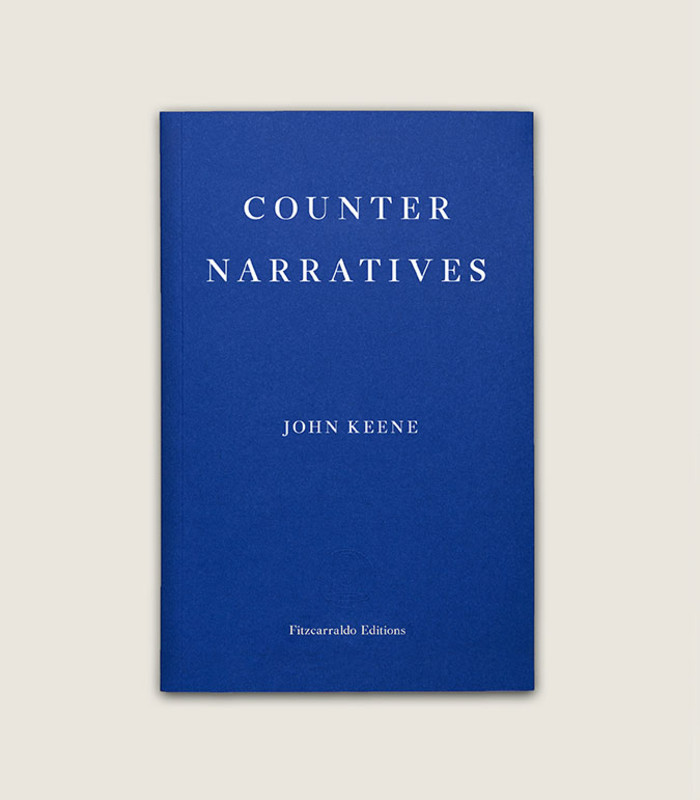
Counternarratives Featured on Howard Rambsy's Culture Front

Photo from Cultural Front (© Howard Rambsy II)
UPDATED: Cultural Front has added two new posts, "John Keene's 'Acrobatique' and the poet as short story writer" and, bestowing me what I consider to be one of highest possible honors, he places the remarkable Elizabeth Alexander and her foundation poem "The Venus Hottentot" in conversation with "Acrobatique." (This is particularly important to me because Elizabeth has been a huge inspiration since I first saw her read, from The Venus Hottentot no less, at the Dark Room in Cambridge, Massachusetts many moons ago. I hold her and her art--her poetry, her criticism, her nonfiction--in the highest esteem. She is for me one of essential poets of her generation.)

The reviews of Counternarratives continue to trickle in now that we're a few weeks into 2016. One by Daniel Green is forthcoming on Kenyon Review's online, and I think it will be positive, given that he selected it as the best book of 2015. Currently online but inaccessible--to me, since neither the Rutgers or New York Public Library systems subscribe to the journal--is Alex McElroy's review, at Georgia Review. (We currently are conversing by email about the book and hope to see a copy of the review one of these says soon.) Just before the new year arrived, another online site, Wuthering Heights blog, which had previously wrestled with the book, named it to its "Best of 2015" list (you can read the prior review at the link). Lastly James Crossley of Mercer Island Books selected Counternarratives as one of his 2015 "Books to Give At the Holidays."

In the meantime, it has been encouraging to have an African American scholar, Howard Rambsy II, who teaches at Southern Illinois University and writes about black poetry and poetics, book history and textual studies, to write a bit about the book on his blog Cultural Front. Rambsy is the author of The Black Arts Enterprise and the Production of African American Poetry (Ann Arbor: University of Michigan Press, 2011), and is involved with several important scholarly and critical projects involving black literature, among them the Project on History of Black Writing, based at University of Kansas. He also served as faculty member for the Black Poetry after the Black Arts Movement Institute, about which I heard extensive praise, this past summer at KU. As Rambsy's archive list will show, he has been blogging about poetry and black writing more generally since 2008, so make sure to scroll through the trove of posts.

Howard has now posted three entries about Counternarratives. The first provides a list of some of the online coverage of the collection, helpfully aggregating many of the book's reviews. The second does something that I think is a first for this collection and which has not popped up in most of the reviews, which is to explore how the Counternarratives fits, extends and exceeds--I guess that's the right word--the African American short story tradition. As Rambsy notes, there are aesthetic links to prior black writers, some of them like Charles Chestnut and Zora Neale Hurston (though I love their work) whom I was not thinking of, and some of whom, like Richard Wright and Charles Johnson, that I was. (I would add that other black short story writers who have strongly influenced my work include James Baldwin, Toni Cade Bambara, Ernest J. Gaines, Gayl Jones, Paule Marshall, Reginald McKnight, James Alan McPherson, Alice Walker, and John Edgar Wideman, to name just a few from preceding generations.)

His third post concerns the character "Zion" from my story "An Outtake from the Ideological Origins of the American Revolution," and focuses as this protagonist as an example of the "bad man," akin to similar figures in African American folklore and popular culture, and in books by writers I deeply admire, including Tyehimba Jess, Adrian Matejka, Tony Medina, Cornelius Eady, and Rita Dove. Rambsy points out that Zion is in some ways linked to the mythical figure (High) John the Conqueror, and like him he continually eludes attempts to keep him in bondage. Yet Zion also operates on the plane of realism in that he moves through his world attempting always to experience and embody freedom, but as an enslaved black person, is denied the option, in part because he is not recognized with in the larger discursive space, as Bernard Bailyn so artfully describes in his landmark 1967 book The Ideological Origins of the American Revolution, that would permit him to realize freedom as the unfolding social and political systems and practices of the society around him. His revolution is internal and considered lawless, even as it mirrors that of the larger society and of black people across the northern states. 

I imagined Zion as a fictional counterpoint to figures like Phillis Wheatley, Prince Hall, Wentworth Cheswell, and Lucy Terry, to give just a few examples of real 18th century African American pioneers. Zion, as the story makes clear, refuses to play by any rules, unlike his fellow enslaved person Jubal, because he senses that the entire system disregards and oppresses him. Moreover, there is the fact that much of his behavior parallels that of his white master and others whose actions are rationalized and permitted by the society's racialized legal, political, cultural, and social structures.  One need only look at the contemporary prison-industrial complex, the ties between capital and criminalization, and the unequal application of justice and incarceration to see that we are still living with these same systems and institutional mechanisms. I'll stop there, but I offer my deep thanks to Howard for highlighting the book, and welcome any comments from readers of his blog or this one about the book (or anything else).

Monday, April 20, 2015

The Spring 2015 Awards & Prizes Season

Greg Pardlo reading at his
book party in November 2014
This afternoon I learned upon signing onto Facebook that the poet Greg Pardlo received the 2015 Pulitzer Prize for Poetry, for his 2014 collection Digest, published by Four Way Books! This is a marvelous selection for an incredibly talented writer, and an excellent book of poems. CONGRATULATIONS TO GREG and to his publisher! I was fortunate to attend Greg's book launch last November at Dumbo Sky in Brooklyn, and after hearing him read and purchasing a copy I pored through the smart, inventive volume on the subway-and-PATH trip home. A graduate fellow of Cave Canem, Greg's first book of poetry, Totem, was selected by Brenda Hillman for the American Poetry Review/Honickman First Book Prize, and published by Copper Canyon Press. That collection offered more than a few clear signals that he was on his distinctive, poetic way. In addition to writing poetry and criticism, Greg is a translator, and brought Pencil of Rays and Spike Mash by the Danish poet Niels Lyngsø into English. The other poetry finalists for this year's Pulitzer included the great poet Arthur Sze, for his collection Compass Rose (Copper Canyon Press), and Alan Shapiro, for his collection Reel to Reel (University of Chicago Press).

Other Pulitzer Prize winners this year include fiction writer Anthony Doerr for his novel All the Light We Cannot See (published by Scribner); playwright Stephen Adly Guirgis for his play Between Riverside and Crazy (Suzan-Lori Parks was a finalist in this category for her play Father Comes Home from the War (Parts 1, 2, 3)); David I. Kertzer for his biography The Pope and Mussolini: The Secret History of Pius XI and the Rise of Fascism in Europe (Random House); reporter Elizabeth Kolbert in the general nonfiction category for her book The Sixth Extinction: An Unnatural History (Henry Holt); and composer Julia Wolfe in the music category for her oratorio for chorus and sextet Anthracite Fields (Red Poppy Music/G. Schirmer, Inc.). In the news category, no paper received an award for print coverage of the murders of Michael Brown in Ferguson, Missouri or of Eric Garner in Staten Island, or any other similar state-sanctioned murders that occurred last year, nor for reportage or commentary on the subsequent protests, but the St. Louis Post-Dispatch, once part of the Pulitzer family of newspapers, did receive a Pulitzer in the Breaking News Photography category for its photojournalist coverage of the aftermath of Brown's death. Congratulations to all the finals and winners!

***

I don't think I posted congratulations for Claudia Rankine, who was awarded both this year's National Book Critics Circle Award in Poetry, and just the other day the Los Angeles Times Book Prize, for her timely invaluable book Citizen (Graywolf Press). This collection of innovative prose and verse texts had earned an unprecedented nomination in the criticism. Other recipients of the NBCC awards included Marilynne Robinson in fiction for Lila (FSG); David Brion Davis in history for The Problem of Slavery in the Age of Emancipation (Knopf); Roz Chast in autobiography for her graphic novel Can't We Talk about Something More Pleasant? (Bloomsbury); John Lahr in biography for Tennessee Williams: Pilgrimage of the Flesh (W. W. Norton & Co.); and the late Ellen Willis in criticism for The Essential Ellen Willis (University of Minnesota Press). There were three other awards presented: Military veteran Phil Klay, who had won the National Book Award for fiction last fall, received the John Leonard Prize for his collection of short stories Redeployment (Penguin Press); Nobel Laureate Toni Morrison received the Ivan Sandrof Lifetime Achievement Award; and Alexandra Schwartz received the Nona Balakian Citation for Excellence in Reviewing.

At the Los Angeles Festival of Books, which took place last week, other winners of book prizes included actor LeVar Burton, who was honored with the Innovator's Award for his successful, ongoing efforts to increase reading among children; Andrew Roberts in the biography for Napoleon: A Life (Viking); Jeff Hobbs in current interest for The Short and Tragic Life of Robert Peace: A Brilliant Young Man Who Left Newark for the Ivy League (Scribner); Siri Hustvedt in fiction for The Blazing World (Simon & Schuster); Valeria Luiselli, with the Art Seidenbaum Award for First Fiction, for her book Faces in the Crowd (Coffee House Press); Jaime Hernandez in the Graphic Novel/Comics category for The Love Bunglers (Fantagraphics Books); Adam Tooze in history for The Deluge: The Great War, America and the Remaking of the Global Order, 1916-1931 (Viking); Tom Bouman in the mystery/thriller category for Dry Bones in the Valley (W. W. Norton & Company); Pulitzer Prize-winner Elizabeth Kolbert in the science/technology category for The Sixth Extinction: An Unnatural History (Henry Holt & Co.); and Candace Fleming in the young adult category for The Family Romanov: Murder, Rebellion, and the Fall of Imperial Russia (Schwartz & Wade/Random House Children’s). Congratulations to all the finalists and winners!

***

This month also brought the announcement of the 2015 John Simon Guggenheim Foundation fellows. The list is always a compendium of major and emerging figures in the broad areas the foundation supports, which include creative arts, humanities, natural sciences, and social sciences. Among this year's cohort in creative arts and humanities are a number of friends, colleagues and acquaintances, including Jeffrey Renard Allen, Brent Hayes Edwards, Thomas Sayers Ellis, Percival Everett, Cathy Park Hong, Rowan Ricardo Phillips, Christina Pugh, Beryl Satter, and Akhil Sharma. Other literary figures receiving awards include Dan Beachy-Quick, Maud Casey, Vikram Chandra, Megan Daum, Matthew Dickman, Kristoffer Diaz, Rivka Galchen, Anthony Marra, Cate Marvin, Bernadette Mayer, Joshua Mehigan, Kevin Powers, Alex Ross, and Kenneth Warren. Also, visual artists such as Mel Chin, filmmakers like Akosua Adoma Owusu, philosophers like the aesthetician Dominic McIver Lopes, critics like G. Gabrielle Starr, composers like AACM member and chronicler George Lewis, and social scientists such as my former colleague the eminent psychologist Jennifer Richeson all received fellowships. Congrats to all the recipients!

Tuesday, February 03, 2015

Nathaniel Mackey Awarded Bollingen Prize + Poem: Nathaniel Mackey + NBCC Nominees

Nathaniel Mackey
The Bollingen Prize for American Poetry, administered by the Yale University's Beinecke Library, is one of the most prestigious awards of its kind. Since its initiation in 1948 by the Library of Congress, in a firestorm of controversy because of the inaugural winner, avowed fascist and bedrock Modernist Ezra Pound, it has recognized many of the US's most important and innovative poets. The Bollingen shifted to its home at Yale by 1949, and originally was conferred on a yearly basis until 1962, when it switched to a biennial calendar, in some years honoring two poets at the same time. Throughout its history nearly all the honored poets have been white and the overwhelming majority male, and this has mostly remained the case, though some of the country's greatest women poets, including Marianne Moore (1951), May Swenson (1981), Adrienne Rich (2003), and most recently Susan Howe (2011). The sublime Jay Wright was the first African American recipient of the award, which I recognized in my very first post at J's Theater in 2005.

Yesterday another extraordinary, prolific poet--as well as fiction writer and critic--Nathaniel Mackey, has been selected to receive the Bollingen Prize. Mackey first came to wider public notice when he won the National Poetry Series in 1985 for Eroding Witness, but he has been publishing his poetry since 1978's Four for Trane, for a total of nine books or chapbooks of poetry, and a forthcoming tenth volume, Blue Fasa, to be published this year by New Directions. His collection Splay Anthem, also published by New Directions in 2006, received the National Book Award for Poetry. Among the other awards he has received for his work are the Stephen Henderson Award from the African American Literature and Culture Society, a Whiting Writer's Award in 1993, a Guggenheim fellowship in 2010, and the Ruth Lilly Prize from the Poetry Foundation in 2014. In 2001, he was elected a Chancellor of the Academy of American Poets, serving until 2006. He currently is Reynolds Price Professor at Duke University, and has for decades published the literary journal Hambone.

Nearly all of the works since Eroding Witness can be read as constituting a long, serial poem under the rubric of the Song of the Andoumboulou and Mu, combining with consummate artistry cross-cultural strands drawn from African and African American mythological and musical traditions, tuned to a peerless pitch. The ear never errs in Mackey's work; he has a gift for generating an often entrancing music, full of mix and dance, that carries the complex and profound knowledge his lyric imparts. For many years during his long tenure at the University of California-Santa Cruz, Mackey hosted a radio program on local public radio station KUSP, "Tanganyika Strut," that featured African music, and this well of familiarity with the language of music, with song's cadence and power, along with his grasp of multiple literary, philosophical and critical traditions, richly informs the poems' form, texture and content. As the Bollingen Prize committee said of Mackey's poetry:

“Nathaniel Mackey’s decades-long serial work—Songs of the Andoumboulou and Mu—constitutes one of the most important poetic achievements of our time. Outer Pradesh (2014)—jazz-inflected, outward-riding, passionately smart, open, and wise—beautifully continues this ongoing project.”

and, of the 2014 book Outer Pradesh:

“The book’s epigraph is Jean Toomer’s assertion of modernist open-endedness and generic not-belonging: ‘There is no end to ‘out.’’ Mackey applies this endlessly outward-going passage to an ecstatic, exilic experience, as a group of travelers—a ‘philosophical posse’—makes its way across an Indian province. What they and we encounter on this journey is a pre-history embodied by ‘old-time people’ whose songs must be heard. Together we find ourselves within an improvised social continuum that grows larger, stranger, more remote, and more consoling at every turn. Memory becomes a site of social commentary and collective vision. Mackey’s epic of fugitivity forms a stunning meditation on being.”

I must note Mackey's fiction as well; he has published four novels that together constitute another serial project, this time in prose: From a Broken Bottle Traces of Perfume Still Emanate. The first volume, Bedouin Hornbook, published in 1986, went off like a volcano when I first came across it during my Dark Room Collective days. I still have that volume, which I peer into periodically; it is a book that, like its intense and probing companion volumes, From A Broken Bottle Traces of Perfume Still Emanate: Bass Cathedral (2008), Atet A. D. (2001), and Djbot Baghostus's Run (1993), could sustain repeated and extended readings--and studies--for years.

Congratulations to a nonpareil writer, Nathaniel Mackey!

***

Before I post a poem by Nate Mackey, I wanted to offer congratulations to all the writers nominated for this year's National Book Critics Circle Awards, which will be announced on March 12. It is a remarkable lineup, and I can say that I know and admire the work of many of the nominees, and reviewed one of the books, Ian S. McNiven's biography of James Laughlin, a few posts back.

Among this year's honorees, Claudia Rankine, a poet whose work I hold in the highest esteem, was nominated not only in the poetry category, but also in the criticism category for her superlative volume Don't Let Me Be Lonely, which should have received the National Book Award last fall. My  brilliant former Northwestern colleague, Eula Biss, who received the National Book Critics Circle Award a few years ago, was nominated again in the criticism category. Another former Northwestern colleague, Chris Wiman, who was also the editor for many years of Poetry magazine, received a nomination in poetry too, as did Saeed Jones, a dazzlingly talented young poet who graduated from Rutgers-Newark a few years before I started, and Willie Perdomo, a superb poet I've known and read since my early 20s.

Also, the great Toni Morrison, who received the National Book Critics' Circle Award for her 1977 novel The Song of Solomon, will receive the Ivan Sandrof Lifetime Achievement Award. Congratulations to Claudia, Christian, Eula, Rasheed, Willie, and all the other nominees!

AUTOBIOGRAPHY:
Blake Bailey, “The Splendid Things We Planned: A Family Portrait” (W.W. Norton & Co.)
Roz Chast, “Can’t We Talk About Something More Pleasant?” (Bloomsbury)
Lacy M. Johnson, “The Other Side” (Tin House)
Gary Shteyngart, “Little Failure” (Random House)
Meline Toumani, “There Was and There Was Not” (Metropolitan Books)

BIOGRAPHY:
Ezra Greenspan, “William Wells Brown” (W.W. Norton & Co.)
S.C. Gwynne, “Rebel Yell: The Violence, Passion and Redemption of Stonewall Jackson” (Scribner)
John Lahr, “Tennessee Williams: Mad Pilgrimage of the Flesh” (W.W. Norton & Co.)
Ian S. MacNiven, “Literchoor Is My Beat”: A Life of James Laughlin, Publisher of New Directions (Farrar, Straus & Giroux)
Miriam Pawel, “The Crusades of Cesar Chavez” (Bloomsbury)

CRITICISM:
Eula Biss, “On Immunity: An Inoculation” (Graywolf Press)
Vikram Chandra, “Geek Sublime: The Beauty of Code, the Code of Beauty” (Graywolf Press)
Claudia Rankine, “Citizen: An American Lyric” (Graywolf Press)
Lynne Tillman, “What Would Lynne Tillman Do?” (Red Lemonade)
Ellen Willis, “The Essential Ellen Willis,” edited by Nona Willis Aronowitz (University of Minnesota Press)

FICTION:
Rabih Alameddine, “An Unnecessary Woman” (Grove Press)
Marlon James, “A Brief History of Seven Killings” (Riverhead Books)
Lily King, “Euphoria” (Atlantic Monthly Press)
Chang-rae Lee, “On Such a Full Sea” (Riverhead Books)
Marilynne Robinson, “Lila” (Farrar, Straus and Giroux)

NONFICTION:
David Brion Davis, “The Problem of Slavery in the Age of Emancipation” (Alfred A. Knopf)
Peter Finn and Petra Couvee, “The Zhivago Affair: The Kremlin, the CIA, and the Battle over a Forbidden Book” (Pantheon)
Elizabeth Kolbert, “The Sixth Extinction: An Unnatural History” (Henry Holt & Co.)
Thomas Piketty, “Capital in the Twenty-First Century,” translated from the French by Arthur Goldhammer (Belknap Press/Harvard University Press)
Hector Tobar, “Deep Down Dark: The Untold Stories of 33 Men Buried in a Chilean Mine, and the Miracle that Set Them Free” (Farrar, Straus & Giroux)

POETRY:
Saeed Jones, “Prelude to Bruise” (Coffee House Press)
Willie Perdomo, “The Essential Hits of Shorty Bon Bon” (Penguin Books)
Claudia Rankine, “Citizen: An American Lyric” (Graywolf Press)
Christian Wiman, “Once in the West” (Farrar, Straus & Giroux)
Jake Adam York, “Abide” (Southern Illinois University Press)

NONA BALAKIAN CITATION FOR EXCELLENCE IN REVIEWING
Alexandra Schwartz

Finalists:
Charles Finch
B.K. Fischer
Benjamin Moser
Lisa Russ Spaar

IVAN SANDROF LIFETIME ACHIEVEMENT AWARD
Toni Morrison

JOHN LEONARD PRIZE Phil Klay, Redeployment (Penguin Press)

***

A now, a poem by Nathaniel Mackey:

SONG OF THE ANDOUMBOULOU: 50
-ring of the well-                        


Fray was the name where we came
to next. Might’ve been a place,
might not’ve been a place but
we were there, came to it
                     sooner
than we could se... Come to
so soon, it was a name we stuck
pins in hoping we’d stay. Stray
was all we ended up with. Spar
was another name we heard
                           it
went by... Rasp we also heard it
                              was
called...          Came to it sooner
than we could see but soon enough
saw we were there. Some who’d
come before us called it Bray...

Sound’s own principality it was, a
pocket of air flexed mouthlike,
meaning’s mime and regret, a squib of
something said, so intent it
seemed. At our backs a blown
                       conch,
bamboo flute, trapic remnant,
                        Lone
Coast reconnoiter come up empty
but for that,          a first, forgotten
warble trafficked in again even so,
                              the
mango seed’s reminder sent to what
end we’d eventually see...

                              We had
Come thru there before we were
told. Others claiming to be us had
come thru... The ubiquitous two lay
bound in cloth come down from on
                                high,
hoping it so, twist of their raiment
                             steep

integument, emollient feel for what
might not have been there. Head in the
clouds he’d have said of himself,
                                she’d
have said elsewhere, his to be above and
below, not know or say, hers to be
alibi, elegy otherwise known...

have said elsernrheren

Above and below, limbo what fabric
intervened. Limbo the bending they moved
in between. Limbo the book of
                            the
bent knee... Antiphonal thread
attended by thread. Keening string
by thrum, inwardness, netherness...
                                   Violin
strings tied their hair high, limbo
the headrags they wore... The admission
of cloth that it was cover, what
was imminent out of reach,          given
                                   what
went for real, unreal,                                          

                         split,
silhouetted                                          
redress 
                                                     
“Song of the Andoumboulou: 50” from Splay Anthem by Nathaniel Mackey, copyright © 2006 by Nathaniel Mackey. New Directions Publishing Corp., all rights reserved.

Saturday, January 11, 2014

RIP Amiri Baraka (1934-2014)

Amiri Baraka (at right), at NYU,
May 3, 2014


"What will be / the sacred words?" - Amiri Baraka

A great light, a fire, a forge has gone out of our literatures, our cultures, our society: Amiri Baraka has passed away. There are many important and a few major living poets, writers, social critics today; fewer still have assumed the mantle of change-agents, have put and continue to place themselves at center of social, political and economic, as well as aesthetic transformation, and done so continuously for most of their lives. The risks are tremendous, the payoff perhaps invisible and too small in personal, let alone broader terms. But Amiri Baraka did. He lived what he thought and believed, even when it was problematic or outright wrong, and in the process he played crucial roles in reframing how we think and see. If we think of him primarily as a poet, we should also consider that his poetry, and a poetics of the self, of the mind, of action, flowed through everything he did, whether it was producing literature across a range of genres (poetry, drama, fiction, essays, speeches, collaborative works, etc.), creating institutions and fighting to keep them alive, serving as a teacher, a professor, an editor, a mentor, a paterfamilias and parent, a polemicist, a friend, a cultural connector, a mage, working with activists of his generation and younger ones, being and living as a revolutionary and liberationist. He took very seriously, embodied, the charge of the ancestors and the principles espoused by W. E. B. DuBois in his famous essay, "Criteria of Negro Art." For Baraka, art and culture were not value-free or worthless, but, as the great Cape Verdean-Guiné-Bissauan poet and freedom fighter Amílcar Cabral pointed out, often weapons, and Amiri Baraka wielded them, when necessary, towards goals and aims far beyond himself or his career.

I first read Amiri Baraka's work in childhood, in an anthology (was it Black Fire!) that my godparents had in their library. In junior high, I am amazed to say, we read his poem "In Memory of Radio (for Lamont Cranston)," which I did not really understand--the radio's centrality to American culture having given way by then to TV--though I did grasp that at some elemental level I was picking up a frequency I had to pay attention to. By the time I graduated from high school I had decided to include a quote by Baraka on my high school senior yearbook page (along with quotes by Gwendolyn Brooks, T. S. Eliot (!) and Archibald MacLeish). Yet again I did not fully grasp what I was quoting--and did not realize until this past spring, when I was teaching my course on the "Black Arts Movement" at Rutgers-Newark that the words came from his introduction, as "Imamu Ameer Baraka," the first name he chose after ceasing to be Everett LeRoi Jones, as he was born in Newark in 1934, to Black Fire!, the landmark anthology of Black Arts Poetry--but something in his words spoke directly to me, almost like a life-force, and if I cannot remember much poetry by heart these days, those words, or a version of them, took root deep inside me.

An excerpt from Amiri Baraka's
"Foreword," from Black Fire!
Later, in college and after, I read quite a bit of Baraka's work, and found some of it deeply upsetting, confounding, enraging, especially his sexism, misogyny and patriarchy, his homophobia, his anti-Semitism; sometimes all of these can be found in just a single of his works, like "Black Art" or the play Mad Heart. Yet I also learned to read Baraka as a person of his time--my own father shared many of the same feelings and ideas, even if he never, expressed them as furiously or eloquently as Baraka, or became a Black Nationalist, Marxist, a Maoist--and to appreciate his deep love of black people, of working and poor people, of people engaged in the struggle whatever their race or ethnicity or gender or sexuality; I came to appreciate his ongoing self-criticism and self-correction, however stuttered it sometimes was, his capacity for reading himself and rethinking his views, and for his courage--and this is one of the greatest gifts Baraka has given us, in addition to the work--his remarkable courage, at speaking out, and then even greater courage in revising and recalibrating his views.
The Black Renaissance Noire panel
at NYU (Barrett, Ismaili, Baraka, Johnson,
Dill, Jess), May 3, 2014
As a writer and artist, I admire his tremendous prodigiousness and fluency, the richness and variability of his works, their capacity to engage the mind and the heart in multiple ways. I admire his critical acuity and facility, his ability to merge creativity and critique in ways that still hold value long after the moment of a given work's conception has passed. I admire the range of his learning and his ability to infuse his art with it. I admire his use of his own life, in multiple ways, as the ground for his art, and his fusion of times of life and art, his performance of his life as a work of political art. Had he merely continued writing only poetry, he still would have been a significant literary figure in the poetic firmament, his first five books alone worth dozens by other poets of his generation. Had he shifted to plays and stopped there, he would have ranked with Adrienne Kennedy as one of the most innovative American and African American playwrights of the 1960s, and with his revolutionary plays that appeared in the late 1960s, he would have cemented his fame alongside Ed Bullins and others. Had he written more fiction, he could have gained significant currency as an innovator in that genre. As a music critic he wrote one of the still salient--foundational--texts on Black music, Blues People: Negro Music in White America, and could have rested on those laurels for the rest of his life. As an essayist he was original from the start, and could have packaged all his essays together and used their afterlife as a calling card, if not to a cushy position somewhere--his battles in and with academe are legendary, though it is in part through his struggles and those of other black literary pioneers that I and many others have our jobs today--then to the lecture circuit. 

Outside of the literary realm, as one of the co-founders of the Black Arts Movement, as one of the political artists engaged in real-world politics in pushing for a national black political convention, as a force in New York and in Newark (New Ark, he labeled) it who helped to elect the latter city's first African American mayor, Kenneth Gibson, he could have operated primarily in the political and social arenas, with identifiable success in his track record. Yet Baraka did all these things and more. It is both the particularities and the holistic quality of his life and work that commend him to us and to the ages. He was that rare thing, the real thing, and even in the works that were less successful--some of the poetry of the 1970s, for example--the force of his drive to work through his vision and understanding, even if a misunderstanding, of the world still burns through.


"Ka 'Ba," from The Amiri Baraka Reader

I feel very fortunate to have met and spoken with Amiri Baraka several times. One story involving him that I have told many times (forgive me for repeating it again) involves a job I had at NYU in the late 1990s, which entailed sometimes going to pick up important visitors for a weeklong summer faculty development program. I was thus sent, via car service, to Newark, to go pick up Amiri Baraka at his home. Off we drove, we arrived at his house, I went in, and met his assistant, and then, we waited. He was getting ready, I believe--I don't think he was feeling his best then--and various people, all friendly, came and went from the living room. I cannot remember if Mrs. Baraka was there, or if I spoke with any of his children--I had met Ras Baraka some years earlier, when I was in my early 20s and with the Dark Room Writers Collective--but I vividly recall him finally appearing from upstairs, and then, we were off. Only we weren't. We had to stop to get his books and pamphlets, from another residence. I began to worry because given the awfulness of New Jersey and New York traffic at the best of times, but especially near rush hour, I could see us being late, possibly very late, and I knew my boss, and my boss's boss, the then-Senior Vice President at NYU, were not going to be happy. But I also had to accommodate our speaker. So as things proceeded at a glacial pace, our car eventually on the road and crawling from Newark through Jersey City to the Holland Tunnel, I sat there beside Baraka, and tried, despite my mounting anxiety, to make small talk with him and his assistant. (I wish I could remember his name.)

What did we talk about? His work, my admiration for him, Ras, black writing, NYU, all sorts of things. It was light and nothing went beyond the surface of my nerves or his politeness. He was not warm, but he also was not rude. I even summoned the brazenness to give him a copy of my first book. At some point, one of my bosses called my cellphone and said, "Where are you? You're late, and the big boss is thinking of firing you on the spot." I pleaded with him and tried to explain what was going on, but knew it was out of his hands. On we crept, inching forward, and Baraka could feel my anxiety, so he asked me what was wrong. I told him, and he urged me not to worry. Finally we arrived at NYU's Cantor Film Center, where he was to give his talk. All my colleagues were lined up at the curb, including the Senior Vice President. (Even she knew how important Baraka was.) The first thing he uttered after getting out of the car and greeting everyone was to defend me and explain why we were so late. He assumed all the blame, and even said something to the effect of "Do not fire him," quite forcefully, as if to preempt what at least one of the higher ups was considering. I apologized profusely and quickly, and then my direct boss said, "Just find out what he needs and bring him into the lecture hall." I accompanied him inside, he said he had to go to the bathroom, I made sure he was okay and he asked me if I was okay, and with that, he went into the packed hall where faculty members from all over the country were waiting, and brought the house down. It was one of the best lectures the program had witnessed, I was told, in its history. I kept my job.
Amiri Baraka, at NYU, May 3, 2014
Last spring I saw Baraka for the last time this past spring when I attended a May 3, 2014 launch reading for the Spring/Summer 2013, Vol 13.1 issue of the journal Black Renaissance Noire, edited by Quincy Troupe. Among the readers were Tyehimba Jess, A. Igoni Barrett, Rashida Ismaili, Lesley Dill, and Jacqueline Johnson. And Amiri Baraka. I thought I had blogged about this, but when I searched my posts it turned out that I hadn't, nor had I at the very least included the photos in my "Random Photos" post. He was fiery, feisty, full of life, referring to the provocative essay he had written on the anthology Angles of Ascent, but more than anything, he was vintage Baraka, a figure who in a few words could bring a room to life. All of the readers were superb, and I was glad that I caught the reading, but I especially wanted to speak with Baraka afterwards, because, since I was teaching his work, so wanted to say hello to him in person after the reading, express on behalf of my students their enthusiasm for him and the ideas of his and the other Black Arts figures that they were encountering, and ask if he would be willing to come speak to my class in the future. Without hesitation, he told me, "Yes." I asked a gentleman who was standing nearby to take our picture, and he only captured our hands, in a shake, though I didn't realize this until afterwards.  I think of that handshake now, and of all that I have gotten from Amiri Baraka, all that we all have received from him over the years, and without hesitation, I can say, Thank you. Thank you. Thank you.

Rest in piece, Amiri Baraka (1934-2014).

Amiri Baraka's hand, and mine