Showing posts with label Adam Morris. Show all posts

Monday, June 04, 2018

*Essays On Hilda Hilst* Now Available


Thanks to the dedication of editors Adam Morris and Bruno Carvalho, Essays on Hilda Hilst: Between Brazil and World Literature, the first English-language scholarly volume dedicated to the work of one of Brazil's most singular and path-blazing authors, is now available for purchase. Published by Springer this month, the book opens with an insightful introduction about Hilst (1930-2004) and her relation to the category of "World Literature," by Morris, a gifted translator and scholar who produced an exceptional rendering of Hilst's 1986 novella Com os meus olhos de cão (With My Dog Eyes, Melville House, 2014), as well as works by Jõao Gilberto Noll, Beatriz Bracher, and other major contemporary Portuguese-language writers, and Carvalho, a Princeton professor of Spanish and Portuguese, whose scholarly interests span an array of topics and whose study Porous City: A Cultural History of Rio de Janeiro (2013), received the Brazilian Studies Association Robert Reis Book Award in 2014. Other essays in the volume explore different aspects of the late author's oeuvre, ranging from her plays (Tatiana Franca Rodrigues Zanirato), fiction (David William Foster), poetry (Alva Martinez Teixeiro), and broader theoretical, political and ideological readings (Deneval Siqueira Azevedo Filho, Eliane Robert Morães, Morris, and Nathanaël).

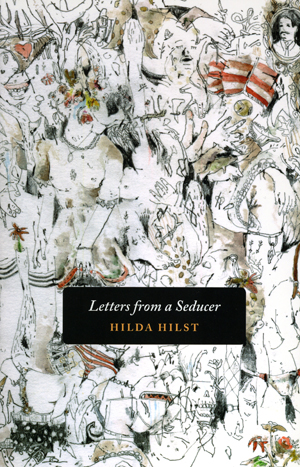
For my part, I contributed a revision of a talk I delivered in at the New York Public Library back in 2014, "Translating Brazil's Marquis de Sade," which explores the complexities of Hilst's Cartas de um Sedutor (Letters from a Seducer), for which Carvalho wrote the introduction, and the challenges I--and anyone--might face bringing it and her work in general into English. (In "Derelict of Duty, "Nathanaël also discusses some challenges faced co-translating Hilst's A obscena Madame D (The Obscene Madame D, Nightboat and A Bolha Editora, 2013). It is especially exciting to see this essay in print and in this volume, which I hope will serve as an enticing overview and introduction that I hope sparks more studies in English about Hilst, and spurs more translations of Hilst's work. I believe a translation of Hilst's Fluxo-Floema is on its way soon, and this year, Hilst's Of DeathMinimal Odes, translated by Laura Cesarco Eglin, will be published by co•im•press.

Please consider getting a copy of this volume, or at least suggesting your nearest library do so. And please, read Hilda Hilst!

Friday, April 25, 2014

First Review of Hilst Translations


A few posts back I mentioned that the somewhat altered and edited version of an online roundtable discussion about Hilda Hilst was now live on the website Music & Literature, but I had not realized that in early April, in preparation for the roundtable, writer and critic Adam Z. Levy posted an insightful, well-considered and very praiseworthy review both of my translation of Hilda Hilst's Letters from a Seducer (Nightboat Books/A Bolha Editor, 2014) and of scholar Adam Morris's recent superb translation of Hilst's earlier novella, With My Dog-Eyes (Melville House, 2014) about a mathematician whose eyesight and consciousness are disintegrating.

Some quotes from Levy's review (which heartened me tremendously when it singled out my rendering both of Hilst's seemingly inexhaustible lexicon of terms for sexual organs, as well as of the multiple registers of idiom and discourse in the character Karl's letters, effectively capturing their often absurd--and I do mean absurd--humor):

If the abnegation of traditional values and hierarchies runs through Hilst’s life, her attempt to find a literary analogue becomes clear with the arrival in English of two more of her novels: With My Dog-Eyes (published in Brazil in 1986, and this month in Adam Morris’s translation) and Letters from a Seducer (translated by John Keene). Letters from a Seducer is the third book in her “pornographic tetralogy,” which solidified her notoriety upon its Brazilian release in 1991. Included in the quartet are a book of poems and three novels (O Caderno Rosa de Lory Lamby, Contos D’Escárni / Textos Grotescos, and Cartas de um sedutor). Though Hilst’s later writing is considered radically different than her earlier work, the break represented by the tetralogy is merely an intensification and deepening of themes Hilst had long explored. Her “pornographic” books are united by the violence with which she works to undo the grammar of systems of confinement—language, gender, sexuality, and form—and the tenderness and comedy with which she scours the bleakness of circumstance for something that an optimist might call hope.

and

There is an Ouroboric quality to Kéres’s descent from genius to madness, concurrent with the novel’s own formal descent from coherence to chaos. Many of the pleasures and challenges of reading Hilst’s fiction can be found in this loop. By the end of the book’s sixty-two pages, Kéres has fractured and dissociated almost entirely from himself. Hilst renders this with a mix of first- and third-person narration, with Kéres hovering over himself—and over the text—as an intermediary between the reader and the professor’s thoughts:
Amós Kéres. From here I can hear him comparing the lucidity of an instant to the opacity of infinite days, I can hear him thinking of the various manners of madness and suicide. The madness of the Search, which is made of concentric circles and never arrives at the center, the obscuring, incarnate illusion of finding and understanding . . . From here can I hear him thinking how should I kill myself? or how should I kill in me the various forms of madness and be at the same time tender and lucid, creative and patient, and survive?
As Kéres fractures and becomes increasingly diffuse, Adam Morris does an impressive job handling the sudden shifts in perspective and the disorienting rhythms of the text. Toward the end, it is almost impossible to know whom to attribute various lines of exposition and thought, as though Kéres himself were a poem emptied of signification, and Hilst seems to ask whether this is liberation or the essence of madness itself.

and

In the back of my book, in a column that carries over to a second page, I noted the following euphemisms that Hilst uses for penis: catfish, pole, blunt, harmonica, banana, pod, thrush (as in “to pluck one’s thrush”), piece, club, table leg, rosy mallet, bat, tombstone, creeper, strap, box, nib, basket, and gourd. There is also starfruit-loquat-hole, rosy pulp, poompoom, dove, hairy cavern, butterfly, chocha, and petunia, where female genitalia are concerned. 
But the pornographic nature of the novel reaches further than the physical. The three short sections that constitute Letters from a Seducer are narrated by two men: Karl, the seducer of the title, and Stamatius (Tiu, for short) an impoverished writer who is resentful of Karl’s money and manner. Karl’s letters are the most accessible and the most enjoyable, although enjoyment and accessibility are categories of which I imagine Hilst herself would be suspicious. The letters are lustfully written to Karl’s forty-year-old sister, Cordélia (named with reference to King Lear), who lives alone in the country. “Cordélia, my sister, come out of your cloister / The countryside ages women and cows,” one of Karl’s teasing lyrics goes. Karl’s own cloister is his family’s estate in an unnamed Brazilian city, where he lives with two German servants who putter about the house, muttering passages of Jean Genet by heart. Karl’s voice is arch and affected, often to the point of hilarious parody, but Hilst endows him with a clever self-consciousness and serial seducer’s charm. That John Keene’s translation captures the humor of Karl’s constant suggestiveness and change in register is a remarkable achievement of its own.

If you haven't picked up either book--they're short!--please do, and also do not forget the brief, enthralling The Obscene Madame D, the first of Hilst's works to appear in book form in English, translated collaboratively and with great panache by Nathanaël and Rachel Gontijo Araújo (Nightboat Books / A Bolha Editor, 2012)!

Wednesday, April 09, 2014

Hilda Hilst Online Roundtable

The young Hilda Hilst
Over the last few months I participated in an online roundtable about Hilda Hilst, whose sublime and sublimely perverse novel Letters from a Seducer (Nightboat Books, 2014) I translated last year. Organized by critic and author Sarah Gerard, the roundtable, which comprised questions posed by Sarah (and translator Caroline Aguiar), and responses by authors, translators, scholars and publishers including Alex Forman, Rachel Gontijo Araújo, Adam MorrisNathanaël, Stephanie Sauer, and I, does give a deeper sense of who Hilst was, and what she was up to. The conversation is now live at Music and Literature.

One unfortunate aspect of the conversation, however, is that it appears to have been reordered and edited, with some errors inserted, after the fact--by Music and Literature or someone else I'm not sure. Nevertheless, it reflects our real-time online exchanges, and for the most part (or at least my part) did not receive any subsequent polishing. Were we onstage, bodily as opposed to virtually, this is the sort of conversation--without the remixing--you might hear.

One highlight:

Caroline Aguiar: Hilst was willing to explore the limits of language while going deep into aspects such as God and immortality. At the same time, she was deeply connected with the very core elements of human existence, such as passion, comradeship, life, and death, often finding inspiration not only in philosophical books but also books on biology, physics, anatomy, and math. How do you interpret the fact that the public is now more interested and prepared to embrace Hilst’s view of literature than any time before? 
Nathanaël: This seems a recasting of the first question of our conversation. As I think a number of us have indicated previously the question of the timeliness of these translations seems to mislead the apprehension one might have of Hilst’s work; John has underscored the degree to which this is already an Anglo-centric question, since Hilst arrived in other languages well in advance of these efforts here; so perhaps the question is one, if it does indeed need to be asked at all—and I’m not personally convinced that it does—of the English language’s belatedness and hitherto lack of receptivity. And the way in which borders between languages are more or less passable. On the occasion of the U.S. film release of Macunaíma in 1968, the U.S. public’s ability to receive the work was, according to one critic, limited by its impoverished understanding of Brazilian specificities and political realities within a larger South American context, with which it was somewhat more familiar. It would seem to me, though, that this kind of limitation is a consequence of a kind of deliberate ignorance. And I am concerned that the same kind of short-sightedness can lead us to congratulate ourselves misguidedly for identifying a particular moment as a zeitgeist. Literature has no time and articulates itself reiteratively with a reader. 
Alex Forman: Caroline makes an important point about the elements of the metaphysical in Hilst’s literature, ideas brought over from other fields such as philosophy, math, and science. And though I don’t immediately see the math, I do find biology, and I want to think more about this… I do see a predominant focus on literature itself (the notion of Literature) in a sort of meta-textual writing and the Metaphysical. In the books I have read, there are monster narrators who eat little children; we have children whose living uncles turn into great authors of Brazilian literature (in a game of smoke and mirrors) and narrators who speak from beyond the grave. We have multiple interior voices—some, like John mentioned earlier, come from Hilst’s fascination with recording seance-like encounters with spirits, while others seem to be simply the “voices in our heads” at play in her fascination with mental illness. So many of these elements are in communion with Brazilian culture. They end up being the manifestation of a cultural reality, a stream that runs permanently beneath the surface here, so much so that it is never described but simply permeates daily rituals. Hilst works it all into her literature as fantastical and absolutely natural, absorbed and accepted by her characters in such a way that we, her readers, come to accept it too.