Showing posts with label activism. Show all posts

Thursday, February 01, 2018

Black History Month/Langston Hughes Day + Poems: Nicolás Guillén & Langston Hughes

Langston Hughes in Harlem,
1959. (The LIFE Picture
Collection/Getty Images)
Happy Black History Month! February ushers in the month on the US calendar when the history, culture, and experiences of people of African descent, African Americans and all other Black peoples, in America and across the globe, occupy the foreground. As readers of J's Theater know well, every day, every month, every year here offers an opportunity to highlight the artistry, past and present experiences, and rich cultures of Black people, and to the extent that I can do so this month as every month, I intend to.

February 1 is also the birthday of arguably the greatest and most prolific African American poet, (James) Langston (Mercer) Hughes (1902-1967), a Joplin, Missouri native whose poetry transformed Black American and American literature, and who was one of the central figures in the Harlem Renaissance and a link to many of the Black American and non-US literary traditions that followed. One of the many aspects of Hughes' career that has deeply influenced me is his work as a translator; he brought into the English the drama of Spain's Federico García Lorca, the poetry of the Afrocuban luminary Nicolas Guillén, and the prose of Haitian writer Jacques Roumain.

I've previously posted one of his translations of Guillén's poems from Motivos de Son (1938), the collection that made the Cuban poet's reputation. I shared it in conjunction with my trip to Cuba,  which though 9 years ago feels like it was just yesterday. Hughes visited Cuba three times, in 1927, 1930 and 1931, before the Revolution, and as Ervin Dyer discussed in a CBS News piece, the American poet played a role in helping the country connect to its African roots, engaging in conversations with and championing the work of Afrocuban artists and writers at a time when racial discrimination there, as in the US, was rife. One of the poets he met and whom he encouraged was Guillén, who interviewed him for Diário de Marina, according to Dyer. Many stars aligned: Hughes was already famous and being translated in Cuba, Guillén's career was ascendant, and the newspaper had a page dedicated to fighting racism. Hughes would go on to translate Guillén's poetry and cultivated their friendship to the end of his life. At the same time, his presence in Cuba and his art continued to galvanize an array of Afrocuban artists working across genres.

Here is Hughes' translation of Guillén's "Little Song for the Children of the Antilles," which I screenshot from The Translations: Federico García Lorca, Nicolás Guillén, and Jacques Roumain, by Langston Hughes, edited and with an introduction by Dellita Martin-Ogunsola, Columbia: University of Missouri Press, 2003.


And here is a poem Dyer mentions in his article, one of Hughes' tributes to Cuba, "To the Little Fort of San Lázaro on the Ocean Front, Havana." It is also a humorous and sarcastic critique of capitalism, especially of the predatory US kind, which had reached its tentacles deep into Cuba before Fidel Castro and the Revolution hacked it away.  We also might think of it as a fitting epigraph for a good deal of what gentrification and global capital are laying waste to today.

TO THE LITTLE FORT OF SAN LÁZARO
ON THE OCEAN FRONT, HAVANA

by Langston Hughes


Watch tower once for pirates
That sailed the sun-bright seas —
Red pirates, great romantics.

  DRAKE
  DE PLAN,
  EL GRILLO

Against such as these
Years and years ago
You served quite well —
When time and ships were slow.
  But now,
Against a pirate called
THE NATIONAL CITY BANK
What can you do alone?
Would it not be
Just as well you tumbled down,
Stone by helpless stone?

From The Collected Works of Langston Hughes: The Poems, 1921-1940, edited and with an introduction by Arnold Rampersad, Columbia: University of Missouri Press, 2001. All rights reserved.

Friday, January 26, 2018

Hugh Masekela, Trumpeter & Activist, Passes

South African trumpeter and musician
Hugh Masekela at St. Lucia Jazz
festival, May 2012.
(Reuters/Andrea De Silva)
This past week brought a number of homegoings, taking from us the South African musician and activist Hugh Masekela (April 4, 1939 - January 23, 2017), a trumpeter of impressive talent, and a freedom fighter against apartheid and for full equality for Black and brown South Africans. A native of KwaGuqa Township, Witibank, Masekela began his musical career at age 14, after seeing Kirk Douglas in the Hollywood film Young Man with a Horn, and his first trumpet was a gift from Louis Armstrong, via an anti-apartheid Anglican archbishop, Trevor Huddleston.

Masekela would go on to an internationally renowned career, traveling the continent and globe and playing with many of the most important jazz, pop and world-music musicians of his generations, but he never ceased agitating for his people's freedom. Throughout his oeuvre are numerous pieces that address the toxins of apartheid, racism, slavery, social, political and economic inequality, poverty, and other ills. After the 1960 Sharpeville Massacre, in which South African authorities killed 69 protesters in cold blood, Masekela went into exile, and settling in New York, where he befriended US musicians and activists, and was able to study at the Manhattan School of Music, graduating in 1964, and briefly marrying the marvelous singer Miriam Makeba shortly thereafter.

Among Masekela's musical achievements were the chart-topping 1968 instrumental song "Grazing in the Grass," and his star turn with the pop R&B/jazz group The 5th Dimension, on their unforgettable hit "Up, Up and Away," in 1967. He also recorded with musicians ranging from Paul Simon to Abdullah Ibrahim to Kalahari, making a special point to engage other African and Black Diasporic, musicians, including Fela Kuti and Jorge Ben, and musical forms in his work. Throughout, he  enriched the century-long traditions of jazz music. Masekela founded the Botswana International Music School (BIMS) in 1985, an institution that continues, in different form but which still brings together young and established musicians from across Africa.

My introduction to Masekela's music came from hearing my father play both albums featuring his work and ones he issued, and then, in early adulthood, when he was one of the highlighted artists who participated in Paul Simon's famous album Graceland tour, which also included Miriam Makeba and brought to wider attention groups like Ladysmith Black Mambazo. (I may even have the Graceland LP in my collection!)

May he keep blowing his horn and creating beauty wherever he is now, and may we keep listening. In tribute to him, here are a few clips from YouTube. Enjoy!


Hugh Masekela, "Grazing In The Grass"


Hugh Masekela, "Afro Beat Blues"


Hugh Masekela, "Don't Go Lose It Baby [Rare Version]


Hugh Masekela, "Stimela" (with Graceland)
Hugh Masekela, "Blues for Huey"


Hugh Masekela, "Bring Him Back Home (Nelson Mandela)"

Monday, October 31, 2016

Photos: American Book Awards

Here a few photos from the 2016 American Book Awards ceremony, which was held at the San Francisco Jazz Center. The highlight of the event for me was meeting all of the other honorees--congratulations to ALL of them, those present and those unable to be there--and hearing the extraordinary, often deeply moving speeches. Thanks once again to the Before Columbus Foundation and its board, Justin Desmangles, Ishmael Reed, and everyone who makes the foundation, the awards, the event, and all the important work BCF does in the world possible! (All photos are by C (thank you!).)

With THE Beefeater,
in front of the Sir Francis Drake
Hotel, Union Square
C & I before the event 
Chatting with my Rutgers-Newark
colleague Lyra Monteiro 
Meeting ABA winner Jesús Salvador Treviño,
author of Return to Arroyo Grande 
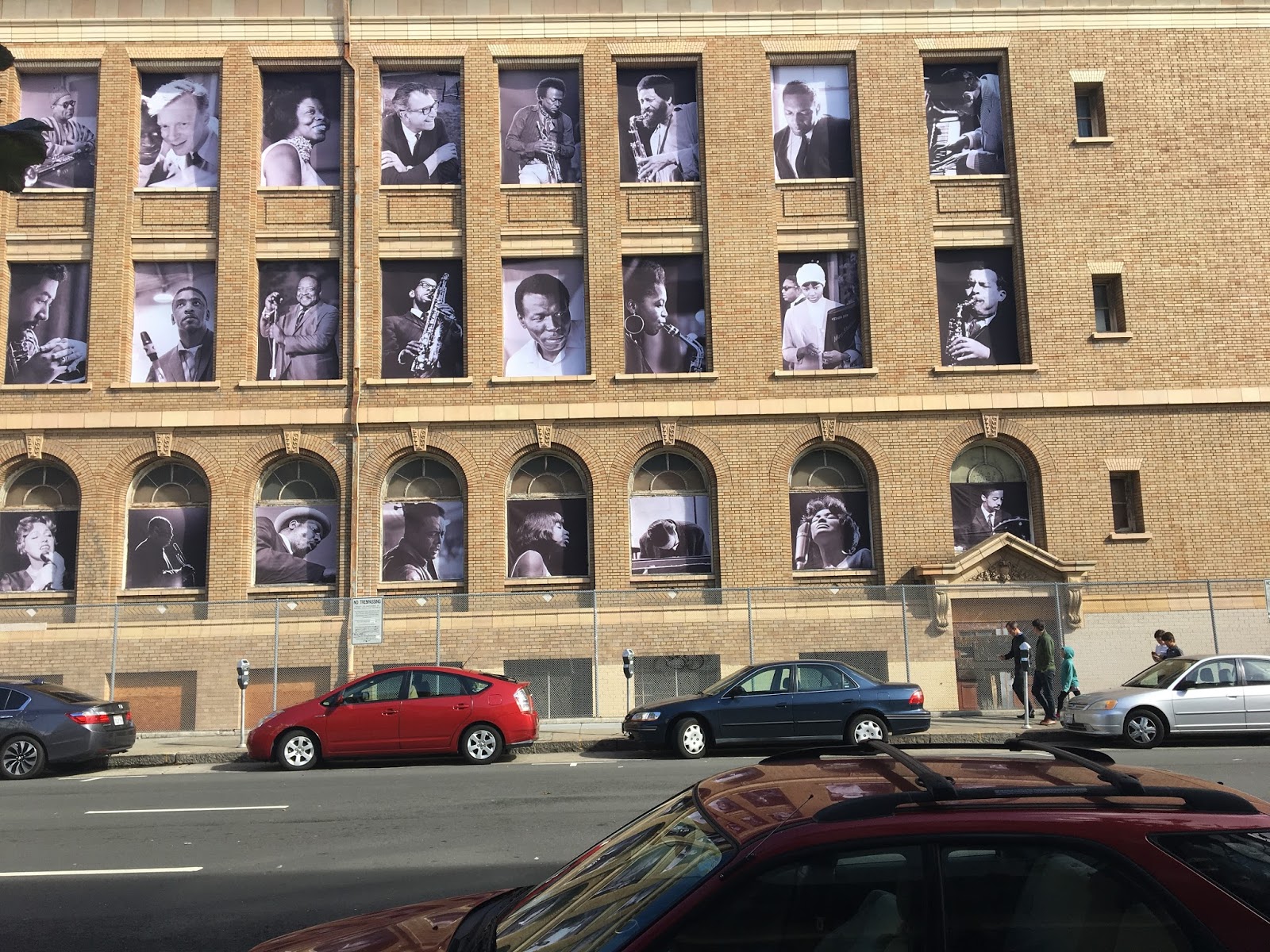
The façade of jazz greats across the
street from SFJazz Center 
Justin Desmangles, radio host, writer,
and MC for American Book Awards 
ABA winner Lauret Savoy, author of Trace:
Memory, History, Race, and the American Landscape
Poet Laura Da', author
of Tributaries and ABA winner
Jesús Salvador Treviño 
ABA winner Susan Muaddi Darraj, author
of Curious Land: Stories from Home 
ABA winner Deepa Iyer, author
of We Too Sing America:
South Asian, Arab, Muslim, and Sikh Immigrants
Shape Our Multiracial Future
Before Columbus Foundation and American
Book Awards founder Ishmael Reed,
introducing the Lowenfels Award for
Criticism, which went to Lyra Monteiro
and Nancy Isenberg
Lyra Monteiro, accepting her award
Washington University professor Bill Maxwell,
speaking after receiving his American Book
Award for his study F. B. Eyes: How J. Edgar Hoover's
Ghostreaders Framed African American Literature
Roxanne Dunbar-Ortiz, accepting ABAs for
Ned Sublette and Constance Sublette,
authors of The American Slave Coast: A History
of the Slave-Breeding Industry
The mother and sister of college student
Chiitaanibah Johnson, who received the
Andrew Hope Award for her activism
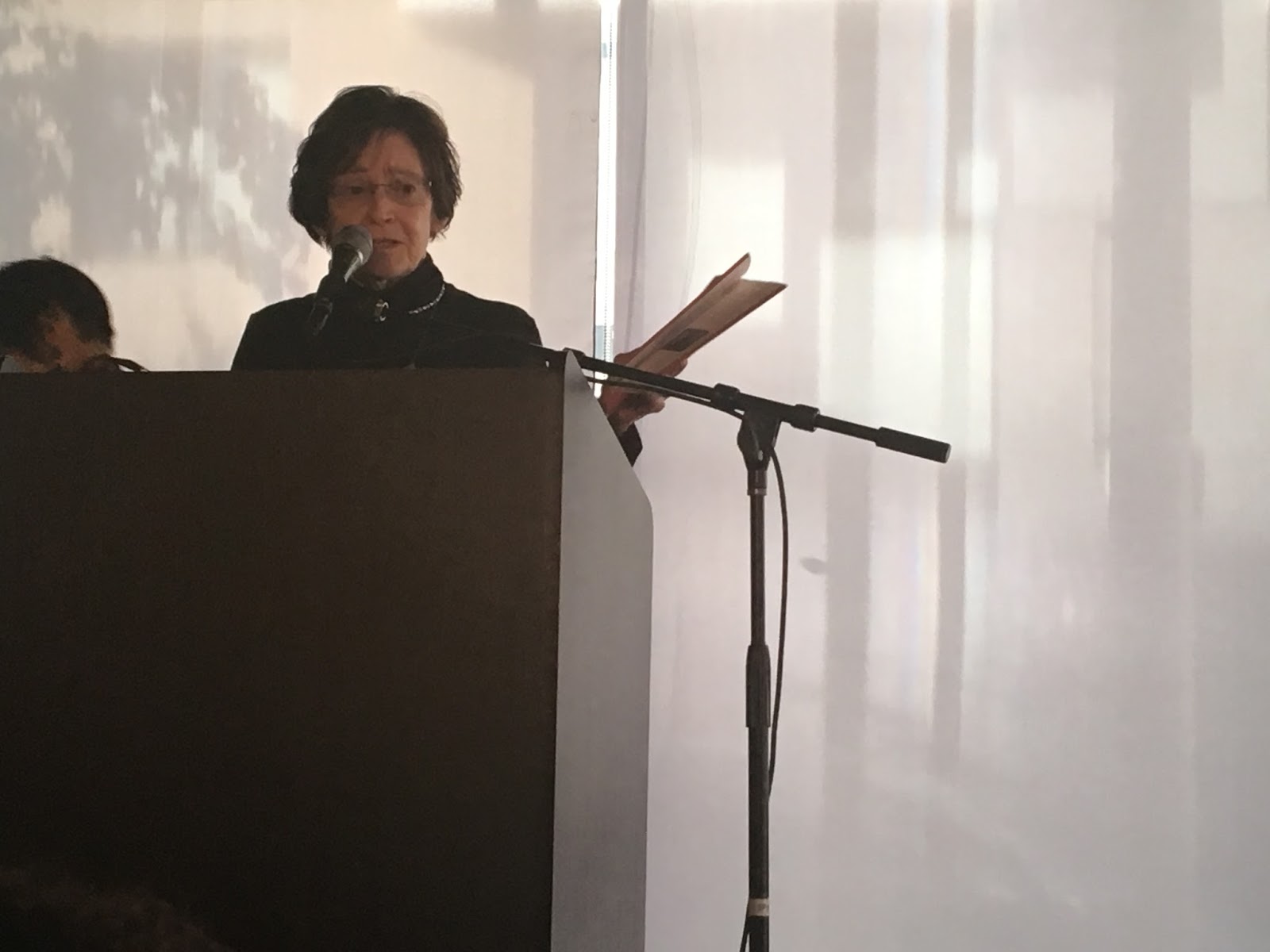
Lyra speaking and breaking it down
Yours truly, giving my speech
A group photo
Lyra and I


Wednesday, April 01, 2015

Borrowed Post: Heriberto Yépez on Kenneth Goldsmith

Happy Inter________ Poetry Month, and April fools are welcome here. Poems are on the way.

Out of deep interest, however, I am beginning this month's posts by borrowing the following entry directly from poet, translator and activist Guillermo Parra's site, Venepoetics, which I have now linked to at right and which I came across several times before being directed there in linkworthy fashion by coldhearted scientist وداد's post on Juan Sánchez Peláez. At both sites there are blossoms there too numerous to name so I recommend dropping in and wandering in the garden, sitting, staying a while, reflecting, and then dropping in again.

But back to the purloined post (all rights reserved): Parra presents his translation of a statement the poet and activist Heriberto Yépez gave on the recent anthropophagous spectadebacle by Kenneth Goldsmith at Brown.  Scroll down and you'll see a link to an earlier, prescient piece Yépez wrote about Goldsmith, who is a literary hustler of the highest order, have mapped and pursued a trajectory upwards from the local airwaves to a post at Penn. Nice work if you can get it--and he did. At any rate, Yépez is on to him. Keep reading, and you'll see. I'll be posting on the Mongrel Coalition Against Gringpo very soon.

But seriously, do check out Parra's site, as well as coldhearted scientist وداد's!

***

El escándalo del sujeto-concepto: Kenneth Goldsmith / Heriberto Yépez

The Subject-Concept Scandal: Kenneth Goldsmith


On March 13th, the well-known writer Kenneth Goldsmith read a poem titled “The Body of Michael Brown” at Brown University. It was an appropriation of the autopsy report for the African American young man murdered by a police officer in Ferguson in 2014; this lynching has provoked huge protests against persistent racism in the United States. As soon as news of Goldsmith’s poem circulated, the polemic exploded on the Internet.

On his Facebook page Goldsmith justified that the poem gives continuity to his work, based on the appropriation of texts. Then he asked the university to not make the video available.

I’ve already written about my political disagreement with Goldsmith. Now I’d like to make note his conceptual inconsistency.

Goldsmith advocates for an uncreative writing derived from textual appropriation in the era of electronic distribution. But his work is actually a re-creative writing of the manner in which the gravity of reports is destroyed by the neoliberal system.

Goldsmith has transformed into art the kind of appropriations usually conducted by media, corporations and the U.S. government.

A key tactic of this conceptualism is to deny the geopolitics that make this re-creative aesthetic possible; applauded, literally, by the White House.

In the face of the indignation provoked by his re-creation of a report about the cadaver of a victim of racial ultra-violence, Goldsmith tried to allege there were no bad intentions.

This is an inconsistency because Goldsmith himself has insisted for years that his works are derived from concepts removed from the Romantic subject. But by defending himself morally, Goldsmith recurs to the poetic subject he claims to have left behind.

In order for Goldsmith to be consistent with his art he should stop feigning innocence or justifying his re-creations.

If Goldsmith wants to be consistent he should let him himself be completely appropriated by the logic of the U.S. government. He should become a subject-concept ruled by neoliberalism and rigorously embrace the brutality, the looting and the total program of capital.

The legacy of Goldsmith will be to have emptied North American literary experimentalism of any anti-capitalist critique. If he doesn’t want to undermine that legacy, he should take it to its final consequences instead of appealing to personal motivations or retreating into alleged misunderstandings or good intentions.

Goldsmith will make a contribution to the history of poetry if he finishes the job of burying the last remnants of the lyrical I and transforms it into a conceptual-subject predetermined by capital.

Kenneth: you shouldn’t abandon the inner logic of your work. On the contrary, you should allow capitalism to completely appropriate your literary-persona, instead of trying to justify it by means of your moral-persona. You’re a neo-imperial artist. Don’t sabotage that function with a retro-romantic artist’s discourse.

Besides, that literary work and persona already incarnate the desire for beautifying the Capital Concept.

And don’t forget, the crisis will be transnational —or will not be at all.


{ Heriberto Yépez, Archivo Hache, Suplemento Laberinto, Milenio (México D.F.), 21 March 2015 }

Wednesday, October 30, 2013

Street Stories with Gbenga Akinnagbe @ Rutgers-Newark

Gbenga Akinnagbe

Two wonderful colleagues of mine, my English department chair Professor Frances Bartkowski, and Senior Associate Dean of Faculty and Associate Professor of Sociology Sherri-Ann Butterfield, decided last year to co-teach an undergraduate course revolving around the former HBO series The Wire. The five-season series was one of my favorite TV shows of the last decade and one I blogged about a few times in the past. But nothing I have written about the series could compare to the fastidious, thoroughly engaging interdisciplinary approach Fran and Sherri-Ann are taking in introducing this richly provocative program to Rutgers undergraduates.

As part of their class, they invited to campus actor, activist and entrepreneur Gbenga Akinnagbe, who played one of The Wire's profound villains, Chris Partlow, to speak not just to their class, but to the larger Rutgers and Newark communities.  Rutgers-Newark's College of Arts and Science Departments of English and Sociology and the Paul Robeson Campus Center: Office of Service Learning and Student Development sponsored the Washington, DC-native's visit.

Akinnagbe spoke about his upbringing as a Nigerian American, some of the struggles he had encountered over the years and how wrestling helped him in multiple ways, including gaining a scholarship to Bucknell University, his career as an activist, and how he has gone on to participate in civil and social activism, both in the USA, where he has been active in opposing the New York Police Department's racist "stop and frisk" policy, and overseas, including with Occupy Nigeria. He also talked a bit about current projects, including his recent work as a producer of multiple films in 2013, among them the documentary Children of the Wind, and the feature film Newlyweeds (2013), has received a lot of industry buzz.

Akinnagbe patiently answered questions, many of them about his preparation for and the effects of playing Chris Partlow, whom he deemed a "sociopath," as well as his roles in programs like Graceland, for over an hour, never flagging and frequently and smoothly shifting from seriousness to humor, all while providing a richer picture of who he is and many of the things he's been up to. I asked him about balancing acting and activism, and he responded that he was still trying to figure out how to do so, but he is not giving up on lending his voice, time and platform to causes he believes in. Afterwards I expressed my wish that he and some of the other members of The Wire reconvene on another project that would allow them--like Seth Rogen's film repertory--to display their talents on screen, and he said that some of the actors do appear in Newlyweeds, but that he would love to do more projects bringing them all together. I hope it happens soon! Many thanks to Fran, Sherri-Ann, Mr. Akinnagbe, and everyone else who made his visit possible.

Fran Bartkowski and Sherri-Ann Butterfield
Sherri-Ann with Gbenga Akinnagbe

Gbenga Akinnagbe
One of the Rutgers-Newark
students with Akinnagbe
after his talk

Sunday, May 20, 2012

HUMAN MICROPOEM @ Protest NATO Rally, Chicago

The 2012 NATO Summit is currently taking place in Chicago, and as I need not tell anyone, the city's and state response to dissent of any sort, by groups and people affiliated with the Occupy movement, longstanding peace and anti-war activists, veterans, union members, and others on the left and left-of-center who expressed a desire to assemble and march without confrontation, has been really over the top. From the militarization of the police forces surrounding the site of the summit, the McCormick Place Convention Center, near Soldier's Field, including restrictions on access to major roadways and north-south routes; to an early-morning raid on Zoe Sigman's home in Chicago's Bridgeport section, which resulted in the arrest of 3 people, with 2 others arrested on different charges today, though alternative reports suggest that the arrestees have been framed or the charges have been trumped up as a deterrence; to violent responses to marchers over the last few days, including a brutal showdown at McCormick Place this evening, the state reaction to Constitutionally-guaranteed dissent has been reactionary and violent.  I demurred for a moment, I must admit, but only for a moment, before deciding to participate in today's HUMAN MICROPOEM, performed by a loosely-affiliated group of poets and performers sponsored by and affiliated with the experimental Red Rover Series, who have supported the Occupy Chicago movement in its earlier Federal Reserve of Chicago encampment mode, commemorated Veterans Day with a march to the Vietnam Veteran's Memorial, and staged guerrilla readings at this year's Associated Writing Programs (AWP) conference in Chicago. More generally, "The Human Micropoem is a call and response choral form utilizing the human microphone at the occupy movements to amplify the speaker's words by those listening. The speaker says a line and then everyone who can hear repeats it."

I turned out to be the fourth of a quartet who convened as the HUMAN MICROPOEM from 11 am to a little after 12 pm, on the sidewalk at the southwest corner of Jackson & Columbus, just catercorner to the major March and Rally to Protest NATO in Grant Park (and directly across the street from the rump side of the Art Institute of Chicago), a legal, permitted rally at Petrillo Bandshell, in the park, to be followed by a march toward McCormick Place, with the Iraq Veteran's Against the War (IVAW) marching  in solidarity and culminating in IVAW members of IVAW conducting a closing ceremony in which they planned to return their medals to NATO.  We Human Micropoets performed original works, including declaiming from a collaborative poem by one of the poets, reading dictionary entries (cf. "revolution," "peace," "action," "silence," etc.), offering impromptu chants, and reciting poems by other, well-known writers (June Jordan, Czeslaw Milosz, Thomas Transtromer, Lorine Niedecker, and Siegfried Sassoon) writing anti-war, pro-peace poems.  We drew a decent number of onlookers and participants, who arrived on their way to the main rally in waves, leading poet and organizer Jen Karmin to astutely time the readings by the lights. Cagean, as she put it. (For longer poems, of course, this presents a little problem.) Well-wishers included a tyke heading towards the lake with his parents, and numerous ralliers who stopped to take pictures and record us, as well as others who wrote up the event. A reporter from AP Radio even took audio, while a young onlooker assured me he would post the video of us on his YouTube channel. (It's not there but when it is I'll add the link.)  After the event, several of us went and sat on the lawn under a cooling bower, and chatted and listened to the speakers at the rally, whose crowds grew larger by the hour.  I had schoolwork to attend to, so I couldn't attend any of the several marches that were to take place. I headed back north, and it wasn't until a few hours later, as I was walking to the train and passed flat screens in the open windows of bars on Clark Street in Wrigleyville, that I learned that there'd been a violent standoff between police and the marchers south of the rally ground, and that the medal-returning event had also ended with brutal state response. The ironies are too numerous to list.

I do hope to continue the Human Micropoeming over the summer in the New York/New Jersey area. Among the many things it has clarified for me are how important public, social performances of poetry can be; that any sort of text, not just a poem, can work under the correct conditions; and that certain poems, particular ones that can easily be broken down prosodically and syntactically, that have a looser rhythm and shorter lines, often work best.  June Jordan's poems were perfect in this regard, and their severity felt in perfect keeping with the gravity of what protesters have faced over the last few years. Nevertheless, performing Milosz's "Declaration," I had to catch myself several times not stopping at the sheer power of his language, which, even somewhat atomized, still bore so much beauty and force.  As always, a few photos:

At the Human Micropoem performance, Chicago Rally Against NATO Summit
A rally participant photographing Jen (article here)

At the Human Micropoem performance, Chicago Rally Against NATO Summit
Peace activists who joined the performance

At the Chicago Rally Against NATO Summit
Marchers heading toward the rally site

At the Chicago Rally Against NATO
Grant Park, near the Petrillo Bandshell (Chiscrapers in the background)

At the Chicago Rally Against NATO
Rally participants relaxing near us

At the Chicago Rally Against NATO
Peace activists

At the Chicago Rally Against NATO
People distributing newspapers and leaflets

Chicago Rally Against NATO Summit
Rally participants

At the Chicago Rally Against NATO
As the rally site began to fill up

Thursday, April 19, 2012

Poem: Lorna Dee Cervantes

I was trying to figure out how to introduce the following poem, by Lorna Dee Cervantes (1954-), which I thought of when I read the hedging admission by the House Majority Whip, Eric Cantor (R-VA) that anti-Semitism and racism were (still) a problem in his (the Republican House) caucus.  Well, duh. (Yet does he realize how he's been part of the problem?) I read this poem many years ago and recall it every so often because of how it captures so much of what was surging through me back then, and what I still sometimes feel, beginning with her opening line, "In my land there are no distinctions." Yet she must qualify her utopian statement rather quickly by noting that despite this view, despite the fact that "there are no boundaries," there is a system that is trying to destroy her, there are people whose words and actions are killing her, people who do not want her be alive, that there "is a real enemy / who hates me," and that even some of the best and best-meaning people seem unwilling to do or say anything to stop this.

I also know that she wrote it when she was very young and yet it shows such nuance, such sophistication, then ends with a bang that I feel we shouldn't forget.  We are a country at war, sadly, without our selves, "our various selves," as Amiri Baraka once put it. At any rate, I was thinking of introductions when I came across this 2007 blog post by none other than Cervantes herself, from her blog Lorna Dice, in which she explains to a student named Emily her motivations, the writing of the poem, and what she thinks it means. (Can I just say, I love that with I can read Lorna Dee Cervantes' musings after a few seconds' search via DuckDuckGo. She actually has two other blogs: Lorna Dee Cervantes, and Mission Poetry Center--La Misión Poética)  Cervantes, for those who may not be familiar with her, is a Chicana/Native American (Chumash) poet long active in feminist, progressive, antiracist causes, and has been writing and fighting since the 1970s.

Her first, perhaps best known book, is the award-winning volume Emplumada (Pittsburgh: University of Pittsburgh Press, 1981).  Ten years later she published her second book, From the Cables of Genocide: Poems on Love and Hunger (Houston: Arte Público Press, 1991), and has gone on to publish two more volumes, while also serving as editor or co-editor of journals and anthologies, teaching (for many year at the University of Colorado, Boulder, and now at University of California, Berkeley), and keeping the dream of a better world alive through her work in many communities.  Her blog is an extension of this; on it you see she not infrequently responds to young people who contact her about her work, theirs, life in general, the issues they're going through, and it represents yet another aspect of her longtime efforts to improve literacy among young people, especially young Latinos.

One thing I want to note about Cervantes' poetry, especially since I have called attention to her emphasis on social activism, is how much it summons vivid, sensuous details of the natural world, particularly flowers, details of the urban terrain, material aspects of the everyday world, to etch sharp pictures in the mind. In my mind, when I think of her poems, I often see them beginning with the naming of a plant whose blooms, colors, scent, grounds me immediately. She writes many other kinds of poems, but her work also makes clear that one doesn't have to surrender social concerns no matter what or how one is writing a poem.

Now, this famous poem, which seems especially fitting given the rhetoric that regular fills the airwaves and the numerous tragedies, arising out of sexism and misogyny, racism, homophobia, classism, religious intolerance, and general disrespect for the humanity of others, for difference and pluralism, that have scarred the news of late. Do read her blog if you get a moment; she doesn't disappoint there or in her poems.

POEM FOR THE YOUNG WHITE MAN
WHO ASKED ME HOW I, AN INTELLIGENT,
WELL-READ PERSON, COULD BELIEVE IN
THE WAR BETWEEN THE RACES

In my land there are no distinctions.
The barbed wire politics of oppression
have been torn down long ago. The only reminder
of past battles, lost or won, is a slight
rutting in the fertile fields.

In my land
people write poems about love,
full of nothing but contented childlike syllables.
Everyone reads Russian short stories and weeps.
There are no boundaries.
There is no hunger, no
complicated famine or greed.

I am not a revolutionary.
I don't even like political poems.
Do you think I can believe in a war between the races?
I can deny it. I can forget about it
when I'm safe,
living on my own continent of harmony
and home, but I am not
there.

I believe in revolution
because everywhere the crosses are burning,
sharp-shooting goose-steppers round every corner,
there are snipers in the schools...
(I know you don't believe this,
You think this is nothing
but faddish exaggeration. But they
are not shooting at you.)
I'm marked by the color of my skin.
The bullets are discrete and designed to kill slowly.
They are aiming at my children.
These are facts.
Let me show you my wounds: my stumbling mind, my
"excuse me" tongue, and this
nagging preoccupation
with the feeling of not being good enough.

These bullets bury deeper than logic.
Racism is not intellectual.
I cannot reason these scars away.

Outside my door
there is a real enemy
who hates me.

I am a poet
who yearns to dance on rooftops,
to whisper delicate lines about joy
and the blessings of human understanding.
I try. I go to my land, my tower of words and
bolt the door, but the typewriter doesn't fade out
the sounds of blasting and muffled outrage.
My own days bring me slaps on the face.
Every day I am deluged with reminders
that this is not
my land

and this is my land.

I do not believe in the war between the races.

but in this country
there is war.

Copyright © Lorna Dee Cervantes, "Poem For The Young White Man Who Asked Me How I, An Intelligent, Well-read Person, Could Believe In The War Between The Races," from Emplumada, Pittsburgh: University of Pittsburgh Press, 1981.

Tuesday, April 17, 2012

Poem: Kwame Dawes

Continuing with the theme of congratulations, I want to extend my heartiest best wishes to another poet, Kwame Dawes (1962-), who was one of the select few recipients of this year's John Simon Guggenheim Foundation Fellowships, an honor accorded to artists, scholars, scientists, and others who have achieved a high level of distinction in their fields. Kwame combines many talents in one person. A prodigious, acclaimed poet, featured before on J's Theater, he has published a dozen or more complete collections since the early 1990s; yet he has also published novels, a book of short stories, a biography of Bob Marley, and a play, and edited at least five books of poetry of various kinds (Reggae poetry, Black British poetry, Caribbean writing, and poetry from South Carolina). This constellation may seem a bit unusual, but it touches upon Kwame's background and his connections within and across communities. A native of Accrah, Ghana, he grew up in Kingston, Jamaica, attending the University of the West Indies for college, before heading to the University of New Brunswick in Canada for graduate school. He taught literature and creative writing for 20 years at the University of South Carolina, achieving the Louis Frye Scudder Professorship of the Liberal Arts there, while also directing the USC Arts Initiative, and advising the student publication Yemassee. In the last year, he has moved to the University of Nebraska, where he holds a chair and also edits the highly regarded literary journal Prairie Schooner

But I'm not done; during his South Carolina years, he deeply engaged with the local and state arts communities, serving as director of the South Carolina Poetry Initiative, whose annual poetry contest he established, and whose winning books he edited. His links to South Carolinians took other forms, including works like his book Wisteria: Twilight Poems from the Swamp Company (Los Angeles: Red Hen, 2006), which he later translated into a musical work, with artist and photographer Kevin Simmonds, the staged version debuting at Royal Festival Hall in London.  I could of course go on, but I'll only mention one further thing before getting to one of his poems; between 2007-2009, he again collaborated with Kevin Simmonds, and photographer Andre Lambertson, on a project documenting the HIV/AIDS pandemic in Jamaica. I previously blogged about this important effort, titled Hope: Living and Loving with HIV Jamaica, or Livehopelove. It is still live and if you haven't visited it, I urge you to. As all this background suggests, Kwame is indefatigable, but he also draws from many different rivers of experience, and his poetry reflects this pluralism and richness. His poems bear the influence of the Jamaican, Caribbean and Anglophone literary and popular cultures of his youth; Diasporic exchanges also nourish his poetics; his decades in Canada and the United States brought him into closer contact with American and African-American poetries, and he has influenced poets in his turn.

The poem below, from Wisteria, comes directly out of his experiences and time in South Carolina; its immediate story, of a domestic who worked for a segregationist (the real story, not the Hollywoodized The Help version), is American down to its phonemes (though a similar sentiment we know exists not just in countries that have had legalized apartheid, like South Africa, but throughout the colonial and post-colonial world). The younger poet's witnessing, however, is universal, one starting ground of and for the art itself. "I, scavenger poet / swoop and pick // at the living thing"--isn't this what so much poetry, so much literature, so much art does? There is an ethical grounding here, too. The poet isn't just taking to make something out of someone else's life, but seeks to bear witness, and the fidelity of the voice he listens to, records, is crucial: "I let my mother down / and commit sins of the soul."  He does not back away from her truth telling realization, nor from his role in setting it down, but for both poet and lyric speaker, the fact of seeing the now blind segregationist have to live with his beliefs balances this out, providing a "gourmet of irony" different from, and yet not so different from that of the poem.  So here, then, is Kwame's poem.

POEMS IN EVERYDAY PLACES

     Your story told,
     Your poem made,

     I, scavenger poet,
     swoop and pick

     at the living thing,
     to make my own

     feast of metaphor
     gourmet of irony.

He said those words,
spat them out in my face:

"Not as long as I live
will I see no colored child

riding a school bus."
Roosevelt looking down

like God almighty,
and the flag curled in the corner.

Well, he never saw them,
those colored children

climbing onto the yellow bus
books in hand, and riding,

but someone whispered it into his ear
while he stared into the black.

My mother never said rejoice
in the infirmities of others;

sometimes I let my mother down
and commit sins of the soul.

I am singing this song for him
and dancing on his grave:

"What you wish for,
that's what you're gonna get."

Thursday, March 29, 2012

Remembering Adrienne Rich

Adrienne Rich at Northwestern, 2006 (Photos by Marion Hanlon)
Last night I started to see posts, first via email, then on Twitter, that poet, essayist and activist Adrienne Rich (1929-2012) had passed away, and Googling quickly confirmed this sad news. I immediately felt a sense of loss, as so many others did and expressed in multiple ways, the most common, at least on Twitter, through quotations of Rich's poetry and essays, which will be with us for time to come.

Adrienne Rich inspired generations of people; first as a young, incredibly talented female poet who in her senior year (1951) at Radcliffe College won the Yale Series of Younger Poets Prize, meriting offhandedly sexist praise from the judge, W. H. Auden; then, by the early 1960s, as a woman writer who had moved away from the formal strictures of her early verse, while also increasingly expanding upon what was evident in her earliest published poems, a critique of the political, social and economic strictures on American women; then, by the late 1960s, through her active involvement in the anti-Vietnam War, Civil Rights, Women's Rights, and anti-colonialist and anti-imperialist movements; and then, in the early 1970s, through her increasingly powerful articulation of feminism and her coming out publicly as a lesbian, which produced her landmark books Diving into the Wreck (1973), for which she was co-awarded the 1974 National Book Award for Poetry (with Allen Ginsberg), an award she accepted not for herself but, with the other nominees, two queer women of color, Audre Lorde and Alice Walker, present on stage beside her, on behalf of all women, followed by her "Twenty-one Love Poems" (Effie's Press, 1976), which appeared first as a stand-alone text and quickly became a major work of lesbian and queer literature, and then in Dream of a Common Language: Poems 1974-1977 (1978); then through her essays, such as "Compulsory Heterosexuality and Lesbian Existence," her published notebooks and other theoretical essays, her ongoing poetic oeuvre, and her public activism, particular on behalf of equality, her advocacy for women writers, writers of color, working-class and poor people, people battling American imperialism and neocolonialism; and always, because of her courage, her willingness to be herself, a woman, a Jewish woman, a lesbian, to criticize herself, lay bare her privileges, to risk calumny and condemnation because of her political stances, to be dismissed as a serious poet because of the same, to ally herself with those who had no privileges to offer, to speak truth to power, including in 1997 to a Democratic president who wanted to honor her with one of the country's highest honors but whose actions flew in the face of so much that she believed in.

I met Adrienne Rich several times over the years, including being introduced by another poet I admire so very deeply, Marilyn Hacker, but perhaps most special to me in this regard was having had the opportunity to offer my thoughts on her work with her present, at Northwestern, in 2006.  I later posted them on this blog: you can read them here. I also had the pleasure just this past quarter to teach Adrienne Rich's poetry and "Compulsory Heterosexuality" again, and look forward to doing so in the future. We have lost a major figure in our literature and culture, a guérillière, to use Monique Wittig's term, of the likes we might not see anytime soon.

And, in honor of her passing, here is one of her poems, Number XIII from "Twenty One Love Poems":


Copyright © Adrienne Rich, from Dream of a Common Language: Poems 1974-1977, W. W. Norton, 1978. All rights reserved.