Showing posts with label criticism. Show all posts

Wednesday, September 11, 2019

A Tale of Two Exhibitions: The 2019 Whitney Biennial

Earlier this summer, I had the immense pleasure of viewing the 2019 Whitney Biennial, which is still running, for a few more weeks (until September 22, 2019), at the Whitney Museum of American Art in New York. It was not only a better show than the 2017 installment, I thought, but in essence two different exhibits in one, I ultimately argued, in a review now out for Art in America. The second of the two exhibits became possible, however, only after the Whitney resolved a festering crisis that had underpinned the exhibit--and the institution itself as a whole. In fact, the revolt that occurred, creating the new exhibition, necessitated that I rewrite the laudatory first review I'd drafted.

The qualitative differences between the two exhibits, whether visually evident or not, resonate throughout the work on display, throughout the museum's spaces itself, as a shift in ethos and an aura, however temporary. I won't replay my entire essay, which underwent a great deal of editorial distilling (so many thanks to Will Ratik and his editorial team at Art in America), so here is the link to the full essay, "The Whitney Biennial: A Tale of Two Exhibitions," and a paragraph from it, in which I argue for further action by the exhibits artists and, I would assert, artists working in all media, including literature.

I believe we are at the moment when the artists should be encouraged to actively trouble the “circuits of valorization,” as prior generations of artists have done. I say trouble rather than disrupt, since the latter term has taken on particular connotations in the language of neoliberal capitalism, particularly in Silicon Valley and Wall Street. But what might the effects be of such a troubling on the lives and careers of today’s artists, especially those who, like many of this year’s biennial participants, come from groups, intersectionally understood, that have been traditionally excluded from participation in exhibitions such as this, as well as from elite art schools and institutions, and from the global gallery, art fair, and auction networks? What would more extensive rethinking, dismantling, and transformation of those circuits look like? How much energy and effort can and ought they expend in understanding and critiquing the ecosystem in which they are working? From an ethical standpoint, can they forgo such an undertaking, whatever the cost?
If you can, please see the exhibit before it goes, and do leave your thoughts on the Biennial and my review in the comments section if you'd like.

Saturday, September 01, 2018

Farewell, Village Voice


For the last decade or so, I have only occasionally read Village Voice, mostly online, but once upon a time, when I was in my 20s and living in Boston, acquiring a copy of the Voice at one of the news stands there, and perusing it to find out what was happening in New York, was one of the highlights of my week. (Back then I also read the New York Times in print almost every day too.) The Voice provided a trove of news about politics, in New York and beyond, as well as some of the most invigorating criticism about art, entertainment, the broader culture and the world, that you might find anywhere. For me it constantly outmatched Boston's own Phoenix, that city's alternative paper, and was part of a national ecosystem of similar papers that offered fresh, often left-leaning and progressive but always counter-mainstream perspectives on the state of the world. Now, the Voice is gone.

It's where I first learned about New York's legendary Public Theater and its pathblazing directors Joseph Papp and George C. Wolfe; it was one of the mainstream places where I regularly found informative reportage, Andrew Kopkind, Richard Goldstein and others, about about HIV and AIDS. It was a regular-go to learn about the newest and less common films, books, music, theater and performances of all kinds. The Voice also brought to me and countless readers original photography (Sylvia Plachy, C. Carr, etc.), cartoons by Jules Feiffer, Ted Rall, Lynda Barry, Mark Alan Stamaty, and Tom Tomorrow, and literature (I recollect reading a story by the great poet Elizabeth Alexander's there, among other gems). I was enthralled by Greg Tate's, Joan Morgan's and Gary Indiana's criticism, and when my friend Scott Poulson-Bryant (now Dr. Poulson-Bryant, and a professor at Fordham University) secured an internship and then a job there, it seemed like an unimaginably wonderful thing had occurred. Other than Greg Tate, the one columnist I made sure never to miss was Michael Musto, whose tour through NYC's once inimitable queer club scene will probably never be equalled again.

When C and I moved to the New York area, the Voice remained a paper I rarely missed reading. I'd even looked in its ads section in my search for an apartment when heading to NYU. When Annotations appeared, a young writer named Colson Whitehead wrote one of the most insightful, praiseworthy reviews the book received, and it meant everything to me that it appeared in the Voice. When the Voice became free in New York in 1996--which I loved but also figured was a bad sign--I would grab a copy in Manhattan before heading back to New Jersey, where we still had to pay for them. Yet I also paid attention to the labor strife that was wracking the paper in 2005 and 2006, and again in 2013: editors fired or resigning, writers sharing their fears over decreased benefits and the new owners' tunnel vision, and worse. Even as its leadership changed, the Voice remained one of the rare news organs that seemed not to coddle the rich and powerful--I recall Wayne Barrett's extensive  reporting on Rudy Giuliani's administration, and the time it ran an article outing New York's conservative Catholic Cardinal Edward Egan--and continued to employ incisive writers like Steven Thrasher. Yet in the end, its most recent owner, and the shifts in the media industry, ensured its demise.

Established in 1955 by Dan Wolf, Ed Fancher, John Willcock, and Norman Mailer, the Voice was the US's first alternative weekly, and received a wide array of honors over its 63-year existence, including Pulitzer Prizes, National Press, and George Polk awards. It survived a number of owners over the years, until it was sold in October 2015, by its penultimate owner, Voice Media Group, to billionaire heir Peter Barbey. In August 2017, the Voice announced it would cease to exist as a print publication, and its final print issue appeared on September 17, 2015. Although Barbey said that he wanted to save the Voice, and despite his considerable financial reserves, he claimed that financial exigencies required him to shut down the paper, even as he allegedly has been searching for someone to buy it. Yesterday, the electronic edition ceased publication, half the staff were laid off, and those who remain will assist for a limited period in archiving the paper's rich store of articles and materials. Yet the fact remains that one of the once truly vital organs of reportage, investigation and criticism, for New York, the US and the globe, is gone, and with it passes an era--many really--that we will somebody


Tuesday, April 03, 2018

Wilson Harris, Among the Ancestors

Sir Wilson Harris, with his final novel,
The Ghost of Memory (2006)
Such is life, so death comes calling. Sir Wilson Harris (1921-2018), the great Guyanese-British author whose fiction, poetry and essays form a singular, ever experimental whole, left the earthly plane on March 8. I only learned about his passing recently, when Chris Stackhouse shared the news. Oddly enough, I had been thinking about Wilson Harris quite a bit of late, as returned to several longstanding fictional projects, and would wade back into various works of his for knowledge and fortification. He was and remains one of the most important literary artists in my personal firmament. His imagination, daring and craft really were peerless, as was his exacting inner aesthetic compass, which led him to write over two dozen books, at a steady clip, and it is fair to say that none of them are easy, but ever last one offers multiple rewards.

Over the years, I have invoked his name and work many times on this blog, particularly in conjunction with the annual folly known as the Nobel Prize in Literature, an award that almost completely debased itself when its jury gave the prize to Bob Dylan, arguably the most decision amidst a host of recent ones, while literary pathblazers like Harris, John Ashbery, E. L. Doctorow, and countless others died overlooked. One post from 2006 focusing on Harris bore the title "Four Books," and his was the second I discussed. I will repeat it verbatim here, because everything I said then I still believe, with even stronger conviction:


Speaking of passing through strange mirrors, I recently reread Wilson Harris's Carnival (Faber Faber, 1985, out of print) for the graduate course I'm teaching. I realized upon finishing it once again that it must be one of the most difficult novels written in English in the last 25 (50? 75? more?) years. Though it only runs to 168 or so pages, it serves up prose so densely lyrical, disorienting, distancing, and taxing that I have to admit my reading strategy involved pausing, then rereading, then rereading again certain passages, even though I'd already read the novel several times in the past. My conviction remains that this is a work of manifest artistry that manages tosimultaneously embody multiple genres and modes while also functioning diegetically as an allegorical narrative. I also think it stages, from the level of syntax all the way up to the level of the plot, a very complex textual embodiment and performance of epic and ritual, as a revisionary "Carnival" site in prose (Carnival and the carnivalesque, masking/masqueing, transformation and metamorphosis, performance and performativity, trauma and recovery). In this work, Harris employs a relentlessly dialectic, fractal, negative capability in writing the social, economic, political, and spiritual "history" of Guyana, the Western epic tradition, the Diaspora and diasporas, society and the self. I also suggested to the class that though he was (and is) interested at the time in quantum theory, which is most evident in The Four Banks of the River of Space (yet operative, in terms of ways of reading time and space in Carnival and the carnival), he seems also to have anticipated string theory in this book, at least as I understand it from many articles and Brian Greene's and Lisa Randall's books on the topic (which isn't very well). Harris brain nevertheless strikes me as having been on the branes before almost anyone else--in the literary world, that is.

I again looked at Carnival last fall, as I was mentoring one of my brilliant graduate students, Simeon M., and shared, by reading aloud, Harris's opening to that novel, a series of passages that seem to take metaphysical flight as the eyes and voice box move from word to word. It is a remarkable performance, refined in that novel to sublimity, and for it alone Harris should have received every award under the sun. As these things go, of course, it did not work out that way, but he kept writing, and published right into his 80s. I have his final novel, The Mask of the Beggar, and though a late(r)/last work, it glimmers with his distinctive genius. In his work, Guyana, the Caribbean, black diasporic and mixed people of the new and old worlds, the spiritual and scientific, the metaphysical, the cross-cultural imagination, as he once put it, all take flight.

I never had the opportunity to meet Wilson Harris, but I did work with him quite pleasurably for a brief period in the early 1990s, when I was the managing editor of a literary journal that was planning to dedicate an issue to him. This involved written correspondence, and I noted then his graciousness and warmth, but also his exactitude when it came to how his work should appear and what we would include. What provided me with a lesson I had never gotten before was to see his edited manuscripts, and to note how, perhaps more so than any other author I had ever read, he distilled everything on the page down to an intoxicating brew.  Covering the typewritten text like a spiderweb, his penned cross-outs and substitutions suggested a continuous search for concision not with the aim of efficiency but of discursive precision was incredibly instructive. To put it another way, Harris was not in search just of the right word, but the combination of words through which the force of his narration, his ideas, the presence of the story, would resonate most fully. To give an example, here are two paragraphs from my quotation, back in 2011, of his Four Banks of the River of Space:

"The flute sings of an ancient riverbead one hundred fathoms deep, far below the Potaro River that runs to the Waterfall. Two rivers then. The visible Potaro runs to the Waterfall. The invisible stream of the river of the dead runs far below, far under our knees. The flute tells of the passage of the drowned river of the dead and the river of the living are one quantum stream possessed of four banks. We shall see!

"So deep, so far below, is the river of the dead that the sound of its stream may never be heard or visualized except when we clothe ourselves with the mask, with the ears of the dancer in the hill. Then the murmur of the buried stream comes up to us as if its source lies in the stars and it may only be heard when we are abnormally attentive to the mystery of creation and the voice of the flute within the lips of three drowned children.

Out of that interaction came an intermittent dialogue, and I made sure to send him my work as it appeared. He also did one of the kindest things an established writer can do when back in 1994, I sent him a copy of the manuscript of my first book Annotations, and, busy though he was--and though we had never met in person and only communicated via letter or electronic means--he sent back a one-page assessment that both summed up the novel in impressive form, affirmed what I was striving for, and provided me with my first blurb. It was a generous gesture, which he did not take lightly, and I will be forever grateful to him for doing so.

Theodore Wilson Harris was born in New Amsterdam, British Guiana, now Guyana, in 1921. He studied at Queen's College in Georgetown, Guyana, then worked as a surveyor in the country's interior, an experience that informed his work for the rest of his life. One can see the landscapes of his native country in his first novel, The Palace of the Peacock (1960), which made his reputation, and in one his late-career masterpieces, the beguiling, trenchant Jonestown (1996), which explores the US preacher Jim Jones' religious cult and its subsequent mass suicide that took place outside Guyana's capital. Harris took up a career as a writer and editor in the late 1940s, publishing poems and essays in journals such Kyl-over-Al, and emigrated to the UK 1959, primarily to foster and further his literary career.

Wilson Harris in 2006 (The Guardian)
The Palace of the Peacock also demonstrated his interest in an approach to narrative that broke down the strictures of realism, which he had linked in his critical work to the rise of colonialism, empire and the global slave system, in favor of storytelling which was more fluid in temporality, metaphorical and metonymic, speculative, oneiric, and philosophical. In as much as Harris took Guyana's multilayered history as his template, he also drew upon numerous European canonical texts, re(-en)visioning them so that his work entailed less of a rewriting and more of a dialogue with the prior texts. In this debut novel, the quest story leads to a profound reckoning for its characters but for the Caribbean novel, and Anglophone fiction, going forward. This was a new kind of mythic fiction, and Harris would, in all his subsequent work, demonstrate its numerous possibilities.

The Palace of the Peacock initiated what came to be known as the Guyana Quartet of novels, which appeared in rapid succession: The Far Journey of Oudin (1961), The Whole Armour (1962), and The Secret Ladder (1963). In each he explored aspects of Guyana's colonial history and present, while also delving into aspects of its indigenous past and the complex merger of cultures that opened up spaces within and beyond reality. The rainforest, the plantation, the bush, and the river become not just the sites where the novels unfolded, but chronotopes permitting an innovative mode of literary and critical exploration. Through the 1960s Harris would publish roughly a novel a year, the subsequent novels often centering on women protagonists grappling with various forms of loss, as the mythic component already present in the work moving ever more fully toward the forefront of the texts.

In the 1970s, his novels shifted to the UK and other points across the globe, including Mexico, but the revisionary conversation with Guyana's past and present, the Caribbean and Latin America, the African Diaspora and Amerindia's multiple currents, only deepened, as did his exploration of reality's multiplicities culminating in the remarkable Carnival trilogy of the 1980s, which includes the eponymous novel, as well as The Infinite Rehearsal (1987) and The Four Banks of the River of Space (1990). He was knighted by Queen Elizabeth II in 2010, and received a lifetime achievement award from the Anisfield-Wolf Foundation in 2014. His wife of many decades, Margaret, predeceased him in 2010. He leaves four children by his first wife, Cecily Carew, as well as his sister, grandchildren, and great-grandchildren.

Monday, March 12, 2018

AWP Presentation: Notes on Literary Style in Fiction

UPDATE: The full and corrected version of this essay is now up at LitHub, as "Elements of Literary Style." I'm keeping the introduction here, with one quote. Please check out the full version at LitHub, and many thanks again to Christian Kiefer, and to Jonny Diamond at LitHub, for agreeing to run the piece.

‡‡‡

Yesterday I mentioned that I would post my remarks for the AWP 2018 panel "Profundity as Purpose: Thoughts on Sentences, Vocabulary and Style," organized by writer and critic Christian Kiefer. Other panelists included Coffee House Press editor Caroline Casey; acclaimed writers Kim O'Neill and Christine Schutt. I should note that I slightly modified the introduction below when I read it aloud, and also read only a portion of the full set of notes, to which I added a few quotations, by panelists O'Neill and Schutt, based on their remarks and readings. Many thanks to Christian, Caroline, Kim, Christine, and everyone who attended the panel, which was held at 9 am on Saturday, and drew a full house. Many thanks to Christian and my fellow panelists, and to all who attended the event!

(I should also note that at the panel Caroline and I offered the name of some living authors whose styles exemplified what Christian, others on the panel, and I were talking about--ourselves included--but I decided not to list them here, because there are so many great fiction writers, and I do mention but a few of the many I admire and regularly read with enthusiasm in my notes. I encourage J's Theater readers to add names of distinctive living fiction stylists they admire in the comments, if you'd like, and I'll aim to post them at some point soon if there are more than a handful.)

Lastly, I also want to note another highlight of this year's AWP, which was attending the Jack Jones Literary Arts' welcome event at the Columbia Cafe in Tampa! Many thanks to Kima Jones and Allison Conner, and it was so much fun to meet everyone on Jack Jones' roster--which includes yours truly--and its fans!

‡‡‡

INTRODUCTION

I want to begin by thanking Christian for organizing this panel, and thank all of my fellow panelists for their thoughts on this topic, I initially thought I would write a short essay, but instead I decided to draft a series of provisional notes on the topic of literary style in fiction, interlaced with quotations on the topic by various writers of note. (You can find a number of these quotes online, as well as on the website "Some Literary Criticism Quotes," which is where I culled them.) Unless otherwise noted, however, the comments and thoughts are mine.

Two quotes:

Is there an ethics of style? How might we talk about it? What happens when we consider how one template for now-dominant literary styles, emphasizing craft and de-emphasizing politics, that are taught in many—most?—MFA and undergraduate programs, may have their possible origins in the US government-funded approaches instituted at Iowa and Stanford, as Eric Bennett argues us in his 2015 scholarly study Workshops of Empire: Stegner, Engle and American Creative Writing During the Cold War (University of Iowa Press)? Even setting this particular history to the side, as usually occurs in most creative writing programs, doesn’t every artistic act require some level of ethical inquiry? Are there styles and stylistic approaches we might label more ethical or less, and if so, why? Or might another way to speak of the ethics of style be to raise questions not just of historicity and genealogy, but also of the truth(fulness) of representations in relation to a given narrative? What role or roles do the larger social, political, economic, and cultural contexts hold in this line of questioning?

*

“In order to find his voice he must first have mastered style”

–A. Alvarez, The Writer’s Voice

*

Prose (fiction) should not be musical; this is the province of poetry. (“Poetry is music set to words” –Dennis O’Driscoll.) This is another dictum I have always worked under, and to some degree, because of my inner sensibility, against. Yet so much of the most memorable prose, not just poetry, appears to aspire to, as the old phrase goes, and often achieves the condition of music. What lines in prose fiction do you most readily recall? Even the ideas and statements that engrave themselves on your consciousness do so not just because of their aptness and timeliness, but because of how they were written, how they unfold, almost like lyrics or lyric, as prose.


Friday, December 01, 2017

A Few New Interviews

This summer, I had the pleasure of chatting in person with Madison McCartha, who is currently a student in the MFA Program in Creative Writing at the University of Notre Dame. Madison had previously held conversations other writers, including the amazing Douglas Kearney and Rachel Galvin, to discuss topics under the rubric Polyphone: Interviews with Diasporic Poets. We ranged over all manner of things and people, and I really enjoyed meeting Madison and am looking forward to his work as it appears in the world. Recently the journal Full Stop published the interview, which you can find here. Many thanks to Madison for the excellent questions and thoughts, and to Full Stop for running this discussion.

Here's a snippet:

In an essay on the Poetry Foundation’s Harriett Blog, Ken Chen says he always finds himself “met with troubles [as] to how to fit something infinite like death energy of grief or the death energy of Empires within a box that is finite like a book of poems or a book of fiction.” I’m wondering what has been the difficulty for you in translating the sublime trauma of imperialism, as he calls it, and whether that process (of translation) expanded or complicated your thinking about it?

By all means. It’s extremely difficult, and part of the challenge is presenting it in a way that is comprehensible to people today. Because on one level, yes, we can try to imagine what it would be like to be a black soldier in a battle in the US Civil War. On the other hand, I think it’s quite difficult to ever imagine what that experience was like. I mean consider the multiple layers of precarity that that person was embodying, but also, at the same time, their extraordinary bravery: to put oneself in extraordinary danger, not just for one’s own home but so many others. What does that mean? What does such a radical practice of freedom look like? How do we depict it?

There are multiple ways. Creating scenes, and creating characters, to tap into emotions elusive to us and yet that we know intimately: that is a form of translation. That’s something art can actually do, that other forms of writing can’t, or not exactly. Moreover, there is the question of the larger canvas, of colonialism and empire: how does a fiction writer convey these larger systems and structures without didacting, without essentially writing an essay (though there are hybrid fictional-essay forms that would work well)? What does it mean to put pressure on the usual recourse to the individual, when what we need is this larger backdrop, which tends to go missing in so many of our public discussions?
***

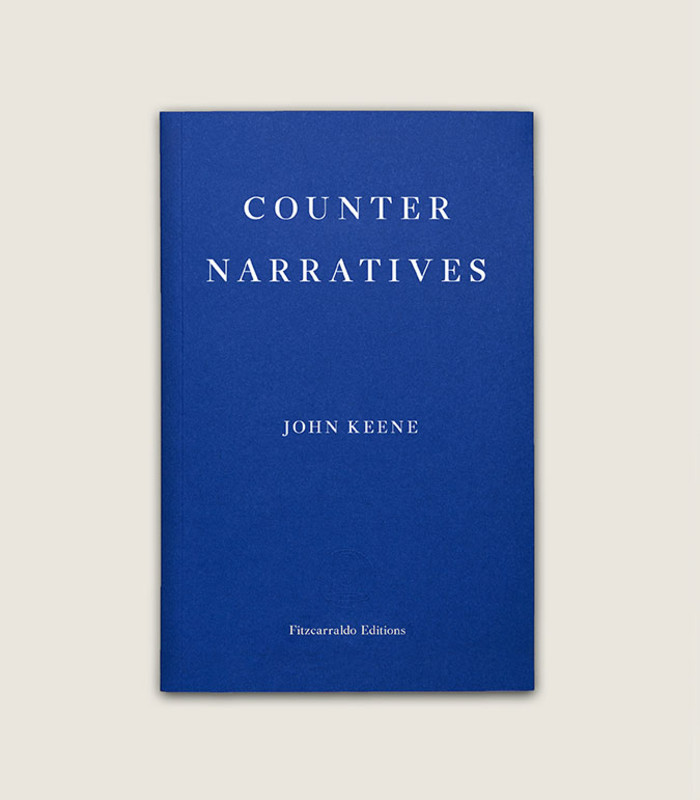
A few years back, perhaps shortly before Counternarratives was published, I met up with writer, scholar and activist Rochelle Spencer to discuss the topics of Afrofuturism and speculative Black writing and poetics, but I'd forgotten about it until she alerted me that our exchange was set to appear in Chicago Literati, and it did this past spring (April). Here's a link to the piece, which Rochelle titled "'Like Currents in a River': A Conversation with Speculative Writer John Keene." Since this discussion occurred before the many since Counternarratives appeared, it was a bit more free-wheeling in many ways. Many thanks to Rochelle (now Dr. Spencer, I believe!) and Chicago Literati for running it.

Here is one Q&A exchange from that conversation that centers on the Black Arts Movement:

RS: You just alluded to the Black Arts Movement. How did the Black Arts Movement influence the Dark Room?

Keene: The DNA of the Black Arts Movement is in every contemporary Black American poet and in Black poets all over the world, whether they acknowledge this influence or not. The ideas of self discovery, black pride, connection, to do something on your own rather than waiting for someone else to do it—those ideas were central to Dark Room Collective writers in their youth, so I feel we wouldn’t have been possible without them, without the crucial well of Black Arts Movement poets. They are invaluable, and they remain invaluable, though people sometimes talk about the Movement as if it failed. I think counter to that: their influence will continue well into the first century and beyond.

***

Lastly, I don't think I'd mentioned on this blog that, by some strange turn of events, Counternarratives finally received a review, two years after its hardcover debut, and a glorious one at that, in The New York Times Book Review this past September. I extend my profound thanks to writer and critic Julian Lucas, who authored the long and insightful review essay, one of the finest and most in depth the book has received. Titled "Epic Stories That Expand the Universal Family Plot," it situates the collection in relation to the history of fictional family sagas in order to show how it performs, as it were, a kind of queer affiliation and relationality, how it embodies a different understanding of history and kinship, that might offer a way forward for the future. (I have decided not to expend any additional energy trying to figure out why the Times completely ignored the book when it appeared in 2015.)

Here is how Lucas ends his review, a fitting tribute to the book and to many who are tending similar literary and artistic gardens:
Entranced by the ancestor who crossed on the Mayflower, escaped from the plantation or started anew in a hostile foreign city, we too often limit our retrospective gaze to those predecessors who made provisions for a future we recognize in our own present. We deprive ourselves of people whose visions were never realized, who left no obvious legacy. More people have lived on earth than the tendentious nets of genealogy — inevitably tangled in the chronologies of faith, race, nation — can catch, and we are connected to them by threads more subtle, and resonances more profound, than have yet been explored. Imagining those lives, deeply and without the prejudice that they must be prologue to our world, can be both radical and beautiful.

Saturday, July 15, 2017

Anthurium: A Caribbean Studies Journal Special Issue on Paule Marshall


The vagaries of literary fortune are such that a writer who was quite famous in her time might very well be forgotten a decade later, while a little known and acknowledged wordsmith might find her work resurrected and championed. For a writer like Paule Marshall (1929-), still with us and an author whose long career has included numerous distinctions, she should be part of current literary, critical, theoretical, and cultural conversations, particularly around Black women's, Caribbean, African American, African Diasporic, immigrant, New York, and contemporary US writing.

To that end, Kelly Baker Josephs, Associate Professor of English at York College, CUNY, has edited a new issue of Anthurium: A Caribbean Studies Journal (Vol. 14, No. 1) devoted to Paule Marshall's life and work. The issue comprises a range of essays that offer ways of thinking and reading Marshall's writing, particularly around the theme of Black women--especially Black Caribbean women--and personhood, as Baker Josephs frames it in her introduction. Other contributors include Marlene Clark on Marshall's prescient understanding of "slumming" and gentrification in Brooklyn; Justin Haynes reading Marshall's The Timeless Place, The Chosen People through the lens of the posthuman; and Shirley D. Toland-Dix on Marshall's rereading of The Tempest.

Also in the issue are Janelle Rodriques on Afrofuturistic diaspora in Marshall's Praisesong for the WidowPetal Samuel on "regimes of aural discipline" in Marshall's The Fisher King; Patricia G. Lespinasse on women and jazz in that same novel; Lia Bascomb on mapping Diaspora "through biomythography"; and Jason Hendrickson on speech, resistance, and the ongoing relevance of Marshall's work. I contributed a short piece that began as response to questions posed by Baker Josephs, about having studied with Paule Marshall, which was one of the best classroom experiences I had at NYU.

I'll end by quoting Baker Josephs's insightful introduction, and urge you to check the full issue out:
The very different approaches to Chosen Place included in this issue indicate how fertile it can be for us at this historical moment, in which one has to cull the past to understand the roots of—and to locate resources with which to combat—contemporary traumatic social and political violences. In “Ghosts in the Posthuman Machine: Prostheses and Performance in The Chosen Place, the Timeless People,” Justin Haynes reads the interaction between humans and machines in the novel as the space within which we might examine the limits of resistance and mobility then and now. Haynes’ reading of Vere’s Opel is especially compelling amidst current controversies about autonomous automobiles. More interested in the timeless challenges of human interaction in the novel, Shirley D. Toland-Dix reads the novel as Marshall’s “audacious” reimagining of the Caliban-Prospero dyad via the Merle-Harriet dyad. TolandDix’s careful reading of the interactions between these two complex characters against the larger backdrop of the novel and its concerns argues for the ways in which Marshall articulates and anticipates the later demands of black and third world feminist movements.

In particular, the dynamic Marshall probes between socially (and often financially) privileged white women and less powerful women of color illustrates the implicit “limits of personhood” that plague attempts at intersectionality (when attempts are made at all). The direct link in the novel between Harriet’s choices and the failure of the Bournehills project foregrounds the blind enactment of privilege that we see criticized today in similar “development” projects. Harriet’s consistent alignment with power, even as she professes otherwise, may also evoke for readers comparable contemporary moments in which race and class privilege prevail over the promise of gender and sex equality—think here of the demographic breakdown of results in the 2016 United States presidential election, with 53% of white women voting for Donald Trump while 94% of black women voted for Hillary Clinton. One can easily see parallels between Merle’s insistent (especially about Harriet’s complicity) and Angela Peoples’ iconic 2017 Women’s March photo.

Monday, January 09, 2017

Quote: Christina Sharpe

"What does it mean to return? Is return possible? Is it desired? And if it is, under what conditions and for whom? The haunt of the ship envelops and persists in the contemporary. French President François Hollande 'returned' when he began his trip to the Antilles on May 10, 2015, with a visit to Guadeloupe for the opening ceremony and the dedication of a 'museum and memorial site to honour the memory of slaves and their struggles in the French Caribbean island Guadeloupe,' the 'first of its kind by France to remember those who suffered during the slave trade.' The Memorial ACTe, housed in a former sugar factory in the Guadeloupian city of Pointe-à-Pitre, is called 'a place of remembrance and reconciliation' and described as 'a Caribbean centre on the expression and memory of slavery and the slave trade.'"

"Hollande's visit to the site spotlighted, for those who would not and did not know, the ongoing reparation claims made by descendants of enslaved peoples in Guadeloupe, in Haiti, Cuba, and all over the Caribbean. And while in 2013, Hollande acknowledged France's 'debt' to Africa because of slavery and the 'baneful role played by France,' he added that this history 'cannot be the subject of a transaction.' Unless, of course, that transaction benefits France (like the indemnity Haiti was forced to pay) through trade and other contracts and 'investments.' But what is a moral debt? How is it paid? Is it that Black people can only be the objects of transactions and not the beneficiares of one, historical or not?"
-- Christina Sharpe, from In the Wake: On Blackness and Being, Durham: Duke University Press, 2016, p. 60.

Monday, October 31, 2016

Photos: American Book Awards

Here a few photos from the 2016 American Book Awards ceremony, which was held at the San Francisco Jazz Center. The highlight of the event for me was meeting all of the other honorees--congratulations to ALL of them, those present and those unable to be there--and hearing the extraordinary, often deeply moving speeches. Thanks once again to the Before Columbus Foundation and its board, Justin Desmangles, Ishmael Reed, and everyone who makes the foundation, the awards, the event, and all the important work BCF does in the world possible! (All photos are by C (thank you!).)

With THE Beefeater,
in front of the Sir Francis Drake
Hotel, Union Square
C & I before the event 
Chatting with my Rutgers-Newark
colleague Lyra Monteiro 
Meeting ABA winner Jesús Salvador Treviño,
author of Return to Arroyo Grande 
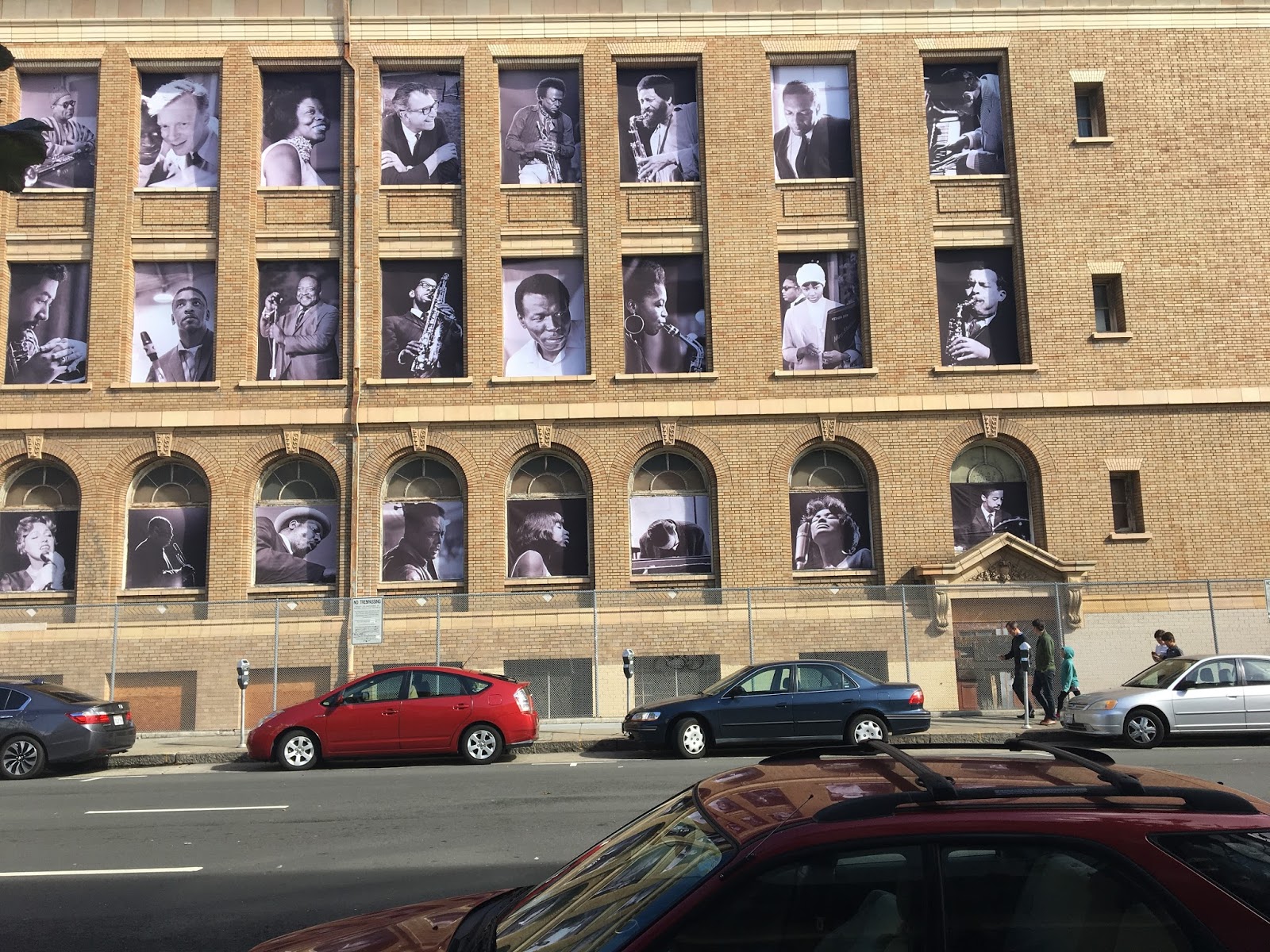
The façade of jazz greats across the
street from SFJazz Center 
Justin Desmangles, radio host, writer,
and MC for American Book Awards 
ABA winner Lauret Savoy, author of Trace:
Memory, History, Race, and the American Landscape
Poet Laura Da', author
of Tributaries and ABA winner
Jesús Salvador Treviño 
ABA winner Susan Muaddi Darraj, author
of Curious Land: Stories from Home 
ABA winner Deepa Iyer, author
of We Too Sing America:
South Asian, Arab, Muslim, and Sikh Immigrants
Shape Our Multiracial Future
Before Columbus Foundation and American
Book Awards founder Ishmael Reed,
introducing the Lowenfels Award for
Criticism, which went to Lyra Monteiro
and Nancy Isenberg
Lyra Monteiro, accepting her award
Washington University professor Bill Maxwell,
speaking after receiving his American Book
Award for his study F. B. Eyes: How J. Edgar Hoover's
Ghostreaders Framed African American Literature
Roxanne Dunbar-Ortiz, accepting ABAs for
Ned Sublette and Constance Sublette,
authors of The American Slave Coast: A History
of the Slave-Breeding Industry
The mother and sister of college student
Chiitaanibah Johnson, who received the
Andrew Hope Award for her activism
Lyra speaking and breaking it down
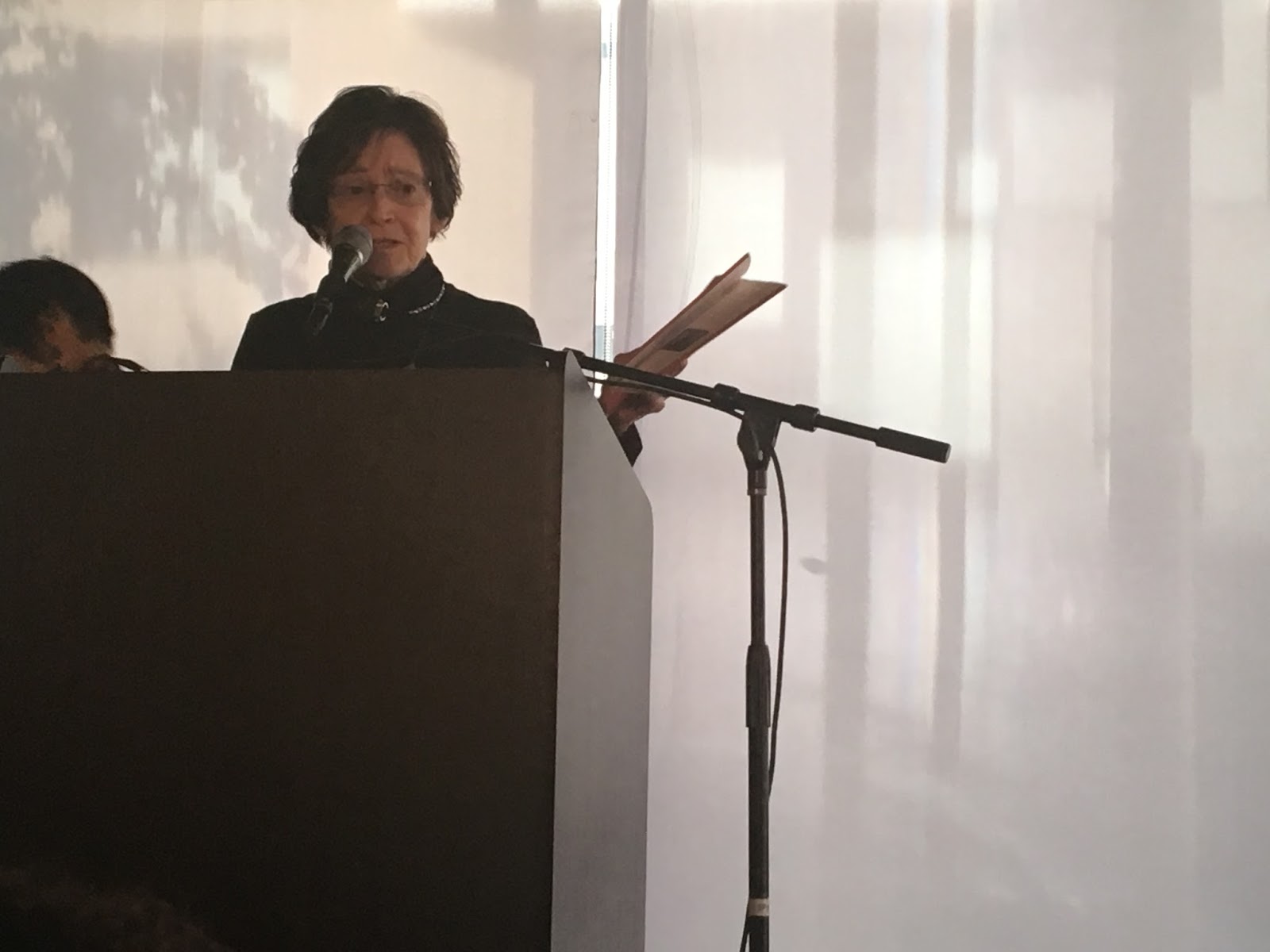
Yours truly, giving my speech
A group photo
Lyra and I


Sunday, June 19, 2016

Quote: Robin D. G. Kelley (on Cedric Robinson)

"When Cedric [J. Robinson] submitted his dissertation for approval, the faculty did not know what to make of it. One by one, individual members resigned from his committee citing an inability to understand the work. No one could reasonably reject a thesis so sound, elegant, and erudite, but few were willing to sign off. Only after Cedric threatened legal action was his thesis finally accepted—nearly four years later. Finding a publisher proved equally frustrating. When SUNY Press finally released the book, now titled The Terms of Order: Political Science and the Myth of Leadership in 1980, it was thoroughly ignored and soon disappeared. (Fortunately, the University of North Carolina Press brought it back into print with a brilliant foreword by Erica Edwards, giving the book a new life and the attention it deserved thirty-five years ago.)"

"As they awaited Stanford’s decision, Cedric accepted a position as Lecturer in Political Science and Black Studies at the University of Michigan from 1971 to 1973. His appointment was partly the product of student struggles waged by the Black Action Movement the previous year. Cedric and Elizabeth joined a community of radical and progressive blackmarxismintellectuals, including Harold Cruse, anthropologist Mick Taussig, Africanist historian Joel Samoff, cultural critic Marshall Sahlins, and Archie Singham, noted scholar of Caribbean and African politics. Elizabeth returned to school, earning an M.A. in Anthropology from U of M. Together they devoted much of their energy to the graduate students, hosting regular seminars and workshops in their home, feeding and nurturing a generation who would reshape Black Studies. Darryl Thomas, then a first-year grad student in Political Science, found these gatherings invaluable: “That community remained a source of strength and survival long after the Robinsons’ departure from the university in 1973. The workshop exemplified how to pursue the type of interdisciplinary research and scholarship originally imagined by the students and faculty members who led the insurrections that created Black studies."
-- Robin D. G. Kelley, "Cedric J. Robinson: the Making of a Black Radical Intellectual," Counterpunch, June 17, 2016.

(Cedric J. Robinson (b. 1940), one of the towering figures in the development of Black Studies, died on June 5, 2016.)

Monday, May 23, 2016

Oakland Book Festival


This weekend I traveled to Oakland, California to participate in its second annual Oakland Book Festival, on Sunday, May 22. Though I have traveled a number of times to the Bay Area over the last few years, I hadn't ventured to Oakland in over a decade and a half or more, so it was a treat to have a reason to return to the East Bay metropolis. The Oakland Book Festival, which convened a wide array of authors, publishers, booksellers, and Bay Area residents, is, I learned, a one-day non-corporate sponsored ideas fest, held in around Oakland's majestic City Hall, and the diversity and political salience of the panels and screenings, which ranged from the FBI's pursuit of African American writers to utopian thought today and the future of the family to the experiences of porn stars and sex workers, bore this out.
L-R: Manuel "Manolo" Callahan, Stefano Harney,
Fred Moten, Linda Norton, and two unknown attendees
at the Convivial Research panel
Author and radio host Justin Desmangles, who heads the Before Columbus Foundation, organized and moderated the panel on which I participated, on the theme of multiraciality in 21st CenturyAmerican literature. The other panelists were two highly acclaimed writers I know and admire so much, the married couple fiction and nonfiction Emily Raboteau and fiction and comics writer Victor LaValle. Our public conversation, of the afternoon's first, ranged widely, with explorations of capitalism's and slavery's influence on American literature today, the challenges writers of color, including President Barack Obama faced, of public racial representation, and the current political climate, including one of its most horrifying emanations, Donald J. Trump. I personally thought the exchanges, including the audience's comments and questions, were informative, and I loved the differing approaches Victor and Emily took. It was an honor to be in conversation with them, and Justin. Many thanks to everyone who came to hear us, including Tan Khanh Cao and D. Scott Miller, as well as Elmaz Abinader, whom I had the chance finally to meet, among many others. 
Rochelle and her colleague at Prison Lit Project
After our panel and a short stint signing copies of the newly issued paperback version of Counternarratives, I moseyed to some of the other panels, only to learn that festival organizers were very strict about adhering to occupancy code requirements, so I could not get into a number of panels I wanted to attend. In the interim I did run into a number of writers and publishers I admire, including Aaron Bady, Adam Levy and his partner Ashley Nelson Levy at Transit BooksMauro Javier Cárdenas, and Caille Milner. (Because of the booksigning I missed Mauro's and Caille's panel). I did manage, however, to slip into the "Working With Others: On Convivial Research" panel, featuring Manuel (Manolo) Callahan, Stefano Harney, and my friend and hero Fred MotenLinda Norton, whom I had the pleasure of chatting with a little earlier, and whose shared a copy of her exquisite book Public Gardens: Poems and History with me, served as moderator. I had never heard of convivial research, but by the time Callahan, Harney and Fred had finished defining and walking us through examples of it, I certainly did.
At McSweeney's table
I relished also having the opportunity to check out the booksellers' tables. One serendipitous encounter came when I happened upon writer, editor and critic Rochelle Spencer, who is doing great work with the Prisoners Literature Project. So great to see you! I keep vowing when attending book festivals that I will not buy any books, but the serendipity of new enchanting titles or the availability of ones I intended to buy once again overcame my willpower, and I bought enough books to fill a tote bag, which I mailed back to my university office rather than paying an extra bag fee to the airline bringing me home. I also got to chat with Brad Johnson, bookseller extraordinaire. Thanks so much to Diesel Books, which had copies of Counternarratives for sale (and whose pile of many was a pile of just a few by the time I returned later in the day--thank you, Diesel and readers!), and to Small Press Distributors, which had a trove of goodies I could not resist. Now I will have even more reading to catch up on this summer!

A few more photos from the festival:

Hip Hop for Change
Some of the booths
Booksellers and other vendors
At Diesel Books
Author signing
A familiar book at the center of
this photo
More books
Loviosa, advertising the
Harry Potter conference in
Las Vegas
LitQuake's booth
Nomadic Press's Open Mic

Wednesday, January 20, 2016

Gukira on Claudia Rankine's *Citizen: An American Lyric* & "microaggressions"

A week ago I posted about two standout examples of literary criticism, a young Barack Obama's super-concise reading of T. S. Eliot's "The Waste Land," and Frank Kermode's extraordinary disquisition on the word and concept of "shudder" in that and other works by Eliot and a range of authors. Neither is exactly a model of traditional literary criticism, which brings me to another stellar example, at Gukira: With(out) Predicates, the brilliant Keguro Macharia's thought-site (to call it a blog barely does it justice).

In his January 19, 2016 post "microaggressions," Keguro shows what another approach to critical writing about literature might look like, exploring Claudia Rankine's highly lauded 2014 collection Citizen: An American Lyric (Graywolf) with a level of discernment, analytical brio and lyric verve that marks all of his writing. I won't try to summarize the piece's argumentation except to say that it takes one on a journey both into Rankine's book and into the aesthetic, social and political discourse surrounding it. He begins by pointing out that the book "circulates as an aesthetic object that documents microaggressions," and then continues:

The “micro” in microaggressions suggests the low hum of noncatharsis Sianne Ngai taught us to call “ugly feelings.”

Nothing explodes. 

Nothing releases. 

An archive builds. 

We are far from anger, far from rage, far from the demands created by the word racism.
Instead, we are in the world of microaggressions, the world of archive building, the world of opportunities created by the aesthetic object to engage in a dialogue on race or a conversation on race, in which we are encouraged to share our stories of racialization, of being marked by race, singled out, unseen in our particularities and embedded within histories we did not create and do not want to own.

Learning from Fanon, we scream that we are not our histories. 

Frantz Fanon is only one of many figures he thinks with--alongside, to, and through--beginning with Elizabeth Alexander and Barack Obama (whom he also critiques). As importantly, Keguro historicizes and defines the term "microaggression," so ubiquitous these days, in order to show what it means--what meanings emerge--from, around and because of the circulation of an "aesthetic object that documents microaggressions." The (current) aesthetic object that documents microagressions--in American society. Is much of the extant criticism about the book about the book or about the discourse that surrounds it--"the wreck and not the story of the wreck / the thing and not the myth that surrounds it," quoting, as he does Adrienne Rich

As I note above, this essay--in the truest sense of the world,  a trying out of thought, an attempt to think into and through ideas--concludes on a powerful note. I'll quote it:

I conclude this writing a week after Obama’s State of the Union speech, on the Monday designated this year as Martin Luther King, Jr. Day. I am arrested by the question of lag, caught by the duration of the pause. The “micro” in “microaggressions” might describe the lag that one must overcome—that return to the untime of unmaking, that disembedding from the human that one overcomes but does not overcome. How long is that pause? How is it measured? What happens in that pause? 

Chester Pierce names that pause as where the cumulative takes hold. What accretes in the pause, and how? A model of resilience reaches for the grit in the oyster, the pearl-making potential of adversity. Recall, the much-lauded Citizen is the aesthetic object that documents microaggressions. White space can be a pause. Pauses are cumulative. Something accumulates in the pause. How long is that pause? How is it to be measured? How does one measure pauses as they accumulate? How does one evaluate the pause that is considered an aesthetic object? 

how does one live—how can one breathe—in the pause

This is one dazzling example of how one thinks--in the pause.

Tuesday, January 19, 2016

Amidst the Notes: RIP Pierre Boulez & David Bowie

Pierre Boulez,
by Carlo Bavagnoli
I've been of two minds about the recent deaths of two leading figures in the world of music, Pierre Boulez (1925-2016), and David Bowie (1947-2016), mourning their deaths while also feeling the need to acknowledge key faults--which are not commensurate, let me be clear--that marked the characters of both. Both were musicians of original vision and talent, and born performers. Both left a deep mark not only in the musical cultures of their native countries but in the US and globally. Both wrote music that I turn and return to periodically, for differing but aesthetically and emotionally necessary reasons. So I feel sorrow and grief at their deaths, but at the same time, perhaps akin to the form of negative capability I maintain when reading certain writers like Wallace Stevens or T. S. Eliot, I keep in mind certain criticisms of them, even if the elation and admiration their music brings sometimes temporarily evacuates that criticism. (Keguro at "With(out) Predicates" offers one of his characteristically profound, moving and concise meditations on the necessary distinction between acknowledging the flaws of a deceased person and haranguing someone who is mourning that person as a way of forcing them to engage in such acknowledgement.)

Pierre Boulez was perhaps the towering figure in avant-garde Western classical music in the second half of the 20th century. He became one of the leading composers and judgmental exponents of new music, championing certain composers, especially those of his generation, as well as key figures in the French tradition, and the leader early 20th century modernists. He pursued a parallel career as a conductor, beginning in the 1950s, and perhaps most famously, led the New York Philharmonic from 1970-1975, a tenure that still provokes mixed reviews, though his focus on contemporary composers and the 20th century repertoire was undeniable, and remains unmatched by the Philharmonic even today, in 2016. His conducting style, without a baton and noted for its precision and clarity, brought the modernist composers Claude Debussy, Arnold Schoenberg, Alban Berg, Anton Webern, Gustav Mahler, Bela Bartók, Maurice Ravel, and Edgard Varèse in particular to life. His own work showed their influences while moving in its own direction; just a few years ago I saw Messagésquisse performed at Columbia University, and it was more beautiful and stirring than any recording of it I'd ever listened to. Boulez, however, could be extremely harsh to the point of cruelty in his criticisms. He famously proclaimed Arnold Schoenberg "dead" at the end of an eponymous essay in which he trashed Schoenberg's failure to fully exploit the possibilities of the dodecaphonic system he had developed, and published the essay shortly after that pioneering composer died. Boulez cruelly described the great Russian composer Dmitri Shostakovich as "the third pressing...of Mahler," and cast Karl Amadeus Mozart off as "trite." His fallings out with fellow musicians, including his former teacher Leibowitz, and former experimental compatriots John Cage and Karlheinz Stockhausen, are well recorded. He also apparently never publicly came out of the closet as a gay man, though some critics and many fellow musicians knew about his sexual orientation and relationships. I take all of this into account, but also point to his music itself, which at its best--and there are certainly high points--is the lasting testament of the man.


Pierre Boulez, Répons - Ensemble intercontemporain - Matthias Pintscher, conductor, 2015.


 Pierre Boulez, Messagesquisse - Eric-Maria Couturier - Ensemble intercontemporain, Matthias Pintscher, conductor, 2014.

David Bowie, 2016
David Bowie championed another kind of 20th century music, or several, rock & roll and soul-influenced pop. Born Robert Jones in Brixton, London, he initially launched his career in the late 1960s, and first made the charts with his song "Space Oddity," which introduced the figure Major Tom, whom Bowie would revisit later in his career. In the early 1970s, he created the queer, glam rock alter ego character Ziggy Stardust, the titular figure of his LP The Rise and Fall of Ziggy Stardust and the Spiders from Mars, and transformed the public figure of the male rock icon through his overtly androgynous persona, which he concluded with Diamond Dogs. Throughout his career, Bowie remade himself, shifting into "plastic soul" in 1975, with the album Young Americans, which featured the overtly queer "John, I'm Only Dancing," one of my favorites, includes one of my favorite songs, and 1976's Station to Station, with the track "Golden Years," which he performed as one of the first white musicians on Soul Train. Subsequent shifts included the adoption of electronic elements and collaboration with Brian Eno, a stagy pop style with "Ashes to Ashes," and his biggest hit, which was one of the top tunes during my senior year of high school and freshman year in college, "Let's Dance." Bowie continued to record up through the final months before his death, issuing his final album, Blackstar, just days before he died. He acted in films, including the still striking and bizarre The Man Who Fell to Earth, an unforgettable vampire in The Hunger's sex trial, and an equally memorable Andy Warhol in the biopic Basquiat. David Bowie flirted with Nazism in his youth, adopting some of its trappings as a kind of fashion statement and aesthetic performance, and also had sex with an underage girl, the first of which I knew, the latter of which I didn't, and both disturb me tremendously. On the racist front, he did speak out more than once about the racism in the music industry, famously calling out MTV's overt discrimination while on air; as to whether the song China Girl is heard as something other than the Orientalism it ostensibly is a matter for others to uncover, and whether he ever atoned for what essentially involves the abuse of a teenager I cannot say. I can speak to the electric feeling I felt as an early adolescent watching him perform in a plastic suit, and later drag, with gender performers Joey Arias and Klaus Nomi, which I link to below.

David Bowie - Let's Dance, EMI Music.


David Bowie & Klaus Nomi - TVC15 & Boys Keep... by ZapMan69

Wednesday, September 16, 2015

Reading @ Rutgers-Newark + New Reviews & Interviews

On Monday, as I mentioned in my post about my HuffPost Live appearance, I gave a reading at Rutgers-Newark as part of the African American and African Studies Fall 2015 event series. This was actually the second time I read from Counternarratives at the university, though the first since the book was published back in May. Previously I had read "Mannahatta" at the MFA program reading back in 2013, but this time, I read "Acrobatique," and, for an encore, two short sections from "The Aeronauts."

Though the reading coincided with the MFA program's workshop period, a full crowd filled the room, with many colleagues and students present, as well as members of the Newark community; the question and answer session was lively; and I sold and signed a handful of books. A free reception with lots of delicious food followed.

Below is a short film by Justine Hunter with some video clips and a voice-over of me reading. Many thanks to Justine, and to departmental administrator Christina Strasburger and administrative assistant Rabeya Rahman, as well the Dana Library, for making this wonderful event possible!


***

The good reviews keep rolling in, thank the gods. Brad Johnson, a bookseller and critic, penned and published one the most laudatory reviews of Counternarratives to appear thus far, in The Quarterly Conversation. I am especially pleased that Johnson connected the collection's themes to today's local and national events, and identified the political consciousness informing the stories. Like several other readers, he views it almost as a novel in stories: A quote:
This is the context of John Keene’s ambitious collection of stories and novellas, Counternarratives. Though many of these were published elsewhere, together they read very much like the multi-genre, patchwork novels of Alexander Kluge—or perhaps more grandly still, László Krasznahorkai’s recent Seiobo There Below, a work bound not by plotted coherence but by a conceptual aesthetic thriving on difference. This is to say, while Counternarratives makes no claim to being a “novel of short stories,” its epic sweep and conceptual unity bear the marks. Indeed, one might speculate further that this “story collection” lives up to its title and effectively challenges—like Kluge and Krasznahorkai (among others)—the commonplace sense of how a novel should look and what it should do.

In Front Porch Journal, a journal published by MFA students at Texas State University, critic Patrick Cline praised Counternarratives, with a focus on its aesthetics, which we discussed further in a conversation with Book Reviews editor Michaela Hansen. One quote:
To this reader, the chameleon-like range of the writing is impressive. The book as a whole feels like an entry from Oulipo, the French writer’s collective devoted to prompts and restrictions, but like a really good Oulipo book. One whose writer is invigorated by the challenge posed by each prompt, and uses each as an opportunity to explore his pet themes—freedom and control, legacy and hauntings, the influences of religion, and queer love throughout history. Each story is a surprise and a success, and cumulatively they come together to feel vital. This is an important book—it’s important to own, to read, to teach, and to slip in your shelf beside the classic narratives that it’s in conversation with.
In Full Stop, reviewer Patrick Disselhorst offers kudos through and amid a perceptive reading of Counternarratives that gets the relationship between the written and the oral, the constructedness of narration and of lives, and the power of fiction to reorient not just our thinking, but our vision of the world. He writes of a sentence in the first story, "Mannahatta":
Keene’s long sentence meanders and searches for something to grasp ahold of. But, the lack of specificity, the lack of demarcations, is inherent to his character’s predicament. Rodriquez [sic], Keene alerts the reader in the introductory note to the story’s initial publication in TriQuarterly, as “a mulatto . . . of San Domingo,” the son of a Portuguese father and African mother, complicates the reader’s understanding of New York. The first settler of the city, simultaneously African, Dominican, and Latin American, is underrecognized, but in this story, he emerges, “never to return to the Jonge Tobias, or any other ship, nor to the narrow alleys of Amsterdam or his native Hispaniola.” Rodriquez [sic] functions as our introductory figure to the text — a man of African descent arrives as a settler, and along with him, an alternative understanding of how the Americas were initially constituted. Keene trains the reader to be alert to openness; to view things singularly involves a lack of foresight in watching figures or situations brush up against received knowledge.
***

Three of the best interviews and conversations I've participated in have recently been published. In conjunction with the Front Porch Journal review, which I link to above, I chatted with Book Reviews Editor Michaela Hansen and reviewer Patrick Cline, who sent me a set of questions, and then sent a few more based on my first set of responses. In this interview, titled "Countering the Narrative," I love how much they delved into the stories and how curious Patrick was about the relevance and effects of a post-modernist approach:

FP: Hmm, I suppose it’s the stylistic pastiches of “Encounternarratives” that I’m asking about. The styles invoked seem to correspond to the historical moment of each story—an impressionistic style in “Acrobatique” to capture an impressionist subject, the cacophony of languages in “Cold” at a time when it seemed that art was working to capture exactly that (e.g. Dada, Eliot)—as well as the subjects. I think what I was most struck by was that the stories seem to exhibit no fear of Yvor Winters’ “imitative fallacy”—that they’re fully willing to invent new stylistic modes simply to accurately capture varieties of experience, without reflexively casting doubt their ability to do so. I’m wondering if the justification of pastiche affords them this boldness. 
JK: Your identification of the historicization embedded in the stories’ forms is a great one. I do wonder, though are these fully stylistic “pastiches”? Of Modernist prose? Or does “pastiche” function as one of many modes in them and all the volume’s narratives? I see the forms and styles as apt textual embodiments and enactments of the stories’ themes. To put it another way, the prose forms and texts here serve not merely as presentations but as partial representations of the narratives they convey, which is to say, they possess a mimetic function or component, which is, admittedly, fairly uncommon in contemporary American literature. With “Acrobatique,” the prose visually mirrors the story’s progression but also its central ideas. In popular memory, the specificity of Miss La La had become as lost to us as any single thread within the vast tapestry of Degas’s artistic output. That recovered thread, via my imagination, is the one the story hangs on. As for Winters, I suppose I read his “imitative fallacy” as too proscriptive, which is always a spur to defiance. How did Caliban put it in The Tempest? “I’ll have none on’t.” Or as Elizabeth Alexander has written, “Oh language/my trinket, my dialect bucket,/my bracelet of flesh.” If we listened too closely to Winters, we’d lose a sizable swath of our literary treasures, and not just those from modernism—or post-modernism—o

Earlier this summer, writer and reviewer Blake Butler conducted an interview with me for VICE. We spoke by phone around the time of the book launches, and some of what we discussed I've since repeated several times, but the conversation was free-wheeling and I felt particularly expansive at times. At one point we discussed current approaches to teaching Mark Twain's The Adventures of Huckleberry Finn:
I remember maybe it was like five years ago when they were trying to get the racial slurs removed from Huck Finn, or at least change them to a different word. Do you think of a practice like that versus going in and exposing the trouble from a completely different way?  
I feel like we shouldn't whitewash anything. Because Huckleberry Finn, and any number of such books, are artifacts of our history. And I think if you're teaching it to a younger person then the teacher should frame it. You don't want to say, "This is a bad book, this is a good book." You want to say: "This term will appear here, and we want to understand why it is in here. So one of the things we are going to think about while we're reading—and it's not going to be easy—[is] why do you think this term appears in here and what does it tell us about the moment, the era, the time in which it was written?" I think this is actually very, very powerful for students. But it's the role of the teacher to contextualize and assist the students in understanding why a book reads the way it does. This is not just in the matter of race and racism, but gender and misogyny, and homophobia and classism in certain kinds of books. Because if a book is a very good book on most levels, we want to understand not only why it's a good book and its successes, but also what are its failures? What is problematic about it? Not just a book, but any work of art. What is succeeding in it, and also what isn't succeeding?

Last but not least, while at Image Text Ithaca I participated in a long, remarkable conversation with poet, critic and scholar Tonya Foster, whose new, stellar collection of poems A Swarm of Bees in High Court has just been published by New York publisher Belladonna*. The conversation appears in the new Fall 2015 issue of BOMB Magazine, and so is not online yet (I think it'll appear in full once the next issue goes to press), but an excerpt, titled "Haikus of Grief, Silence in Harlem," did appear on LitHub, the new aggregator site sponsored by several major New York publishers.

Though it's a tiny sliver of our exchange, and zeroes in on questions of grief and trauma in Tonya's collection, it offers a distilled taste of what we both were thinking and had to say. I can't wait to post the full version, and please do grab a copy of BOMB to read it if you can.

From LitHub:


John Keene: In the notes at the end of your new poetry book, A Swarm of Bees in High Court, you describe it as “a biography of life in the day of a particular neighborhood,” and you use the phrase “the multiple as subject and as swarm of actors.” Based on those descriptions you could have written a nonfiction text or a more literal reflection, but you’re capturing this world in a lyric mode, undertaking compelling things with form.

What really comes through is a play of both the ear—sound, music, and noise, in the positive sense of the term, as distortion—and also the eye. Could you talk about how you decided to go with the haiku-like form, which you stick to at certain points, and you break in others? At the very end we get a little section of prose, almost like a fable.

Tonya: The first thing that comes to mind is Amiri Baraka saying, “You know, I would read poems in The New Yorker and think, I can’t write poems like that.” (laughter) The work of the book began when someone asked me to write about 9/11, and I thought, What? It just seemed bizarre.

How do you write about grief when you’re in the middle of it? How do you imagine or traverse that necessary distance? I had been writing erotic haiku to a man I liked. And someone else said, “Why don’t you write haiku about 9/11?” I thought, Okay, I could do that and not weep, right? I could write these little condensed pieces about New York at that period. It was a time when there were these condensed, very tense encounters with the images of people who were missing—but not only with them; you were also encountering the people missing them, looking for them.