Showing posts with label culture. Show all posts

Wednesday, February 27, 2019

14th Blogiversary

Photo by Rachel Eliza Griffiths

Fourteen years ago, on February 27, 2005, I began blogging at J's Theater. I was regularly reading the blogs of friends and writers, artists, political commentators, and others I'd never met but felt a desire to be in conversation with, and so I started this blog. I viewed it as a creative and cultural space, with far less emphasis on politics and responsive to the news cycle--which has sped up incalculably more these days now that Facebook and Twitter have taken off--than it has assumed at various points. More than anything, however I wanted it to be a site where I could try thoughts and ideas out, imperfect as they might be, without the usual concern of perfection or even the struggle, customary as well, to get them into print. (My entire writing career has entailed a struggle to get my work into print.)

From writing about poetry and poets, like Jay Wright, as I did in my first post, to my life and experiences at the university (which has become a new university over the years I've blogged), to reviews of books and films, to snippets about Black history, art and culture, and history, art and culture over all, to translations from Portuguese, Spanish, French, and, I sometimes am amazed to admit, Dutch and German, to posts about rugby, track and field and other less popular (in the US imagination, at least) sports, my iPhone and iPad sketches, and on and on, J's Theater has provided an ideal space for me to explore, (mostly--haha!) pressure-free, as I see fit. It also has served as a site of documentation at times for cultural activities, and especially was so during my decade in Chicago, which wasn't even a decade ago but feels like a lifetime has passed between then and now.

I've repeatedly debated whether to keep blogging or to quit. One great frustration after the earliest years (2005-2008 or so) was the sharp drop off in comments, which were for a while replaced by spam, which disappeared (thanks, Blogger?), only to reappear in recent years with a vengeance. It thankfully is very easy to delete these days, but that requires its own dedicated attention. Far more pressing were my academic responsibilities, which have grown to include 12-month administrative duties that devour more mental space and energy than I ever imagined. I don't think it's any surprise that before this year, 2014, the first year I became a department chair (acting during that year) and 2017, just before my last sabbatical, saw the fewest posts. It was not for lack of interest, but time and vigor.

Not so long ago, we were told that blogging was dead. No one blogged, everyone had moved to YouTube, Facebook and Twitter. And Tumblr, which was and is a blogging platform that in essence mostly deprioritized words. (It also has banned not just pornography, but nudity in general, that's another matter.) And Instagram, which is all pictures (for the most part). And Snapchat, of course. Now there's Tiktok, and other walled gardens. One thing I loved and still do about blogging (though to its credit, Twitter also is almost fully public) via Blogger, WordPress and similar sites is that whatever you published was and remains visible to all; a private company does own this platform, but the blog remains more a public square-style venue than many other options out there. For good and ill, of course. The dazzlingly brilliant Kegur'o M, who continues to blog at Gukira: Without Predicates, is a stellar example of the good that can come from a blogger at the top of their game.

But that public aspect is one that I cherish, and one reason I hope to continue blogging. I also wish some of my old blogging friends, many listed on the blogroll to the right, and other bloggers I never interacted with but who've given up blogging, would start up again. No shade against Medium, but before ideas are fully polished, why not bounce them off readers on a blog? You can always--well, so far--revise as you go.

Tuesday, February 16, 2016

New York Times' "Unpublished Black History"

A young Ferdinand Lewis Alcindor, Jr., high school
basketball star at Power Memorial Catholic during
the Catholic High School Athletic Association Championship, in 1965, 6 years before he became
Kareem Abdul-Jabbar (Don Hogan Charles)
I have been checking the New York Times every day to see what photographs and stories will be featured as part of its "Unpublished Black History" series, which it debuted this year for Black History Month. In essence, it is a catalogue of material, often newsworthy in some way, that nevertheless failed to make it into the paper. In some cases, the Times editors approach candor about why they did not publish the images or stories, but in other cases, some quite fascinating, they do not.

It's hard to know, lacking documentation of some sort (notes, audiotaped material, etc.) or the direct comments of the editors, writers and photographers themselves, why some of these key moments were passed over, but it also underlines the fact that even today, and not just with Black History, editorial choices of various kinds shape what makes it into the mainstream news and what gets complete passed over. As I view the photographs and read the brief entries, I keep wondering, what led to this story being skipped and others receiving coverage? This would be a great subject for the Times to devote one of its roundtables to.

A few images from the series, which you can find here (in reserve chronological order, going back to February 1):

Run-DMC performing at Madison Square Garden
in 1986 for an anti-crack benefit (Chester Higgins, Jr.)

Several photos (one by Allyn Baum at left) from the
unpublished Rev. Dr. Martin Luther King Jr. trove

Scholar Kenneth B. Clark at home in 1969, with his wife
and family, in Hastings-on-Hudson (Eddie Hauser)

Martina Arroyo, in 1965, during her run
in Verdi's Don Carlo (Sam Falk)

Some of the many photos, taken in 1972 by
Jack Manning, of James Baldwin;
only one of which ended up in the New York Times 
Protesters confronting police during
a 1964 march in Jackson, Mississippi, in
response to the assassination of civil rights
leader Medgar Evers (Claude Sitton)

Friday, June 06, 2014

James Baldwin Conference at Université Paul-Valéry


The James Baldwin: Transatlantic Commuter conference is underway at the Université Paul-Valéry, Montpellier, and it has been an amazing experience thus far. Organized by D. Quentin Miller of Suffolk University and Claudine Raynaud of Université Paul-Valéry, Montpellier, the conference has brought together many of the major scholars of Baldwin's work, as well as creative writers, filmmakers, longtime friends of Baldwin, and graduate students now in the process of writing and thinking about Baldwin's life, work and legacy.

Thus far there have been several keynote talks. Yesterday David Leeming, widely considered one of the leading Baldwin scholars and his major biographer, delivered the first, offering personal anecdotes about his experiences with "Jimmy," with one highlight an extraordinary story about the time he collected painter-seer Beauford Delaney from his Paris apartment-temple, though only after lying head to head with him on cots, in a sheet-draped room, and talking about everything for five days. He then drove Delaney and another poet to Baldwin's lodgings in Istanbul, and to keep Delaney from running off (he was falling apart mentally) had to hold him in bed to keep him lying down.

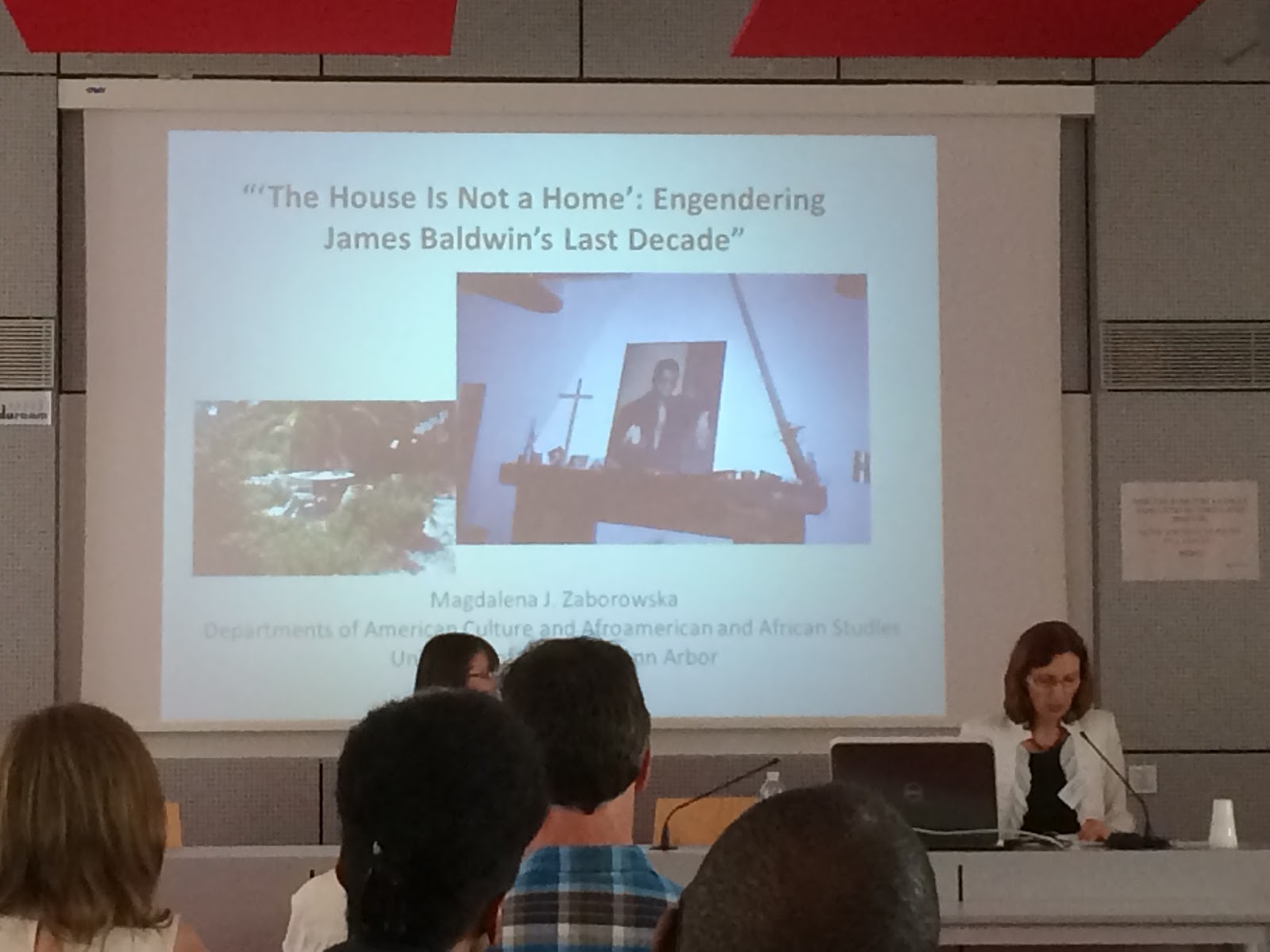
Today Magdalena Zaborowska, author of the award-winning James Baldwin's Turkish Decade: Erotics of Exile (Duke, 2009), who talked about Baldwin's final home in St. Paul de Vence, France, and how we might recover from "the material the metaphorical," and "the literal the literary" new ways of thinking about Baldwin's archive. One aspect of her forthcoming project that I found particularly fascinating was her discussion of how Baldwin's interest in certain women in his life increased toward the end of his life, and in his clothing and mannerisms began to play with gender more openly. She linked these shifts to his final work, The Welcome Table, which captured both this turn and social aspects of his life, including his relationships with women friends, in his final days.

On a plenary panel yesterday author and screenwriter Cecil Brown spoke about his friendship with Baldwin from the early 1970s on, when Baldwin was being heavily surveilled by the FBI and carefully considering the terms of his exile. A number of his anecdotes centered on time he spent with Baldwin at the house in St. Paul de Vence, and on the relative rarity in those days, compared with today, of American black people in France. Some of Brown's comments veered into problematic territory and his comments today in response to a presentation again did so, but one way of looking at this was that he was giving his unvarnished truth, offensive as it might be. Jacqueline Jones Compaore, who was Baldwin's student during his stint at the western Massachusetts 5-college system, joined him on the plenary panel, talking quite movingly of Baldwin as a teacher who could terrify students by challenging their BS outright, but also showed great care for many of them and deeply inspired her. 

Amidst the keynotes have been full days of panels, on all aspects of Baldwin, from discussions of music in his work to his public and private lives to a digital annotations project now underway to to his transatlanticism. My panel, on new approaches, was the first of this afternoon, and I gave an abridged (because of time) version of a paper on "queer futurity" and James Baldwin's final novel, Just Above My Head, which I think even more now having reread and thought about it carefully deserves to have much stronger cases made on its behalf. It is a novel in which nearly all of Baldwin's concerns come together--often felicitously but sometimes not--with some of his most astonishing prose, and, as David Leeming noted in his talk, it is a "experimental," often shocking work that rewards its reader in multiple ways.

The other panelist's talks, Brian Norman's on the "Cassandra effect" of Baldwin's use--the "ventriloquism" of him after his death--and Nigel Hatton's, on his work teaching Baldwin's fiction to young people in prison, and including the great writer's work in the field of narrative medicine, were excellent. Other panels have ranged widely, but in general, have provided a rich critical engagement with every aspect of James Baldwin the artist, the intellectual, the critic, the theorist, the activist, the visionary, the man. Concluding the today's session was a screening of The Price of the Ticket, with filmmaker Karen Thorsen present to discuss many aspects of her process, her contact with Baldwin, some particulars of the film, and related anecdotes. I have seen this film before, but hearing her provide background information enriched my thinking about it. There's one more day of Baldwiniana, and I'm looking forward to it and to seeing more of Montpellier!

First morning registration
The organizers, D. Quentin Miller
and Claudine Raynaud
Dennis Tyler, who gave the first talk
of the day, and D. Quentin Miller
David Leeming
Site St Charles, Université Paul-Valéry
Cecil Brown and Jacqueline Jones Compaore


Anti-fascist posters near the university 
Jezy Gray, Ed Pavlic, giving his paper,
and Quentin Miller 
Magdalena Zaborowska,
at right, at her keynote 
Actor and videographer Samuel
Légitimus, founder of the
Collectif James Baldwin
Rasheeda Briggs, Monica Miller,
and Christopher Driscoll

Tuesday, May 06, 2014

Random Photos

It is been a long while since I posted any photos, as my posts in general so far this year have appeared rather sporadically. But it has been that kind of six months, very busy, with so much going on that even posting photographs has proved a challenge. Here are a few. Enjoy.

Dr. Khalil G. Muhammad, Director of the
Schomburg Center, speaking at Rutgers-Newark
during Black History Month 
Julian Simmons & Sarah Lucas
project, Tittipussidad, Karma, NYC 
Filming, Washington Square Park
NOTICE, Manhattan

In Bryant Park, late winter 
George Saunders, Matthea Harvey,
and Jayne Anne Phillips, Writers at Newark
series, Rutgers-Newark 
The ongoing renovation of
Fulton Street Station, lower Manhattan
On the street, Jersey City 
My former colleague Brian Edwards,
after his talk at New York University
At a bus stop, Manhattan 
A temporary arcade in front
of the Metropolitan Museum of Art
Bettye Saar, at the opening of her show in March 
Malcolm Gladwell, West Village
The cast of Alban Berg's Wozzeck,
expertly performed at the Met Opera,
and conducted by James Levine

Railroad track bed in Jersey
City (when the light rail train abruptly
stopped without explanation between stations)


Wednesday, November 27, 2013

The Black Atlantic @ 20 @ CUNY Grad Center

Every scholarly book is important (at some level) to its author, but as with other kinds of texts only a select few resound long beyond their field and moment of publication. Paul Gilroy's The Black Atlantic: Modernity and Double Consciousness, published in 1993 by Harvard University Press, is one such book whose central premise, that "blackness" was and remains constitutive of and central to "Modernity" and the political, economic, social, and intellectual development of the "West" as we know it, opened up new ways of thinking about and understanding the relationship between these concepts across a range of fields, including literary studies, anthropology, history, sociology, political and philosophical thought, and cultural studies. Two decades on, and despite an array of critiques, Gilroy's The Black Atlantic, continues to foster and inform new and older epistemologies linked to modernity and its multiple afterlives.
Paul Gilroy speaking with Jacquelyn
Nassy Brown and Robert Reid-Pharr
A month ago, at the CUNY Graduate Center, CUNY's Academic Research Collaborative, Certificate Program in American Studies, Caribbean Epistemologies Seminar in the Humanities, Institute for Research in the African Diaspora in the Americas and the Caribbean (IRADAC), and the Revolutionizing American Studies Initiative, sponsored a two-day event, The Black Atlantic @ 20, as part of a series of events throughout the 2013-2014 academic year, focusing on the Gilroy's book and work. The speakers included Gilroy himself, as well as numerous luminaries teaching or visiting CUNY, including Jacquelyn Nassy BrownSusan Buck-Morss; Tina Campt; Kandice ChuhDuncan FahertySujatha Fernandes; Eric Lott; Stephan PalmiéRobert F. Reid-Pharr; and Ruth Wilson Gilmore. 
Faherty, Nassy Brown, Reid-Pharr,
Buck-Morss, Fernandes, Wilson Gilmore
and Bennett
As the program noted concerning the effects of Gilroy's book, "scholarship no longer simply posits the relationship between blackness and modernity as an irreconcilable problem," and while we might argue that Gilroy was not the first or only thinker to challenge this assumption, his study, perhaps more than any of its particular moment, the ideas in it, and the pedagogy he and it enabled "engendered debates" in a range of humanities and social sciences fields that were "once perceived as the exclusive domain of an organic and hermetically sealed Western tradition." The opening night's panelists, Bennett, Nassy Brown, Buck-Morss, Fernandes, Wilson Gilmore, and Reid-Pharr, all delivered short pithy (9 minute) presentations showing the field critiques and responses respectively in history; anthropology; philosophy; hip hop and musicological studies; geography; and literary studies. Each asked and answered the question of whether it is possible to "produce innovative work around race, colonization, cosmopolitanism, and imperialism while also continuing to privilege traditional modes of intellectual inquiry," and several also contributed to a larger conversation that the Revolutionizing American Studies initiative and other programs have been posing for some time about ways to restructure research and pedagogical approaches at the CUNY Graduate Center and beyond.
Paul Gilroy chatting with an audience member
I could fill about 10 blog posts if I were to recount all of the dazzling insights the panelists offered, but I'll touch upon only a few. I should also note that not everyone who spoke offered a paean to Gilroy's book; several were thoughtfully and respectfully critical. Yet all attested to the centrality of the work to ongoing work in their fields. Herman Bennett noted how the text had helped to further an "epistemological exorcism" in terms of understanding race in Latin American intellectual history, and opened up "a new horizon of employment." Nassy Brown was more overtly critical, and cited Gilroy's earlier landmark study, There Ain't No Black In the Union Jack as particularly important, but averred that Gilroy's work in both texts had played a key role in fostering an anthropology of global blackness, and its engagement with geography, which is now framed in dialogic terms. She also noted the importance of its having posited "emancipation" as a touchstone for black subjectivity.
Ruth Wilson Gilmore speaking with
a member of the CUNY community
Buck-Morss did not deliver a paper, but spoke from notes. She urged that we not forget the "political reality in which the text emerged," its challenges to the "disciplinary police," and its skill in placing events and histories in juxtaposition, its rejection of ethnocentrism and nationalism (which remains controversial, as Gilroy noted in his own comments the next day), and its exploration of aesthetics as self-fashioning and critique of art as "immanent." Fernandes focused on how music in particular held pride of place in Gilroy's analyses, to some extent displacing language and writing, but how his text also pushed us away from Black American situatedness towards a more diasporic perspective. Wilson Gilmore's short talk brimmed with insights, beginning with the basic fact that the book had made it possible for her to understand the discipline she'd chosen. Other key points she made were that in this text, "theory is method," that it brought together the concept of diaspora not by a mythic path but through a "continuous and ongoing present"; and that it critiqued Raymond Williams' famous Structures of Feeling, in part by laying out the contradictory structures of feeling in diaspora, asking what discontinuous traditions rested on, and what might be the infrastructures of feeling that made the structures of feeling possible, reshaping our sense of the archive.
Poet and scholar Tonya Foster
Reid-Pharr concluded the panel presentations with brio, asking that, after Gilroy, we think about black intellectuals in less obvious positionalities, such as among the enslaved people in transit, on board ships or at market, that we ask who counts as a proper subject of our inquiry, and that we consider immigrants, sex workers, soldiers, and so on, jettison our reliance on heroic subjectivities. Are we, in the light of Gilroy, committed to give up cultural nationalism, he asked. After these brilliant presentations, Gilroy graciously took the podium to thank everyone for their comments on his behalf, and noted that he had always thought of The Black Atlantic as an "open-source project," rather than a closed intellectual work forbidding critique. It was a powerful moment, and added to the intellectually generous atmosphere that unfolded as the question-and-answer session began. If one sentence can sum up the fascinating exchanges during this section of the program, it would be: "Freedom is the practice of making unbounded life."
Scholar and critic Eric Lott
The next day, I did not make it over to CUNY until the early afternoon, and thus missed the morning talks by Palmié and Campt. I did get to hear Eric Lott, whom I first met many years ago when he had just published Love and Theft and was starting out at the University of Virginia, weave a web of thought that has to be read to be fully appreciated, but his talk "Open Letters," which poet and scholar Tonya Foster introduced, managed to tie together President Barack Obama's Dreams of My Father, and his negotiation between sovereignty and homo sacerLauren Berlant's concept of the "anatomy of national fantasy"; the Emancipation ProclamationMartin Delany's Blake; Jay-Z's and Beyoncé's controversial trip to Cuba and Young Hov's rap "Open Letter," which Lott assessed as "derailed by neoliberal self-regard"; Assata Shakur; and methods and ways of reading and analyzing popular music. It was a breathtaking tour.
Paul Gilroy
Last came Gilroy, who in a talk entitled "The Half-Life of The Black Atlantic" spoke about the book's afterlife, criticisms of this and subsequent work (especially the furor-inducing Against Race: Imagining Political Culture Beyond the Color Line (Harvard UP, 2002), and how he might rewrite The Black Atlantic today. He also mapped out what he saw as potential future pathways the book's ideas might offer. He began by discussing the critique of methodological nationalism in the book, and said that were he to write it today, he would include Alain Locke in it. He also spoke about how one strand in it to develop might to look more closely at the idea of culture in relation to "war," and African-American culture as "the machinery of diplomacy" today, which is to say, as a kind and form of "soft power". He related this to Penny von Eschen's work, and the idea of the "weaponization of culture." He also talked about the cultural revolution neoliberalism is wreaking, and how this is altering the currency of racial difference. He gathered around this idea the notion of "neoliberal poetics" and "depressive hedonia." Religion was another direction for further pursuit, and the idea of freedom as "individuality within a religious context," which he asserted once would have been problematic within Christianity.

Other points included thinking of Marcus Garvey and the idea of a cultural multiculturalism not limited only to black people and other racial and ethnic minorities; the increasing influence of neoliberal "self-help books" among young people of color in the UK and the USA (Sawyer, 50 Cent with Robert Green, etc.), and the ways that these ideas were having the effect of "soliciting the cooperation of people into their own subordination." He related this to the ongoing belief that through "work" and financial success, "deep racism" could be overcome, and to history of being denied recognition as a individual and how this was leading to an "extreme individualism." From this he proceeded to talk about the possibility, inherent in Aimé Césaire's writings, of the "human raised to the dimension of the world" as a way of positing a "new humanism," but which licensed a "critique of racial categories." Such thinking about "humanism" would be difficult given the extensive anti-humanist training and reflexes now present in the academy, and the appetite both for post-humanism and adherents to that concept's lack of concern with racism. (We discussed this in my fall 2012 class on the topic.)
Robert Reid-Pharr
In discussing this possible humanist turn, Gilroy invoked W. E. B. DuBois (whose name had, naturally, come up more than once already) and his idea of the tertium quid (that third thing, between human and animal); the humanism of Rev. Dr. Martin Luther King, Jr., and the strikers in Memphis (I AM A MAN); June Jordan's Civil Wars, in which she demanded a "reinscription of the human guided by cosmopolitanism" and gender, reifying no identities at all; and the great Sylvia Wynter, who long sought to give critical theory a role in "re-enchanting humanism," with "race" summoned as "solidarity." Lastly, Gilroy spoke about the role in South Africa of forgiveness in informing humanism. Unsurprisingly, many questioners asked Gilroy specifically about his conceptualizations of humanism, and he ranged widely, mentioning Frantz Fanon, the US success of "settler colonialism" and the lack of public queries about a Truth and Reconciliation Commission (or multiple ones) here, Donna Haraway's arguments about Sojourner Truth's aims to articulate "an alternative humanism", Fanon's and Edward Said's secular humanism, and so on. In response to Caricom's call for "reparations" from Britain, Gilroy talked about being "disposed against melancholic formations" and called for a "working through rather than melancholic" responses. And there was so much more (environmentalism and biocolonialism; his omission of "Taksim Square" in relation to the topic of "democracy"; the topic of temporality and music, and how sonic environments allow us to "hear around the corner or into the future", etc.), but I'll end here by saying that it was like a weeklong seminar I'm still working through, and I thank all the speakers, and especially the organizers and Paul Gilroy himself, for this exemplary event that offered real intellectual and critical engagement.
The Skylight Room
Reid-Pharr and Gilroy, in conversation

Saturday, November 02, 2013

Celebrating the Umbra Workshop @ CUNY

The Black Arts Movement has rightly received extensive--though still not enough--critical and scholarly treatment as one of the major moments in 20th century African American and American literary and cultural history, but before the founding of the Black Arts Repertory Theater School (BARTS) in Harlem in 1965, another group of young black writers and artists had already gathered in New York City, mostly on the Lower East Side, hosting workshops, throwing parties that brought together people creating in a range of genres, and publishing a magazine, titled Umbra. They were the Umbra workshop. Established on New York's LES in 1961, most of its members had dispersed by 1964, some of them heading up to Harlem, others across the northeast and to the South, still others to California, Europe, and parts beyond. Umbra's influence, through its members' work, projects (like Cannon's Gathering of the Tribes, Reed's numerous literary, cultural and political projects, including the St. Mark's Poetry Workshops, the Before Columbus Foundation, Konch, and The Yardbird Reader, to name a few), teaching and links to parallel and subsequent movements, including the Black Arts Movement and many others.

On Friday, several of the former members, including Steve Cannon, David Henderson, Rashidah Ismaili, Joe Johnson, and Ishmael Reed, convened at the CUNY Graduate Center for two events sponsored by IRADAC and the PhD Program in English, as well as by a grant from the National Endowment for the Arts, an afternoon seminar and conversation (which I was unable to attend) and a reading, which included not only their work, but also the poetry of some of the notable members who had already passed away, including Calvin Hernton, Tom Dent, Tom Feelings, Raymond Patterson, and Norman Pritchard (an influence on my own poetry, especially in Seismosis).  As the CUNY announcement stated, the Umbra Workshop comprised "an aesthetically diverse group of young artists, many with 'a strong commitment to "nonliterary" black culture.'" During the workshop's active years, elders like Langston Hughes and peers like Andrew Young encouraged the members, while musicians like Archie Shepp and Cecil Taylor performed at events. As several members noted, the aesthetic and political foci were intraracial and intercultural, and interracial and intercultural, as non-black writers also participated at times too.

Nearly all of the writers read selections from their work and that of their late peers, though Phoebe Halkowich read a piece based on her conversations with Steven Cannon. In her conversational piece, which was really a performance, one of the things Cannon noted was the general sense of possibility at that moment in history, but also the sense of terror; it was the season of assassinations, with President John F. Kennedy being murdered in 1963, and only two years later, Malcolm X was killed. The society was moving towards upheaval and transformation; the Civil Rights Movement was underway, and Black Americans were shifting in their views of themselves and what they expected and were demanding from the nation. The literary world was hardly immune from these currents and tensions, and, as several members noted, they played out in the workshop and in part led to its demise. Yet it was great to see the members together; the fondness and deep respect each held for the others was quite apparent. It also drew a wide array of New York-area writers who have been inspired (and taught and mentored, etc.) by one or many of the Umbra Workshop's former participants. Many thanks must go to poet, critic and grad student Tonya Foster, who was deeply involved in planning, organizing and pulling off the events, including a festive dinner.

Below are some photos from the event.

Ammiel Alcalay, offering introductory remarks,
with the panelists beside him (l-r, Joe Johnson,
Ishmael Reed, Rashidah Ismaili AbuBakr, and
Phoebe Halkowich with Steve Cannon
Tonya Foster, offering a wonderful
introduction to the panel.
The one and only Steve Cannon
Phoebe Halkowich
David Henderson
Rashida Ismaili AbuBakr
Joe Johnson
Ishmael Reed
The long and lively dinner table