Showing posts with label teaching. Show all posts

Thursday, January 02, 2020

My 2019 (Semi-)Hiatus

A photo from our contract rally at
Rutgers-Newark, April 2019
As J's Theater readers--if there still are any!--may have noted, last year (2019) was a very lean one in terms of my presence here. I believe I managed six entries (with perhaps double that still in draft mode), and that was pushing it. One, which I only recently published, featured a review I undertook for Art in America on last year's Whitney Biennial, which I found fascinating on multiple levels, in contrast to many mainstream critics, including one who summed it for me at lunch late in the year, as "predictable." As it turns out, it was anything but--and, as I argued in that piece, really multiple Biennials, including one transformed by the protests that not only the Biennial's artists, but outside activists, supporters and artists, and the Museum's staff, launched. To be able to watch it unfold and write about it was a pleasure, but alas, I had almost no time to focus on it here.  I also had no real time--or rather no time to focus--to complete memorials to figures who have been incredible important to me, whom we lost in 2019, and I am thinking in particular of Toni Morrison, Paule Marshall (who was one of my favorite teachers in grad school), and Ernest J. Gaines, among many others. They are but a few of the people who left this human plane last year, and perhaps at some point I can either finish my mini-tributes and turn those live or write new ones this year. We will see.

My day jobs are, as readers know, a writer, and a professor of English and African American and African Studies (AAAS). Over the last six years (roughly since 2013), however, I've also served first as Acting Chair and then full-time Chair of AAAS, a post I have enjoyed deeply, but which also has entailed a very different level and kind of time commitment, since chair duties, I had to learn quickly, run every day of the week and all year long, and involve all kinds of matters, from curricula to student needs and concerns to staff and faculty personnel issues to other kinds of university service to general administration to tasks defying categorization. 

What I also learned was that there often is little training, except on the job, for the challenges that present themselves. Soliciting the advice of one's peers, especially other chairs or former chairs, and colleagues, listening to them carefully, addressing pressing and longer-term issues, and encouraging and engaging not only in an ethos but a practice of collaboration are all key, but administrative duties can be very stressful, and run along timelines parallel to but different from those of the academic year. Add this to my regular (teaching, mentoring, advising, my own life and writing) and irregular duties (letters of recommendation, tenure, judging panels, etc.), and it's fair to say that my blogging has been one major area to suffer some of the the greatest blows as a result.

This past fall was also a particular challenge because, on top of everything else, I was serving on four search committees. Serving on one search committee is a high hurdle; four is almost impossible to describe, though I grasped why I was asked to serve, and was cognizant throughout of what my presence could help to effect and why I committed to each. I can say, breaking no confidences, that each went quite well, and 2020 should bring good news to my institution and some excellent people who, I hope, will be wonderful leaders in their various ways and invaluable colleagues. That, as all such work tends to be, is the hope and goal, making people, programs and departments, the institution itself, better and stronger than they were before, with added benefits not yet foreseen but which will redound and resonate long after the moment of the work has ended. That is the core of so much of what we do in life, though, isn't it, or at least hope to?

2020 brings a competitive leave sabbatical--courtesy of several fellowships I received in 2018--so I hope to be able to post here more often. I have been thinking quite a bit about how blogging has changed in the 14 (soon to be 15!) years since I began this blog, and though I am ever more convinced that we live in an increasingly post-literate, let alone post-post-modern world, where the power of the regime of images grows ever stronger, the role of the oral has become more central and dominant, public prose is transforming into a shadow of itself, and social media's forces and forms are reshaping not only language as an exterior medium but our interiorities in ways we have not fully recognized or reckoned with,  I do believe there is a place for this blog and others, even if it ends up looking somewhat different than it did in the past, so I will strive to post semi-regularly here, even if, as I have at times, primarily with quotes and notices from others, including citations of and links to blogs I still follow, like Keguro Macharia's, to name one of my favorites and one of the very best. (And speaking of which, his remarkable study Frottage: Frictions of Intimacy Across the Black Diaspora is now out from NYU Press!)

So, here's to 2020, more blogging (I hope), and the excitement to come!

Saturday, March 30, 2019

My Appearance on State of the Arts NJ

Last fall, Susan Wallner of the wonderful TV program State of the Arts New Jersey contacted me about possibly producing a short clip about my work and me. I am always a bit wary about such efforts, as I would always rather have my work do the speaking for me, but since there was a possibility that SOANJ would feature my students, teaching and Rutgers-Newark, I thought I'd go along with it. The filming occurred in early November, and again in late February, and I can say without hesitation that Susan and her crew were a pleasure to work with, from start to finish.

Many, many thanks to them and everyone at State of the Arts New Jersey who made this possible. Many thanks also to superb critic and writer Julian Lucas, and to Poet Laureate of the US, Princeton professor, poet extraordinaire, and my former Dark Room Collective compatriot Tracy K. Smith for their kind, insightful comments on my work and me. Also a very hearty thank you to my MFA students, who agreed to be filmed, and sparkled (as they always do) on camera, and to everyone at Rutgers-Newark who greenlighted the filming. 

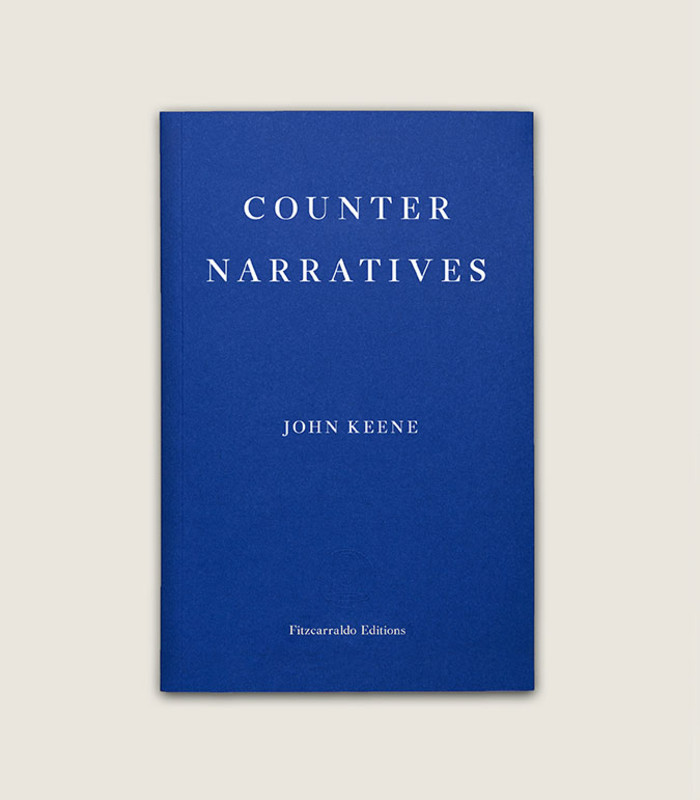
I am so shy and self-conscious I could not initially bear to look at it (I needed but did not get a haircut before the February filming), but C told me it came out very well, and pointed out that Susan and her team had even threaded a Bob Cole tune through the video, a lovely touch, of course, and tribute to one of the artistic figures I explore in Counternarratives. The show aired last week, and though we've been DVRing the episodes and keeping an eye out for it, we also missed its debut airing! Here, for those who do not regularly watch State of the Arts New Jersey, is the short video. Enjoy!

Friday, November 10, 2017

Master Class on the Novella in Translation

Bolaño's Una novelita lumpen
At the beginning of September, the fall semester always looks endless to me, like a river whose mouth or delta lies beyond the horizon of the looming holidays. Once class begin, however, the weeks and months always race by more swiftly than I envision. By December, I find myself remarking how the term has slimmed down to final papers and exams, with the restorative winter break--that terminus--only weeks away. Even still, I always worry about overloading and wearing myself out, which I have come to realize is unavoidable. Beyond classes these days, there is everything else, which was always there, but even more so with each passing year.

I nevertheless had the idea that a mere month's worth of--four--classes on a free Wednesday alongside my usual teaching and advising load would not be unreasonable and a pleasant change of pace, and it turns out that it was. For four weeks from mid-October through the beginning of November, I taught a masterclass on the novella in translation to a small cadre of MFA students at Columbia University's School of the Arts, and once I properly figured out the commute, which required heading in the opposite direction from Newark, things ran quite smoothly.

Having not headed into Manhattan regularly during morning rush hour in 17 years, I was reminded that the PATH trains are usually reliable, if stuffed like a coffee vacuum pack, at that hour, and that the trip into the city is especially quick because it only requires a few stops to Christopher Street station, which once was my destination when I was a student at NYU (except when I taught in the East Village and in the winter, when I would take it further, to 9th Street) and again when I worked in SoHo in the late 1990s. From the Christopher St. PATH stop, I walked down the famous street, still mostly shuttered at 9 am, to the 1 Train at 7th Avenue, and then changed to the 2 to speed uptown, then back to the 1 to end up right outside Columbia's main gate on Broadway. Trips back to New Jersey (and usually the Rutgers campus for afternoon meetings) ran more leisurely in reverse.

Since we had only four weeks, so I assigned four novellas in translation:
  • Roberto Bolaño's 2005 mini-masterpiece A Little Lumpen Novelita, the last work of fiction he published in his lifetime, which was translated by Natasha Wimmer and published by New Directions in 2016;
  • Amélie Nothomb's 1993 novella Loving Sabotage, translated by Andrew Wilson and published by New Directions in 2003;
  • Yoko Ogawa's The Diving Pool: Three Novellas, originally published as three separate works, in 1990 and 1991, and translated by Stephen Snyder and published by Picador in 2008;
  • and Abdourahman A. Waberi's 2009 Passage of Tears, translated by David and Nicole Ball, and published by Seagull Books, 2011.
I had read all of these books before, the Waberi and Bolaño texts most recently, and the Nothomb not long after it appeared a little over a decade ago. I chose these texts with the aim of linguistic, aesthetic, and thematic diversity, among other goals, yet still ended up with two Francophone authors, writing from rather different perspectives, and three works in European languages. (Since I can read French and Spanish, though, I had a clearer sense of the translators' skills.) Of the four works, Bolaño's and Ogawa's were clearly labeled novelas (or "novelita"), while Nothomb's and Waberi's were issued as novels. All four are authors I admire, Bolaño especially so, and though I had taught his work before, I had never included fiction by any of the other authors, nor these four works, on my syllabi.

I'd chosen Waberi's text, I realized after the course had begun, in part as a provocation, because its length suggests that it might not fit the criteria. And what are they? I won't reprise the essay, based on a talk I gave last spring at Northwestern's annual spring Festival of Writing, that I revised and shared with my students to start the class, but some of the key characteristics I asked the students to think about were the novella's usually limited scope (more than a story, perhaps, but less than most novels) and concentrated effects, its unity of voice and plot, and its concision in narration. One of my students metaphorized, specifically apropos of Ogawa's work, the novella's narrative focus to a "tunnel." I thought this a brilliant insight, and thought it applied, in varying ways, to all four works. The students' assignments included in-class discussion and writing, response papers, and, as their final submission, a set of novella starters. Each student produced several that I hope they pursue, if not as novellas then, plumped out as novels.

They were to a person smart, engaged, and original in their thinking. I did not see any of their creative work, but nearly all were fiction writers, and I got a sense of what each of them was working on. It was a pleasure to experience thinking through the texts with them. Each novella offers different challenges in terms of how it works, and the class as a whole was more than up to the case, puzzling out as well other aspects of the texts. One of the students who read French was able to point out how much more ironic Nothomb's original was compared to the English (and how it riffed off a variety of works that Francophone readers would know, though Anglophones might not), while Waberi's French was a bit more formal in places, and less so in others.

Will they write a novella or novellas? I hope my proselytization was effective, though I did discuss, in the essay and the class, the US publishing industry's reluctance about the shorter long form. I also hope I might have sparked an interest in translation among some of them. I did leave the very brief course--like an "eyeblink," as one student put it--as encouraged as I always am when I finish a semester with my MFA (and other graduate, and undergraduate) students at Rutgers-Newark, about the future of American literature and writing. The hurdle, of course, is to get inventive, talented writers (of all ages and backgrounds) like these students and my Rutgers students and mentees, into print, and their work to readers. The sharp, gifted novella class cohort, I sincerely hope and trust, will be doing so before long.

Monday, May 29, 2017

Random Photos

A sampling of photos from April and May, two incredibly busy months!

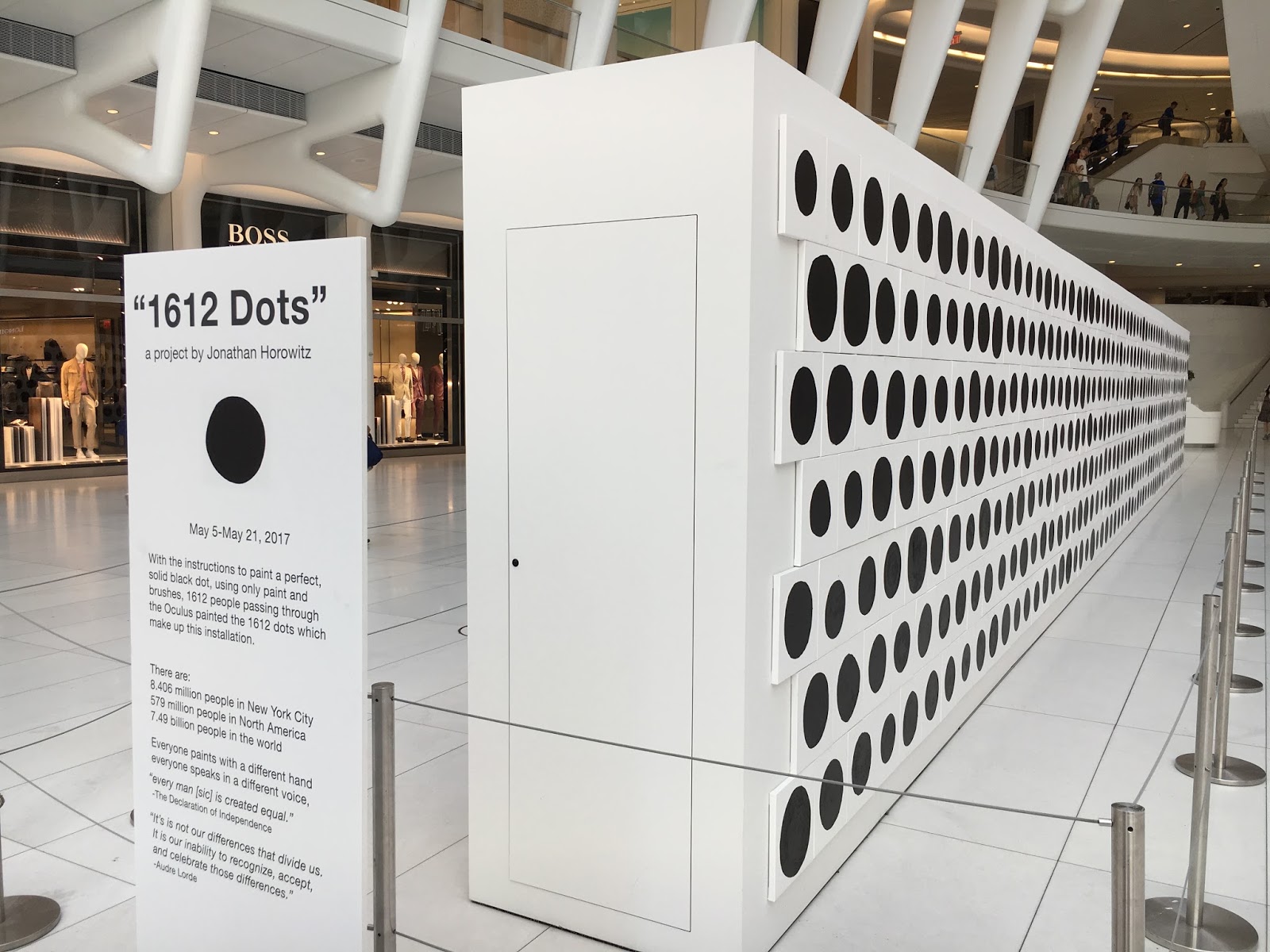
"1612 Dots," a participatory, conceptual
 sculpture in Brookfield Place,
World Trade Center
Geese and goslings, Jersey City
The flyer for A Stray, a superb film
by one of my Rutgers-Newark MFA
advisees, filmmaker and fiction writer
Musa Syeed
Musa introducing his film, A Stray
At the Montclair Literary Festival (l-r: Sam Lipsyte
Garth Risk Hallberg &
 Nicholas Delbanco),
with our host introducing the event, The Sanctuary at First 

Elena Delbanco at the Montclair Literary Festival
Cleaning the pedestrian walkway,
mall in downtown Jersey City
One of my brilliant honors undergraduate
students, Madani Sheikh, presenting his
work at the Rutgers-Newark Student Research Fair
My other honors undergraduate
student, Secilia Flores, presenting her
work at the Rutgers-Newark Student Research Fair
A mural underway, Jersey City
Colm Toibín, and my colleagues MFA program
director Jayne Anne Phillips and Brenda
Shaughnessy, Writers @ Newark reading series

The packed house for the Writers @ Newark reading
David Hyde Pierce signing autographs
outside Hello, Dolly! on Broadway
Lower Manhattan, infogged (befogged?)
Newark doorway
My brilliant former student Serena Lin,
reading at her farewell event (before moving
back West), in Brooklyn
Pondering pigeon
A truly gifted author, poet and fiction writer
Jeffery Renard Allen, with whom I read
this year's MELUS conference, at a panel
organized by Keith Byerman
MIT's postmodern and avant-garde
Stata Center
A discarded twist brush, which was sitting
right in front of my building at
Rutgers-Newark
Lincoln, Illinois

Friday, May 19, 2017

2017 Rutgers-Newark Commencement

Some of our MFA students before the Graduate
Hooding. I had the immense pleasure of having nearly
all of them in a workshop or literature class! 
It has been eons since I've blogged, I know, but this year so far has easily been my busiest in a while, perhaps ever. I've recited the litany so often I think friends and associates, and most certainly my colleagues, are tired of hearing it, but in addition to my departmental chair duties, teaching, mentoring graduate students (3 MFAs, 1 independent study, 1 TA, two different doctoral committees), undergraduates (2 honors students), multiple search committees, and university committees, as well as various non-university profession-related duties, I also spent a good portion of the semester traveling to continue promoting Counternarratives and my other books, and while I love doing so, the physical and psychic toll of travel, especially these days, is always steeper than I envision.

As the scant entries this year testify, my blogging has especially fallen by the wayside this year. This  saddens me because I enjoy writing on here, and I feel like there's a particular need for it now. (I can also recall how just a few years ago, we were told that Twitter was becoming irrelevant and that blogging would soon be joining the ranks of the dodo bird and the woolly mammoth.) My several entries on the current resident of the White House remain stubs, however, and every day--sometimes it feels like every hour--brings so many new political revelations, bombshells, and shocks that, as was the case during the George W. Bush years, if you miss a week, you might as well wait for the next cluster of horrors and outrages. I think you can reasonably describe the White House's attempted Muslim Bans, its health care bills, its assault on regulations, its draconian budget, and so on horrors and outrages, even for some of Donald Trump's supporters....

But my aim with this entry was not to talk about Trump, but rather to congratulate the Rutgers-Newark (and Rutgers more broadly) Classes of 2017, undergraduate and graduate, and by extension, all who graduated this spring and year.  I'm very glad the semester and academic year have come to a close, but I already miss the students I worked with this year. As I mentioned, I supervised three MFA fiction students, Soili Smith, Matt Weir (whom I'd taught when he was a beginning creative writing student at Northwestern!) and Magally "Maggie" Zelaya, all of whom successfully completed their theses this spring. In addition, Soili applied and was admitted to Rutgers-Newark's PhD program in American Studies.

I also supervised two honors undergraduate students, both of whom successfully submitted fiction theses, Secilia Flores and Madani Sheikh. Madani graduated summa cum laude, received a senior prize from the English department, and gained admission into Rutgers-Newark's MFA program. He even was recently the subject of a thoughtful profile on Rutgers-Newark's website, and had previously received coverage as part of a social entrepeneurship team that made it to the regional finalist stage when he was a freshman.

All of these students, as well as others I mentored and taught, were a joy to work with, and I will definitely miss them, though I'll get to see Soili and Madani this upcoming academic year. Congratulations to all of them and all of this year's graduates!

Below are a few photos from Rutgers-Newark's various end-of-the-academic-year and Commencement events. For the Graduate Hooding ceremony and the actual Prudential Center campus-wide commencement, I wore a purple robe (for my graduate degree from NYU), but a creative writing colleague told me that I need to get the fancier, final degree model, with the fancier hat. Will do!

The big shebang, at the Prudential Center! 
Yours truly, one of our talented MFA graduates,
Darise Jean-Baptiste, and my wonderful
colleague Tayari Jones, after Commencement
The MFA graduates, during their end-of-year
reading at the MFA house
Matt Weir, one of my MFA advisees,
reading from his hilarious thesis
Poet Jeremy Clark, with Matt at right 
Darise Jean-Baptiste, reading from
her fiction thesis
Leslie Jones, reading from her
fiction thesis--well, showing its cover
before reading from it 
Maggie Zelaya, sharing her cover before
reading from her thesis, which I saw take
shape over her time at Rutgers-Newark
Aarthi Monteiro, another student I finally
got to work with last fall, reading from
her fiction thesis
Soili Smith, one of my MFA advisees,
reading from her fiction thesis, Sasquatch,
which did not include the story featuring Sasquatch
(though I hope the full collection will)
Students in the book arts course,
with their art-text projects, which they
discussed before sharing a bit of work
The faculty and students listening to the readings
Faculty and students enjoying the readings

Sunday, May 08, 2016

RIP Michael S. Harper

Yesterday I learned that Michael S. Harper (March 18, 1938 - May 7, 2016), one of the major poets of his generation, a profoundly influential teacher and mentor, and the Kapstein University Professor Emeritus at Brown University, had passed away, surrounded by his family and the music of one of his favorite musicians, John Coltrane.

Michael was, first and foremost, a poet of tremendous skill, whose poetry often fused a precise contemporary lyric style, profoundly informed by the African American tradition, with subject matter drawn from his personal life, as well as the vaster tapestry of black history and culture. Though he emerged in the wake of the Black Arts Movement and developed a poetics informed by it, he was not a polemicist, and his later poems suggested ways to bridge the racial divide. He was in particular a master of the occasional poem.

Michael published fifteen collections of poems, was twice nominated for the National Book Award, edited several important anthologies, including (with Robert Stepto) Chant of Saints: A Gathering of Afro-American Literature, Art, and Scholarship, and Every Shut Eye Ain't Asleep: An Anthology of Poetry by African Americans since 1945 (with Anthony Walton); served as the first poet laureate of Rhode Island; and received many honors, including the Melville Cane Award of the Poetry Society of America and the Frost Medal for lifetime achievement from the Academy of American Poets.

As any of his students might attest, Michael was a proselytizer for the cause of poetry in general, and of black poetry in particular. He urged those who studied with him as well as fellow poets to delve more deeply in the black American poetic past. Accounts of how he would send a budding poet, who came to his office to chat about poems with him, into the archive to do background work in preparation, are legion. His own personal stories about figures like Sterling Brown were legendary, and he trained a number of major writers during his long tenure at Brown.


My own interactions were Michael were few, but memorable. The first came during a National Black Arts Festival and involved assuring him that I had a distinct identity from my boss, a literary editor, at that time. It took a while, and the intercession of another academic figure, to convince him of this. The next came several years later during my first year at Cave Canem, I found myself no longer needing an alarm clock, as Michael's early morning efforts on his typewriter in the room next door more than sufficed in waking me up early. Very early. Then there was the experience of walking alongside him and as we chatted he listed in my direction and eventually had me flat against the wall, all the while recounting a series of insights I can no longer remember. (I remember that experience of being against the wall!). He was a towering figure, literally as well as figuratively, so I believe I squeaked out a "Professor Harper" to free myself, and return us both to our journey down the hallway.

In my second year at Cave Canem I lucked out in having Michael as one of my workshop leaders. I'd been waiting for this experience for years, since I'd never attended Brown and had missed him in the round-robin rotation of faculty members the year before. As part of his workshop, he had us memorize poems, and I chose Robert Hayden's "Those Winter Sundays," one of the masterpieces of 20th century African American and American poetry, a poem I had read more than once but had not fully internalized. One of the pleasures of memorizing that Hayden poem, in addition to integrating it into the very fiber of my being, was witnessing all the other poets in Michael's workshops that summer learning their chosen poems by heart. And recite them we did. To this day, I can still recite that poem, and, despite the fact that he wasn't so fond of the poem I wrote in his workshop, can recall many of the lessons Michael taught about rigor and concision and listening to one's ear.

During the year I taught at Brown I never saw Michael, but we communicated a few times via notes. I have retained one of the notes he left for me, typed out on a standard index card, and the little message unfolds like poetry. I knew he had gone through a great deal and recognized the toll that academe had taken on him; that was another lesson I tried to learn, that our colleague Aishah Rahman tried to make sure I understood. He was a poet to the core, and one of my hopes is that readers return to his work and find the many treasures in it. I also hope that his students carry on the best aspects of his teaching, including sending students to the archives to read and read and read some more, and to be as exacting with their own work as is possible. Read the greatest writers, learn how they do what they do, listen to their stories and share them with others, and push yourself. Push yourself. You can't fake the funk.


Here is one of my favorite poems by Michael S. Harper. When he read during my first year at Cave Canem, as all the faculty do, I tried to send him brain waves to read it. He went through poem and poem and then announced, "A Mother Speaks..." and I turned to Toni Asante Lightfoot and said, I willed that poem! Perhaps it was telepathy, or just him deciding on one of his masterpieces, as relevant, sadly, today as it was when he wrote it in the 1960s. For this and all his work in the world, I think him. RIP, Michael S. Harper.

A MOTHER SPEAKS: THE ALGIERS MOTEL INCIDENT, DETROIT

It's too dark to see black
in the windows of
Woodward or Virginia Park.
The undertaker pushed his body
back into place with plastic and gum
but it wouldn't hold water.
When I looked for marks or lineament or fine stitching
I was led away without seeing
this plastic face they'd built
that was not my son's.
They tied the eye torn out
by shotgun into place
and his shattered arm cut away
with his buttocks that remained.
My son's gone by white hands
though he said to his last word--
"Oh I'm so sorry, officer,
I broke your gun."

Copyright © Michael S. Harper, from Dear John, Dear Coltrane,
University of Pittsburgh Press, 1970.

Tuesday, December 22, 2015

Fall Semester's Embers

It's nearly January, which is another way of saying that the fall semester has raced past and is now over. In addition to marking my return from my spring sabbatical, this term also included my first stint as full-time chair of African American and African Studies. At the same time, as I've chronicled to some extent here, these last few months have also included a mini-book tour, which encompassed stops on both coasts. The combination--and pace--of the teaching, administration and travel has worn me out, so I'm truly grateful for the holiday break, though as I was able to share during the final course meeting with my students in "Foundations of Literary Study," the undergraduate course I taught this fall, no matter how tired I felt on the Monday following my trips or reading through a stack of papers, I experienced a surge of exhilaration once I entered the classroom. I also had the benefit of an exceptional teaching assistant, award-winning writer Drew Ciccolo, who graduated from Rutgers-Newark's MFA program and is currently pursuing his Ph.D. in American Studies at the university. To Drew, a million thanks many times over!

Although I'd taught this course once before, in the fall of 2013, I decided to update it with some new works and slightly modify my approach, using post-colonialism as our underlying theoretical approach, since it struck me as salient in light of contemporary national and global events. We looked at five genres, in the following order: creative and critical nonfiction; poetry; drama; fiction; and graphic novels. Among the new works I added were Akhil Sharma's acclaimed novel Family Life, poems by Mónica de la TorreMonica Ong, and Edward Baugh (who read on campus this fall), and stories by Ernest HemingwayJames JoyceToni Cade Bambara, and Jaquira Díaz. I also retained components that had worked before, like the transcription-and-commentary exercise involving Emily Dickinson's texts online at the Boston Public Library's Flickr page, Shakespeare's sonnets as our introduction to the poetry unit, and Elizabeth Bishop's "One Art" to teach the fixed form of the villanelle, but added a new exercise, involving use of Google's n-gram tool, as a way of exploring the field and practice of distant reading. For a change I threw in a few pop quizzes, the first of which appeared to serve as a spur for some in the class to read a bit further in the assigned longer works than they had been.

What worked particularly well was the requirement of multiple short papers (7 in total) and research and creative exercises (4) in building up my students' critical and literary skills. The two-stage final, in which they submitted half their final papers to me in order to ensure that their arguments were on track, also worked well. For those students who failed to submit the first half of their papers, however, the results were less positive. Nevertheless, many of the final papers did show some evident improvement in some way over their authors' initial submissions in the course's early weeks, and even in those cases where the technical aspects of the writing were still shaky, I could at least perceive an improved sense of confidence in argumentation.

Emily Dickinson,
Ms. Am. 1093(3),
Boston Public Library
(Flickr.com)
To conclude the class I decided to try something new this time. Since I was teaching an intro to literary studies course for English majors, I held a book raffle of extra copies of wonderful books on my office shelf, with everyone picking a number attached to a book, and then calling out the numbers, with each student receiving a book. Since some did not show up, I allowed everyone who'd gotten a book to exchange it at the end of class. A few did, and they snapped every single poetry text (by Van Jordan, Tyehimba Jess, Allen Ginsberg, Kristiana Rae Colón, etc.), along with fiction books by Junot Díaz, Michael Lukas, and others. Sadly, no one appeared to want the volumes by Raymond Carver or Ray Bradbury!

I also asked the students to write a letter to future students, detailing what they found useful in the course and what they would change or wanted more of. (I'd just seen someone else suggest this.) I was curious to see their assessments, in order to incorporate them into future iterations of this class.
Among the comments: "I would like a bigger selection of poetry only because I love poetry and diving into poetic devices and how they're used in other forms of literature (or vice versa)." And: "I started [to] love authors like Junior Díaz and I loved reading the Shakespeare play and I wish we could have studied more on those authors, but then I would have never learned what a travel narrative is or even given a chance to graphic novels that are not comic books. Odd assignment like the Emily Dickinson [manuscript] decipherment was brilliant." And: "Thankfully we do not only read white, male, cis, heterosexual authors!" And: "Side effects may include: interest in literary research; improved writing; appreciation/admiration for what at first seemed boring; drowsiness/fascination by Roland Barthes' theory regarding 'The Death of the Author'...."

And now, it's just a matter of entering those final grades!

Tuesday, May 19, 2015

Congratulations to the 2015 Graduates

2015 Commencement at Rutgers University-Newark,
at the Prudential Center, Newark, NJ
(photo © Rutgers University-Newark Facebook)
When I switched back from teaching on the quarter to the semester system in 2012, I wasn't sure how long it would take me to readjust, but in truth it took no time to reacquaint myself with the fact that May, rather than June, would bring a swift conclusion to the academic year, with final exams and grading compressed into a rapid-fire period, and graduation following swiftly thereafter. (I confess that I do like semesters more--a lot more!--than quarters.)

This year, my sabbatical-sick leave has kept me away from campus for most of the last five months, so the spring academic calendar has remained fairly hazy, but when May rolled in, I knew graduation events would also arrive soon. This past Saturday evening I was able to drop by the celebration for our graduating Rutgers University-Newark MFA students, who received their hoods at a ceremony that afternoon. They, like the rest of the graduating students from all the university's constituent divisions walked at the university-wide Commencement ceremony, which was held at the Prudential Center in Newark on Monday.

Rutgers University-Newark's 2015
Commencement speaker, Earl Lewis,
President of the Andrew W. Mellon Foundation
(photo © Rutgers University-Newark Facebook)
Because of the sabbatical I did not advise any MFA or undergraduate students this spring, but I was fortunate to have many of the graduating writers in classes that included last spring's Writers at Newark and last fall's fiction workshop, and I taught some of the departing undergraduates in courses ranging from Foundations of Literary Study to my courses on contemporary African Diasporic Fiction and the Black Arts Movement. Both groups were diverse in every way, and I feel fortunate to be able to say that I have learned as much from them as they from me.

To all of the 2015 Rutgers-Newark MFA graduates, as well as my many undergraduate students who have received their degrees this week, I offer my heartiest and warmest CONGRATULATIONS! I look forward to staying in touch in the years to come, and as I always say to the writers among you, please keep writing!

***

Over the decade that I taught at Northwestern, I supervised quite a few students: 13 MFA theses as first reader; 11 as second reader; 15 MFA student independent studies; 11 undergraduate creative writing honors theses; 4 undergraduate literature or African American Studies theses; 2 undergraduate internships; 1 MA independent study (which was curtailed when the student was injured in a car accident); and 7 undergraduate creative writing or literature independent studies. These superb students have gone on to do wonderful things in the literary and other worlds, and I treasure having had the opportunity to work with all of them, as I do with all my students, going back to NYU, Brown, and of course, now at Rutgers-Newark.

Yet it was not until a few weeks ago that I could offer congratulations to my last NU MFA thesis advisee, Whitney Youngs, who submitted as her thesis an excerpt of a novel she is writing. I was delighted to serve as her first reader, to read the manuscript through again, and to be able to sign off on her behalf. As a result, Whitney will receive her MFA degree in June! I have watched Whitney grow as a writer and person since she enrolled in an MA/MFA workshop I taught many years ago, and it has been a special pleasure to work with her in shaping and polishing her fiction, especially this novel, which I hope she completes and publishes.

To Whitney, congratulations many times over, and to all my students, including the Northwestern MA/MFA and undergraduate students with whom I worked and who are also receiving their degrees this June, CONGRATULATIONS AND THANK YOU!

Sunday, April 12, 2015

My AWP 2015


Posing with the Mary Tyler
Moore statue (downtown
Minneapolis)
(Photo by John Domini)
I've just returned from the year's biggest annual American--and perhaps global?--creative writing gathering, the Associated Writing Programs (AWP) conference, which concluded yesterday after four days in Minneapolis. Over 10,000 (or was it 11,000?) writers, readers and publishers packed the rooms and auditoriums of the Minneapolis Convention Center, nearby hotels, restaurants, bars, clubs, libraries, and a variety of offsite venues, to deliver papers, talks and presentations, and to read their work, buy books, talk about writing, and just hang out with other literary folks.

Inside the Convention Center
As an officially academic conference AWP primarily convenes people in academe or who want to be in it, focuses a sizable portion of its panels on educational issues, and represents one of the major networking opportunities for those seeking jobs within educational institutions. Yet despite this it is above all a writers' and writing conference. To me AWP's real emphasis, unlike that the Modern Language Association's annual conference or the Book Expo America, remains on conversations on and around writing and literary practices and production, and the presentation of literary works; the opportunities to participate in and attend the onsite and offsite readings and book-signings, and the immense book fair are chief among the reasons many writers scare up the funding to attend. Another key benefit is running into new and old friends and acquaintances, and meeting new ones, with the added possibility of hearing them read and talk about their work.

One of the skyways leading
to the Convention Center
A post-snowy morning
outside my hotel

Giving and attending readings and seeing people I otherwise would not get a chance to were mu reasons for attending this year, and my visit didn't disappoint. I should note that during the worst days of my knee troubles earlier this year, I was not sure at first that I would be able to attend, but hope springs eternal and physical therapy works, and since the trip to Missoula, I have grown increasingly more mobile, so I was able to make my daily way from my hotel, the Marriott City Center, to the convention center mostly on foot, and most outdoors, even during one of the sleet/snowfalls that occurred during the conference's run, and I even spent a good several hours every day I was there in the immense hall hosting the book fair, walking as much as 6 miles on Friday alone. I did feel all the walking while there and once I go back, but I was resolute in not wearing any knee braces and in not carrying around a backpack or bookbags full of books, so I avoided straining my knees and utilized UPS's services several times, and now my campus office has heavy, stuff troves waiting for me.

Inside the AWP Book Fair
At the Book Fair
The perambulations around the book fair afforded many serendipities, including running into countless writers I seldom get the opportunity to see and hang out with, as well as happening upon books I had been intending to buy, with the writers nearby to sign them, as well as ones I had no idea about but am incredibly I happened upon. I saw and chatted two of the publishers I have worked with (New Directions and Nightboat Books), and learned that at the former a steady stream people were asking for my book, which will be out on May 21, 2015 (a few weeks later than originally). I took that as a very positive sign. Other highlights were the lunches and dinners with friends and colleagues, including former students, and one amazing book party I attended where I had the opportunity to meet yet more writers. While I prefer the scale of smaller conferences like Thinking Its Presence, AWP definitely has its charms, and rather than feeling overwhelmed as I sometimes have at  the sheer size of the crowds, the surfeit of texts on display, and the undertow of competitiveness, this year felt more manageable and enjoyable. (Was it the 10,000 or 12,000 fewer people than a year or two ago?)

At New Directions table; Tynan Kogane
is seated at table; to the right is Archipelago
Books, where I learned a former student,
Eric Wilson, is now working
Lorenzo Herrera, poet and publisher
of Kórima Press, which shared a table
with Lisa Moore's RedBone Press
For the first time ever I was a featured reader, on a panel sponsored by the Cave Canem Writers Foundation that featured four poets who received the Mrs. Giles Whiting Foundation's annual writing awards: Thylias Moss, Tyehimba Jess, Atsuro Riley, and I. Before the conference I learned from a colleague that there was tremendous concern over the paucity of openly gay featured readers and LGBTQ-focused panels, and another friend told me that I was the only out featured reader, though I learned that another fellow member of my reading slate, the poet Atsuro, is openly gay, so that doubled the total, and also meant that two men of color were intersectionally representing for LGBTQ communities at AWP. Instead of poetry I read the lyrical opening to my story "Blues," in which Langston Hughes and Xavier Villaurrutia meet up in Depression-era New York. The story is a tribute to both poets, but especially Hughes, as well as Richard-Bruce Nugent, author of "Smoke, Lilies and Jade," whose style and themes provided the template for mine. Supposedly we were visible on a Jumbotron monitor, which I thankfully could not see or I'd never have been able to take the podium! Many thanks to CC, the Whiting Foundation, and to AWP for the event!

Lisa Moore and I
A panel on creative writing as a second career,
headed by Tayari Jones (at right), with Evie
Shockley seated at the table at center
The following evening I read at an offsite event to promote the new Volta Book of Poets, edited by Joshua Marie Wilkinson and published by Sidebrow Books, between whose covers I have a few poems. The 3-hour reading was at Harriet Brewery in St. Paul, and many of the poets in the anthology were present, including Eric Baus, Susan Briante, Julie Carr, Don Mee Choi, Arda Collins, C. S. Giscombe, Fred Moten, Yona Harvey, Dawn Lundy Martin, J. Michael Martinez, Andrea Rexilius, Evie Shockley (my cab and Uber mate), Matthias Svalina, TC Tolbert, and Lynn Xu. (I probably have left someone off, so my apologies.) The beer hall was loud and packed, and some patrons seemed more eager to hear poetry than others, but the readers in general were on their game and I aimed to have fun and read an Internet-app based poem that elicited a good deal of laughter, in keeping with the venue's tone. I had to head out to another event, so I missed the evening's final readers.
At the Harriet Brewery reading,
Fred Moten seated at center
The Obsidian panel, with (1-r) Kwame Dawes,
Duriel Harris (editor), and Sheila Smith McKoy
I also got to attend several panels, including one devoted to the literary journal Obsidian, which I have read for years and now serve as one of its fiction and hybrid forms editors, and the invigorating words and atmosphere of fellowship in that room underpinned for me, as so many other experiences did, of why I attend AWP.  Next year's conference will take place in Los Angeles, and I'm already looking forward to it. Below, a few more photos!

The Convention Center
Lynn Xu at the Volta reading
Fred Moten at the Volta reading
Don Mee Choi, translating, and Valerie
Mejer, reading in Spanish,
at the Volta reading
Susan Briante at the Volta reading
Yona Harvey at the Volta reading
Cecil Giscombe at the Volta reading
and:

An arrest Tyehimba Jess and I witnessed
one night walking back from dinner