Showing posts with label Racism. Show all posts

Thursday, August 02, 2018

Quote: James Baldwin

James Baldwin (Associated Press)
"Until my father died I thought I could do something else. I had wanted to be a musician, thought of being a painter, thought of being an actor. This was all before I was nineteen. Given the conditions in this country to be a black writer was impossible. When I was young, people thought you were not so much wicked as sick, they gave up on you. My father didn’t think it was possible—he thought I’d get killed, get murdered. He said I was contesting the white man’s definitions, which was quite right. But I had also learned from my father what he thought of the white man’s definitions. He was a pious, very religious and in some ways a very beautiful man, and in some ways a terrible man. He died when his last child was born and I realized I had to make a jump—a leap. I’d been a preacher for three years, from age fourteen to seventeen. Those were three years which probably turned me to writing."
--James Baldwin (born on August 2, 1924), from "James Baldwin: The Art of Fiction, No. 78," interviewed by Jordan Elgrably, The Paris Review, Issue 91, Spring 1984.

Tuesday, May 08, 2018

National Memorial for Peace & Justice + Legacy Museum Now Open


National Memorial for Peace and Justice
Despite the fact that the US has a well documented history of nearly two and a half centuries of legalized enslavement (1640-1865/66), enshrined in the US  Constitution; nearly another century of legalized apartheid known as Jim Crow (1876-1960-1980s?) and multiple de facto forms of explicitly racialized and class segregation (continuing today); and centuries of racist terror and enforced white supremacist terror, policing, brutality, and violence against peoples of African descent (as well as Native Americans and other non-white peoples), there have been relatively few national or regional museums or monuments recognizing this terrible history.

The aftermath of a lynching
Across the US there (rightly) museums calling attention to the horrific Nazi Holocaust against Jewish people that occurred in Germany and across much of Europe from the 1930s through 1945. There are specific museums and commemoration cites honoring specific African American figures, regional events, and particular moments, like Civil Rights history. Yet until very recently, there were only a few general museums specifically recognizing African American history and culture, and almost none calling attention to the horrendous legacy of slavery, segregation and racialized terror, all of which have contributed in numerous ways to shaping the society in which all Americans live today.
A sculpture commemorating
the brutal history of chattel slavery
Thankfully, Americans and people from all over the globe are flocking to the architecturally stunning National Museum of African American History and Culture (NMAAHC) in Washington, which provides an exceptionally thorough overview and celebration of the richness of African American and Black life in the United States and North America. (I wrote about visiting the NMAAHC last February.) To the NMAAHC, as of a week ago you can also now visit a museum that acknowledges the legacy of lynching, one of the most horrific manifestations of racialized terror in American history, as well as chattel slavery and its many afterlives, which include the carceral state. The Legacy Museum: From Enslavement to Mass Incarceration, and the National Memorial for Peace and Justice, both projects of the Equal Justice Initiative (EJI), opened in Montgomery, Alabama 2 weeks ago on April 26, 2018. According to its website,
The Legacy Museum: From Enslavement to Mass Incarceration is situated on a site in Montgomery where enslaved people were once warehoused. A block from one of the most prominent slave auction spaces in America, the Legacy Museum is steps away from an Alabama dock and rail station where tens of thousands of black people were trafficked during the 19th century....

The 11,000-square-foot museum is built on the site of a former warehouse where enslaved black people were imprisoned, and is located midway between an historic slave market and the main river dock and train station where tens of thousands of enslaved people were trafficked during the height of the domestic slave trade. Montgomery's proximity to the fertile Black Belt region, where slave-owners amassed large enslaved populations to work the rich soil, elevated Montgomery's prominence in domestic trafficking, and by 1860, Montgomery was the capital of the domestic slave trade in Alabama, one of the two largest slave-owning states in America.

and
The National Memorial for Peace and Justice, which opened to the public on April 26, 2018, is the nation’s first memorial dedicated to the legacy of enslaved black people, people terrorized by lynching, African Americans humiliated by racial segregation and Jim Crow, and people of color burdened with contemporary presumptions of guilt and police violence.

Work on the memorial began in 2010 when EJI staff began investigating thousands of racial terror lynchings in the American South, many of which had never been documented. EJI was interested not only in lynching incidents, but in understanding the terror and trauma this sanctioned violence against the black community created. Six million black people fled the South as refugees and exiles as a result of these "racial terror lynchings."

This research ultimately produced Lynching in America: Confronting the Legacy of Racial Terror in 2015 which documented thousands of racial terror lynchings in twelve states. Since the report’s release, EJI has supplemented its original research by documenting racial terror lynchings in states outside the Deep South. EJI staff have also embarked on a project to memorialize this history by visiting hundreds of lynching sites, collecting soil, and erecting public markers, in an effort to reshape the cultural landscape with monuments and memorials that more truthfully and accurately reflect our history.

African Americans re-enslaved
through convict leasing
The Equal Justice Initiative (EJI), established by public interest lawyer, author and MacArthur Foundation "genius" award-winner Bryan Stevenson in 1989, was long known for its impressive work providing legal aid to innocent death row prisoners and successfully exonerating a number of them, as well as its manifold efforts on behalf of economically and socially marginalized communities across the US. As Stevenson looked at the history of the US prison-industrial complex, the school-to-prison pipeline and unequal applications of justice that African Americans faced, and the larger, profoundly skewed narrative about race in the US, he realized that one component of maintaining the structures and systems that allowed this narrative to take root was the absence of public recognition of the history that had helped to create it and the structures of oppression now in place, and one key element was the occluded history of US lynching, which usually went unpunished by federal or state authorities--and in the case of the latter, often had their complicity or tacit acquiescence--and which helped to support and further white supremacy and inequality.

Newly freed African Americans
in the post-Civil War era
Moreover, the absence of public museums and venues commemorating this history have helped in allowing narratives of white and national innocence to take hold; what the public doesn't know cannot exist, right? Out of site, out of mind. It only happened down there or far away, etc. Slavery ended and that was the end of it, right? Furthering this, the absence and silencing of the names of the more than 4,000 lynched, of their stories and voices, their families' and communities' traumas, except in specific works of art (films, photographic exhibits, works of fiction and nonfiction, etc.), has allowed the horror to become abstracted and thus, to a certain degree, ignored and dismissed. And yet, it waters the very soil and sand on which every American treads, much as the dispossession, forced removals and slaughter of Native Americans, to name but another frequently obscured component of US history does as well.

Stevenson and a group of fellow lawyers spent years delving into this history, combing through archives to notate names and stories of lynchings across the South, and documented roughly 4,400 across the South (though there were lynchings all over the US, including in the North and West), from 1877 to 1950, which are featured at the Memorial site. As a result, the National Memorial for Peace and Justice redresses this long silencing and invisibility; its architecturally striking building housing the tribute to those who were lynched and the site on which it sits have drawn considerable praise. The latter venue was inspired by the unforgettably powerful Holocaust Memorial in Berlin, and by the Apartheid Museum in Johannesburg. To quote The New York Times's Campbell Robertson

At the center is a grim cloister, a walkway with 800 weathered steel columns, all hanging from a roof. Etched on each column is the name of an American county and the people who were lynched there, most listed by name, many simply as “unknown.” The columns meet you first at eye level, like the headstones that lynching victims were rarely given. But as you walk, the floor steadily descends; by the end, the columns are all dangling above, leaving you in the position of the callous spectators in old photographs of public lynchings.

The magnitude of the killing is harrowing, all the more so when paired with the circumstances of individual lynchings, some described in brief summaries along the walk: Parks Banks, lynched in Mississippi in 1922 for carrying a photograph of a white woman; Caleb Gadly, hanged in Kentucky in 1894 for “walking behind the wife of his white employer”; Mary Turner, who after denouncing her husband’s lynching by a rampaging white mob, was hung upside down, burned and then sliced open so that her unborn child fell to the ground.
At the second site, the Legacy Museum makes the connection between the slavery and apartheid past and the present prison system, showing how the past evolved into a system that continues to wreak havoc on countless Black and brown lives. As the Times article notes, the Museum guides the visitor through the compelling argument that Stevenson have made for how this system is still operating, ending on the hopeful note encouraging voter registration and political activism. Like the NMAAHC, where I witnessed groups of students eagerly queuing up to visit, the Legacy Museum and National Memorial for Peace and Justice should be obligatory sites for American school children to spend time and study. Given the current state of our politics and society, the US can only benefit as a result.


The Guardian interviews museum founder Bryan Stevenson:

Thursday, February 15, 2018

The Parkland Massacre & The Pressing Need for Gun Control

16 of the 17 fatal victims of the
Parkland school shooting
(From NBC News)
Another day, and extremely saddening and confounding to have to say, another school shooting, this one at Marjory Stoneman Douglas School in Parkland, Florida. Yesterday, on Valentine's Day, a 19-year-old expelled student, Nikolas Cruz, arrived on the school campus at 2:19 pm and, according to reports, began his terroristic assault  using a AR-15 assault rifle, ultimately killing 17 students and teachers, several of whom sacrificed their own lives to save others, and wounding over a dozen more. Cruz managed to escape with the fleeing students, walking to a nearby Walmart and then a Subway, but was later apprehended by police at 3:41 pm that same day as he strolled down a nearby residential street.

Reports suggest that despite Cruz's deeply troubled history at home and in school, the young man was able to purchase the AR-15 legally, in February of last year. Orphaned after the death of his adopted father, Roger Cruz, roughly ten years ago and his adoptive mother, Lynda, of pneumonia last November, he had been living at the home of a former schoolmate, whose parents apparently knew about the assault rifle and other weaponry he possessed. Cruz also had been working at a local dollar store at the time of the attack.

In addition to his expulsion, Cruz apparently was known for virulently racist and anti-Semitic postings online. Cruz has been pictured wearing a pro-Trump red cap, and a white supremacist leader also came forward to say that Cruz was linked to his group and had trained with them, though that assertion remains under scrutiny. One neighbor had videotaped Cruz firing off a BB pistol, and classmates stated that, before the murderous assault, they were concerned that Cruz might commit such an attack. Indeed, one teacher came forward to say that the school had been warned not to let Cruz bring a backpack onto campus. The FBI had received a warning about one of Cruz's disturbing social media posts on YouTube, in which he supposedly wrote that he wanted to "be a professional school shooter," but their followup produced no leads. The Bureau has since expressed regret for not being able to do more.

New York Times reporters Julie Turkiewicz, Patricia Mazzei and Audra D. S. Burch note in their roundup of news about the Parkland incident that "with this shooting, three of the 10 deadliest mass shootings in modern U.S. history have come within the last three months." Since Adam Lanza's 2012 mass murder of children and teachers at Sandy Hook Elementary School in Newtown, Connecticut, 438 people--children, adults--have been wounded in over 200 school shootings, and 138 have died. Moreover, there have been eight school shootings through the first seven weeks of the new year; to put it another way, as the Guardian points out, "guns have been fired on school property in the US at least 18 times so far this year."

School shootings since Sandy Hook, in 2012
Gunshot victims in school shootings:
Red dots = killed; pink dots = injured
(from New York Times)

Under any measure, this is a horrifying and unacceptable situation, though the persistence of such attacks, going back decades (remember Columbine?), and the continued inaction of the US Congress in tightening a range of gun laws--or even severely restricting access to firearms--underlines why these mass tragedies have become almost routine. Indeed, Congress and many stage legislatures, in thrall to the National Rifle Association and similar groups, have moved in the opposite direction, to loosen gun laws, allowing concealed carry provisions, guns in college classrooms, and so on.

At the time of the time of the Newtown massacre, then President Barack Obama vowed to address the crisis with legislation, and received support from many Democrats in Congress. But Republican leaders and legislators in the House and Senate refuse to enact new strictures, or even reauthorize lapsed ones, like the assault weapons ban. Early last year, Donald Trump even signed away the gun check regulation President Obama had put in place to make it harder for mentally ill people to acquire firearms. I should note that while violent crimes have plummeted in the US since the 1990s, other forms of violence, ranging from police killings of suspects to these mass murder events have not slowed. The US remains more armed than some entire foreign militaries, and guns, especially ones than can kill large numbers of people, are too easy to sell and purchase.  One parallel I noted on Twitter was the US's barely discussed but extensive wars across the globe, which continue under Trump's watch as they did under Obama, who inherited a number of them from George W. Bush; these external, almost shadow wars mirror the ones occurring inside our borders, where certain kinds of violence and, as we witnessed yesterday, slaughter have essentially become normalized.

One difference this time may be the outspokenness of the young survivors, who have not been silence since this incident. From outraged parents to students calling out Congress, Florida's governor and legislators, and Trump and the GOP-controlled Congress, the outcry looks like it may have some effect. The key word, of course, is "may"; again and again after these unspeakable tragedies, which do not occur anywhere else in the world outside of wartime conditions with the frequency they do here, we have heard calls for regulation gun access, but the NRA and Republicans--and even some Democrats--stall meaningful legislation. Let's hope that this time is different, and that those slain and injured in Parkland receive at least one tribute they merit, which is to spur those in positions of power to do something, beginning with reinstituting sane gun laws and eventually going much further, to make it as difficult as possible for anyone to acquire a human-killing machine, in order to prevent any more massacres of this kind.

Saturday, February 10, 2018

The Music of Florence Price

Florence Price
The treasures of the past may seem lost, but often enough, they are merely forgotten, or hidden. Such is the case with the music of Florence Price (1887-1953), an African-American composer whose work has never entered the mainstream canon, but which was very much in the current of the classical music of her time. In 1933, the Chicago Symphony Orchestra performer her "Symphony in E," making her black woman to have her work performed by a US symphony orchestra. Yet, as Micaela Baranello reminds readers in today's New York Times, Price probably never receive a reply to her repeated requests for consideration from Serge Koussevitzky, the famous conductor of the Boston Symphony Orchestra and champion of new music, who commissioned or premiered works by the likes of Alexander Scriabin, Maurice Ravel, Paul Hindemith, Igor Stravinsky, Albert Roussel, Bela Bártok, and Leonard Bernstein, just to name a few.

All were white men; Price did not register on Koussevitzky's radar, nor on that of many other major conductors. Baranello states, however, that she was well known among the major African American intellectuals of her era, corresponding with W. E. B. DuBois, among others. She also set poems by Langston Hughes and Paul Lawrence Dunbar to music. Price's background, in fact, primed her for success as a member of DuBois's "Talented 10th." Born the daughter of a prominent dentist in Little Rock, Arkansas, she showed musical talent early on, and enrolled in the New England Conservatory at the age of 14. Because of the widespread racism of that era, she passed as non-black person, claiming that she was from Pueblo, Mexico, and studied with the head of the NEC, the famed composer George W. Chadwick.

Yet numerous struggles marked her life from this point forward. Eventually she settled in Chicago, where she continued her studies in music and other disciplines at a number of institutions, including the University of Chicago and the Chicago College of Music (now a division of Roosevelt University), and, after a divorce, raised her two daughters as a single mother and worked as an organist for silent movies and under a pseudonym, wrote advertising jingles for radio. In addition to pieces she composed on her own, she also collaborated frequently with her former student, fellow composer and pianist, and frequent collaborator Margaret Bonds. It was a first prize win and public recognition for her Symphony in E in the 1932 Wanamaker Foundation Awards that led to conductor Frederick Stock's premiere the subsequent year of her orchestral piece.

Though Price's music did receive performances during her lifetime, including Marion Anderson's delivery, at her landmark 1939 concert at the Lincoln Memorial, of Price's arrangement of spiritual "My Soul's Been Anchored in De Lord," in the years after her death from a stroke, a good deal of her work was thought to have been lost. In 2009, as critic Alex Ross relates in his recent New Yorker discussion of Price's life and work, homeowners Vicki and Darrell Gatwood found a cache of her manuscripts in what was her former summer house, in St. Anne, Illinois, outside Chicago. This has led to a mini-resurgence in interest in Price's work, including new recordings and performances, among them Janacek Philharmonic's  premiere recording of her First Violin Concerto, with University of Arkansas professor and violinist Er-Gene Kahng as soloist.

Price's oeuvre draws from a number of aesthetic springs, chief among black spiritual and vernacular music traditions, as well as American and European early 20th century Modernism. Her Second Violin Concerto "reflects the richly chromatic language of [American] composers like William Schuman and Roy Harris," and, as musicologist Douglas Shadle recently learned, she even studied with Harris briefly in 1940. To quote Baranello:
Marquese Carter, a doctoral student at Indiana University who specializes in Price’s work, said in an interview that she “uses the organizing material of spirituals. You may not hear direct quotation, but you will hear playing around with pentatonicism, playing around with call and response, some of these organizing principles that African-American scholars like Amiri Baraka have pointed out as indicative of black musical discourse.”

“Florence Price is a representation in music of what it means to be a black artist living within a white canon and trying to work within the classical realm,” Mr. Carter added. “How do we, through that, create a sound that sounds our culture, sounds our experience, sounds our embodied lives?” 
***
“Everything she was doing was musically mainstream but at the same time idiosyncratic,” he said. “Her music has kind of a luminous quality that strikes me as her own. Our understanding of American modernism of the 1930s and 1940s is not complete without Price’s contribution.”

Price's compositions are numerous, and despite recent interest, the question remains: who will perform, let alone premiere, many of these works? Baranello argues, and I agree, that if US symphony orchestras are serious about diversifying not just their audiences but their repertoires, composers like Price and Bonds--and María Teresa Carreño García, William Grant Still, R. N. Dett, Adolphus Hailstork, Anthony Davis, Tania León, and many others--offer a direct and corrective option. According to Baranello, the Fort Smith Symphony plans to record all four of her symphonies for Naxos, but far more orchestras need to step up, now and in the future. Yesterday, NPR featured Price's Violin Concerto No. 2 on its "Songs We Love" page.

Here are YouTube links to Florence Price's music:


Excerpts from Florence Price, Violin Concerto No. 2 (1952), dedicated to Minnie Cedargreen Jernberg, excerpts with the Janacek Philharmonic Orchestra, Er-Gene Kahng, violin, Ryan Cockerham, conductor


Karen Walwyn, piano, New Black Music Repertory Ensemble, Leslie B. Dunner, conductor, from Albany TROY1295


New Black Repertory Ensemble, Leslie B. Dunner, conductor


Night by Florence Price, Amy Petrongelli, soprano, Blair Salter, piano, Kerrytown Concert House, Ann Arbor, MI

Wednesday, July 12, 2017

Commemorating the 50th Anniversary of the Newark Rebellion

Protesters and guardsman with a bayonet
(Neal Boenzi/The New York Times)
Fifty years ago today, the Newark Rebellion, also known--still too often ideologically misnamed and misread, I would argue, as the "Newark Riots"--unfolded in New Jersey's largest city. The rebellion was one of a wave of uprisings in the US and across the globe, especially during the tumultuous year that followed, 1968, and left Newark deeply scarred, in human and material terms, and in the local and national imagination. Lasting five days, resulting in 26 dead (mostly Black residents of Newark, as well as a White firefighter and cop) and 700 people injured, the riots left numerous streets in the city in ruins, to the cost of roughly $10 million (roughly $73 million adjusted for inflation today).

A coalition of organizations, including ALI - Abbott Leadership Institute, The North, New Jersey Performing Arts Center (NJPAC), People's Organization For Progress New Community Corporation, WBGO News, New Jersey Institute for Social Justice, Newark Public Library, City of Newark, NJ - City Hall, Newark NAACP, and The New Jersey Historical Society, has organized a weeklong 50th anniversary commemoration of the rebellion that began yesterday. Events include a prayer and memorial service; a 50th anniversary march to the monument memorializing the rebellion; a public forum to be aired on local NPR-affiliated radio station WBGO; an intergenerational conversation about the rebellion; and, to conclude the week, a conversation at the Newark Public Library involving people who lived through the rebellion.

Commemoration poster
My Rutgers-Newark colleague Junius Williams, who directs ALI and lived through the rebellion, has created a deeply informative website, RiseUpNewark, that provides a rich background to how Newark came to be the city it was and is, as well as specific sections examining the period leading up the rebellion (1950-60) through the decade in which it occurred.  I would venture to say that the vast majority of Newarkers and New Jerseyans have not encountered the trove Williams's site provides, and though it is specific to Newark, its broad outlines suggest a narrative applicable to many other urban areas across the US. Professor Williams has also written a first-person account, "The Rebellion in Newark," that appears in New Jersey Monthly.

Here's an excerpt (the medical school he mentions eventually became the University of Medicine and Dentistry of New Jersey (UMDNJ), and is now the Rutgers School of Biomedical and Health Sciences (RBHS)):
For weeks, black people had been saying the community was ready to explode. I heard it in bars and at neighborhood meetings. I heard it from speakers protesting the two hot issues of the day: Mayor Hugh Addonizio’s plan to build a medical and dental school on 150 acres in the Central Ward that would displace 20,000 mostly black and Puerto Rican residents; and the mayor’s decision to place James Callaghan, a white man with a high school diploma, in the position of board secretary (business administrator) for the Newark public schools, instead of Wilbur Parker, the first black CPA in New Jersey. “Keep this shit up and there’s gonna be a riot in Newark!” was the word on the street. (Applause meter off the charts; everybody agreed.)

In addition, the New York Times, which covered the rebellion in real time, devotes a feature on the momentous event's anniversary today. Rather than straight reportage, the Times assembles the voices of people who lived through the uprising, creating an oral historical collage that provides a fuller view than standard reportage usually provides. In many of the accounts, the frustration and sorrow at the conditions that led to the uprising, and its aftermath, are front and center. One of the immediate consequences was the acceleration of White flight, already underway since the 1950s, and the departure of numerous businesses, some of which were departing Newark as cities all over the country were deindustrializing, a shift that continues today.

I think it's fair to say that Newark is on the upswing these days under its current mayor, Ras Baraka, but the turnaround has been a long-term process and is nowhere near complete. Some of the key challenges the city faced before 1967 are still in place, and the still pressing issue of decent wage-paying jobs for the city's residents has not abated. Gentrification, evident near Rutgers-Newark and the downtown area, will only exacerbate this problem, though having (some) people in power, particularly in the city, who want to listen and collaborate with Newark's people is a major advance over the situation of 50 years ago.

A man taken from a building in which
sniper fire was coming (Neal Boenzi/New York Times)
Below are a few excerpts from the Times' curated testimonies. I found some of the feature's photos, like the one at the top of this blog post, particularly evocative and moving.
Junius Williams
As the smoke cleared and the last dying embers of the flames receded, some of us realized the power structure was afraid. First time they had ever been afraid of us in this city. So we began to think of, how are we are going to take advantage of this violence that nobody wanted? My group was formed, the Newark Area Planning Association, and we decided we were going to work on the medical school. We had to cut that medical school down. Some people didn’t want it at all, but some of us saw it as something valuable.

The black community was definitely empowered. Nobody wanted that violence. But at the same time, people were politically adept enough to see that we had the opportunity to turn that destructive power into something that was positive for the community, which if they had just allowed us to do in the beginning, it never would have happened.
Jonathan Lazarus
I grew up in Newark when it was a thriving commercial and manufacturing hub, a city of vast parks, strong schools, wonderful branch libraries and viable neighborhoods, all except the Central Ward, the deliberately overlooked ground-zero ghetto. This all went away with the riots. My family moved to the suburbs in 1957, so we escaped the immediacy of the destruction, but felt its impact for a lifetime.
I worked nights in Newark for the remainder of my news career and saw the scarring effects of those four nights of hell linger for decades. But Newark has definitely managed to turn a corner. 
Development, jobs and commerce are improving. The city has become a higher education center. Political leadership, while imperfect, is superior to previous iterations, both black and white. And, after a 40-year absence, the city ended its food-desert reputation by enticing supermarkets to come in.
Mildred C. Crump
There has been significant progress, but not enough, trust me. But there's been progress for African-Americans. Now we’re a black and brown community. Our Hispanic brothers and sisters were part of the progression that we made. For example, my husband and I bought a house in the South Ward where the Jewish community was in prominence. That could never have happened if 1967 had not happened.

Saturday, July 08, 2017

Quote: Ibram X. Kendi

"Hate and ignorance have not driven the history of racist ideas in America. Racist policies have driven the history of racist ideas in America. And this fact becomes apparent when we examine the causes behind, not the consumption of racist ideas, but the production of racist ideas. What caused US senator John C. Calhoun of South Carolina in 1837 to produce the racist idea of slavery as a positive good, when he knew slavery's torturous horrors? What caused Atlanta newspaper editor Henry W. Grady in 1885 to produce the racist idea of "separate but equal," when he knew southern communities were hardly separate or equal? What caused think tankers after the presidential election of Barack Obama in 2008 to produce the racist idea of postracial society, when they knew all those studies had documented discrimination? Time and again, racist ideas have not been cooked up from the boiling pot of ignorance and hate. Time and again, powerful and brilliant men and women have produced racist ideas in order to justify the racist policies of their era, in order to redirect the blame for their era's racial disparities away from those policies and onto Black people.

"I was taught the popular folktale of racism: that ignorant and hateful people had produced racist ideas, and that these racist people had instituted racist policies. But when I learned the motives behind the production of many of America's most influentially racist ideas, it became quite obvious that this folktale, though sensible, was not based on a firm footing of historical evidence. Ignorance/hate-->racist ideas-->discrimination: this causal relationship is largely ahistorical. It has actually been the inverse relationship--racial discrimination led to racist ideas which led to ignorance and hate. Racial discrimination-->racist ideas-->ignorance/hate: this is the causal relationship driving America's history of race relations."
-- Ibram X. Kendi, from "Prologue," in Stamped from the Beginning: The Definitive History of Racist Ideas in America, New York: Nation Books, 2016. (This book received the 2016 National Book Award for Nonfiction.)

Wednesday, October 26, 2016

Paul Beatty Wins Man Booker Prize


(Photo by John Phillips/Pool photo via AP)
Congratulations to Paul Beatty, winner of the 2016 Man Booker Prize, for his novel The Sellout! Paul is the first Americanever to receive this prize, which the Booker Prize organization opened up in 2014 to all novelists writing in English, and is the second black writer in a row to receive the award, after Marlon James, who received it for his volume A Brief History of Seven Killings, and the third over all, with Ben Okri, the first black writer to receive the Booker back in 1991 for The Famished Road. Paul's novel is a hard-hitting, sometimes harsh satire about the United States, American history, slavery, segregation, and racism, and hardly relents from its blistering opening pages to its conclusion. 

I first met Paul over 25 years ago when he was among the initial readers at the Dark Room Writers Collective. He had just published his first book of poems, Big Bank Take Little Bank, and had recently won the Nuyorican Poets Cafe poetry slam. Each of the poems in that has narrative force, but it wasn't until Paul published his acclaimed novel White Boy Shuffle (1996) that the world, I included, realized he was not only a poet of originality and talent but a fiction writer to reckon with. He has since published another volume of poetry, Joker Joker Deuce (1994), as well as two more novels, Tuff  (2000) and Slumberland (2008), and as befits a master of satire, he edited Hokum: An Anthology of African-American Humor, in 2006. 

Congratulations again to Paul, and a hat tip to the Man Booker Prize jury for its excellent and unanimous decision!

Friday, June 24, 2016

BREXIT

UPDATE: After an extraordinary series of machinations among the Tory Party's leadership, Theresa May, who was Home Secretary in David Cameron's second cabinet, has emerged as the new Prime Minister of the United Kingdom. She is the second woman PM in British history, and faces the difficult task of unwinding the country from the European Union, even though she publicly, if quietly, supported the Remain camp. 

She won the post after Tory Secretary of State for Justice Michael Gove appeared to turn against his Leave ally, Boris Johnson, challenging him for the vote. That knocked Johnson out, leaving May, Gove, and Andrea Leadsom, another Eurosceptic Tory who was further to the right than either of her two opponents. She made heteronormative comments about motherhood that were considered insensitive to May, and also is alleged to have inflated her record, so she removed herself from the race, leaving May as the sole candidate. 

May has begun to clear out Cameron's cabinet, in the process making bizarre moves that include appointing the known racist and xenophobe Boris Johnson as Foreign Secretary. Also out has been one of the UK's major champions of austerity, George Osborne, who has stepped down after a six-year run as the Chancellor of the Exchequer. 

Both the Labour and Liberal Democratic Parties have called for a general election soon, to certify May's position as head of Parliament. Neither opposition party looks ready to offer an alternative to the Brexit vote, nor does either one have an answer for Scotland's push to become independent, so in addition to leaving the EU, the likelihood of a shrunken UK seems increasingly likely.

ALSO: I corrected the typos in the post below!
.
***
(Image © BBC.com)

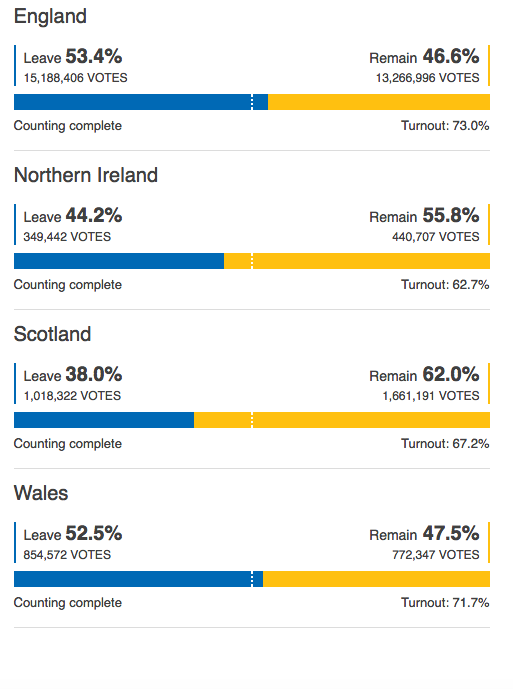
Heckuva job! Yesterday the British people faced a major vote on their future, and chose by a 52% to 48% margin to have the United Kingdom leave the European Union. The "Leave" vote dominated in most of England outside the major cities, particularly the capital, London, and in Wales, achieving a goal that UK Eurosceptics had pressed for since Britain joined the EU in 1973. On the other hand, Scotland, which nearly two years ago voted to remain part of Great Britain, voted overwhelmingly to remain part of the EU, as did the heavily Roman Catholic western counties of Northern Ireland. Only months ago, polls showed the "Remain" position in the lead, but last night's vote was decisive, with a 72% turnout and 17,410,742 votes in favor of withdrawing vs. 16,141,241 against. (Strangely enough, the UK's leave vote total was almost identical to its 1975 vote, at 17.3 million, to stay in the EU.)

The vote spells the end of David Cameron's six-year tenure as Prime Minister and head of the Conservative Party, since he had called the national referendum partially to decisively quell an intraparty struggle between the Conservatives' dominant, elite neoliberal faction and its vocally Eurosceptic, far-right flank, and to consolidate his power as PM after having been reelected just 13 months ago with an increased Parliamentary majority. Now he's out of a job, and his party is in disarray. The successful leave vote also may endanger the position of main opposition Labour Party leader Jeremy Corbyn, who unenthusiastically supported staying in the EU, which was also the stance of the Liberal Democratic Party, led by Tim Faron.

(Image © BBC.com)
The main political beneficiaries of the vote appear to be former London mayor Boris Johnson, a controversial MP, known racist and xenophobe, and longtime rival of Cameron's, as well as the United Kingdom Independence Party (UKIP), led by Nigel Farage, who lost his UK parliamentary seat but ironically currently holds one in the European Parliament in Brussels. Tussles over the UK's EU membership had created problems for Cameron's two Tory predecessors, Margaret Thatcher and John Major, and have now brought Cameron down as well. He has announced he will resign once the Conservatives have chosen a new leader, by this coming October. Corbyn's battle to retain his post will like ensue as well; he already has faced stiff challenges from the neoliberal wing of the Labour Party over his strongly Leftist positions and statements.

The "Little England" voters, particularly hit hard by globalization, the global financial crisis, and just as importantly, Conservative austerity under Cameron and his Treasurer and Chancellor of the Exchequer, George Osborne, chose the path emphasized by UKIP, which was to blame immigrants and decry directives from and treaty obligations to Brussels. Many issues, such as the EU's mishandling of the economic downturns in members states like Greece, Spain and Portugal; its central policy ensuring the free flow of EU member state citizens to wealthier countries like Germany and Britain; and its inability to provide a viable program to address the continent's influx of refugees and immigrants from outside the EU all combined to produce a potent brew that "Leave" voters swallowed wholesale. Despite the EU's stumbles, younger voters on the whole supported staying in, while voters above 50 supported the "Vote Leave" position, and ethnic, racial and religious minority voters unsurprisingly supported continued EU membership, while a sizable Britain's still overwhelmingly white electorate did not. This "populist" nationalism, which has clear parallels with Donald Trump's success in the GOP primaries, bodes ill for the stability of the UK as we know it. Queen Anne and her Stuart predecessors might not be the last British monarchs to hold a personal, rather than governmental, reign over the UK's constituent parts.

As predicted, the markets reacted with shock, with non-US exchanges suffering huge losses and the Dow plummeting 600 points. The leaders of the "Vote Leave" have already begun to backtrack somewhat on their claims about the financial benefits of Britain's independence, but they also face a more shocking scenario in that the UK itself could splinter, with Scotland once again holding a referendum to become an independent country, and, contrary to decades of tension, Northern Ireland, or at least parts of it, merging with the Republic of Ireland, an EU member state, to the South. While full Scottish devolution would probably mostly entail major administrative and bureaucratic challenges, any sharp changes in the sovereign status of Northern Ireland could reignite sectarian violence of the kind that marked the country for decades. Britain's vote could also spur a push by Eurosceptic and ultraconservative parties in other member states, like France and the Netherlands, to quit the Union. Whether Scotland can block the referendum's results is unclear. Also, calls for a new referendum have gained 2 million votes so far, and it's also unclear whether a popular referendum can override the will of Britain's elected Parliament. Unlike the the US, the UK has no written constitution (time for one!), and lawyers, legislators and historians will have to hit the books to figure out whether the referendum is binding or not. (Imagine if it turns out that it isn't!)

(Image © BBC.com)
The risks to Britain's economy and society are real. It has benefited from maintaining its own currency, which fell by 11% the day after the BREXIT vote, but its links to and avoidance of trade barriers non-EU states and across the globe face have helped its economy tremendously over the last 40 years. EU membership has also helped London become one of the world's global financial capitals; as an EU state with less regulation and a strong national currency, it has become a major spot to park money and speculate, all of which could change if the EU assumes a harsh stance on trade policy.

Withdrawal from the EU may also exacerbate xenophobic and racist elements in the UK, particularly given the putative leaders of the Conservatives and UKIP; neither Johnson nor Farage has hesitated to use overtly racist rhetoric and discourse to further their aims. Once Cameron's successor takes over, she, he or they will have a set timetable to follow, with roughly two full years expiring as the UK unwinds itself from Brussels' embrace, and renegotiates all manner of relationships with the EU's constituent states.

At the same time, the European Union must figure out a way to resolve its internal economic and social problems lest it too begin to splinter. The euro--and Eurozone--remains a major issue. Britain had avoided the euro debacle of the last few years, but it now enters very dangerous territory. How it and the EU's leaders respond in the near and long term will determine its fate.

Thursday, January 28, 2016

Who Runs the Publishing Industry?

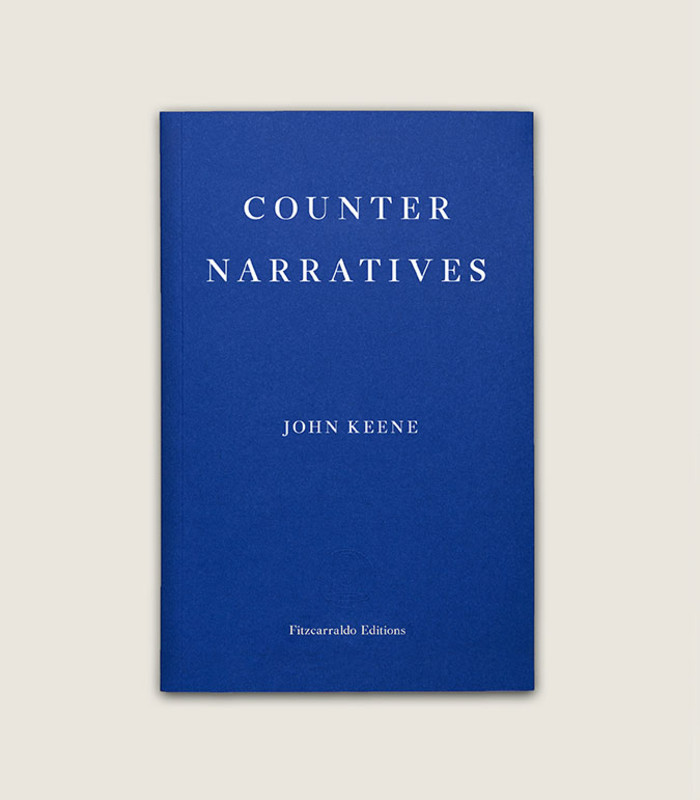
UPDATE: Jonathon Sturgeon has just posted a piece on Flavorwire comparing the publishing industry to the Motion Picture Academy of Arts and Sciences, and gives Counternarratives a shout-out in the process.

The semester has begun, Blizzard Jonas and all, and I can already see my blogging pace dwindling, so I am going to try to follow a plan I set out a few years ago but have never followed, which is to maintain my blogging activity by posting micro introductions to interesting things I find on the web, and just let the articles speak for themselves. (I also hope to do this with the stubs of pieces I've begun but not finished in the recent past.)
Marlon James at the Man Booker Prize ceremony
So here goes. Last year Marlon James, author of several novels, including the 2015 Man Booker Prize-winning novel A Brief History of Seven Killings (Riverhead, 2014), stated at a Guardian-sponsored event in London that the publishing industry "panders to that archetype of the white woman, that long-suffering, astringent prose set in suburbia. You know, 'older mother or wife sits down and thinks about her horrible life'."

He went on to say:
[B]ecause white women readers dominate the market, “the male editors will only accept one type of story. Everyone knows what a New Yorker story will look like. I could have been published 10 times over – I knew that there was a certain kind of prose I could have written; intense scenes that hinted, rather than explored.”
In its report on James's remarks, linked above, the Guardian noted that "Women, particularly white women, make up the vast majority of regular fiction readers, purchasing two thirds of all books sold in the UK. Almost 50% of women classify themselves as avid readers, compared to 26% of men." He expanded a bit on these assertions in a highly entertaining and informative Guardian Books podcast.

James was responding, in fact, to a Tin House essay, "On Pandering," by Claire Vaye Watkins, who received multiple prizes for her 2010 collection Battleborn. Watkins' is a rich, exploratory attempt to make sense of her experiences as a white woman writing in a tradition that usually valorizes white men, abets sexism and racism, and consciously and unconsciously urges women, including white women, to write against their perspectives and themselves.

Claire Vaye Watkins
To quote her:
The stunning truth is that I am asking, deep down, as I write, What would Philip Roth think of this? What would Jonathan Franzen think of this? When the answer is probably: nothing. More staggering is the question of why I am trying to prove myself to writers whose work, in many cases, I don’t particularly admire? I recently finished Roth’s Indignation with nothing more lasting than a sincere curiosity as to whether Roth is aware that these days even nice girls give blow jobs.

I am trying to understand a phenomenon that happens in my head, and maybe in yours too, whereby the white supremacist patriarchy determines what I write.

I wrote Battleborn for white men, toward them. If you hold the book to a certain light, you’ll see it as an exercise in self-hazing, a product of working-class madness, the female strain. So, natural then that Battleborn was well-received by the white male lit establishment: it was written for them. The whole book’s a pander. Look, I said with my stories: I can write old men, I can write sex, I can write abortion. I can write hard, unflinching, unsentimental. I can write an old man getting a boner!
In The New Republic, Phoebe Maltz Bovy took issue with James's assessment, penning a response, "Don't Let Men Attack Pumpkins Spice Literature,"filled with links to others responding to Watkins' essay. In it she asserted that James was half-right, and was focusing on literary sexism. She contrasted his take with freelance writer Nicole Perkins' reading of "On Pandering" in the Los Angeles Times, and stressed the need for a more intersectional understanding of the literary marketplace, and for the voices of women of color to be heard (yes!). (NYRB critic, author, translator and blogger Tim Parks offered thoughts about conformity in literature that sidestepped any discussion of race or gender, but which I thought connected at certain points with what all these critics were saying.)

There have been many other essays and articles on the lack of diversity and need for equity in publishing, including in children's literature. There are even organizations, like We Need Diverse Books, dedicated to highlighting and transforming this situation. A few years ago, a former student and I attended a great workshop in Brooklyn on diversifying children's literature, especially in the speculative fiction and fantasy genres. Shortly before he passed away the late, highly acclaimed writer Walter Dean Myers and his son Christopher--who used the term "apartheid"--published essays in the New York Times calling for diversity in children's literature. But the need across all genres remains, and not just in the US, but in other plural Western societies, like the UK.

Yesterday, Electronic Literature posted an article based on a new publishing diversity baseline survey by children's book publisher Lee and Low showing that the US and Canadian publishing industries are overwhelmingly white and dominated by cis-gender, abled heterosexual women. Moreover, executive level publishing jobs US and Canadian publishing executives are even more concentrated in the hands of straight, cis-gender, abled white women. Shades of Hollywood, though with a gender reversal. These are the decision-makers in the book biz.


These facts suggest that real diversity, beyond lip service, is necessary if the publishing even wants to begin to reflect the reality of the society around them; James' critique has a basis in the sheer facts of who runs the industry; and that Watkins' understanding of the internalization of male-centered values extends beyond writers, to the people and institutions that put books into readers' hands.

I'll conclude by saying that my own experience as an author has tended more towards what Marlon James says, though I have never let that stop me. In fact, I even encountered pushback from industry people--though not, thankfully, my publisher, New Directions, whose chairperson is the legendary editor Barbara Epler--concerning Counternarratives. In other ways, however, I have been fortunate to encounter people from all backgrounds--all races and ethnicities, genders and sexualities, national origins, class, religious affiliation, physical abledness--who have been supportive of my work, and whose work I could enthusiastically support.


Friday, January 22, 2016

Oscars Whiteout (Again)

Who really cares about the Oscars? Clearly some of us care about the Oscars. Should we care about the Oscars? Should we care about the fact that the #Oscars(Are)SoWhite--again?

For the second year in a row, the Academy of Motion Picture Arts and Sciences, the organization that awards out the annual gold-plated Oscar statuettes, considered the pinnacle of the multibillion-dollar American film industry's honors, have nominated an all-white slate of actors in the Best and Supporting categories. Ten slots, ten white women and men, and even in two films, Creed and Straight Outta Compton, with black leading actors, only a white supporting actor and the white scriptwriters respectively received nominations. No leading actors of other races or ethnicities were nominated, nor were any films in which they played the leading roles.

While this might not have drawn much notice fifty years ago in 1966 (which in fact did have an all white roster of nominees) or, in 1936 (unsurprisingly), closer to the Oscars' establishment in 1929, it does stick out in 2016, at a time when the United States is growing increasingly more diverse in racial, ethnic, religious, and other ways, and when industry figures themselves note that 46% of Hollywood movie ticket buyers in 2013 alone were people of color (designated as black, Latinx and "other" in the marketing study linked above), and Latinxs in particular are the most enthusiastic moviegoers. And the Academy has a black woman, Cheryl Boone Isaacs, as its president.

2013 in fact was supposed to be "turning-point year" for black filmmakers. In his The Dissolve article "New study puts numbers to the lack of minority representation in film," Vadim Rizov quotes producer Harvey Weinstein uttering a quintessentially post-racial (and deeply deluded) paean to America's changing political and thus social terrain, noting that the micro-burst of black directed and starred films "signals, with President Obama, a renaissance. He’s erasing racial lines. It is the Obama effect." How wrong he was and is. Hollywood cinematic representations lag behind those on TV, which has certainly improved since the heyday of the 1970s, and those "racial lines" Weinstein spoke of are as present today as they were in 2013 or before.

As it turns out, 2013 was more of a mirage than anything else. The USC Annenberg School for Communications and Journalism study that Rizov cites makes clear, diverse racial and ethnic representation in Hollywood cinema is still a problem:

Examining 500 top-grossing films released in the U.S. from 2007 to 2012, the study considers some 20,000 characters and finds diversity is sorely lacking. “Across 100 top-grossing films of 2012, only 10.8 percent of speaking characters are Black, 4.2 percent are Hispanic, 5 percent are Asian, and 3.6 percent are from other (or mixed race) ethnicities,” the paper notes at the outset. “Just over three-quarters of all speaking characters are White (76.3 percent). These trends are relatively stable, as little deviation is observed across the five-year sample.”

I observe this not only when I catch previews during my increasingly rare visits to see movies in theatrical release but on TV, where film after film appears to reflect a very narrow, usually white, upper-middle-class, coastal perspective. Innumerable stories not just from the present but the past remain offscreen, at least those screens commandeered by Hollywood studios. Non-traditional casting has improved somewhat, but people of color are still relegated to secondary or subsidiary, and often stereotypical roles, and even though blackface performance thankfully is rare to nonexistent in Hollywood these days, whitewashing source characters happens regularly, and yellowface characterizations crop up. Far more frequent, though, are stereotypes.  Quoting Rizov again:

Among the other conclusions reached: “Hispanic females are more likely to be depicted in sexy attire and partially naked than Black or White females. Asian females are far less likely to be sexualized.” While women got assigned the same kind of domestic status regardless of their race or ethnicity, “Hispanic males are more likely to be depicted as fathers and relational partners than males in all other racial/ethnic groups. Black males, on the other hand, are the least likely to be depicted in these roles.”

Some actors of color, like Kevin Hart--who has become the current go-to black sidekick-enabler in comedies--continue to make careers out of this situation. What exacerbates the problem is the lack of diversity behind the camera, with the ratio of white directors dwarfing directors from any other racial background. Thinking intersectionally, given the sexist and ageist challenges women in Hollywood still face (articulated without intersectionality last year by Patricia Arquette and again this year by media darling Jennifer Lawrence), things are even worse for women of color.

Meanwhile certain plotlines, including "white men battling adversity"; an older white man paired with a younger white woman; younger upper-middle-class white people facing relationships hurdles; and all or mostly white historical scenarios characterize a great many of the plots of Hollywood films. Yes, pace Vladimir Propp, there are a limited number of plots out there, but still a far greater array of narrative configurations, inflected by cultural difference, which is to say stories and experiences, in the US and across the globe, that rarely if ever make it through Hollywood's system.

Sylvester Stallone and Michael B. Jordan
in Creed (moviepilot.com)
This imaginative narrowness, which I would only partially chalk up to racism, only magnifies the inequities the Academy members' racial and gender makeup (94% white and 77% male) and voting patterns produce. Fewer and less culturally and narratively diverse film opportunities mean fewer roles in which actors of color appear on screen, whatever their acting skill level. I should also note that most of the black actors who have won Oscars in recent years have usually been honored for performances involving strong elements of abjection and spectacle, which also points to Academy voting biases.

Ultimately it comes back to gatekeepers at all levels of the movie industry who fail to approve and advance scripts and films that might offer a richer portrait of the society, or who tend to view issue of race and ethnicity, religious difference, and so on, through a narrow lens, are one major source of the problem. The revelations emerging from the Sony hack made this very clear. Moviegoers who support the status quo are another, but while it is conceivable that Americans could boycott Hollywood standard offerings (and excuses), films are a global business, circulating from Canada to Argentina, the UK to South Africa, Russia to New Zealand--and China is the largest single market of all. Hollywood's representations are not just a domestic problem.

Actress Jada Pinkett Smith, supported by her husband actor and musician Will Smith, who starred in the film Concussion (which I did not see) and did not garner a nomination this year, has called for a boycott of the Oscars ceremony, as has director Spike Lee. Actor and comedian Chris Rock, the event MC, may be considering boycotting the proceedings as well, though it appears he will show up and, I hope, skewer the debacle. Other actors, including 2013 Academy Award winner Lupita Nyong'o and actor Idris Elba have called out the movie and TV industry's failings, and in the Briton Elba's case, the UK's parallel problems with cinematic and TV racial representations.

April Reign, creator of the #OscarsSoWhite hashtag, has challenged one of the default excuses behind the film industry's ongoing whiteout, male domination and this and the previous year's nominations: "Don't tell me that people of color, women can't fill seats." But Hollywood, which pays attention to the bottom line, apparently isn't as concerned about who fills those seats as it is with endlessly replicating its tiny store of self-regarding visual narratives. It's not about the money, but rather systemic and structural problems that need to be dismantled completely. Perhaps beginning with a boycott of the Oscars this year, and from now on all movies with retrograde casting approaches and stories.

As important, filmmakers, actors and movie audiences must proactively devise ways to build systems to enable domestic filmmakers of color to create, distribute and screen not just more, but better films, and perhaps if people desire an awards system, as in the case in the literary world and other artistic areas, create that as well. The technology is increasingly there, as are the rival film bases Bollywood and Nollywood (whose films I increasingly watch). Given that Hollywood's earnings have taken a dip in recent years, the studios will change--or they'll realize too late that they could have but did not.