Wednesday, December 11, 2013

National Book Awards & Poem: Mary Szybist


I watch too much TV, still. I say every single day that I am going to cut back, and I have had periods (like winters in Chicago) when I could go for long stretches watching almost nothing except a show or two (The Wire, Sleeper Cell, Project Runway, etc.), but now that I'm back in New Jersey full-time, part of the rhythm of home involves that infernal digital box (I was going to write cathode ray contraption, but those days are now mostly gone). My TV watching--which does not preclude reading, for classes, for pleasure, etc.--even extended recently to a program I never thought I would sit through, the 2013 National Book Awards ceremony. It ran on CSPAN-2, I believe, and I know that I wasn't the only one watching, because as is now the case with many TV programs, it included a vibrant social media component, which meant that my Twitter feed lit up with comments from Twitterati I follow (or who were retweeting other wits and observers) who were watching the program too.


The fiction finalists

One part of me did think that it was perhaps ridiculous to be tweeting about an awards ceremony focused on book awards, but another part of me said, how wonderful that literary arts, though framed by a strong commercial push from the National Book Foundation and major global and domestic publishers, are not only being celebrated, but televised, and not just televised, but watched and reviewed in real time. Most of the people in my Twitter feed, as did I, tended to celebrate the authors, make positive comments about the winners' work and self-presentation, and cheer about specific books that were nominated and those that won. I thankfully did not see many--any?--negative comments about the authors or their book nor did I see arguments break out about the selections. In truth it is so rare to see living poets, fiction and nonfiction writers, and authors of young adult literature individually or together, and their work, their art, our arts, being celebrated no less, on our dominant cultural mass medium that I think this may have held a lot of negativity in check.


The nonfiction finalists

One person who provoked a smidgen of negative commentary was one of the two co-hosts, Mika Brzezinski. She struck me as somewhat incongruous amidst the proceedings, though it turns out that the National Book Awards finalists were revealed on Morning Joe, the program she co-hosts with former GOP Congressman Joe Scarborough. I am not being snide or snarky when I say that while I think she may be a savvy person--and she has gotten quite far in the world, admittedly with the boost of a famous parent--she does not give the impression of being a regular reader or literary enthusiast. But I have not studied her life exhaustively and could be quite wrong; she did study English at Williams College and very well may consume books the way many around us devour reality TV shows and TV melodramas, and perhaps her performance on Morning Joe is more performance than anything else. She unfortunately did make a major flub when, after having announced the order the prizes would be handed out--there were only four, so it should have been fairly easy to remember them and figure out something was amiss, especially for an on-camera professional--she announced the nonfiction presenter instead of the person presenting the award for fiction. Allegedly she also left before the awards ceremony was over. I guess too much of the book business can get to some.


The poetry finalists

The winners included author and musician James McBride for his Civil War-era novel about a young man who accompanies abolitionist John Brown, The Good Lord Bird (Riverhead Books/Penguin Group USA); nonfiction writer George Packer, for his meditations on the contemporary state of American society, The Unwinding: An Inner History of the New America (Farrar, Straus & Giroux); Cynthia Kadohata's young adult book The Thing About Luck (Atheneum Books for Young Readers/Simon & Schuster); and poet Mary Szybist, who gave the most affecting speech this year, for her collection Incarnadine (Graywolf Press). A few years ago a furor arose because the five fiction finalists were not well known, and most were with smaller presses, but as this year's winners make clear, the big houses mostly cleaned house. There also was for the first time a Man Booker Prize-like longlist, which I think aimed to generate a bit more "buzz" and was a good idea in terms of honoring more writers than fewer, though in a sense it also seems a bit cruel to those who did not advance to the finalist stage. But what are you going to do? In any case there are several more big American/global literary prizes to go (the National Book Critics Circle Award, the Pulitzer Prizes, and the various PEN awards, etc.), so perhaps some of the nominees who did not win this time will merit consideration for some of the ones for later this award season cycle, and other authors, like the great Jay Wright, and my brilliant and prolific Rutgers colleagues Rigoberto González, Jim Goodman, Rachel HadasJayne Anne PhillipsBrenda Shaughnessy, all of whom I believe published new books (several in the case of Rigoberto!), will also receive some of these honors. Congratulations to all this year's winners--and to all 2013 authors too!


The young people's literature finalists

I thought I would post two of the most formally daring poems from Mary Szybist's Incarnadine. Their content and rhetoric give a good sense of the book and its concerns, though these two poems go much further, in terms of their formal daring and visuality, than the rest of the book, thus making them almost unrepresentative. I have to say that I like them and like looking at them and like trying to read them, and like that an author is both tackling the subject of God and the numinous, and yet also doing so in ways that are unexpected. And I like that some other poets and critics, serving as judges, saw fit to honor such daring. Several of my undergraduate students have been particularly interested in poetry's non-verbal qualities and abilities, its multiple capacities for signification, and these poems, hearkening in some ways back to George Herbert in the case of the "How (Not) to Speak to God" and to May Swenson or the Concrete poets, just to offer a few examples, in the case of "It is Pretty to Think," exemplify what my students and I have been talking about.


Enjoy:


Copyright © "How (Not) to Talk to God" and "It Is Pretty to Think," by Mary Szybist, from Incarnadine, Minneapolis: Graywolf Press, 2013. All rights reserved.


Thursday, December 05, 2013

Nelson R. Mandela, 1918-2013


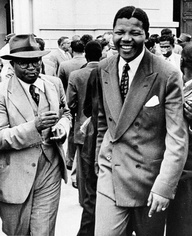
We have lost one of the true heroes and greatest statesmen of our era or any other. A brilliant person, a freedom fighter, a beacon of resistance, a visionary leader, an icon of peace. A person who, alongside others, bore arms when he needed to. A person who, alongside others, consulted the law when he needed to. A person who, alongside others, endured decades years in prison because he had to. A person who, alongside so many other women and men, brought a new dawn and a new day to one of the most benighted countries, wracked by the cancer of institutionalized and systemic racism and white supremacy known as apartheid. A man who chose democracy, who chose inclusion, who chose justice informed and enrichd by forgiveness rather than vengeance. A man who promoted economic, political and justice in the new South Africa. A man who assumed the role of President of a renewed country that was forever changed, giving hope to his people, all the people of his country, and to many more across the globe.

Nelson Rolihlahla MANDELA (July 18, 1918 - December 5, 2013)

The forthcoming New Yorker cover
by Kadir Nelson


Mandela in traditional clothing
A young Mandela
President Nelson R. Mandela
Mandela the young lawyer
Celebrating with Miriam Makeba
Mandela at an ANC rally
Winnie and Nelson Mandela
as newlyweds
"I am prepared to die" (1964)
Mandela at Robben Island

Nelson Mandela with Walter Sisulu

Mandela receiving the Nobel Peace Prize
with South Africa's last apartheid
leader, F. W. de Klerk
MADIBA
Mandela with actor and musician Will Smith

The landmark 1994 South African
presidential ballot
Rest in peace, Madiba, rest in peace.

Videos after the jump:

Sunday, December 01, 2013

World AIDS Day

World AIDS Day. December 1. Today is the  25th World AIDS Day. Around 35 million people across the globe are living with HIV/AIDS, and new HIV seroconversions are declining. Embracing and helping to foster public policies that advance this decline are part of what World AIDS Day aims to do.

You can find more information on the global approach to HIV/AIDS at the World AIDS Campaign's website.

Here are some basic facts about HIV/AIDS, from the UK's World AIDS Day site, that we all should know.

HIV can be passed on through infected bodily fluids, most commonly via sex without a condom or by sharing infected needles, syringes or other injecting drug equipment.

And:

There is no vaccine and no cure for HIV.

And:

Please consider getting tested for HIV so that you know your serostatus.

[Use the AIDS.gov locator below, if it appears on your browser, to find a testing site near you.]

Also:
  • You can now get tested for HIV using a saliva sample
  • HIV is not passed on through spitting, biting or sharing utensils
  • You can get the results of an HIV test in just 15-20 minutes
  • There are a number of things you can do to reduce the risk of serotransmission and seroconversion

Also, HIV/AIDS seroconversion is not a moral judgment, you cannot tell whether you or someone else has HIV/AIDS just the way she or he looks, and it's what one does that is the key factor for HIV seroconversion. These all seem like old hat some three decades into the HIV/AIDS pandemic, but it remains the case that too many people still don't know or fully understand these facts, and many others.


You can find many more facts about HIV/AIDS, including discussions of risk reduction, HIV testing and counseling, prevention and research, and ways to find help, support and treatment if you or someone you know is diagnosed with HIV/AIDS, legal rights, steps for discussing serostatus with family and friends, other health-related issues, and more here.

The much-maligned Affordable Care Act includes coverage for HIV/AIDS treatment and support!

USCA 2013 Federal Plenary on the Affordable Care Act

UPDATE: The ever on-top-it Rod 2.0 featured the following excellent graphic about HIV/AIDS and young gay men. You can find more information on Rod's excellent blog.


Friday, November 29, 2013

Poem & RIP: Wanda Coleman

Wanda Coleman at Woodland
Pattern's 25th Anniversary Celebration,
Milwaukee (© Woodland Pattern)

There is so much to say when a great poet leaves us, and so much we need to say when that poet, while critically praised, nevertheless did not receive the acclaim she deserved during her lifetime. Wanda Coleman (1946-2013) was such a poet. The unofficial poet laureate of Los Angeles, her native city, a product of the flowering of writing workshops, some informed by the political and social currents of the 1960s, a working poet her entire life as well as a TV scriptwriter, journalist, playwright, novelist, a soothsayer and mage of language in a range of registers, a writer who knew how to fuse criticism and beauty, wit and ugliness, often funny, often lacerating, rough as tea leaves, gentle as a blowtorch, prolific, daring, unapologetically black and a woman and a mother and a lover, unapologetically cosmopolitan and creative and visionary, someone who lived her literature, Coleman passed away last weekend after a long illness.

She was one of the poets I always wanted to hear and see read live. I remember someone telling me about her performance that later appeared as poems in Tripwire, how she rocked as she read, how she declaimed the poetry with force and ferocity, how she could as easily be reading with a jazz or blues or rock band--and she recorded with Excene Cervenka among others. There was rhythm, blues, jazz, roll, rap, struggle, soar, and sear throughout her work. But I never was where she was when she was reading live, and so I was a fan from afar, turning to the pages of Mercurochrome or African Sleeping Sickness or her other books with admiration and awe, knowing that somewhere out there in the cosmos, Wanda Coleman's gifts, received and given, were and are resounding, and that readers, young and old, who were unfamiliar with her work might be so moved to crack open a volume to sample and savor what she has to offer.

Here are two poems from Mercurochrome: New Poems, a volume which includes a fine range of her talents, including her continuation of her "American Sonnets" series, which play hard with that form, as well as her "Retro Rogue Anthology," a series of riffs on major American poets (from Alan Ansen and John Ashbery, to C. D. Wright and Charles Wright), that both capture and send up those writers while also demonstrating Coleman's skill and verve. She was the real thing, word. So: two poems. Remember her, remember and read her, read her and listen to what she has to say.

EL CAMINO REAL

leads me through one overtaxed
little citytown
after gas stop after vista view,
eludes the gridlocked main highway,
avoids the rain-and-moon patrols and fiery
extinction on that hairpin curve
of credit and industry. i'm on the look see
for that mean motor scooter,
one payment outracing the other
as i nightdrag cloud-lined bluffs toward
the destination i'm building on installments,
fingers crossed as i drive, double-malted in one hand,
French fries tucked against the armrest,
cheeseburger leaving grease stains
on the dashboard of my vision

AMERICAN SONNETS: 95

seized by wicked enchantment, i surrendered my song

as i fled for the stairs, i saw an earth child
in a distant hallway, crying out
to his mother, "please don't go away
and leave us." he was, i saw, my son. immediately,
i discontinued my flight

from here, i see the clock tower in a sweep of light,
framed by wild ivy. it pierces all nights to come

i haunt these chambers but they belong to cruel
     churchified insects.
among the books mine go unread, dust-covered.
i write about urban bleeders and breeders, but am
troubled because their tragedies echo mine.

at this moment i am sickened by the urge
to smash. my thighs present themselves

stillborn, misshapened wings within me.

"El Camino Real" and "American Sonnets: 95," Copyright © by Wanda Coleman, from Mercurochrome: New Poems, Santa Rosa: Black Sparrow Press, 2001. All rights reserved.

Thursday, November 28, 2013

Happy Thanksgiving

REPOSTING from 2011, with updated dessert photo!

A happy Thanksgiving Day to all, and I wish the best to all J's Theater readers. Wherever you are, whatever you are doing, try to take time out to consider what you have to be thankful for, as tiny or tremendous as it is, and also consider how you might help someone else out there who might be struggling in some aspect of life.

For those who are scrambling to finish holiday meals, if you want a thorough and easy-to-read guide to holiday cooking with a soulful edge, consider C's Holiday Kitchen, which is now available as an ebook on the Amazon Kindle, B&N Nook and iTunes stores.


There's also an iPhone/iPad app version as well!

I can attest to the deliciousness of every dish in this book. But don't just take my admittedly biased advice: as Maggie Da Silva writes in her Examiner.com review,  the author

is no snob and helps us out with painless instructions for turkey roasting, “one of the easiest meals to prepare,” he writes. “Try it!”  He also provides simple recipes for dishes I had assumed were beyond my reach – like lemon curd! Who knew it was a snap? In fact, most of the recipes in this delectable ebook reveal what all experienced cooks know: food doesn’t have to be complicated to be great.

So true!

This year I am going to make a pumpkin pie, so if it turns out okay, I'll post a photo of it!

Update: The pumpkin pie! It turned out well, and everything about it, from the crust to the filling, is homemade!

Untitled
Homemade pumpkin pie, using
real pumpkins!

Wednesday, November 27, 2013

The Black Atlantic @ 20 @ CUNY Grad Center

Every scholarly book is important (at some level) to its author, but as with other kinds of texts only a select few resound long beyond their field and moment of publication. Paul Gilroy's The Black Atlantic: Modernity and Double Consciousness, published in 1993 by Harvard University Press, is one such book whose central premise, that "blackness" was and remains constitutive of and central to "Modernity" and the political, economic, social, and intellectual development of the "West" as we know it, opened up new ways of thinking about and understanding the relationship between these concepts across a range of fields, including literary studies, anthropology, history, sociology, political and philosophical thought, and cultural studies. Two decades on, and despite an array of critiques, Gilroy's The Black Atlantic, continues to foster and inform new and older epistemologies linked to modernity and its multiple afterlives.
Paul Gilroy speaking with Jacquelyn
Nassy Brown and Robert Reid-Pharr
A month ago, at the CUNY Graduate Center, CUNY's Academic Research Collaborative, Certificate Program in American Studies, Caribbean Epistemologies Seminar in the Humanities, Institute for Research in the African Diaspora in the Americas and the Caribbean (IRADAC), and the Revolutionizing American Studies Initiative, sponsored a two-day event, The Black Atlantic @ 20, as part of a series of events throughout the 2013-2014 academic year, focusing on the Gilroy's book and work. The speakers included Gilroy himself, as well as numerous luminaries teaching or visiting CUNY, including Jacquelyn Nassy BrownSusan Buck-Morss; Tina Campt; Kandice ChuhDuncan FahertySujatha Fernandes; Eric Lott; Stephan PalmiéRobert F. Reid-Pharr; and Ruth Wilson Gilmore. 
Faherty, Nassy Brown, Reid-Pharr,
Buck-Morss, Fernandes, Wilson Gilmore
and Bennett
As the program noted concerning the effects of Gilroy's book, "scholarship no longer simply posits the relationship between blackness and modernity as an irreconcilable problem," and while we might argue that Gilroy was not the first or only thinker to challenge this assumption, his study, perhaps more than any of its particular moment, the ideas in it, and the pedagogy he and it enabled "engendered debates" in a range of humanities and social sciences fields that were "once perceived as the exclusive domain of an organic and hermetically sealed Western tradition." The opening night's panelists, Bennett, Nassy Brown, Buck-Morss, Fernandes, Wilson Gilmore, and Reid-Pharr, all delivered short pithy (9 minute) presentations showing the field critiques and responses respectively in history; anthropology; philosophy; hip hop and musicological studies; geography; and literary studies. Each asked and answered the question of whether it is possible to "produce innovative work around race, colonization, cosmopolitanism, and imperialism while also continuing to privilege traditional modes of intellectual inquiry," and several also contributed to a larger conversation that the Revolutionizing American Studies initiative and other programs have been posing for some time about ways to restructure research and pedagogical approaches at the CUNY Graduate Center and beyond.
Paul Gilroy chatting with an audience member
I could fill about 10 blog posts if I were to recount all of the dazzling insights the panelists offered, but I'll touch upon only a few. I should also note that not everyone who spoke offered a paean to Gilroy's book; several were thoughtfully and respectfully critical. Yet all attested to the centrality of the work to ongoing work in their fields. Herman Bennett noted how the text had helped to further an "epistemological exorcism" in terms of understanding race in Latin American intellectual history, and opened up "a new horizon of employment." Nassy Brown was more overtly critical, and cited Gilroy's earlier landmark study, There Ain't No Black In the Union Jack as particularly important, but averred that Gilroy's work in both texts had played a key role in fostering an anthropology of global blackness, and its engagement with geography, which is now framed in dialogic terms. She also noted the importance of its having posited "emancipation" as a touchstone for black subjectivity.
Ruth Wilson Gilmore speaking with
a member of the CUNY community
Buck-Morss did not deliver a paper, but spoke from notes. She urged that we not forget the "political reality in which the text emerged," its challenges to the "disciplinary police," and its skill in placing events and histories in juxtaposition, its rejection of ethnocentrism and nationalism (which remains controversial, as Gilroy noted in his own comments the next day), and its exploration of aesthetics as self-fashioning and critique of art as "immanent." Fernandes focused on how music in particular held pride of place in Gilroy's analyses, to some extent displacing language and writing, but how his text also pushed us away from Black American situatedness towards a more diasporic perspective. Wilson Gilmore's short talk brimmed with insights, beginning with the basic fact that the book had made it possible for her to understand the discipline she'd chosen. Other key points she made were that in this text, "theory is method," that it brought together the concept of diaspora not by a mythic path but through a "continuous and ongoing present"; and that it critiqued Raymond Williams' famous Structures of Feeling, in part by laying out the contradictory structures of feeling in diaspora, asking what discontinuous traditions rested on, and what might be the infrastructures of feeling that made the structures of feeling possible, reshaping our sense of the archive.
Poet and scholar Tonya Foster
Reid-Pharr concluded the panel presentations with brio, asking that, after Gilroy, we think about black intellectuals in less obvious positionalities, such as among the enslaved people in transit, on board ships or at market, that we ask who counts as a proper subject of our inquiry, and that we consider immigrants, sex workers, soldiers, and so on, jettison our reliance on heroic subjectivities. Are we, in the light of Gilroy, committed to give up cultural nationalism, he asked. After these brilliant presentations, Gilroy graciously took the podium to thank everyone for their comments on his behalf, and noted that he had always thought of The Black Atlantic as an "open-source project," rather than a closed intellectual work forbidding critique. It was a powerful moment, and added to the intellectually generous atmosphere that unfolded as the question-and-answer session began. If one sentence can sum up the fascinating exchanges during this section of the program, it would be: "Freedom is the practice of making unbounded life."
Scholar and critic Eric Lott
The next day, I did not make it over to CUNY until the early afternoon, and thus missed the morning talks by Palmié and Campt. I did get to hear Eric Lott, whom I first met many years ago when he had just published Love and Theft and was starting out at the University of Virginia, weave a web of thought that has to be read to be fully appreciated, but his talk "Open Letters," which poet and scholar Tonya Foster introduced, managed to tie together President Barack Obama's Dreams of My Father, and his negotiation between sovereignty and homo sacerLauren Berlant's concept of the "anatomy of national fantasy"; the Emancipation ProclamationMartin Delany's Blake; Jay-Z's and Beyoncé's controversial trip to Cuba and Young Hov's rap "Open Letter," which Lott assessed as "derailed by neoliberal self-regard"; Assata Shakur; and methods and ways of reading and analyzing popular music. It was a breathtaking tour.
Paul Gilroy
Last came Gilroy, who in a talk entitled "The Half-Life of The Black Atlantic" spoke about the book's afterlife, criticisms of this and subsequent work (especially the furor-inducing Against Race: Imagining Political Culture Beyond the Color Line (Harvard UP, 2002), and how he might rewrite The Black Atlantic today. He also mapped out what he saw as potential future pathways the book's ideas might offer. He began by discussing the critique of methodological nationalism in the book, and said that were he to write it today, he would include Alain Locke in it. He also spoke about how one strand in it to develop might to look more closely at the idea of culture in relation to "war," and African-American culture as "the machinery of diplomacy" today, which is to say, as a kind and form of "soft power". He related this to Penny von Eschen's work, and the idea of the "weaponization of culture." He also talked about the cultural revolution neoliberalism is wreaking, and how this is altering the currency of racial difference. He gathered around this idea the notion of "neoliberal poetics" and "depressive hedonia." Religion was another direction for further pursuit, and the idea of freedom as "individuality within a religious context," which he asserted once would have been problematic within Christianity.

Other points included thinking of Marcus Garvey and the idea of a cultural multiculturalism not limited only to black people and other racial and ethnic minorities; the increasing influence of neoliberal "self-help books" among young people of color in the UK and the USA (Sawyer, 50 Cent with Robert Green, etc.), and the ways that these ideas were having the effect of "soliciting the cooperation of people into their own subordination." He related this to the ongoing belief that through "work" and financial success, "deep racism" could be overcome, and to history of being denied recognition as a individual and how this was leading to an "extreme individualism." From this he proceeded to talk about the possibility, inherent in Aimé Césaire's writings, of the "human raised to the dimension of the world" as a way of positing a "new humanism," but which licensed a "critique of racial categories." Such thinking about "humanism" would be difficult given the extensive anti-humanist training and reflexes now present in the academy, and the appetite both for post-humanism and adherents to that concept's lack of concern with racism. (We discussed this in my fall 2012 class on the topic.)
Robert Reid-Pharr
In discussing this possible humanist turn, Gilroy invoked W. E. B. DuBois (whose name had, naturally, come up more than once already) and his idea of the tertium quid (that third thing, between human and animal); the humanism of Rev. Dr. Martin Luther King, Jr., and the strikers in Memphis (I AM A MAN); June Jordan's Civil Wars, in which she demanded a "reinscription of the human guided by cosmopolitanism" and gender, reifying no identities at all; and the great Sylvia Wynter, who long sought to give critical theory a role in "re-enchanting humanism," with "race" summoned as "solidarity." Lastly, Gilroy spoke about the role in South Africa of forgiveness in informing humanism. Unsurprisingly, many questioners asked Gilroy specifically about his conceptualizations of humanism, and he ranged widely, mentioning Frantz Fanon, the US success of "settler colonialism" and the lack of public queries about a Truth and Reconciliation Commission (or multiple ones) here, Donna Haraway's arguments about Sojourner Truth's aims to articulate "an alternative humanism", Fanon's and Edward Said's secular humanism, and so on. In response to Caricom's call for "reparations" from Britain, Gilroy talked about being "disposed against melancholic formations" and called for a "working through rather than melancholic" responses. And there was so much more (environmentalism and biocolonialism; his omission of "Taksim Square" in relation to the topic of "democracy"; the topic of temporality and music, and how sonic environments allow us to "hear around the corner or into the future", etc.), but I'll end here by saying that it was like a weeklong seminar I'm still working through, and I thank all the speakers, and especially the organizers and Paul Gilroy himself, for this exemplary event that offered real intellectual and critical engagement.
The Skylight Room
Reid-Pharr and Gilroy, in conversation

Monday, November 25, 2013

Farewell to the Clocktower Gallery


In 1972, New York was a very different city than today. (It was even quite different as recently as 2002.) Less populous, far poorer, much grittier. The City was only a few years from near-bankruptcy, and decades into its ongoing economic decline. Yet 1970s New York was also experiencing one of its great moments of creative ferment, as artists old and young were developing new artistic forms as well as venues to perform and display them. The Clocktower Gallery, which Alanna Heiss established in the upper reaches of a beautiful 1894 Mead, McKim and White building in lower Manhattan, became one of the important sites for downtown avant-gardists, as well as one of several spaces operating under the larger framework of the Institute for Art and Urban Resources, which produced experimental works in under-used spots, among them 10 Bleecker Street, the Coney Island Sculpture Museum, the Idea Warehouse, and P.S.1 Contemporary Art Center (now MoMA PS1), all over the city. As a result Clocktower was the oldest continuous space for alternative art in New York.

Among the artists who exhibited at the Clocktower Gallery are names now burned into the annals of late 20th century art: Marina Abramovic, Vito Acconci, Laurie Anderson, Richard Artschwager, Lydia Benglis, Gordon Matta-Clark, Michelangelo Pistoletto, Pat Steir, and Richard Tuttle. Matta-Clark even famously soaped up and showered on on the actual external clock's hands! Some 30 years later, in 2003, the building began housing the online radio station and audio archive Artists International Radio (www.ARTonAIR.org). In keeping with contemporary New York reality, developers have purchased the building and plan to transform it into…you know what's coming: luxury condominiums and retail space. Because there cannot ever be enough housing for the superrich, or spaces for national and global chain stores or restaurants and service outlets for the global élite!

This past Saturday the Clocktower Gallery was shuttering its final exhibit, Dale Henry: The Artist Who Left New York, an amalgamation of a number of Henry's (1931-2011) prior New York shows, and last-day performances, so I made sure to stop by. The Clocktower Gallery was not just an exhibition space, but a hive of artists' studios, most of which had been almost completely packed up by this weekend. What I found once I had passed through the security gauntlet downstairs (after being singled out--I was the only brown-skinned person waiting to get in--by one of the guards, who demanded to know if I'd RSVP'ed, and even after I said I had and tried to explain the admissions procedures on the website, would not believe me, until someone from the gallery itself appeared and ushered me forward--WTF?) was that only traces of the once vibrant art-making atmosphere remained. Henry's show seemed a fitting analogue to the gallery's closure, however. He had left the city in the 1980s after growing increasingly disenchanted with the art world of that era (which of course is nothing like the international financial behemoth of today), and moved to a small town in Virginia, from which he stayed in contact with longtime friends and where he continued to create new work. At his death, he left his art to gallery founder Heiss, with the proviso that it not be parceled off and out to the same sort of wealthy speculators involved in the gallery's closure.

The security gauntlet downstairs
At the gallery's entrance
Performing on the gallery's final day was Min Tanaka, who danced a farewell to the space. I'd never seen any of his prior performances at Clocktower, but his history with the gallery and the New York artworld was a long one, and included a dance at the opening of PS 1 and a dance to commemorate author and critic Susan Sontag's death in 2005. Tanaka danced his slow, almost dirgeful piece on a roof facing east, with a backdrop of skyscrapers worthy of Joseph Stella and a sky that Van Gogh might have dreamt of unfurling behind him, amid winds that made clear that winter was starting to settle in. A mourning, yes, but also a celebration of all the years that the Clocktower had brought so much new art to the city and the world. Now it searches for a new home, though it will lodge temporarily at Neuehouse, contributing to that space's programming; Heiss will be Curator in Residence. In 2014 the gallery will head to Brooklyn, now another global brand, to collaborate with Pioneer Works, Center for Art and Innovation, staging a new presentation of Henry's works and staying for a year's residency. As a result, Clocktower will live on beyond the archives, physical and memorial.  Below are some photos from the space.

Entering the Clocktower Gallery space
The hallway off which studios once bustled;
Mary Heilman's Two-Lane Highway is
visible on the floor
One of the former studios
Part of Dale Henry's Continuous Lineage Drawings
and Prosody Drawings, originally exhibited in 1973
One of the evacuated studios
The roofs cape of lower Manhattan
In another of the former studios
Another of the former galleries
$3 glasses of red and white wine
One of the stairwells to the upper floors
Henry's Camera Obscura, 1996

In the main gallery, with several different
series of Henry's paintings
A ceiling-mounted painting
from Henry's Wet Grounds, 1971
(I love the idea of this; why don't
more artists try this?)
A closeup of one of the pieces from
Henry's Primer Sets Installation, 1972
Some of the rows of paintings from
Henry's Primer Sets Installation, 1972
A closeup of several of the paintings from
Henry's Primer Sets Installation, 1972
Henry's Body of Work, 1976
The original announcements for Henry's
shows, as well as a 1970s guide
to New York's art galleries
Some of Henry's Stretcher Bar Series, 1976
works (all made from wooden stretchers)
Waiting for the performance to begin
The spiral stairwell to the clock tower itself
(it was roped off)
People gathering for Tanaka's performance
One of the gallery attendants, adorning
the spiral staircase
Onto the roof below the clock
(The Woolworth Building in the rear)
More (including Min Tanaka) after the jump!