Showing posts with label american poetry. Show all posts

Monday, April 30, 2018

Poem: John Yau


I end this month's run of ekphrastic poems with yet another approach to the genre, by John Yau (1950-), a poet whose work has garnered an array of awards over the years but who, I believe, remains still too little known or discussed. A native of Lynn, Massachusetts and a longtime professor of art history and criticism at Rutgers University-New Brunswick, Yau began publishing his work in the early 1970s, and from the beginning, he showed a singular voice with his inventive, playful, humorous poems, drawn from his experience as an Asian American child and young adult growing up in mid-century America, viewing the work of Asian American and white artists, taking in the mass culture of those years, and engaging in dialogue with his avant-garde contemporaries as well as senior figures whom he studied with at Boston University, Bard College and Brooklyn College, including John Ashbery and Robert Kelly. Yau also has published fiction; established and runs a press, Black Square Editions; and serves as a freelance curator, and regularly writes for an online magazine he co-founded, Hyperallergic Weekend. He was the Art Critic for the Brooklyn Rail from 2006-11.

Yau's poetry can range from riffs on popular culture to readings of rarefied art, but his personal, incisive vision and sensibility always come through. By far the best and most subtle reading of Yau's poetry (and of Mei-Mei Berssenbrugge's work, Asian American poetry and contemporary experimental poetics, particularly in relation to the politics of race and form in general) can be found in Dorothy Wang's award-winning scholarly monograph Thinking Its Presence: Form, Race, and Subjectivity in Asian American Poetry (Stanford, 2014). As Dorothy notes in the opening of her first chapter on Yau, in his work one can find "Film noir, Jasper Johns, Peter Lorre, Anna May Wong, Eugene Delacroix, Boris Karloff, Dashiell Hammett, X-rated movies, German Expressionist writers...." (Wang, Thinking Its Presence, p. 162). Yau has developed a unique means for bringing all of these strands together, even though, as he has said, he aims not to have a particular "style," but to leave open all avenues of experimentation.

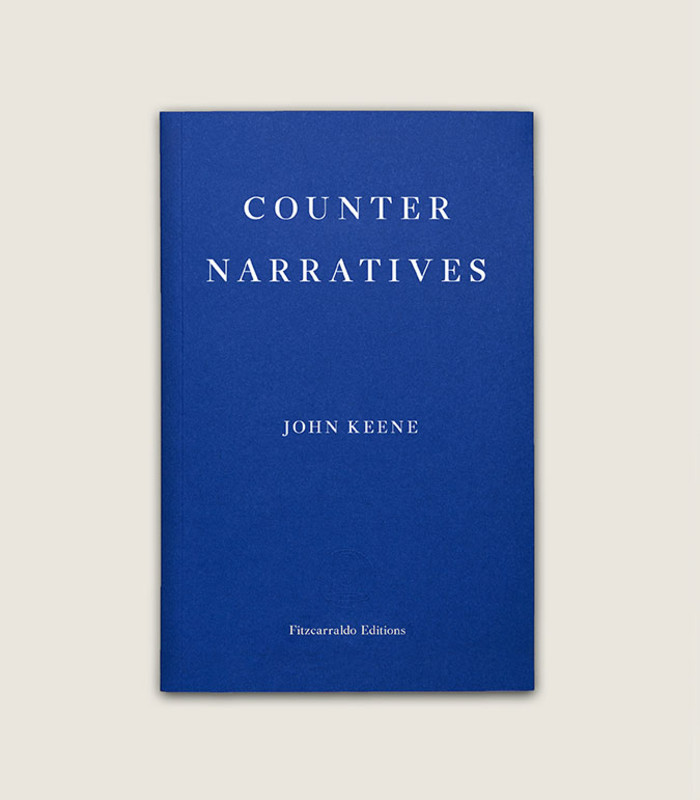
Like Ashbery, Yau has written extensive art criticism, and published a hybrid book of poetic criticism, entitled Further Adventures in Monochrome in 2012. The title immediate tips off an astute reader to the book's subject and focus: the experimental genius and proto-conceptualist Yves Klein (1928-1962), whose untimely death cut short a path-charting career across a range of formal experiments. Klein was a painter, composer, sculptor, installation and performance artist, judoka (!), and exemplar of the Nouveau réalisme movement, while also prefiguring Pop and minimal art. And, as I wrote of Frank O'Hara but a few days ago, he accomplished all of this in a very tiny window of time. Perhaps best known for his International Klein Blue 191, the sublime, seemingly infinite blue monochrome that he made the subject of various works--and which is the color of the British edition of Counternarratives, published by Fitzcarraldo Editions!--he also created a number of other works that both critiqued the post-war moment of their appearance and looked forward to whole swaths of art to come.

In Further Adventures in Monochrome, Yau attempts to do more than write about Klein and his art. In 2013, Rachel May interviewed Yau for the Los Angeles Review of Books, and introduces the collection in this way:

The title poem of Further Adventures, written in 15 sections that alternate between poetry and prose, addresses issues central to Yau’s work: his insistence that “painting is not dead,” the materiality of paint and language, language’s plasticity. He takes on the voice of Yves Klein throughout the poem’s 15 sections, and also speaks to Klein’s own writing about painting in 1954, and engages with Baudelaire, Mallarme, Dickinson, Rilke, Trakl, Whitman, Pollock, Warhol, and Johns, among others. The work is sometimes playful, as in the section titled “(Robert Desnos and Yves Klein meet in the sky),” but he’s pushed past what might be categorized as ekphrastic poetry or criticism, to create a form that combines the two. He speaks from or with the art, rather than “about” it. The penultimate section opens in the voice of Klein:

What I wanted from art was impossible. This is what every artist wants. If you settle for the possible, then your failure is ordinary, although, in a few cases, spectacular. I didn’t want what was there for the taking, the images of things that could be named. I didn’t want to add names to the vocabulary.


 Yau goes on to say in the interview that

That’s part of it. In a way, what I learned from painters is that words could be treated as things, that you could put any one color next to any other color. And I thought, in poetry, you should technically be able to put any one word next to any other word. So, looking at painting made me look at language differently.

I’m interested in what language is capable of, and I am interested in collage without collaging. In other words, I do try to put one thing next to another — words, phrases — but I haven’t actually collaged. I haven’t taken it from one place and collaged it next to something from another place.

Here then, is the excerpt, borrowed (as I did with Shin Yu Pai's poems the other day) from Michael Leong's excellent curated selection, "Lines of Sight: Visual Art in Asian American Poetry," at the Asian American Writers Workshop's online site The Margins. I have blathered on enough, so let's read and hear what Yau's poetic speaker--and Klein and his work(s)--have to say.


FROM “FURTHER ADVENTURES IN MONOCHROME”

by John Yau

4)

I dwell in possibility, Emily Dickinson

I dwell in impossibility, Yves Klein

You should understand that I did not want you to read a painting. I wanted you to bathe in it before words domesticated the experience, and you turned to such stand-bys as “illumination” and “transcendent” to describe what happened to you. Painting should not be sentenced to sentences.
Painting is COLOR, I yelled at my first champion and biggest supporter. COLOR banishes words from its domain. When you read a painting, you turn it into language, but there is so much that cannot be turned into language that each of us experiences every day.

Red shadows leak out of rusting cars and collapsed bridges. Green smoke rises from behind horizons and rooftops. The spectrum of your mother’s voice the last time she spoke to you.
Every day there are thresholds that you must cross to reach the domain where words mar every transmission, rendering them intangible. We put our memory of these reverberations aside in favor of what is known and, we believe, knowable. We say we are going to the beach and we will look at the ocean and leave indentations in the sand, but that is not what happens. We go there to ponder a blue parcel cut from infinity.

True poets and artists know where language ends, which is why they go there. Some settle for going beyond the possible into possibility, but others want to dwell in the impossible. I am not talking fantasy here, because that version of the impossible is just a story about a girl named Thumbelina or a boy named Jack. The ones who go to where two roads diverge in a yellow wood are not poets, because they believe that experience can be reduced to a lesson about choices. True poets know that language is neither window nor mirror. The mistake is to believe that the opposite is true, that words (or signs) are arbitrary.

This is my example of why words are not arbitrary. Charles Baudelaire believed that there are perfumes for which all matter is porous. These perfumes can permeate the air of one’s dreams. Our thoughts quiver in the shadows that fall over us; they begin to free their wings and rise in flight, tinged with azure, glazed with rose, spangled with gold.

Azure, Rose, Gold.

I was not thinking of Baudelaire when I made my paintings, but the poet was clearly dreaming of me when he sat at his desk and wrote “The Perfume Flask.”

Can’t you see that this is how I, radiating outward, happened to appear on this planet, this speck of dust? Yves Klein was born because Baudelaire predicted this propitious event by naming colors, which, like all colors, escape the confines of their names, becoming more than an emanation of infinity. Even black can get away from its name, which is why Malevich had to surround it with white. But what is color that isn’t surrounded by another color? What is that boundless world we catch a glimpse of whenever we look up at the sky? Is it so vast that we must turn away from it, afraid that it will swallow us up, which it will? Astronomy, the Greeks believed, was a royal science, which means I am a royal painter. Do not confuse me, however, with a painter of royalty, with Ingres, who used lines to hold and improve the faces of his sitters, who believed in the despotic power of beauty.

I am not interested in beauty. I am not Andy Warhol. He longed for possibility, but was afraid of what it might tell him. I dwell in impossibility, and I want to be embraced by what it will tell me. My name is Yves Klein. There is a photograph of me that you might know. I have put on my best suit and jumped out a window. My arms are outspread, but they are not wings. I don’t need them to fly. Nor am I the prince of clouds, Baudelaire’s albatross, fallen from the sky. Screw that fascist Marinetti. My arms are not the wings of a drunkard beating against the wall. Mine are the outstretched arms of a diver. I fall effortlessly through the air, but I never am completely fallen. The cobblestones and I will never meet. I hover in a miracle, which is why you believe in the photograph, even after you have learned how I tricked you. It wasn’t that hard to do. The true magician shows everyone how the trick was done, and after seeing how you were deceived, you believe in the trick all the more. I jumped out the window and I stayed in the air, which is where you wanted me to stay. I dwell in impossibility—that zone that lies beyond here and there, while embracing both.

Copyright © John Yau, from Further Adventures in Monochrome, Port Washington: Copper Canyon Press, 2012. All rights reserved.

And here are two of Klein's works, also borrowed from Michael's curated selection:

Yves Klein. Silence is Golden (1960). ADAGP, Paris.

Yves Klein, photographed by Harry Shunk
and Janos Kender. 
Leap into the Void (1960).
Gelatin silver print. 25.9 x 20 cm.
The Metropolitan Museum of Art.

Wednesday, April 11, 2018

Poem: Monica Youn

Monica Youn
I should start today's post by saying I'd initially imagined, as I often do, that these entries would be brief and that the poems would speak for themselves. In a few cases, that's how things have unfolded. In others, like yesterday's...well, one paragraph leads to another, followed by another, and then I've written far more than I intended to. I hope none of it is boring, and that, for readers who might not be familiar with the poem and poet, the commentary is at least somewhat interesting and perhaps even a little insightful. But I am going to strive for brevity or I'll struggle to finish these posts.

Today's poem takes the idea of writing about art and ekphrasis in yet another direction. Instead of focusing on a particular art work or artist, Monica Youn's "Drawing for Absolute Beginners" starts from a more basic principle: drawing--that is, learning to draw--for absolute beginners. Whether in art school or browsing bookstore shelves, you can come across courses and books geared toward "absolute beginners" that presuppose no familiarity with picking up a pen or pencil and sketchbook t all, a state utterly foreign to someone like me who began drawing at 18 months old.

But there are absolute beginners in almost everything out there, and with drawing, a quick Net search showed one such course at The Cooper Union, as well as Andrew Loomis's various instructional series, which include the line quoted as an epitaph in Youn's poem. Yet Youn's poem is about more than drawing per se than, I would venture, exploring how we assemble meaning out of various strands of experience, information, knowledge we encounter, the lines and hatchmarks and shadings of art and life, and how, almost like beginners, we have to interpret what we hope to understand. That also is one definition of how we "read" a poem. We can approach it, as I once suggested in a micro-essay entitled "The X-Ray of the Poem," in a variety of ways, and perhaps we should.

The basic template, however, is that initial instruction beginning "Take any desired height...." And then we proceed from the top of the head to the feet or, as Youn's numbering suggests, from the bottom up. Each eighth is a clue, a glimpse, an answer, with some, like section (or stanza) #7 replete with subsets. What answers to we draw up by the time we're done? Desire is here, tenderness and brutality, relationships of various kinds, loss, and yet, by #1, we hear, overhear, someone saying they want to leave the friend, the beloved, the person with whom they have connected, exactly as they found them. So much has been drawn, indirectly and with a great deal of mystery, but the addressee has not been erased. The relationship between the speaker and the addressee has deepened considerably, though.

Monica Youn is a poet and lawyer who grew up in Houston, the daughter of Korean immigrants, and was a Rhodes Scholar.  She has published three award-winning books of poetry, Barter (2003), in which the poem below appears; Ignatz (2010); and most recently, BLACKACRE (2016), which won the Poetry Society of America's William Carlos Williams Award and was a finalist for the National Book Award. She also book on one of the most controversial Supreme Court decisions of the last 30 years, entitled Money, Politics, and the Constitution: Beyond Citizens United (2011). She currently teaches creative writing at Princeton University, and is a member of the curatorial group The Racial Imaginary Institute and chairs the Lewis Center Committee on Race and Arts.


DRAWING FOR ABSOLUTE BEGINNERS
by Monica Youn
Take any desired height, or place points for
top of head and heels. Divide into eights. . . .


8.  Head tilted back between the headboard slats. Eyes glass boxes
     filling up with light. Later, drained to a blue-gray, the color of
     good government.
 
7.  Thus, we see that commodification is a function of local necessity.
     a.  As Angelenos collect percolating shade in shallow pans, to
          leach the arsenic out of the light.
     b.  “And then I buried it.”
          “Where, exactly? And when?”
          “In the chest. Insertion point at the base of the throat. You
          were still asleep.”
          “But what is it, exactly? I mean, I can’t figure out its precise
          extent. I mean, I can feel it there sometimes, like stitches, or
          sometimes like a flanged or branching bone.”
 
6.  Cross-hatchings of street noise and the Minotaur with his boy’s
     body. Narrowing. Rib cage the verge of a canoe. Armpit a whiff of
     pencil lead.
 
5.  “If you want to fuck me with that bottle, Mr. Arbuckle, best take
     the foil off first.”
 
4.  osculation:
     a.  The act of kissing. A kiss.
     b.  Math. A point where two branches of a curve have a common
          tangent and extend in both directions of the tangent.
     c.  To the ankles. Or to the knees. Or just unzipped enough.
 
3.  Charmeuse chemise. A shuddering fall. Miss Adelaide Hall on
     the chaise longue singing I ain’t much caring / Just where I will
     end. Then jerked upright, skirt hiked to the knee, that bridge
     stretching out under every skip-step. Slaphappy scat-puppet of
     the fixed smile, the meanwhile, Ain’t got nobody to love now.
 
2.  The bone begging bowl. The foot that pushed it away.
 
1.  “I want to leave you exactly as I found you.”


Monica Youn, “Drawing for Absolute Beginners” from Barter. Copyright © 2003 by Monica Youn. Reprinted by permission of Graywolf Press, www.graywolfpress.org

Wednesday, March 07, 2018

Poem: Lucie Brock-Broido (RIP)

Lucie Brock-Broido
(Concord Poetry Center)
The award-winning poet Lucie Brock-Broido (1956-2018) passed away yesterday at the age of 61.

The Washington Post offers a brief obituary, with an overview of her work. The Poetry Foundation, which has links to a number of her poems, shares a deeper picture of her life and career.

Some years ago, when her collection The Master Letters, invoking her--and our--ancestral American poet Emily Dickinson, appeared in 1995, Brock-Broido, already praised for her distinctive voice, became one of the most highly regarded poets of her generation. She was, as many online testimonies underline, a beloved, rigorous teacher, and a crucial mentor for many.

In 2013, critic and poet Dan Chiasson thoughtfully discussed her collection Stay, Illusion, in The New Yorker; a good deal of his praise in that essay could stand for all of her work. is one of her poems, so many of which have unforgettable titles: "The Supernatural Is Only The Natural, Disclosed," from Ploughshares, Vol. 17, No. 2/3, Twentieth Anniversary Issue, Fall 1991, pp. 137-38.

May she rest and write in peace.


Friday, July 28, 2017

Happy 90th, John Ashbery + Roffman's New Ashbery Bio

John Ashbery receiving the National Medal for
the Arts from President Barack Obama, in 2012
Today is the 90th birthday of John Ashbery, one of the most influential American and English-language poets of late 20th and now 21st century literature. Ashbery's career has had its ups--in addition to having won nearly every major award in the United States, he is the only poet, I believe, to have received the National Book Award, National Book Critics Circle Award and Pulitzer Prize for a single collection, his 1975 masterpiece Self-Portrait in a Convex Mirror--and downs, which included critic John Simon famously using Ashbery's own words to trash the poet's second book, The Tennis Court Oath, as "garbage," an assessment that other peer poets like James Dickey agreed with, using different terms.

One might also surmise that from the vantage point of the late 1950s and early 1960s when he began publishing his collection, Ashbery would not have appeared to be the most likely candidate for major status. Among his near-exact contemporaries (born in the 1920s, and including several who were former classmates at Harvard) were quite a few white, mostly straight male poets who began publishing at the same time as him, and in some cases more swiftly achieved critical attention and received most of the major poetry and literary awards. Think Ammons, Blackburn, Bogardus, Creeley, Davison, Dickey, Dorn, Dugan, Gilbert, Ginsberg, Hall, Halpern, Hecht, Hoffman, Hollander, Kinnell, Koch, McClure, Meredith, Merrill, Merwin, Snyder, Whalen, Wilbur, and James Wright. In addition, two poets and close friends who were part of Ashbery's New York School poetic coterie were also poised to become significant figures in the American poetic firmament. (And I have not even mentioned the many white women poets, like Maxine Kumin, Denise Levertov, Ann Sexton, Mona Van Duyn, and Sylvia Plath, as well as poets of color, like African American poets Bob Kaufman, Ted Joans, Etheridge Knight and James Emanuel, of roughly the exact same generation, or who came of age shortly afterwards, like Amiri Baraka, who also made their mark.)

Yet Ashbery's persistence and distinctive aesthetics have paid off. The Tennis Court Oath, which provoked bafflement at its appearance, is from today's perspective is a visionary text that foresaw the emergence of Language poetry and other contemporary trends. Ashbery's prose poetic foray, Three Poems, while not the first text of its kind, also represented a pointer for texts that followed it. Moreover, as Susan M. Schultz's edited collection The Tribe of John: Ashbery and Contemporary Poetry noted, one can find his influence across a wide array of English-language poets and poetics, ranging from John Yau, who was his student, to Jorie Graham, to countless contemporary younger poets. The influence also extends beyond the US: as someone quipped to me years ago, how unfortunate to be the English poet John Ash, whose poetry not only shows Ashbery's strong imprint but also whose name itself sounds like a truncated derivation. Contemporary French poetry, as well as Hispanophone poetry, among others, also have taken lessons from Ashbery's approaches to lyric poetry, even as he has kept moving, shifting, and inventing.

To add a personal note, I first heard of John Ashbery when I was in college. In fact, I kept hearing his name--he was winning acclaim for A Wave (1984) by then, and had been on the Harvard Advocate, as I was--but for whatever reason, I did not read any of his poems. Perhaps the hype turned me off. Nor did I take a single class where we read his poetry. Allen Ginsberg's, yes. James Merrill's, yes. (I read these poets, and others like Gwendolyn Brooks and Robert Justice, in high school, and had read still others, like Robert Frost, Amiri Baraka, and Ishmael Reed, in childhood or on my own.) When I think of the various journals and magazines I was reading, I still happened to miss Ashbery's poetry. A few years later, however, I was working at MIT as an office drone, and regularly visited their humanities library, where every book seemed to stay on the shelves. It was then that I checked out Some Trees (1956), The Double Dream of Spring (1970), and my initial favorite, Rivers and Mountains (1966). It was like little bombs went off in my head; this was a poet I had been waiting to read all my life. As many who know me will attest, I have been a fan of Ashbery's ever since.

Ashbery has now lived long enough to sound utterly contemporary and a few years ago was even named the Poet Laureate of MTV (a fact I once heard another senior poet dismiss by suggesting that Ashbery was already part of the "establishment," and yet I thought as he said that I could count more than a few poets I knew who thought Ashbery was unintelligible, a sham, and really not worthy of all the acclaim or, to their mind, interest by younger poets). He also is recognized as a significant gay poet, and studies like my former undergraduate TA John Shoptaw's On the Outside Looking Out: On John Ashbery's Poetry (1995) have opened up readers' understanding of Ashbery's work, particularly how sexuality marks its poetics, in relation to the larger socioeconomic and political contexts in which Ashbery wrote it. At 90 he continues to write and publish, with his most recent book  and to draw new generations of readers.

***

Earlier this summer, I finished Karin Roffman's rewarding new biography of Ashbery's early life and budding career, The Songs We Know Best (Farrar Straus & Giroux, 2017). Roffman's account opens with the story of Ashbery's parents, Chester and Helen Lawrence Ashbery, who lived on a farm in Sodus, in western New York State, and his grandparents, Addie and Henry Lawrence, a physics professor at the University of Rochester, who profoundly encouraged him in his literary pursuits, and moves adroitly through his childhood, when he lost his younger brother, Richard, and later appeared on the national TV show Quiz Kids, showing that he was famous long before truly achieved lasting fame. From childhood on, Ashbery's intellect, his interest in literature, music and visual art, and his queerness, marked him out as different and proved an ongoing source of tension with his father, who favored the more outgoing, athletic Richard. Again and again, we see the portrait of the artist as a young child, his gifts and vision shaped by circumstances and the contexts in which he grew up, and how he adopted strategies of self-concealment that would later develop into what we think of as his adult style. One of Roffman's revelations, based on copious childhood diaries Ashbery kept and later shared with her, was his pre-adolescent fragmentation and abstraction of his queer desire, into poetic entries that read like later Ashbery, to prevent his mother from figuring out what he was describing.

Pursuing this thread, Roffman delves into Ashbery's difficult experiences at the elite, then all-boy's Deerfield School, where a wealthy, troubled classmate who was somewhat obsessed with him stole his poems and sent them to Poetry, where they were published under the classmate's name. When Ashbery later sent the same poems into Poetry, the editors mistook him as the plagiarist. At Deerfield, his distinctive poetic gifts began to flower, but it was at Harvard College, where he fell in with an artistic milieu and began several gay relationships, that he wrote a number of the poems that would fill his first collection, the Yale Younger Poets Series Prize-winning Some Trees (1956), which was selected, with some disaffection and after a convoluted process, by W. H. Auden. Roffman traces out Ashbery's literary influences and the various personal and immediate and broader cultural strands that led to these distinctive, still provocative poems, while also giving an account of how Ashbery negotiated being gay at a time when it was not just still extremely fraught but illegal. Through the Harvard Advocate--which Roffman reveals had a kibosh on gay, Black and Jewish students--he met Kenneth Koch, who remained a friend till the end of Koch's life and, at the very end of Ashbery's senior year, Frank O'Hara, who became his fast, and best friend until O'Hara's early death in 1966. Koch, Ashbery and O'Hara all nurtured each other's avant-garde interests, and O'Hara in particular offered another model for out queerness during the Cold War and the McCarthy era. Roffman ends her account with Ashbery's immersion in New York City's mid-century art world, which he navigated as a young writer bouncing from job to job and then as a graduate student at NYU and Columbia, before his departure for France on a Fulbright.

If I have any quarrels with Roffman's book it would lie in what I felt were his misreadings of the poems, hewing closely to his biography while overlooking what the words themselves say, though this is common in many a literary biography. Roffman's sense of pacing, her skill and judiciousness in weaving facts together, and her eye for telling details make this a valuable text for glimpsing a white, cis-queer, middle-class, male writer's formation in the pre-Stonewall Era. What also comes into focus is the politics of Ashbery's style; the New York School poets were criticized, in part because of flippant comments by O'Hara during the Vietnam War, for their lack of overt politics, but what this book suggests, alongside ones like Shoptaw's Ashbery study On the Outside Looking Out, was that Ashbery's and James Schuyler's--and more overtly, Frank O'Hara's poetry, could be viewed through other lenses as insistently political, especially in how it subverted the conventions of then contemporary American lyric poetry and in its recurrent pursuit of queer--in broad terms--themes and subject matter, as well as its incorporation of wit, camp, and irony. A poem like "The Instruction Manual," Roffman and Shoptaw lead us to see, is not just about reverie, fantasy, and the drudgery of office labor, but also a critique of idealized heteronormativity and an expression, in negative, of what could not be expressed so openly at that moment, same-sexual desire, love, and coupling. If you are a fan of the New York School poets or Ashbery, I recommend Roffman's biography.

Friday, October 21, 2016

RIP Kelly & Antin + Dylan A No Show So Far + Nobel Thinkers

Brigit Pegeen Kelly (Academy of American Poets)

I was very sorry to learn via Twitter that poet Brigit Pegeen Kelly had passed away. I still have not seen an obituary so I will write only what I know about her, which is that she was born in California in 1951, had taught for many years at the University of Illinois in Champaign-Urbana, and was the author of several acclaimed books whose lyricism is nearly peerless. James Merrill selected her first collection, To the Place of Trumpets (1987), for the Yale Younger Poets Series prize, and her second collection, Song (1995), received the  Lamont Poetry Selection of the Academy of American Poets. Her third collection, The Orchard (2004), was a finalist for numerous awards, including the Pulitzer Prize and the National Book Critics' Circle Award.

I was fortunate to meet and hear Kelly read and speak when she came to visit Northwestern back in 2008 as part of the Creative Writing Program's annual Festival of Writing. I remember that she was very shy and asked that we have a guided conversation, providing her with the questions in advance, which was a departure from the usual approach, but she participated without a hitch, and I still have the notes I took from her responses. Best of all was her reading, in which the poems themselves set the air on fire. Lyric poetry can be many things, and Kelly's work represents the best of one stand in that larger tradition; the poems achieve what a great deal of literature, as Oscar Wilde suggested aspires to, "the condition of song," while being very much in and of a contemporary idiom, shot through with traces of myth and ritual, and with emotion so profound that in a lesser poet it might overwhelm the art.

Kelly's output, though slender, was of the highest quality. Right after her reading I blogged one exquisite example of her work, "Iskandariya," which can stand against entire books, to put it kindly. Lastly, I know that one of her finest acts in the literary world was selecting for the National Poetry Series Leadbelly, the first collection by one of my favorite fellow poets, Tyehimba Jess. To her family I send my sympathies, and to her I say, Rest in Peace and Poetry.

Poet David Antin's death today marked another loss for the world of literature. Born in New York City in 1932 and a graduate of City College and NYU, Antin began his career as a translator of business manuals and fiction before shifting to poetry. He and his wife Eleanor Antin, the well known conceptual and performance artist, moved to southern California in 1968 so that he could take up a teaching position in San Diego, and by 1971, Antin had begun to pioneer his improvisatory audience-and-context specific poems, or "talk-pieces," for which he became quite famous. I unfortunately never had the opportunity to see Antin perform live, but have read his books for years, and have watched some of his more recent performances, including several in Paris in 2011. You can find one here. May he also RIP.

***

Bob Dylan, by Andyp57
After last week's literary absurdity--or postmodern coup, as you may see it--in which the Swedish Academy awarded the Nobel Prize for Literature to songwriter Bob Dylan, for "for having created new poetic expressions within the great American song tradition." Yeah, OK, if you say so. (Compare the Kelly poem above to most of what Dylan has written, and...well, maybe don't, if you don't want to throw up your hands in exasperation.) At any rate, the Baby Boomers' beloved bard from Hibbing, Minnesota, has not seen fit to respond publicly to his Nobel prize benefactors--out of indifference? embarrassment? truculence?--and instead actually removed a note on his website mentioning the honor. Swedish Academy member Sarah Danius, who made the award and, with a mostly straight face, compared Dylan to Homer and Sappho, the first the originator of the Greek epic tradition, and the second one of the great figures in early European lyric poetry, seems fairly unconcerned by this, but another member, writer Per Wästberg, who holds Chair No. 12, publicly commented that Dylan's silence was "impolite" and "arrogant."

Wästberg is correct, but then, what did these 17 (one chair is empty) powerful figures think would result when they made what can charitably be described as a "category error," to quote The Conversation, or, to put it another way, as a travesty against the very idea of literature as we know it? (Forgive me, but do Dylan's lyrics, as "poems," hold up against the best 50 random contemporary Anglophone poets of his generation or subsequent ones? NO. And what about the other major poets, writing in a wide variety of languages, who died without even being considered at all for the Nobel Prize, which is for better or worse the most important literary prize in the world.) As I posted on Facebook and elsewhere that I doubted any number of other superb and original English-language songwriters--take Stevie Wonder, say, or Rakim, or Joni Mitchell--let alone any major non-English song writers or singers (Caetano Veloso, Miriam Makeba, Gilberto Gil, etc.), or, to truly invoke the oral tradition, spoken word poets from anywhere, or non-European oral poets and storytellers, like African griots, would be considered at all, and certainly not anytime soon. Does anyone think they will?

After this year's pick perhaps the 2017 prize might--and ought--go to Matt Groening, creator of The Simpsons, among other entertainments. The Simpsons has been innovative and increasingly global in its influence for several decades now. I can vividly recall a Brazilian poet I know making an analogy in which he cited The Simpsons as if it were standard Brazilian TV entertainment. And it is. In fact, why even consider poets, fiction writers, playwrights, nonfiction writers, creators of hybrid written and imagistic forms, etc. (Or someone who can actually sing?) That's so 20th century and pre-post-literary, no?

Here are award-winning writer Caille Millner's funny and on-point thoughts in the San Francisco Chronicle about Dylan's (non-)response.

***

In reviewing the case I made a few weeks ago for potential Nobel honorees, I realized that I had completely overlooked one set of recipients whose predecessors the Swedish Academy had recognized, to a limited degree, in the past. I am talking about critical nonfiction writers, particularly philosophers and essayists, which is to say, authors working primarily in and known for work in this genre, whether they also created in other literary forms.

Among this group, past Nobel Laureates include philosophers Bertrand Russell, Henri Bergson, and Jean-Paul Sartre, historians Theodor Mommsen and Rudolf Eucken, and the conservative British politician Sir Winston Churchill.  Before this year's debacle, the most recent Nobel Prize recipient was a creative journalist, Svetlana Alexievich. I decided for a change to crowdsource potential picks should the Swedish Academy return to primarily written genres and forms and bestow its kröner on one of the living critical or philosophical pathblazers of our era.

Among the suggested winners, according to the great folks who posted on my Facebook page, were:

Giorgio Agamben, K. Anthony Appiah, Alain Badiou, Lauren Berlant, Judith Butler, Anne Carson (who'd of course qualify, I'm sure, as a poet, and who has also probably been nominated by now), Fidel Castro, David Chalmers, Noam Chomsky, Edwidge Danticat (also a major fiction writer), Samuel R. Delany (also one of the major living fiction writers), Henry Louis Gates, Jr., Nelson George, Henry Giroux, Jürgen Habermas, bell hooks, Luce Irigaray, Saul Kripke, Julia Kristeva, Catherine Malabou, Fred Moten, Reza Negarestani, Sianne Ngai, Martha Nussbaum, Derek Parfit, Paul B. Preciado, Avital Ronell, Sarah Schulman, Peter Sloterdijk, Gayatri Spivak, George Steiner, Charles Taylor, Haunani Kay Trask, Paul Virilio, Alice Walker (a major fiction writer, of course), and Slavoj Zizek.

There are many more potential candidates, including perhaps Houston Baker, Jr. Vint Cerf, Angela Davis, Souleymane Bachir Diagne, Basil Fernando, Ruth Wilson Gilmore, Paul Gilroy, Byung-Chul Han, Donna Haraway, N. Katherine Hayles, Rem Koolhaas, Humberto Maturana, Brian Massumi, Bill McKibben, Charles Mills, Trinh T. Minh-Ha, Thomas Nagel, Jean-Luc Nancy, Linda Nochlin, Michel Onfray, Arundhati Roy (also an excellent fiction writer), Thomas Scanlan, Peter Singer, David Suzuki, Tvetan Todorov, Sherry Turkle, Roberto Mangabeira Unger, and Sylvia Wynter, to name just a few. Strangely--or perhaps not, given the preponderance of academics on the prize-judging committee--this fertile orchard of brilliant minds, nearly all of whom have produced  important critical--if not creative in the usual sense--literature, apparently is not under consideration at all.

This leads me to think that perhaps just as the Nobel Prize organization, broadly understood, created a new prize in economics in 1969, to be issued by the Royal Bank of Sweden, "in memory of Alfred Nobel," some enormously wealthy Swede--Ingvar Kamprad, founder of IKEA--with a somewhat dicey background, like Nobel's, might spiritually ennoble herself/himself/theirselves by creating a series of new "Nobels," in important fields, including environmental science, mathematics, applied engineering, and critical--and humanistic?--thought. This may not help the creative writers among us, but it may mean recognition for more of the world's greatest minds. Would this be a bad thing? Who would you choose?

Wednesday, April 23, 2014

Poem: James Baldwin

One of the treats of this year's Inter/National Poetry Month is the publication of a new collection of poems by James Baldwin (1924-1987), one of the greatest figures in 20th century African American and American literature and culture. Baldwin was an exemplary essayist, social critic and public intellectual whose vision and insights, nearly three decades after his death, still provides a vital lens for understanding our society, and a talented, pioneering fiction writer and playwright, whose courage in tackling subject matter, especially racism and white supremacy, and the complexities of black and queer lives, and whose lyrical voice, sometimes achieving a condition not unlike poetry and song, enshrine him as an important author always worth returning to.

Like many writers of prose, Baldwin loved and wrote poetry all his life. From my perusal of his 1983 volume Jimmy's Blues, I would say that he saw poetry as a way to memorialize not just moments but people, and thus among his oeuvre are some famous occasional poems, including "Sweet Lorraine," a tribute to his friend, another great, pioneering writer, Lorraine Hansberry (1930-1965). For him poetry often served as as a way for Baldwin to register the rich currents of personal and societal feeling, flashes of intellection, in and as language, without the systematic approach a writer choosing poetry as her primary mode of expression might follow. Nevertheless his poetry, as Nikky Finney argues persuasively in her introduction to Jimmy's Blues and Other Poems (Boston: Beacon Press, 2014), Baldwin's poetry merits our reading. Its rewards are multiple. To quote Finney, excerpted on the Poetry Foundation's website Harriet:

James Baldwin, as poet, was incessantly paying attention and always leaning into the din and hum around him, making his poems from his notes of what was found there, making his outlines, his annotations, doing his jotting down, writing from the mettle and marginalia of his life, giving commentary, scribbling, then dispatching out to the world what he knew and felt about that world. James Baldwin, as poet, was forever licking the tip of his pencil, preparing for more calculations, more inventory, moving, counting each letter being made inside the abacus of the poem. James Baldwin, as poet, never forgot what he had taught me in that seventeen-hundred-and-seventy-six-word essay — to remember where one came from. So many of the poems are dedicated back to someone who perhaps had gone the distance, perhaps had taught him about the rain: for David, for Jefe, for Lena Horne, for Rico, for Berdis, for Y.S.

and

When the writer Cecil Brown went to see James Baldwin in Paris in the summer of 1982, he found him “busy writing poems,” quite possibly these poems. Brown reports that Baldwin would work on a poem for a while and then stop from time to time to read one aloud to him. “Staggerlee wonders” was one of those poems, and “Staggerlee wonders” opens Jimmy’s Blues, the collection he published in 1983. The poem begins with indefatigable might, setting the tone and temperature for everything else in this volume, as well as the sound and sense found throughout Baldwin’s oeuvre. “Baldwin read to me from the poem with great humor and laughter,” Brown wrote in his book Stagolee Shot Billy.

Here is one of the poems from the collection, which I am reprinting from Buzzfeed.com, which originally ran three. Enjoy!

“MUNICH, WINTER 1973 (for Y.S.)”

In a strange house,
a strange bed
in a strange town,
a very strange me
is waiting for you.

Now
it is very early in the morning.
The silence is loud.
The baby is walking about
with his foaming bottle,
making strange sounds
and deciding, after all,
to be my friend.

You
arrive tonight.

How dull time is!
How empty—and yet,
since I am sitting here,
lying here,
walking up and down here,
waiting,
I see
that time’s cruel ability
to make one wait
is time’s reality.

I see your hair
which I call red.
I lie here in this bed.

Someone teased me once,
a friend of ours—
saying that I saw your hair red
because I was not thinking
of the hair on your head.

Someone also told me,
a long time ago:
my father said to me,
It is a terrible thing,
son,
to fall into the hands of the living God.
Now,
I know what he was saying.
I could not have seen red
before finding myself
in this strange, this waiting bed.
Nor had my naked eye suggested

Friday, November 29, 2013

Poem & RIP: Wanda Coleman

Wanda Coleman at Woodland
Pattern's 25th Anniversary Celebration,
Milwaukee (© Woodland Pattern)

There is so much to say when a great poet leaves us, and so much we need to say when that poet, while critically praised, nevertheless did not receive the acclaim she deserved during her lifetime. Wanda Coleman (1946-2013) was such a poet. The unofficial poet laureate of Los Angeles, her native city, a product of the flowering of writing workshops, some informed by the political and social currents of the 1960s, a working poet her entire life as well as a TV scriptwriter, journalist, playwright, novelist, a soothsayer and mage of language in a range of registers, a writer who knew how to fuse criticism and beauty, wit and ugliness, often funny, often lacerating, rough as tea leaves, gentle as a blowtorch, prolific, daring, unapologetically black and a woman and a mother and a lover, unapologetically cosmopolitan and creative and visionary, someone who lived her literature, Coleman passed away last weekend after a long illness.

She was one of the poets I always wanted to hear and see read live. I remember someone telling me about her performance that later appeared as poems in Tripwire, how she rocked as she read, how she declaimed the poetry with force and ferocity, how she could as easily be reading with a jazz or blues or rock band--and she recorded with Excene Cervenka among others. There was rhythm, blues, jazz, roll, rap, struggle, soar, and sear throughout her work. But I never was where she was when she was reading live, and so I was a fan from afar, turning to the pages of Mercurochrome or African Sleeping Sickness or her other books with admiration and awe, knowing that somewhere out there in the cosmos, Wanda Coleman's gifts, received and given, were and are resounding, and that readers, young and old, who were unfamiliar with her work might be so moved to crack open a volume to sample and savor what she has to offer.

Here are two poems from Mercurochrome: New Poems, a volume which includes a fine range of her talents, including her continuation of her "American Sonnets" series, which play hard with that form, as well as her "Retro Rogue Anthology," a series of riffs on major American poets (from Alan Ansen and John Ashbery, to C. D. Wright and Charles Wright), that both capture and send up those writers while also demonstrating Coleman's skill and verve. She was the real thing, word. So: two poems. Remember her, remember and read her, read her and listen to what she has to say.

EL CAMINO REAL

leads me through one overtaxed
little citytown
after gas stop after vista view,
eludes the gridlocked main highway,
avoids the rain-and-moon patrols and fiery
extinction on that hairpin curve
of credit and industry. i'm on the look see
for that mean motor scooter,
one payment outracing the other
as i nightdrag cloud-lined bluffs toward
the destination i'm building on installments,
fingers crossed as i drive, double-malted in one hand,
French fries tucked against the armrest,
cheeseburger leaving grease stains
on the dashboard of my vision

AMERICAN SONNETS: 95

seized by wicked enchantment, i surrendered my song

as i fled for the stairs, i saw an earth child
in a distant hallway, crying out
to his mother, "please don't go away
and leave us." he was, i saw, my son. immediately,
i discontinued my flight

from here, i see the clock tower in a sweep of light,
framed by wild ivy. it pierces all nights to come

i haunt these chambers but they belong to cruel
     churchified insects.
among the books mine go unread, dust-covered.
i write about urban bleeders and breeders, but am
troubled because their tragedies echo mine.

at this moment i am sickened by the urge
to smash. my thighs present themselves

stillborn, misshapened wings within me.

"El Camino Real" and "American Sonnets: 95," Copyright © by Wanda Coleman, from Mercurochrome: New Poems, Santa Rosa: Black Sparrow Press, 2001. All rights reserved.

Monday, May 13, 2013

Two Poems


I plan to post a short note, with photos doing most of the talking, about this past weekend's Dark Room Collective reunion at Poets House, and the celebration at the Harlem Arts Salon for US Poet Laureate and Dark Room member, poet extraordinaire Natasha Trethewey, but I think as fitting a tribute might be to post new poems inspired by the conversations we had with the audiences and each other.

One topic that arose at the Saturday panel, provoking some contention, centered on the role of politics in black poetry, and in particular, the role of the Black Arts Movement. As some J's Theater readers may be aware, Amiri Baraka recently posted on the Poetry Foundation website "A New Post-racial Anthology?," a sharp critique of a new anthology, Angle of Ascent by Callaloo editor Charles Rowell, that reads Rowell for reading out of the African American poetic tradition various trends and schools. I am not in the anthology and have not seen it, but having just taught a semester-long class on the Black Arts Movement, some of its predecessors and some of its heirs, I will only reiterate what I said at Poets House, which is that all aesthetics are political, if we understand the latter term broadly, and that the influence of the Black Arts Movement, like that of the Harlem Renaissance, runs like a river--or in some cases, a tiny stream--through a broad swathe of contemporary Black Diasporic writing, including work produced outside the United States.

That said, this morning I wrote two poems which I then posted first to Twitter, in keeping with an idea I have produced a conference paper about, black digital literature. What is the experience of reading a poem on Twitter, which now allows stanzas and line breaks? (I've already seen someone delightfully mash up the poem in his citation of it.) I have slightly modified them here. The poems are rather simple, overtly political, and topical, and in couplets, sparked in part by a comment by the scholar and poet Keguro Macharia made this morning on poems using that stanzaic form. Like haikai and senryus, both of which I've tweeted before, short coupleted stanzaic poems are Twitter-fit.

CO2

An engineer fires up a new power plant.
A city on the grid flares like the surface of a star.

At the border, a small army masses and husbands its weapons.
We fail to grasp that we are always grasping

and mostly feeling, which eludes the plotted axis.
The mother tortoise sweeps beneath the silver wave

and the axes, if not the plastic nets. Will we eventually dream
of tortoises when there are no more tortoises or mothers to dream of?

CLEVELAND

Something unspeakable struggles behind these windows.
Shadows of a cry or cries or their aftermath.

Neighbors come and go and say hello and drive
into the silence of their hard, separate lives.

Or do not say goodbyes or enough to sustain a single
sentence. Do not lend an eye to tear into the darkness.

While in it there are horrors no sentence could bear, not
even the tumor feeding off indifference. Love thy neighbor.

Copyright "CO2" and "Cleveland" © John Keene, 2013. All rights reserved.

Wednesday, April 03, 2013

Poem: Amy Lowell

I've asked the same question on this blog about her distant relative Robert Lowell (1917-1977), but does anyone read Amy Lowell (1874-1925) any more? In school or elsewhere? I recall having to, and neither liking or disliking her work. Returning to it long after childhood has not increased my enthusiasm, though it has helped me to appreciate her overall efforts more. She was from the same prominent Boston family that produced James Russell Lowell (1819-1891), the sometime-abolitionist, scholar and poet, and her brother, A. Lawrence Lowell (1856-1943), one of Harvard's major presidents, as well as a notorious anti-Semite and anti-gay bigot, yet unlike these male figures, she was not allowed any education beyond what she provided herself, which included copious reading and book collecting. With her wealth she was able to travel, live quite independently for most of her life, and challenge many conventions, including indulging her love of smoking cigars.

Amy Lowell was an early and consistent advocate for free verse, which few poets today think twice about, as well as of stylistic innovation in terms of form, particularly through her theorization of "polyphonic verse," which advocates for the use of prose lines and a range of styles within a single poem (do many poets today even know where this comes from?), but in the late 19th and early 20th century, she stood among the Modernist avant-garde. Her work also articulates an erotics of female desire, especially same-sexual desire, quite transparently in certain ways, yet veiled in others, as is clear in the poem below, the "Moon-white" body leaning beside the poem's speaker the unnamed actress Ada Dwyer Russell, with whom Lowell is thought to have had an extended relationship. (A Boston marriage, you could say, but I am unsure whether they lived together.) She also got under Ezra Pound's skin, to his mind hijacking the Imagist movement from him, although the school was big enough for both and whereas Pound approached his poems with a scalpel, Lowell employed a large house-painting brush with hers. "July Midnight" makes a good argument for why we should keep reading her work. Whether there'll be an Amy Lowell vogue is another matter altogether.

JULY MIDNIGHT

Fireflies flicker in the tops of trees,
Flicker in the lower branches,
Skim along the ground.
Over the moon-white lilies
Is a flashing and ceasing of small, lemon-green stars.
As you lean against me,
Moon-white,
The air all about you
Is slit, and pricked, and pointed with sparkles of lemon-green flame
Starting out of a background of vague, blue trees.

Copyright © Amy Lowell, from The Complete Poetics Works of Amy Lowell, with an introduction by Louis Untermeyer, Boston: Houghton Mifflin Company, 1955. All rights reserved.

Saturday, July 14, 2012

John Ashbery @ Poets House + Poem: Ashbery

He is 85 years old, and one of the most famous living American poets, a vital figure in mid-to-late 20th century experimental poetics, a central member of the literary coterie that came to be known as a New York School, the winner of every major US poetry prize including the Pulitzer Prize-National Book Award-National Book Critics Circle Award triad in 1975-76, a highly lauded translator of note and a former art critic, and the poet laureate of MTV. I am of course talking about John Ashbery (1927-), who read this past week at Poets House as part of their summer series and the River to River Festival. He had been scheduled to read earlier this year at Poets House, I believe, but had taken ill, and although I have seen Ashbery read many times, all over New York City, I decided under the circumstances that I ought not miss this appearance. Evidently quite a few other people did as well, and I had to join the overflow audience upstairs, to catch him on the TV monitor. And still people kept arriving! And yet Marjorie Perloff claims nobody likes or pays attention to poetry!

He was, once settled into his dovecoat downstairs and with a few sips of water, in fine form, and after Stephen Motika graciously introduced him, Ashbery read both from his most recently published book, 2009's Planisphere, and from his forthcoming one, Quick Questions. (I think I got the name right.) His poems were frequently hilarious. This is one aspect of Ashbery's poetry that I think often gets underplayed; he is one of the funniest poets writing, and his humor is not only droll and witty, but sometimes verges on verbal slapstick. Yes, there is that wistful tone, drenched in a kind of counternostalgia, that he can evoke (belatedness!), but there is also the highly comic in his work as well. He often is not that far either from Laurel and Hardy, whom he cited several times, or The Three Stooges, or Monty Python. Or the Firesign Theater, about which I knew and know nothing, but which Reggie H. told me Ashbery, and his partner, David Kermani (and Reggie too), were and are afficionados. It was initially warm downstairs, but cooled upstairs at least as Ashbery declaimed, and Poets House kindly provided sparkling wine and water afterwards, including to those who were waiting to get their book (for only one was allowed) signed. I got him to sign his translation of Arthur Rimbaud's Illuminations.

Innumerable are the Ashbery poems that I love, but here is one from one of his books that I have always found particularly beguiling, The Double Dream of Spring. It appeared a few years after he returned from his decade-long stay in France, and the poems, dreamlike in their logic (cf. Giorgio deChirico, whose painting inspired the title) but less syntactically disjunctive or overtly playful in their sentiments than his poems of the French years, marked a shift in Ashbery's work and to me pointed to a mastery of idiom that would reach its apogee in his poetry of the next decade and a half, including his most famous book, Self-Portrait in a Convex Mirror, and the difficult but I think equally beautiful book, Houseboat Days, before he shifted into his next phase, which I call "overheard chatter," and which so many younger poets I knew first encountered and have found utterly baffling. Go back to the early poems, and then the ones of the 1970s, I always say--and then Ashbery begins to make a lot more--well, if not sense, at least impact.

Here are some photos from the event, and then, "For John Clare."
The overflow room crowd, John Ashbery reading at Poets House
The overflow audience upstairs (there was a packed room downstairs too)

John Ashbery (Reggie Harris at right)
John Ashbery exiting the green room (Reggie H. at right)

Ashbery reading on the monitor
The bard of Sodus on the screen

People waiting for John Ashbery's signature
The line of people snaking up the stairwell waiting to get his autograph

John Ashbery signing books
Ashbery signing books


FOR JOHN CLARE

Kind of empty in the way it sees everything, the earth gets to its feet and salutes the sky. More of a success at it this time than most others it is. The feeling that the sky might be in the back of someone's mind. Then there is no telling how many there are. They grace everything--bush and tree--to take the roisterer's mind off his caroling--so it's like a smooth switch back. To what was aired in their previous conniption fit. There is so much to be seen everywhere that it's like not getting used to it, only there is so much it never feels new, never any different. You are standing looking at that building and you cannot take it all in, certain details are already hazy and the mind boggles. What will it all be like in five years' time when you try to remember? Will there have been boards in between the grass part and the edge of the street? As long as that couple is stopping to look in that window over there we cannot go. We feel like they have to tell us we can, but they never look our way and they are already gone, gone far into the future--the night of time. If we could look at a photograph of it and say there they are, they never really stopped but there they are. There is so much to be said, and on the surface of it very little gets said.

There ought to be room for more things, for a spreading out, like. Being immersed in the details of rock and field and slope --letting them come to you for once, and then meeting them halfway would be so much easier--if they took an ingenuous pride in being in one's blood. Alas, we perceive them if at all as those things that were meant to be put aside-- costumes of the supporting actors or voice trilling at the end of a narrow enclosed street. You can do nothing with them. Not even offer to pay.

It is possible that finally, like coming to the end of a long, barely perceptible rise, there is mutual cohesion and interaction. The whole scene is fixed in your mind, the music all present, as though you could see each note as well as hear it. I say this because there is an uneasiness in things just now. Waiting for something to be over before you are forced to notice it. The pollarded trees scarcely bucking the wind--and yet it's keen, it makes you fall over. Clabbered sky. Seasons that pass with a rush. After all it's their time too--nothing says they aren't to make something of it. As for Jenny Wren, she cares, hopping about on her little twig like she was tryin' to tell us somethin', but that's just it, she couldn't even if she wanted to--dumb bird. But the others--and they in some way must know too--it would never occur to them to want to, even if they could take the first step of the terrible journey toward feeling somebody should act, that ends in utter confusion and hopelessness, east of the sun and west of the moon. So their comment is: "No comment." Meanwhile the whole history of probabilities is coming to life, starting in the upper left-hand corner, like a sail.

Copyright © John Ashbery, "For John Clare," from The Double Dream of Spring, New York: E. P. Dutton, 1970. All rights reserved.

Monday, April 30, 2012

Poem: Ishmael Reed

Ishmael Reed (National Black Writers Conference)
We come to the end of Poetry Month. Since I began the month with a poem by a poet I know and have had the great luck to study with, I shall choose a final poem about poetry by another poet, of an earlier generation, whom I also had the good fortune to study with. This writer's poem "i am a cowboy in the boat of ra" was my favorite in childhood and for many years after, even though it took me years to fully understand what he was talking about. In fact, I would have chosen that poem, but it doesn't foreground thinking about poets or poetry as a medium in the way that the poems I've selected all month do, so I must pass it by, this time.  This poet first introduced me to the work of Mei-Mei Berssenbrugge (in person, no less); Adrienne Kennedy; and Jessica Hagedorn.  He also invited me to participate in the only reading I gave as a college student (which, it turns out, several of the Dark Room Writers Collective founders attended, though we didn't know each other then), and has over the years been an advocate. I know he is a controversial figure for many, but he was an excellent teacher, and, when I think of his work in prose fiction, in poetry, in playwrighting, in nonfictional and critical essays, and in lyric writing for musical accompaniment (whether it be jazz, hiphop, or other musical genres) I can only say that he remains one of the more original American and African American authors of his and subsequent eras.

He also has been a diehard champion of underrepresented perspectives in American literature, whether championing the work of Native American, Latino and Latina, Asian American, Arab American and mixed race writers, or founding Konch, which provided a venue for those writers, or editing over a dozen anthologies, such as From Totems to Hip-Hop: A Multicultural Anthology of Poetry Across the Americas, 1900–2001 (2003), featuring writers of all backgarounds, or establishing with others the Before Columbus Foundation and PEN/Oakland, which has given out the American Book Awards to writers whom the mainstream literary world often ignored.  His most frequent mode is satire, which often works very well, but sometimes not; but it has provided him with a means for engaging in one of the longest sustained critiques of of American exceptionalism, imperialism and structural racism of any American writer living. While producing this large and impressive body of work, he taught for 35 years at the University of California, Berkeley and elsewhere (which is where I encountered him). In 1998, the John D. and Catherine T. MacArthur Foundation, perhaps considering not just his many literary works but his literary advocacy and community building efforts, honored him with their "Genius" Award.

Who am I talking about? I am talking about Ishmael Reed (1938-). And I will end this month with one of his best known--and, according to Gale Research, one of the most widely taught--poems in the curriculum. You may know which one I mean: "Beware: Do Not Read this Poem."  It is a masterful post-modern poem about poetry's seductive power, the satire undercutting the figurative and literal horror Reed invokes when he talks about the film's and the poem's voracious, anthropophagic appetite, but then cites the US Census figures on missing persons, a stat whose bureaucratic and ominous significance shifts through its connection to poetry.  Reed is saying, I think, through and amidst his satire, that poetry does have power, even if it might be rendered hyperbolic and linked to the obvious artifice of a "horror film" scenario and character.  It makes you laugh and think. Look at yourself, the poem says: not just the poem, but the poet and the readers themselves, have quite a bit of power. The power to devour each other, but of a voraciousness that might not be so bad. If you let it, if it lets you.

BEWARE: DO NOT READ THIS POEM

tonite, thriller was 
abt an ol woman , so vain she 
surrounded herself w/ 
          many mirrors

it got so bad that finally she 
locked herself indoors & her 
whole life became the 
          mirrors

one day the villagers broke 
into her house , but she was too 
swift for them . she disappeared 
          into a mirror 
each tenant who bought the house 
after that , lost a loved one to 
          the ol woman in the mirror : 
          first a little girl 
          then a young woman 
          then the young woman/s husband

the hunger of this poem is legendary 
it has taken in many victims 
back off from this poem 
it has drawn in yr feet 
back off from this poem 
it has drawn in yr legs

back off from this poem 
it is a greedy mirror 
you are into the poem . from 
         the waist down 
nobody can hear you can they ? 
this poem has had you up to here 
          belch 
this poem aint got no manners 
you cant call out frm this poem 
relax now & go w/ this poem

move & roll on to this poem 
do not resist this poem 
this poem has yr eyes 
this poem has his head 
this poem has his arms 
this poem has his fingers 
this poem has his fingertips

this poem is the reader & the 
reader this poem

statistic : the us bureau of missing persons re- 
         ports that in 1968 over 100,000 people 
          disappeared leaving no solid clues 
          nor trace     only 
a space     in the lives of their friends 

Copyright © Ishmael Reed, "Beware: Do Not Read This Poem," from New and Collected Poems, 1966-2006, New York: Carroll & Graf, 2006.

Sunday, April 29, 2012

Poem: W. H. Auden

W. H. Auden
(Photo © Jill Krementz)
I mentioned him in yesterday's (or a recent) post, so here a poem by the one and only W. H. Auden (1907-1973), one of the lodestones of 20th century Anglo-American poetry, whose life and work really need no introduction.  The fifth line in this poem's second stanza is one of the most quoted by poets, though the fuller thought often is not. Ireland remains (even today) torn, and the Irish Republic finds itself saddled with one of the worst economic collapses in all of Europe (blame those bankers and their government enablers), so in that regard, as with the weather, Yeats' poetry might not have made anything happen, but on the other hand, it's clear that Yeats and countless other writers prepared the way, politically, culturally, socially, discursively, for the Free Irish State and the Republic that followed, and provided a framework through which an Ireland, no matter how governed, could imagine itself as constituting a(n even illusory) whole.

That was in part the aim of Modernism, shoring fragments up against ruin, to echo T. S. Eliot, trying to create a whole from the shards modernity, in its multifarious ways, had left behind.  Auden continues: "For poetry....survives/In the valley of its making where executives/Would never want to tamper, flows on south/From ranches of isolation and the busy griefs,/Raw towns that we believe and die in; it survives,/A way of happening, a mouth." In effect, it does make things happen, by its every survival, which, he astutely noticed, passes right by the "executives" out of the mostly solitary conditions (this was in the days before MFA programs) of poets' affective and material labor ("busy griefs"), onto pages, into eyes and ears, through and out of every "mouth" that utters or imagines uttering a poem. So it was with Yeats's poetry, so it is with Auden's, so it will be with every poem that survives. There is so much more to say about this poem, a tribute, a memoriam, an elegy, an invocation, but I will leave it to Auden himself, one of the best rhetoricians of his or any age.

IN MEMORY OF W. B. YEATS   

I


He disappeared in the dead of winter:
The brooks were frozen, the airports almost deserted,
And snow disfigured the public statues;
The mercury sank in the mouth of the dying day.
What instruments we have agree 
The day of his death was a dark cold day.

Far from his illness
The wolves ran on through the evergreen forests,
The peasant river was untempted by the fashionable quays;
By mourning tongues
The death of the poet was kept from his poems.

But for him it was his last afternoon as himself,
An afternoon of nurses and rumours;
The provinces of his body revolted,
The squares of his mind were empty,
Silence invaded the suburbs,
The current of his feeling failed; he became his admirers.

Now he is scattered among a hundred cities
And wholly given over to unfamiliar affections,
To find his happiness in another kind of wood
And be punished under a foreign code of conscience.
The words of a dead man
Are modified in the guts of the living.

But in the importance and noise of to-morrow
When the brokers are roaring like beasts on the floor of the Bourse,
And the poor have the sufferings to which they are fairly accustomed,
And each in the cell of himself is almost convinced of his freedom,
A few thousand will think of this day
As one thinks of a day when one did something slightly unusual.

What instruments we have agree
The day of his death was a dark cold day.

II

     You were silly like us; your gift survived it all:
     The parish of rich women, physical decay,
     Yourself. Mad Ireland hurt you into poetry.
     Now Ireland has her madness and her weather still,
     For poetry makes nothing happen: it survives
     In the valley of its making where executives
     Would never want to tamper, flows on south
     From ranches of isolation and the busy griefs,
     Raw towns that we believe and die in; it survives,
     A way of happening, a mouth.


III

          Earth, receive an honoured guest:
          William Yeats is laid to rest.
          Let the Irish vessel lie
          Emptied of its poetry.

          In the nightmare of the dark
          All the dogs of Europe bark,
          And the living nations wait,
          Each sequestered in its hate;

          Intellectual disgrace
          Stares from every human face,
          And the seas of pity lie
          Locked and frozen in each eye.

          Follow, poet, follow right
          To the bottom of the night,
          With your unconstraining voice
          Still persuade us to rejoice;

          With the farming of a verse
          Make a vineyard of the curse,
          Sing of human unsuccess
          In a rapture of distress;

          In the deserts of the heart
          Let the healing fountain start,
          In the prison of his days
          Teach the free man how to praise.

From Another Time by W. H. Auden, published by Random House. Copyright © 1940 W. H. Auden, renewed by The Estate of W. H. Auden. Used by permission of Curtis Brown, Ltd.

Tuesday, April 24, 2012

Poem: Denise Levertov

Denise Levertov
Do students read Denise Levertov (1923-1997) in high school or college these days? Do high school teachers or college professors teach her work?  I never hear anyone mention her name, and it's a shame. It was in junior high that I first read a poem of hers, though I don't remember which; I made a faint impression, but an impression it did make. I decided to learn more about her when I started coming across books of hers from the 1960s and 1970s at used bookstores in Boston, and became curious about her poems, how they worked, why they worked--because compared to other poets I was reading a lot of then, they seemed deceptively understated, quiet, sometimes even casual, shorn of metaphor and allusion, often given to descriptions of objects, scenes, people, places--and then about her, her life, her relationship with the poets closely and loosely grouped about the Black Mountain school and her political stances, especially during the Vietnam War.

She wrote a number of poems about her opposition to this conflict and against war in general, especially in the volume The Sorrow Dance (1967) and The Freeing of the Dust (1975) and her progressive views on many different topics are evident in her poetry. Yet it is the poetry itself, limpid and lucid, proceeding often as if she were speaking but carefully shaped, full of internal music, that testifies to her importance in American letters.  Levertov was born in the United Kingdom, however; her father was a Russian Jewish immigrant who converted to Christianity, and her mother was Welsh. She served as a nurse during World War II, and came to the US only in 1948, a year after marrying an American writer, Mitchell Goodman. From then on, through her affiliation with the Black Mountain writers, on to her final works, which include more personal and sometimes overtly confessional lyrics, she published regularly and to considerable recognition, while taking stands on behalf of women's liberation and civil rights, and teaching and mentoring younger writers, including at Stanford University from 1981 to 1994.

Here's one of her poems, "To the Reader," which gives a sense of how effortlessly profound she can be. At first, she contrasts the experience of the reader with an almost generic scene occurring somewhere in nature (which of course could be and is, ironically, a scene in this book), which quickly becomes much more specific and memorable with that "saffron" (note too the subtle, but effective music here, born of deftly deployed prosody, consonance and rhyme), and then in the second stanza, she shifts to a more ambigious scene--where is it taking place, described as it is with evocative lyric precision--"lie among lianas: eyes of obsidian"--and then, only in the final paragraph, do we get a metaphor, the sea turning the pages of its waves, like the reader of the book, the final repetition both mirroring the action of the reader and the sea, while also inverting the action through personification so that it's the sea's "dark pages" that now have agency, turning the pages, of life and time; the natural world is set into motion by the work of art, this poem. Of course analogically these shifts are akin to what reading offers, what a good book, a great poem, can do: leaps of all kinds are possible, not just between stanzas, but between words, images, metaphors, or, as is the case here, metonyms and images, activating the world and life itself. I do hope readers turn to her from time to time; there is much to gain from doing so, and much to love.

TO THE READER

As you read, a white bear leisurely
pees, dyeing the snow
saffron,

and as you read, many gods
lie among lianas: eyes of obsidian
are watching the generations of leaves,

and as you read
the sea is turning its dark pages,
turning
its dark pages.

Copyright © Denise Levertov, "To the Reader," from The Jacob's Ladder, London: Jonathan Cape, 1965. All rights reserved.