Showing posts with label black history. Show all posts

Tuesday, May 08, 2018

National Memorial for Peace & Justice + Legacy Museum Now Open


National Memorial for Peace and Justice
Despite the fact that the US has a well documented history of nearly two and a half centuries of legalized enslavement (1640-1865/66), enshrined in the US  Constitution; nearly another century of legalized apartheid known as Jim Crow (1876-1960-1980s?) and multiple de facto forms of explicitly racialized and class segregation (continuing today); and centuries of racist terror and enforced white supremacist terror, policing, brutality, and violence against peoples of African descent (as well as Native Americans and other non-white peoples), there have been relatively few national or regional museums or monuments recognizing this terrible history.

The aftermath of a lynching
Across the US there (rightly) museums calling attention to the horrific Nazi Holocaust against Jewish people that occurred in Germany and across much of Europe from the 1930s through 1945. There are specific museums and commemoration cites honoring specific African American figures, regional events, and particular moments, like Civil Rights history. Yet until very recently, there were only a few general museums specifically recognizing African American history and culture, and almost none calling attention to the horrendous legacy of slavery, segregation and racialized terror, all of which have contributed in numerous ways to shaping the society in which all Americans live today.
A sculpture commemorating
the brutal history of chattel slavery
Thankfully, Americans and people from all over the globe are flocking to the architecturally stunning National Museum of African American History and Culture (NMAAHC) in Washington, which provides an exceptionally thorough overview and celebration of the richness of African American and Black life in the United States and North America. (I wrote about visiting the NMAAHC last February.) To the NMAAHC, as of a week ago you can also now visit a museum that acknowledges the legacy of lynching, one of the most horrific manifestations of racialized terror in American history, as well as chattel slavery and its many afterlives, which include the carceral state. The Legacy Museum: From Enslavement to Mass Incarceration, and the National Memorial for Peace and Justice, both projects of the Equal Justice Initiative (EJI), opened in Montgomery, Alabama 2 weeks ago on April 26, 2018. According to its website,
The Legacy Museum: From Enslavement to Mass Incarceration is situated on a site in Montgomery where enslaved people were once warehoused. A block from one of the most prominent slave auction spaces in America, the Legacy Museum is steps away from an Alabama dock and rail station where tens of thousands of black people were trafficked during the 19th century....

The 11,000-square-foot museum is built on the site of a former warehouse where enslaved black people were imprisoned, and is located midway between an historic slave market and the main river dock and train station where tens of thousands of enslaved people were trafficked during the height of the domestic slave trade. Montgomery's proximity to the fertile Black Belt region, where slave-owners amassed large enslaved populations to work the rich soil, elevated Montgomery's prominence in domestic trafficking, and by 1860, Montgomery was the capital of the domestic slave trade in Alabama, one of the two largest slave-owning states in America.

and
The National Memorial for Peace and Justice, which opened to the public on April 26, 2018, is the nation’s first memorial dedicated to the legacy of enslaved black people, people terrorized by lynching, African Americans humiliated by racial segregation and Jim Crow, and people of color burdened with contemporary presumptions of guilt and police violence.

Work on the memorial began in 2010 when EJI staff began investigating thousands of racial terror lynchings in the American South, many of which had never been documented. EJI was interested not only in lynching incidents, but in understanding the terror and trauma this sanctioned violence against the black community created. Six million black people fled the South as refugees and exiles as a result of these "racial terror lynchings."

This research ultimately produced Lynching in America: Confronting the Legacy of Racial Terror in 2015 which documented thousands of racial terror lynchings in twelve states. Since the report’s release, EJI has supplemented its original research by documenting racial terror lynchings in states outside the Deep South. EJI staff have also embarked on a project to memorialize this history by visiting hundreds of lynching sites, collecting soil, and erecting public markers, in an effort to reshape the cultural landscape with monuments and memorials that more truthfully and accurately reflect our history.

African Americans re-enslaved
through convict leasing
The Equal Justice Initiative (EJI), established by public interest lawyer, author and MacArthur Foundation "genius" award-winner Bryan Stevenson in 1989, was long known for its impressive work providing legal aid to innocent death row prisoners and successfully exonerating a number of them, as well as its manifold efforts on behalf of economically and socially marginalized communities across the US. As Stevenson looked at the history of the US prison-industrial complex, the school-to-prison pipeline and unequal applications of justice that African Americans faced, and the larger, profoundly skewed narrative about race in the US, he realized that one component of maintaining the structures and systems that allowed this narrative to take root was the absence of public recognition of the history that had helped to create it and the structures of oppression now in place, and one key element was the occluded history of US lynching, which usually went unpunished by federal or state authorities--and in the case of the latter, often had their complicity or tacit acquiescence--and which helped to support and further white supremacy and inequality.

Newly freed African Americans
in the post-Civil War era
Moreover, the absence of public museums and venues commemorating this history have helped in allowing narratives of white and national innocence to take hold; what the public doesn't know cannot exist, right? Out of site, out of mind. It only happened down there or far away, etc. Slavery ended and that was the end of it, right? Furthering this, the absence and silencing of the names of the more than 4,000 lynched, of their stories and voices, their families' and communities' traumas, except in specific works of art (films, photographic exhibits, works of fiction and nonfiction, etc.), has allowed the horror to become abstracted and thus, to a certain degree, ignored and dismissed. And yet, it waters the very soil and sand on which every American treads, much as the dispossession, forced removals and slaughter of Native Americans, to name but another frequently obscured component of US history does as well.

Stevenson and a group of fellow lawyers spent years delving into this history, combing through archives to notate names and stories of lynchings across the South, and documented roughly 4,400 across the South (though there were lynchings all over the US, including in the North and West), from 1877 to 1950, which are featured at the Memorial site. As a result, the National Memorial for Peace and Justice redresses this long silencing and invisibility; its architecturally striking building housing the tribute to those who were lynched and the site on which it sits have drawn considerable praise. The latter venue was inspired by the unforgettably powerful Holocaust Memorial in Berlin, and by the Apartheid Museum in Johannesburg. To quote The New York Times's Campbell Robertson

At the center is a grim cloister, a walkway with 800 weathered steel columns, all hanging from a roof. Etched on each column is the name of an American county and the people who were lynched there, most listed by name, many simply as “unknown.” The columns meet you first at eye level, like the headstones that lynching victims were rarely given. But as you walk, the floor steadily descends; by the end, the columns are all dangling above, leaving you in the position of the callous spectators in old photographs of public lynchings.

The magnitude of the killing is harrowing, all the more so when paired with the circumstances of individual lynchings, some described in brief summaries along the walk: Parks Banks, lynched in Mississippi in 1922 for carrying a photograph of a white woman; Caleb Gadly, hanged in Kentucky in 1894 for “walking behind the wife of his white employer”; Mary Turner, who after denouncing her husband’s lynching by a rampaging white mob, was hung upside down, burned and then sliced open so that her unborn child fell to the ground.
At the second site, the Legacy Museum makes the connection between the slavery and apartheid past and the present prison system, showing how the past evolved into a system that continues to wreak havoc on countless Black and brown lives. As the Times article notes, the Museum guides the visitor through the compelling argument that Stevenson have made for how this system is still operating, ending on the hopeful note encouraging voter registration and political activism. Like the NMAAHC, where I witnessed groups of students eagerly queuing up to visit, the Legacy Museum and National Memorial for Peace and Justice should be obligatory sites for American school children to spend time and study. Given the current state of our politics and society, the US can only benefit as a result.


The Guardian interviews museum founder Bryan Stevenson:

Tuesday, February 16, 2016

New York Times' "Unpublished Black History"

A young Ferdinand Lewis Alcindor, Jr., high school
basketball star at Power Memorial Catholic during
the Catholic High School Athletic Association Championship, in 1965, 6 years before he became
Kareem Abdul-Jabbar (Don Hogan Charles)
I have been checking the New York Times every day to see what photographs and stories will be featured as part of its "Unpublished Black History" series, which it debuted this year for Black History Month. In essence, it is a catalogue of material, often newsworthy in some way, that nevertheless failed to make it into the paper. In some cases, the Times editors approach candor about why they did not publish the images or stories, but in other cases, some quite fascinating, they do not.

It's hard to know, lacking documentation of some sort (notes, audiotaped material, etc.) or the direct comments of the editors, writers and photographers themselves, why some of these key moments were passed over, but it also underlines the fact that even today, and not just with Black History, editorial choices of various kinds shape what makes it into the mainstream news and what gets complete passed over. As I view the photographs and read the brief entries, I keep wondering, what led to this story being skipped and others receiving coverage? This would be a great subject for the Times to devote one of its roundtables to.

A few images from the series, which you can find here (in reserve chronological order, going back to February 1):

Run-DMC performing at Madison Square Garden
in 1986 for an anti-crack benefit (Chester Higgins, Jr.)

Several photos (one by Allyn Baum at left) from the
unpublished Rev. Dr. Martin Luther King Jr. trove

Scholar Kenneth B. Clark at home in 1969, with his wife
and family, in Hastings-on-Hudson (Eddie Hauser)

Martina Arroyo, in 1965, during her run
in Verdi's Don Carlo (Sam Falk)

Some of the many photos, taken in 1972 by
Jack Manning, of James Baldwin;
only one of which ended up in the New York Times 
Protesters confronting police during
a 1964 march in Jackson, Mississippi, in
response to the assassination of civil rights
leader Medgar Evers (Claude Sitton)

Saturday, March 07, 2015

President Obama at Selma's 50th Anniversary

Yesterday President Barack Obama traveled down to Selma, Alabama to participate in the commemoration of the 50th anniversary of "Bloody Sunday," March 7, 1965, which was the day on which roughly 300 Civil Rights marchers, who had been planning and organizing for several years to launch their attempt to march, on behalf of voting rights, from the smaller city to the state capital, encountered a horrifying brutal response from white Alabama State troopers and local posse members. As they proceeded over the Edmund Pettus Bridge, marchers, who included organizers Southern Christian Leadership Council (SCLC) Director of Action James Bevel and Amelia Boynton, as well as future US Representative John Lewis (D-GA), encountered beatings with nightsticks, horses trampling them, and near-suffocation by tear gas. TV cameras captured the attacks, including Boynton clubbed and lying unconscious, broadcasting them across the nation and globe, which helped to make possible two subsequent marches, the third successful and both led by the Reverend Martin Luther King, Jr., and also spurred President Lyndon Johnson and Congress to pass the Voting Rights Act of 1965, as Ava Duvernay's Oscar-nominated film Selma, depicts with great skill.

In his remarks, which I watched today and found to be among the best speeches he has given since becoming president, the President outlined how far we as a society have come since the events of 50 years ago while noting the journey left before us. His emphasis on voting rights is especially important given the challenges black voters--and voters in general, especially the poor, and the young and elderly--still face as a result of changes enacted by state legislatures, and court rulings, including the US Supreme Court's 2013 decision in Shelby County v. Holder, which held that the coverage formula delineated in Section 4(b) was unconstitutional, since it no longer responded to current conditions in the US, thereby rendering Section 5 of the Act, which apply to specific jurisdictions singled out in Section 4(b), legally unenforceable. The stakes of voting rights are huge, and as the President and other speakers at the event asserted, the future not only of the blood-stained, tear-drenched gains of the past hang in the balance, but of our democracy in general. We have come so far, as a nation, but we still have a way to go.


Later, the President, Mrs. Obama, their daughters, and Mrs. Robinson, the First Lady's mother, marched with participants, including many veterans, across the Edmund Pettus Bridge as a symbolic gesture to those who had bravely done so 50 years before, and who have done so many times since. Commemorative marches also took place all over the country, including over the Brooklyn Bridge.

U.S. President Barack Obama (3rd L) participates in a march
across the Edmund Pettus Bridge in Selma, Alabama, March 7, 2015.
Also pictured are first lady Michelle Obama (L), U.S. Representative
John Lewis (D-GA) (2nd L), former first lady Laura Bush (2nd R)
and former president George W. Bush (R). The event comes
on the 50th anniversary of the 'Bloody Sunday' march
at the bridge, where police and state troopers beat
and used tear gas against peaceful marchers
who were advocating against racial discrimination
at the voting booth. REUTERS/Jonathan Ernst
To build upon the events of 50 years and today, and of the hundreds of years of struggle over the right to vote, over social, political and economic equality and freedom, I hope everyone commits to contacting her Congressperson to urge them to vote for new legislation to address the Supreme Court's ruling; to pushing all our state legislators to expand, rather than restricting voting rights, including greater access, extending voting periods, and the franchise to former felons; and to championing the repeal of the SCOTUS's monstrous 2010 decision in Citizens United vs. FEC, which has gutted regulation of campaign spending laws and unleashed an ocean of money, masquerading as "speech," into our election system at all levels.

Monday, October 08, 2012

Juan Rodríguez, NY's First Immigrant

Charles Lilly Painting, courtesy of the Schomburg Center
for Research in Black Culture, New York Public Library 
Thanks to Monaga's blog, where I first saw it late last week, I was able to start my undergraduate literature class this afternoon with a recent news snippet that was directly relevant to our readings and discussions. It turns out that the first non-indigenous immigrant to what is now New York City--and thus New York State--was, fittingly enough, a black or mix-raced polyglot named Juan Rodriguez (or João Rodrigues, or Jan ____) from Santo Domingo, then San Domingo and the capital of Hispaniola. Early last week New York Times reporter Sam Roberts drafted a short note about it in the paper's "City Room" blog section, and the piece exemplifies the difficulties of applying contemporary categories on historical facts, and the slipperiness even of documented historical discourse, though as my class averred, the deeper truth of the story is clear.  Roberts writes:

In 1613, Juan (or Jan or Joao) Rodriguez (or Rodrigues) appears to have accompanied Thijs Mossel, a Dutch sea captain, on the vessel Jonge Tobias from San Domingo, now known as Santo Domingo. Mossel returned to the Netherlands, while Rodriguez was marooned in what became New York (on either Governors Island or Manhattan) or more likely decided on his own to remain. 
Something of a linguist, he is believed to have mastered the local Indian language and manned a tiny trading post (the Dutch apparently gave him 80 hatchets and other tools and weapons as payment for his services). 
Much of what is known about him comes from affidavits by another captain, Adriaen Block, who complained that Mossel, presumably through Rodriguez, was overpaying for beaver pelts and was ruining Block’s business. Mossel insisted that Rodriguez was not his agent, but rather that Rodriguez had abandoned ship and remained on the island voluntarily (at least into 1614, when Mossel returned) and might have eventually married an Indian woman. 
Crew members said in affidavits that the “mulatto” or “Spaniard” had “run away from the ship and gone ashore against their intent” and that Block’s crew “ought to have killed him” when he refused to go with them to Holland.

Juan or João may have become marooned or was a maroon (he fled the ship), to New York, beginning a centuries-long trend. He was an agent for the Dutch, except that he wasn't. He was a "mulatto," and a "Spaniard," which need not be contradictory, except when, in Spanish royal administrative texts, they were. He married an Indian woman, or he didn't. What we know of him comes second, or even third-hand. His crewmates, cheery fellows, thought he should have been "killed" for not packing off to the Netherlands with them. Then there were the squabbles over money. Some things never change.

According to the Latin American Herald Tribune, Dr. Ramona Hernández and her team at the Dominican Studies Institute at the City College of the City University of New York followed up on leads drawn from historian Simon Hart's 1959 study of a "free black man from Santo Domingo," and established the fuller contours of Juan Rodríguez's study. As they aptly say, piecing all the swatches together, since there's no documentation that he ever left, he was "the first immigrant, the first black person, the first merchant, the first Latino and, to us, the first Dominican to have ever lived in New York City," and, as with Jean Baptiste Point du Sable, also allegedly from Santo Domingo (or Saint-Domingue) and Chicago, his presence antedates the official founding of the city of New York--in Rodríguez's case, by some 12 years.

Roberts reports that last Tuesday Mayor Michael Bloomberg signed legislation, sponsored by city councilperson Ydanis Rodríguez, to re-co-name Broadway, that ancient city thoroughfare, in after this Afrolatin-Dominican pioneer from 159th St. in Washington Heights to 218th St. in Inwood, which is to say, along the aorta of two of the city's most heavily Dominican and Dominican-American neighborhoods.  At some point down the road, perhaps there'll be a bigger celebration on his behalf. Let's see if he makes it into the general US history books any more swiftly than the TV shows and films set in and around New York have grasped that the city is still over 50% black and latino.

Friday, May 04, 2012

Locating African Diaspora: Mexico & Ecuador, at NU + Nathaniel Tarn Reads

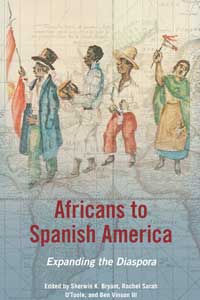
Thursday was the joint. First, in the early afternoon, two leading scholars in the field of Afro-Latin American history, Ben Vinson III, the Herbert Baxter Adams Professor of Latin American History and the Director of the Center for Africana Studies at Johns Hopkins University, and Sherwin Bryant, who teaches in the departments of African American Studies and History at Northwestern University, spoke on "Locating African Diaspora: Exploring Blackness in Mexico and Ecuador" at the invitation of Northwestern's Colloquium on Ethnicity and Diaspora.  Rather than simply delivering standard scholarly talks, both Vinson and Bryant, whose work focuses on the materiality of the colonial-era Americas, engaged in a conversation, through a recounting of their research trajectories, presentations of their current research, and questions each posed for the other. Throughout they returned to a number of salient issues in contemporary Afro-Latin historical research, many of which underpin the anthology they recently co-edited, with Rachel Sarah O'Toole, Africans to Spanish America: Expanding the Diaspora (Urbana: University of Illinois Press, 2012).

To simplify, and I must because though my interest in their work is great, this is not my field, for Vinson, who has been exploring the material and cultural history and function of castas (castes) in Mexico, three questions he has been asking include how do we define "race" and was it sufficiently explanatory as an interpretive tool; where does Latin American fit into the "Diaspora" and how do we read Afro-Latins in the African Diaspora in light of recent work on transnationalism and globalism; and lastly, what is the relationship of slavery to freedom, and how do modern understandings of both enslaved and free experiences shift our concepts of both.  With regard to race, he pressed the query of whether it was the best rubric through which to understand the some of the historical, social, political, and economic issues in the history of Afro-Mexicans, though he did note that other angles into understanding Afro-Mexican history by their nature might thus be ways of understanding "race" and related issues such as racial formation and identification. He talked about research on very specific and "extreme" castes in Mexico as a means of demonstrating how these categories proved mobile, useful, and habitable, and informed both local and national self-perceptions.

For Bryant, undergraduate and graduate level study drew him to his research, and in particular to the topic of slavery in the Americas. His subsequent research on Quito, Ecuador led him back to "slavery" as a key issue, not only as a way of understanding a deeply entrenched social system, but also of people of African descent as "political subjects" within the framework of slave societies and societies with enslaved people.  Recent archival research and study have led to deeper knowledge of slavery not just as an economic system but as a way of understanding systems of  "governance, sovereignty, display, and circulation of power."  One of the most powerful points he raised, about thinking of race in other ways (and he cited another colleague, Barnor Hesse) beyond its reducibility "to the body" or "phenotype," but in language, cultural practice, and so forth, sparked my thinking.  Another vital point he raised involving constructing a genealogy of the idea of race (and racial formation) before the rise of 19th century racial pseudoscience, which has continued to infect discussions of race up through today.

After their individual presentations, each pressed the other on unresolved issues, demonstrating for those present the very lively debates underway in the field. (I should note that it was particularly enriching for me to hear them talk about these strands in Mexican, Ecuadorian and Latin American history, since I think it's probably the case that in the US there is little public consciousness about blackness in either country, which affects governmental conversations and policies concerning both. I can recall Afro-Mexicans even importuning then-candidate Barack Obama for help, before he was elected, but as to whether he has ever responded to them or has ever broached any bilateral discussions with Mexico's government about their plight, I have heard and read nothing.) After their exchanges, Vinson and Bryant opened the floor to questions, which led to a number of insightful exchanges on their specific research projects and the larger topics they're engaging.

Historian Ben Vinson III talking about his work on Afro-Mexicans
Ben Vinson III speaking on his research

Historian Sherwin Bryant giving a talk about his work on Afro-Latins in Ecuador
Sherwin Bryant speaking on his research (Vinson at left)

+++

Afterwards, I hurried over to the English department so as not to miss Franco-British-American poet, critic, translator, editor, and antropologist Nathaniel Tarn (1928-), who was this academic year's final reader for the Poetry and Poetics Colloquium's reading series. I'd heard Tarn's name even before I came across his poetry, which with his works of criticism totals over thirty volumes, the most recent being Avia: A Poem of International Air Combat, 1939-1945 (Exeter, Shearsman Books, 2008), and Ins and Outs of the Forest Rivers (New York, New Directions, 2008), but I'd never heard him read.

After my colleague Harris Feinsod introduced Tarn, the poet read poems from Ins and Outs of the Forest Rivers as well as new poems, but not without expressing a deeply pessimistic view on the future of humankind who, he suggested, are moving inexorably toward self-destruction.  He leavened that grim pronouncement with his work, often dark but also demonstrative of language's ability to shape experience. Afterwards I had the opportunity to chat with him and he could not believe that I was honored to meet him, so let me underline that fact again. It was quite an honor, and I look forward to returning to his work soon. (I also had the opportunity to meet poet Joseph Donahue, who teaches at Duke University and who was traveling with Tarn for part of his reading tour.)

Tarn & Feinsod chatting before Tarn's reading
Nathaniel Tarn chatting with Harris Feinsod

Harris Feinsold introducing Nathaniel Tarn before his reading
Feinsod introducing Tarn

Nathaniel Tarn & Harris Feinsod
Tarn during the Q&A (Feinsod at right)