Showing posts with label Afro-Latin people. Show all posts

Friday, January 11, 2013

Shaun El C. Leonardo's "Champion of the World" at Praxis-International

Shaun El C Leonardo
Shaun El C. Leonardo, at his opening
Many thanks to Bruce Morrow, an old friend, for alerting me to the opening of artist Shaun El C. Leonardo's current show at Praxis International Art in Chelsea. Leonardo's work, which dates back  over a decade, has consistently and insistently explored the theme of masculinity, or masculinities, through visual imagery, sculpture, installations, and his legendary performances as a luchador, in galleries and public spaces. What have been and are his models for constructing and deconstructing masculinities as a Latino man (of Dominican and Guatemalan ancestry) coming of age in the late 20th and early 21st centuries? His art, through process and practice, has been working and reworking this question and similar ones out.

With his new show, "Champion of the World," he has begun to move away from the physically exacting projects of the last few years into new forms of visuality and performance, symbolically staging a crowning of his prior projects and a partial requiem for them. (He even had a bandaged, booted foot to show for his real-world exertions.) Through charcoal drawings of wrestlers grappling, representational images that dissolve towards abstraction; large-scale charcoal "self-portraits" depicting his choices as the "greatest" in their respective martial arts fields (Mike Tyson in boxing; Rick Flair in wrestling; Anderson Silva in mixed-martial arts); smaller self-portraits (the Gotti series); gilt-framed photos of past public performances; and a multi-screen projection of the video for the 2012 version of "Battle Royal" (a problematic form that makes its appearance not just in Ralph Ellison's The Invisible Man, which inspired Leonardo, but in Quentin Tarantino's Django, Unchained); and, perhaps most emblematic, a stunning black, laminated championship belt, he pays tribute to the iconography and performances through which he has made his name, while suggesting a shift into a new realm that entails a return to figurative drawing, photography, and other forms of artistic labor and materiality.

Where in this work, and possible future directions, does the masculine, his notions of masculinities, of himself as a male artist (of color), lie?  Only Shaun El C. Leonardo can answer these questions, and he certainly will. Until then, though, there is his website, which provides glimpses of prior work--which I have only seen via the Net, since I was almost always in Chicago when he was performing in New York--and there is the show, which runs until February 2, 2013.  I highly recommend it, and maybe the very beautiful and friendly artist himself will be there to great you. He throws no shade, only conviction and warmth.
Shaun El C Leonardo
El C. Leonardo greeting a fan
A series of pencil sketches of grapplers
The "Match" series of charcoal drawings
The show's opening night
El C. Leonardo's "Self-Portrait Campeon (Mike Tyson),"
Charcoal on paper, 72" x 60" 
A video clip, from Shaun El C's show
A still from the video of "Battle Royal" (2012)

Monday, October 08, 2012

Juan Rodríguez, NY's First Immigrant

Charles Lilly Painting, courtesy of the Schomburg Center
for Research in Black Culture, New York Public Library 
Thanks to Monaga's blog, where I first saw it late last week, I was able to start my undergraduate literature class this afternoon with a recent news snippet that was directly relevant to our readings and discussions. It turns out that the first non-indigenous immigrant to what is now New York City--and thus New York State--was, fittingly enough, a black or mix-raced polyglot named Juan Rodriguez (or João Rodrigues, or Jan ____) from Santo Domingo, then San Domingo and the capital of Hispaniola. Early last week New York Times reporter Sam Roberts drafted a short note about it in the paper's "City Room" blog section, and the piece exemplifies the difficulties of applying contemporary categories on historical facts, and the slipperiness even of documented historical discourse, though as my class averred, the deeper truth of the story is clear.  Roberts writes:

In 1613, Juan (or Jan or Joao) Rodriguez (or Rodrigues) appears to have accompanied Thijs Mossel, a Dutch sea captain, on the vessel Jonge Tobias from San Domingo, now known as Santo Domingo. Mossel returned to the Netherlands, while Rodriguez was marooned in what became New York (on either Governors Island or Manhattan) or more likely decided on his own to remain. 
Something of a linguist, he is believed to have mastered the local Indian language and manned a tiny trading post (the Dutch apparently gave him 80 hatchets and other tools and weapons as payment for his services). 
Much of what is known about him comes from affidavits by another captain, Adriaen Block, who complained that Mossel, presumably through Rodriguez, was overpaying for beaver pelts and was ruining Block’s business. Mossel insisted that Rodriguez was not his agent, but rather that Rodriguez had abandoned ship and remained on the island voluntarily (at least into 1614, when Mossel returned) and might have eventually married an Indian woman. 
Crew members said in affidavits that the “mulatto” or “Spaniard” had “run away from the ship and gone ashore against their intent” and that Block’s crew “ought to have killed him” when he refused to go with them to Holland.

Juan or João may have become marooned or was a maroon (he fled the ship), to New York, beginning a centuries-long trend. He was an agent for the Dutch, except that he wasn't. He was a "mulatto," and a "Spaniard," which need not be contradictory, except when, in Spanish royal administrative texts, they were. He married an Indian woman, or he didn't. What we know of him comes second, or even third-hand. His crewmates, cheery fellows, thought he should have been "killed" for not packing off to the Netherlands with them. Then there were the squabbles over money. Some things never change.

According to the Latin American Herald Tribune, Dr. Ramona Hernández and her team at the Dominican Studies Institute at the City College of the City University of New York followed up on leads drawn from historian Simon Hart's 1959 study of a "free black man from Santo Domingo," and established the fuller contours of Juan Rodríguez's study. As they aptly say, piecing all the swatches together, since there's no documentation that he ever left, he was "the first immigrant, the first black person, the first merchant, the first Latino and, to us, the first Dominican to have ever lived in New York City," and, as with Jean Baptiste Point du Sable, also allegedly from Santo Domingo (or Saint-Domingue) and Chicago, his presence antedates the official founding of the city of New York--in Rodríguez's case, by some 12 years.

Roberts reports that last Tuesday Mayor Michael Bloomberg signed legislation, sponsored by city councilperson Ydanis Rodríguez, to re-co-name Broadway, that ancient city thoroughfare, in after this Afrolatin-Dominican pioneer from 159th St. in Washington Heights to 218th St. in Inwood, which is to say, along the aorta of two of the city's most heavily Dominican and Dominican-American neighborhoods.  At some point down the road, perhaps there'll be a bigger celebration on his behalf. Let's see if he makes it into the general US history books any more swiftly than the TV shows and films set in and around New York have grasped that the city is still over 50% black and latino.

Thursday, September 06, 2012

A New School, A New School Year

Call slips, NYPL
Call slips at the NYPL
This past two month's post-move's worth of scurrying about searching for books and films at local libraries and bookstores, speed-reading, photocopying and scanning, writing and rewriting and re-rewriting syllabi has come to fruition in the form of my first week, and first undergraduate and graduate classes at my new employer. I'll say more about my classes soon, but I'll note that I am teaching two this fall: one in African American and African Studies, focusing on Afro-Latin literature, and the second a graduate course in English, under the rubric of postmodernism, which explores transhumanism and posthumanism. (I thank my former Northwestern colleague Alex Weheliye for turning me on to Sylvia Wynter and getting me to think more carefully about the latter two concepts.)  The first class yesterday went very well, and I am charged up for the first course meeting of the grad course tonight. (UPDATE: It went very well too.) I'll write more soon, but to all who have returned or are returning the classroom over these next few weeks, as teachers or students or both, at all levels, BEST WISHES FOR A GREAT SCHOOL YEAR!

Friday, May 04, 2012

Locating African Diaspora: Mexico & Ecuador, at NU + Nathaniel Tarn Reads

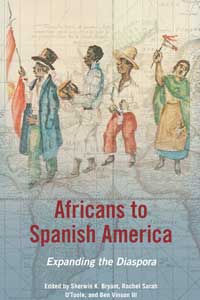
Thursday was the joint. First, in the early afternoon, two leading scholars in the field of Afro-Latin American history, Ben Vinson III, the Herbert Baxter Adams Professor of Latin American History and the Director of the Center for Africana Studies at Johns Hopkins University, and Sherwin Bryant, who teaches in the departments of African American Studies and History at Northwestern University, spoke on "Locating African Diaspora: Exploring Blackness in Mexico and Ecuador" at the invitation of Northwestern's Colloquium on Ethnicity and Diaspora.  Rather than simply delivering standard scholarly talks, both Vinson and Bryant, whose work focuses on the materiality of the colonial-era Americas, engaged in a conversation, through a recounting of their research trajectories, presentations of their current research, and questions each posed for the other. Throughout they returned to a number of salient issues in contemporary Afro-Latin historical research, many of which underpin the anthology they recently co-edited, with Rachel Sarah O'Toole, Africans to Spanish America: Expanding the Diaspora (Urbana: University of Illinois Press, 2012).

To simplify, and I must because though my interest in their work is great, this is not my field, for Vinson, who has been exploring the material and cultural history and function of castas (castes) in Mexico, three questions he has been asking include how do we define "race" and was it sufficiently explanatory as an interpretive tool; where does Latin American fit into the "Diaspora" and how do we read Afro-Latins in the African Diaspora in light of recent work on transnationalism and globalism; and lastly, what is the relationship of slavery to freedom, and how do modern understandings of both enslaved and free experiences shift our concepts of both.  With regard to race, he pressed the query of whether it was the best rubric through which to understand the some of the historical, social, political, and economic issues in the history of Afro-Mexicans, though he did note that other angles into understanding Afro-Mexican history by their nature might thus be ways of understanding "race" and related issues such as racial formation and identification. He talked about research on very specific and "extreme" castes in Mexico as a means of demonstrating how these categories proved mobile, useful, and habitable, and informed both local and national self-perceptions.

For Bryant, undergraduate and graduate level study drew him to his research, and in particular to the topic of slavery in the Americas. His subsequent research on Quito, Ecuador led him back to "slavery" as a key issue, not only as a way of understanding a deeply entrenched social system, but also of people of African descent as "political subjects" within the framework of slave societies and societies with enslaved people.  Recent archival research and study have led to deeper knowledge of slavery not just as an economic system but as a way of understanding systems of  "governance, sovereignty, display, and circulation of power."  One of the most powerful points he raised, about thinking of race in other ways (and he cited another colleague, Barnor Hesse) beyond its reducibility "to the body" or "phenotype," but in language, cultural practice, and so forth, sparked my thinking.  Another vital point he raised involving constructing a genealogy of the idea of race (and racial formation) before the rise of 19th century racial pseudoscience, which has continued to infect discussions of race up through today.

After their individual presentations, each pressed the other on unresolved issues, demonstrating for those present the very lively debates underway in the field. (I should note that it was particularly enriching for me to hear them talk about these strands in Mexican, Ecuadorian and Latin American history, since I think it's probably the case that in the US there is little public consciousness about blackness in either country, which affects governmental conversations and policies concerning both. I can recall Afro-Mexicans even importuning then-candidate Barack Obama for help, before he was elected, but as to whether he has ever responded to them or has ever broached any bilateral discussions with Mexico's government about their plight, I have heard and read nothing.) After their exchanges, Vinson and Bryant opened the floor to questions, which led to a number of insightful exchanges on their specific research projects and the larger topics they're engaging.

Historian Ben Vinson III talking about his work on Afro-Mexicans
Ben Vinson III speaking on his research

Historian Sherwin Bryant giving a talk about his work on Afro-Latins in Ecuador
Sherwin Bryant speaking on his research (Vinson at left)

+++

Afterwards, I hurried over to the English department so as not to miss Franco-British-American poet, critic, translator, editor, and antropologist Nathaniel Tarn (1928-), who was this academic year's final reader for the Poetry and Poetics Colloquium's reading series. I'd heard Tarn's name even before I came across his poetry, which with his works of criticism totals over thirty volumes, the most recent being Avia: A Poem of International Air Combat, 1939-1945 (Exeter, Shearsman Books, 2008), and Ins and Outs of the Forest Rivers (New York, New Directions, 2008), but I'd never heard him read.

After my colleague Harris Feinsod introduced Tarn, the poet read poems from Ins and Outs of the Forest Rivers as well as new poems, but not without expressing a deeply pessimistic view on the future of humankind who, he suggested, are moving inexorably toward self-destruction.  He leavened that grim pronouncement with his work, often dark but also demonstrative of language's ability to shape experience. Afterwards I had the opportunity to chat with him and he could not believe that I was honored to meet him, so let me underline that fact again. It was quite an honor, and I look forward to returning to his work soon. (I also had the opportunity to meet poet Joseph Donahue, who teaches at Duke University and who was traveling with Tarn for part of his reading tour.)

Tarn & Feinsod chatting before Tarn's reading
Nathaniel Tarn chatting with Harris Feinsod

Harris Feinsold introducing Nathaniel Tarn before his reading
Feinsod introducing Tarn

Nathaniel Tarn & Harris Feinsod
Tarn during the Q&A (Feinsod at right)