After my initial arrival in
Marseille and encounter with a grifter posing as a cabbie, I wasn't sure what to expect on my return for several days of stay after that inspiring and inspiriting
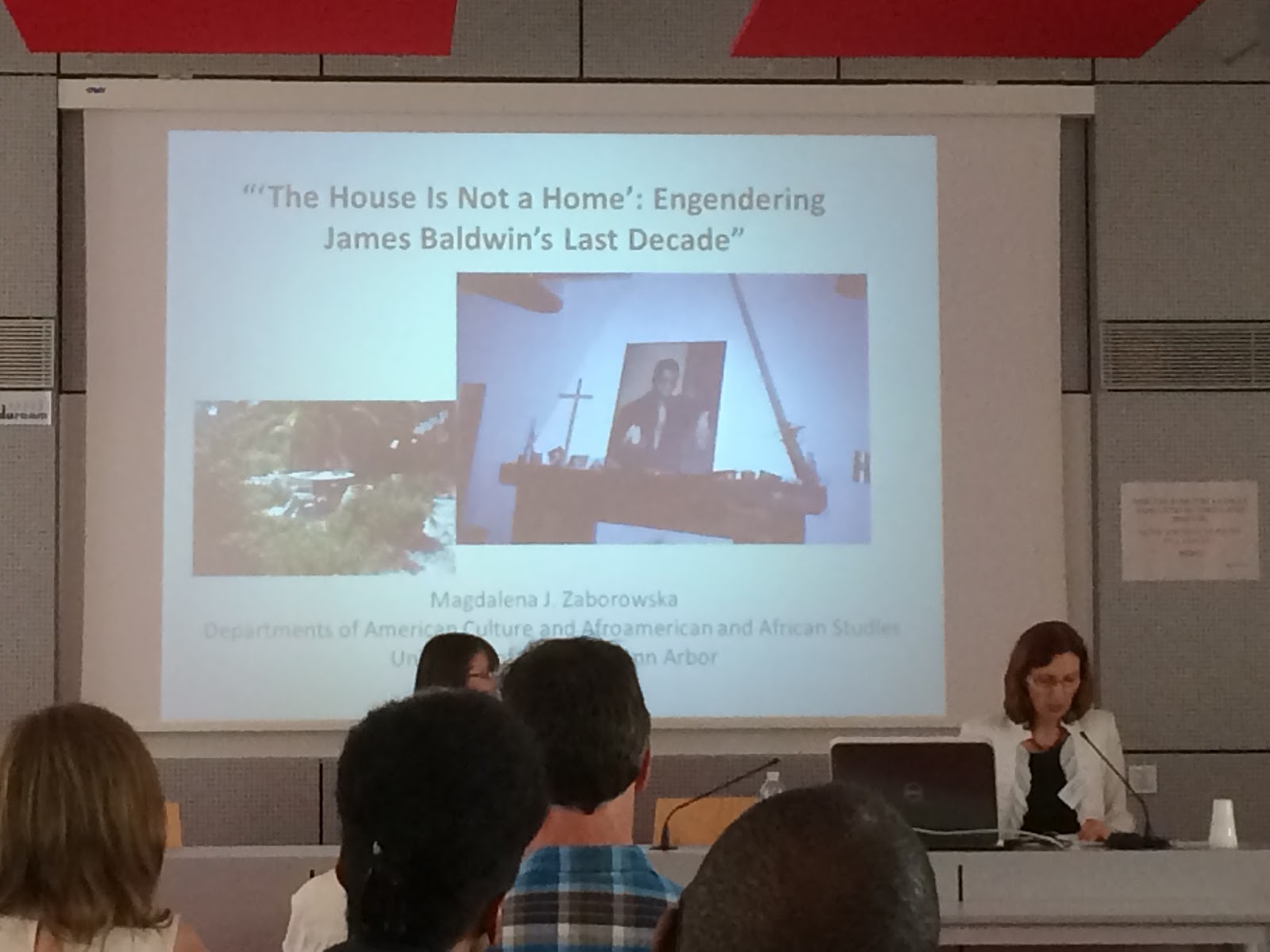
James Baldwin conference in
Montpellier, a city that exudes charm from every stone and plaster wall, but Marseille, I learned quickly, has its charms too, and is a city of great beauty, historical and cultural richness, and, yes, grit, a huge
Mediterranean port city that looks north and south, east and west. In just a few days I have traced the usual tourist steps, though I have not (yet?) seen l'Estaque, where
Renoir, Cézanne and others painted, or
Joliette, where
Claude McKay's
Banjo strolled and lolled, making music), but the Mediterranean sun and light that drew those great painters, and the cultural diversity and richness that McKay's novel portrays are very present. There are times walking the streets here that I forget I am not in North Africa, and at other times I think, this could easily be Harlem, or Brooklyn. There are also signs everywhere of the pan-or-trans-Mediterranean, as well as of
France's multiple European facets, among them those of the
Provence region, something I think I forgot before I arrived, until I began to see "PROVENCE" everywhere. (I have not yet heard anyone speaking
Provençal, though, not that I would be able to distinguish it from
Catalan if I heard it.) So far it has proved a a stirring mix of a place to see, not as run-down or seedy as I had been warned by some, and full of the
joie de vivre and vivacity that I had long imagined and which two friends (N and TJ) had implied in their excellent recommendations of things to do and see.
 |
Marseille, from the heights of
Notre Dame de la Garde |
Yesterday I went to
Mucem, the Museum of European and Mediterranean Civilizations, located partially in the
Fort Saint-Jean as well as in an adjacent, striking building I'd spotted the night I arrived from a nearby promontory in the
Jardin du Pharo. The fort (and there are several here) commands the eye, but far more intriguing was the modern building, clad in a metal netting that looked like a green spider web from afar and up close. The Museum itself was most interesting to me for its architecture; I found myself less engaged by its accounts of European and Mediterranean history, a good deal of which I knew, and which stinted a bit on some of the peoples involved in creating the Mediterranean we know today. Yet I expected nothing less. The puppet exhibit, which I snapped a few photos of, did hold my interest, but I have to admit, some to the puppets were a bit scary. It was, nevertheless, an enjoyable visit, and I walked all around the fort and the new building, also viewing and photographing but not entering the cantilevered
Villa Mediterranée. I love the tagline on the door, though, which reminded me oddly enough of the famous May '68 slogan "Sous les pavés la plage" (Under the paving stones a beach): "Sous la mer, un monde." (Under the sea, a world).
On my way to Mucem, I detoured along a historic trail that took me to various key sites and points in Marseille history, including the
Hotel Dieu, which is now an Intercontinental Hotel; the
Hotel de Ville; the
Église des Accoules, which was completely razed during the
French Revolution; the site of Roman Docks; another site (which I did not see but had a plaque marking it--?) of a Greek amphitheater; and the 12th century
Church of Saint Laurent, which the revolutionaries (thankfully) saw fit not to burn down. Further walking took me past the
Cathédral du Majore, the Roman Catholic Church's main church in Marseille. It is in a neo-Byzantine style, which seems appropriate given the multiple strands on which the city is built. I had missed the ferry across the Old Port and ended up walking all the way around it, which was invigorating, but after several hours in the relentless heat, I was crisping. I took the ferry back, and walked back up the long road to my hotel, on the Corniche near the Anse des Catalans, and by the time I got to my room, I was ready to pass out.
According to my Move app I managed to walk 9.1 miles one day in Montpellier, and 7.2 miles on Saturday, when I traveled back to Marseille, but the lack of wifi meant I could not record how far I walked yesterday, which could easily have been 12 miles or more. I had drunk water all day and taken pauses in the shade and cool spots, but was so sore--my body, my back, my shoulders, my legs, my feet--hat I had to lie down, and wasn't sure I'd be able to get up to meet friends for dinner. By the time we did meet up after 8 pm, I had revived, and was ready to spend this morning getting gifts and gearing up for the next big tourist goal, which was to climb up to
Notre Dame de la Garde, the highest point (I believe) in Marseille. My friend Trasi had said that church was not architecturally distinguished, and it isn't, looking almost like a sibling of the cathedral far below. But the vistas it offers are astonishing, and the packed interior basilica, chock full of paintings and relics and votives and believers, moved me to give the sign of the cross, and to light a candle for friends and acquaintances who are facing various challenges. To get there, though, you must climb a very steep hill, steeper I think that the one at
Montmartre to reach
Sacré Coeur, which made me think about how suffering is woven into Catholic experience, and to ponder, as I always do with such things
who and how those whos pulled this off. Just getting up here was exhausting enough, so to imagine bring all the materials, to be working in this southern heat, or even in the cold, etc., made me think about all the labor, casualties and so on the creation of such a site of devotion requires.
 |
| The medieval church of St. Laurent |
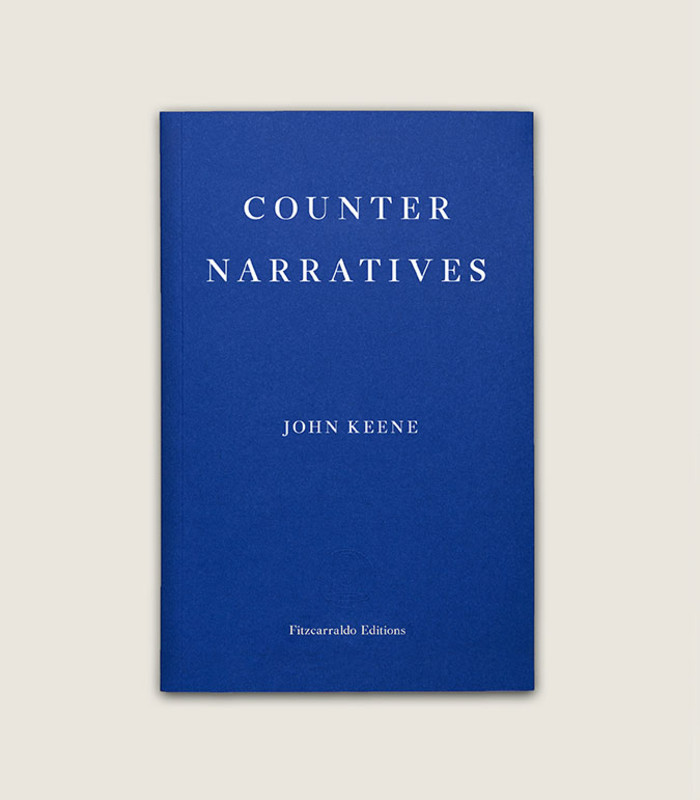
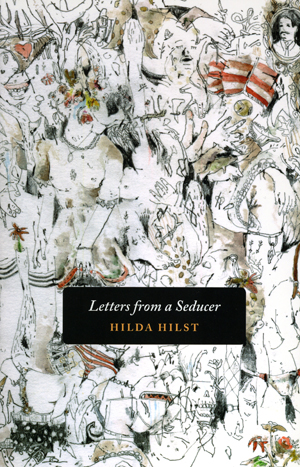
I have tried not to load up on books as I tend to do when I travel, and my first order of business tomorrow is to mail the ones I've purchased back, but I could not help myself in the Mucem's bookstore, which was decent, and bought a few books that caught my eye, including
Scholastique Mukasonga's
Notre-Dame du Nil [Notre Dame of the Nile], which was published by
Gallimard in 2012 and won the
Prix Renaudot that year;
Djilal Bencheikh's novel
Tes yeux bleus occupent mon esprit [roughly: Your Blue Eyes Occupy My Spirit], published by
Elyzad in its
Poche series and winner of the
Prix Maghreb 2007 de l'Association des Écrivains de langue française (ADELF) [2007 Maghreb Prize of the French Language Writers' Association];
Nouvelles du Maroc, featuring the work of writers
Mohamed Leftah, Abdellah Taïa, Karim Boukhari, Fadwa Islah, Abdelaziz Errachdi, and
Zineb El Rhazoui, published in 2011 by MAGELLAN & Cie/Courrier International in their Miniatures Series;
Slam Poésie by
Sunjata Sabir, published by Vents d'ailleurs in 2014; and the fascinatingly named
Christophe Ono-Dit-Biot's
Plonger, another Gallimard publication, from 2013, which received the
Grand Prix du Roman de l'Académie Française and the
Prix Renaudot des Lycéens in 2013. (I especially liked that he had written a novel entitled
Génération Spontanée in 2004. I look forward to reading at least some of them this summer.
On a political tip I have been curious to see if I pick up any of the tensions that have led to the high vote totals for the far right in
France (and for alternative conservative parties in the
UK, Denmark, and elsewhere in Europe) in the EU elections, but I would be lying if I said, in my few days as a tourist, that I saw anything at all. Marseille is, as I noted above, very diverse, with a sizable population of people of North African and sub-Saharan ancestry, as well as many people with ancestry from the Comoros, other parts of the Mediterranean, and so on. It has been a gateway city for centuries and questions of diversity, migration, globalism and global flows, borders, and so forth are hardly new here, nor are political contestations over immigration, demographics, power, everything underpinning the recent victories by right-leaning parties in the EU parliament. (Even Montpellier was visibly more diverse than I remembered from a brief prior visit more than 20 years ago.) From what I can tell, people appear to get along, though this could be because of my routes here and hardly reflective of the realities. A colleague from Montpellier told me that the wealthier cities on the
French Riviera, like
Nice, Cannes, Cap d'Antibes, as well as rural areas and the formerly industrial North of the country provided votes for
Marine Le Pen's
National Front, though I thought I had seen some mention of support in Marseille and surrounding areas as well. I am keeping my antennae up, and taking notes.
I'll stop there but here are a few photos from my perambulations. I'll post more in a subsequent entry. Enjoy.
 |
| The steps of the Fort d'Entrecasteaux |
 |
A sculpture in the Jardin du Pharo,
with the Palais du Pharo in the background |
 |
On the lower level of the Jardin du Pharo,
with the Digue du Large in the background |
 |
In the Jardin du Pharo, with
Notre Dame de la Garde in the distance |
 |
A sculpture sitting between the Old Port
and the Lower Fort Saint Nicolas |
 |
| Acrobats along the Old Port's Quai |
 |
The Hôtel DeVille's façade
along the Old Port's Quai |
 |
| The Hôtel Dieu, now the Intercontinental |
 |
| One part of the Hôtel de Ville |
 |
| The reconstructed Church of the Accoules |
 |
| Heading up to the Préau des Accoules |
 |
| Street art |
 |
| An exhibit |
 |
| The St. Laurent Church |
 |
Puppets, from an exhibit in the
Fort Saint-Jean |
 |
| At the Fort Saint-Jean |
 |
| At the Fort |
 |
| One of its towers, from a northeast view |
 |
The striking Mucem building, with
the Villa Méditerranée beside it |
 |
| Inside Mucem |
 |
| Along the rocks outside the Fort |
 |
| The Villa Méditerranée |
 |
The Cathédrale de la Major
(Marseille Cathedral) |
 |
| Art students drawing the cathedral |
 |
Sculptures near the
Hôtel de Ville |
 |
On the ferry boat back across
the Old Part |
 |
A political statement, on my way back
to my hotel |
 |
The Abbaye of St.-Victor
of Marseille |
 |
| Along the Corniche |