Thursday, July 14, 2011

Scenes from a New York Protest: Color of Change Calls Out Fox News

Happy Bastille Day
C'est Bastille Day!
Earlier this week, I received a post from ColorOfChange.org, alerting me to a protest rally occurring today, at noon, across the street from Rupert Murdoch's home at 834 5th Avenue, in New York City.  The rally developed out a previous ColorOfChange petition drive, in which the progressive organization gathered signatures--over 110,000 in the final count from ColorOfChange supporters and allies--which it sent last week sent to Fox News head Roger Ailes. The petition urges Ailes to fire TV personality Eric Bolling, who has repeatedly made racist on-air comments, ranging from his statement that President Barack Obama was in Ireland "chugging forties" to his depiction of the president's meeting with Gabon's president, Ali Omar Bongo, replete with racially inflammatory imagery, that the president was inviting "hoods to the hizzouse."

Two weeks ago, ColorOfChange had run a full-page ad in the New York Daily News to raise public awareness about Murdoch's profiting from a cable and newspaper empire that has drawn viewers in part based on race-based fears and resentment.  I could spend several blog posts detailing these, but it should suffice to list just a few of the most egregious names in this regard: Glenn Beck, Sean Hannity, Steve Doocy, Gretchen Carlson, Bill O'Reilly, and Juan Williams, to name only a few.  These figures have driven a great deal of racist hysteria, profoundly shaped our public political and civil discourse over the last few years, severely harmed the work of progressive and even moderate liberal--and conservative!--interests, yet this approach has been good business for Fox News, which has helped blast print, cable and broadcast media ever rightward.

ColorOfChange noted that Ailes's response to the petitions was silence, so instead the organization decided to go straight to Rupert Murdoch, who, as we all know, is trying to hold together the unraveling threads of his empire over in the UK, as a steadily waxing hacking/wiretapping/bribery scandal engulfs his British newspaper chain and may potentially spread to his holdings in the US and Australia. ColorOfChange, knowing that a bit of theater is never a bad thing, thus invited supporters to attend a brief rally and join them as they delivered the petitions (boxes) to Murdoch's very, very post 5th Avenue apartment. 

I showed up just before noon, and the crowd was sparse, but by the time the rally got underway and ColorOfChange's Rashad Robinson spoke from a podium on the west side of the street, abutting the park, with Murdoch's apartment building on the east side, a sizable group had gathered. There were also, at least to my mind, a noteworthy number of journalists and representatives from foreign and local news organizations, including many of the New York-area TV stations and the British Telegraph, The New York Observer, and NDTV. As I said, a bit of theater does draw attention.  Ironically enough, as Robinson was speaking, a Fox News truck barreled past down 5th Avenue, which provoked an outcry from people in the crowd, and the large, clear placards ensured that all the tourists taking in New York on those double-decker buses also got a bit of activism amidst their sightseeing. The police, as well as numerous other law enforcement-looking individuals, some in plain clothes (FBI?) were also present, but the police were in general polite and accommodating.  Perhaps they even recalled some of the hateful crap Fox News Channel's pundits have spewed against their union brethren, their comrades who were injured in the 9/11 cleanup effort, and even survivors of those murdered on 9/11.

The highlight of the protest was the march to Murdoch's apartment building's front door. At first I thought, why isn't ColorOfChange going to Fox News's New York headquarters, but then I realized, why not the home. Not that there was any possiblity that the building's doorpeople, or security guards, or anyone else would allow anyone affiliated with ColorOfChange into the vestibule, but as I said, it made for good theater, and showed that in fact, sometimes you have to take things to the source. Murdoch's wife, Wendy Murdoch, was probably nowhere near the premises today--or even in the US, given that it's summer, the man's a multi-billionaire, and has homes all over the world--but actually seeing either of them was hardly the point.  What the action did do was further underline the burgeoning critiques of Murdoch's businesses and his business practices, which show a throughline of sleaziness, intimidation, propaganda, and, as the British scandals are showing ever more daily, what amounts to criminality. When you are hacking into the phones or computers of anyone, especially abducted children and victims of mass murder; paying police officers to access files or posing as individuals to do so; possibly blackmailing or intimidating government officials to pass policies favorable to you and your companies, to advance your bankrupt ideology, and to overlook your crimes, and so forth, you're talking about extremely unethical, and likely criminal behavior.  Free speech, a US right, is one thing, but indications suggest that units of News Corporation have gone much further.

That you are also using racism and racial resentment, xenophobia and anti-immigrant testeria, sexism and misogyny, classism, etc. to advance your agenda, also deserves the harshest condemnation, but as I said, there is a throughline here, and ColorOfChange.com has been focusing on one aspect of it.  As the news each day has shown, the abyss News Corp. finds itself in is a deep one, and today's announcement that the FBI will be looking into the company's behavior is good news, though given the US government's abject failure to explore the mountain range of federal criminal action, from warantless spying to torture to destruction of government documents, and on and on, that occurred between 2001-2008, I wouldn't bet any money that anything will result, at least over here. That is, unless the British government takes serious action, in which case there might be no way out for US investigators as well. We shall see. At any rate, here are some photos and videos from earlier today.

Rashad Robinson of Color of Change
Rashad Robinson speaking about the protest rally and Fox News's racist behavior

Rashad Robinson speaking at Color of Change protest against Fox News's racism & Rubert Murdoch
Robinson speaking

People at the rally/protest, NYC
People at the rally

834 5th Ave.
Chez Murdoch

Before the rally
Before the rally, assembling for the cameras

A rally attendee being interviewed by NDTV
A rally attendee being interviewed by a reporter from NDTV

At the Color of Change protest, NYC
One of the ColorOfChange ralliers speaking with a reporter from Univision

Rashad Robinson in conversation with a fellow activist
Rashad Robinson (on right), speaking with one of the rally attendees after the event

Rashad Robinson of Color of Change
Robinson being interviewed after the event

Videos after the jump

Wednesday, July 13, 2011

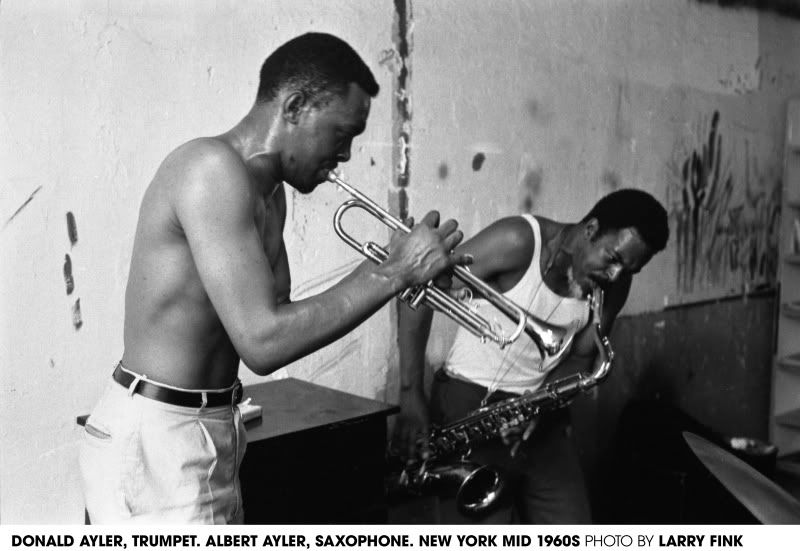
Albert Ayleriana

b. Cleveland Heights, Ohio, July 13, 1936 - d. New York, NY, November 25, 1970

"Love means nothing in tennis, but it's everything in life."
Albert Ayler, "My Name Is Albert Ayler"

"John [Coltrane] was like a visitor to this planet. He came in peace and he left in peace; but during his time here, he kept trying to reach new levels of awareness, of peace, of spirituality. That's why I regard the music he played as spiritual music -- John's way of getting closer and closer to the Creator." - Albert Ayler, in Valerie Wilmer, As Serious As Your Life, p.31

from lyssa.humana.blogspot.com
+ saxophonist, major figure in free, avant-garde jazz, "energy music"
+ music characterized by almost elemental force, piercing, versatile tone and range, startling improvisatory skills, bone-chilling, other-wordly feeling
+ drew from blues, R&B, marches and classical music, Tin Pan Alley standards, rock & roll, and other established and vernacular forms
+ studied at the Academy of Music in Cleveland with Benny Miller
+ US Army veteran
+ played with Little Walker, Stanley Turrentine, Cecil Taylor, Gary Peacock, Sunny Murray, Don Cherry, brother Donald Ayler, Charles Tyler, Lewis Worrell, Bobby Few, Niels-Henning Ørsted-Pedersen

Notable recordings: My Name Is Albert Ayler (Delmark, 1963); Spirits (a/k/a Witches and Devils) (Delmark/Freedom, 1964); Goin' Home (a/k/a Swing low sweet chariot) (Black Lion/Osmosis, 1964); Prophecy (ESP, 1964); Spiritual Unity (ESP, 1964); New York Eye and Ear Control (ESP, 1964); Ghosts (a/k/a Vibrations) (Debut/Freedom, 1964); The Hilversum Session (DIW, 1964); Bells (ESP, 1965); Spirits Rejoice (ESP, 1965); At Slug's Saloon, Vol. 1 & 2 (ESP, 1966); In Greenwich Village (Impulse!, 1966); Music Is The Healing Force of the Universe (Impulse!, 1969); The Last Album (Impulse!, 1969); The Complete ESP-Disk Recordings (ESP, 2006).

Documentary: My Name Is Albert Ayler (2007), Kasper Collin, director and writer.

I once spent an afternoon listening to Bells and felt afterwards like my ears had been reset.

"I feel really free over here. One thing every day will be as it should be." - Albert Ayler, on "My Name Is Albert Ayler"


Albert Ayler, "Billie's Bounce"


Albert Ayler, "Summertime"


Albert Ayler Quartet, at John Coltrane's Funeral, July 21, 1967, "Love Cry, Truth Is Marching In, Our Prayer"


Albert Ayler, "Nobody Knows the Trouble I've Seen"


Albert Ayler, "Ghosts"


Albert Ayler, "Spirits"


Albert Ayler, "Angels"


Albert Ayler, "All Love"


Albert Ayler, "Spiritual Reunion," Nuits de la Fondation Maeght, 1970

Albert Ayler, "On Green Dolphin Street

Tuesday, July 12, 2011

Translation: Poem: Stéphane Mallarmé

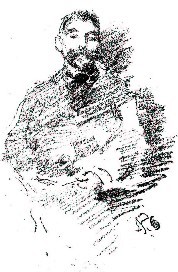
Mallarmé, by Whistler, 1893
I really did think about posting about the various things happening today (the debt limit talks fiasco; the Major League All Star Game in anti-immigrant pacesetter Arizona; the primaries in Wisconsin, in which the real Democrats defeated the fake Democrats; the unfolding News International/News Corporation scandals, etc.), but instead I'm going to post a translation I undertook earlier this afternoon during a break from writing fiction (i.e., a novel, which has nothing to do with the poem below). It is my rendering of one of the more celebrated later sonnets by Stéphane Mallarmé (1842-1898), a poet who needs little introduction.  One of the things that intrigued me early on and still does about Mallarmé, among his many poetic distinctions and triumphs, was his willingness to prioritize sound over sense, or the music of language over the usual semantic approaches to meaning that were predominant in his day (and still hold sway in most poetic precincts as I type this entry). This direction, emphasizing music over meaning, linked to a post-Romantic, intricately developed symbolic register, made possible, as students and readers of modernist literature know, the sorts of poetic innovations that would appear across a range of languages.  He anticipated--and wrote--the poems and books to come even as he dreamed of writing the Poems and Books to Come.

In the translation below, which I have always loved, and which I sent earlier to some poet friends, I tried to retain some semblance of a rhyme scheme, which given the poem's aural structure and specific phonemes, is impossible; Mallarmé's final "i" and "ui" sounds, almost a kind of piercing bell--'eeeee'--cannot be captured in English, so I went for long vowels, with a few short ones in those places where nothing else was possible, and consonance in the final two stanzas (the "s" sounds) to mirror the rhyming. Also, in terms of the content itself, in some cases I took leaps ("flow" for "flee," "it is itself alone," for "it is he,"  "which to it says no" for "it denies it," "seized" for "taken," etc.), following the leads of a colleague and great translator who, in a number of discussions and papers, has led  me to think a lot more about how important it is to think with even greater complexity about translation and what might be carried over and created in the target language. One task I set for myself upon reading Mallarmé's poems like this one was to trace out an argument, thematic or lyric arc, or narrative. Can you figure this one out? Can you trace out the symbols?  I have a book in Chicago, Towards the Poems of Mallarmé (California, 1980), by Robert Greer Cohen, that explores this and similar poems in depth, in case you want to see a scholar's take. I think, that devotes a I think it's clearer than some of his poems, like the famous sonnet "Ses purs ongles....", also known as the "Sonnet ending in -yx", for example. At any rate, here is pale echo, for I do love this poem, in its infinite strangeness.

THE VIRGIN, THE VIVID AND THE BEAUTIFUL NEW DAY

The virgin, the vivid and the beautiful new day
Will it tear apart with a drunken wing's blow
This forgotten hard lake haunting beneath the frost
the transparent flights' glaciers which did not flow!

A swan of yesteryear remembers it is itself alone
Magnificent but without hope of freeing itself
For having not sung the region where it dwelt
When the boredom of sterile winter shone.

Its whole neck will shake off that white agony
Inflicted by space on this bird which to it says no
But not the soil's horror in which its plumage is seized.

Phantom which its pure brightness here assigns,
it is immobilized in the cold dream of scorn
that enfolds amidst useless exile the Swan.

***

LE VIERGE, LE VIVACE ET LE BEL AUJOURD'HUI

Le vierge, le vivace et le bel aujourd'hui
Va-t-il nous déchirer avec un coup d'ail ivre
Ce lac dur oublié que hante sous le givre
Le transparent glacier des vols qui n'ont pas fui!

Un cygne d'autrefois se souvient que c'est lui
Magnifique mais qui sans espoir se délivre
pour n'avoir pas chanté la région où vivre
Quand du stérile hiver a resplendi l'ennui.

Tout son col secouera cette blanche agonie
Par l'espace infligée à l'oiseau qui le nie,
Mas non l'horreur du sol où le plumage est pris.

Fantôme qu'à ce lieu son pur éclat assigne,
Il s'immobilise au songe froid de mépris
Que vêt parmi l'exil inutile le Cygne.

From Stéphane Mallarmé, Poésies, 1887. Translation © John Keene, 2011.


Monday, July 11, 2011

On Metaphor: Book Review: James Geary's *I Is an Other*

Twice today during his press conference on the debt limit talks, President Barack Obama used the word "entitlement" to describe the three major social safety net programs--Social Security, Medicare and Medicaid--that the Republicans and even he and some Democrats want to put on the chopping block. Considering the terms you might use to describe these programs, "entitlement," which has become the standard among both parties, journalists, economists, and many others, strikes me as a terrible choice, but it's as common as daylight before between dawn and noon. I mention Obama's invocation of "entitlement" not to debate his or Congress's plans, but as an opening gambit in discussing James Geary's excellent and thorough new generalist study, I is an Other: The Secret Life of Metaphor and How it Shapes the Way We See the World (New York: HarperCollins, 2011). Geary doesn't touch upon the term "entitlement" directly, but his larger argument demonstrates how such words work, and why they resonate for us in certain ways. What he does say is that if you take almost anything anyone says, you can pluck out metaphors almost every 10 to 25 words, or about 6 every minute. In this paragraph alone, I've used a number of them: "put on chopping block," "consider," "strikes me," "common as daylight" (a simile), "debate," "opening gambit," "demonstrate," "resonate," "pluck out," to name a few. We cannot communicate without it.

But first, back to entitlement: It's clear enough to me that the term is a naturalized metaphor, a noun deriving from the much older English verb "entitle," which appears in the 14th century, its origin Anglo-Norman, from entituler or entiteler, from the Latin intitulare, fr. in+titulus (title). "Entitle" originally meant to give a name or title to, as in a deed, right or claim, or for a text, though since the 1960s and the rise of pop psychology, "entitlement" has taken on a negative valence in psychology and the wider cultural discourse. We often speak of "entitled" people as those expecting something they they may or may not deserve. Yet even before pop psychology encoded in the word is the metaphorical idea of individuality and private ownership and authorship. "Entitlement's" metaphorical effects in politics are real. "Cutting entitlements" sounds far less troubling, and has a different cognitive and emotional effect on us, than appeals to "cutting the social safety net." This term is more obviously a metaphor: a "safety net" we can all easily visualize as something helpful—something we want--to catch us if we're on a trampoline or a highwire or any high place and might fall; the "social" involves a group of people, likely a community, which we also seek, at a prelinguistic level.

You might dismiss this as just so much ado about language and competing terms, or, more specifically, linguistic framing, as cognitive linguists like George Lakoff have rightly described it. But what Geary does, in 226 entertaining pages, plus ample end-notes, a fine bibliography, and a thorough index, is to show that in fact, the very use of terms like "entitlement" vs. "social safety net" affects--that is, impacts emotionally and psychologically—us at deep cognitive level, prelinguistically, in part because it plugs into our bodily experiences and understanding of the world. Take that "falling" aspect of the safety net: all humans, across languages, grasp the concept of falling and its dangers. Metaphors of "falling" often tend to be negative, across languages and cultures. The Biblical story of Adam and Eve's banishment from the Garden of Eden is also known as a "the Fall," but all kinds of negative processes and their outcomes often include ideas of "falling." Falling ill, falling from grace, falling short, falling under a spell, falling to pieces, and so on, are all metaphorical uses of the term, idioms that English speakers often don't think twice about. Yes here's falling for someone, and falling in love, but also falling out of it.

Geary shows in every chapter that metaphors are more than just figurative uses of language. As he argues, "Metaphor is a way of thought long before it is a way of with words." (p. 3). Even the word "metaphor" itself is a metaphor, deriving from the Greek term to "carry over" (meta, across + pherein, to carry, related to English's to bear). In linguistic terms, it is a substitution of one term for another ("your eyes are diamonds"), and in psychocognitive terms, it is a powerful system for making meaning, one of the most important for any language and our understanding of the world, by leveraging what we sense and name, to create new names and ideas. Throughout the book and in particular at the beginning of each chapter, Geary points that poets, perhaps more so than many, have profoundly grasped metaphor's implications, as it is intrinsic to the poetry as an art and literary form. French poet Arthur Rimbaud's main principle, Je es un autre, or I is an other, is "metaphor's defining maxim, its secret formula, and its principal equation." (2) Indeed, poet Robert Frost, in a 1930 Amherst College address, "Education in Poetry," urged students to study metaphor to be able to "evaluate the claims made by historians or scientists, newspaper editorialists aor political campaigners," noting that we often don't grasp when we're being "fooled" by metaphor. (35) Geary links Frost's and other poets insights to the larger issue of metaphor's power in structuring our thinking, helping us both to see and ravel patterns, often without our realizing it, for metaphor arises out of our most basic human--we could even say animal—experiences in the world.

Rather than a technical study of metaphor, of which there are many, Geary synthesizes a raft of studies and discussions about how metaphor works and works on us. Chapters explore how every language represents a kind of "fossil poetry" such that the naturalization of metaphors I describe above permits the construction and development of languages, and enables other kinds of innovation and creativity; how it relates to our grasp of the abstractions of numbers and finance (sometimes to deleterious effect, as in the endless analogies to the "family around the kitchen table"); how it operates at various levels in the mind and brain, because there is a growing scientific study of metaphor; how, as I noted above with the political use of "entitlement" and other metaphors can have profound ramifications in advertising and political framing; why certain metaphors are nonfunctional or just laughably bad; and why those old saws and platitudes we heard from parents and relatives guide for us, even when we might consciously reject them as, well, so much empty language.

Geary demonstrates, through deft argumentation and copious citations of studies, that it's our sensory experience in the world that informs our metaphorical, and thus linguistic understanding, world. We cannot help but think of the sun as good and night as bad, at a primal level, or orientate ourselves in space and link this to metaphors of up and down or directionality; we process colors and associate these metaphorically without fully understanding how this operation occurs. Interestingly he does not point out, as Lakoff has, that the central idea underpinning the post-structuralist perspective of language and our systems of signification, that they are fundamentally arbitrary, as Ferdinand de Saussure suggested at the turn of the 20th century, is deeply problematic and cognitively and biologically just wrong. I particularly enjoyed his discussions, which he moves through with clarity and verve ("move" being a metaphor), of psychological and cognitive experiments that involve linguistic and even visual priming, using metaphors, which determine test participants' responses without their having any clue about how the language affected and effected their behavior. To give one example, one experiment exploring corporal metaphor use aimed to explore the priming effects of the "nation = body" metaphor by having participants read an article

ostensibly from a popular science magazine, describing airborne bacteria as ubiquitous and harmful to human health. Another group read a similar article describing airborne bacteria as ubiquitous but harmless to human health.

Both groups then read parallel articles about the history of U.S. domestic issues than immigration. The only difference between the two articles was that one contained "nation = body" metaphors...and the other did not.

Both groups then answered two questionnaires. The first gauged their agreement with statements about immigration and the minimum wage....The second assessed their concerns about contamination....Subjects who read the article describing airborne bacteria as harmful reported being more concerned about contamination. No surprise there.

But the same people also expressed more negative views about immigration when America was metaphorically described as a body. Those who read the more netural description of U.S. domestic issues had more positive views of immigration, even though they read the article describing bacteria as harmful. Both group's views about the minimum wage were about the same because, unlike immigration, the "nation=body" metaphor does not attend that issue. (128-129)

Researchers realized that manipulating someone's attitude about one issue (health) affected that person's attitude about an unrelated issue (immigration) if they were linked metaphorically. This is only one of many examples Geary provides, going so far as to cite legendary figures like neuroscientist V. Ramachandran, famous for his "phantom-limb" studies, but whose basic insights into synesthesia and graphemes offer a way of understanding how metaphor works, linking this idea to Wolfgang Köhler's 1929 discovery of the "bouba-kiki" effect, in which he showed Tenerife islanders two shapes, one hard and spiky, one soft and bloblike, and asked them associate them with two made-up words, "takete" and "baluba"; participants overwhelmingly linked the former to the spiky shape, the latter to the softer blob, and Ramachandran and cognitive psychologist repeated Köhler's experiment with the words "kiki" for "takete" and "bouba" for "baluba," getting the same result, with 98% of research subjects linking "kiki" to the spiky shape and so on.

This brings me back to the relentless use of "entitlement," mindless in the case of many journalists, unintentionally harmful in the case of a brilliant, liberal economist like Paul Krugman because it's the technical term he and his peers have learned to use, and extremely destructive as it leaves the mouths of the President and top Congressional leaders who, like the many sworn enemies of the social safety net, want to "reform" it, "privatize" it, and outright "end" it. What Geary goes a long way to proving is that metaphor is hardly an "abusio," as the old rhetorical term suggested, or a throwaway figure best left to the poets and having no meaning beyond being clever and illustrative, as some anti-rhetoricians might argue, but rather a foundational aspect of our human experience of the world intimately and indissolubly linked to how we think and speak and act. Language matters, metaphors especially, Geary makes clear, more than the vast majority us ever imagine.

Sunday, July 10, 2011

Ai Wei-Wei's New York, 1983-1993 @ Asia Society

Some people have an eye for their times. I don't mean they just see it for what it is, or more clearly than others, or more fully than those around them. They see more deeply into it, almost penetratingly so, and if we're fortunate, they may capture this vision in some form in which they can share it with others. The artist Ai Weiwei (艾未未), perhaps best known today as one China's leading persecuted dissidents and, before the Chinese government's recent harassment of him, as one of the visionaries (along with the Swiss architectural team of Jacques Herzog and Pierre de Meuron of  Herzog and de Meuron) behind the remarkable 2008 National Stadium, the "Bird's Nest" which was the main Olympic stadium venue in Beijing, is one of those people. Ai has left his mark in a variety of areas in the visual and plastic arts and architecture, ranging from the extraordinary stadium to the Beijing Village East experimental art collective he founded in 1993, to his China Art Archives & Warehouse (CAAW), an experimental archive and gallery, whose building he designed.


While active in making art of all kinds, from site installations to interior design to books, Ai has also followed the path of his father, the poet Ai Qing, who with Ai's mother, Gao Ying, was sent by Mao Tse-Tung's government to a labor camp in 1958 for allegedly being a "rightist" in the Communist Party; in addition to speaking out against the Chinese government's suppression of human rights and cultural and political freedom, he has specifically criticized certain government actions or nonactions, such as the corruption endemic in the Sichuan local government in the years preceding the horrific 2008 Sichuan earthquake, in which thousands of children were killed because of shoddy schoolbuildings. His outspokenness has led to repeated detentions, including this year, when on April 3 he was arrested on charges of "economic crimes", which provoked an international outcry, with his release coming finally on June 22, just before China's Prime Minister, Wen Jiaobao, was set to visit Europe.

"Police protest" by Ai Wei Wei

Ai's ability to see through to the heart of things, even in a potentially alienating environment, is clear in his photos from his 1983-1993 stay in in New York, which are on display at the Asia Society.  The show, "Ai Weiwei: New York Photographs 1983-1993," opened shortly after his release, on June 29, and runs until August 14, 2011. I highly recommend it. Featuring 227 photographs (out of an estimated 10,000 he took), by Ai, printed by inkjet on Fantac Innova Ultra Smooth Gloss, it manages to sketch two worlds which intersected through Ai's eyes: one was the world of Chinese immigrants, many of them dissidents intellectuals and artists in exile, many of them young, a few now world-famous (like Tan Dun), and the other was New York and the US of that era, wracked then as now by economic crises and a heaving class divide, but also marked by racial strife, the AIDS pandemic, the dying glimmers of the punk and indie music scenes, and so much more. Ai, with little money but skills and hustle, managed to capture an incredible amount of what was going on, in vivid images that sometimes appeared ready to break open into mini films, or they at least suggest or depict enough narrative that a short seems hidden in them.

iPhone drawing of Tan Dun
(iPad) Drawing of young Tan Dun, based on photo by Ai Weiwei

I took quite a few notes on what Ai, who studied for a while at Parsons and lived in Brooklyn, the East Village and the Lower East Side, managed to snap, though the Asia Society provides an exhaustive list but no commentary, except of the audio sort. In addition to lots of snapshots of attractive, languid young friends and colleagues and their children, people like Dun, Zhou Lin, Chen Kaige, Hu Yongyan, Bei Dao, and Hsieh Tehching, many of whom like the gradually thickening and visibly exhausted but intellectually energized Ai were barely hanging on, busking or painting portraits or gambling to keep food on the table and art supplies at hand, he also snapped The Pyramid Club, Allen Ginsberg visiting his E. 3rd St. apartment, Andy Warhol, grafittied subway car interiors and exteriors and stations (the last of which have made a return, despite the cameras), abandoned buildings on the Lower East Side (many of which are now luxury condos), the homeless, a young African American man, planted in front of a subway station, with a sign announcing that he had AIDs and urging passersby "PLAES HELP"; one of his own early shows, the "Safe Sex Solo Show" in 1988, which would have been even harsher in its irony that many might imagine today; scenes of police brutality; the Tompkins Square Park Riots, a popular uprising against the forces of gentrification that has been almost completely erased from popular memory today; protests in pre-reconfigured Washington Square Park, as well as photos of heavily armed police patrols passing through it; police finding a gun in a grassy lot at Bowery and Delancey Sts.

"Our first and last love is self love" by Ai Wei Wei

Others feature a young Al Sharpton, both emerging from a town car and leading the Tawanna Brawley protest in 1988; an early Wigstock; ACT-UP protests in 1989; and a punk concert in 1990, which features banners describing the NYPD as the "Army of the Rich" and "Class War Thugs," while another states that "Community defense is not a crime." Talk about ironies! One of the most telling photos shows a young man in 1990 wearing a t-shirt that says "I'M NOT GOING! DON'T FIGHT FOR THE OIL BO$$ES," which was as appropriate then as it would become in 2002-3, or in 2008, or for any young people considering a military whose commander-in-chief would be willing to send them into an unnecessary, unexplained and unconstitutional war in Libya or Yemen or wherever big oil considerations led him.  In fact one of the shocks of this exhibit, like others I've come across indexing that earlier era, which I vividly remember and lived through, was how much of the worst of it remains, even as other aspects, like a seriously run-down and dangerous New York, no longer exist, except in the popular memory and consciousness. In fact one of the photos details the murder of a compatriot portrait artist, Lin Lin, lost to the easy street violence of that era, when New York did not just feel out of control, but was. By the time Ai departs for China, physically heftier and with a decade of American life under his belt, both the city and the country were on an economic upswing, and one of the final photos, astonishingly enough, shows then-candidate Bill Clinton in one of his final 1992 campaign stops in New York, on the Lower East Side.


We know how that narrative unfolded, and Ai's photos give us glimmers of what was and what would be; Allen Ginsberg and Andy Warhol are gone, as are some of the Chinese exiles he photographs, but the planes returning from the Persian Gulf and Operation Desert Storm in 1991 represent metonymies of the wars that still continue, of the state of endless war we've been in now for decades, in the Middle East, in Latin America, in Africa, in South Asia, all over the globe.  The photos also metonymize the immigration that would increase immeasurably during and after the period in which they were taken; we live in a substantially different and still changing country because of this, and because the ghostly traces of neoliberalism that papered over the world Ai presents here, the "cure" that gave us a troubled but real economic boom just after Ai left and a troubled but false one a decade later, a destructive explosion from which those now holding the US and other nations in a chokehold are benefitting from greatly. Ai faces his own challenges, as do his peers, as do we all, but he has done us an extraordinary favor by sharing his vision of New York and the US at a crucial earlier period. It takes us back while also piercing deep into our present moment. See it before it's gone.

From the Asia Society's website:
Ai Weiwei on political awareness

Saturday, July 09, 2011

Jeter Hits 3,000 + FIFA Women's Soccer World Cup 2011

Suzy Allman for The New York Times
Only a month ago New York Yankees shortstop, captain and longtime star Derek Jeter was maintaining that 3000 hits were "still too far away." At 37 years of age and in the league since 1995, only a year before the Yankees began their late 1990s string of World Series victories (1996, 1998, 1999, and 2000, before they won another in 2009), in all of which he played a vital role, Jeter has faced criticism over the last few years for his faltering bat, but it has been clear even to any casual observer that though he might be at the end of his storied career, he still was going to reach what would only be a major professional milestone and put him the top rank of legends of one of one of baseball's most legendary teams. And today, at Yankee Stadium, he did it, with a home run, becoming only the 28th player ever to reach 3,000 career hits, the second player ever to do so with a home run (former Yankees Wade Boggs, also mostly a singles hitter, was the other), and the first Yankee (amazingly, at least to me), to reach this mark.

The third-inning homer, off a full-count curveball from Tampa Bay Rays lefthander David Price, one of the better pitchers in the American League, was one of five hits Jeter posted in the game, which the Yankees won 5-4, and his performance in the game exemplified how special and exceptional he has always been, despite playing in the shadow at times of far more heralded teammates like Roger Clemens and Álex Rodríguez, both of whom seemed destined for the Hall of Fame before revelations of steroid use, denied in Clemens and admitted in Rodríguez's, have likely derailed their chances. I tend to cast no blame on these or any other roided players but rather on Major League Baseball itself, since it and its teams made billions off these chemically-enhanced stars and looked away in the process for decades, only to turn on them when the secret got out, but I think it's fair to say that however one judges steroid use, Jeter has never been accused of doing so, and has, from his rookie year on, appeared to make the best use of his skills and talents, not only as a player but as a team leader.

It's difficult to imagine the Yankees' teams, great as many have been over the last 17 years and loaded with stars (from Hall of Famers Randy Johnson and Mariano Rivera to Hideki Matsui, Johnny Damon and C. C. Sabathia) and superb supporting players, without him and his quiet determination and resolve.  The Pequannock, New Jersey native has never been flashy, never been a showboat, never been anything but a cornerstone, to use an old and perhaps inadequate metaphor, around which which the Yankees' success for a decade and a half has risen. His teammates greeting him at home plate recognize this as readily as Yankee and baseball fans across the league have since he started. The 1996 Rookie of the Year has a lifetime .313 batting average, has scored 1727 runs (with more to come) and, despite never being a power hitter, driven in 1159, and has 481 doubles and 4,319 total bases, an .833 OPS, and a .383 on-base percentage, all testimonies to Jeter's excellence.  Now that he's crossed 3,000 hit mark, I hope he realizes that he can exit his playing career at the summit. He proved that yesterday, and has nothing left to answer for; his plaque has already been awaiting him in Cooperstown.

New York Times graphic on Jeter's 3,000 hits, and his 27 predecessors (from Cap Anson to Craig Biggio).

Jeter's 3,000th hit:


+++

The FIFA Women's Soccer World Cup has been underway since June 26, and enters the quarterfinal stage this weekend. 16 teams have played in four groups, with the USA team in Group C, with Sweden, North Korea, and Colombia. The USA women finished their group play with a 2-1-0 record, good enough to make it to the quarterfinal round, and just short of Sweden's 3-0-0 tally. The top teams in the other groups have been Germany 3-0-0 (Group A), England 2-0-1 (Group B), and Brazil 3-0-0 (Group D), and as of this past Wednesday, the quarterfinal matchups will pair England and France (2-1-0 also), Germany and Japan (2-1-0), Australia (2-1-0) and Sweden, and Brazil and the USA.

I would be telling a huge tale if I said I was at all familiar with any of these teams, let alone the USA women, but based on their play it's clear that they're as talented at controlling the field and scoring as some of their World Cup predecessors.  In 3 games they've scored 6 goals so far against 2 allowed, with all six goals coming from different players (Lauren Cheney, Rachel Buehler, Heather O'Reilly, Megan Rapinoe, Carli Lloyd, and Abby Wambach), and outstanding goaltending in Hope Solo.  Brazil is one of the tournament favorites--big surprise!--but the US team has surprised more than once in the lead-up to the tournament, so Sunday's matchup should be a great one. If they do get past Brazil, they still will have their feet busy against at least one of the other championship contenders Germany or Sweden.  Can they win?  I don't know.  Will it be a game to watch? Definitely.

Heather O'Reilly of US team, vs. Colombia, World Cup 2011 (FIFA via Getty Images)

Friday, July 08, 2011

End-of-Week Roundup + Memories of Chekhov

A girl holds a South Sudan flag with stripes symbolising the people, their blood and the land. Photograph: Ho/Reuters
After decades of war, South Sudan is now an independent country! It broke away from Sudan, has its new capital at Juba, and its new president is Salva Kiir. Eight facts about the new Republic of South Sudan. Congratulations!


Elizabeth Ann Bloomer Warren Ford, better known as Betty Ford (1918-2011), the wife of late 38th president (1974-77), Gerald Ford (1913-2006), has passed away. She was more progressive on many issues, such as equal rights for women and abortion rights, than her husband, and probably would have made a better president than either he or his predecessor.

A certain Nobel Laureate economist thinks the President (OK, quickly, did we elect a Republican in 2008, just asking?) is really off track. Said economic genius ain't alone....

Television is truly imaginatively bankrupt: TNT is resurrecting Dallas, a program appropriate to its era, for a new generation of viewers. Why not, say, Tent/Car City California, or Orlando: Foreclosureville, or, if a show must be set in Texas, San Antonio? Oh, I know, those would require...IMAGINATION.

The situation grows worse and worse regarding the hacking scandal at Rupert Murdoch's News International soon-to-be-nonexistent newspaper The News of the World. Its former editor, Conservative-Liberal Democratic former minister Andy Coulson, has been arrested.

The NFL lockout, in which the very rich owners are locking out the very rich players, who belong to a union, continues, as the US 8th Circuit Court of Appeals refuses to overturn the lockout. The NBA is also locking out its players. The assault on organized labor continues apace, even in its upper reaches.

The MLB All Star Game takes place next week, in Arizona. It should either have been canceled or moved rather than be played in a state with overtly racist anti-immigration laws, especially considering how many immigrant players fill the league's rosters and its stadiums. As a result, this is one of the first years in many that I can recall in which I did not cast a single vote for any of the players, though if I had, the New York Mets' José Reyes would have been at the top of my list, and I'm no fan of the Mets. (Sorry, Albert Pujols...).

+++

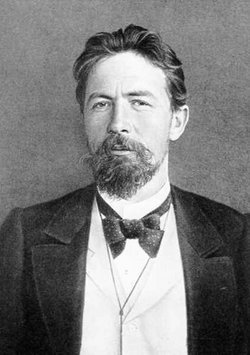
Every year I include on my undergraduate fiction workshop reading list at least one story by Anton Chekhov (1860-1904), who, as I need not tell any reader of this blog, I'm sure, was an exceptional playwright and one of the greatest short story writers ever. His influence flows through many a current of short and even longer fiction of the last century, and he is a writer whose gifts for characterization, scene-setting, tone, stylistic fluidity, varieties of irony, thematic openness and ambivalence, and narrative concision, displayed in all his mature works, offer a lesson any writer can learn from.  As I once mentioned to one of my advanced fiction writing classes, the basic argument in Francine Prose's Reading Like a Writer: A Guide for People Who Love Books and For Those Who Want to Write Them (HarperCollins, 2006) is, if all else fails, read and learn from Chekhov. The late Roberto Bolaño says as much (read and learn from Chekhov or Raymond Carver) in one entry I glanced at in Between Parentheses, New Direction's (June 2011) new book of his collected prose.

The current online New York Review of Books offers excerpts from a new book, Memories of Chekhov, edited by Peter Sekirin (Mcfarland and Co. Inc. Publishing), featuring memories of Chekhov by his peers, some of them, like Ivan Bunin (1870-1953), received the Nobel Prize in Literature in 1933. (Chekhov likely did not live long enough to merit consideration, though had he survived a few more decades, he ought to have been a leading candidate.)

Below is Bunin's excerpt; there are many more at the NYRB site:

I got to know Chekhov in Moscow at the end of 1895. I remember a few specifically Chekhovian phrases that he often said to me back then.

"Do you write? Do you write a lot?" he asked me one day.

I told him, "Actually, I don’t write all that much."


"That’s a pity," he told me in a rather gloomy, sad voice which was not typical of him. "You should not have idle hands, you should always be working. All your life."


And then, without any discernible connection, he added, "It seems to me that when you write a short story, you have to cut off both the beginning and the end. We writers do most of our lying in those spaces. You must write shorter, to make it as short as possible."
Sometimes Chekhov would tell me about Tolstoy: "I admire him greatly. What I admire the most in him is that he despises us all; all writers. Perhaps a more accurate description is that he treats us, other writers, as completely empty space. You could argue that from time to time, he praises Maupassant, or Kuprin, or Semenov, or myself. But why does he praise us? It is simple: it’s because he looks at us as if we were children. Our short stories, or even our novels, all are child’s play in comparison with his works. However, Shakespeare… For him, the reason is different. Shakespeare irritates him because he is a grown-up writer, and does not write in the way that Tolstoy does."

Thursday, July 07, 2011

Crispus Attucks: "Knees Nearer Together than Common"

John Bufford after 
William L. Champey, ca. 1856
Just because:

"Some call them shavers, some call them geniuses. The plain English is, gentlemen, most probably a motley rabble of saucy boys, negroes and molattoes, Irish teagues and outlandish jack tarrs. And why we should scruple to call such a set of people a mob, I can't conceive, unless the name is too respectable for them: The sun is not about to stand still or go out, nor the rivers to dry up because there was a mob in Boston on the 5th of March that attacked a party of soldiers. Such things are not new in the world, nor in the British dominions, though they are comparatively, rareties and novelties in this town. Carr a native of Ireland had often been concerned in such attacks, and indeed, from the nature of things, soldiers quartered in a populous town, will always occasion two mobs, where they prevent one. They are wretched conservators of the peace!"
-John Adams, defending the British soldiers, at the Boston Massacre Trial, 1770

"This Attucks...appears to have undertaken to be the hero of the night...to have this reinforcement coming down under the command of stout mulatto fellow, whose very looks was enough to terrify any person, what had the soldiers to not to fear?"
-John Adams, defending the British soldiers, at the Boston Massacre Trial, 1770

"Ran-away from his Master William Brown of Framingham, on the 30th of Sept. last, a Molatto Fellow, about 27 Years of Age named Crispus, 6 Feet two inches high, short curl'd Hair, his Knees nearer together than common, had on a light colour'd Bearskin Coat, plain brown Fustian Jacket, or brown all-wool one, new Buckskin Breeches, blue Yarn stockins, and a check'd woollen shirt."
Boston Gazette, October 2, 1750.

Wednesday, July 06, 2011

Strauss on "'Like' Culture" + Twombly RIP + Geosynchrony: Beck in Bryant Park

About a year and a half ago, I thought of saying goodbye to this blog. It wasn't the first time, though. I'd considered doing this even further back, perhaps after the first year and a half of blogging, which would have been around late 2006. At that time I was still receiving a trickle of comments and the occasional hate post (based, if I recall correctly, on my epithet for George W. Bush, the "warrantless wiretapper"), as well as a small bombardment of spam, but I'd begun to feel like I not only was running out of things to say, but that I was unable because of work and life demands to remain timely, that I was mainly writing them for myself and that perhaps that wasn't enough to keep my commitment to this site. This issues very well could still be the case, but I do know that people read or at least skim this blog from time to time, be it friends old and new, students and colleagues, people referenced on the site, or even, as I learned, perhaps in 2009, people writing dissertations who have cited J's Theater in their arguments, and even, I'm told, at their defenses. (I kid you readers not, and my scholarly colleague who politely told me of one such case was not amused!)  And though comments are rare, I have come to terms with the fact that I enjoy posting here, when I can, and that sometimes the posts resonate beyond this seeming echo chamber in which I cast them.

I say this as a prelude to commenting on Neil Strauss's recent Wall Street Journal article "The Insidious Evils of 'Like' Culture," which ravels one strand from Jaron Lanier's You Are Not a Gadget: A Manifesto (a book he doesn't mention) and similar works (M. Jodi Dean, Nicholas Carr, etc.) and builds an argument around it. The argument: the "like" feature, so prominent on Facebook and increasingly all over the web, is molding what we write and who we are online--and perhaps who we are and become. In order to curry "likes" and provoke "RTs" (retweets), we're performing and conforming, rather than just being ourselves.  (You can block it, of course, but that's not Strauss's point....)

I would not be the first one to point out that in virtual space as in any other who we are is always a performance, that we already are shaping ourselves in various ways wherever we are, based on various contexts, that there is no pure or ideal self that is not at some point affected by the performative and all it entails. In fact this lies at the heart of any number of contemporary fields of critical and scholarly inquiry. That isn't to say that I'm completely disagreeing with Strauss, for I do believe that--and he doesn't mention the economics of the net and web, but Lanier and many others do--he's right on a certain level, and I find the "like" aspect of Facebook one of the most maddening, but I also feel that he doesn't address the facdt that there're benefits if you can conform and commodify yourself in certain ways. Wittier, shorter posts go over better than drier, longer ones, but single-issue blogs and Twitter feeds and Facebook pages probably attract more adherents than eclectic ones. The more personal you are, the more people will be interested, especially if there's a nice serving of (melo)drama tossed into the mix.  Sex goes over better than its absense. If you're criticizing an unpopular president (Bush) vs. one whose still fairly popular and whom people expect you to extol (Barack Obama)....

For Strauss it's both a social and psychological issue. People want and need community, they want and need affirmation and attention...and above all approval, so they--we--are increasingly tailoring ourselves to provoke and be able to cull those "likes," instead of writing or tweeting whatever we--or Strauss and others--think to be "our true selves." Again, I'm not so sure about this "true selves" bit, though. But I get his point. C and I were even joking about this "like" mania a while ago, even using the term as a form of punctuation on the phone, to uproarious laughter. (It's been replaced with, among other things, "Yeezy taught me," but that's another matter.)  Strauss mentions Google's new entry for its ++ service, those +1s that I, as someone publishing the blog via Google, now see at the bottom of these posts.  As I wrote in my review of Lanier's book, he urges people to create in ways that cannot be subsumed within or reduced to forms meriting a simple (and simplistic) "like," which Strauss echoes, saying:

So let's rise up against the tyranny of the "like" button. Share what makes you different from everyone else, not what makes you exactly the same. Write about what's important to you, not what you think everyone else wants to hear. Form your own opinions of something you're reading, rather than looking at the feedback for cues about what to think. And, unless you truly believe that microblogging is your art form, don't waste your time in pursuit of a quick fix of self-esteem and start focusing on your true passions.

He even goes so far as to urge no comments on his post and certainly no "likes," though his employer, tracking page traffic, surely wants some. So I've violated his challenge, and will say that I "liked" his article. But believe me, I didn't click that button on his page nor comment.

(((

Cy Twombly (1928-2011) is no longer with us, I learned this evening from the New York Times. He had been suffering from cancer for the last several years, and passed away in Rome, where he has lived for most of each year since 1957. He is a major figure in the narrative of 20th century American and global art, but not without lingering controversy.  His paintings grabbed me from the first time I saw them, their seeming artlessness suggesting the very inverse, depths that it would take many hours of looking to parse, their almost throwaway charm marking another kind of beauty, or possibility of the beautiful, particularly in the moment and aftermath of sensory engagement.  I wrote in response to a friend's email about his death, referring to without mentioning the specific passages in the obituary:

Quite a loss. I like his attitude about his work, too. Also that he he was able to live long enough to see it come back into fashion and then to be recognized as central to the narrative of the art of his and our time. Of course it helps to have some wherewithal and connections, to be able to make your work, and to have critical champions, peers and those who don't know you from Eve. And to be able to plug into existing belief systems that people cherish, so that you don't have to continually explain what you're doing, unless you have champions who're willing to keep up with you all the way through. So many don't. But the work speaks for itself. The later pieces are gorgeous, so full of life, so redolent of what art can do in speaking to and creating life and reality, while also aware of Thanatos.  I also of course like that he was queer, as primly and Victorianly as the NY Times stated it. Lastly, it's kind of resonant for me that I just snapped photos of his sculptures when my friend Jerry W and I went to MoMa last week, primarily to see the Francis Alÿs show. That was so slick; Twombly felt like a gift from another world. RIP.

Here are those photos of his sculptures; I was permitted to photograph them but not Alÿs's work (not that that stopped me):

Legend for the Cy Twombly sculptures @ MoMa
Legend for the Twombly sculptures
Cy Twombly sculptures @ MoMa
In foreground, "Untitled (Funerary Box for a Lime Green Python)," New York, 1954
Cy Twombly sculptures @ MoMa
Foreground, "Untitled," Lexington, Virginia, 2005
Cy Twombly sculptures @ MoMa
Left to right: "Untitled," Rome, 1984-85; "Untitled," Rome, 1976; and "Untitled," New York, 1955.
Cy Twombly sculptures @ MoMa
In foreground, "By the Ionian Sea," Naples, 1988.

(((

A concept that enthralls that I haven't read a lot about but I'm sure someone is exploring or has already exhaustively looked at is geosynchrony*, which is the name I give (geo = space, place + syn = together + chronos = time) to being in the same place and space and time as someone else, sometimes over long periods, but seeing the same people all the time, perhaps never coming into contact with them or only doing so once or twice. In Care Crosses the River (translated by Paul Fleming; Stanford University Press, 2010), I believe, Hans Blumenberg recounts one of my favorite stories evoking this concept, noting that although Marcel Proust and James Joyce lived in Paris at the same time for a number of years, they reportedly only once encountered each other directly, when in May 1922 they shared a cab, with Sydney and Violet Schiff, after a dinner to honor a Stravinsky-Diaghilev Ballet Russe performance. (Can you imagine Proust and Joyce together in a cab?)  Blumenberg recounts, much like the one I link to above, what occurred, which is to say, Proust, who had not arrived to the dinner until 2 or 3 chattered on, while an inebriated and smoking Joyce was silent, and the cab ride was over before you could say either À la recherche du temps perdu or Finnegans Wake.

I was thinking of this on a much more banal level, though, as I was reviewing some recent photos: one, from last week, was taken on June 29, 2011, in Bryant Park, as I was leaving the New York Public Library and people waiting to see that evenings film were clustering around the lawn to stake out their spots and set up their blankets and personal effects.  Now it turns out that on that evening, if I am reading the news reports correctly, a certain Glenn Beck attended the movie screening and encountered some resistance to his presence there. A young woman, Lindsay Piscitell, accidentally, in her account, knocked over a glass of white wine onto his blanket and apologized profusely, before and after a few people in the crowd expressed their disapproval of him, that was it. In his typical bombastic TV account, he was razzled repeatedly by "hateful people", and the young woman, whom he excoriated as "lost" and "arrogant," spilled wine on his wife. Who knows what really happened, though I'm inclined to take the young woman's account more seriously than Mr. Testeria, but, that said, I was thinking, somewhere, maybe, in that gaggle I photoed edging the grass stands the Beck, his wife and their bodyguard, and had I chosen for the first time ever to stay in the park and catch one of these free films, I very well might have been witness to this event as unfolded, as I can spot people around corners and through doors (even if I cannot remember names to save my life anymore), and could have recounted to any and all who would listen, echoing Ted Hughes' simple Birthday Letters statement, "I was there, I saw it." I do think I would have had enough maturity not even to need to suppress a banal heckle--or gentle chiding--at the very sight (and site) of this man, though, especially given his advocacy of so much that's wrong with this society, and his hatred of the very concept of the commons and public spaces like Bryant Park, which he, his wife and his bodyguard were able to enjoy like anyone else who'd gotten there on time and found a spot, as opposed to the privatized, corporatized spaces he shills for on his programs. But I would certainly have taken his photograph, and posted it here.
Bryant Park before the film
The countdown to seating in Bryant Park on movie night, 6.29.11

Tuesday, July 05, 2011

Poem/Translation: Claudia Roquette-Pinto

Arquivo Portugal Telecom
Next fall the Brazilian poet Claudia Roquette-Pinto is scheduled to visit the university for a bilingual reading and conversation with the Poetry and Poetics Workshop and Colloquium.  Roquette-Pinto (1963-), a native of Rio de Janeiro, is also a translator and the co-founder and former editor of the literary journal Verve (1986-1991). At the age of 17 she lived for 7 months in San Francisco, where she studied English and American Studies at San Francisco State University, then went on to receive a degree in literary translation at the Pontifical Catholic University of Rio de Janeiro in 1987, and she has translated a number of her own poems into English.  She has published five books of poetry in Portuguese, beginning with os dios gagos (author's edition, 1991) on through 2005's Margem de manobra (Rio de Janeiro: Editora Aeroplano); selections of her first three works have appeared in English translation in the collection Shadow Zone (Los Angeles: Seeing Eye Books, 1999).

Roquette-Pinto's poetry has also appeared in bilingual anthologies such as The PIP Anthology of World Poetry of the 20th Century, Volume 3: Nothing the Sun Could Not Explain—20 Contemporary Brazilian Poets (Los Angeles: Sun & Moon Press/Green Integer, 1997/2003); in Outras Praias*/13 Poetas Brasileiras Emergentes - Other Shores/13 Emerging Brazilian Poets, Ed. Ricardo Corona:  São Paulo: Editora Iluminuras, 1998; and in "Lies About the Truth: An Anthology of Brazilian Poetry," edited by Régis Bonvicino in collaboration with Tarso M. de Mélo, in New American Writing, no. 18 (2000).  If you're curious to see more of her work online, click on her name, which I've hyperlinked above, and it'll take you directly to her website, which is in Portuguese.

I thought I'd try my hand at translating one of her poems from Outras Praias*/13 Poetas Brasileiras Emergentes - Other Shores/13 Emerging Brazilian Poets, "Space-Writing," inspired by a Man Ray photo. In this poem as in her others in the volume, Roquette-Pinto's Portuguese is precise and playful, seemingly light and yet layered in ways that are hard to bring fully into English. For example, the "desa / tino" in the original splits the word for "madness" but to a Portuguese reader could almost seem to be saying, "of that / sense" (though grammatically it would properly be "desse / tino") while also echoing the different and English cognate word "destino." Also in this particular poem certain rhymes recur that I could not bring into English, though I tried to find similar consonances (the "s's", for example), while exploiting English's own resources in terms of rhyme and meter.  That led to a few syntactic reversals, as at the end. Translator Charles Perrone's version of them is somewhat different; for example, he ends with "rapture/of the sealant." It's fine, but I didn't like the music, so instead, I tried to maintain something I think is closer to the original, while still sounding mellifluous (and yet, harsh in the way the flat "a" and "r's" respond to each other).  Any thoughts you have, don't hesitate to let me know!

SPACE-WRITING
(sobre foto de Man Ray)

para escrever no espaço: o
arco do braço mais
ágil que o sobressalto
das idéias em fuga (tinem
os cascos)
o traço
que as mãos no encalço (desa
tino de asas) precursam:
circunvoluções do
improviso na moldura
findo o lapso resta
em claro (i
tinerário de medusas)
a escrita que perdura para o
espasmo  o "olho armado" o
rapto
do obturador


SPACE WRITING
(on a photo by Man Ray)

to write in space: the
arc of the arm more
adroit than the startling
of ideas in flight (hooves
clopping)
the trace
that hands on heel (mad-
fluttering of wings) crisscross:
circumvolutions of
improvisations in the frame
after the lapse remains
clear (i
tinerary of medusas)
writing that lasts for the
spasm   the "armed eye" the
shutter's
rapture

Copyright © Claudia Roquette-Pinto, from Outras Praias*/13 Poetas Brasileiras Emergentes - Other Shores/13 Emerging Brazilian Poets, Ed. Ricardo Corona:  São Paulo: Editora Iluminuras, 1998. Translation, Copyright © John Keene. All rights reserved.

Monday, July 04, 2011

Independence Day: Guenveur Smith Recites Douglass

Back in 2005 and 2006, I posted links to Frederick Douglass's famous 1852 speech, "What to the Slave Is the 4th of July?" (The prior links to the Douglass archives are now defunct, but the new link is working.) He delivered this oration to the Rochester Ladies’ Anti-Slavery Society, unpacking that already crystallizing haze around the American Revolution and the gap between the country's espoused principles and its reality. Only two years earlier, in 1850, California's admission threatened to overthrow the balance between free and enslaving states, and only two years later, another political battle erupted over Kansas's possible admission as an enslaving state to pair with Minnesota. (Both entered the Union as free states, Minnesota in 1858, Kansas in 1861.)

Although a gulf of 150 years separates us from the start of the Civil War and its aftermath, elements of Douglass's speech still have relevance. In honor of the Sesquicentennial of the Civil War's beginning, here is a video, which Chris Stackhouse sent via a link today, with the actor Roger Guenveur Smith, perhaps best known for his play and performances as the late intellectual, activist and Black Panthers leader Huey Newton, reciting a small portion of Douglass's words. (Oddly, as a another friend pointed out, it's tagged as "extreme" and also listed as under "Comedy"...huh? America!) A bit of searching online turned up a fuller performance of Douglass's words (at 1:19:40 into the video.) Smith has also written and performed a solo show, Frederick Douglass Now.

We might also ask ourselves what citizenship and independence mean at a time when we have a sizable number of people living in the US who have no opportunities to live and participate fully in the society because of a lack of legal documentation; when we do not have equal rights for all Americans regardless of gender, sexual orientation, national origin, class, religious faith, disability status; when we're incarcerating far too many black and brown people still; and when we have innocent people interned without any legal rights, without any charges against them, without any recourse, and no outcry from the vast majority of our fellow Americans about any of this.  What to them, or to us, really, is the 4th of July? It must be about more than cookouts, family reunions, a long weekend, firecrackers, and whatever distractions those in power whip up to keep our eyes off the true prizes, which include our humanity and that of those living amidst us.


Roger Guenveur Smith recites "What To the Slave Is the Fourth of July" at 1:19:40 (from Children of the Enlightenment: The Ideological Origins of Black Agency and Activism—A dramatic reading of Frederick Douglass' speech "What to the Slave is the Fourth of July?" by actor Roger Guenveur Smith sets the stage for a wide-ranging discussion and interpretation of the evolution of black activism between the Revolutionary and the Civil War periods. NMAAHC Director Lonnie Bunch is joined by scholars such as Clement Price of Rutgers University. Music by the Umoja String Quartet. Presented on February 16, 2011)

Sunday, July 03, 2011

Trane's LI House Needs $ + Roscoe Mitchell, Hidden Chi Treasure

Are you a music fan? A rich one? Or one blessed with carpentry and masonry skills?  Rich and skilled enough to help restore and preserve a ramshackle ranch house on Long Island where one of the greatest works of the jazz canon was written and first performed? Where its composer lived, raised a family, and recovered from personal struggles that threatened to overwhelm him, to ultimately create the most transcendant art?

The house has been empty for about seven years. Ravi Coltrane, the musician's youngest son, visited his childhood home.
Credit: Fred R. Conrad/The New York Times

If you are, please contact a jazz enthusiast named Steve Fulgoni, who in 2003 was able to purchase John Coltrane's former home in Dix Hills, which is falling down, saving it and its surrounding acreage from the jaws of local developers. The house has nevertheless continued in its state of dilapidation. Abandoned by human habitation for 8 years to raccoon residents, now gone, it still has termites devouring its timber and cracks snaking up its sides. "A Love Supreme" alone isn't going to revive it.

According to an editorial in today's New York Times, the National Trust for Historic Preservation has already put the home on its "Most-Endangered List." If it were to become a cultural site of importance, it would be among the few focusing on Long Island's long African-American presence. Fulgoni for his part is seeking assistance to turn the home into the sort of museum that Louis Armstrong's former home in Queens has become, and think needs about $1 million total to rescue it fully. I would imagine 10 times that amount, to ensure a small endowment as well, would be the way to go.

So, do you or do you know anyone who can help a jazz fan out?

***

Back in December I featured a photo of composer and musician Roscoe Mitchell from the Association for the Advancement of Creative Musicians' (AACM) 45th anniversary, which took place at Chicago's Museum of Contemporary Art. I assumed J's Theater viewers would know who Roscoe Mitchell is. But if not, artist/archivist Plastic Crimewave at the Chicago Reader's Secret History of Chicago Music site has drawn a tight little graphic to clue you in. Click here to see the image at full size. I hope Roscoe Mitchell is hipped to it too.


Roscoe Mitchell is now the Distinguished Milhaud Professor at Mills College.  His university biography is here.  Mitchell's Art Ensemble of Chicago page is here. His AACM page is here.

Saturday, July 02, 2011

Krzhizhanovsky's Memories of the Future + Krasznahorkai's Ontological Depths

Four years ago on the Open Democracy website I came across a strange but prescient short story, "Yellow Coal," by a writer I'd never heard of, Sigizmund Krzhizhanovsky (1887-1950). The site had excerpted the story from the first collection of English translations, by Joan Turnbull, of his work, Seven Stories (Moscow: Glas, 2007). In the story, Krzhizhanovsky imagines that an alternative and inextinguishable fuel source arises to replace the almost complete depleted stores of oil, coal, and so on: human bile.  I'll say no more, because it's better to savor Krzhizhanovsky's (translated) words themselves.

Despite enjoying the story I completely about Krzhizhanovsky's work until I recently came across Adam Thirwell's sprightly June 2011 New York Review of Books essay "The Master of the Crossed Out," which made me want to find the review's new publication of Turnbull's translation, with Formozov, of Krzhizhanovsky's stories, Memories of the Future (New York: New York Review Books, 2009), and also provided an insightful overview of the ill-fated writer's life. Krzhizhanovsky, a Russian of Ukrainian-Polish ancestry, was active in the post-Revolutionary Moscow literary world, but because of thematic vision and aesthetic daring quickly ran afoul of Stalin and his censors. In addition to short stories he wrote novellas, short stories, plays, screenplays, and libretti, but as Thirlwell recounts, his publishing history is the nightmare of any author.

In 1924 a collection of Krzhizhanovsky’s stories, Fairy Tales for Wunderkinder, was accepted for publication, but the publishing house went bankrupt before the book came out. And so begins the sad history of Krzhizhanovsky’s impossible publications. In 1928 and 1929 he wrote more stories, a screenplay, and a play. None of these appeared in public. On April 23, 1932, the Central Committee of the Communist Party created the Union of Soviet Writers, with Maxim Gorky appointed the first chairman. In the same year, Gorky stated that stories like Krzhizhanovsky’s “would hardly find a publisher,” and if they did, and managed to “dislocate a few young minds,” he added, would this really be desirable?

In effect, his opinion made Krzhizhanovsky definitively unpublishable. The next year, Krzhizhanovsky’s Academia edition of Shakespeare was canceled. In 1934, another play, The Priest and the Lieutenant, went unstaged. A collection of stories that was provisionally accepted by the State Publishing House was stopped by the censors. 
It was only downhill from there; the war prevented publication of another collection of stories, while censors gutted or held back his plays. He sank into alcoholism, suffered a stroke in the spring of 1950 and died before the year was out.

As "Yellow Coal" shows, Krzhizhanovsky was able to see almost 75 years ago what people today still fail to grasp in terms in terms of our limited resources and the truth of who we truly are. In 1976 scholar Vadim Perlmuter discovered a cache of Krzhizhanovsky's papers at the State Archives in Moscow, and 13 years later, during the Perestroika period, was able to publish one of his stories, which led to the slow but steady publication of his collected works and a concomitant rise in his reputation.  I'm slowly making my way through Memories of the Future, but it's clear that Krzhizhanovsky's is a highly original voice, a parallel to Kafka with the SF chops of generations of writers who appeared decades later, and a clarity of vision that would make many a realist envious. I'm enjoying dipping into the new volume, which does not include "Yellow Coal," but you can read that online as a way of entering this deservedly-acclaimed writer's world(s).

===

Another writer with a long and poetic last name, the Hungarian László Krasznahorkai (1954-), is the subject of critic James Wood's thoroughgoing critical essay in the current (July 4, 2011) New Yorker; the article unfortunately remains behind a firewall.  The screenwriter of five films, all directed by the internationally praised director Béla Tarr, Krasznahorkai has also authored six novels, only two of which, The Melancholy of Resistance (1989, published in English in 1998) and War and War (1999, translated into English in 2006), are available in English, from New Directions Publishing Corporation; his first, Sátántángo (1985), in its cinematic form secured Tarr's reputation outside Hungary as much as earned Krasznahorkai within his local literary culture.

To summarize, Wood, whose chief critical interest is Euro-American realist prose fiction, explores the idea, taken from Krasznahorkai's novel War and War that the author's work represents "reality examined to the point of madness." Citing a host of well known and challenging avant-gardists ranging from Nobel Prize winners Claude Simon and José Saramago to the late W. G. Sebald, Roberto Bolaño and David Foster Wallace, Wood argues that Krasznahorkai is perhaps the most unusual (and that's saying something) of all of them, squaring the tendences both of the maximalists (like Thomas Bernhard) and the minimalists (like the later Samuel Beckett), as his prose pushes the boundaries of the real inwards and thus outwards, not towards the fantastical but as if scanning the depths of the real as our perceptions, however skewed, record, reflect and create it, doing so through exhaustively serpentine sentences, hallmarks of nearly all the writers listed above, that pierce like rays not only plot, character, theme, tone, and the other fundamental elements of fiction, but of perhaps the most fundamental ones, language and time.

Wood describes Krasznahorkai's narrative ontology--for dramatic arc is not exactly what he's describing, nor is thematic arc, or character trajectory, let alone plot, but the status of the narrative as the text progresses--as "unstable," almost to the point of dizzying, though rendered superbly by translator George Szirtes. It produces for Wood a feeling akin to that of two of Krasznahorkai's epigones, Bernhard and Beckett, but goes even further, charting "abysses [that] are bottomless and far from logical," in a maximalist prose different from the later work of the latter, more vertiginous, disorienting and yet self-correcting, leaving Wood feeling that he "had got as close as literature could possibly take me to the inhabiting of another person, and, in particular, the inhabiting of a mind in the grip of 'war and war'--a mind not without visions of beauty but also one that is utterly lost in its own boiling incommunicable fictions, its own grotesquely fertile pain ('Heaven is sad')." That sounds almost like he's encountering a version of the sublime, which is to say, it's quite an appraisal.

I'll only note in conclusion that Wood also analyzes the other New Directions-published novel, The Melancholy of Resistance, which became Tarr's Werckmeister Harmonies, a film that's on my Netflix queue, to suggest that it's less involuted than War and War and not at all magical-realist as the film adaptation portrayed, but still quite exceedingly strange, demonstrating the author's interest in "apocalypse," as the late Susan Sontag wrote of him, "broken revelation," and "indecipherable messages" that nevertheless appear to convey substantial truths.  In discussing Melancholy, he also touches upon the author's most recent English-language book, 2010's Animalinside, texts in conversation with images by German artist Max Neumann, with an introduction by Colm Tóibín. Animalinside was jointly published by New Directions, Sylph Editions of London and the Center for Writers and Translators at the American University of Paris, and translated by Ottilie Mulzet.  In this text disturbing images of a dog-like creature parallel Krasznahorkai's texts, which evoke the work of Beckett, but the Hungarian writer is more overtly political. Or, as Wood says, "By the end of this text, the dog has passed through the political and become metaphysical and theological." I was given a copy of The Melancholy of Resistance last summer, but did not get to it. Before the end of this summer I shall....


From New Direction's Website, a snippet of Animalinside:

(Excerpt) Krasznahorkai Animalinside

Friday, July 01, 2011

Parkour/Free-Running

I haven't posted any sports-related entries in a while, though I do plan to write a short comment or two about the current Major League Baseball season, which nears its midpoint, but as longtime J's Theater readers know, I do love sports, particularly of the non-professional variety.  I'm thus posting a handful of videos inspired by a short segment C and I caught on one of my favorite shows, Santo Domingo Invita, which featured young practitioners of the sport of parkour and free-running displaying their skills in Santo Domingo's Colonial Zone. If I were a friend, partner or sibling of any of these traceurs/traceuses, as practitioners of this sport are called, I'd have to do everything in my power to keep my hearts in my chest with every leap, somersault and dive. As it is I don't know any of them and I gulp at half their moves. If I were a parent, let's just say I'd resort to what I hated hearing my parents say, "Not in this house...." That said, watching these athletes perform these moves is like seeing capoeira, the Brazilian martial arts form, crossed with gymnastics, and a bit of magic. It's enchanting even as the traceurs' speed, dangerous moves, and seeming caprice rev up the heart and the amygdala.  But their evident skill also provides some reassurance. Some. This is about as close as we'll get, without further evolution, to flying. Enjoy.


El Parkour (Santo Domingo Invita)


Jump|London, a documentary about Parkour


"Parkour, literally" (celui que c'est ça)


"Parkour, literally" #2


The one and only Sébastien Foucan, free-running


Karen Palmer, traceuse


Traceur extraordinaire David Belle


Parkour in the movie Banlieue 13 (District 13) - some violence


Damien Walters: 2010 - high-voltage parkour (sorry about the advertising that opens it)


Parkour Brasil (São Thomé, Minas Gerais)