|
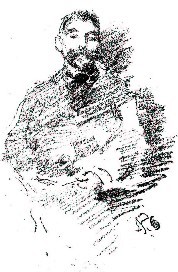
| Mallarmé, by Whistler, 1893 |
I really did think about posting about the various things happening today (the
debt limit talks fiasco; the Major League All Star Game in anti-immigrant pacesetter
Arizona; the primaries in
Wisconsin, in which the real
Democrats defeated the fake Democrats; the unfolding
News International/News Corporation scandals, etc.), but instead I'm going to post a translation I undertook earlier this afternoon during a break from writing fiction (i.e., a novel, which has nothing to do with the poem below). It is my rendering of one of the more celebrated later sonnets by
Stéphane Mallarmé (1842-1898), a poet who needs little introduction. One of the things that intrigued me early on and still does about Mallarmé, among his many poetic distinctions and triumphs, was his willingness to prioritize sound over sense, or the music of language over the usual semantic approaches to meaning that were predominant in his day (and still hold sway in most poetic precincts as I type this entry). This direction, emphasizing music over meaning, linked to a post-Romantic, intricately developed symbolic register, made possible, as students and readers of modernist literature know, the sorts of poetic innovations that would appear across a range of languages. He anticipated--and wrote--the poems and books to come even as he dreamed of writing the Poems and Books to Come.
In the translation below, which I have always loved, and which I sent earlier to some poet friends, I tried to retain some semblance of
a rhyme scheme, which given the poem's aural structure and specific phonemes, is impossible; Mallarmé's final "i" and "ui" sounds, almost a kind of piercing bell--'eeeee'--cannot be captured in English, so I went for long vowels, with a few short ones in those places where nothing else was possible, and consonance in the final two stanzas (the "s" sounds) to mirror the rhyming. Also, in terms of the content itself, in some cases I took leaps ("flow" for "flee," "it is itself alone," for "it is he," "which to it says no" for "it denies it," "seized" for "taken," etc.), following the leads of a colleague and great translator who, in a number of discussions and papers, has led me to think a lot more about how important it is to think with even greater complexity about translation and what might be carried over and created in the target language. One task I set for myself upon reading Mallarmé's poems like this one was to trace out an argument, thematic or lyric arc, or narrative. Can you figure this one out? Can you trace out the symbols? I have a book in Chicago,
Towards the Poems of Mallarmé (California, 1980), by
Robert Greer Cohen, that explores this and similar poems in depth, in case you want to see a scholar's take. I think, that devotes a I think it's clearer than some of his poems, like the famous sonnet "
Ses purs ongles....", also known as the "Sonnet ending in
-yx", for example. At any rate, here is pale echo, for I do love this poem, in its infinite strangeness.
THE VIRGIN, THE VIVID AND THE BEAUTIFUL NEW DAY
The virgin, the vivid and the beautiful new day
Will it tear apart with a drunken wing's blow
This forgotten hard lake haunting beneath the frost
the transparent flights' glaciers which did not flow!
A swan of yesteryear remembers it is itself alone
Magnificent but without hope of freeing itself
For having not sung the region where it dwelt
When the boredom of sterile winter shone.
Its whole neck will shake off that white agony
Inflicted by space on this bird which to it says no
But not the soil's horror in which its plumage is seized.
Phantom which its pure brightness here assigns,
it is immobilized in the cold dream of scorn
that enfolds amidst useless exile the Swan.
***
LE VIERGE, LE VIVACE ET LE BEL AUJOURD'HUI
Le vierge, le vivace et le bel aujourd'hui
Va-t-il nous déchirer avec un coup d'ail ivre
Ce lac dur oublié que hante sous le givre
Le transparent glacier des vols qui n'ont pas fui!
Un cygne d'autrefois se souvient que c'est lui
Magnifique mais qui sans espoir se délivre
pour n'avoir pas chanté la région où vivre
Quand du stérile hiver a resplendi l'ennui.
Tout son col secouera cette blanche agonie
Par l'espace infligée à l'oiseau qui le nie,
Mas non l'horreur du sol où le plumage est pris.
Fantôme qu'à ce lieu son pur éclat assigne,
Il s'immobilise au songe froid de mépris
Que vêt parmi l'exil inutile le Cygne.
From Stéphane Mallarmé,
Poésies, 1887. Translation © John Keene, 2011.