|
| Vincent Toro |
I have been intending for several weeks to offer congratulations on this site to Vincent Toro, one of the first students I taught upon arriving at Rutgers-Newark, though not in a creative writing course. A poet and playwright, Vincent was one of the intrepid souls who signed up for my Fall 2012 graduate literature class, "Topics in Postmodernism: Transhumanism and Posthumanism," which unfolded in almost magically smooth fashion, despite the intercessions of Hurricane Sandy.
I did not have another opportunity to work with Vincent, but I could tell by his MFA program and off-campus readings, as well as his performance and final submission in the literature course that he was not only a brilliant mind but also possessed a special gift as a writer.
I did not have another opportunity to work with Vincent, but I could tell by his MFA program and off-campus readings, as well as his performance and final submission in the literature course that he was not only a brilliant mind but also possessed a special gift as a writer.
After graduating with his MFA in 2014, Vincent, a New York native, received a Poets House Emerging Poets Fellowship, and also earned a Fellowship from the New York Foundation for the Arts. Not long ago, I learned the great news that he won the 2015 Ahsahta Press Sawtooth Poetry Prize, which includes $1,500 and publication of his first book, Stereo.Island.Music, with Ahsata Press, in January 2016. This year's judge was my former Northwestern colleague, the marvelous Ed Roberson, and the two finalists, Sasha Steensen and Lauren Russell, are noted poets as well.
***
On June 8 the PEN American Center held its annual awards ceremony, adding one of the last waves of authors and books to 2014's list of prize winners. I did not attend the ceremony, but as with prior years, the organization created a bit of excitement with its withholding of all the winners in advance, reserving some honorees' names until ceremony time. (Also overshadowing the event was the uproar surrounding PEN's decision to give its inaugural PEN/Toni and James C. Goodale Freedom of Expression Award to Charlie Hebdo, which led a number of its major author, beginning with Francine Prose, Peter Carey, Michael Ondaatje, Teju Cole, Rachel Kushner, and Taiye Selasi, to withdraw from this year's annual fundraising dinner in New York.)
The main award event went off, if the absence of reports of any dust ups are to be believed, without a hitch. One of last year's most highly praised--and timely--works, Citizen: An American Lyric (Graywolf Press) by Claudia Rankine, received the PEN Open Book Award for a Distinguished Work by an Author of Color, while another, Rutgers-Newark alumnus and Buzzfeed writer Saeed Jones, received the PEN/Joyce Osterweil Award for Poetry, for his sparkling debut collection, Prelude to a Bruise (Coffee House Press). Saeed's was by a wide measure one of the better poetry books published last year.
Other winners included Jack Livings, who received the PEN?Robert W. Bingham Prize for his debut novel The Dog (Farrar, Straus, and Giroux); Sheri Fink, who received the PEN/John Kenneth Galbraith Award for Nonfiction for Five Days at Memorial: Life and Death in the Storm-Ravaged Hospital (Crown); Anna Whitelock, who merited the PEN/Jacqueline Bograd Weld Award for Biography, for her volume The Queen's Bed: An Intimate History of Elizabeth's Court (Sarah Crichton Books/Farrar, Straus, and Giroux); and Adriana Ramírez, in the PEN/Fusion Emerging Writers Prize category, for her unpublished manuscript Dead Boys.
Among the translation awards, Eliza Griswold received the PEN Award for Poetry in translation for her assured rendering from Pashto of I Am the Beggar of the World: Landays from the Contemporary Afghanistan (Farrar, Straus, and Giroux). I have no familiarity with this particular language or poetic tradition, but because of Griswold I felt as if I were grasping something vital in and from these poems. I also appreciate that the award went to an author translating non-canonical work from a non-European language. The prose winner was Denise Newman's translation from the Danish of Baboon (Two Lines Press), by Naja Maria Aidt. For distinguished lifelong work in this area, Japanese literature translator Burton Watson received the PEN/Ralph Manheim Medal for Translation.
Unusually among the annual bestowers of American literary honors, PEN also hands out awards for sports and science writing; you can find out who received those awards, as well as the wonderful fact that this year, all the winners of the playwriting awards were women (none of whose work I was familiar with, though I plan to look all of them up), and more of the awards here.
***

László Krasznahórkai, whether in his native Hungarian or in the stirring translations by George Szirtes, is a masterfully innovative stylist. His sentences are serpentine to a dizzying degree, and within them he is able to weave a range of material so that once you as a reader fall under his spell, proceeding through his books almost feels like navigating down a strange and enstranging but deeply compelling living river. (Twitter they ain't!) The Danubian sentences, with their clusters of narration, observation, detail, and imagery, give way something lighter, more luminous, more strange and yes, more compelling, to my mind, in his recent book Seiobo There Below (New Directions, 2013). This text confirmed for me at least his greatness as an international literary figure, a fact that the Man Booker International Prize jury saw fit to ratify by giving him, and his translators, who include Ottilie Mulzet, this year's award, which it only presents on a biennial basis. (Why? There are too many great authors to wait every two years to honor one.)
About Krasznahórkai's award, the judges, enamored of those sentences, stated:
In László Krasznahorkai’s The Melancholy of Resistance, a sinister circus has put a massive taxidermic specimen, a whole whale, Leviathan itself, on display in a country town. Violence soon erupts, and the book as a whole could be described as a vision, satirical and prophetic, of the dark historical province that goes by the name of Western Civilisation. Here, however, as throughout Krasznahorkai’s work, what strikes the reader above all are the extraordinary sentences, sentences of incredible length that go to incredible lengths, their tone switching from solemn to madcap to quizzical to desolate as they go their wayward way; epic sentences that, like a lint roll, pick up all sorts of odd and unexpected things as they accumulate inexorably into paragraphs that are as monumental as they are scabrous and musical.’
In addition, judging panel chair Marina Warner added:
Laszlo Krasznahorkai is a visionary writer of extraordinary intensity and vocal range who captures the texture of present day existence in scenes that are terrifying, strange, appallingly comic, and often shatteringly beautiful. The Melancholy of Resistance, Satantango and Seiobo There Below are magnificent works of deep imagination and complex passions, in which the human comedy verges painfully onto transcendence. Krasznahorkai, who writes in Hungarian, has been superbly served by his translators, George Szirtes and Ottilie Mulzet.
I sign on to what she's saying 100%. Krasznahórkai was in excellent company, too. The other finalists included César Aira; Ibrahim al-Koni; Hoda Barakat; Maryse Condé; Mia Couto; Amitav Ghosh; Fanny Howe; Alain Mabanckou; and Marlene Van Niekerk. I don't know the work of al-Koni, Barakat or Van Niekerk at all, unfortunately, but any of the others could have received the award, though something tells me none of their work--Aira's prodigiousness; the smartness of Condé's fiction; Couto's fantastical portraits of Mozambique; Ghosh's immense and knowing novels; Howe's poetic prose; and Mabanckou's witty, opportune fiction--cast the same spell, on the judges, of those sentences! Congrats to all the finalists, and to Krasznahórkai, who I'm told will be in New York this fall, so I hope to hear him read live at some point!
Another Central European author, also writing a quite singular book, received a major international prize recently. I am talking about Jenny Erpenbeck, who with her translator Susan Bernofsky, one of the greats, received the Independent Foreign Fiction Prize, for the novel The End of Days (New Directions, 2014). She becomes the first living German author to receive the award, as the prior ones, -W. G. Sebald and Gert Hofmann, were both honored posthumously. Among her shortlist companions were Haruki Murakami (Japan), Edwin Mortier (Belgium), Daniel Kehlmann (Germany), Tomás González (Colombia), and Juan Tomás Ávila (Equitorial Guinea).
The award, now in its 25th year, honors non-Anglophone authors and their translators for a book published the previous year. Longtime prize panelist and Independent columnist Boyd Tonkin noted of Erpenbeck's book that "This is a novel to enjoy, to cherish and to revisit many times. Into its
brief span, Erpenbeck packs a century of upheaval, always rooted in the
chances and choices of one woman’s life." This only scratches the surface of this entrancing, disorienting book, which opens with the main character's death...only to reveal what might have happened had she lived and followed other paths, and died...and lived...and died...and--well, if this description intrigues, you should run and get the book!
***
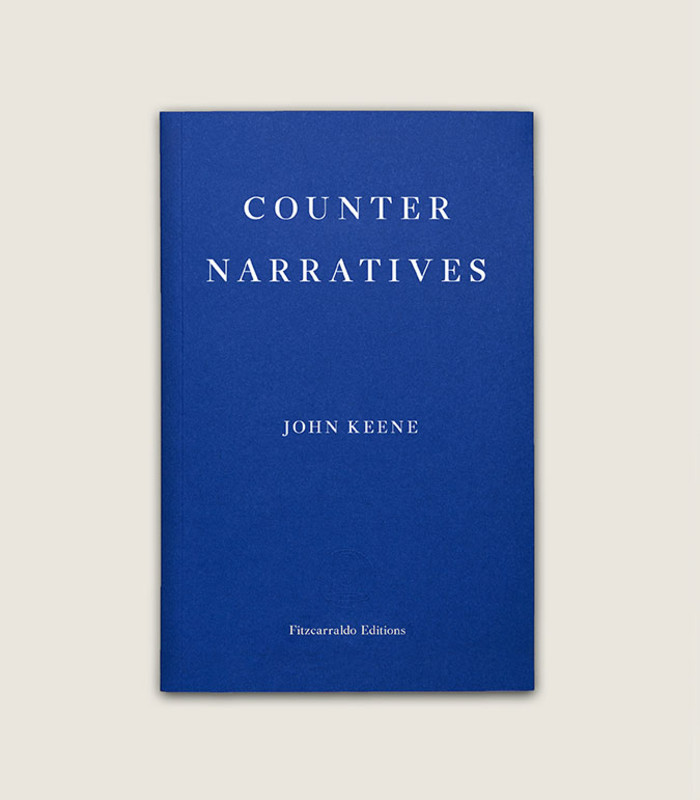
I want to offer my deep thanks to Nate West for his probing, laudatory review of Counternarratives, which is now up at the arts and letters site Music & Literature. His reading, which opens with a discussion of the contemporary cleavage among writers between those who adhere to a conception that the bourgeois imagination is sufficient (Jonathan Franzen, for example), and others who believe in the necessity of confronting, through a variety of formal and stylistic means, the effects of history and politics (the late Edouard Levé, W. G. Sebald, and I'd add, Roberto Bolaño), as a way of talking about how he believes Counternarratives addresses questions arising from this divide. I'll let J's Theaters dive into the review to find out where the critic takes this thread, but I want to note that West's thorough reading of the book, though not long, brims with insight, ultimately identifying something I have not really been asked about in any of the excellent reviews so far, which is to say, the political thread woven throughout all the stories.
Two quotes:
Keene’s Counternarratives offers a corrective to boilerplate that would forbid art from entering into the political. Its very title suggests that not only that the story has been told wrong, not only that it is not enough to tell other stories to be placed in their appropriate box (African-American, Post-Colonial) and thereby neutralized before being passed on to readers as ersatz probity while the real economic and political conditions that perpetuate injustice grind on unaffected; but rather that, for literature to continue to fulfill its vocation, the record has to be set straight. The political is not imposed on these tales from above; instead, a full account of the character’ life histories cannot be given without recourse to the political. Even their names are imbued with relations of power
and
Throughout the book, Keene plays with the possibilities of his title: Counternarratives serves as the heading for the first group of stories, Encounternarratives the second. The final section, Counternarrative, implies a more conceptual approach—the opposition to narrative, or the narrative that exists solely by opposition. It consists of a single story, Lions. In a conversation between a dictator and his muffled victim, the easy continuity between ideology and demagoguery and the inexhaustible lure of corruption come to life in a cell that could equally lie in Zimbabwe, in Uganda, or in Equatorial Guinea. The two figures speak of their youthful idealism, their yen for Fanon and Amilcar Cabral; of the depraved luxury of power and rapine; of boyhood love incompatible with the struggle for dominance; of what might have been, had Africa been untouched by Western hands.
Do check it out, and many thanks to Music & Literature!