Showing posts with label summer. Show all posts

Monday, July 20, 2015

Summer Notes

July is racing by. I was wondering when the brutal summer heat would finally appear and today, it settled on our doorsteps. I no longer gallivant about in it like I used to; age and health have a way of finally impressing better sense on some of us at least, so I made sure my trips outdoors today were brief. This blog post will be like those trips, brief and full of little snippets.

>>>

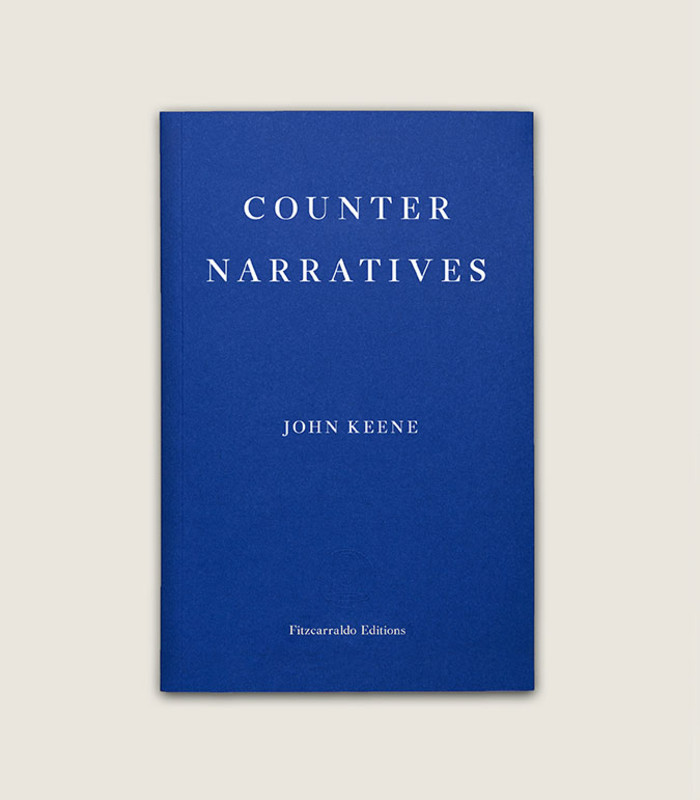
Counternarratives continues to receive reviews, and very good ones, for which I am extremely thankful. In addition to the slowly gathering ratings on Goodreads (thank you!), an excellent review recently appeared in Bookforum. Written by Max Nelson, it offered a distinctive, affirmative, nuanced critical take on the book. One thing I really appreciate about the piece was his discussion of the collection's prose. Here's the opening snippet:
The American author John Keene writes sentences that begin in states of tight restraint, steadily loosen, unravel, sprawl or expand, and then—in their last few beats—contract suddenly into piercingly acute points. One such sentence comes two-thirds of the way into an epically named story, “Gloss on A History of Roman Catholics in the Early American Republic, 1790-1825; Or the Strange History of Our Lady of the Sorrows,” included in Keene’s remarkable new short fiction collection Counternarratives. The sentence conveys—among other things—one of the story’s grimmest plot twists. A dead, unidentified newborn has been found at a secluded convent in early-nineteenth-century Kentucky. None of the nuns or students could have been responsible, two schoolgirls decide among themselves, because “none of them could possibly have been with child.”
I thank Max Nelson, and invite you to savor his critical acumen and prose, which are quite artful themselves!

<<<

As an entrant to their annual award, Larry Dark at The Story Prize invited me to contribute a short post about Counternerratives for its blog site, so I tried to think of something I had not yet discussed extensively in interviews or public conversations, but which has come up in reviews. What I thought about was the music of the prose in many of the stories, and here is the link to what I wrote, keeping under the 750-word limit: "John Keene's Hidden Soundtrack."
If you were to place any book against your ear, what would you hear? Unless it were an audiobook, very likely nothing behind the sound of paper on skin, along with background ambient sound. One aspect of my collection Counternarratives that surprises me when I reread it, however, is that each story's prose contains an internal music and rhythmicality specific to that text, and both function in complementary, productive ways in relation to the stories' narration. I find myself surprised because when I was writing the stories, I was not consciously considering this element of my prose, yet somewhere in my subconscious, I apparently was scoring and setting pitches. Additionally, among the thirteen stories in the collection, only two specifically explore the lives of musicians, and in only one of these, "Cold," which recounts the final day in the life of the minstrel composer and performer Bob Cole, was I intentionally attempting to convey what the composer's music might have sounded like.
There's more, along with sharp pieces by many others at the Story Prize's blog and website.

>>>

I had never before set up Google Alerts, but did so recently, and given my ineptitude with online technology, it has not alerted me to a single new thing that regular Googling or searching Twitter also reveals. The other day, via Google's standard search tool, I happened upon a beautiful mention of Counternarratives and Annotations (!) by the acclaimed writer Maud Casey in the Washington City Paper, in a column focusing on what local DC-area writers are reading this summer. Casey mentions that she is currently reading Maggie Nelson's highly acclaimed The Argonauts, and then says:

The book I’m in the middle of is Helen MacDonald’s H is for Hawk, a raw, beautiful, elegiac love story involving a ginormous goshawk. The book I’ll be reading next is John Keene’s collection of stories and a novella, Counternarratives. His first novel, Annotations, blew me away, and Counternarratives looks to be as nimble and strange and awesome. James Baldwin wrote, “The purpose of art is to lay bare the questions hidden beneath the answers” and Keene—and Nelson and MacDonald—do that. I’m very pro-questions these days.
Talk about fine company! Many thanks to Maud Casey for the shot out!

<<<

Some of last week's harvest from the garden. The blackberries are thriving, though smaller than in prior years. All of the other plants are also thriving. Caterpillars are eating the collard greens, so we'll have to find a non-toxic solution to get rid of them. Any suggestions are welcome.


Thursday, July 25, 2013

Poet's Showcase at Poets House

Every year Poets House has its marvelous Showcase of newly published books, and its series of readings that coincide with the display.  This past Tuesday featured two writers I know and deeply admire, and two whose work I was not at all familiar with, but now have some appreciation for. What I loved about the reading is that although Poets House has one of the largest libraries of poetry, of all kinds, in New York or anywhere else, it also invites writers in other genres to present their work, and the final two writers, Thomas Glave and Rachel Levitsky, though they are published poets, read from new prose works.

Thomas, whom I've known for two decades, read an essay on beauty, violence, homophobia, and courage set in and drawn from his experiences in his ancestral Jamaica and in particular with the human rights organization J-FLAG (Jamaica Forum for Lesbians, All-Sexuals and Gays), which appears in his newly published and acclaimed book of essays and imaginative prose pieces, Among the Bloodpeople: Politics & Flesh (Akashic Books, 2013).  One of the many things his reading, which began with his invocation of a vulnerable queer Jamaican person viewing the astonishingly beautiful sea and sky that envelope the island, stirred in me was a reminder yet again not only of how precious and precarious life remains for some of us, but how important art can be in focusing our attention on addressing pressing problems, and on what is most important and crucial not only in our own lives, but in the lives of others, especially those we cannot otherwise see or understand, which art can help to do. I look forward the reading the entire collection and sharing it with my students.

Rachel, whom I've also known for many years, also read from a new prose work, a novel entitled The Story of My Accident Is Ours (Futurepoem Books, 2013), and before beginning she talked about her poetic practice and how she had already been writing in and around prose, thereby paving the way for her transition to her lyrical novel. One theme I took away from her work was the vitality of the novel form, which a certain sector of the literary commentariat continues to pronounce dead, much in the manner that a similar sector regular decries the death of poetry, or its obsolescence, or lack of social relevance or public appeal, especially as more women, writers of color, queer writers, writers using new technologies and creating new genres, emerge. The snippet I heard of Rachel's novel suggests it makes a vital contribution, and I am looking forward to reading the entire work.

Catherine Barnett, the evening's first reader, shared poems from her new collection The Game of Boxes (Graywolf Press, 2012), as well as some very new poems, many short, all attentive to the possibilities of their internal music, cadence, and silence, and her final one, from even more recent poems struck me as very simple in its effects but moving in the way she made a casual, personal observation into something profound and memorable. The fourth reader, Peter Filkins, a noted translator as well as poet, presented poems from his collection The View We’re Granted (Johns Hopkins University Press, 2012). He opened with a poem about two unusually thick birches that had stood in the front yard of the home in which he grew up and once again lives in, in western Massachusetts, and closed with a poem about maple trees, filling the space between them with poems brimming with his erudition, but handled with a light touch.

All in all a wonderful way to spend a warm mid-summer evening. Photos follow:

Stephen Motika, at Showcase Reading, Poets House
Stephen Motika of Poets House, introducing the reading
The audience, at Showcase Reading, Poets House
Part of the audience
Catherine Barnett, at Showcase Reading, Poets House
Catherine Barnett
Peter Filkins, at Showcase Reading, Poets House
Peter Filkins
Thomas Glave, at Showcase Reading, Poets House
Thomas Glave
Rachel Levitsky, at Showcase Reading, Poets House
Rachel Levitsky

Wednesday, September 12, 2012

Random Photos

Baseball player Dan Uggla, near Grand Central Station
Atlanta baseball player Dan Uggla, autographing outside Grand Central Terminal
Outside one of the fashion shows, at the NYPL
Outside a Fashion Week show, at the New York Public Library's research branch
The Freedom Tower (WTC) at night
The Freedom Tower, at night
Stylin, on the PATH to Newark
On the PATH train to Newark
At the Yayoi Kusama show
At the Yayoi Kusama show, Whitney Museum
At the Fulton St. station, NYC
Sweltering Fulton Street station, NYC
Bolivian Day parade, Jersey City
Bolivian (Day) celebration,  Jersey City
A reporter, on 9/11 (2012), near WTC
A reporting preparing to broadcast, near the WTC, on 9/11 (2012)
The storm, approaching from Long Island
The weekend's storm clouds, barreling in from Long Island towards the Bronx
Sagging, at 42nd St.
At 42nd Street
At the NYPL's (quiet) main reading room
The "quiet" reading room, NYPL Research Branch
Eric Bogosian at the NYPL
Author Eric Bogosian (ordering books, NYPL Research Branch)
At the 1980-2012 exhibit, MoMa
Keith Haring paiting reduced to wallpaper, MoMa
At the 1980-2012 exhibit, MoMa
Still from a Steve McQueen film, MoMa
At the Alighieri Boetti exhibit, MoMa
That beguiling Freedom Tower
Looking towards Lower Manhattan, from Jersey City
Lovers in Union Square
In Union Square Park, Manhattan

Thursday, September 22, 2011

Classes Underway + End-of-Summer Poems: Basho & John Ashbery

September is nearly over, the quarter charges forward, my classes have begun.  This fall I am teaching two fiction classes, one undergraduate, the other a graduate workshop. The undergraduate course, "The Theory and Practice of Fiction," is a required course for all the fiction majors and minors, and runs into the winter quarter's midpoint, or early February, making it one of the rare semester-long classes in the university's undergraduate curriculum.  (All three major/minor required tracks, poetry, fiction and nonfiction, have this course.) As part of the class students read short stories by established writers (this year ranging from Anton Chekhov and Flannery O'Connor to Jhumpa Lahiri and ZZ Packer) and (practical) theoretical texts (including Francine Prose's Reading Like a Writer) on fiction writing, and produce three draft short stories (as well as in-class reports, critical papers and commentary), which they'll revise and submit by the end of the long-course, at which point I guide them to my colleague who will lead through the writing of a novella, which they'll complete by next June.  They are a very sharp, talented group, and I'm greatly looking forward to working with them. I also have a wonderful MFA student who is conducting a practicum this quarter, and will be joining me as a teaching assistant.

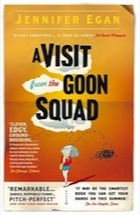
The graduate course is the standard fiction workshop for all MA/MFA students, and it too brims with smart, skilled writers.  Earlier this year, at Reggie H.'s urging, I read Jennifer Egan's Pulitzer and National Book Critics Circle Award-winning novel, A Visiting from the Goon Squad (Knopf, 2010), and among the many things about this outstanding work that struck me, I realized it might offer another way of thinking about negotiating the relationship between writing short stories and novels, which the graduate students often are thinking about. Egan's consists of chapters that could work as free-standing short stories, and she has in fact said that she wrote two of them first, then thought about how to relate them to each other, which produced the inventive novel that resulted. In addition to Egan's book, with which we'll be concluding the class, I've assigned chapters from works that comprise interrelated short stories, novellas, or near-autonomous story-like texts that also have been termed, by the authors themselves, critics or readers novels. These include texts by Rebecca Barry, Ray Bradbury, Sandra Cisneros, J. M. Coetzee, David Mitchell, Nami Mun, Gloria Naylor, Tim O'Brien, and W. G. Sebald. I'm excited about the potential discussions to arise out of these works, as well as about the work the students will be submitting.

This year I have several graduate literature students I'm working with, several graduate fiction students, and one honors creative writer, who is writing a novel to submit as his thesis.  A lot of reading, and this is only one aspect of my job, but one I'm definitely glad about so far!

+++

Today is the last day of summer. Could I have written that more prosaicly? What about: today summer's over. There's a touch of poetry there. Here, however, are two great poems elegizing summer's end. One by one of the greatest poets of concision, the Edo-era master of haiku no renga and other forms, Basho Matsuo (松尾 芭蕉, 1644-1694), the other by one of the most important living poets writing in English, American poet John Ashbery (1927-). Its opening sentence enacts what it describes, and is one of my favorites among all his poems. Enjoy!

A statue of Matsuo in Hiraizumi, Iwate (from Wikipedia)
[Farewell, my old fan]

by Basho

Farewell, my old fan.
Having scribbled on it,
What could I do but tear it
At the end of summer?

***

Summer

by John Ashbery

There is that sound like the wind
Forgetting in the branches that means something
Nobody can translate. And there is the sobering “later on,”
When you consider what a thing meant, and put it down.

For the time being the shadow is ample
And hardly seen, divided among the twigs of a tree,
The trees of a forest, just as life is divided up
Between you and me, and among all the others out there.

And the thinning-out phase follows
The period of reflection. And suddenly, to be dying
Is not a little or mean or cheap thing,
Only wearying, the heat unbearable,

And also the little mindless constructions put upon
Our fantasies of what we did: summer, the ball of pine needles,
The loose fates serving our acts, with token smiles,
Carrying out their instructions too accurately—

Too late to cancel them now—and winter, the twitter
Of cold stars at the pane, that describes with broad gestures
That state of being that is not so big after all.
Summer involves going down as a steep flight of steps

To a narrow ledge over the water. Is this it, then,
This iron comfort, these reasonable taboos,
Or did you mean it when you stopped? And the face
Resembles yours, the one reflected in the water.


Copyright © John Ashbery, from The Double Dream of Spring, New York: Dutton, 1970, 2011. All rights reserved.

Sunday, August 21, 2011

Random Photos

Some posts are coming. In lieu of one, some photos.
In front of Madame Tussaud's Wax Museum
At Madame Tussaud's Wax museum
Giant racket, 34th Square
Giant racket, 34th Street The tophatters
The top-hatters, 34th Street
Dancers-acrobats, 42nd St.
Dancer-acrobats, in front of the New York Public Library's Schwarzman Branch
Lonely crusader, Times Square
Lonely crusader, 34th Street
Man shaving his head outdoors, Mercer St.
Man shaving his head outside, Mercer St., West Village Butcher's shop, 9th Ave.
Outside a butcher's shop, 9th Avenue
Surveyor, 42nd St.
Surveying
Young man in a top hat
Young man in a top hat Waiting for a garment pick-up
Waiting for a pick-up
Willi Smith's plaque, Fall Walk of Fame, NYC
 Willi Smith's plaque, New York Fashion Walk of Fame Bright pole, Astor Place
Lamppost gaily adorned, Astor Place, West VillageJapanese crew filming at Kinokuniya in NYC
Japanese film crew, at Kinokuniya Street saviors
Hebrew Israelite street saviors, 14th StreetPrepping an empty storefront
Prepping an empty storefront, 14th Street Painting outdoors, NYC
Man painting outside the New York Public Library's Schwarzman Research Branch Outside the Port Authority
People waiting outside the Port Authority Bus terminal Cat on the tracks, Jersey City
Kitten on the train tracks, Jersey City

Wednesday, September 01, 2010