Showing posts with label reading. Show all posts

Friday, April 01, 2022

Imani X. Davis Reads "Napoleon Club" + Happy National/International Poetry Month

HAPPY POETRY MONTH!

Back in 2018 I posted a clip on here of a young performer, Orlando Watt, on YouTube performing a snippet of my poem "Words," which had appeared on the Academy of American Poets' Poetry Daily, courtesy of the amazing poet Dawn Lundy Martin. It is rare to have anyone read or perform my work, and I didn't know Watt, but I loved his interpretation, which he subsequently removed from YouTube. I believe he stated that it was part of his audition reels, which I also appreciated, because if one of my poems can in any way help another young artist get a gig, that for me is an unexpected but added bonus of creating it.

This morning while scrolling on Twitter I came across a tweet by Mani (Imani X. Davis), a doctoral student I've never met but who very kindly selected another poem of mine, "Napoleon Club," which like "Words" appears in my new collection Punks, to read online, and they do so beautifully. What a marvelous way to launch National/International Poetry Month, which begins today!

Many thanks to Imani X. Davis, and thank you especially for selecting a poem from Punks. You can follow this scholar and reader at @imanixdavis on Twitter, and please do read some poetry this month if you can!


And here is the video (many thanks again!):


Saturday, February 27, 2021

16th Blogiversary

The Translation Project's Black
History Month tweet, from February 21, 2021,
 highlighting my essay "Translating Poetry,
Translating Blackness"

Happy Black History Month and Happy Almost-End-of-February 2021. We are almost a year into the Covid-19 pandemic, and it has been over a year since I posted on this blog. It sometimes amazes me that more than a decade and a half has passed since I first began blogging, back in 2005, during what was a decidedly different time in the online world. Social media platforms as we know them barely existed; blogging was still a somewhat new and exciting activity, though the bloggers who inspired me had been blogging for several years; and people read and commented on blogs, including this one. I have over 2,000 non-spam comments attesting to that. 

16 years later, blogs and blogging do still exist, and the term "the blogs" is often bandied about on reality shows as a catch-all for any site, blog or not. This is the case despite that period perhaps ten years ago when some in the media trumpeted blogging's demise, and despite the proliferation of quasi-blog-like sites, like Tumblr and Instagram, the former of which has done away with words altogether, and both of which are now part of many peoples' daily consumption, even if blogs as they once existed--as they existed in 2005--seldom are. I won't rehearse my blogging history, which is available via a search of this prior blogiversary posts on blog (I started off blogging about poetry and the arts, etc.), but blogging here was, at least for that first year, and certainly for the next decade or so, a vital experience for pondering the sometimes imponderable, conveying some of my enthusiasms and interests, especially across the arts, posting translations, sharing photographs (from daily life, events I attended, my random walks through NYC, Chicago and elsewhere), and just having a scratchpad to play, in written form.

Things began to change demonstrably, I think, in 2014-2015 when I began chairing a department. My free time increasingly disappeared, which meant that that I had to rearrange my priorities, with some things suffering more than others, among them blogging. (A colleague queried whether I had In 2013, my second year at Rutgers-Newark (I was acting chair for part of that year) I blogged 140 times; by 2014 it had fallen to 59. I made an effort over the next few years to blog a bit more and got up to 78 and 71 blog posts, successively, in 2015 and 2016, but my entries plummeted in 2017. In 2018, I again made a strong push to blog, and nearly reached 100 posts, but most of them that year appeared during National Poetry Month, and by the end of the year, I was down to a 1-a-month trickle. Two years ago I only managed six posts, a miracle I sometimes think, in that I had one of my busiest and most draining years in academe, and I think I consciously tried to post something, though the results were, as the total underscores, paltry. 

This past year, the Covid-19 pandemic, which is still very much with us, didn't result in a flood of posts, but rather a feeling of PTSD-style wordlessness, at least in terms of blogging, that I am still trying to process. I had a few blog stubs I began, and I will try to finish some of them, even if they consist mostly of links and images, but I also feel like the silence--the absence of posts--is testimony to what has transpired over these last 17 months (since February of 2020). Most of the people who were blogging when I began or who started during the last 16 no longer do so, at least regularly, though Gukira bucks that trend, with entries that are always rich, subtle, lyrical, and distinctive, however brief. This month he continues his readings of Dionne Brand's remarkable 2018 collection The Blue Clerk. I keep thinking that I will again be able to find the time and focus to blog, but I also increasingly feel, as I pointed out in a blog several years back, reading itself appears  fallen by the wayside, and videos, whether on Youtube or IG's stories--which Facebook, tellingly, has adopted, even though it owns Instagram--or TikTok, accompanied by music and each with its own distinctive set of active participants, have become increasingly predominant, so perhaps even occasional posts, as loose and free as possible, might be the thing to aim for.

One of the many types of blog posts I tried to include over the years entailed reviews, of films, series videos, and books of course, and I feel proudest of some of those, which still hold up. One of my most read posts (4,100 views) is a short review of Christopher Honoré's 2010 feature film Homme au bain, starring the writer Dennis Cooper and the porn star François Sagat. Perhaps its stars drew more readers than most of my other posts, though I think it provided a helpful introduction to the film, the best I have seen by Honoré. I also have been able to write about more recent offerings like Terence Nance's 2018 Afrofuturist masterpiece series Random Acts of Flyness (one of the strangest and most original things I have ever seen on TV), Boots Riley's 2018 film Sorry to Bother You (I dream of more films like this!), and John Trengove's 2018 film Inxeba (Wound), which also spurred a series of typically, thoughtfully dazzling responses from Gukira (Ke'guro). One of my favorite films, which I haven't seen in years, is Tsai Ming-Liang's slow, astonishing Goodbye, Dragon Inn. I remember watching it and thinking, the viewership for a film like this is probably very small, but I most certainly am one of those cineastic people, yet in reviewing it, I tried to make it legible for a wider array of potential viewers. Perhaps if and when I find the opportunity I'll try a few more reviews this year, so keep an eye out.

I'll wind down here, and say that I feel like I've accomplished something just by posting something on this blog today. (I also deleted a slew of spam comments, which also felt like an achievement!) I am still chairing and teaching (including a graduate novel workshop this semester) and supervising theses, all via Zoom (like everyone else), every day of every week feels even more busy than usual (each seems to be triple-booked at a minimum in terms of Zoom meetings, calls, etc.), and my stack of required reading grows and grows, but it feels invigorating even to have gotten this far in this post. It is here. It is done. & I am going to try to post more.


Sunday, September 30, 2018

Farewell, Victory Hall/Drawing Rooms on Grand Street

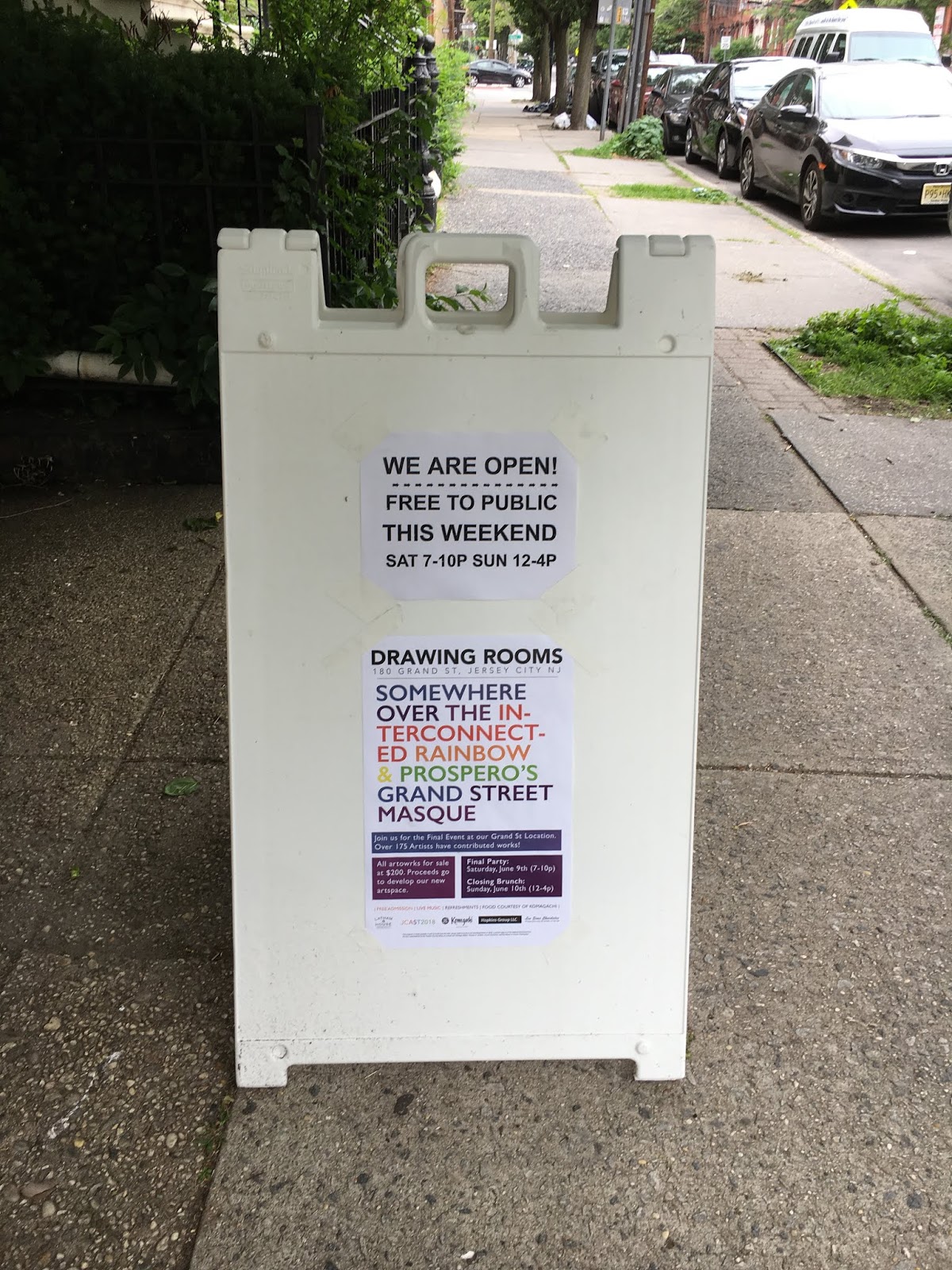
The sign outside Drawing Rooms' former site
Note: Originally I had planned to post this in June, but life intervened, so better late than never, no?

One aspect of Jersey City that particularly has interested since moving here over two decades ago is the small but vibrant arts communities that has managed to thrive in the shadow of New York City's far larger global art-industrial-complex world just across the Hudson. Jersey City's downtown, part of which was once dubbed the Powerhouse Arts District, once was full of warehouses and lofts where artists could and did live and work quite affordably, particularly compared to Manhattan and even Brooklyn. Many of the older buildings have been razed for new towers, which began rising in the lead up to the 2007-9 financial crisis, and once again began rising in 2011-12, or they were repurposed for rich condo buyers, as the downtown has steadily gentrified, scattering artists to nearby districts and cities, like Newark. A few organizations and a good number of artists have managed to hang on.

One, Victory Hall Inc., began hosting a series of programs in 2011 under the rubric of Drawing Rooms, a contemporary arts center in what was a former convent next to the campus of St. Peter's Preparatory High School, near the Paulus Hook neighborhood of Jersey City. Drawing Rooms hosted a range of shows of "two and three-dimensional works"--drawings, paintings, mix-media works, sculptures of various kinds--as well as performances by emerging and mid-career artists based in the metro area Its focus on local artists, especially those from Jersey City, Hudson County and northern New Jersey, has been heartening. Some have gone on to shows a bigger galleries in New York and elsewhere, but Drawing Rooms never lost the intimacy of its exhibition spaces, the informality and friendliness of the staff, or the affordability of works on display, for those interested in buying it. All of these set it apart even from most smaller galleries in the City.

What I learned once I started dropping by Drawings Rooms's shows, which run regularly throughout the year, was that its parent organization, Victory Hall, comprises more than Drawing Rooms, however; its other programs include Rainbow Thursdays Artists, art classes for local developmentally disabled adults; Artist Workspaces, hosted in Drawing Rooms and other sites in Jersey City; Victory Hall Press, which published original catalogues of work by Victory Hall-affiliated artists; Victory Arts Public Projects, which have included partnering efforts with other local organizations; and The Art Project, shows and gallery tours organized for four new condo developments, in conjunction with Shuster Development, in downtown Jersey City: Art House, The Oakman, Hamilton House and Gallery at 109 Columbus. (I have to say that while I understand how politics and economics have changed the equation for not-for-profit arts organizations, pushing all but the wealthiest to the brink, it still pains me a bit to witness the very institutions squeezed out or suffocated by gentrification partnering with gentrifiers in order to stay alive and keep a foothold in the very spaces and places they alone once brought to life. Neoliberal capitalism is something else, and this pattern has repeated itself over and over, I know.)

As of June 15, however, Drawing Rooms will no longer occupy its ex-convent home; it had previously announced that it would be moving to the Topps Building/Mana Campus in the Journal Square neighborhood of Jersey City. (The Mana Campus is part of Mana Contemporarythe contemporary arts powerhouse in Chicago and Miami. In preparation for its move, Drawing Rooms held a two-day final celebration and fundraiser, titled "Somewhere Over the Rainbow & Prospero's Grand St. Masque," which included an art sale, so I headed over during the second day's Brunch session to spend a little time with the artworks and artists, including James Pustorino, the Executive Director, and Anne Trauben, Exhibitions Director/Curator, who work I featured on here back in 2013, when I read poems based on them as part of a Halloween event. For the Masque, Drawing Rooms had taken its aesthetic design from Edgar Allan Poe's famous 1842 story "The Masque of the Red Death," and decorated the rooms in the colors delineated in the tale, with two additional ones, yellow for an eighth room, and red for the hallway, signifying not death and morbidity, but a rainbow's promise and ephemerality.

It was encouraging to see how many people were there that Sunday, and to later learn that a number of the artworks did sell. Below are some photos from the event; you can find the names and titles on the Masque link above. if you are in Jersey City and want to see some of the artists whose work has been featured at Drawing Rooms, Drawing Rooms' new exhibits, "Now Ya See It, Now Ya Don't" and will open this upcoming weekend at the new gallery in the Topps Building, and there will also be an Artists' Studio Tour, including Art Project exhibits at the Art Project sites listed above.

The sandwich board out front
Some of the artwork (I can't remember which color
designated this room)
Artworks by (l-r) an unknown artist,
Cathy Diamond, Gregory Stone, and Brian Hallas

Patrons and supporters of Victory Hall
& Drawing Rooms
More artwork, at left by Robyn Feld
and Andrew B. Cohen, two at
right by god@daddy borja
Conversations amid the art 
 Works in the Yellow Room (I think), by Barbara Lubliner
(fourth from left), an unknown artist,
and  Joan Mellon (at far right), 
Works by Anne Trauben (left) and Joan Mellon (right) 
Conversations in one of the galleries 
The Black Room
Some of the art in it 
Viewing the art up close
The now former home of Drawing Rooms


Tuesday, September 04, 2018

Maryanne Wolf on the Death of (and Ways to Protect) Deep Reading

When journalist Nicholas Carr’s The Shallows: What the Internet Is Doing to Our Brains appeared in 2010, I remember exchanging emails with Reggie H. and Lisa M. about it, reading numerous articles about it (including excerpts from the book) online, and eventually buying the book to dive fully into what he had to say. Overwhelmed at the time by my usual mountain of required reading it took me a while to get to it, but I did, and found his argument about the effects of the Internet on our brain and neural system quite persuasive. I even blogged a snippet from The Shallows at the end of that year. To quote Carr again:
The Net's cacophony of stimuli short-circuits both conscious and unconscious thought, preventing our minds from thinking either deeply or creatively. Our brains turn into simple signal-processing units, quickly shepherding information into consciousness and then back out again.
He was certainly on to something crucial about the various cognitive changed spurred by the US's increasing digital turn, and he wasn't alone in his assessment. Others like internet pioneer and guru Jaron Lanier took up related arguments about the effects not just of the net and our brains and nervous system, but the entire e-technological apparatus and its transformation of human sociality, economics, and our contemporary polity. Where Carr was alarmist--now proving to have been correct in his worries--Lanier was more measured, but in both cases, as with others who have written about the effects of the net, social media, etc., they were identifying the songs of more than one canary in the coal mine we're now deeply immersed in.

One very recent entry in this genre is Maryanne Wolf's Reader, Come Home (Harper Collins, 2018), which takes up some of the threads of her earlier books, Proust and the Squid (Harper Collins, 2011), and Tales of Literacy for the 21st Century (Oxford University Press, 2016), with a shift, as was the case with Carr, on online reading and its effects. Her earlier books explored the origins of human literacy and the challenges that our long human history of interacting with text faced as we moved into our current millennium, but now Wolf, Director of Center for Reading and Language Research at Tufts University, where she is Associate Professor of Child Development, and thus someone steeped in the current state of research on reading, is concerned with reading itself. As Laura Miller describes in her recent Slate review of the book, Wolf began to notice something about her own experience as a reader that I'd noted anecdotally with some of my students, beginning perhaps roughly 10 years ago and increasing among them to the point that I had to rethink my syllabus and approach to teaching: a waning ability to concentrate, and engage in sustained, "deep reading."

And it was not just my students: even for me, I have begun at times to feel a creeping distraction and impatience at any online text that was too long or complex ("tl;dr"), with a resulting desultory engagement in response. When it comes to expansive online texts, the feeling waxes. Skim, leap, surf: shift from one open page to another, one link to another, expect that the headline and the first few paragraphs will supply you with all you need to know. Earlier this year, as I had witnessed among my undergraduates, I even found myself struggling to get into novels, growing impatient after only a few pages, something I had never experienced befored. Wolf felt something similar, bemoaning her own inability to stick with a long, complex text, which is to say, a work not unlike a great deal of literature in a variety of genres written for hundreds of years. This was one of the central points Carr had broached back in 2010--as had Wolf, in turns out, in her 2011 Guardian essay "Will the speed of online thought deplete our analytic thought?", citing none other than Marshall McLuhan, who'd suggested that the medium was the "massage" and the message, that the technology would not only serve as a vessel but shape what it brought to us, and would shape our understanding of it.

In her new book, Wolf specifically recounts the experience of testing her capacity to "deep read" by returning to a novel she'd loved when she was younger, the very dense, multilayered Magister Ludi (The Glass Bead Game), German Nobel Laureate Hermann Hesse's 1943 futuristic magnum opus about a group of monk-like intellectuals who retire to a fictional European country known as Castalia, sequestered from most technology and economics, where they run a school for boys and engage in a complex, profoundly subtle form of play, the eponymous Glass Bead Game, that requires a lifetime of study and reflection to perfect. As she recounts, she tried repeatedly to begin it, but could not, yet it was not as if she could not read anything; online texts she sailed, or rather skimmed through. Hesse's novel, however, proved to be a tremendous struggle, and she temporarily set it aside. As an experiment, she set aside a period each day in which she would try again to read it, and, lo and behold, she began to find that after an extended period of struggle, she not only could get into Hesse's novel, but was carried away by it, her mind now in deep reading mode.

As note above, I have seen what Wolf is describing increasingly not just with my students and in my own recent reading habits, but with friends, one of whom admitted not to have read a novel by another writer in a while. The first person buys books of fiction and nonfiction, but when I ask if they have read them, the reply is, No. In terms of my own reading this spring and summer, I've had to force myself not to set the book aside after a few pages to check email or Twitter or look up something on Google, yet when I have stuck with the books. I get transported into the world of the work. This has been the case with novels and collections of short stories by Tayari Jones, Tommy Orange, Rachel Cusk, Uzodinma Iweala, Matthias Énard, Nafissa Thompson-Spires, Jamel Brinkley, Celeste Ng, and Beatriz Bracher, to name just a few of them, as well as various longer works I have blurbed or read for judging projects. I enjoyed every last one of them, but initially entering each was more difficult than it ever had been in the past.

So, you might say, Who cares if no one reads long or dense or long, dense works of fiction any more?  What happens if we lose the "cognitive patience" and focus that Wolf argues we may be losing? Hesse's writing and ways of thought may have reached their ends in terms of their possibility of connection--or, to put it more simply--relatability, with contemporary readers. (As someone with a propensity for for dense prose and serpentine syntax, this is not an idle concern.) Even if that's true, what Wolf--like Carr--shows, as prior studies have borne out, is that "deep reading," and the virtual engagement with narratives have powerful, beneficial cognitive effects. One is to foster a capacity for analysis, which texts by Hesse, or the authors I list above, or Marcel Proust, the subject of Wolf's first book, require. To put it another way, every complex work is a kind of detective story, leaving clues the reader must assemble to make sense of the work, even as we are relating it to and contextualizing it with what we already know. The second is a quite powerful feature of fiction writing in particular: empathy. When we enter the minds, perspectives, bodies, and experiences of others in fiction, we connect with them, even if briefly, and this shapes our own views in the wider world. It sounds like hocus-pocus, but it isn't. Literature's emotional power should never be underestimated. But the fact remains, even the simplest works of fiction--and nonfiction--are slow, or at least slower than tiled or laddering screens. You can skip a few sentences or flip a pages ahead but you've probably missed something important--that is, unless you're reading a book like Julio Cortázar's Hopscotch (Rayuela), where this is an integral feature of the novel.

Rather than categorically decrying digital reading, what Wolf suggests is that even if it is reshaping our brain and cognition, there is a way, particularly for those with children or teaching and working with them, to ensure that they learn and engage not only with screens, but with books, so that they don't lose the deep reading facility altogether. For adults, will power and a concerted effort to put digital devices away--and turn off TV screens--is probably the easier and best option. Cultivating this "bi-literate" brain is what Wolf is aiming for. How to do this will a challenge for the future, especially how many people cannot pull themselves away from their phones, especially younger ones. I tend to take a gentle approach with my students in terms of their in-class texting, urging them not to do so, but also recognizing that at times they may have a pressing issue they need to address. On the other hand, I also try to remind myself that I, like most people on this earth when I was in school from age 5 to roughly 32 or so, nearly a decade out of the classroom as part of that mix, made it through entire days without 1) ever picking up a telephone unless it was an emergency and 2) only talking about things on a screen, unless we were watching a video or TV program as part of our less, or doing something very specific on a computer required for class. How did we survive? I did, we did, and I place this thought in the forefront of my brain as I close my laptop, shut off my phone, and dive into another book--a novel, a collection of poetry, short stories or essays, a play. But I'll get to that as soon as I post and read a few Tweets, bookmark a YouTube video, watch a few Instagram stories, and look at one more article online....

Wednesday, March 14, 2018

Shakespeare & Co. To Open New Stores in NYC, Philly

The old Shakespeare & Co.
on Broadway (via Yelp)
Independent bookstores in New York City and elsewhere experienced a fatal period from the late 1990s through the early 2010s. A number of the iconic (Gotham Book Mart, A Different Light,  St. Marks Bookshop, Left Bank Books, Coloseum, Barnes & Noble flagship, etc.) and less well known indies and mini-chains (Posmans, Bent Pages, 12th Street Books, New York Bound Books, Revolution Books, Book Court, etc.) in the city shuttered their doors, sometimes with the promise or at least hope of reopening, and, as was the case with St. Mark's, eventually doing so only to close their doors permanently. Between the assault by larger chains, the exorbitant rental prices, the dip in readers, and other problems, the once bookstore-rich has become a comparative desert over the last 25 years, though some indie bookshops, like McNally-Jackson and Greenlight Books, and chains, like the financially precarious Barnes & Noble have hung on.

One survivor, now under new ownership, that is now on the verge of expanding is Shakespeare & Company. After having shrunk to a single store, its 939 Lexington Avenue space next to Hunter College on the Upper East Side, the holding company that took over the lease for the remaining store and bought its trademark in 2015 now plans to open two new Manhattan stores, one on the Upper West Side at 2020 Broadway (between 69th and 70th Streets), and a new one in the West Village, at 450 6th Avenue, near 11th Street, in what was the old Jefferson Market. Both have planned openings in the fall of 2018. Alongside these new stores, S&Co. also will open a café right outside the Hunter-68th Street 4/5/6 (Green line) train station, at Lexington Ave. and 68th Street. As the press release notes, the UWS store is a homecoming, since the first Shakespeare & Company opened in that neighborhood in 1982 and closed in 1996, but the West Village store will also be a significant return for the bookseller, since its Broadway storefront next to NYU's campus also had a major following up through its closing in 2014. (Other branches, in Brooklyn and on 23rd Street, had also disappeared.)

That branch was one of the first to carry my first book, Annotations, and it also is where I met the Canadian poet, director and intellectual James Oscar Jr., now in Montréal. He worked there, and we used to have long, illuminating conversations about literature, life and everything else. One other significant component of that old Broadway branch was its section featuring British imprints, which it updated and sold at reasonable prices. This is hardly a big deal today, when you can order books from almost everywhere in the world and get them in a reasonable amount of time, but in the mid-to-late 1990s, it was tough to find any bookstores, including most in NYC, that had British versions of US-published books, as well as rare finds that weren't available anywhere else, on the bookshelf. I can think of a number of volumes, including editions of novels by J. G. Ballard, Will Self and Peter Kalu, and several anthologies, that I found there and nowhere else.
The old Shakespeare & Co. on
Broadway, in Manhattan (via Yelp)
In addition to the New York openings, S&Co. plans to open a Philadelphia branch as well, in the Rittenhouse Square area of Center City, at 1632 Walnut Street. This will be the company's first store outside Manhattan. All the stores will have an Espresso Book Machine, which are produced by On Demand Books, a sister subsidiary to Shakespeare & Co. headed by CEO Dane NellerMcNally-Jackson currently has an Espresso Book Machine, which allows visitors not only to print published books on demand, but also self-publish books as well. S&Co. is already experimenting with customizable children's books, and will feature some of the self-published works near the Espresso Book Machines. I've watched books being printed up and have done so once myself at McNally-Jackson, and I find the process and machinery spell-binding. I think it may be a possible way to get Seismosis, now completely sold out and thus out of print, back into readers' hands (at far less than the $50-$100+ it now sells for online.)

One worrisome note is S&Co. CEO Dane Neller's comment that "My vision for Shakespeare & Co. has always been to create the biggest little bookshop in the world." (You can find a longer interview with Publishers Weekly here.) I understand the expansive dreams, but haven't we seen this before, with disastrous results on multiple levels? I immediately think of Barnes & Noble, which became a behemoth and drove many smaller chains and indie stores out of business, only to fall prey itself to an even more massive beast, Amazon, which has undercut bookstores and retailers of all sorts and continues to grow with abandon. Perhaps I'm reading too much into Neller's comments, but I sincerely hope that as the company grows, it takes into account the broader publishing and literary ecology. Jeremiah's Vanishing New York, which covered the closing of the Broadway store, features a brief, positive interview with Neller about the new stores.  My fingers are crossed that this will all work out!

Sunday, February 11, 2018

Shakespeare, Plagiarist?

A page from the George
 North manuscript that
starts the poem about
Jack Cade. The last stanza
lists terms for dogs,
which Shakespeare used
in King Lear and Macbeth.
(New York Times)
In a field as deeply explored as textual studies of William Shakespeare's work, it might seem as there were little more to be said. But if you think that, you would be wrong, as independent scholar Dennis McCarthy demonstrated in conjunction with Professor Emerita June Schlueter of Lafayette College. In the forthcoming "A Brief Discourse of Rebellion and Rebels” by George North: A Newly Uncovered Manuscript Source for Shakespeare’s Plays (D.S. Brewer, an imprint of Boydell & Brewer, with the British Library), out next week, they discuss how they used WCopyfind software, which English, composition and other faculty members sometimes employ to find out whether students have committed plagiarism, to discover that the source of at least 11 of Shakespeare's plays, including several of his most famous, such as King Lear, Richard III, Henry V, and one of my favorites, the verbal and dramatic masterpiece Macbeth, was the eponymous tome by the obscure writer George North.

According to Michael Blanding's New York Times report, McCarthy does not believe that Shakespeare actually plagiarized North's unpublished work, which he somehow acquired, but as was the case with other sources of his borrowings, North's text served as a crucial guide and source, down to words deployed in the exact same order, but repurposed in style and often, it seems, meaning.  A self-taught Shakespearean and magazine journalist, McCarthy was inspired both by the idea of evolutionary development, which he had already written about, and practically by former ETH Zurich Professor Sir Brian Vickers' use of similar software in 2009 to establish that Shakespeare had co-written Edward III. McCarthy began sussing out the sources of Shakespeare's work, and followed that led him to George North's volume. Next, the Times notes

To make sure North and Shakespeare weren’t using common sources, Mr. McCarthy ran phrases through the database Early English Books Online, which contains 17 million pages from nearly every work published in English between 1473 and 1700. He found that almost no other works contained the same words in passages of the same length. Some words are especially rare; “trundle-tail” appears in only one other work before 1623.

In the past, some scholars have identified sources for Shakespeare from a few unique words. In 1977, for example, Kenneth Muir made the case that Shakespeare used a particular translation of a book of Latin stories for “The Merchant of Venice” based on the word “insculpt.” In recent years, however, it’s become rare to identify new sources for Shakespeare. “The field has been picked over so carefully,” [former University of Chicago Professor David] Bevington said.

I would add that back in 2013, I blogged about Saul Frampton's assertion that the Renaissance scholar and translation John Florio not only edited Shakespeare's works, but enriched them linguistically, adding to the Bard of Avon's already rich trove of innovative language. I found his argument quite convincing, and when I have taught the foundational course in literary studies, it is one of the essays I share and discuss with students.

Before Florio got to Shakespeare, though, Shakespeare was gleaning all kinds of gems from North, and polishing them up, McCarthy and Schlueter will suggest in their study. In the Times article, McCarthy points out how North's preface contains a unique series of terms, many familiar to us today--"proportion," "glass," "feature," "fair," etc.--to urge those who seem themselves as unattractive instead to create an inner beauty, against the stamp of nature; as it turns out, Shakespeare uses the exact set of words, in the same order, to make a different statement in the opening soliloquy of one of his unforgettable villains, the hunchbacked and unloved Richard III. What McCarthy and Schlueter divined was that this is not a one-off case; Shakespeare repeatedly not only borrowed exact terms from North, but also employed in similar series and scenes, as well as similar figures from history.

For example, in Macbeth, Shakespeare has his protagonist declaim,
"Ay, in the catalogue ye go for men;
As hounds and greyhounds, mongrels, spaniels, curs,
Shoughs, water-rugs and demi-wolves, are clept
All by the name of dogs (Macbeth, III, 1)
In King Lear, Edgar says:
Tom will throw his head at them. Avaunt, you curs!
Be thy mouth or black or white,
Tooth that poisons if it bite;
Mastiff, grey-hound, mongrel grim,
Hound or spaniel, brach or lym,
Or bobtail tike or trundle-tail,
Tom will make them weep and wail:
For, with throwing thus my head,
Dogs leap the hatch, and all are fled. (King Lear, III, 6)
This list, McCarthy and Schlueter argue, is almost a mirror of North's text, with the ultra-rare "trundle-tail" a term appearing only in the source text, Shakespeare's play and one other early 17th century text. The playwright spins these borrowings out into something memorable in both plays. In another example, the reference to Merlin's speech in King Lear diverges from any previously known prophecy by the wizard, yet McCarthy and Schlueter found a version of Merlin's speech in North's text, and that it not only influenced what Shakespeare later wrote, but also the figure of the "Fool," who delivers it.

In Henry V, McCarthy finds many correspondences, as Quartzy demonstrates in the following chart:


According to reports, including one in Atlas Obscura, scholars have praised McCarthy and Schlueter's work, and it suggests that digital humanities scholars and students looking at texts might do well to utilize all the software at hand, including a tool often used to catch potential miscreants, to learn even more about the roots of key works of the past. Mr. McCarthy, it appears, certain intends to do so. His book hits bookshelves this Friday, February 16.

Saturday, June 17, 2017

Boston Globe Picks Counternarratives + Matthew Cheney on My Sentences


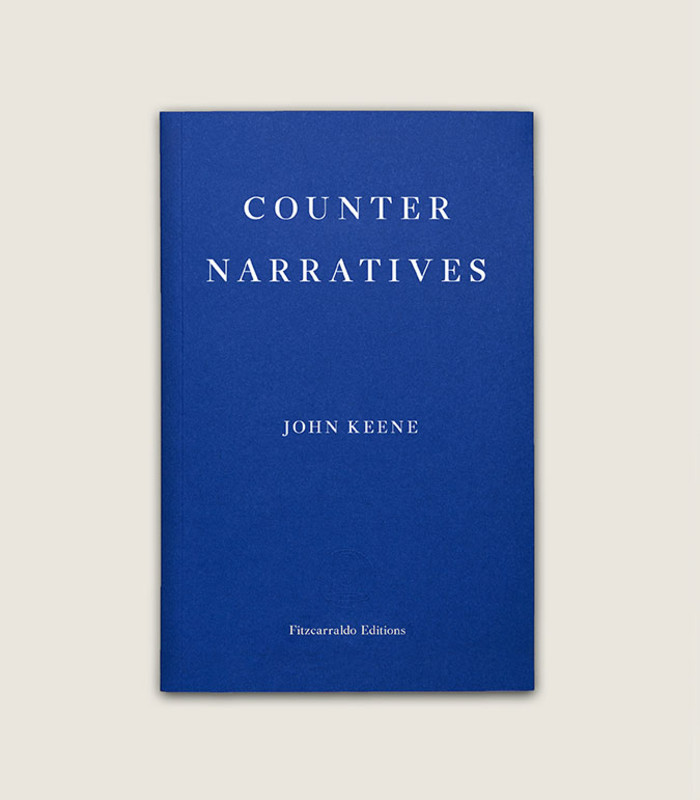
Counternarratives originally appeared roughly two years ago in hardcover, and since then has received a host of reviews, on these shores and across the Atlantic. What has not occurred since July 2015 (and The Wall Street Journal's positive take) was for a major US newspaper to review the book. So it was both surprising and encouraging that the Boston Globe selected Counternarratives, among a host of other books, for its Summer 2017 Reading Picks, and reviewer Anthony Domestico offered one of the better rationales to check out the book, a one-sentence summary that could serve as a perfect little blurb:

"Keene’s story collection is truly radical — in its politics, in its stylistic restlessness, in its rethinking of the myths we tell ourselves about race and sexuality in the history of the Americas."

The Boston Globe blurb
Beach reading? Why not?

***

It is National Short Story Month--did you know that? I didn't!--and author, blogger and critic Matthew Cheney has chosen to write one of the best short critical assessments of Counternarratives' prose for his friend, Dan Wickett, at the Emerging Writers Network. Titled "Keene Sentences," it provides a perspicuous reading of what he sees the Counternarratives' sentences--and the prose, spreading outward to the stories' structures, and the collection as a whole--undertaking and achieving.   He gets it, and gets it right on target. Here's a quote:
Here, again, deferral: “It was […] the very first thing he saw.” Because of it’s structure, this is not a sentence most readers will absorb fully on one reading. It is a sentence that explodes from the inside, its substance packed in between subject, verb, and object, and as such it enacts many of the ideas of this book — for instance, that the detail and complexity of experience is lost by some ways of telling stories and using language and constructing histories. What Keene is up to in this sentence, and in much of the book generally, parallels some of what Chinua Achebe achieved with Things Fall Apart, reflected in the painful, ironic final sentences of the novel (“One could almost write a whole chapter on him. Perhaps not a whole chapter but a reasonable paragraph, at any rate. There was so much else to include, and one must be firm in cutting out details. He had already chosen the title of the book, after much thought: The Pacification of the Primitive Tribes of the Lower Niger”).
The reference to Achebe's writing I take as the highest praise, and I thank him for this deep and illuminating reading, which is what authors hope for from critics. If you want to read more of Matthew Cheney's writing, you can purchase his Hudson Prize-winning short story collection, Blood: Stories, published by Black Lawrence Press in 2016. A fine review of the award is available here, and you can hear Matthew talking about Blood: Stories on New Hampshire Public Radio.

You can also read his 14-year-long blog, The Mumpsimus, which brims with smart literary and cultural readings and critiques, sharp as a laser but never wielded like a blade. In his most recent post, he writes about watching the films of the late German wunderkind director Rainer Werner Fassbinder now. (I keep thinking and hoping that Fassbinder's aesthetically innovative, critically engaged art and his guerrilla approach to filmmaking will inspire younger generations of queer, especially queer POC, filmmakers, and perhaps that's happening, perhaps on YouTube or Vimeo or another platform, so if anyone knows whether this is the case, please do post a comment.

In other recent posts, Cheney has explored Guido Mazzoni's A Theory of the Novel, and earlier posts walk readers through Samuel Delany's temporally-reversed Dark Reflections, and a book by an author I often recommend to students interested in speculative writing and good storytelling, Kelly Link's Stone Animals. There's a lot more at Mumpsimus, so definitely check it out, and pick up his collection if you can.
.

Wednesday, June 07, 2017

Photos II: 2017 G37 Summit of Poetry

All of these photos are courtesy (©) of C. Enjoy!

The poets at the end of the reading,
Piedimonte Etneo
Yours truly
With Josephine Pace, at the TV station
in Caltagirone
At the TV station in Caltagirone 
At the TV station in Caltagirone
The student poets
Antonio Presti, introducing
some of the student readers
Me reading, with Josephine translating
Biaggio Guerrera, reading his poems
One of the students from Giare  reading his poems,
with Antonio Presti at right


Some of the student poets reading 
Michele LaPaglia
The musicmakers
Carmine Elisa Moschetta entering the venue 
Bringing forth the spirit of the birches
and the volcano, as well as poetry and song 
The reading area
Birch trees 
With the students from Palermo
In a square in Castiglione
Sunlight in the piazza
Word art 
The vineyard at the Cantina, at night
Mt. Etna

Saturday, October 08, 2016

Photos: Venice Beach

While out in Los Angeles last week to read at the Otis College of Art I had the pleasure of visiting Venice Beach, which I hadn't seen since I was a child. Many thanks to everyone at Otis, especially Peter Gadol, who made my visit possible, and here are a few photos from my stroll along the Venice Beach Speedway and up Rose Avenue nearby.

Looking north along the Speedway,
towards Santa Monica
Looking south 
One of many talented
live musicians
Another view
Pigeons and other birds
feasting on bagels 
People biking along the beach
Looking east 
I didn't dare hop on a skateboard
though it might have been the quickest
way to see everything
T-shirts 
A bit of turf near the surf

#kamakosmickrusader

The mural says it all  
A vintage Jeep 
Rose Ave
Self-portrait in a plate
glass mirror
Full Circle
One of many homeless
encampments 
A semi-arbor (or
overgrown bush) 
A rhododendron 
Looking west to the beach
Street scene 
At Otis College of Art,
during a fire drill
In the quadrangle
Some of the Otis students