- Posted using BlogPress from my iPhone
Wednesday, February 06, 2013
iPhone Drawings, New Set #1
Drawn by finger(s)--often just my thumb--, on this phone, during my daily commutes.


- Posted using BlogPress from my iPhone
Monday, February 04, 2013
Daniel Barenboim @ Edward Said Memorial Concert, Columbia University
| Daniel Barenboim and Ara Guzelimian |
The Institute for Comparative Literature and Society (ICLS) at Columbia University and The Cogut Center for the Humanities (CCH) at Brown University sponsored the talk, "Remembering Edward W. Said: A Conversation with Daniel Barenboim and Ara Guzelimian," as well as the subsequent performance by selected members of the Seville-based West-Eastern Divan Orchestra. Both took place at Columbia's Miller Theater. I hadn't realized it, but this was but the first event in larger program, running throughout 2013 at Columbia, that will commemorate Edward W. Said on the 10th anniversary of his passing. I looked online and cannot find the other events, but I expect they will be posted at some point down the road.
![]() |
| Daniel Barenboim |
Its skill was on display in particular in three of the pieces it performed that night: Pierre Boulez's Mémoriale and Messagesquisse, the latter a favorite of mine and so expertly rendered I wish I had been able to record it (verboten, naturally) and post it here. The soloist, Hassan Mataz El Molla, was particularly adroit in leading and playing his violoncello off against the sextet of violoncellos producing the sonorous buzzing background Boulez devises. Between the two Boulez pieces came an original composition by K. Azmeh, who performed the clarinet solo entitled Prayer, a tribute to Edward Said. Though it possessed some pretty moments, it felt a bit underdeveloped and overshadowed by the virtuosic Boulez pieces. I also couldn't help but think of Douglas Ewart's more successful and dazzling compositions, expertly performed on a range of woodwinds, that I used to catch at Chicago's Velvet Lounge.
Last on the bill Franz Schubert's Piano Quintet in A major D.667, "The Trout." Both Barenboim and his son Michael performed in the latter piece, and I must say that while at the end of the piece I felt as I had heard an animated sewing machine, as I often do when I listen to Schubert's music, I also thought he accompanists in particular were sharp, summing with panache piece's playfulness as well as its darker notes. Barenboim's rhythm seemed a little off at first, but by the middle of the piece he was in sync, and brought the quintet to a powerful close.
| L-R: Daniel Barenboim, Yosef Abraham, Nassib Ahmadieh, Julia Deneyka, and Michael Barenboim |
Friday, February 01, 2013
Happy Black History Month
![]() |
| Rev. Dr. Martin Luther King, Jr. and Malcolm X (Ralph Abernathy in the backgorund) |
Happy Black History Month! I find myself deeply immersed in Black History these days in part because of my courses, both of which focus on differing moments but which eventually overlap (the longer period of Reconstruction to the present day in the intro class, and the shorter time span from the Harlem Renaissance to today in the "Black Arts Movement" class), but as I have posted on this blog and stated elsewhere many times, while I champion devoting an entire (though the shortest) month to celebrating Black History (in the African-American and broader senses of the word), I also strongly urge that people incorporate the history and achievements of Black people, as with all people, more fully into every aspect of the "mainstream" as well. It may seem as though this occurs, but to pick an area I feel very familiar with, academe, I can say without hesitation from my experiences in over a decade and a half in academe that this isn't happening, not in literary studies, not in comparative literary studies, not in English and American literature, not in many fields. Some scholars and writers have made the leap, but far too many still do not, even when it's clear that they are cheating their students and themselves by doing so.
I had the experience, just a few weeks ago, of a friend forwarding me the proposed syllabus, by a very famous younger black woman writer, for a literature course on "sensibility" and "style," she was going to be teaching a prestigious local university. On her syllabus, there was not a single writer of color, let alone black writer, and only a precious few women. For an undergraduate course on a broad subject for which one could easily field an entire syllabus comprising writers of color, women or both, in 2013; this was and is appalling, and yet it is less uncommon than many people think. Not only is she reinforcing a narrow, Eurocentric, sexist view of her subject and the field, in effect erasing not just a vast body of work, a vast corpus of writers, but herself. I mention this not to focus solely on this particular person, but to say that we have lived with centuries of this erasure and self-erasure, and it's tiresome and needs to end. Black History Month, as Carter G. Woodson imagined of its predecessor, "Negro History Week,"which debuted in 1927, and as writers such as George Washington Williams, W. H. Crogman, William T. Alexander, and W. E. B. DuBois all imagined in their important works of the later 19th and early 20th centuries, would serve as both a spark to expanded consciousness about black history and lives, and as a growing archive from which to draw upon. In 2013, let us honor Black History Month, as we will Women's History Month, LGBTIQ History Month, Latino/a History Month, and other such tribute months, but let's also strive, as much as we can, to open up our understandings of the world so that our approach, across a range of fields, many far beyond academe, is richer, deeper, fuller, and truer to the realities around us.
Wednesday, January 30, 2013
Random Photos
| A bouncer throwing a very drunk man into the street on 3rd Avenue |
| Young fashion student, examining her portfolio at a West Village copy shop |
| Snowy evening, E 13th St. |
| Patrick Rosal, Jessica Hagedorn, and Jayne Anne Phillips, at the first MFA reading of the spring semester |
| Bobst Library's atrium, from the 8th floor, behind the suicide-proof gilded screens (which weren't in place when I was a student there) |
| Temporary squash court, Grand Central Terminal |
| Voguer/performer/dancer, Union Square Park |
| Two skateboarders, watching the light rail preacher, Newport Station |
| "The Ultimate Sacrifice" 42nd Street |
| Food cart, 135th Street, Harlem |
| Gold man, with his ATM radio 50th Street station |
| Columbia University professor Mae Ngai, lecturing on trans-Pacific Asian diasporas at the New York Public Library |
| A hungry, homeless man (a common sight all over Manhattan, especially in Midtown) |
| Gotham, on a rainy day |
| A temporary oil tank, West Village |
| Workers repairing the ceiling, Fulton Street station |
| Young man with a mohawk, 3 train heading uptown |
Tuesday, January 29, 2013
Drinking Gourd Chapbook Prize Launch + Clifton Gachagua Wins Sillerman First Book Prize
For those in Chicago, a wonderful event I've been involved with that you don't want to miss:
The Drinking Gourd Chapbook Poetry Prize Launch is this Thursday, January 31st at 7:00 p.m.. We will host an evening of poetry, song, and dance at The Poetry Foundation's auditorium (61 W. Superior St., Chicago) to celebrate our first annual Drinking Gourd Chapbook Poetry Prize for emerging poets of color. Kristiana Rae Colón (our prizewinner) and renowned poet Ed Roberson will read from their new chapbooks, entitled promised instruments and Closest Pronunciation. Their readings will be punctuated by a vocal performance of songs from the tradition of African American spirituals by Timothy McNair, bass at the Bienen School of Music, and original dance choreographed by Devin Buchanan from Giordano Dance Chicago. The event (like all our events) is free and open to the public.
______________________
Ed Roberson, Distinguished Artist in Residence, taught from 1990-2003 at Rutgers University, and from 2004-2006 at Columbia College in Chicago. He was the recipient of the Shelley Memorial Award from the Poetry Society of America in 2008, and was one of three writers honored at the recent Literature, Culture, & Critique conference, organized by Callaloo magazine.Roberson is the author of To See the Earth Before the End of the World (2010); The New Wing of the Labyrinth (2009); City Eclogue (2006); Atmosphere Conditions, winner of the 2000 National Poetry Award series; Just In: Word of Navigational Change (1998); Voices Cast Out to Talk Us In, winner of the 1994 Iowa Poetry Prize; as well as earlier books, including Lucid Interval as Integral Music (1984); Etai-Eken (1975); and When Thy King Is a Boy (1970).
Kristiana Rae Colón is a poet, playwright, actor, and educator living in Chicago. She has been featured on the HBO television series Def Poetry Jam and on WBEZ’s Chicago Public Media. Her work has been nominated for a Pushcart Prize honoring the best writing published in small presses, and it has been anthologized in Not a Muse (2009), Best of the Web 2010, and the upcoming collection Chorus: A Literary (Re) Mixtape, an anthology of poetry by young people edited by Saul Williams and Dufflyn Lammers.
Devin Buchanan is a dancer with Giordano Dance Chicago. Trained at The Ailey School in New York City in a variety of dance techniques, including Horton, Devin also created "Winter’s Bleu" and "Do You Trust Your Friends," works that were performed by his colleagues in The Ailey School’s "Global Harmony" and "Fall Fest." In May 2010, he was accepted into "The Fraulein Maria Project," which gave him the chance to continue his work in modern dance and tour the USA. This is Devin’s second season with GDC.
Timothy McNair is a vocalist and Eckstein scholar at Northwestern's Bienen School of Music. He began his acquaintance with music through his studies of saxophone and double reed instrument, but began singing in the choir at the age of 17. He has studied with Mezzo-soprano, Victoria Livengood as a vocal major at East Carolina University and received further training at the University of North Carolina School for the Arts with Dr. Marilyn Taylor, where he was the 2008 University of North Carolina Fletcher Scholar.
***
Also, another wonderful project I'm delighted to have been involved with has resulted in a wonderful book of poetry that will soon be available for readers:
Kenyan poet Clifton Gachagua’s manuscript Madman at Kilifi has been selected by the African Poetry Book Fund & Series for the Sillerman First Book Prize for African Poets. As the winner of the First Book Prize, Gachagua’s Madman at Kilifi will be among one of the four books to be published by the African Poetry Book Series in 2014.
The Sillerman First Book Prize for African Poets is awarded to African poets who have not previously published a book-length collection. The prize includes a $1000 cash award and publication with the University of Nebraska Press and Amalion Publishing in Senegal.
Kwame Dawes, Series Editor of the African Poetry Book Fund & Series, notes that Madman at Kilifi was selected because, “Above all, there is a distinctive voice here. This is a difficult trait to define, but when it emerges as it does here, it is striking for its originality. There is a fresh and adventurous intelligence and delight in Gachagua’s poems. The judges are all thrilled with this manuscript and we are expecting great things from Clifton Gachagua."
Clifton Gachagua is a writer, screenwriter, and filmmaker based in his native city of Nairobi, Kenya. Gachagua’s poetry has appeared in Kwani? 06, Saraba, and on his blog “The Drums of Shostakovich.” His prose has appeared in the online journal Storymoja, the anthology AfroSF, and a collection of science fiction writing from Africa. He has recently completed a novel and is currently developing a French-Nigerian feature-length film. He holds a bachelor’s degree in biomedical sciences.
The Sillerman First Book Prize is named after philanthropists Laura and Robert F. X. Sillerman whose contributions have endowed the establishment of the African Poetry Book Fund & Series. The African Poetry Book Fund & Series promotes the writing and publication of African poetry through an international complex of collaborations and partnerships. The Fund and its partners offer support for seminars, workshops, and other publishing opportunities for African poets.
The University of Nebraska-Lincoln’s literary journal Prairie Schooner manages the annual Sillerman First Book Prize for African Poets as a partner in the African Poetry Book Fund & Series.
In addition to Dawes, the Series Editor, who is of Ghanaian birth, the editorial board for the African First Book Fund is comprised of the South African poet Gabeba Baderoon, the American novelist John Keene, the Nigerian poet and novelist Chris Abani, the Egyptian-American poet Matthew Shenoda, and Bernardine Evaristo, award-winning novelist and poet from the UK.
The Drinking Gourd Chapbook Poetry Prize Launch is this Thursday, January 31st at 7:00 p.m.. We will host an evening of poetry, song, and dance at The Poetry Foundation's auditorium (61 W. Superior St., Chicago) to celebrate our first annual Drinking Gourd Chapbook Poetry Prize for emerging poets of color. Kristiana Rae Colón (our prizewinner) and renowned poet Ed Roberson will read from their new chapbooks, entitled promised instruments and Closest Pronunciation. Their readings will be punctuated by a vocal performance of songs from the tradition of African American spirituals by Timothy McNair, bass at the Bienen School of Music, and original dance choreographed by Devin Buchanan from Giordano Dance Chicago. The event (like all our events) is free and open to the public.
______________________
Ed Roberson, Distinguished Artist in Residence, taught from 1990-2003 at Rutgers University, and from 2004-2006 at Columbia College in Chicago. He was the recipient of the Shelley Memorial Award from the Poetry Society of America in 2008, and was one of three writers honored at the recent Literature, Culture, & Critique conference, organized by Callaloo magazine.Roberson is the author of To See the Earth Before the End of the World (2010); The New Wing of the Labyrinth (2009); City Eclogue (2006); Atmosphere Conditions, winner of the 2000 National Poetry Award series; Just In: Word of Navigational Change (1998); Voices Cast Out to Talk Us In, winner of the 1994 Iowa Poetry Prize; as well as earlier books, including Lucid Interval as Integral Music (1984); Etai-Eken (1975); and When Thy King Is a Boy (1970).
Kristiana Rae Colón is a poet, playwright, actor, and educator living in Chicago. She has been featured on the HBO television series Def Poetry Jam and on WBEZ’s Chicago Public Media. Her work has been nominated for a Pushcart Prize honoring the best writing published in small presses, and it has been anthologized in Not a Muse (2009), Best of the Web 2010, and the upcoming collection Chorus: A Literary (Re) Mixtape, an anthology of poetry by young people edited by Saul Williams and Dufflyn Lammers.
Devin Buchanan is a dancer with Giordano Dance Chicago. Trained at The Ailey School in New York City in a variety of dance techniques, including Horton, Devin also created "Winter’s Bleu" and "Do You Trust Your Friends," works that were performed by his colleagues in The Ailey School’s "Global Harmony" and "Fall Fest." In May 2010, he was accepted into "The Fraulein Maria Project," which gave him the chance to continue his work in modern dance and tour the USA. This is Devin’s second season with GDC.
Timothy McNair is a vocalist and Eckstein scholar at Northwestern's Bienen School of Music. He began his acquaintance with music through his studies of saxophone and double reed instrument, but began singing in the choir at the age of 17. He has studied with Mezzo-soprano, Victoria Livengood as a vocal major at East Carolina University and received further training at the University of North Carolina School for the Arts with Dr. Marilyn Taylor, where he was the 2008 University of North Carolina Fletcher Scholar.
***
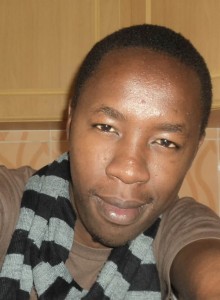
| Clifton Gachagua |
Kenyan poet Clifton Gachagua’s manuscript Madman at Kilifi has been selected by the African Poetry Book Fund & Series for the Sillerman First Book Prize for African Poets. As the winner of the First Book Prize, Gachagua’s Madman at Kilifi will be among one of the four books to be published by the African Poetry Book Series in 2014.
The Sillerman First Book Prize for African Poets is awarded to African poets who have not previously published a book-length collection. The prize includes a $1000 cash award and publication with the University of Nebraska Press and Amalion Publishing in Senegal.
Kwame Dawes, Series Editor of the African Poetry Book Fund & Series, notes that Madman at Kilifi was selected because, “Above all, there is a distinctive voice here. This is a difficult trait to define, but when it emerges as it does here, it is striking for its originality. There is a fresh and adventurous intelligence and delight in Gachagua’s poems. The judges are all thrilled with this manuscript and we are expecting great things from Clifton Gachagua."
Clifton Gachagua is a writer, screenwriter, and filmmaker based in his native city of Nairobi, Kenya. Gachagua’s poetry has appeared in Kwani? 06, Saraba, and on his blog “The Drums of Shostakovich.” His prose has appeared in the online journal Storymoja, the anthology AfroSF, and a collection of science fiction writing from Africa. He has recently completed a novel and is currently developing a French-Nigerian feature-length film. He holds a bachelor’s degree in biomedical sciences.
The Sillerman First Book Prize is named after philanthropists Laura and Robert F. X. Sillerman whose contributions have endowed the establishment of the African Poetry Book Fund & Series. The African Poetry Book Fund & Series promotes the writing and publication of African poetry through an international complex of collaborations and partnerships. The Fund and its partners offer support for seminars, workshops, and other publishing opportunities for African poets.
The University of Nebraska-Lincoln’s literary journal Prairie Schooner manages the annual Sillerman First Book Prize for African Poets as a partner in the African Poetry Book Fund & Series.
In addition to Dawes, the Series Editor, who is of Ghanaian birth, the editorial board for the African First Book Fund is comprised of the South African poet Gabeba Baderoon, the American novelist John Keene, the Nigerian poet and novelist Chris Abani, the Egyptian-American poet Matthew Shenoda, and Bernardine Evaristo, award-winning novelist and poet from the UK.
Friday, January 25, 2013
"Lunch Hour NYC" Exhibit @ NYPL
| Depression era sign, Lunch Hour NYC (NYPL.org) |
| All about peanut butter for lunch (NYPL.org) |
| Fr. Divine, immortalized by Ralph Ellison (NYPL.org) |
The word lunch is adopted in that ‘glass of fashion’, Almacks, and luncheon is avoided as unsuitable to the polished society there exhibited), and still in its salad days if salads hardly made any menus but those of the penniless, but by the end of the century it had gained currency and become the name of the midday meal all English-speakers know today.
| The automat case handle (NYPL.org) |
| The automat case (NYPL.org) |
| Opening one of the doors, with free recipes inside (NYPL.org) |
There's a little section devoted to the Algonquin Hotel and its legendary "round table," with drawings and photographs of notable attendees, including Alexander Woollacott and Dorothy Parker. There is a section devoted to African American lunchers, with an immense reproduction of a cafeteria packed with black diners. I grew up hearing "Why don't you go sell an apple?" as a snide remark, and the exhibit includes materials, like the poster above, detailing how this was for the most destitute of the destitute in the city (and others), at least temporarily, an employment option. Another wall features archival material and historical documents on dieting, which gained in popularity in the post-World War II era. Not only New York-based magazines, especially those geared towards women, but some restaurants attempted to capitalize on the growing interest in growing thinner and more svelte. At the exhibit's end perch artists' books, which show how great a subject lunch food can be in the right creative hands. Across from it, a multi-screen wall flashes images recent lunch-takers in the city, capturing and underlining the diversity and commonalities that have marked New York mid-day dining habits for nearly two centuries. The exhibit is one of the few free (visual, tactile, intellectual) lunches you can get in New York, and you won't gain a pound enjoying it.
| A menu from 1954, I believe (NYPL.org) |
| Ladies who lunch, in 2012 (NYPL.org) |
Labels:
archive,
art,
automat,
exhibit,
food,
history,
Jeremiah Moss,
literature,
lunch,
luncheon,
new york city,
NYPL
Thursday, January 24, 2013
Spring Semester Classes Begin
Monday, January 21, 2013
Happy MLK Jr. Day & Inauguration Day + Inaugural Speech & Poem
What an auspicious day, in an auspicious year! Today, as we honor the great Rev. Dr. Martin Luther King, Jr., whose vision and courage and sacrifice and martyrdom, alongside so many others whose names we know and do not know, made possible the freedoms we enjoy today, Barack Hussein Obama, Jr., will be publicly sworn in, for the fourth time, and reinaugurated as the 44th President of the United States of America.
President Obama's second inauguration occurs during 150th anniversary year of the Emancipation Proclamation, and the 50th anniversary year of the March on Washington, which marked one of the most important events in the modern push for equality for African-Americans and all Americans, and one of Rev. Dr. King Jr.'s greatest speeches. How fitting that President Obama was reelected, and that as I write these lines, this country continues to change and improve in ways even I never would have imagined, for the better.
In honor of Rev. Dr. King, Jr., all the heroines and heroes of our history, and President Obama, I am posting the President's 2nd Inaugural speech, which was so progressive that it probably would have brought tears to Dr. King's eyes and joy and amazement to his heart, and after it the poem that poet Richard Blanco, the first latino, first openly gay and first immigrant inaugural poet, delivered today!
Congratulations to the President and Vice Presidents, their families, our nation, our newest inaugural poet, and here's to the next four years!
PRESIDENT OBAMA's SECOND INAUGURAL SPEECH (JANUARY 21, 2013):
![]() |
| President Obama, being sworn in today, January 21, 2013 (Doug Mills/New York Times) |
President Obama's second inauguration occurs during 150th anniversary year of the Emancipation Proclamation, and the 50th anniversary year of the March on Washington, which marked one of the most important events in the modern push for equality for African-Americans and all Americans, and one of Rev. Dr. King Jr.'s greatest speeches. How fitting that President Obama was reelected, and that as I write these lines, this country continues to change and improve in ways even I never would have imagined, for the better.
![]() |
| Dr. King, on the Mall, 1963 |
In honor of Rev. Dr. King, Jr., all the heroines and heroes of our history, and President Obama, I am posting the President's 2nd Inaugural speech, which was so progressive that it probably would have brought tears to Dr. King's eyes and joy and amazement to his heart, and after it the poem that poet Richard Blanco, the first latino, first openly gay and first immigrant inaugural poet, delivered today!
Congratulations to the President and Vice Presidents, their families, our nation, our newest inaugural poet, and here's to the next four years!
***
![]() |
| President Obama, delivering his Second Inaugural Speech (Chang W. Lee/New York Times) |
MR. OBAMA: Vice President Biden, Mr. Chief Justice, Members of the United States Congress, distinguished guests, and fellow citizens:
Each time we gather to inaugurate a president, we bear witness to the enduring strength of our Constitution. We affirm the promise of our democracy. We recall that what binds this nation together is not the colors of our skin or the tenets of our faith or the origins of our names. What makes us exceptional – what makes us American – is our allegiance to an idea, articulated in a declaration made more than two centuries ago:
“We hold these truths to be self-evident, that all men are created equal, that they are endowed by their Creator with certain unalienable rights, that among these are Life, Liberty, and the pursuit of Happiness.”
Today we continue a never-ending journey, to bridge the meaning of those words with the realities of our time. For history tells us that while these truths may be self-evident, they have never been self-executing; that while freedom is a gift from God, it must be secured by His people here on Earth. The patriots of 1776 did not fight to replace the tyranny of a king with the privileges of a few or the rule of a mob. They gave to us a Republic, a government of, and by, and for the people, entrusting each generation to keep safe our founding creed.
For more than two hundred years, we have.
Through blood drawn by lash and blood drawn by sword, we learned that no union founded on the principles of liberty and equality could survive half-slave and half-free. We made ourselves anew, and vowed to move forward together.
Together, we determined that a modern economy requires railroads and highways to speed travel and commerce; schools and colleges to train our workers.
Together, we discovered that a free market only thrives when there are rules to ensure competition and fair play.
Together, we resolved that a great nation must care for the vulnerable, and protect its people from life’s worst hazards and misfortune.
Through it all, we have never relinquished our skepticism of central authority, nor have we succumbed to the fiction that all society’s ills can be cured through government alone. Our celebration of initiative and enterprise; our insistence on hard work and personal responsibility, these are constants in our character.
But we have always understood that when times change, so must we; that fidelity to our founding principles requires new responses to new challenges; that preserving our individual freedoms ultimately requires collective action. For the American people can no more meet the demands of today’s world by acting alone than American soldiers could have met the forces of fascism or communism with muskets and militias. No single person can train all the math and science teachers we’ll need to equip our children for the future, or build the roads and networks and research labs that will bring new jobs and businesses to our shores. Now, more than ever, we must do these things together, as one nation, and one people.
This generation of Americans has been tested by crises that steeled our resolve and proved our resilience. A decade of war is now ending. An economic recovery has begun. America’s possibilities are limitless, for we possess all the qualities that this world without boundaries demands: youth and drive; diversity and openness; an endless capacity for risk and a gift for reinvention. My fellow Americans, we are made for this moment, and we will seize it – so long as we seize it together.
For we, the people, understand that our country cannot succeed when a shrinking few do very well and a growing many barely make it. We believe that America’s prosperity must rest upon the broad shoulders of a rising middle class. We know that America thrives when every person can find independence and pride in their work; when the wages of honest labor liberate families from the brink of hardship. We are true to our creed when a little girl born into the bleakest poverty knows that she has the same chance to succeed as anybody else, because she is an American, she is free, and she is equal, not just in the eyes of God but also in our own.
We understand that outworn programs are inadequate to the needs of our time. We must harness new ideas and technology to remake our government, revamp our tax code, reform our schools, and empower our citizens with the skills they need to work harder, learn more, reach higher. But while the means will change, our purpose endures: a nation that rewards the effort and determination of every single American. That is what this moment requires. That is what will give real meaning to our creed.
We, the people, still believe that every citizen deserves a basic measure of security and dignity. We must make the hard choices to reduce the cost of health care and the size of our deficit. But we reject the belief that America must choose between caring for the generation that built this country and investing in the generation that will build its future. For we remember the lessons of our past, when twilight years were spent in poverty, and parents of a child with a disability had nowhere to turn. We do not believe that in this country, freedom is reserved for the lucky, or happiness for the few. We recognize that no matter how responsibly we live our lives, any one of us, at any time, may face a job loss, or a sudden illness, or a home swept away in a terrible storm. The commitments we make to each other – through Medicare, and Medicaid, and Social Security – these things do not sap our initiative; they strengthen us. They do not make us a nation of takers; they free us to take the risks that make this country great.
We, the people, still believe that our obligations as Americans are not just to ourselves, but to all posterity. We will respond to the threat of climate change, knowing that the failure to do so would betray our children and future generations. Some may still deny the overwhelming judgment of science, but none can avoid the devastating impact of raging fires, and crippling drought, and more powerful storms. The path towards sustainable energy sources will be long and sometimes difficult. But America cannot resist this transition; we must lead it. We cannot cede to other nations the technology that will power new jobs and new industries – we must claim its promise. That’s how we will maintain our economic vitality and our national treasure – our forests and waterways; our croplands and snowcapped peaks. That is how we will preserve our planet, commanded to our care by God. That’s what will lend meaning to the creed our fathers once declared.
We, the people, still believe that enduring security and lasting peace do not require perpetual war. Our brave men and women in uniform, tempered by the flames of battle, are unmatched in skill and courage. Our citizens, seared by the memory of those we have lost, know too well the price that is paid for liberty. The knowledge of their sacrifice will keep us forever vigilant against those who would do us harm. But we are also heirs to those who won the peace and not just the war, who turned sworn enemies into the surest of friends, and we must carry those lessons into this time as well.
We will defend our people and uphold our values through strength of arms and rule of law. We will show the courage to try and resolve our differences with other nations peacefully – not because we are naïve about the dangers we face, but because engagement can more durably lift suspicion and fear. America will remain the anchor of strong alliances in every corner of the globe; and we will renew those institutions that extend our capacity to manage crisis abroad, for no one has a greater stake in a peaceful world than its most powerful nation. We will support democracy from Asia to Africa; from the Americas to the Middle East, because our interests and our conscience compel us to act on behalf of those who long for freedom. And we must be a source of hope to the poor, the sick, the marginalized, the victims of prejudice – not out of mere charity, but because peace in our time requires the constant advance of those principles that our common creed describes: tolerance and opportunity; human dignity and justice.
We, the people, declare today that the most evident of truths – that all of us are created equal – is the star that guides us still; just as it guided our forebears through Seneca Falls, and Selma, and Stonewall; just as it guided all those men and women, sung and unsung, who left footprints along this great Mall, to hear a preacher say that we cannot walk alone; to hear a King proclaim that our individual freedom is inextricably bound to the freedom of every soul on Earth.
It is now our generation’s task to carry on what those pioneers began. For our journey is not complete until our wives, our mothers, and daughters can earn a living equal to their efforts. Our journey is not complete until our gay brothers and sisters are treated like anyone else under the law – for if we are truly created equal, then surely the love we commit to one another must be equal as well. Our journey is not complete until no citizen is forced to wait for hours to exercise the right to vote. Our journey is not complete until we find a better way to welcome the striving, hopeful immigrants who still see America as a land of opportunity; until bright young students and engineers are enlisted in our workforce rather than expelled from our country. Our journey is not complete until all our children, from the streets of Detroit to the hills of Appalachia to the quiet lanes of Newtown, know that they are cared for, and cherished, and always safe from harm.
That is our generation’s task – to make these words, these rights, these values – of Life, and Liberty, and the Pursuit of Happiness – real for every American. Being true to our founding documents does not require us to agree on every contour of life; it does not mean we all define liberty in exactly the same way, or follow the same precise path to happiness. Progress does not compel us to settle centuries-long debates about the role of government for all time – but it does require us to act in our time.
For now decisions are upon us, and we cannot afford delay. We cannot mistake absolutism for principle, or substitute spectacle for politics, or treat name-calling as reasoned debate. We must act, we must act knowing that our work will be imperfect. We must act, knowing that today’s victories will be only partial, and that it will be up to those who stand here in four years, and forty years, and four hundred years hence to advance the timeless spirit once conferred to us in a spare Philadelphia hall.
My fellow Americans, the oath I have sworn before you today, like the one recited by others who serve in this Capitol, was an oath to God and country, not party or faction – and we must faithfully execute that pledge during the duration of our service. But the words I spoke today are not so different from the oath that is taken each time a soldier signs up for duty, or an immigrant realizes her dream. My oath is not so different from the pledge we all make to the flag that waves above and that fills our hearts with pride.
They are the words of citizens, and they represent our greatest hope.
You and I, as citizens, have the power to set this country’s course.
You and I, as citizens, have the obligation to shape the debates of our time – not only with the votes we cast, but with the voices we lift in defense of our most ancient values and enduring ideals.
Let each of us now embrace, with solemn duty and awesome joy, what is our lasting birthright. With common effort and common purpose, with passion and dedication, let us answer the call of history, and carry into an uncertain future that precious light of freedom.
Thank you, God Bless you, and may He forever bless these United States of America.
© President Barack H. Obama, Jr.
***
And Richard Blanco's beautiful poem, with its many rhetorical flourishes, including its mention of his father's hard work, its use of repetition, its invocation of the Newtown, Connecticut tragedy, and final, open-ended and thus echoing conclusion, "together"...:
![]() |
| Richard Blanco, reciting his inaugural poem, "One Today" (Getty Images) |
ONE TODAY
One sun rose on us today, kindled over our shores,
peeking over the Smokies, greeting the faces
of the Great Lakes, spreading a simple truth
across the Great Plains, then charging across the Rockies.
peeking over the Smokies, greeting the faces
of the Great Lakes, spreading a simple truth
across the Great Plains, then charging across the Rockies.
One light, waking up rooftops, under each one, a story
told by our silent gestures moving behind windows.
My face, your face, millions of faces in morning’s mirrors,
each one yawning to life, crescendoing into our day:
pencil-yellow school buses, the rhythm of traffic lights,
fruit stands: apples, limes and oranges arrayed like rainbows
begging our praise. Silver trucks heavy with oil or paper —
bricks or milk, teeming over highways alongside us,
on our way to clean tables, read ledgers or save lives —
to teach geometry, or ring-up groceries as my mother did
for 20 years, so I could write this poem.
All of us as vital as the one light we move through,
the same light on blackboards with lessons for the day:
equations to solve, history to question or atoms imagined,
the “I have a dream” we keep dreaming,
or the impossible vocabulary of sorrow that won’t explain
the empty desks of 20 children marked absent
today, and forever. Many prayers, but one light
breathing color into stained glass windows,
life into the faces of bronze statues, warmth
onto the steps of our museums and park benches
as mothers watch children slide into the day.
One ground. Our ground, rooting us to every stalk
of corn, every head of wheat sown by sweat
and hands, hands gleaning coal or planting windmills
in deserts and hilltops that keep us warm, hands
digging trenches, routing pipes and cables, hands
as worn as my father’s cutting sugarcane
so my brother and I could have books and shoes.
The dust of farms and deserts, cities and plains
mingled by one wind — our breath. Breathe. Hear it
through the day’s gorgeous din of honking cabs,
buses launching down avenues, the symphony
of footsteps, guitars, and screeching subways,
the unexpected song bird on your clothes line.
Hear: squeaky playground swings, trains whistling,
or whispers across cafe tables, Hear: the doors we open
for each other all day, saying: hello, shalom,
buon giorno, howdy, namaste or buenos días
in the language my mother taught me — in every language
spoken into one wind carrying our lives
without prejudice, as these words break from my lips.
One sky: since the Appalachians and Sierras claimed
their majesty, and the Mississippi and Colorado worked
their way to the sea. Thank the work of our hands:
weaving steel into bridges, finishing one more report
for the boss on time, stitching another wound
or uniform, the first brush stroke on a portrait,
or the last floor on the Freedom Tower
jutting into a sky that yields to our resilience.
One sky, toward which we sometimes lift our eyes
tired from work: some days guessing at the weather
of our lives, some days giving thanks for a love
that loves you back, sometimes praising a mother
who knew how to give, or forgiving a father
who couldn’t give what you wanted.
We head home: through the gloss of rain or weight
of snow, or the plum blush of dusk, but always — home,
always under one sky, our sky. And always one moon
like a silent drum tapping on every rooftop
and every window, of one country — all of us —
facing the stars
hope — a new constellation
waiting for us to map it,
waiting for us to name it — together.
Copyright © Richard Blanco, 2013.
UPDATED to reflect the standard version of this poem. The version I originally featured came directly from The New York Times's website.
told by our silent gestures moving behind windows.
My face, your face, millions of faces in morning’s mirrors,
each one yawning to life, crescendoing into our day:
pencil-yellow school buses, the rhythm of traffic lights,
fruit stands: apples, limes and oranges arrayed like rainbows
begging our praise. Silver trucks heavy with oil or paper —
bricks or milk, teeming over highways alongside us,
on our way to clean tables, read ledgers or save lives —
to teach geometry, or ring-up groceries as my mother did
for 20 years, so I could write this poem.
All of us as vital as the one light we move through,
the same light on blackboards with lessons for the day:
equations to solve, history to question or atoms imagined,
the “I have a dream” we keep dreaming,
or the impossible vocabulary of sorrow that won’t explain
the empty desks of 20 children marked absent
today, and forever. Many prayers, but one light
breathing color into stained glass windows,
life into the faces of bronze statues, warmth
onto the steps of our museums and park benches
as mothers watch children slide into the day.
One ground. Our ground, rooting us to every stalk
of corn, every head of wheat sown by sweat
and hands, hands gleaning coal or planting windmills
in deserts and hilltops that keep us warm, hands
digging trenches, routing pipes and cables, hands
as worn as my father’s cutting sugarcane
so my brother and I could have books and shoes.
The dust of farms and deserts, cities and plains
mingled by one wind — our breath. Breathe. Hear it
through the day’s gorgeous din of honking cabs,
buses launching down avenues, the symphony
of footsteps, guitars, and screeching subways,
the unexpected song bird on your clothes line.
Hear: squeaky playground swings, trains whistling,
or whispers across cafe tables, Hear: the doors we open
for each other all day, saying: hello, shalom,
buon giorno, howdy, namaste or buenos días
in the language my mother taught me — in every language
spoken into one wind carrying our lives
without prejudice, as these words break from my lips.
One sky: since the Appalachians and Sierras claimed
their majesty, and the Mississippi and Colorado worked
their way to the sea. Thank the work of our hands:
weaving steel into bridges, finishing one more report
for the boss on time, stitching another wound
or uniform, the first brush stroke on a portrait,
or the last floor on the Freedom Tower
jutting into a sky that yields to our resilience.
One sky, toward which we sometimes lift our eyes
tired from work: some days guessing at the weather
of our lives, some days giving thanks for a love
that loves you back, sometimes praising a mother
who knew how to give, or forgiving a father
who couldn’t give what you wanted.
We head home: through the gloss of rain or weight
of snow, or the plum blush of dusk, but always — home,
always under one sky, our sky. And always one moon
like a silent drum tapping on every rooftop
and every window, of one country — all of us —
facing the stars
hope — a new constellation
waiting for us to map it,
waiting for us to name it — together.
Copyright © Richard Blanco, 2013.
UPDATED to reflect the standard version of this poem. The version I originally featured came directly from The New York Times's website.
Sunday, January 20, 2013
Poetry Makes Something Happen + Poem: Marianne Moore
"Poetry makes nothing happen," or so writes W. H. Auden in his famous elegy, "In Memory of W. B. Yeats," though he went on to qualify this oft-quoted fragment with a much cannier and profounder understanding of poetry, noting that
That is to say, by its very existence and presence, by our engagement with it, poetry creates a reality--or many, aesthetic, discursive, imaginative, material, social, historical, ontological--that is significant, that does make something "happen," though we usually don't credit it beyond its immediate effects on us as listeners and readers. Poetry is a "way of happening," a "mouth"--processual, sensuous, truth-telling, connected to the root sources of our understanding of the world--that we would do well to listen to. It is a means of knowledge, sensuous and real even as it foregrounds its artifice. It cannot offer the only truth or means to reality, but it provides one of them. Thus Plato feared it, and Aristotle lauded it. About it "men die miserably every day / for lack / of what is found there," the speaker in William Carlos Williams's "Asphodel, that Greeny Flower" astutely notes; the "new," the real "news" lies in those "despised poems": the deeper truths, a deeper awareness not just of language, but of the world, the self, ourselves.
But all of this sounds like a poetry advocate trying to make the case for why we ought to read poems. Like lemons for the kidneys, or cucumbers for the skin, or whole oats for digestion, or apples for combatting colds and staying thin, this verges on a prescription, which doesn't make poetry so palatable. Especially because it often seems like it should be simple, but, as the quote from Auden above makes clear, it often isn't. Especially when it is doing the many things poetry can do all at once. What I am saying about poetry, also applies to fiction and other literary forms. For poetry it is language, its use and arrangement, for prose fictional forms it is language and the various tools and techniques of narrative, but in both cases, as well as for related and analogous genres (drama, creative nonfiction, narrative cinema and video, long-form narrative TV, etc.), more goes on that mere entertainment. They are "good" for us, not just in the cathartic sense, as Aristotle suggested, but they have specific effects on the mind that we still have not fully reckoned with.
In the past I have blogged before about psychological and cognitive scientific research showing that fiction can provoke feelings of aggression and empathy; fictional narratives create powerful physical virtuality for readers; nonsensical and syntactically difficult texts providing important spurs for thought; mirror neurons are a key factor in our processing embodied reality; embodied cognition is so powerful that our bodies even respond with movement to certain metaphorical cues; poetry itself slows down our eye movements as we read it; and that, at a more holistic level, neuroaesthetics is a growing field, and Nobel laureate Eric Kandel has written an important book about it. I even reviewed James Geary's excellent book on metaphor and how it is considerably more potent on our brains and bodies than most of us imagine. Now comes another article showing the yet more powerful effects of literary texts, or certain ones at least: poetry by William Shakespeare, William Wordsworth, T. S. Eliot, and other canonical Euro-American Anglophone writers.
According to Julie Henry, an education reporter for the Telegraph, Liverpool University literary scholars and cognitive scientists working together have found that poetry and dramatic texts by Shakespeare, Wordsworth and others has "beneficial" effects on the mind, in part because of the complexity of the texts' linguistic organization arrests and holds the reader's attention, even if briefly, provoking self-reflection as a result. As with many of the other studies, the brain researchers used scanning devices to monitor brain activity while conducting a series of tests, and they found that when they presented the test subjects with the poetic and dramatic texts versus more straightforward prose versions, the poetic texts triggered more electrical activity in the brain, particularly when the test subjects encountered "unusual words, surprising phrases or difficult sentence structure."
Yet this temporary electrical activity did persist beyond the initial flicker, leading the subjects to continue reading the texts. Poetry in particular increases activity in the right hemisphere of the brain, Henry states, "an area concerned with 'autobiographical memory,'" suggesting that poems aid readers in thinking about and understanding their own lives in relation to what they have read. One of the researchers, English professor Philip Davis, will reportedly tell a conference this week that "Serious literature acts like a rocket booster to the brain," reorganizing it in vital ways. "[Poetry] is a matter of deep versions of experience that add the emotional and biographical to the cognitive." (This appears to be true of fiction as well.) Yet Henry adds that the researchers claim this means that classic literary texts were more valuable than self-help books, though this appears to be a bit of scientism running amok, and she doesn't give evidence for this. Davis's assertion appears to be borne out by many of the studies I point to in the links above, and in overviews by writers like Geary, George Lakoff, Steven Pinker, and others. But what about a self-help book written using the techniques of poetry or fiction, or written as poetry or fiction (cf. Thomas Traherne's deeply meditative work, or John Ashbery's semi-parodic, playful version in Three Poems)? Perhaps the researchers' claims go a bit too far, or are simply not precise enough.
Nevertheless, Henry's article underpins the reality that we ought to read Auden's fragment not just more carfully, but ironically at the very least, for he, like every poet of worth, certainly has been aware, at least at some point regard her or his own poetry, as well as regarding the poetry they admire, that poetry, and literary language and texts more broadly do make things happen, even if not in the immediate sense that some poets--and writers in general--might like. Or that tyrants and philosophers might not. You might even point to one of the world's most poetic books, The Holy Bible, especially the King James version, which, for anyone who has (had to) read it, has decided cognitive effects, sometimes hypnotic, and these cannot all be chalked up merely to social, cultural and sometimes political and economic traditions and contexts. Reading certain sections of the Bible can be entrancing; I would imagine they spark the same sorts of electrical activity, and effects that Davis describes above.
This got me thinking about a poem fragment that Geoffrey Jacques sent in a recent email, which brought back almost immediately thought not with complete clarity the following poem, which I hope some enterprising brain scientist studies in relation to the topic above. If you have never read it, you are in for a treat. Many of the poems I've posted on here would also be worthy of study in this regard, but I am posting this one since Geoffrey cited it and it is does promote a decent amount of mind work. Read it aloud and see if you can do so without stumbling, listening to the words as you do so, before you begin analyzing it, if you can. I can assure you that it's doing something (good) to and for your brain, even if just making you more attentive to words, sounds, and language's power. But of course it's doing far, far more than that. Eliminating the need for self-help texts, analysis and therapy or more, I can't say. But a boost--or several kinds--is occurring.
The poem, a sonnet, by Marianne Moore (1887-1972, and native of Kirkwood, Missouri), "No Swan So Fine":
Copyright © Marianne Moore, from The Complete Poems of Marianne Moore, New York: Penguin Books, 1982. All rights reserved.
it survives
In the valley of its making where executives
Would never want to tamper, flows on south
From ranches of isolation and the busy griefs,
Raw towns that we believe and die in; it survives,
A way of happening, a mouth.
That is to say, by its very existence and presence, by our engagement with it, poetry creates a reality--or many, aesthetic, discursive, imaginative, material, social, historical, ontological--that is significant, that does make something "happen," though we usually don't credit it beyond its immediate effects on us as listeners and readers. Poetry is a "way of happening," a "mouth"--processual, sensuous, truth-telling, connected to the root sources of our understanding of the world--that we would do well to listen to. It is a means of knowledge, sensuous and real even as it foregrounds its artifice. It cannot offer the only truth or means to reality, but it provides one of them. Thus Plato feared it, and Aristotle lauded it. About it "men die miserably every day / for lack / of what is found there," the speaker in William Carlos Williams's "Asphodel, that Greeny Flower" astutely notes; the "new," the real "news" lies in those "despised poems": the deeper truths, a deeper awareness not just of language, but of the world, the self, ourselves.
But all of this sounds like a poetry advocate trying to make the case for why we ought to read poems. Like lemons for the kidneys, or cucumbers for the skin, or whole oats for digestion, or apples for combatting colds and staying thin, this verges on a prescription, which doesn't make poetry so palatable. Especially because it often seems like it should be simple, but, as the quote from Auden above makes clear, it often isn't. Especially when it is doing the many things poetry can do all at once. What I am saying about poetry, also applies to fiction and other literary forms. For poetry it is language, its use and arrangement, for prose fictional forms it is language and the various tools and techniques of narrative, but in both cases, as well as for related and analogous genres (drama, creative nonfiction, narrative cinema and video, long-form narrative TV, etc.), more goes on that mere entertainment. They are "good" for us, not just in the cathartic sense, as Aristotle suggested, but they have specific effects on the mind that we still have not fully reckoned with.
In the past I have blogged before about psychological and cognitive scientific research showing that fiction can provoke feelings of aggression and empathy; fictional narratives create powerful physical virtuality for readers; nonsensical and syntactically difficult texts providing important spurs for thought; mirror neurons are a key factor in our processing embodied reality; embodied cognition is so powerful that our bodies even respond with movement to certain metaphorical cues; poetry itself slows down our eye movements as we read it; and that, at a more holistic level, neuroaesthetics is a growing field, and Nobel laureate Eric Kandel has written an important book about it. I even reviewed James Geary's excellent book on metaphor and how it is considerably more potent on our brains and bodies than most of us imagine. Now comes another article showing the yet more powerful effects of literary texts, or certain ones at least: poetry by William Shakespeare, William Wordsworth, T. S. Eliot, and other canonical Euro-American Anglophone writers.
According to Julie Henry, an education reporter for the Telegraph, Liverpool University literary scholars and cognitive scientists working together have found that poetry and dramatic texts by Shakespeare, Wordsworth and others has "beneficial" effects on the mind, in part because of the complexity of the texts' linguistic organization arrests and holds the reader's attention, even if briefly, provoking self-reflection as a result. As with many of the other studies, the brain researchers used scanning devices to monitor brain activity while conducting a series of tests, and they found that when they presented the test subjects with the poetic and dramatic texts versus more straightforward prose versions, the poetic texts triggered more electrical activity in the brain, particularly when the test subjects encountered "unusual words, surprising phrases or difficult sentence structure."
Yet this temporary electrical activity did persist beyond the initial flicker, leading the subjects to continue reading the texts. Poetry in particular increases activity in the right hemisphere of the brain, Henry states, "an area concerned with 'autobiographical memory,'" suggesting that poems aid readers in thinking about and understanding their own lives in relation to what they have read. One of the researchers, English professor Philip Davis, will reportedly tell a conference this week that "Serious literature acts like a rocket booster to the brain," reorganizing it in vital ways. "[Poetry] is a matter of deep versions of experience that add the emotional and biographical to the cognitive." (This appears to be true of fiction as well.) Yet Henry adds that the researchers claim this means that classic literary texts were more valuable than self-help books, though this appears to be a bit of scientism running amok, and she doesn't give evidence for this. Davis's assertion appears to be borne out by many of the studies I point to in the links above, and in overviews by writers like Geary, George Lakoff, Steven Pinker, and others. But what about a self-help book written using the techniques of poetry or fiction, or written as poetry or fiction (cf. Thomas Traherne's deeply meditative work, or John Ashbery's semi-parodic, playful version in Three Poems)? Perhaps the researchers' claims go a bit too far, or are simply not precise enough.
Nevertheless, Henry's article underpins the reality that we ought to read Auden's fragment not just more carfully, but ironically at the very least, for he, like every poet of worth, certainly has been aware, at least at some point regard her or his own poetry, as well as regarding the poetry they admire, that poetry, and literary language and texts more broadly do make things happen, even if not in the immediate sense that some poets--and writers in general--might like. Or that tyrants and philosophers might not. You might even point to one of the world's most poetic books, The Holy Bible, especially the King James version, which, for anyone who has (had to) read it, has decided cognitive effects, sometimes hypnotic, and these cannot all be chalked up merely to social, cultural and sometimes political and economic traditions and contexts. Reading certain sections of the Bible can be entrancing; I would imagine they spark the same sorts of electrical activity, and effects that Davis describes above.
This got me thinking about a poem fragment that Geoffrey Jacques sent in a recent email, which brought back almost immediately thought not with complete clarity the following poem, which I hope some enterprising brain scientist studies in relation to the topic above. If you have never read it, you are in for a treat. Many of the poems I've posted on here would also be worthy of study in this regard, but I am posting this one since Geoffrey cited it and it is does promote a decent amount of mind work. Read it aloud and see if you can do so without stumbling, listening to the words as you do so, before you begin analyzing it, if you can. I can assure you that it's doing something (good) to and for your brain, even if just making you more attentive to words, sounds, and language's power. But of course it's doing far, far more than that. Eliminating the need for self-help texts, analysis and therapy or more, I can't say. But a boost--or several kinds--is occurring.
The poem, a sonnet, by Marianne Moore (1887-1972, and native of Kirkwood, Missouri), "No Swan So Fine":
NO SWAN SO FINE
"No water so still as the dead fountains of Versailles." No swan, with swart blind look askance and gondoliering legs, so fine as the chintz china one with fawn- brown eyes and toothed gold collar on to show whose bird it was. Lodged in the Louis Fifteenth candelabrum-tree of cockscomb- tinted buttons, dahlias, sea-urchins, and everlastings, it perches on the branching foam of polished sculptured flowers--at ease and tall. The king is dead.
Copyright © Marianne Moore, from The Complete Poems of Marianne Moore, New York: Penguin Books, 1982. All rights reserved.
Thursday, January 17, 2013
Three From Kluge & Richter in NYRB
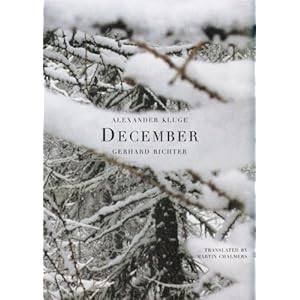
Alexander Kluge, Germany's living avatar of analytical fiction (and a cinematic pioneer in the l950s and 60s), and Gerhard Richter, one of its most important living visual artists, have collaborated on a book entitled December, which Seagull Books, distributed by the University of Chicago Press, published early last year in an English translation. (Seagull posted a pre-publication interview with Kluge in December 2011.)
There are few fiction writers who can pack as much critical thought into condensed, vivid narration as Kluge, and in December it appears he is still working at at the level of adamantine economy he displayed with prior books such as The Devil's Blind Spot (New Directions, 2004) and Cinema Stories (New Directions, 2007). The 80-year-old author's 39 calendar-based narratives here, as in prior books dating back to the 1960s, draw from German, European and global histories as well as from his lively imagination, and sometimes run no longer than a page or two, in concert with Richter's 39 beautiful, enigmatic photographs of wintry landscapes.
The Decembers in these stories, however, bear little of the holiday cheer we associate with the winter holidays or the conclusion of the calendar year. Instead, one story--or prose poem, so brief and clipped is its unfolding--concerns German children collecting scrap metal in 1941. What is not said--the fascist state, brutal war, the Holocaust--looms behind this and other narratives, as it does behind the tranquil but ominous images of nature. A few of the texts present in fictional form realist flashes of Kluge's life; born in 1932 in Halberstadt, in what is now the German state of Saxon-Anhalt (formerly part of East Germany), he likely would have experienced circumstances not unlike these. Most, however, transmit the theoretical and emotional clarity that Kluge's work so often offers, whether he's writing about the near death in 1931 of Adolf Hitler or an obscure monk whose sense of time upends our own sense of temporality. Kluge's prose pieces always come pierced, as Rilke might have written, with rays of wisdom and feeling, usually through metaphors and aphorisms, that most other writers would take sentences to achieve.
Last month, The New York Review of Books published three Kluge excerpts, alongside three Richter images. I found myself rereading the Kluge pieces several times despite their brevity, and studying the Richter photographs, which grew more ominous with each view. You can read the pieces at the NYRB link above. (You can download some of his movies here.) Below is one of the photographs. If you were to compose a short prose piece for December to accompany this image, what would it be?
There are few fiction writers who can pack as much critical thought into condensed, vivid narration as Kluge, and in December it appears he is still working at at the level of adamantine economy he displayed with prior books such as The Devil's Blind Spot (New Directions, 2004) and Cinema Stories (New Directions, 2007). The 80-year-old author's 39 calendar-based narratives here, as in prior books dating back to the 1960s, draw from German, European and global histories as well as from his lively imagination, and sometimes run no longer than a page or two, in concert with Richter's 39 beautiful, enigmatic photographs of wintry landscapes.
The Decembers in these stories, however, bear little of the holiday cheer we associate with the winter holidays or the conclusion of the calendar year. Instead, one story--or prose poem, so brief and clipped is its unfolding--concerns German children collecting scrap metal in 1941. What is not said--the fascist state, brutal war, the Holocaust--looms behind this and other narratives, as it does behind the tranquil but ominous images of nature. A few of the texts present in fictional form realist flashes of Kluge's life; born in 1932 in Halberstadt, in what is now the German state of Saxon-Anhalt (formerly part of East Germany), he likely would have experienced circumstances not unlike these. Most, however, transmit the theoretical and emotional clarity that Kluge's work so often offers, whether he's writing about the near death in 1931 of Adolf Hitler or an obscure monk whose sense of time upends our own sense of temporality. Kluge's prose pieces always come pierced, as Rilke might have written, with rays of wisdom and feeling, usually through metaphors and aphorisms, that most other writers would take sentences to achieve.
Last month, The New York Review of Books published three Kluge excerpts, alongside three Richter images. I found myself rereading the Kluge pieces several times despite their brevity, and studying the Richter photographs, which grew more ominous with each view. You can read the pieces at the NYRB link above. (You can download some of his movies here.) Below is one of the photographs. If you were to compose a short prose piece for December to accompany this image, what would it be?
![]() |
| © Gerhard Richter |
Subscribe to:
Posts (Atom)