Sunday, May 30, 2010

Photos: AWP Conference

Here they finally are! I'd almost forgotten that I took them, or how enjoyable the conference was. Denver!

Alison Meyers and Duriel Harris at the Cave Canem Booth
Cave Canem director Alison Meyers and Duriel Harris at the Cave Canem booth, at AWP
At Leela's, a really cool spot
At Leela's, a really cool little Denver café
Forrest Gander and Dan Beachy-Quick
Young poet and Treasure Williams
Treasure Williams (at right), and another poet (I cannot recall her name)
Young poet and Jericho Brown
The one and only Jericho Brown, in foreground
Hannah Tinti (my former grad school classmate)
Hannah Tinti, my former grad school classmate, and editor of One Story
Tim Liu and Nathalie Stephens/Nathanaël (fellow panelists)
Timothy Liu and Nathanaël, who were on a panel I organized, on LGBTQ translation
Nightboat Books crew, including Stephen Motika (at right)
The Nightboat Books crew, with writer Edwin Torres (at left), and editor Stephen Motika, at right
Saeed Jones (snapping a photo), a friend, Cyrus Cassells
Saeed Jones, a friend, and Cyrus Cassells
Mitchell Douglas and Indigo Moor
Duriel Harris and Indigo Moore
Duriel Harris and Indigo Moor
Randall Horton reading at the Cave Canem table
Randall Horton, reading at the Cave Canem booth
Tiphanie Yanique
Fiction writer Tiphanie Yanique
Amina Cain at the AWP Book Fair
AWP Book Fair, with Amina Cain approaching the camera (in the sunny blouse)
The Translating Contemporary Literature from Latin America panel
Translating Contemporary Latin American literature panel, with Kristin Dykstra at the podium, and l-r (unknown poet, Daniel Borzutzky, Monica de la Torre, and Urayoán Noël)
Anne Waldman
Ann Waldman, reading at the Mandorla reading at the Denver Center for Contemporary Art
Mónica de la Torre
Mónica de la Torre, reading at the Mandorla reading at the Denver Center for Contemporary Art
Steve Thomasula
Steve Thomasula, reading at the Mandorla reading at the Denver Center for Contemporary Art
Gabriela Jauregui
Gabriela Jauregui, reading at the Mandorla reading at the Denver Center for Contemporary Art
Dawn Lundy Martin
Dawn Lundy Martin
Patricia Smith, and a fellow poet
Patricia Smith, and a fellow poet, posing for a photo
Denver by night
Denver night streetscape
Gar Patterson at the Black Nature panel
Gar Patterson, speaking at the "Black Nature" panel
Cyrus Cassells at the Black Nature panel
Cyrus Cassells, who chaired the "Black Nature" panel

Photos: Readings, Events Since April

I managed one post, I think, if even that, from the Associated Writing Programs (AWP) Conference in Denver before I had to shift to intermittent blogging, but I have been snapping photos of lots of events since then, so here are some photos from the last few months. The AWP photos will appear in a separate posting.

Jennifer Karmin introducing the Red Rover Experiment #36 event
Jennifer Karmin introducing the Red Rover Series Experiment #36 event, "Textual Ecologies & Contaminations," featuring Jennifer Scappettone and Asimina Chremos
Jennifer Scappettone setting up
Jennifer Scappettone setting up her performance of Exit 43
Performing Jen Scappettone's piece (Jen in green blouse) at Red Rover
Jennifer and part of her chorus performing her piece, Exit 43
Jennifer Scappettone's piece at Red Rover
One of Jennifer Scappettone's really beautiful, complex "stills," a pop-up from/within Exit 43
Asimina Chremos
Asimina Chremos, introducing her piece, a collage text with performances (one via Skype)
The audience, between performances
The Red Rover loft audience, between sets
At Jennifer Karmin's book launch
Kathleen Duffy, Jennifer Karmin, and Chris Glomski, performing a quarto from Jennifer's new book, Aaaaaaaaaaalice (Film Forum, 2010), at its launch
At Jennifer Karmin's book launch
Kathleen Duffy, opening the program
Krista Franklin at Jennifer Karmin's book launch
Krista Franklin, at Jennifer Karmin's book launch (Krista, Chris Glomski, Kathleen Duffy, Laura Goldstein, Joel Craig, Lisa Janssen, and I all participated/collaborated in this event)

M. NourbeSe Philip
M. NourbeSe Philip, at the Poetry and Poetics Working Group workshop, at the university, in May
Sandra Richards and M. NourbeSe Philip
My distinguished colleague Sandra Richards, and M. NourbeSe Philip, after Philip's superlative reading from Zong!, in May
The hosts of the Uncalled For Reading Series
The hosts of the Uncalled For Readings Series at Las Manos Gallery in Andersonville, Tim Jones-Yelvington and Megan Milks, in May
Nathalie Stephens/Nathanaël
The incomparable Nathanaël (Nathalie Stephens), reading from The Sorrow and the Fast of It at the Uncalled For Readings Series at Las Manos Gallery in Andersonville, in May
Trish Bendix
Reader Trish Bendix, reading from her short story at the Uncalled For Readings Series at Las Manos Gallery in Andersonville, in May
Kareem Khubchandani
Kareem Khubchandani, reading from her short story at the Uncalled For Readings Series at Las Manos Gallery in Andersonville, in May
Douglas Ewart's group (Duriel Harris at right)
Douglas Ewart and Company, with Duriel Harris (at far right), at the Velvet Lounge, in April
Joanne Beard  reading during the Annual Writers Festival
Joanne Beard, reading at the English Major in Writing's annual Writers Festival, in April
Frank Bidart, Writers Festival, Northwestern University
Frank Bidart, reading at the English Major in Writing's annual Writers Festival, in April
George Saunders, Writers Festival, Northwestern University
George Saunders, leading his master class, at the English Major in Writing's annual Writers Festival, in April
George Saunders reading during the Annual Writers Festival
George Saunders, reading at the English Major in Writing's annual Writers Festival, in April
Cristina Henriquez, Writers Festival, Northwestern University
Cristina Henríquez, reading at the alumni reading, at the English Major in Writing's annual Writers Festival, in April
Josh Weiner, Writers Festival, Northwestern University
Joshua Weiner, reading at the alumni reading, at the English Major in Writing's annual Writers Festival, in April

Saturday, May 29, 2010

On the Road to Vegetarianism Pt. 2 + An Afternoon at Wrigley Field

A while back I posted about switching over to a mostly vegetarian diet, and now I'm nearing the 6-month mark (June 4, to be exact). I have, to my amazement, kept it up.  For some of these months, I've gone weeks without eating any meat, though I still do have some from time to time (this past week I don't think I had any). I also have almost completely given up all processed, prepared foods, unless I'm getting them at a cafe or restaurant (where I have little choice, though I've been trying to patronize restaurants, when I can afford to, that prepare whole foods on the premises). Since January perhaps the only processed, prepared foods I've bought would be oatmeal (and I do also buy the organic rolled oats from a nearby food coop), orange juice, and a few other items like wine.  I haven't bought any frozen dinners or anything else frozen and processed, though I do still sometimes pick up frozen fruits and vegetables, and fish. Other than chocolate, I've stopped buying any candy, and haven't bought any sorts of chips except tortilla chips from restaurants, or an occasional bag made locally. One of the most difficult things to maintain, particularly over the last month, during which I was involved in several very stressful committee assignments (similar versions of which over the past few years led to my having stopped cooking and ordering out food when I felt most under duress), has been the cooking, breadmaking, baking, and so on, but I'm glad to say that I've kept it up.  I note this not for a pat on the back, but just to acknowledge that it amazes me that I've been able to keep this going.

My diet now consists mostly of those hated carbs, and yet, as I noted before, almost as soon as started eating this way I immediately began losing weight (20 lbs, now close to 24 lbs--I've gone from 220 lbs. to about 196 or so, give or take the day) , and I've kept it off.  I had sworn off potatoes after C passed on an article about how bad they are for you (think heavily starchy root vegetable growing in toxic soils!), but I love potatoes, so I've started to reincorporate them into various dishes, where applicable. I have not, however, had French fries more than 1-2 times over the last 6 months. I eat a lot of bread, as any reader of this blog knows. Since the food coop I often shop at in Chicago has had a regular supply of organic sundried tomatoes, I've been regularly baking whole wheat sundried tomato bread, with a few detours, especially during the colder months, to rye bread (I will probably make a pumpernickel loaf again this summer, just because it was so good) or to French bread (which is one of the easiest breads you can make).

I can say that I eat a lot more squash (especially zucchini and yellow squash, which I loathed as a child), eggplant, and beets (which I also wasn't fond of, though I don't know why). I also regularly devour carrots, one of my favorite foods, as well as broccoli, brussel sprouts, and turnips. I eat grains, including couscous and quinoa, and legumes, like lentils and black beans, that I didn't used to eat so much. I don't, however, eat much salad, which I always associated in my mind with 1) healthier eating; 2) weight loss; and 3) vegetarianism. Occasionally I will have salads, and I'll probably eat more once the summer rolls around, but in general, they're not part of the mix. Another bonus of this approach has been that I spend far less money on a weekly basis on food. The coop's prices are decent, but I always end up paying less than I do at the supermarket, and the food usually comes from local (Illinois, Indiana, Michigan, Iowa, etc.) farms (or organic farms in California, Florida, etc.). Interestingly enough, the fruits often seem to last longer that supermarket fruits, which makes me wonder how long they've been sitting on trucks. When I add up how much I will spend at the coop and, say, at Trader Joe's, it's usually far less than I was spending when I primarily hit the supermarket. (Can anyone tell me how Trader Joe's keeps its food prices so low?)  Even when I factor in an occasional visit to Whole Foods, which I was boycotting for a while, my food expenses are still lower than before; and because the food I cook lasts, I spend far less (often nothing) on a daily basis buying lunch, etc., as I once did. (I also avoid the bleached, excess-gluten bread that's overtaken the US market, making many people sick. I often wonder, if more of us baked our own bread, how widespread would the gluten-related problems be that plague us?)

Friday, May 28, 2010

Classes (Nearly) Over + 2010 FIFA World Cup

Classes have (nearly) come to an end. Or rather, this is the final official week of classes in the College, though I still have one more class to teach next week, during reading week. (We'll be discussing the final three student novellas in workshop.) Now that it's over, I can shout from the blogtops Conceptual Art/Writing class exhilarated me; I feel incredibly grateful to have had the opportunity to teach the class, and to have been able to do so with students who were willing to step out, as it became clear, on what sometimes initially appeared to be shifting ice. By which I mean, to be looking at, thinking about and creating work--and whose exemplars--that remain under tremendous contention.  The class served as an intellectual transfusion for me, as it required me to think through a genealogy that was indistinct, but discernible, and put it together, in coherent fashion, for the class, while also making clear that this was only one reading of the history of this constellation of art forms. (It helped too that we have the graduate level Poetry and Poetics Working Group, because its conversations informed those in my class.) Now that I've done it, I feel I have a much clearer and deeper sense of conceptual art's history, its origins and antecedents, and its relation to and phantasmal presence in other canonical and non-canonical artforms. As I was saying to a friend, I feel capable now of reading backwards, before the coining of "conceptual art," to see conceptual practices in many different places and forms. (This was also the first time that I've taught the work of figures such as Marcel Duchamp, John Cage, Andy Warhol, Kenneth Goldsmith, Rob Fitterman, Mendi + Keith Obadike, and many others.) The students all created 6-8 projects, grounded in language and its possibilities, and it was a delight to read them, and imagine how the ones containing the possibility of performance might be realized. One student proposed realizing them--performing some of them--during the assigned exam period, so we'll see how that turns out. At any rate, the class, like the other one I'm teaching, represents one of the most enjoyable aspects of teaching, which is transmitting knowledge to students, watching them learn, grow intellectually and create knowledge, and learning from them in the process.  And who knows, down the road another Yoko Ono or Marcel Duchamp might emerge from this experience.
+++

The 2010 FIFA World Cup begins in two weeks, on June 11, running till July 11, in South Africa. This is the most watched sporting event in the world, and this is the first time it'll be held in Africa, with the host country leading a group of 32 national teams, including prior winners England (1966), France (1998), Italy (1934, 1938, 1982, 2006), Germany (1954, 1974, 1990), Brazil (1958, 1962, 1970, 1994, 2002), Uruguay (1930, 1950), and Argentina (1978, 1986), and stalwarts such as Netherlands, Japan, Portugal, Mexico, Denmark, Cameroon, South Korea, and, interestingly enough, North Korea. Though the opening matches, pairing South Africa and Mexico, and Uruguay and France, will be held in Johannesburg and Cape Town respectively, subsequent matches will be held all over the country, culminating in the third place match at Nelson Mandela Bay Stadium in Port Elizabeth, and the championship match at Soccer City in Johannesburg.

Saturday, May 22, 2010

Harvey Milk Day + Translation: Guillaume Dustan

Happy Harvey Milk Day!

****

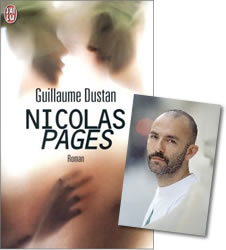
Five years back, after learning of his death, I wrote about Guillaume Dustan (1965-2005), the enfant terrible of late 20th century French gay male literature. I won't restate all of that here, except to note that around the age of 30, he began publishing a series of novels, drawn directly from his life, that placed him squarely at the center of the French autofiction movement, in which autobiography and fiction are so closely merged that they unsettle the question of genre. Dustan published 8 or 9 books, most of them fiction but several works of philosophical essays, especially on the topic of queerness, before his death, from an accidental drug overdose. He was also an editor for Balland's now extinct Rayon Gay line--which I also wrote about on here, and which is how I first learned about and had a brief email exchange with him, getting clearance for a translation--and a film producer and actor. Dustan's first three books, only one of which, Dans ma chambre (In My Room) from 1996, has been translated, are pulse-like accounts of his very active sex-and-love life, but they are also shorn of sentimentality; the concise, speedy, casual prose paints a rich picture, often full of feeling, without evoking affect in the usual ways. In 1999, he published the novel Nicolas Pages, which was somewhat of a departure. Denser, more full of anecdotes, digressions, and self-analysis and philosophizing, it takes up Dustan's pursuit of and relationship with the eponymous, younger author and conceptual artist,
Nicolas Pages (1970-, at right), who had only a few years before, in 1997, published his first book, Je mange un oeuf, which I've I translated a portion of.  I subsequently did translate some of Dustan's novel, and realized this week, while teaching a unit on conceptual writing and rereading the works of Rob Fitterman, Tan Lin, and many others, that one way to think about Pages' first novel, and a good deal of the more chronologically-grounded, stylistically flat or affectless, verisimilitudinous works like Pages, would be as a form of documentary realism, or conceptual fiction. Pages, as I noted is a conceptual artist, but as far as I can tell, I haven't seen that link made in US criticism, though Pages and Dustan are frequently linked to Bret Easton Ellis, whose influence is evident in their work, and whom both approvingly cite repeatedly. (Other writers whose names have been evoked in relation to both are Renaud Camus, Hervé Guibert, Céline, and the American queer master Dennis Cooper.) One great aspect of reading and translating Dustan's Nicolas Pages was seeing his appreciation of Pages' first book stated so clearly and forcefully in the opening pages of the novel; I have long wondered if it was just me who saw validity in what Pages was doing. Now that Goldsmith and company are big, perhaps there will be more appreciation for at least some of their counterparts, especially Pages and the late Dustan, overseas.

Friday, May 21, 2010

Malawi Conviction, Colonialism & Other Thoughts

At the end of my post on IDAHO, I linked to Reggie H's post, which mentions the horrific show trial the Malawi government staged to convict Steven Monjeza, 26, and Tiwonge Chimbalanga, 20 (at right, photo: Eldson Chagara/Reuters), for the "crimes" of buggery (sodomy) and gross indecency. Gukira, in commenting on that post, cited the trial's tragic outcome: yesterday, Monjeza and Chimbalanga were convicted and sentenced to the maximum 14 of prison after having held a symbolic wedding ceremony. The magistrate, Chief Resident Magistrate Nyakwawa Usiwa Usiwa, imposed this sentence because, he argued, "the public must be protected....Malawi society is not ready to see its sons marrying other sons, nor daughters marrying daughters. It is immoral in our society."

This conviction, while horrendous in its cruelty and homophobia, was not an isolated incident; in fact, back in February, the Guardian Online reported on the Malawi police's operation against gay and lesbian people, parallelling similar campaigns in other parts of Anglophone East and southern Africa, including Uganda, where the parliament is debating a bill that would impose life imprisonment on anyone convicted of having same-sexual relations, and which had earlier broached the death penalty for gay people; and Kenya, where gay people have been arrested for participating in a wedding ceremony.  Back in Malawi, as the Guardian UK notes
A 21-year-old man was recently sentenced to two months' community service for putting up pro-gay rights posters, and a senior minister expelled a woman from her town even after a court acquitted her on charges of having sex with two girls.

The sentence the two men in Malawi face is horrifying, as is the vitriol directed at them by many members of the public and the people affiliated with various "Christian" churches. In the case of Uganda, in particular, there has been much discussion and criticism of the role of fundamentalist US Christian churches and missionaries, who have been actively fomenting anti-gay rhetoric and legislation in Anglophone Africa. Yet taking a broader historical and geographical view, I've come to see that it's frequently in former British colonies--especially in the Caribbean, Africa, the Middle East, and South and East Asia, where homophobic legislation and rhetoric are strongest.  (On the issue of anti-gay legislation, penalties, and public vehemence against LGBTQ people compare Jamaica to Cuba, the Dominican Republic, or even Haiti, for example; or Nigeria to Niger, Mauretania or Cape Verde; or Egypt to Morocco or Tunisia; or India, until fairly recently, to Indonesia or Thailand.) This is hardly an ironclad rubric, but it does seem to bear out (and I'm certainly not the first to cite it.) What I guess I've not worked out is how European colonialism, and in specific, the British rule, appears to have often led, across the globe, to these extremist Christian-centered anti-gay regimes. In the case of Southern Africa, both colonial and imperial legal approaches and cultural practices, and the religious fundamentalism, have obscured and in some cases prior cultural and social traditions in which same-sexual behavior, performances and practices were accepted (cf. Luiz Mott, Will Roscoe, Stephen O. Murray, James H. Sweet, J. Lorand Matory, et. al.)

Thursday, May 20, 2010

Abramovic Portraits + Super Tuesday + RIP Arakawa + Boycott Arizona!

Is it mid-June yet? Nope. Oh well.

On another tip: a while ago I wrote about attending Marina Abramovic's show, "The Artist Is Present" at the Museum of Modern Art. Today a student, Rachel K., sent me a link to Marco Anelli's portraits of Abramovic and her sitting participants, all 20 pages of them: Marina Abramović: The Artist Is Present—Portraits.

The Artist Is Present, from above, MoMaHere's the young woman I captured a photo of on the day I went. As has been reported, some notables (Colm Toibín, who wrote about his experience on the New York Review of Books' blogsite; Agnes Gund; James Franco; Lou Reed; Rufus Wainwright; Björk (and her daughter); Tehching Hsieh, etc.) have participated. Some, like this gentleman, participated multiple (10+?) times. Some have been brought to tears by and during the experience. Another tried to bring Abramovic energy through humor, even painting a red dot on her nose. And perhaps, most dramatically, Abramovic's former partner, Ulay, joined her as the third participant, on the first day, and took her hand, bringing her to tears.

Finally, it seems, even the museum guard who appeared to have been a bit bemused about it all the day I was there got into the act. Oh well. If you can't dismiss them, join them!

Monday, May 17, 2010

IDAHO (Int'l Day Against Homophobia and Transphobia) + Harvey Milk Week of Action in Chicago

It's May 17, which means it's also International Day Against Homophobia and Transphobia, or IDAHO. The brainchild of Dr. Louis-Georges Tin, a black gay scholar, writer and activist (with whom I conducted an interview several years back, accessible here), IDAHO began 5 years ago, after Tin began an initiative, in August 2004, to create a truly global International Day Against Homophobia. His aim was for "universal recognition" of this day, and he proposed that it be fixed on May 17, "to commemorate the World Health Organisation’s decision to remove homosexuality from the list of mental disorders." Since May 17, 2005, numerous countries and groups within those countries have called for an end to homophobia and transphobia, and a push to decriminalize "homosexuality" has also spread. The idea behind today is an important one: what would it mean to fight against fear and hatred of and end legal oppression of LGBTQ people?

Central to the logic of the day is that it is homophobia that is the problem, and should be "deconstructed in its social logic and done away with." On the map below, in countries colored blue, there have been or will be events--marches, celebrations, parades, kiss-ins, public speeches--to commemorate IDAHO.

Sunday, May 16, 2010

Music Keeps Me Sane

Another day, another day deep in a document mine. I did agree to participate in Jen Karmin's launch of her new book, Aaaaaaaaaaalice (Flim Forum Press) this evening, so I'm heading over to Cole's Bar (the event is free, 21 & older) for that and a bit of poetry fuel. If you're in or around Chicago, please do stop by!

In between reading, I've been alternating between listening to lots of great podcasts and watching lots of YouTube videos. (Remind me again why I pay for monthly cable TV service?) Here are a few I've been listening to over and over. Enjoy.

The Younger Lovers, "Sha-Boo-Lee"


Janelle Monáe, "Tightrope"


Yin Yang Rita Indiana, "El Blu de Ping Pong


Baden Powell, "Tristeza"


Dope Sagittarius, "Dope Sagittarius"


Anthony Hamilton, "The Point of It All" (Live)


Raheem DeVaughn (feat. Ludacris), "Bulletproof"


The More Assured, "All In Your Head"


Casiotone for the Painfully Alone, "White Corolla"


Lena Horne, "Love Me or Leave Me & The Eagle and Me"

Friday, May 14, 2010

Update + Recent Drawings

The steamrolling weeks continue, but there have been some highpoints. (I also want to acknowledge the passing of pioneers Lena Horne and Dorothy Height, two strong, smart, beautiful, visionary black women whose courage, determination and grace have made so very much possible for all who follow in their footsteps.)

On Wednesday, Nathalie Stephens/Nathanael, whom I'd seen read last Saturday at Las Manos Gallery's Uncalled-For Reading Series (photos coming!), with Kareem Khubchandani (a grad student at the university, working with the brilliant E. Patrick Johnson), and Trish Bendix, came to speak to my class about her remarkable recent book, Absence Where As: Claude Cahun and the Unopened Book (Nightboat Books, 2009), which was revelatory in so many ways. Then, right after class concluded, I went to M. Nourbese Philip's reading, which was sponsored by the university's Poetry and Poetics Working Group and the Humanities Center. She read/performed--quite extraordinarily, I testify--from her recent work, Zong! (as told to her by Setaey Adamu Boateng) (UPNE, 2008), which I believe the UniVerse of Poetry and Chicago Public Radio audiotaped, meaning that it will be available very soon, I hope. On Thursday afternoon, she participated in a conversation sponsored and attended by members (students, faculty) of the Poetry and Poetics Working Group and scholars from outside the university.  It was as Barbara Tucker sang: I got lifted.

Amidst everything else, I've been trying to funnel my artistic yearnings into something productive, which has meant a bit of sketching whenever I can. Below are some very recent drawings. A certain developer I know very well (Mr. C-thank you!) passed on a first generation iPad, so I've been trying that out too, though I haven't figured out if the iPhone drawing app I like, Sketchbook, is fully functional, especially with layers. I'll post some of those soon.  Miriam asked in a previous comment whether I completed these all at once, and I'd say that I usually finish the monochrome ones fairly quickly, but with the full-color ones I tend to get as much done as I can the first pass through, then I return to work with them a bit more. I also tried a few different styles this time through, as will be evident. The fastest drawing of this group is the one of Gerard Cadava (a colleague in history), at his father's talk. I was taking notes assiduously, so as soon as I found a lull of sorts, I sketched him, then returned to my note-taking. The base pen tool color was blue, so that's what I went with. The two black-and-white drawings are the first I've ever done in one pass, while standing (I was waiting in line at a restaurant, so I drew people standing right near me). And then there are the drawings of the artists: Cristina (I haven't shown this to her yet), Chris Ware, and Anders Nilsen. If I can get the latter two figures email addresses, I think I'll forward them directly.

iPhone drawing
Drawing from today
iPhone drawing
Drawing from today
Gerardo Cadava: iPhone drawing
Gerardo Cadava
Cristina Henríquez: iPhone drawing
Cristina Henríquez
Chris Ware: iPhone drawing
Chris Ware (did you ever wonder what he looked like?)
Anders Nilsen: iPhone drawing
Anders Nilsen

Friday, May 07, 2010

Some Talks & Music (Garcia, Cadava, McGurl, the Drawers)

I'd actually forgotten that I'd posted a blog entry to start May off, so I was about to apologize for just now acknowledging the month had arrived, but it's been slamming me and beyond classes and my syllabi I barely can keep up with what day it is, let alone month. I thought this week was going to be slower, but it's been just as rough, but June is, thankfully, just around the corner....

Amidst all the reading, I have attended a few events at the university, all of which have been edifying in different ways. Starting backwards, tonight I went to hear the musician Paulinho Garcia present a short (1 1/2 hour) tour of Brazil.  Truthfully, as all who know me will readily acknowledge, anything having to do with Brazil gladdens me immensely, and this didn't fail in that regard. The interactive performance felt like the best way to end a busy week. Garcia, a native of Belo Horizonte and 3-decade long resident in the US, was introduced by my great colleage Ana Thomé-Williams (above at right, with Garcia) also from Brazil, who had also helpfully created a slideshow featuring not only a map of Brazil but featuring song authors, titles, and lyrics, to which we could all sing along with Garcia. And sing people did as Garcia walked us through the samba (giving us information on its origins in Bahia and before that the Congo region, and word's Bantu etymology), then several different sertanejo (from the sertão, the harsh scrubland interior or backlands of the northeast) forms, and then the choro and chorinho, then a caipira (another type of folk song--and the source of the word, on through bossa nova.  Tracing it via songs and musicians, he sang (beautifully, touchingly) Ari Barroso's "Aquarela do Brasil," Luiz Gonzaga's "Asa Branca," Tom Jobim's "Andança," Pixinguinha's "Lamento," Zequinho de Abreu's "Tico-Tico no Fubá" (one of the earliest Brazilian songs to achieve fame in the US, and which made Carmen Miranda famous), Pixinguinha's "Carinhoso" (so achingly moving), Renato Teixeira's "Romaria" (which Ana graciously led us through in chorus), Tom Jobim's and Vinícius de Moraes's "Eu sei que vou te amar," Jobim's and Vinícius's "Chega de Saudade" (from Marcel Ophuls's Orfeu negro/Black Orpheus), João Bosco's and Aldir Blanc's fairly contemporary "Coisa Feita" (with its strong Afro-Brazilian storyline), and finally, to end the event, Ana and Garcia sang the always stirring Carnaval melody, "Tristeza," a snippet of which I captured on camera. Afterwards I chatted briefly with Garcia, who was explaining the ins and outs of Brazil to some undergraduates and other attendees, and I ran into a former student, from my earliest days at the university, who was doing really well. I also spoke with a young math student from Belo Horizonte, who suggested I tell a friend now conducting research in Niterói, just across the Guanabara Bay from Rio, about the Institute of Pure and Applied Mathematics that sits between Rio's Botanical Garden and its Tijuca Forest. How on earth could you get any work done in such a remarkable setting? I'd like to find out.

Sunday, May 02, 2010

Congrats to Wilson & Martin & Dowdy + Glissant Book Launches + Mille Grazie to Gukira

Congratulations to the one and only Ronaldo V. Wilson, who received the Publishing Triangle's Thom Gunn Award for Gay Poetry for his lightning bolt of a second collection, Poems of the Black Object (Futurepoem Books, 2009)! This is an extraordinarily important collection embodying what's most exciting these days in poetry. It's great to see it and Ronaldo, who also won the Cave Canem Poetry Prize for his first book, so honored.

Congratulations also to Ronaldo's fellow Black Took Collective member Dawn Lundy Martin, whom I got to hang out with a little at AWP, for winning the Nightboat Books Poetry Prize, for her new collection, Discipline, which will be published in 2011. Fanny Howe was the judge. If you know Dawn's work, including her first book, which also received the Cave Canem Poetry Prize, you can be sure this new collection will leave you thinking about it every time you set it down. Props to a brilliant and blazing poet.

Congratulations to my cousin, Dawn Cecilia Dowdy, whose new Christian Romance three novels-in-one, Chesapeake Weddings (Barbour Books, 2010) is now available! I remember back when Dawn began actively seeking a publisher for her first novel, and her persistance, determination and vision have paid off; she's the author of 6 volumes, totally 10 or so works of long fiction, and her talent and prodigiousness never cease to impress me!

Also, congratulations on Nightboat Books' recent publication of Edouard Glissant's Poetic Intention, translated by Nathalie Stephens/Nathanaël. As part of the book's official launch, Glissant and Stephens participated in a public discussion with NYU Professor J. Michael Dash last week at the Maison Française. Glissant's Caribbean Discourse and The Poetics of Relation are seminal works, and Stephens is a superb translator, so I'm really looking forward, when I have a breather (months from now), to get a copy and dive in.

Lastly, I would like to thank Keguro Macharia, the dazzlingly sharp thinker and scholar whose blog, Gukira, is an indispensible read. He is one of those people for who loftiness, in the best sense, comes readily and compellingly, and I'm very glad that he continues to blog even as his career in academe takes off. Some years ago he wrote a short meditation on my first book, Annotations, that was so profound and lyrical it left me speechless.  I don't think that's up any longer, but I recently learned from Chris Stackhouse that last year, around this time, there appeared on Gukira a review of Seismosis. About it will say no more, since it speaks for itself, but I do want to thank Keguro from the bottom of my heart, not only for how positive it is, but for full of insight, really deep reading, and knowingness it is. Chris and I have been lucky to have received praise for various quarters for the work, and have also seen it taught in various places (and by people who aren't friends), but as with a good deal of the things I have done, it has also met with great bafflement, to put it mildly, and relative silence in terms of reviews (though we have also received some very good ones), particularly from fellow black and queer writers and thinkers. I will not go into the history of my discouragement about such things, but I do want to make it clear I am aware that there are numerous works out there, including works of this sort, and that scholars in particular have pressing concerns they must address, so for a young scholar to devote his critical eye and acumen to our work is a great honor, and I think it's fair to say on behalf of Chris, once again, thank you!

On Immigration

As I mentioned in my post yesterday, for over a week I've been wanting to write about the issue US immigration, a contentious topic that has festered for years before exploding over a week ago, on April 23, when the GOP-dominated Arizona legislature passed one of the most extreme and extremely racist anti-immigrant laws the US has witnessed in decades. Republican Governor Jan Brewer signed it into law the next day.  To quote the New York Times, this law "would make the failure to carry immigration documents a crime and give the police broad powers to detain anyone suspected of being in the country illegally." In fact, it basically requires them to do so if they suspect someone is in the country without documentation; in fact, Republican Congressman Tom Bilbray (CA) suggested, without irony, that you could tell undocumented immigrants by how they dress!

This element of the law particularly sparked a furor, leading to boycotts, yesterday's marches, withdrawals from the state's higher educational system, and cancelations of events scheduled to take place in Arizona, yet Brewer and those behind the law have claimed, in bad faith in my opinion, that it would not lead to racial or ethnic profiling. The White House, many leading Democrats and some Republicans have condemned the law, as has Mexico's government. The overly broad law caused such an uproar, in fact, that the Arizona legislature passed amendments, signed by Brewer this past Friday, that qualify the pretext for stopping potential suspects, requiring that it occur only if the police were enforcing a law or ordinance. Nevertheless, the ACLU and others note that the law still allows racial and ethnic profiling, while also making it a crime to live in or pass through the state without documentation (meaning that everyone had better have a passport, birth certificate, or other required government ID, such as proper visas on them, at all times). On top of this law, the Arizona Education department will now bar teachers with pronounced accents (!) or who speak ungrammatically from teaching classes for students still learning English, and is sending out auditors to evaluate teachers. While I do agree that people teaching English, especially English as a Second Language (ESL), should be able to convey standard, proper English-language grammar, the arbitrariness of this dictate smacks of yet more racism and ethnocentrism.  Yet another bill, pushed by Republican attorney general candidate Tom Horne, now the Arizona superintendent of public education, awaits Governor Brewer's signature: it aims to ban ethnic studies classes in public schools, and specifically any courses that promote the overthrow of the US; promote resentment toward a race or class of people; are designed primarily for pupils of a specific ethnicity; and advocate ethnic solidary instead of treating students as individuals. So inane and dangerous is this bill that it could bar American history classes that discuss not only the practice of genocide against Native Americans, the enslavement of African Americans, the mass deportation of Latinos under Herbert Hoover, and the internment of Japanese Americans, but the centuries-long political and economic disenfranchisement of White women or the White working class!

Yesterday all over the United States, people marched to protest the truly horrendous new Arizona law, which violates civil rights, human rights, and, as I imagine will be proved when legal challenges play out, the United States Constitution, but also to call attention to the attitudes behind it, and to push for comprehensive, fair, and forward-looking immigration reform.  The current muddle serves no one except powerful business interests, who benefit from open and unsecured borders, disempowered and undocumented workers, lower wages and salaries, and a government that talks out of both sides of its mouth.  This has got to change, and we must demand that the President and Congress, whether they have the courage or stomach for doing so, act instead of dithering and passing the problem down the road, so that it can be demagogued for the benefit of extremists. We're all harmed the longer this goes on.

Almost exactly four years ago on this blog I posted a longish series of thoughts on the immigration issue. (I've posted many times on the immigration issue, and searching the blog will pull these up.) Though we have a new administration, the issues remain almost the same as when George Bush was president, though the rhetoric has gotten harsher in some ways. We still are witnessing foot-dragging from the federal government, conflicting messages instead of policies that will benefit US citizens and undocumented immigrants, and a rhetorical vacuum that racialists and supremacists, many of them rooted in the Republican Party, freely take advantage of.  Here's what I wrote years ago (note the commentary about the anti-Latino component), and unfortunately, nearly all of it still is relevant.
Thoughts on the Current Immigration Discussion (2006)

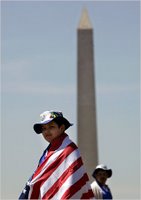
Today, over 1 million immigrants and their supporters rallied across the country, in cities from Atlanta to New York (the photo at left is from the Washington rally, Evan Vucci/AP). My own thoughts on the immigration issue are simple and may be naïve, but here they are:

1) All of the immigrants who are already here should be offered a simple and clear path to naturalization. The INS (or whatever it's called now) should address the problem of anyone who has serious criminal convictions (and I don't mean traffic violations or marijuana possession) here or in their native country, but in general, everyone else should be given a clear and realizable opportunity to become a citizen. All. Of. Them. The last I looked, all of the nativist Republicans in the House or Senate who were pushing for draconian penalties against the immigrants (Sensenbrenner, Tancredo, etc.) were descended from European immigrants, some of whom arrived no more than a century ago (and in many cases were given all kinds of opportunities at the expense of Native Americans and African-Americans), and some of whose ancestors were the objects of harsh anti-immigration sentiment and actions. How quickly and completely they forget.

2) If most Americans are concerned with the economic impact of uncontrolled immigration, and studies on the issue are mixed, though it does appear that adult American citizens who did not graduate from high school are most negatively affected (and this would include white, black American natives, and latinos), then the criticism and penalties should be laid at the doorstep of US businesses that flout the laws and continue to employ undocumented workers, which does depress wages in specific industries while increasing profits. On almost every other measure, immigrants benefit the economy. So long as the US economy keeps growing and businesses keep employing undocumented workers in large numbers without penalty, immigrants seeking jobs will try to get here. The economics seem clear to me, though I could be quite wrong in this.

3) The guest-worker program is a long-term mess waiting to happen. The guest workers will be counted for voting purposes, like Native Americans, African-American enslaved people and women once were, without voting rights and few other civil rights. This is already happening with undocumented workers, and the guest-worker program would write it into law. Again. Employers will continue to employ undocumented workers despite the numerical limits (of 400,000--is this supposed to be a cruel joke?). None of the guest workers will want to go home unless things improve in their home countries or they earn enough to create a viable life back there. Their children, if they have any on US soil, will be American citizens, further tying them to the US. Nothing will be solved. The German and other European models for this sort of program should give everyone pause, though the president [Bush], with his negative capital, was hoping that his lackeys in Congress would pass it, though they had another plan altogether in mind.

4) Since the US government, both the White House and Congress, claims to to take national and border security seriously, it needs to show that this is more than rhetoric and shadowplay. I'm not sure what's going on with the multimillion-dollar boondoggle that we call the Department of Homeland Security, but four years after 9/11, it doesn't appear that there's any real or concerted effort to control the flow of people into the country, unless they are baseball players from Cuba or a European Islamic scholar against whom the current administration has a particular ideological animus. If people can enter the country freely, legally or otherwise, they will, especially if there are available jobs here. For those immigrants who are looking for work, this is a no-brainer.

5) The US needs to revisit the NAFTA agreements and any other pro-free market international trade programs that have devastated particular sectors of treaty members' economies. Mexico's agricultural sector suffered terribly after NAFTA went into effect, and continues to suffer. Neither "free trade" nor the "free market" are "free," despite the neoconservative and neoliberal orthodoxies that the Republican party and much of the Democratic party, especially the DLC wing, subscribe to. Planned, closed economies cannot be the countermeasure, but every US "free-trade," "free market" program needs to be revisited and reworked carefully, particularly if it's only benefitting corporations and shareholders, while millions of working-age people no longer have any realistic employment options. Citizens across Latin America have woken up to the failures of neoliberalism, and Americans need to open our eyes as well.

6) Much of the hysteria involving the immigration issue is focused on Latinos, and in particular, on Mexicans. I'm sure there's no one out there who doesn't already know this, but almost the entire Southwest was under Spanish control, and then was part of Mexico, before it became US territory. Mexicans and people of Mexican heritage have lived in parts of the West and Southwest for centuries. As I pointed out about a month or two ago, Herbert Hoover oversaw the mass deportation of Mexican immigrants and Mexican-Americans, i.e., US citizens, during the Depression, and only recently was there any apology or acknowledgment of this. This is not to imply that the current Mexican immigration is a kind of karmic payback, but I do want to note that Mexicans in particular have longstanding historical, cultural and social ties to the US. Mexicans, like Canadians and the citizens of other countries that are geographically or historically linked to the US are going to come to the US for job opportunities if they're here, as will people from elsewhere in the world. How many undocumented Canadian citizens are there in the US? I don't see any outcry against Canadians, because most Canadian immigrants to the US are, I would imagine, white.

In fact, there is almost no outcry against undocumented immigrants from Europe (and it's as if the immigrants from Africa, the Caribbean [except for Cuba] and Asia are not acknowledged at all), even though our major cities, and many industries, are full of them. The men working on the lot next to our home in New Jersey are from Eastern Europe. Are they documented? Before I bought my car, half of the cab-drivers I encountered in Chicago were from Romania. Were they documented? Yes, the majority of immigrants to US come from Mexico, but this shouldn't surprise anyone, because the US and Mexico are historically and economically linked and many Mexicans have long had ties to the US. There are numerous immigrants from other countries--in my neighborhood and throughout Chicago, I regularly come across immigrants and refugees from Nigeria, Sudan, Haiti, El Salvador, Dominican Republic, Poland, Romania, Russia, and so on. In fact, from 1990 to now [2006], as I reported before, more immigrants from Africa came to this country than all the Africans brought to the US during the period of the slave trade. The immigration issue is not a Mexican or even Latino issue--even if most of the immigrants are from Latin American countries--but a human rights issue.

6) The nativists fail to look at another issue that we should be talking about, which is that if the ideology of neoliberalism and free market globalization are what they are going to keep pushing, they need to rethink issues of nationalism, national sovereignty, citizenship, and the concept of borders altogether. We are quite far from a situation of Kantian perpetual peace pervading a united, one-nation state, yet economic free-trade ideologues seem to believe that goods and services can and should cross borders at will, but fail to acknowledge the real-world national and local issues and crises that arise when real people do so. What do national sovereignty, nationalism, citizenship, constitutionally guaranteed rights, and borders of all sorts mean in an age of globalization, transnationalization, and global and transnational capital?

7) Criminalizing anyone who assists undocument workers is wrong. Building a 700-mile wall is ridiculous. Changing the law to eliminate birth-citizenship is outrageous. Expelling 12-20 million people is absurd and would be impossible anyway even if it weren't.

8) Finally, African Americans individually and as a whole really ought to be thinking carefully about the current immigration situation and its effects on this country. In most of the largest waves of immigration prior to 1965, immigrants of African descent were in the minority, and in places where there was a sizable African-American population, whether Boston, Philadelphia, Savannah, Charleston, New York, etc., African Americans were usually been pushed to the back of the line in favor of the new, mostly European immigrants. Immigrants of African descent usually blended into the African-American population within a generation or two. With the arrival over the last three decades of millions of Africans and people of African descent from Latin America, as well as millions of other Latinos, Asians, Arabs and European people (of all races), I think that we need to revisit and challenge static views of racial prerogatives, race and racial authenticity as they've has traditionally functioned in the US. I also hope the recent waves of immigration provoke a rethinking among African Americans about how we stage racial and ethnic identities in the economic, political and social spheres. Who is black and how do we speak about blackness, and race in general? What is authentic blackness? What is the black real today? How do we and can we represent it? Must one history or set of historical narratives, or racial, national or ethnic (or any other, for that matter) identity or identification trump or cancel out another, or mustn't we begin to think with complexity about who we are? (And this is the case not only for African Americans, but all Americans.) Barack Obama is us. I also hope it will provoke active coalition building to address a number of crucial issues the country faces, and in particular, that African Americans and black people in general face. White supremacy is not going anywhere anytime soon, so thinking of ways to promote countersocialization and counter-processes of identity formation and identification that do not yet again make and reify African Americans as the absolute negative Other, and that foster dynamic cross-racial alliances and means of identification across and within ontological racial boundaries with replicating the current racialized social hierarchies, are some of our current major challenges.

Saturday, May 01, 2010

Moderating Posts + Life These Days + iPhone Drawings

I hate to be forced to go this route, but I'm going to have to moderate comments (few though they be), because Blogger, one of Google's many arms, has fallen prey to aggressive spammers and malware that signal to each other which blogs are good targets. I hadn't realized how much of a problem this was until I saw that composer and critic Greg Sandow's blog, like all the Arts Journal blogs, had to disable comments because of the torrent of spam. I'm starting to get it too. According Sandow, the spammers play people to type in the "captchas" (the letter-number combos that had served to prevent autobot spammers). As I said, I hate to go this route, but for now I'll have to.  I will strive to approve comments, if any come in and they aren't spam, in a timely manner.

+++

As a review of my April posts shows, I wasn't too successful this year with my Poetry Month posts. I still have not had an opportunity blog the photos from this year's AWP conference in Denver, some of which I really like, though I did upload them to Flickr. (Blogger now automatically saves computer-uploated photos to Picasa, which I suppose is another Google tentacle.) I was thinking yesterday, how did I manage even to post poems and commentary while in Cuba last spring, and then I recalled that I wasn't here for our wonderful Writing Festival (I just need to finish those posts, really), and my workload, while always very heavy, wasn't what it is right now. I won't begin a lamentation, but I realized I was feeling something akin to mental whiplash yesterday when talking to C--as I was about to go meet with one of my grad students to discuss his novel-in-progress--because I kept thinking that half the tasks or events I participated in this past week had occurred several weeks ago.  It can get a bit...crazy-making, to put it mildly.

And so, if anything has to go, it's the blogging.  I rarely Facebook, but even my tweeting has diminished to occasional squeaks, as the update at right make clear. Given all the major public events unfolding right now, from the horrificly racist new anti-immigrant laws in Arizona to the unfolding oil rig disaster in the Gulf of Mexico to the British election campaign to debates over financial reform, it's been tough not to be able to post. But such is life, at least right now....

===

On a brighter note, here are a few iPhone sketches I've worked on since returning to Chicago (I already posted the one of Marina Abramovic). Enjoy!

Man in Starbucks, Chicago
Man in Starbucks
Young man on train, Chicago
Man on train, Chicago
Young woman in library cafe (Evanston)
Woman in library cafe, Evanston
Young woman on PATH train, New York
Woman on PATH train, NYC (her Rihanna-esque hairstyle immediately made me want to draw her)