During an overseas trip a few years ago, I picked up several books, by Erik Remès, Nicolas Pages, Djallil Djellad, and Michel Zumkir, which were all published by French publisher Éditions Balland, under their le Rayon (the Ray) gay fiction line.

The editor of the series was a writer I in my ignorance had never heard of, though he was already zooming down the path of becoming one of the most notorious and exciting figures in contemporary French publishing:
Guillaume Dustan. I grabbed these books because I'd asked one of the people working in the bookstore,
Les Mots à la Bouche, who the most interesting younger French gay writers were, and he pointed me towards a table stacked with Rayon's colorful, eye-catching volumes. I also grabbed Rachid O.'s
Chocolat Chaud, published by Gallimard.
Whenever I've been fortunate enough to travel I've looked for new work by (younger) black or LGBT or black LGBT authors, since it's usually the last to be translated. Though none of the authors were from sub-Saharan Africa or the Caribbean or Latin America--which is to say,
black Francophone people as I'd mentally constructed them--Djellad and O. were among the few Maghrebi (from north Africa) presences in this new gay wave.
My original goal was to read and translate all of these works--but of course translation is tough work! I did make some headway with O., Pages, Djellad, and Zumkir, and eventually contacted Balland via e-mail to inquire about publishing the translations of the Swiss artist and writer Pages's novel
Je mange un oeuf (
I Eat an Egg for Breakfast) in an American literary journal. In my translation I'd gotten furthest with it.
Who responded? Not a foreign rights representative, as with Gallimard, but the editor-in-infamy himself, Guillaume Dustan! I had sort of expected a snappish exchange with the author of the laceratingly ironic and anti-sentimental autofiction
Dans ma chambre (translated
into English and published by Serpents Tail),
Je sors ce soir,
Plus fort que moi, and
Nicolas Pages, but he was both professional and pleasant, and stated that I needed to have whatever journal that agreed to publish the work contact Balland to square things away. Doing the translations, he made clear, were okay. I gathered that he actually could speak and write English well (as is the case with nearly every non-U.S. author I've translated), but didn't want to and wouldn't, so our correspondence was in my faltering and too formal written French.
Okay, so I had this e-mail exchange with
Dustan, whoop-de-doo. Well, in the interim, I've tried repeatedly to place the selections from Pages's novel...but no one will touch them. (Pages has since written two others, spent time in the US working with Nan Goldin, and been immortalized, as I noted above, by Dustan, in the eponymous volume that won the Prix de Flore in 1999.) I thought this might be because the translations weren't that good, but I did have several readers and speakers of French review them and they thought they were on target and lively enough. (I refuse to believe that people in the literary world have caught the virus of Francophobia, and rather think the work is just not sophisticated enough.)
The Pages novel is a breezy, highly repetitious diary of his activities, from waking (
je me reveille) to sleeping (
je me dors, je me couche), with a heavy emphasis on cruising guys, having sex, smoking pot, hitting clubs, obsessing over his health, and eating raclettes (a Swiss delicacy). The prose style pulses, like strobe lights (or the techno music that hovers beneath its surface), à la post-modern Pater. Pages jaunts all over the place--across his native country of a thousand years of peace, to London, Paris, Mykonos, etc.--and subtly details an ethics of living and art-making that parallels, in many ways, gay men's all over the world, but more closely Dustan's. In fact, Dustan appears to have incorporated elements, down to the prose style itself, of Pages's novel into
his novel
Nicolas Pages, which differs, however, in its greater formal complexity, thematic depth, and overall chattiness and bitchiness.
Where Pages's novel steadily opens onto the (his) self, Dustan's encompasses the (his) world.
So I couldn't publish the Pages pieces, though I've subsequently applied for grants (about which I'm extremely doubtful about my chances of getting any funds) to continue translations of Djellad and O., because it struck me that, for a variety of reasons, especially right now, providing Americans and other English speakers access to original texts by (LGBT) Muslims living in a hostile Western (a/k/a French) society might be helpful in fostering greater knowledge and understanding--and perhaps even one means to a dialogue. But when I went to contact Dustan again, I learned that he was no longer the editor of the Rayon series, and woe betide, it no longer existed. Balland was still offering the books for sale, but the line was gone. In fact, they'd effectively wiped it from their Website.
Then, last fall, on the online
Nouvel Observateur, I read that Balland itself
had to file for bankruptcy. (This despite its great success in publishing Eve Ensler's
The Vagina Monologues, among other works.) Many of the books have found publishers, but Rayon was significant for blazing a path in publishing a wide range of younger, out, sometimes controversial, and usually very talented French authors, as well as notable foreign authors.
I do intend to keep translating these works, I guess as private projects, though perhaps I will find a publisher for some of them. Pages' novel has since been republished--this is now the third time--by J'ai lu. It's definitely got something going for it. Or take Patrick Thévenin's word: "I remember the first time I read this book, I said to myself that this book only spoke about me. When, in fact, this book spoke only about Nicolas Pages himself, or another. But the important thing was that it spoke so well about me. And I thought that books that spoke so well about me, or about anyone else, were far too rare."
At any rate, maybe I'll even get to Dustan's works too. He, by the way, has published about 4 or 5 new works since our e-mail exchange, including his most recent nonfiction work, Premier essai: chronique du temps présent [First essay: Chronicle of the Present Times] (Broché, 2005), and Dernier roman [Last Novel] (Flammarion, 2004).

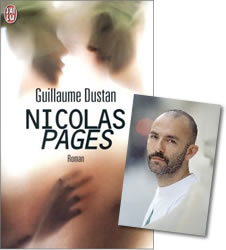
 Nicolas Pages (1970-, at right), who had only a few years before, in 1997, published his first book, Je mange un oeuf, which I've I translated a portion of. I subsequently did translate some of Dustan's novel, and realized this week, while teaching a unit on conceptual writing and rereading the works of Rob Fitterman, Tan Lin, and many others, that one way to think about Pages' first novel, and a good deal of the more chronologically-grounded, stylistically flat or affectless, verisimilitudinous works like Pages, would be as a form of documentary realism, or conceptual fiction. Pages, as I noted is a conceptual artist, but as far as I can tell, I haven't seen that link made in US criticism, though Pages and Dustan are frequently linked to Bret Easton Ellis, whose influence is evident in their work, and whom both approvingly cite repeatedly. (Other writers whose names have been evoked in relation to both are Renaud Camus, Hervé Guibert, Céline, and the American queer master Dennis Cooper.) One great aspect of reading and translating Dustan's Nicolas Pages was seeing his appreciation of Pages' first book stated so clearly and forcefully in the opening pages of the novel; I have long wondered if it was just me who saw validity in what Pages was doing. Now that Goldsmith and company are big, perhaps there will be more appreciation for at least some of their counterparts, especially Pages and the late Dustan, overseas.