Showing posts with label figuration. Show all posts

Monday, August 25, 2014

"No Angel" (Poem for Michael Brown)

Though the motivation often arises in me, especially when certain types of major events occur, I seldom am able to write immediate occasional or topical poems. Today after reading New York Times African American (!?) reporter John Eligon's piece "Michael Brown Spent Last Weeks Grappling With Problems and Promise," however, in which he includes the following paragraph--

Michael Brown, 18, due to be buried on Monday, was no angel, with public records and interviews with friends and family revealing both problems and promise in his young life. Shortly before his encounter with Officer Wilson, the police say he was caught on a security camera stealing a box of cigars, pushing the clerk of a convenience store into a display case. He lived in a community that had rough patches, and he dabbled in drugs and alcohol. He had taken to rapping in recent months, producing lyrics that were by turns contemplative and vulgar. He got into at least one scuffle with a neighbor.

--and in particular, the unnecessary and noxious "Michael Brown...was no angel," subjectively singling out this teenager, whose life was tragically cut short when he was shot dead by policeman Darren Wilson in cold blood, in a way I have almost never see or read for any other major public figures with any life issues, including long histories of drug use, criminal activity, and worse, I became enraged. Yet rather than just stifling or sublimating it (and Eligon's piece provoked a brouhaha, including considerable backlash, all across social and traditional media), I stopped what I was doing at the New York Public Library and wrote out a poem directly on Twitter, titled "No Angel."


Since not all of J's Theater's readers are on Twitter, I am sharing the poem here, edited and with an additional stanza). It is a tribute in and of the moment, to Brown, but I think it works on its own, and the relationships between and among the chain of metaphors and metonyms, as well as the ironies contained within, should be clear enough. To his memory and many others in his situation: RIP.


"NO ANGEL"

No angel?
no god?
no cherub?
no seraph?

no saint?
no deity?
no divinity?
no lord?

no king?
no prince?
no noble?
no peer?

no master?
no idol?
no leader?
no icon?

no star?
no notable?
no hero?
no worthy?

no baby?
no toddler?
no youngster?
no boy?

no brother?
no nephew?
no uncle?
no son?

no ally?
no buddy?
no sidekick?
no friend?

no somebody?
no character?
no nobody?
no fellow?

no being?
no soul?
no mortal?
no individual?

no man?
no person?
no sovereign?
no human?

RIP Michael Brown
© 2014

Copyright © John Keene, 2014. All rights reserved.

Tuesday, June 21, 2011

Quote: Quintilian

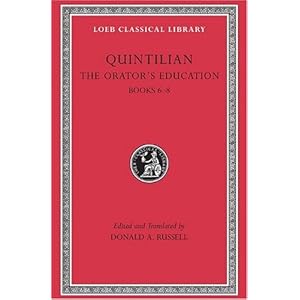
"While moderate and timely use of Metaphor brightens our style, frequent use of it leads to obscurity and tedium, while its continuous application ends up as Allegory and Enigma. Some Metaphors are also low--like the "rocky wart" I mentioned above--and some coarse. If Cicero was right to talk about the 'sink of the state,' meaning the foul ways of certain people, I am not therefore minded to approve the old orator's 'you have lanced the state's abcesses.' Cicero did well to point out the need to guard against an ugly metaphor (like 'the state was neutered by Africanus' death' or 'Glaucia, the excrement of the Senate,' to quote his own examples), and against one which is too grand or (as happens more often) inadequate and unlike. Once alerted to the fact that these are faults, one will find instances of them only too often. Excessive amounts of metaphor, especially of the same species, are also a fault. So too are harsh metaphors, that is to say those derived from distant resemblances, like 'the snows of the head' or
Jove spat white snow upon the wintry Alps.
The biggest mistake however is made by those who believe that everything is appropriate in prose which is permitted to the poets, whose only standard is pleasure and who are often forced into Tropes by the necessities of metre. Personally, I would not say 'shepherd of the people,' on Homer's authority, in a speech, nor speak of birds' 'swimming' through the air, though Vergil uses this very beautifully for the bees and for Daedalus. Metaphor ought either to occupy a vacant space or, if it replaces something else, to be more effective than the word it banishes.
-from "Metaphor," Book 8.6, Quintilian, The Orator's Education, IV, Books 6-8 (Loeb Classical Library No. 127), Cambridge: Loeb Classical Library, 2002.