Showing posts with label Whitney Museum. Show all posts

Wednesday, September 11, 2019

A Tale of Two Exhibitions: The 2019 Whitney Biennial

Earlier this summer, I had the immense pleasure of viewing the 2019 Whitney Biennial, which is still running, for a few more weeks (until September 22, 2019), at the Whitney Museum of American Art in New York. It was not only a better show than the 2017 installment, I thought, but in essence two different exhibits in one, I ultimately argued, in a review now out for Art in America. The second of the two exhibits became possible, however, only after the Whitney resolved a festering crisis that had underpinned the exhibit--and the institution itself as a whole. In fact, the revolt that occurred, creating the new exhibition, necessitated that I rewrite the laudatory first review I'd drafted.

The qualitative differences between the two exhibits, whether visually evident or not, resonate throughout the work on display, throughout the museum's spaces itself, as a shift in ethos and an aura, however temporary. I won't replay my entire essay, which underwent a great deal of editorial distilling (so many thanks to Will Ratik and his editorial team at Art in America), so here is the link to the full essay, "The Whitney Biennial: A Tale of Two Exhibitions," and a paragraph from it, in which I argue for further action by the exhibits artists and, I would assert, artists working in all media, including literature.

I believe we are at the moment when the artists should be encouraged to actively trouble the “circuits of valorization,” as prior generations of artists have done. I say trouble rather than disrupt, since the latter term has taken on particular connotations in the language of neoliberal capitalism, particularly in Silicon Valley and Wall Street. But what might the effects be of such a troubling on the lives and careers of today’s artists, especially those who, like many of this year’s biennial participants, come from groups, intersectionally understood, that have been traditionally excluded from participation in exhibitions such as this, as well as from elite art schools and institutions, and from the global gallery, art fair, and auction networks? What would more extensive rethinking, dismantling, and transformation of those circuits look like? How much energy and effort can and ought they expend in understanding and critiquing the ecosystem in which they are working? From an ethical standpoint, can they forgo such an undertaking, whatever the cost?
If you can, please see the exhibit before it goes, and do leave your thoughts on the Biennial and my review in the comments section if you'd like.

Saturday, September 13, 2014

On Jeff Koons at the Whitney Museum


What is art? What is "good" art? What do we mean by "good" when we speak of art? Does "good" here equate with quality, if we consider the roots of the concept of art in the West lying in the concept of techne? Is this even a relevant question any more, in 2014? Who determines what is good and not good? Or beautiful, or resonant, or sublime, or, conversely, bad, horrible, not worth expending even an epithet on? Are these characterizations a matter of a work of art's holistic aesthetics? Sociopolitical relevance? Technical virtuosity and mastery? Does the fact that a particular institution or an institutional field assigns such values make them valid? Does it matter that their decisions may be based not only on personal views drawn from expertise in the history of and criticism about art, but other institutional values, broader historically, politically, economically, and socially discourses about art, and contemporary market values? How much should any viewer know or factor in that there are immense financial stakes for collectors and connoisseurs?Is that what we mean today by the sensus communis? Does such a term have any meaning at all in the wake of the multiple stratifications and atomizations of the society in which we live? Does the sensus communis perhaps primarily and most aptly apply today to the artistry of Beyoncé Knowles, say, or Seinfeld during its heyday, or the current HBO hit Orange Is The New Black, rather than anything produced by some of the artists who now occupy the upper reaches of the contemporary US and global artworlds?  How important are these issues in thinking about art, about beauty, about aesthetic value?


What is it "good" art for? What makes it worth viewing? Is there any correlation between its aesthetic value and its market value? What do we even mean by "aesthetic value" today? Or use value for that matter? Do any of the additional aesthetic qualities proposed by critics like Sianne Ngai in books like Our Aesthetic Categories: Zany, Cute, Interesting (Harvard University Press, 2012), such as "zaniness" or "cuteness" or "interestingness" factor in at all in terms of this idea of "goodness" and its purpose? Does purposiveness? Does placing a work of art or multiple ones, by the same artist or different ones, within a given context like a gallery or museum, especially one of the major ones in the world, (not) legitimate an artwork and its author? Does it validate them and her? Are legitimation and validation the same thing? Can market value, which is now the primary value in contemporary art, be the only significant value an artwork possesses? What is or are relations between the acceptance of aesthetic and personal commodification and works of art's non-financial values? What do we say about artists who view themselves and their artwork not simply as commodities, which could be said to every degree about every artist creating today who is conscious of the world in which she lives, but as financial instruments? Can such artists ever again be said to approach their art with disinterest, and thus isn't that a category which might be jettisoned today? Which is to say beyond a basic barter system, can a painting or a sculpture also be considered as form of currency, or a derivative? What happens when we speak of works of art as derivatives or financial instruments? What does one call exchange value that is now so inflected? Is there a new name for this contemporary state of aesthetics, and would be be an(ti)aesthetics, commodesthetics, financesthetics, or something else?


Does such value (do such values or non-values) invalidate at a basic level the question of aesthetic, political, social or any other form of "goodness," "beauty," and so on? What is the relationship between this way of thinking, and Duchamp's readymades? Should we assign the the start of this thinking at the doorstep of Duchamp--or perhaps in more recent decades, Andy Warhol--or go back to Plato's ideas about second and third orders of artmaking, or Kant's formalism, as well as the aesthetic writings of Karl Marx? Does it unfairly raise the significance of a work of art and its author that I or anyone invokes such names? Is there a danger in doing so, and how does this relate to legitimation and validation? Does doing so also help to increase the "values" of certain works of art, even if I think they do not deserve it? Does it matter that an artist may or may not be aware of such questions? Or that, even if aware, she neither understands them or even cares?


Can't an artist focused primarily on making money make good art? Why does Jeff Koons make art other than to make money and make things? Does Jeff Koons know what "good" art is? Does Jeff Koons care? Should Jeff Koons care if a museum like the Whitney apparently does not? Does Jeff Koons' background as a Wall Street commodities broker as well as a graduate of an art school factor to a greater degree in the way in which his work appears often to be primarily a financial instrument or derivative? Isn't it fair to use the term "derivative" in relation to Jeff Koons's work, given that he was a broker, and, based on his show at the Whitney Museum, he, like many other artists, "derived" his early practice heavily from the work of Marcel Duchamp? Is it fair to say that Jeff Koons had a significant or noteworthy conceptual understanding of art, and of Duchamp's work, even at the start of his career? Has he had one since? Why does so much of Jeff Koons' work, its technical mastery excepted, look like something that might merit a harsh critique at an art school? Is technical mastery enough?


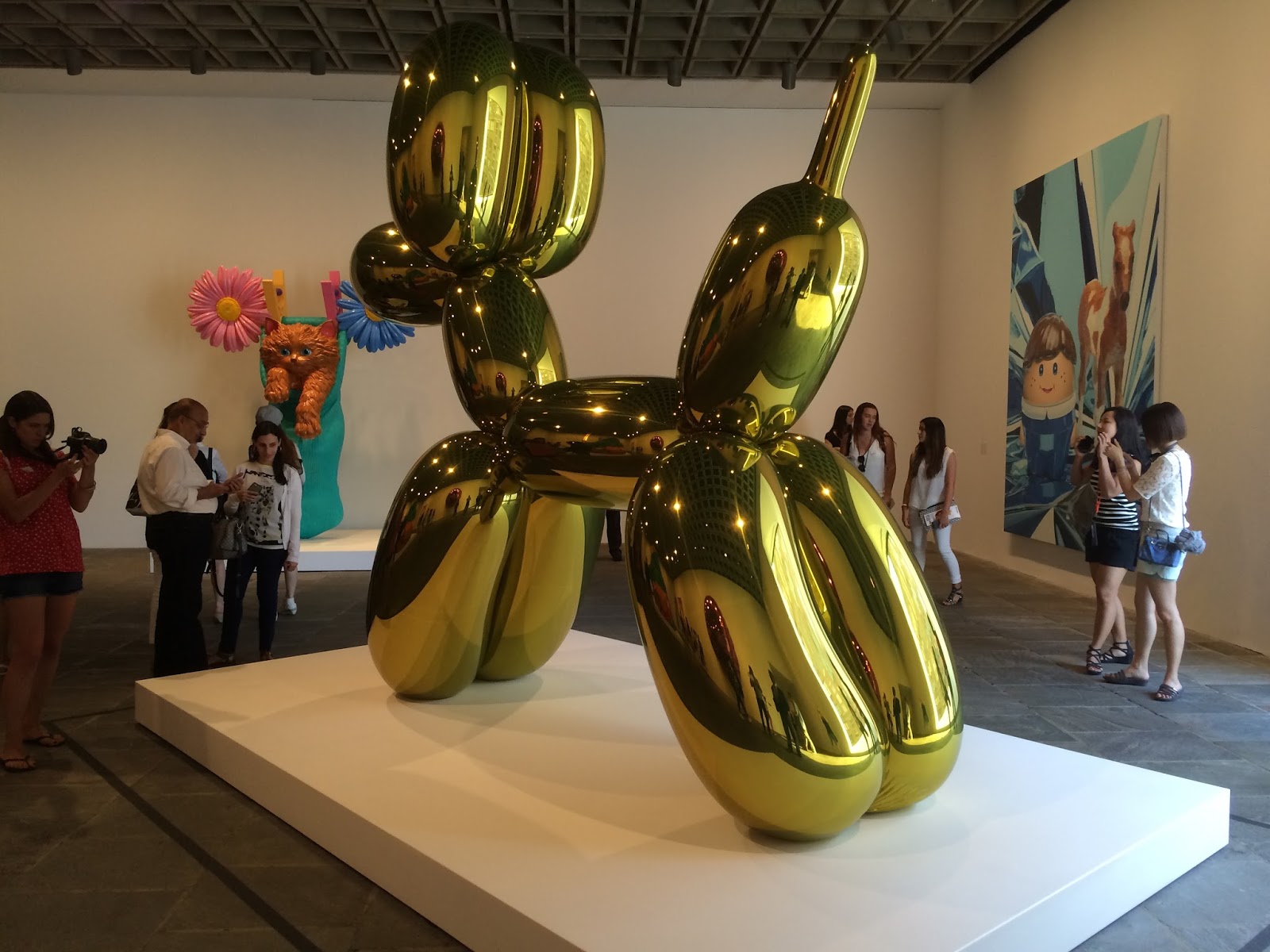
How do we speak of art that is at one level hard to look at and at another to turn away from, like Koons'? Does the monumentality of so much of Koons' work endow it with a significance it might lack if it were smaller in scale? Would we want to look at a golden balloon dog in cast metal if it were the size of one might find at a children's party rather than larger than a Cadillac Escalade? What about a heap of Play-Dough? What about a room or six or five floors of such work? Do such questions even matter? Would Jeff Koons have the career he has if he were not an educated white man from a middle-class middle-American background? Would such artwork be possible for someone not from such a background? What does this say about the roles of power, privilege and possibility in the contemporary art world, or in our society in general? Does it matter that in asking these questions so far I have not even broached questions of labor, production, and who in fact produces this art that has garned Jeff Koons such incredible fame and wealth?


Has the shift to a digital world of images, a world not of artworks but of platforms, as David Joselit has noted in his book After Art (Princeton, 2012), rendered Jeff Koons's work, especially his pornographic images with his ex-wife*, Ilona Staller, La Cicciolina, say, more or less valid? Are there words in the English language to capture my unpleasant physical response to see Jeff Koons naked and simulating or having sex? Is it not, however, a virtue, that works of art can make a viewer like me laugh out loud repeatedly, though not with the artwork's intended meanings, but in spite of and against them? Can an artwork, even in the age of mechanical and now digital reproducibility and infinite expansion and transformation, be said, when viewed either in person or online, to have no aura, and why does this seem to hold for so many (most?) of Jeff Koons' works?


Conversely, does not the possibility of infinite digital reproducibility render certain Koons' works even more auratic? Isn't it perhaps better, to put it another way, to see them on the Internet or some other digital space, as opposed to up close? Isn't there an aura of ratchetness (wretchedness) in contemporary American life to which more than a few aspire? Isn't this a negative aesthetics but a very different one from what Theodor Adorno proposed? Isn't this ratchet auratics a poetics that suffuses so much current popular culture and American culture more broadly? In identifying it am I not also implicating myself in my enjoyment in certain forms (such as reality shows, say) and examples (Mediatakeout.com) of it? What happens when one places Real Housewives of New Jersey alongside Jeff Koons? Hasn't someone already done this? Why did the Whitney choose Jeff Koons' as its final show in its Marcel Breuer space, and what does this say about the Whitney Museum and its role and place in contemporary American and global art? Can any fields but cultural criticism and the history of art account for such an occurrence? Is Jeff Koons not the perfect artist for contemporary America, and if the answer is affirmative, doesn't this answer all the preceding questions?


___
* Many thanks to Andrew Blackley for correcting this error; Ilona Staller was Jeff Koons' wife, not just his girlfriend, which raises a number of related issues that Andrew also pointed out, such as: 

The degree and orientation of both of their agencies shifts within their marriage - regardless of personal respect(s) or equality of sorts or means individually in that there is a more or less an ideological "fair use" clause to the body of the other, and the inability (or difficulty) of protesting against or working counter to the other or the union as a whole ( say, in court.)

Is she the porn star girlfriend (working, or knowing how to work with and through her body) or is she the wife "at work," under an established consent between the two of them as people or "at work" under and as part of an institutional allowance?

And, if the above: what does that say about Jeff Koons and the rest of his "collaborations" with any number of cultur

Sunday, April 14, 2013

In the Life @ Whitney Museum Today!

For any and all in and around New York, a wonderful event will take place this afternoon! Please come if you can.

BLUES FOR SMOKE PERFORMANCE SERIES  

GREGG BORDOWITZ: “IN THE LIFE”

A READING OF WORKS BY GAY BLACK MEN FROM THE 1980S AND ’90S

SUNDAY, APRIL 14, 2013  2 PM   

FILM AND VIDEO GALLERY

For “in the life,”* artist and writer Gregg Bordowitz will host readings from the literary work of gay, male, African American poets and writers, who chronicled sexuality, illness, and death during the height of theAIDS crisis in the 1980s and ’90s. Many of the writers are now dead, and their works have been collected in anthologies, such as In The Life, edited by Joseph Beam, and Brother to Brother, edited by Essex Hemphill. Bordowitz will be joined by a diverse group of readers including Ari Banias, John Keene, Rickey Laurentiis, Glenn Ligon, Eileen Myles, Other Countries, Robert Reid-Pharr, and Pamela Sneed to pay tribute to artists such as Donald Woods, Essex Hemphill, Marlon Riggs and many more.

*In the Life: A Black Gay Anthology was a groundbreaking collection of writing edited by Joseph Beam and published in 1986.

Free with Museum admission; no special tickets or reservations are required. Members enjoy complimentary and express entry to the Museum.


Monday, August 22, 2011

4 Shows at the Whitney: Everson, Arcangel, Cha & the Founding Collection

Soon, the Whitney Museum of American Art, one of the icons of the Upper East Side's Museum Mile district, will abandon its striking Marcel Breuer-and-Hamilton Smith-designed home on 75th Street and Madison Avenue, and head downtown, closer to its original home, which still exists and is now the New York Studio School of Art, on 8th Street and 5th Avenue, for a new space near the High Line Park and New York's main fine art neighborhood these days, Chelsea.  I am agnostic on whether the move is a good idea, but it's in the works, and the museum's trustees and patrons support it and have raised the money (or most of it needed) to move, so it goes. I personally will miss going uptown to the Whitney, though. I have seen many great exhibits there, including several controversial Biennials, yet even when it's packed I've never found it to be the tourist trap the always remarkable Met sometimes can be (cf. my post on the McQueen show), it has never attempted to be as exhaustive (and exhausting) in terms of canonical modern art as MoMa (so when I go I don't worry that I'm missing 2-3 exhibits I would like to see but don't have the time to), and yet the focus is on the artwork, instead of the overwhelming architecture of the building itself, a problem the Guggenheim sometimes presents.  As I love looking at art, the Whitney often summons me forth. Five floors: a morning or afternoon usually will do. So I visited four shows recently: More than That: Films by Kevin Jerome Everson (April 28-September 18, 2011); Cory Arcangel: Pro Tools (May 26-September 11, 2011); Xavier Cha: Body Drama (June 30-October 9, 2011); and, for a hot minute, Breaking Ground: The Whitney's Founding Collection (April 28-September 18, 2011). I could easily write four long reviews, so I'll be succinct about the shows, focusing on the first two, which engaged me the most.
Image from a Kevin Jerome Everson film, "Act One: Betty," Whitney Museum
Still from Everson's film "Act One: Betty"

Kevin Jerome Everson (b. 1965-), a professor at The University of Virginia, works in a range of forms, from filmmaking to sculpture and photography, and his assured grasp of the pictorial and how film can play with the plasticity of imagery and the pictorial space come through in the collection of short films, many (most?) of them 16mm transferred to video, playing in the exhibit. All appear have implicit narratives, but they compel you more to look and think than follow as you would traditional shorts, yet their experimental brevity and disjunction is different from that of experimental filmmaking as I tend to think of it. All of the films here focus on African-American lives. They give glimpses, all seemingly drawn straight from life, of a coherent world, drawn from Everson's imagination and from appropriated footage that he expertly edits, that on closer examination might not be the sum of its parts. Sitting through the films, I enjoyed the realities they created even as I realized how fictional(ized) they were.  Often but brief reels of seductive visual poetry--and in one case, "Blind Huber" (2005), Everson literalizes the poetic by including a snippet of a poem on beekeeping by poet Nick Flynn, which the poet reads aloud--Everson's mini-takes are often sly and effective commentaries on reality he and others (I included) not only live it, but feel it.  Moreover, Everson manages to balance impressive artfulness (from his skillful management of composition, light and darkness, pictorial depth) and the prosaic, without the artistic pretense that screams: "This is an art film, in a museum/gallery, and thus it's important." The films exude their playfulness and seriousness in equal turns.
Still from Everson's "American Motor Company"
Still from Everson's film "American Motor Company"
While I enjoyed all of them, three films really stand out: in "American Motor Company," Everson depicts two workers methodically posting a billboard that is at first unclear and unremarkable but which, when finished, reveals a black man posing in front of the fake town of Volkswagen, Ohio. That's it. Yet the film captures so much: the invisibility and precarity, and the physical efforts required, of blue-collar labor (especially today), the global consumerist fantasy, capitalism's contemporary spectacle, and the steady corporatization of every aspect of our lives, down to municipal government themselves. Only this one has a black face fronting it. "According To" is an especially powerful example of how Everson sometimes puts archival and found footage to novel and evocative ends. In this short piece, he links three different tracks: one is footage of an elderly African-American man, living in the rural South, who recounts his experiences working as a paperboy; the second features footage of a body being dredged from a lake, intercut with clips of notable black people, ranging from Martin Luther King Jr. to Floyd Patterson, and what appear to be civil rights protests; the third features crisp audio local news reports, including some that appear to refer to the drowning. Everson skillfully torques each element, so that the elderly man begins to qualify his accounts, suggesting that he wasn't always paid and that his memory might be faulty. The news reports also shift, also changing the story of the drowned man and our feelings about the nature of his death, and adding other crimes, including one in which an "elderly Negro woman" died in a fire that appears to be a hate crime, and a black man readily admits to having killed a white man. The images shift into sync with this changed narration, showing what appears to be a black body on a gurney; is it the drowned man, who may have been murdered, and how objective can any news be within the context of our particular national, racial, ethnic, and gendered histories? The third film, "Ninety-three" features the same actor in "According To," attempting to blow out the eponymous birthday candles, which, as we come to see, are the trick kind. In the interplay between the slow camera speed, the elderly man's expressive face and the flames lighting it, Everson has captured a world, his world, mine, ours, and by extension, reveals truths more broadly about humanity, as effectively as a poem. Multiple ones.

Cory Arcangel's "Various Self Playing Bowling Games" (2011)
Arcangel's "Various Self-Playing Bowling Games (aka Beat the Champ)"
Cory Arcangel (b. 1978-) is a computer whiz with a great sense of humor, and skills.  His smarts, technical expertise and wit are on ample display throughout this exhibit, which examines the interplay between off-the-shelf technologies and the artist's (and one could add, the hacker's) creative interventions, thus revising our thoughts about the latter in light of evolving legal and aesthetic notions of hardware and software. Throughout "Pro Tools," Arcangel presents now-outmoded technological tools that still offer ways of thinking through our relationship with the electronic and digital, virtual worlds in which we all now exist. What once was the height of sophistication--getting sculptures to move via computer algorithms; pen plotting machines; interactive video games--become almost passé, not just scientifically but in terms of their status as commodities. Arcangel, however, is interested in returning to them and seeing what he can learn from them and what they can still teach us today. Often as I walked through the exhibit I could feel a philosophical and conceptual impulse underlining these pieces; what would it be like to? or what would happen if I? simplistic as such questions sounded, might be among his basic starting points. What connects such starting points is a throughline exploring the effects of technological tools and their relationship to art historical and popular cultural discourses. In "Various Self-Playing Bowling Games (aka Beat the Champ)" (2011), Arcangel presents a wall of multi-channel, large-scale projections of video bowling games from the late 1970s to the 2000s, and in each he reprogrammed them to bowl the ball into the gutter. (He also does something similar with a miniature golf putting game, "Master" (2011), in another room.)  His hacks here undercut our sense of the "interactive," suggesting technology that has gotten out of hand, literally; we watch, are enthralled by the colors, maddened by the noise, but we have no control over the games whatsoever.  I immediately thought, what a metaphor for capitalism as most of us, the non-plutocrats, that is, experience it.

photo
Arcangel's "Palms"
Another set of pieces that I was drawn to were Hello World (2011) and Palms (2011), simple line drawings that Arcangel produced using now superannuated pen and pencil-plotting machines from the 1980s and 1990s. I can recall how expensive and rarefied such equipment was back then, having worked in the late 1980s and early 1990s in an MIT laboratory in which large-scale plotting and printing was sometimes necessary, but as Arcangel tells us, such equipment can be purchased for a song on eBay, which is what he did, and with a bit of configuring, can be put to work playing with the idea of reproduction and mimesis more specifically. What is a copy, and how carefully can our eyes tell the difference? In Palms, Arcangel creates a series of images of palm trees that confuse the boundary between machine and artist-created drawings, challenging the viewer to discern which was produced by the pencil plotting device and which was produced by the artist himself.  In Hello World, he wrote a computer program to create line 2-dimensional drawings connecting random points between 0 and 100.  (One drawing was a blank page, as the program picked the number zero, mirroring works from the early conceptual period of the 1960s, as well as earlier white and blank canvases from the 20th century Euro-American art-historical canon.) In and through such works, as well as the kinetic sculptures (see the video I took below), Arcangel is also reinserting into the art-historical narrative mid-1960s computer art, long written out of the contested accounts of the development of contemporary art history, theory and practice.

Thursday, March 31, 2011

Glenn Ligon @ the Whitney Museum

Mirror, (2002), Coal
dust, print ink,
glue, gesso,
and graphite
on canvas
82 5/8x55 1/8 in.
Collection of Mellody
© Glenn Ligon
Last Friday, I traipsed over to the Whitney Museum to view Glenn Ligon: America, the first mid-career retrospective of Ligon (1960-), an artist who is perhaps best known for his wall-sized, oil and coal dust text paintings from the 1990s through today. (I must note immediately that his beautiful painting "Black Like Me #3 (Study)," from 1992, graces my first book, Annotations.)  The Whitney rightly devotes a floor to Ligon's oeuvre, which consists not only of the paintings but of drawings, prints, photography, and multimedia installations, including sculptures, which together suggest a coherent approach, across forms, that define the possibilities, and perhaps strike the limits, of what identitarian art might do. I use the term "identitarian" with advisement, since I think that Ligon's work exceeds being so easily categorized, but seeing this art, all of it of considerable technical mastery and distinction, a good deal of it even more beautiful when viewed up close (especially the oil text paintings!), brought me back to the core of what the earliest of these works suggest: Ligon's investigations into questions of identity, racial, sexual, social, political, cultural--his own and those of people around him, in America and outside our shores.

What the works also evoked for me, almost in the sense of setting forth a world, of calling into existence the moment of their creation and first appearance, the fraught period of the 1980s and 1990s, when identity-based art surged to the forefront of public consciousness and discussion, just as other genres, such neo-Expressionism and the second waves of minimalism, conceptual and performance art were waning, and I could feel myself reliving some of the debates I witnessed, that I participated in; I could feel the polemics in favor of (which I passionately was and still am) and against this work, which was and, I would argue continues to be important, especially given how crucial it is in reminding of the broader political, economic and social turmoils of that period. The era of the Reagan, Bush I and early Clinton presidencies has been reduced to a caricature these days (Saint Reagan! The greatest president ever! blah blah blah; George H. W. Bush has virtually disappeared; the relentless attacks against Clinton and his centrist policies, even before he was elected, now almost completely forgotten in the public discourse even as they mirror what Michael Dukakis, and later Al Gore, John Kerry, and Barack Obama have endured), but the brutality and ugliness of that period, the period of the AIDS pandemic's emergence, of the anti-affirmative action and anti-abortion fanaticism, of white racial retrenchment and the rise of the militia movement, of the anti-Japanese and anti-immigrant testeria, of supply-side economic's intellectual triumph and practical failure, of the lust for warmongering and the buildup of the military-industrial and security states, of the ramped-up deindustrialization of the country, of the rise of the crack epidemic, of the cultural wars in and outside the academy, etc., all of these forming the foundations for our current moment and yet phantasmal in our mass media, also all form the backdrops to Ligon's art.

Untitled (I Am a
Man (1960)
Oil and enamel
on canvas,
40x25 in.
Collection of
the artist.
© Glenn Ligon
Walking through each room, I felt something akin to the beating wings of Benjamin's angelus novus, but a black, queer, cosmopolitan, left-leaning, and indefatigable one, against my cheek: the now-time (Jetztzeit) of that earlier era, the era of my 20s, the period of Slackers, of Public Enemy, of Eleanor Bumpers and Tawana Brawley, of Do the Right Thing, of ACT-UP and Queer Nation, of the last glimmers of Gay Liberation, of Essex Hemphill and Marlon Riggs, of Audre Lorde still alive speaking out against Jesse Helms, etc., was there with me even as I was firmly in our present moment, with its host of grave concerns.  What I also began to feel, as I reached Ligon's pieces invoking the runaway slave posters, was that a great deal of this art was perhaps, in some ways, too much of its time; universal yes, and yet perhaps too anchored in that earlier moment whose issues are still with us, but in different ways. The retrospective, to put it another way, felt insistently historical, indexing not only Ligon's history, but the country's, the society's, my own. It felt--dated perhaps is too strong a word, but while the formal power of the work struck me as transcendant, especially the oil text pieces, a good deal of the other aspects of the work felt as if it reflected a moment that had passed, but also, as if it were in some ways trapped, as if in amber, in that moment.  In a sense, this underpins some of the past criticism of this work, and of similar art of this or earlier periods, which I must admit upsets me, in part because I worry that in viewing the art in this life I may be undercutting Ligon's achievement, that I am falling into the trap of arguing that art probing identity, particularly the identifications and intersectionalities so central to Ligon's work, cannot transcend its moment, cannot resonate beyond the particular contexts in which it was created; but another way of looking at it might be to say that some of Ligon's work does and will continue to do this, but some of it does and will not. Perhaps, as an artist I greatly respect suggested to me a few weeks later when we discussed the exhibit, what might benefit some of these pieces down the road would be for them to be exhibited with other works of this era, thus providing an even richer immersion in a conversation whose urgency we forget at our peril.

Notes on the Margins
of the Black Book
(1991-93), (detail)
91 offset prints
11 1/2x11 1/2 in.
(framed) 78 text
pages, 5 1/4x7 1/4
each (framed)
Solomon R. Guggenheim
Museum;
gift of the
Bohen Foundation
© Glenn Ligon
I do want to call attention to one part of the exhibit that particularly took me back to the late 1980s and early 1990s, and somewhat shook me up.  That was Ligon's Notes on the Margins of the Black Book (1991-1993), his response to Robert Mapplethorpe's highly controversial 1988 volume The Black Book, which preceded Mapplethorpe's even more charged 1989 exhibit Robert Mapplethorpe: The Perfect Moment. Ligon's exhibit essayed and assayed the responses, from a range of viewers, some famous scholars and critics like Stuart Hall to figures depicted in the portraits themselves to Mapplethorpe himself, figuratively and physically breaking down the book, image by image, page by page, to critique and open up ways of seeing, reading, understanding, and interpreting--which is to say, experiencing--Mapplethorpe's, and by extension, this society's, views of black men, the black male body, the black body, blackness itself. Ligon's interpretive practice here was and remains quite remarkable; it suggested in its richness some of the subsequent revisionings of Mapplethorpe's work by Kobena Mercer and others, while also demonstrating another powerful, effective and moving method of critique. (It would do us all a bit of good never to forget that art, and not just academic criticism, has this capacity, and when it does so effectively it can reach a great deal more people.) I recalled my own reading of The Black Book, my own youthful critiques and conflicts, at the power being accorded Mapplethorpe, at what I read as objectification, at my own insistent attraction to the images, at my desire for someone black, someone of color, to attempt something of this sort and the frustration I knew I would feel as it went ignored by the wider culture in ways that Mapplethorpe's art never would, and so on. Ligon in fact captures all these feelings and many more--some were his own, reflected in the range of commentary, the juxtapositions of image and text, the sheer panorama of visuality that both magnetized--and magnetizes still--as it overwhelms.  This was one aspect of the exhibit that reminded me of why Ligon is such an important artist, and why I hope he continues to make art, especially work that engages the themes and tropes of our times.

One thing I found surprising was that the exhibit did not include--or perhaps I missed them!--Ligon's playful photographic and digital projects from the mid-to-late 1990s, such as Feast of Scraps (1994-98), in which he juxtaposed family photographs with vintage gay pornography, many of the images featuring black men. One outgrowth or extension of this work appeared in his online Dia Center for the Arts project "Annotations" (no reference whatsoever to my book), which is available here (click on "Annotations"). This work struck me as opening out into really interesting possibilities in terms of the emerging queer studies and discourses on and around family, geneologies, filiations and affiliations, and so on, and its use of digital media also marked what I took to be new directions on Ligon's work. But as I said, I did not see this in the Whitney show, and perhaps missed it. If not, I hope that in a future show and in his work to come Ligon resumes it, especially because it was in conversation with some of the exciting work that Thomas Allen Harris has been undertaking around black families and geneologies but also prefigured the mainstream gay shift towards discussions of marriage, family, homonormativities (which Ligon was queering in very interesting ways), and LGBT relationships in the late 20th and early 21st centuries.  All in all, I highly recommend seeing the exhibit, and look forward to seeing another retrospective of his work several decades down the road.
Outside the Whitney Museum (Glenn Ligon neon sign in window)
Outside the Whitney Museum, Glenn Ligon's exhibit, signaled by the neon Negro Sunshine in the window.