More than once on this blog I've championed the poetry of Adélia Prado (1935-).
I've even touted her as a potential candidate for the Nobel Prize, and
she's apparently been nominated by others, though it appears the
Swedish Academy has quite different ideas than I and Prado's other supporters about who should get its annual literary honor totaling around $1 million dollars. Her 8 collections of poetry nevertheless strongly recommend her for the highest honors. She combines the earthly and the mystical, the simple and the fathomless, in language that does not stint on the colloquial, the witty, the figurative. She has a gift for making metaphorical leaps that I especially admire. I have never translated Prado's poetry, however, in part because she has been lucky to have the esteemed poet
Ellen Doré Watson bringing her work into English, and I would venture that it's without question as to the superlative job she's done.
 |
| Adélia Prado |
Earlier this summer Prado and Doré Watson were to appear at
Poets House for a reading, but it was postponed until this fall. On Thursday afternoon, I emailed
Reggie H. to find out if the event was still on, and he assured me it was, so I trooped downtown to Poets House's Kray Hall to see Prado and Doré Watson present the poetry live. I think I heard it said that this was Prado's first visit to the US in some 25 years. After a welcome by Poets House director
Lee Bricetti and a lovely, brief introduction by Poets House's
Stephen Motika, Doré Watson took the stage to offer a fuller introduction not only of Prado, but of her experiences translating Prado's work. She guided the audience through how she initially was drawn to Prado's poetry (via a lackluster translation by a graduate student) and how she became the first Anglophone poet to translate Prado's work. Among her quotes about Prado: her "poetry is written neither from the head nor from the heart but from the gut." And, from a poem: "Everything is small compared to my heart's desire / the sea is a drop."
They then read a series of poems they had jointly selected, first in Portuguese and then in English, based on the English-language volumes of Prado's work. There were a number of Lusophones (many of them Brazilian, I imagine) in the room, and they laughed at those moments of humor in Prado's Portuguese renditions of her poems, while the English speakers and readers were able to get almost as much from Doré Watson's meticulous and emotionally resonant translations. After they read about a dozen poems (was it that many? that few?), they participated in a question and answer session that included a question
reporter from Prado's native town of
Divinópolis, in
Minas Gerais state (the huge interior state, named after its general mines, that has been one of the major political and cultural poles of 19th, 20th and 21st century Brazilian culture). Only in New York City!
 |
| Ellen Doré Watson |
 |
Watson and Prado, beginning
their joint reading |
Prado shared many
palavras boas (good words), as it were, in both her poems and her responses, and Doré Watson was an able simultaneous translator. A good deal of her replies circled around the idea of suffering and its necessity for the poet, which for her meant many things, including a working-class youth, the loss of parents, being the first in her family to be educated, being a woman, a wife, a mother, and an artist, and so much more, though I took her to be suggesting that everyone suffers at some point, suffering being a constitutive aspect of our humanity, and the poet is one who can draw upon this experience. To put it more bluntly, she even said, "To exist is to suffer." Of course "sofrer" in Portuguese can also mean to "experience, to put up with," and think there was a bit of this in what she was saying and implying. I asked the question (in English) about her poetic influences, since this came up in a prior comment, in which she noted that she had not really broken free of her influences until the age of 40, and she mentioned that poets like
João Cabral de Melo Neto, Cecília Meireles, and others, major figures in Brazilian poetry, were her influences from childhood, but also that she drew from the other arts, and from the Roman Catholic liturgy. She did not mention non-Brazilian poets, though predecessors who combine the carnal and the mystical would certainly be in conversation with her.
 |
| Prado, reading in Portuguese |
 |
Doré Watson and Prado during
the Q&A session |
 |
Doré Watson listening as Prado
offers one of her quotable answers |
 |
The announcement for the event projected
in light in front of Poets House |
Here is one of the briefest poems in
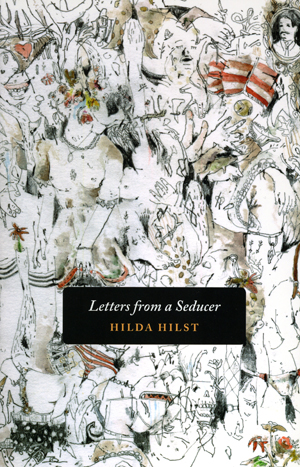
Ex-Voto (Tupelo Press, 2013), Doré Watson's newly translated collection of Prado's poems, which conveys the sacred and the witty, in just three lines. Enjoy!
PARAMETER
God is better-looking than I am.
And He's not young.
That's consolation.
Copyright © Adélia Prado, translation © by Ellen Doré Watson, from
Ex-Voto: Poems, North Adams: Tupelo Press, 2013. All rights reserved.