In response to some of the recent events in the Democratic primary campaign, I sent the following quotes to a dear friend of mine, a retired married woman who lives on the East Coast and is supporting Barack Obama's candidacy. Back in the 1990s, I first jokingly raised the analogy of the Clintons and the Macbeths; I don't claim any originality for it since I would imagine Shakespearean scholars, students and enthusiasts could find analogies for almost anyone and anything in the rich trove of his collected works. Part of what motivated it was an annoyance at something the Clintons, whom I admire but also consider to be one of the most ruthless duos on the political horizon, had done, and part of it was my ongoing fascination with Shakespeare's play, whose drama, structure and language never fail to enthrall me. (I feel the same way about Othello, Hamlet, King Lear, Richard II, and a number of his other works.)
I still would argue that mapping the Shakespearean principals onto the junior Senator and her husband, the former President, is problematic, but I also think that one could very well pull all sorts of passages out of that place to describe some of their (behavior). So here goes (the act and scene are given in parentheses at the end of each quote):
Lady Macbeth:
(Speaking to Macbeth/Bill, but also speaking of her own ambition)
Glamis thou art, and Cawdor; and shalt be
What thou art promised: yet do I fear thy nature;
It is too full o' the milk of human kindness
To catch the nearest way: thou wouldst be great;
Art not without ambition, but without
The illness should attend it: what thou wouldst highly,
That wouldst thou holily; wouldst not play false,
And yet wouldst wrongly win: thou'ldst have, great Glamis,
That which cries 'Thus thou must do, if thou have it;
And that which rather thou dost fear to do
Than wishest should be undone.' Hie thee hither,
That I may pour my spirits in thine ear;
And chastise with the valour of my tongue
All that impedes thee from the golden round. (1.5)
Lady Macbeth:
(Calling for the courage to carry out the drugging, so that Macbeth/Bill may do their enemies in)
Come, you spirits
That tend on mortal thoughts, unsex me here,
And fill me from the crown to the toe top-full
Of direst cruelty! make thick my blood;
Stop up the access and passage to remorse,
That no compunctious visitings of nature
Shake my fell purpose, nor keep peace between
The effect and it! Come to my woman's breasts,
And take my milk for gall, you murdering ministers,
Wherever in your sightless substances
You wait on nature's mischief! Come, thick night,
And pall thee in the dunnest smoke of hell,
That my keen knife see not the wound it makes,
Nor heaven peep through the blanket of the dark,
To cry 'Hold, hold!' (1.5)
Lady Macbeth:
(After reading a letter/email from Macbeth/Bill, exciting her to visions of power)
Thy letters have transported me beyond
This ignorant present, and I feel now
The future in the instant. (1.5)
Lady Macbeth:
(Talking to Macbeth/Bill about what they'll do to poor Duncan/Obama or anyone else who ends up in their lair)
O, never
Shall sun that morrow see!
Your face, my thane, is as a book where men
May read strange matters. To beguile the time,
Look like the time; bear welcome in your eye,
Your hand, your tongue: look like the innocent flower,
But be the serpent under't. He that's coming
Must be provided for: and you shall put
This night's great business into my dispatch;
Which shall to all our nights and days to come
Give solely sovereign sway and masterdom. (1.5)
Lady Macbeth:
(Her sheer ruthlessness, laid bare)
Only look up clear;
To alter favour ever is to fear:
Leave all the rest to me. (1.5)
Macbeth:
(Her ambivalent husband, describing his feelings about the matter)
If it were done when 'tis done, then 'twere well
It were done quickly: if the assassination
Could trammel up the consequence, and catch
With his surcease success; that but this blow
Might be the be-all and the end-all here,
But here, upon this bank and shoal of time,
We'ld jump the life to come. But in these cases
We still have judgment here; that we but teach
Bloody instructions, which, being taught, return
To plague the inventor: this even-handed justice
Commends the ingredients of our poison'd chalice
To our own lips. ...
I have no spur
To prick the sides of my intent, but only
Vaulting ambition, which o'erleaps itself
And falls on the other. (1.7)
Lady Macbeth:
(Speaking to Macbeth/Bill, urging him, as she will, to go on)
We fail!
But screw your courage to the sticking-place,
And we'll not fail. (1.7)
Lady Macbeth:
(Her general principle)
Nought's had, all's spent,
Where our desire is got without content:
'Tis safer to be that which we destroy
Than by destruction dwell in doubtful joy. (3.2)
Now after reading those excerpts, don't you want to go see the play performed? Admit it!
Saturday, May 24, 2008


Thursday, May 22, 2008
Vile Bellow + Roiling Rhetoric/Obamaphobia + Manchester United Wins
I actually had to laugh at this dithyramb to one of the most overtly reactionary, yet critically praised US novels of the 20th century. Do you know which one I'm talking about? If not, it's Mr. Sammler's Planet, Saul Bellow's relentlessly grim, culturally pessimistic rant, a toxic abyss of fear, anxiety, loathing and hate whose discourse wouldn't be out of place in a volume by Spengler or Weininger, a cobbled-together brew of skewed Platonism and Niezschism, whose objects of hatred and disgust are women (naturally) and Negroes (ibid.), and whose climax involves a scene that has few peers in American literature: a tall, smartly dressed, anarchic and diabolical black thief, or, as Bellow describes him, an "African prince or great black beast . . . seeking whom he might devour," whom the helpless Mr. Sammler has been observing manipulating and robbing poor white bus riders, many of them elderly, over a series of weeks. This embodiment of the racist and sexist unrepressed corners poor Sammler and, in an apotheosis of countless repellant fantasies and nightmares, doesn't stab or shoot or bludgeon him; he flashes him with a large, black, uncut penis, before tucking it away and fleeing.
The novel, a transcript of racist, misgonyistic and classist panic and social declinism, has to be read to be believed--for a copy go to the library, please, don't patronize the Bellow estate on this one--and you may draw your own conclusions, but really, it's so over the top that whenever I read someone lauding--and this reviewer goes so far as to claim that the "black" crime wave of the 1970s and 1980s, attributable to the Enlightenment (I kid you not!), liberalism, etc., and not the particular socioeconomic and political conditions of that era, approximated the terror of the Nazi Holocaust!-- it for any reason other than the felicities of Bellow's prose and his materialist prescience, alarm bells go off concerning the reviewer. In this case, I consider the source. But I also say, if someone suggests to you that racism ended long ago or, despite the many cases studies available even in just the current presidential campaign, do point them in the direction of Magnet's review. I can think of several German publications from the late 1930s in which it would fit without much trouble, just as there are a number of "mainstream" news organs today where it wouldn't be out of place. I'm just surprised it hasn't been elevated to canonical status by the far and neocon right, but then again, I guess there's always time, especially when Obama is elected President. I doubt Magnet and his clique will worry about carrying it around in brown paper covers then.
===
Speaking of similar rants, this is another gem that you might almost think was an Onion piece, though it's clearly in keeping with the widespread rhetoric on display these days. (In addition to being a homophobe, she also doesn't have a high opinion of...women!) But then, Pat Buchanan (whom I used to call "Putzi" when he was running for office some years ago and giving his Enoch Powell-esque speeches, which, as some wag once noted, were "better in the original German") is a regular "mainstream" commenter on multiple MSNBC shows, so what do I know? I mean, this is a man who, as a colleague noted, uttered the other night without shame or irony hat voters chose Hillary Clinton because she was one of "us," rather than Obama, who was one of "them." Does it get any more volkisch than that?
OBAMAPHOBIA 3.0 (Obama as "Apostate"--Again)
And we ignore this sort of smear at our peril. This is attempt no. 2. The first was in the New York Times, while this one is in the Christian Science Monitor. (This article is now linked all over the web, to blogs, right-wing sites, you name it. That's the point. Is it psy ops or white ops?) Not Fox News, not the Washington Times, not some right-wing rag. That's the point. By printing trash like this in "mainstream," "establishment" publications, no matter how utterly trash it is, the trash gets legitimated.
When the swiftboating begins in earnest, please don't say it took you by surprise. They have been laying the groundwork for over a year.
===
Au revoir, Florent!
===
Manchester United defeated Chelsea 1-1 on penalty kicks in this year's European Championships. I didn't have a favorite in this contest, being an Arsenal fan. Here are some photos. From the London Times Online:

Christiano Ronaldo heads the opening goal for Manchester United (Graham Hughes/The Times)

The effort from Frank Lampard hits the back of the Manchester United net (Marc Aspland/The Times)

Manchester United players mob goalkeeper Edwin van der Sar after his save wins them the Champions League (Graham Hughes/The Times)
The novel, a transcript of racist, misgonyistic and classist panic and social declinism, has to be read to be believed--for a copy go to the library, please, don't patronize the Bellow estate on this one--and you may draw your own conclusions, but really, it's so over the top that whenever I read someone lauding--and this reviewer goes so far as to claim that the "black" crime wave of the 1970s and 1980s, attributable to the Enlightenment (I kid you not!), liberalism, etc., and not the particular socioeconomic and political conditions of that era, approximated the terror of the Nazi Holocaust!-- it for any reason other than the felicities of Bellow's prose and his materialist prescience, alarm bells go off concerning the reviewer. In this case, I consider the source. But I also say, if someone suggests to you that racism ended long ago or, despite the many cases studies available even in just the current presidential campaign, do point them in the direction of Magnet's review. I can think of several German publications from the late 1930s in which it would fit without much trouble, just as there are a number of "mainstream" news organs today where it wouldn't be out of place. I'm just surprised it hasn't been elevated to canonical status by the far and neocon right, but then again, I guess there's always time, especially when Obama is elected President. I doubt Magnet and his clique will worry about carrying it around in brown paper covers then.
===
Speaking of similar rants, this is another gem that you might almost think was an Onion piece, though it's clearly in keeping with the widespread rhetoric on display these days. (In addition to being a homophobe, she also doesn't have a high opinion of...women!) But then, Pat Buchanan (whom I used to call "Putzi" when he was running for office some years ago and giving his Enoch Powell-esque speeches, which, as some wag once noted, were "better in the original German") is a regular "mainstream" commenter on multiple MSNBC shows, so what do I know? I mean, this is a man who, as a colleague noted, uttered the other night without shame or irony hat voters chose Hillary Clinton because she was one of "us," rather than Obama, who was one of "them." Does it get any more volkisch than that?
OBAMAPHOBIA 3.0 (Obama as "Apostate"--Again)
And we ignore this sort of smear at our peril. This is attempt no. 2. The first was in the New York Times, while this one is in the Christian Science Monitor. (This article is now linked all over the web, to blogs, right-wing sites, you name it. That's the point. Is it psy ops or white ops?) Not Fox News, not the Washington Times, not some right-wing rag. That's the point. By printing trash like this in "mainstream," "establishment" publications, no matter how utterly trash it is, the trash gets legitimated.
When the swiftboating begins in earnest, please don't say it took you by surprise. They have been laying the groundwork for over a year.
===
Au revoir, Florent!
===
Manchester United defeated Chelsea 1-1 on penalty kicks in this year's European Championships. I didn't have a favorite in this contest, being an Arsenal fan. Here are some photos. From the London Times Online:
Christiano Ronaldo heads the opening goal for Manchester United (Graham Hughes/The Times)
The effort from Frank Lampard hits the back of the Manchester United net (Marc Aspland/The Times)
Manchester United players mob goalkeeper Edwin van der Sar after his save wins them the Champions League (Graham Hughes/The Times)
Wednesday, May 21, 2008
Quote: Ray Johnson
"May 30, 1973
Dear Michael,
We heard a rumor that the New York Corres-sponge
Dance School of Vancouver drowned.
The floor of my VW now has been leopard-covered.
Lucy Lippard's kid shoots caps.
New York Crap school.
Pat Loud will be here in July.
Pat Oldenburg has a darling boyfriend.
Pat Ast is quite a clown.
Felix Private Partz's teeth.
I think the Grand Jatte item is choice.
Love and kisses,
                   Sid and Ethyl"
from Ray Johnson: How Sad I am Today..., Vancouver: Morris/Travos Archive and Morris and Helen Belkin Art Gallery, 1995.
Tuesday, May 20, 2008
Tuesday Musings
Another busy week, but the quarter is nearly over, my second-to-last big reading responsibility now done, and only various exams to participate in or administer. As for the big class, three more class meetings, and three more authors to discuss: Donald Barthelme ("The Glass Mountain"), Theresa Ha Kyung Cha (Dictee), and Junot Díaz (The Brief Wondrous Life of Oscar Wao)--and the huge theoretical concept of post-modernity/post-modernism, which, when I drew a schematic of it on the board on Monday, drew thanks from several of the TAs.
I also went to two talks, my colleague Evan Mwangi's penetrating discussion of Ngugi's Maitagari on Monday, which led to a conversation about translation, local languages, and Kenyan censorship of Gikuyu texts versus their English versions; and then tonight a presentation on the legacy of Aimé Césaire, led by colleague John Márquez and featuring Aaron Kamugisha, Paul Breslin, Doris Garraway, and Barnor Hesse. Brilliant people, to put it simply, speaking with cogency and subtlety about a brilliant man. (Did you know that Discourse on Colonialism was one of the leading political texts of the 20th century? If you didn't or doubt it, I know Hesse can convince you.)
I may try to say more about both events soon, but tomorrow I'm on a panel with another brilliant colleague from my department, Alex Weheliye, in conversation with Daphne Brooks, from Princeton. We'll be taking part in a discussion on African American Studies and the disciplines, with this one being English and American literary and cultural studies.
+++
The news of Teddy Kennedy's malignant brain tumor really saddens me. I know things look grim and it's too early to start memorializing him, so let me just say that I am glad I did once have an opportunity to vote for him, back in 1988, when he ran against Joe Malone, though one of my favorite memories of him was from 1994, when we'd moved from Massachusetts, and Kennedy, again up for reelection, faced a younger Mitt Romney. C-SPAN televised one of the debates that took place in downtown Boston, and we sat cheering, many states away, as Kennedy argued rings around Romney. The TV audience was cheering and applauding so much it sounded like a revival. Of course he won that election, as he has every one since 1962, when he assumed the Senate seat his brother had held before his election (and which a family friend, Benjamin Smith, kept warm for two years). It'll be hard to imagine a US Senate without Teddy Kennedy--but then I said I ought not start memorializing him now, and I won't.
+++
What you reap, you sow. In many cases. In big-league global publishing, this is an old and bleak story, told quite succinctly and with brio by André Schiffrin, and it has yet to get any better or less ridiculous. Out with hatchet man Peter Olson, in with...
Now don't you think this news will make Random House's editors, authors, and readers feel a lot more secure? Call centers, Buffett bios, "educational services".... (H/T Lisa Moore).
+++
This is one of the snarkier obituaries I've read in a while. A name I vaguely recalled from childhood, he's probably totally forgotten now. (His white elephant of a personal monument, because rich people still have the power to commemorate themselves as they see fit, no matter how ridiculous the results, however, has been radically transformed.) That still wasn't enough for the New York Times's obituary writer to serve up a dose of corrosive Schadenfreude. Read it, you won't be bored.
I also went to two talks, my colleague Evan Mwangi's penetrating discussion of Ngugi's Maitagari on Monday, which led to a conversation about translation, local languages, and Kenyan censorship of Gikuyu texts versus their English versions; and then tonight a presentation on the legacy of Aimé Césaire, led by colleague John Márquez and featuring Aaron Kamugisha, Paul Breslin, Doris Garraway, and Barnor Hesse. Brilliant people, to put it simply, speaking with cogency and subtlety about a brilliant man. (Did you know that Discourse on Colonialism was one of the leading political texts of the 20th century? If you didn't or doubt it, I know Hesse can convince you.)
I may try to say more about both events soon, but tomorrow I'm on a panel with another brilliant colleague from my department, Alex Weheliye, in conversation with Daphne Brooks, from Princeton. We'll be taking part in a discussion on African American Studies and the disciplines, with this one being English and American literary and cultural studies.
+++
The news of Teddy Kennedy's malignant brain tumor really saddens me. I know things look grim and it's too early to start memorializing him, so let me just say that I am glad I did once have an opportunity to vote for him, back in 1988, when he ran against Joe Malone, though one of my favorite memories of him was from 1994, when we'd moved from Massachusetts, and Kennedy, again up for reelection, faced a younger Mitt Romney. C-SPAN televised one of the debates that took place in downtown Boston, and we sat cheering, many states away, as Kennedy argued rings around Romney. The TV audience was cheering and applauding so much it sounded like a revival. Of course he won that election, as he has every one since 1962, when he assumed the Senate seat his brother had held before his election (and which a family friend, Benjamin Smith, kept warm for two years). It'll be hard to imagine a US Senate without Teddy Kennedy--but then I said I ought not start memorializing him now, and I won't.
+++
What you reap, you sow. In many cases. In big-league global publishing, this is an old and bleak story, told quite succinctly and with brio by André Schiffrin, and it has yet to get any better or less ridiculous. Out with hatchet man Peter Olson, in with...
New Head of Random Comes from Bertelsmann Printing Unit May 20, 2008
Bertelsmann is appointing the head of its worldwide printing operations to replace Peter Olson at Random House, the Wall Street Journal reported.
Markus Dohle, 39, who heads Arvato Print, one of Bertelsmann's most profitable units, is described as "entrepreneurial" and has helped Arvato expand into such unrelated businesses as repairing cell phones, storing pharmaceuticals and running call centers and billing systems, the paper said. Dohle has a degree in industrial engineering and economics from a German university and has no publishing experience.
Hartmut Ostrowski, who became Bertelsmann's CEO at the beginning of the year, headed Arvato for five years and has "vowed to shake up [Bertelsmann's] slow-growing businesses." In the past year, Random sales fell 6% and operating profit was down 5%. Random represented 10% of Bertelsmann's sales and operating profit last year.
Olson blamed the depressed numbers on a lack of megasellers last year. This year already looks brighter: Barbara Walters's memoir, Audition, has a million copies in print already and forthcoming titles include a new novel by Christopher Paolini and a biography of Warren Buffett.
Ostrowski has said that he wants other parts of Bertelsmann, including Random House, to diversify as Arvato did. According to the Journal, "an area of interest" for Random is educational services.
Now don't you think this news will make Random House's editors, authors, and readers feel a lot more secure? Call centers, Buffett bios, "educational services".... (H/T Lisa Moore).
+++
This is one of the snarkier obituaries I've read in a while. A name I vaguely recalled from childhood, he's probably totally forgotten now. (His white elephant of a personal monument, because rich people still have the power to commemorate themselves as they see fit, no matter how ridiculous the results, however, has been radically transformed.) That still wasn't enough for the New York Times's obituary writer to serve up a dose of corrosive Schadenfreude. Read it, you won't be bored.
Sunday, May 18, 2008
McLiar
There's nothing like sitting for 3 hours (or more) in an airport terminal, amid frustrated and anxious fellow passengers, inhaling recycled air and countless illnesses, while munching on a stale sandwich and drinking water that tastes like it was drawn from a sump pump, wondering if your plane is going to arrive from another city so that it can take off and get you where you'd hoped to be 3 hours ago, is there? As one of my recent students used to say all the time, echoing a phrase I would frequently hear a decade ago, good times, good times.
>>>
According to Poblano's site, 538, the person below currently matches up very well against both of the Democratic candidates, the presumptive nominee and his challenger, in the 2008 presidential race. That this is even vaguely possible gives me a headache, but as Mencken said and thousands have quoted since, as I'm doing now, never underestimate the stupidity of the American people, and I would, the ignorance, collusion and indifference of the establishment media. The person below would not know the truth if it slapped him in the face. So, my friends, here is Robert Greenwald doing the media's job, and engaging in a little enlightening, for all of us. Do pass the video on to others, at your earliest convenience.
>>>
According to Poblano's site, 538, the person below currently matches up very well against both of the Democratic candidates, the presumptive nominee and his challenger, in the 2008 presidential race. That this is even vaguely possible gives me a headache, but as Mencken said and thousands have quoted since, as I'm doing now, never underestimate the stupidity of the American people, and I would, the ignorance, collusion and indifference of the establishment media. The person below would not know the truth if it slapped him in the face. So, my friends, here is Robert Greenwald doing the media's job, and engaging in a little enlightening, for all of us. Do pass the video on to others, at your earliest convenience.
Saturday, May 17, 2008
IDAHO: A Brief Interview with Louis-Georges Tin
 Today, May 17, is International Day Against Homophobia (IDAHO), the one day specifically set aside every year to combat the global scourge of homophobia in its many forms. Louis-Georges Tin, an impressive young writer and academic, established IDAHO in 2004, and four years later, May 17 events dedicated to addressing the problem are taking place across the world.
You can learn quite a bit about IDAHO by visiting their site, which includes commentary, links and updates on IDAHO events in various countries on the IDAHO website.
In 2006, I briefly interviewed Tin via email, and here's the bulk of that interview (which I've translated from original French).
AN INTERVIEW WITH LOUIS-GEORGE TIN, FOUNDER OF INTERNATIONAL DAY AGAINST HOMOPHOBIA (IDAHO) - SUMMER 2006
 Two years ago, a young, Black gay French scholar and activist started what has since become one of the most important global efforts against homophobia. May 17, International Day Against Homophobia (IDAHO), which organizations in over 60 countries now recognize and participate in, was the brainchild of Louis-George Tin (right, Patrick745, aol.video.com) a 32-year-old university professor and author who was born in Martinique and now resides in Paris. It grew out of one of Tin's prior projects, the Dictionary of Homophobia, an authoritative compendium he edited which maps the history and theoretical discourses of an issue that remains central to the understanding of the concept of homosexuality. Recently I conducted an email interview with Tin to learn more about IDAHO, other projects he's worked on, and his thoughts about the experiences of Black gays in France.
Q: To start off by telling me some things about yourself. When did your activism in LGBT issues begin?
A: I'm 32 years old, I was born in Martinique, in the French Antilles, where I grew up until the age of 17. My parents, retired today, were both teachers at the Rivière-Salée College, my native town. I studied in Paris, at the École Normale Supérieure (ENS), and wrote a thesis on French literature. I live in Paris, and am now a university teacher, but the essence of my activism resides in my militant fight against homophobia and racism.
My first militant activities go back to the period when I was a student at the ENS. Despite the unyielding opposition of the school's administration, in 1997 I had created Homonormalités (Homonormalities), a gay and lesbian student organization. We organized parties, film screenings, debates, and conferences. I took my first steps there: I was initiated at that time into gay and lesbian studies and to LGBT militancy.
Q: In 2003, you published the Dictionary of Homophobia. What was your aim with this work?
A: The debates on same-sex couples in France provoked an avalanche of homophobic discourse, and I resolved to respond to this violence through a rational discourse, which attempted to deconstruct what centuries of history had little by little constructed. The essence of my reflection lies in this affirmation: the problem is not homosexuality, it's homophobia. It is an epistemological reversal that is also political.
Out of this arose the idea that led me to edit the Dictionary of Homophobia, a collective work comprising 75 researchers from 15 different countries, and published in 2003 by University Presses of France. For me it was a question for me of exploring homophobia in the world, across well-known theoretical systems (theology, medicine, etc.), recurrent themes (abnormal, proselytization, etc.), implicated institutions (school, army, etc.), famous victims or homophobes (Oscar Wilde, Himmler), and diverse regions of the world. It turned on the idea of a work that was at the same time scientific and militant. Apart from the dictionary form, and the choice of a dedicated editor, it was an issue also of giving the battle against homophobia intellectual and political legitimacy that was still lacking in France.
Q: How would you describe in brief the origins of IDAHO? How did you go forward in creating this World Day of fighting against homophobia?
A: The World Day Against Homophobia is, to be sure, the extension of the Dictionary of Homophobia. For me it's a matter of transforming theoretical reflection into practice, practically stated. I have mobilized international contacts whom I could call upon to launch this idea and to put it into play. In each country, there is one person or a group of people, IDAHO correspondents, charged with disseminating the campaign and coordinating actions, in whatever form they take: debates, shows, film screenings, street presentations, strikes, ceremonies, etc.
The interest in the World Day is precisely what puts the emphasis not on homosexuality, but on homophobia. That's not a big issue, but it changes a lot of things. It's not up to gays and lesbians to justify their homosexuality, it's now up to homophobes to justify their attitude towards them. What's reversed is the charge of the argument. Speaking of homophobia or of homosexuality, it's little bit of speaking of the same thing. But it's saying it in a different manner, and often more effectively.
It's why, in the numerous countries where it would seem impossible to organize a gay pride, it remains possible to organize marches against homophobia. And it's in some of these where this is happening. At the same time, a professor would be able with difficult to bring his students to Gay Pride, but he could by every measure tell them today, it's the Day against Homophobia. Within the framework of our courses in history, literature or biology, we'll be able to speak of this question. In addition, the theme for IDAHO 2007 is "No to homophobia, yes to education." The World Day thus has a pedagogical and political function.
Q: How have people responded in France? How have the government and LGBT organizations responded? Have they welcomed your new effort against this social problem? What was the response among academics? When did other countries and foreign groups join and link to you? Did you contact them? How many countries have become affiliated now with IDAHO?
A: On the whole, the reception has been very positive. All the parties on the right have supported the initiative, and the first minister, who's on the right, has promised to write this Day into the official agenda of the French Republic. Organizations have responded equally well. Since the first year, there have been more than 100 diverse actions in France organized in more than 20 cities across the entire country.
I've established a few contacts everywhere in the world, and the World Day of Battle against Homophobia is today recognized officially in the European Parliament. During the first year, in 2004, it was celebrated in 40 countries, and in 2005, it led to actions in more than 50 countries, from Canada to India, as well as Peru, Ghana, Lebanon, and Russia. Notably, at the time of the World Day in 2004, the first public LGBT rallies ever were organized in Bulgaria, Ivory Coast, and China. Feeling integrated in an international network of solidarity, the activists from these countries have surmounted their reticence, and they have decided to jump over a step on the occasion of the World Day in organizing diverse events which have been very well received. These are historic advances, and we are very happy to have contributed to this dynamic.
In a recent press release Matt Foreman, the director of the National Gay and Lesbian Task Force has declared that his organization was ready to conduct the 2007 IDAHO campaign in the United States, which seemed excellent news.
Q: What do you foresee as the future of this important day? What do your thoughts about it in relation to the battle against homophobia around the world?
A: Right now, our principal project concerns the IDAHO resolution which will be proposed to the Human Rights Council at the United Nations: it would permit the decriminalization of homosexuality, which remains a "crime" or an "offense" in 75 states in the world. The resolution is supported by organizations such as the European Association for the Defense of Human Rights, the European Parliament Gay and Lesbian Intergroup, the International Union of Socialist Youth, the International Gay and Lesbian Youth Organisation, the National Gay and Lesbian Task Force, the Federation of Spanish Homosexual Associations, and by personalities such as Jack Lang (former French minister of culture), Michael Cashman (Eurodeputy), Sophie In't Veld (Eurodeputy), Edmund White (American writer), among others.
This campaign benefits from a favorable precedent: the matter of Nicholas Toonen v. Australia, which would became jurisprudence. In effect, on April 4, 1994, the Human Rights Commission ruled in favor of M. Toonen, who had been condemned for homosexual relations in Tasmania. The commission judged that the Tasmanian law contravened the fundamental liberties guaranteed by international conventions, notably in terms of the respect to private life; after that, the legislation had to evolve in Tasmania. Given this history, the aim is to extend this UN jurisprudence to other countries in the world which still penalize homosexuality.
This battle will be led to the UN, and the international petition which accompanies it will be signable on our site www.idahomophobia.org beginning in the month of November. I sincerely believe that this campaign can be led with success. I also believe that it's a fundamental battle for liberty, and I'm ready to get involved to the very end.
Q: I know that last fall you also founded an organization to link all the black associations in France, the Representative Council of Black Associations [Conseil Représentatif des Associations Noires – CRAN], which held its first convention earlier this year, bringing together more than 2000 people from across France. How did CRAN begin?
A: CRAN was launched in November 2005. It brings together more than a thousand organizations across France. An incredible thing, to consider that until then, there didn't exist a federation bringing together Black organizations in this country. Black people didn't know how to make ourselves heard, and no one hardly wanted to hear us, so it was really necessary to acknowledge it. It's in order to right this situation that we created CRAN, for which I am in effect the spokesperson.
Q: What are the goals of the black network that you founded? How do you think this network can affect or change the situation of racism in France? What's currently happening with CRAN?
A: Certain of our claims concern the past, and others the future. For what's in the past, it's an issue of facilitating a better knowledge of colonization, of slavery, of immigration, a great many subjects that the French know nothing about, and don't want to know. The celebration of Napoleon continues, the "national hero," and what's ignored actively is that he also reestablished slavery. 2 French out of 3 continue to think that colonization was a good thing. The contribution of African troops during the Second World War is always ignored and since then, people still refuse to pay the basic pension to the survivors of the former soldiers!
With regard to the future, it's a question of fighting against discrimination, whose racial characteristic is largely hidden in France. Whether it concerns employment, lodgings, or school, there is no program for equal opportunities, for positive discrimination, and it's not really known how many Blacks there are in the country, because ethnic statistics are forbidden. France wants to see itself as the country of the Rights of Man, but this clever propaganda need not create an illusion. France pretends to be blind on race, but above all she's blind on racism!
Q: In the US, there are black LGBT people for whom "gay" culture in general (one speaks of "mainstream gay culture") is alienating. They see it as a "white" thing. Thus, they've formed a parallel black gay culture, with different language, a style and practice well sustained by African-American experience. How would you describe the life of black gays in France? Are they well integrated? Are they visible or invisible, and is it an issue of the problem of racism in general? How should one speak of this situation? Are there black LGBT groups in France? How do they relate to black groups in general?
A: One cannot truly say that there's a Black LGBT community in France. French Black people come from countries in Africa where homosexuality is penalized, or from the Outre-mer [non-continental] departments, where homosexuality is completely taboo. That hardly permits the development of any sort of black queer culture. That said, in 2004, I founded An Nou Allé, the Association of Black homosexuals in France. It's a little organization, but it engages in political lobbying to denounce social homophobia in the Antilles and Africa, and to denounce at the same time the passivity, even the complicity of the French authorities in certain cases.
Q: Now, one sees the current riots [2006] and those of last year in the banlieue, and one supposes that racial and ethnic inequalities, in a system that speaks of a society without divisions of identity and differences, a system so to speak "neutral" with regard to race and sexuality, are central to the problem. But in your life and career, you've represented this nexus and defied the idea that one cannot speak of differences. You've experienced racism, right? Can you tell me a little more about this idea?
A: Some examples? Unfortunately, I have some to give you. I will begin with the first in my university career. Being at the ENS, I wanted to do my masters on Black literature, Senghor or Césaire for example. I asked my tutorial leader for advice. In order to not influence me too much, she decided to consult all her colleagues and ultimately give me their collective response. A week later, she came back to me saying: "All my colleagues are in agreement with me. If you work on this subject, it's professional suicide. The better thing would be to work on a more classical subject, and when you are around 40 or 50 years old, only when you have your post at the Sorbonne, will you be able to do what you like!"
The worst is that this is the position of the social politics of the French university; she was right. Well, then take gay and lesbian studies. When I published the Dictionary of Homophobia, the reactions I encountered were very harsh, and my university career has simply been stopped. I'll pass on telling you all the details, but yes, it's true. This work, it was veritable "professional suicide" as I'd been told. But I regret nothing. I know that often stuns people here in France. Nevertheless, that's how it is. But I didn't drop my fists. I continue the battle… More than ever before!
Copyright © John Keene, 2006-2008
Friday, May 16, 2008
California Rules + RIP Reginald Lockett & Robert Rauschenberg
I'm traveling this weekend, so I'm only able to post intermittently, but I just wanted to note the California Supreme Court's recemt ruling, which validated the possibility of same-sex marriage in the Golden State. Or, to quote the Los Angeles Times,
This is huge news. With a population larger than many countries and a history as a pacesetter (cf. Massachusetts as well), the California ruling, if ratified by the legislature and citizenry, may have a huge impact on the fortunes of same-sex marriage in this country. One thing I'd also note is that now that New York's highest state court has ruled that the Empire State can recognize same-sex marriages from other venues, New York could soon be full of same-sex couples as well, and Governor Paterson would probably sign same-sex marriage legislation, so....
***
I just learned that poet Reginald Lockett has just passed away. For years I only knew him based on his poem "Die Black Pervert," from his early Black Arts Days, which left a bad taste in my mouth, but I later got to know his work more broadly through Cave Canem, and even met him personally two years ago at the Harlem Book Fair.
Reading his work and his messages to the listserv, and seeing what he was up to in with his art, I came to admire him a great deal.
I'm very sorry to hear that he's no longer with us. RIP, Reginald.
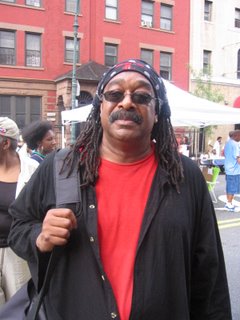
Reginald Lockett, at the Harlem Book Fair, Summer 2006
***
Chris called to ask if I'd heard Robert Rauschenberg passed away. I saw the New York Times's obituary, as well as a few others, and realized that an era had passed. He was one of those icons of post-Abstract Expressionist, pre-Pop art, a signal figure of the 1950s and 1960s, and one of the great exemplars of negative capability, an experimentalist whose wide-ranging work sometimes pushed to the very limits of the banal while often achieving something novel and remarkable. And, in the deep sense of the term, post-modern.
From his monochromes to his combines to the iconic Bed to the rubbings to works such as Rebus, he was also an important leader in cementing the centrality of American art in global art world, as well as in the queering of visual, sculptural and performance art's possibilities in the post-war American art scene, along with John Cage, Merce Cunningham, and his former partner, Jasper Johns. He kept at it until relatively recently, and passed away at his home in Captiva, Florida. RIP, Robert Rauschenberg.
***

Part of downtown North Adams, Massachusetts, with Mass MOCA in the background
The 4-3 ruling declared that the state Constitution protects a fundamental "right to marry" that extends equally to same-sex couples. It tossed a highly emotional issue into the election year while opening the way for tens of thousands of gay people to wed in California, starting as early as mid-June.
This is huge news. With a population larger than many countries and a history as a pacesetter (cf. Massachusetts as well), the California ruling, if ratified by the legislature and citizenry, may have a huge impact on the fortunes of same-sex marriage in this country. One thing I'd also note is that now that New York's highest state court has ruled that the Empire State can recognize same-sex marriages from other venues, New York could soon be full of same-sex couples as well, and Governor Paterson would probably sign same-sex marriage legislation, so....
***
I just learned that poet Reginald Lockett has just passed away. For years I only knew him based on his poem "Die Black Pervert," from his early Black Arts Days, which left a bad taste in my mouth, but I later got to know his work more broadly through Cave Canem, and even met him personally two years ago at the Harlem Book Fair.
Reading his work and his messages to the listserv, and seeing what he was up to in with his art, I came to admire him a great deal.
I'm very sorry to hear that he's no longer with us. RIP, Reginald.
Reginald Lockett, at the Harlem Book Fair, Summer 2006
***
Chris called to ask if I'd heard Robert Rauschenberg passed away. I saw the New York Times's obituary, as well as a few others, and realized that an era had passed. He was one of those icons of post-Abstract Expressionist, pre-Pop art, a signal figure of the 1950s and 1960s, and one of the great exemplars of negative capability, an experimentalist whose wide-ranging work sometimes pushed to the very limits of the banal while often achieving something novel and remarkable. And, in the deep sense of the term, post-modern.
From his monochromes to his combines to the iconic Bed to the rubbings to works such as Rebus, he was also an important leader in cementing the centrality of American art in global art world, as well as in the queering of visual, sculptural and performance art's possibilities in the post-war American art scene, along with John Cage, Merce Cunningham, and his former partner, Jasper Johns. He kept at it until relatively recently, and passed away at his home in Captiva, Florida. RIP, Robert Rauschenberg.
***
Part of downtown North Adams, Massachusetts, with Mass MOCA in the background
Wednesday, May 14, 2008
Nuruddin Farah in Evanston + Rey Andújar's Candela Is Out
 Last night, I finally got to meet and hear Nuruddin Farah (1945-, at left), one of the most important African novelists and perhaps Somalia's best known author, read from his work.
I almost had the opportunity to meet him back in 2001, when we happened to be staying at the same guest house, but my schedule didn't fully coincide with his, and so it didn't happen. Then we'd talked about bringing him to the university, and I'd even gotten his email from a former colleague, but things didn't work out. So I was elated when Reg Gibbons sent along an email to say that Farah would be in town to promote his newest novel, Knots (Penguin, 2007).
Knots, Farah's 10th novel overall, is the second book in his third, unnamed trilogy, and follows Links (2004). The previous trilogies are Variations on the Theme of An African Dictatorship, which includes the volumes Sweet and Sour Milk (1979), Sardines (1981), and Close Sesame (1983); and Blood in the Sun, which includes the remarkable Maps (1986), which was the first volume of his I'd read, Gifts (1993), and Secrets (1998). He was visiting from Cape Town, where he now lives, and he made it clear that he didn't want to discuss politics--though he was perfectly willing to--but rather the work, his work, itself.
He read a sliver from Knots, which I haven't yet perused, but I was struck by one of the first things he said, which was that the name of the protagonist, Cambara, was pronounced "Ambara," a name akin to its Arab cognate, and "amber." The C was silent. Not that I know anything about Somali or any other North African language, but a silent initial "c" did make me sit up. The section concerned Cambara's return to her family's house in Mogadishu (which he spells in the Italian fashion, Mogadiscio), which was now occupied by another family. There was enough suspense to make me want to read more, though Farah's voice and intonation had the effect of lulling me, even though the prose itself wasn't really incantatory. It was almost as if I were listening to an elder and what he was saying was less important than that I was listening. I usually don't have this experience at readings, even by elders, so I did jot it down.
In the Q&A session, people did raise questions relating to his work and life. I asked about the trilogies and how he conceptualized them, whether it was as a whole, in advance, or whether--though I didn't put it so adroitly--he produced them in a more exploratory manner. He talked about ambition, compared himself to a sprinter rather than a marathoner--though 10 novels is close to marathon level, no? He added a bit more, but again, I found his net of words casting a little spell, so I was registering less what he said than the fact that he was saying it. Some other points he made during the discussion were that he was a professional novelist, and not at academic (any more), so he was able to produce work fairly quickly; 5 months, I believe he said, for Knots. (I'd take the 5 year plan!) The only thing he needed, he added, was "time and a quiet place." What novelist doesn't? He stated that his novels were in a conversation with readers and other novels, not only from Africa, but across the globe and history. In fact, he suggested that "quietness, time and a newspaper 50 days old" would do the trick.
When asked about inspiration, he returned to the notion that his reading was broad, which led him to criticize the vast majority of American literature, which he claimed was driven by commerce. But then he raised another question, which was what from any era would last; much of what was being acclaimed now, he posited, wouldn't, and he included his own books. He then spoke about Shakespeare in relation to a call years ago for Africans to read African writers, and pointed out that Shakespeare's territory was broad, like Achebe's, Dante's, and some other writers. It went far beyond the little island the size of a "tissue" (was that the metaphor, or was it "napkin"?). True, true. Returning to inspiration, Maps, I believe he said, had been inspired by Camara Laye's The African Child--a novel I haven't read, though I have read the exquisite The Radiance of the Prince--while Links was sparked in part by George H. W. Bush's follies in Somalia, which the former president had characterized under the rubric of "doing good" and "the work of God." Well, we recall where that led...and now the US is back in Somalia, under the guise of the Ethiopian military, battling alleged Islamic militants it claims are allied to Al Qaeda.... Through the Q&QA, he was suitably resinous, or rather, he wasn't giving too much quarter, though he did answer the questions eagerly. Then he concluded the event with the opening chapter from Maps, which famously unfolds in the second person. This time I heard every word he uttered. I was glad I'd been able to make it, and afterwards, like a schoolboy, I got his autograph. I also think that between Reg, me, and several other colleagues, we'll get him to campus this time.
***
Young Dominican powerhouse writer Rey Emmanuel Andújar has sent word that his new book, Candela (Alfaguara), is now out. Here's the beautiful ad I received from him; he gave readings in Puerto Rico last week and on Monday.
A writeup of the novel is here. (According to the Cronica Digital article, the cover image below is titled "La Matinée" o "Desnudo con paraguas," by the highly regarded Puerto Rican painter Francisco Rodón. An Listín Diario interview with Andújar can be found here. (Both are in Spanish.)

Tuesday, May 13, 2008
Obama-ana + A Little Baseball
More Obama, but a different tip: fivethirtyeight's Poblano has been producing some of the most accurate polls on the primary race. It looks very close, but according to Poblano, McCain right now is beating both Obama and Clinton in the overall race and state-by-state breakdowns. With increases in the percentage of black voters, pro-Obama latino voters, or younger voters, Obama could substantially increase his chances of winning the popular vote and the electoral college vote.
***
Then there's this article, by the Washington Post's Kevin Merida, on the racist abuse some of Obama's staffers have faced when campaigning for the Senator. Are you surprised? Are you also surprised that the establishment media will hardly report on this? I thought not....
***
The Daily Howler's Bob Somerby highlights two very good articles on Obama's and Clinton's supporters, one by Post reporter Darryl Fears (who does respond to email quickly, and is very polite), and one by the New York Times's former anti-Goreist, Katherine "Kit" Q. Seelye. He also critiques the ever-deplorable Richard Cohen, about whom the less said, the better.
***
 Shifting gears again, I am following the baseball season. The Cardinals are hovering near the top of their division, with the Chicago Cubs in first place and the Houston Astros close behind. The Milwaukee Brewers have also been decent enough. This was supposed to be Chicago's year, and the Cardinals were thought to be middling at best, but the young players, clustering around the club's lone star, Albert Pujols, have proved to be more than up to the challenge of keeping pace with the Cubs. The league's other top teams, the Florida Marlins (how having shed some of their best players do they do it?) and Arizona Diamondbacks, have similar records. The beauty-laden Mets have been a real disappointment. No hitting, spotty pitching, a general lackadaisical approach to their games.
In the AL, the team I'm watching is Cleveland, whose starting pitchers have thrown shutouts in at least 1/3rd of the team's games so far. In fact, they've thrown about 32 innings so far, with big, young righty Francisco Carmona (above, AP Amy Sancetta), throwing a complete game, 5-hit, 3-0 shutout in the first game of a double header yesterday against the Toronto Blue Jays, and CC Sabathia, last year's Cy Young winner, pitches tomorrow. Boston, the Los Angeles Angels of Anaheim (when are they going to shed this tongue-freezer of a name?), and for a change, Baltimore (!) and Tampa Bay are among the best teams. The Yankees, in 4th place in their division, aren't so far off the lead, but they haven't looked like contenders at any point so far. Would Joe Torre not have at least gotten them to the same record?
Jumping back 40 years, here's a classic, the Cardinals' sublime Bob Gibson, striking out 17 batters to set a new World Series record, in the opening game of the 1968 World Series, against the Detroit Tigers (which Detroit won). That was the year Gibson posted his peerless 1.12 ERA, the lowest since the deadball era, and 13 shutouts. Watching him pitch this game, you see why; but how did he ever lose 9 games?
***
Then there's this article, by the Washington Post's Kevin Merida, on the racist abuse some of Obama's staffers have faced when campaigning for the Senator. Are you surprised? Are you also surprised that the establishment media will hardly report on this? I thought not....
***
The Daily Howler's Bob Somerby highlights two very good articles on Obama's and Clinton's supporters, one by Post reporter Darryl Fears (who does respond to email quickly, and is very polite), and one by the New York Times's former anti-Goreist, Katherine "Kit" Q. Seelye. He also critiques the ever-deplorable Richard Cohen, about whom the less said, the better.
***
Shifting gears again, I am following the baseball season. The Cardinals are hovering near the top of their division, with the Chicago Cubs in first place and the Houston Astros close behind. The Milwaukee Brewers have also been decent enough. This was supposed to be Chicago's year, and the Cardinals were thought to be middling at best, but the young players, clustering around the club's lone star, Albert Pujols, have proved to be more than up to the challenge of keeping pace with the Cubs. The league's other top teams, the Florida Marlins (how having shed some of their best players do they do it?) and Arizona Diamondbacks, have similar records. The beauty-laden Mets have been a real disappointment. No hitting, spotty pitching, a general lackadaisical approach to their games.In the AL, the team I'm watching is Cleveland, whose starting pitchers have thrown shutouts in at least 1/3rd of the team's games so far. In fact, they've thrown about 32 innings so far, with big, young righty Francisco Carmona (above, AP Amy Sancetta), throwing a complete game, 5-hit, 3-0 shutout in the first game of a double header yesterday against the Toronto Blue Jays, and CC Sabathia, last year's Cy Young winner, pitches tomorrow. Boston, the Los Angeles Angels of Anaheim (when are they going to shed this tongue-freezer of a name?), and for a change, Baltimore (!) and Tampa Bay are among the best teams. The Yankees, in 4th place in their division, aren't so far off the lead, but they haven't looked like contenders at any point so far. Would Joe Torre not have at least gotten them to the same record?
Jumping back 40 years, here's a classic, the Cardinals' sublime Bob Gibson, striking out 17 batters to set a new World Series record, in the opening game of the 1968 World Series, against the Detroit Tigers (which Detroit won). That was the year Gibson posted his peerless 1.12 ERA, the lowest since the deadball era, and 13 shutouts. Watching him pitch this game, you see why; but how did he ever lose 9 games?
Monday, May 12, 2008
Obamaphobia x.0 + Disasters
I haven't posted on the US presidential campaign for a while, in part because a lot of other blogs are doing so and producing some excellent commentary, and because, to the extent possible, I have tried to avoid much of the establishment media's hideous coverage of it. (There is so much to say on this account that it would take several years' entries, as Bob Somerby's The Daily Howler makes clear.)
I did have to note, however, this radioactively hateful and ignorant Op-Ed piece in today's New York Times, by a former Reagan administration official and neocon theorist named Edward Luttwak, that is akin to the sort of discourse I laid out last year in my post on Obamaphobia. In it, Luttwak insinuates that Obama is a Muslim (they will not let it go, people, they can't and won't) who has "converted" to Christianity, so he's now an apostate. As a result, the alleged positive reaction his election would receive in the Muslim world must be challenged on the bizarre grounds that in fact, as a said "apostate," he would the target of assassins following the dictates of Islamic jurisprudence, which Luttwak misreads to suggest that all who "convert" must be killed, and the killers would, again according to Luttwak's reading of Islamic law, remain unpunished. Thus, the governments of predominantly Islamic countries couldn't and wouldn't protect him, and thus he'd be worse than this president whose disastrous, ideologically laden bumbling Luttwak has praised for achieving a new Middle East.
Okay, did you get that? Luttwak states all of this without irony, humor (because when I first read it I had to check its dateline to make sure it wasn't supposed to be a late April Fool's post), or the least recognition of how offensive and hateful it all is, but I read it as yet another neocon attempt to inscribe within our public discourse--via The New York Times, no less--this viral meme and narrative that Obama is, despite all his protestations, a Muslim, exotic and alien, an exotic, unassimilable and unelectable Other, whom we should resign ourselves to as a potential murder target. Only in this case, it won't be crazy American racists trying to harm Obama; why, it'll be that undifferentiated mass of Muslims out there, according to Luttwak, who will do so. In fact, he won't be able to travel to any Muslim country as a result, which I guess will mean that he won't be able to improve things in the Muslim world as well as George Herbert Hoover W Decider has! And this from the man who wrote a blueprint for what's happened to our government these last 8 years, Coup d'État: A Practical Guide, in 1968.
On top of this vile crapola, there are the responses. Could someone tell me why it takes 17 until someone clearly states that Obama was not and has never been a Muslim? (Cf. "liberal" Maureen Dowd's own recent contribution to this genre.) I recognize that some posters may think that stating the obvious is unnecessary, but I also have a lingering feeling that more than a few people, at the back of their minds, continue to harbor this particular illusion. Not that there is anything wrong with being a Muslim, but here, the notion is being circulated and deployed with an overtly anti-Islamic, xenophobic aim. Luttwak's rather clumsy rhetorical gesture is to imply that "Muslim heritage" (?) equals being a Muslim, which would mean, broadly extrapolated, that a huge number of people of Spanish, Portuguese, and French descent, as well as anyone living in areas once ruled by Muslims (i.e., the Greeks, people of South Asia, Sephardic Jews, etc.) would also be captured in his problematic net. Only I don't think he's reasoned it this way. Because Muslim heritage means Obama's birth father, who left the faith before Obama was born...but you get the picture. I said this sort of thing was going to reappear in more outrageous forms, not merely from the GOP and its neocon annex, like Luttwak, but from the Republican-enabling ESTABLISHMENT MEDIA, and it's clear that we all need to be ready for and to challenge it.
***
Speaking of the toxic role of ideology, when combined with a natural disaster (cf. Hurricane Katrina), the situation in Burma/Myanmar is beyond tragic. In the midst of this horrific disaster, the military dictatorship there did manage to push through a vote to legitimate its power! As for the unfolding tragedy in the wake of Cyclone Nargis, how can you help?
I also heard today about the grim situation in China, whose poor, western Sichuan Province suffered a 7.8 Richter scale earthquake. So far 8,500+ people are presumed dead or injured. Beijing also suffered a tremor.
And yesterday I drove back from St. Louis, which suffered through thunderstorms for part of the weekend, but nothing like the storms and tornados that swept through southwestern Missouri, parts of Arkansas, Oklahoma, and Georgia, killed more than a dozen people.
What terrified me a little yesterday were the high winds sweeping across Interstate 55, particularly on those long stretches between the hills just across the river from St. Louis and the denser landscape outside Chicago. With no natural obstacles--no mounds, few hills, no woods, etc.--and vast acres of farmland, the wind was free to heave and shove, and my little sedan felt like it might blow off the road more than once. I also noticed much larger SUVs were also weaving and bobbing. I am a huge advocate of compressed air cars and lighter vehicles, but if they're ever going to be practical certain parts of the country, windbreaks or some other device will be necessary to prevent what could be lots of easily ditched or crushed (by semis and larger trucks) cars otherwise.
I did have to note, however, this radioactively hateful and ignorant Op-Ed piece in today's New York Times, by a former Reagan administration official and neocon theorist named Edward Luttwak, that is akin to the sort of discourse I laid out last year in my post on Obamaphobia. In it, Luttwak insinuates that Obama is a Muslim (they will not let it go, people, they can't and won't) who has "converted" to Christianity, so he's now an apostate. As a result, the alleged positive reaction his election would receive in the Muslim world must be challenged on the bizarre grounds that in fact, as a said "apostate," he would the target of assassins following the dictates of Islamic jurisprudence, which Luttwak misreads to suggest that all who "convert" must be killed, and the killers would, again according to Luttwak's reading of Islamic law, remain unpunished. Thus, the governments of predominantly Islamic countries couldn't and wouldn't protect him, and thus he'd be worse than this president whose disastrous, ideologically laden bumbling Luttwak has praised for achieving a new Middle East.
Okay, did you get that? Luttwak states all of this without irony, humor (because when I first read it I had to check its dateline to make sure it wasn't supposed to be a late April Fool's post), or the least recognition of how offensive and hateful it all is, but I read it as yet another neocon attempt to inscribe within our public discourse--via The New York Times, no less--this viral meme and narrative that Obama is, despite all his protestations, a Muslim, exotic and alien, an exotic, unassimilable and unelectable Other, whom we should resign ourselves to as a potential murder target. Only in this case, it won't be crazy American racists trying to harm Obama; why, it'll be that undifferentiated mass of Muslims out there, according to Luttwak, who will do so. In fact, he won't be able to travel to any Muslim country as a result, which I guess will mean that he won't be able to improve things in the Muslim world as well as George Herbert Hoover W Decider has! And this from the man who wrote a blueprint for what's happened to our government these last 8 years, Coup d'État: A Practical Guide, in 1968.
On top of this vile crapola, there are the responses. Could someone tell me why it takes 17 until someone clearly states that Obama was not and has never been a Muslim? (Cf. "liberal" Maureen Dowd's own recent contribution to this genre.) I recognize that some posters may think that stating the obvious is unnecessary, but I also have a lingering feeling that more than a few people, at the back of their minds, continue to harbor this particular illusion. Not that there is anything wrong with being a Muslim, but here, the notion is being circulated and deployed with an overtly anti-Islamic, xenophobic aim. Luttwak's rather clumsy rhetorical gesture is to imply that "Muslim heritage" (?) equals being a Muslim, which would mean, broadly extrapolated, that a huge number of people of Spanish, Portuguese, and French descent, as well as anyone living in areas once ruled by Muslims (i.e., the Greeks, people of South Asia, Sephardic Jews, etc.) would also be captured in his problematic net. Only I don't think he's reasoned it this way. Because Muslim heritage means Obama's birth father, who left the faith before Obama was born...but you get the picture. I said this sort of thing was going to reappear in more outrageous forms, not merely from the GOP and its neocon annex, like Luttwak, but from the Republican-enabling ESTABLISHMENT MEDIA, and it's clear that we all need to be ready for and to challenge it.
***
Speaking of the toxic role of ideology, when combined with a natural disaster (cf. Hurricane Katrina), the situation in Burma/Myanmar is beyond tragic. In the midst of this horrific disaster, the military dictatorship there did manage to push through a vote to legitimate its power! As for the unfolding tragedy in the wake of Cyclone Nargis, how can you help?
I also heard today about the grim situation in China, whose poor, western Sichuan Province suffered a 7.8 Richter scale earthquake. So far 8,500+ people are presumed dead or injured. Beijing also suffered a tremor.
And yesterday I drove back from St. Louis, which suffered through thunderstorms for part of the weekend, but nothing like the storms and tornados that swept through southwestern Missouri, parts of Arkansas, Oklahoma, and Georgia, killed more than a dozen people.
What terrified me a little yesterday were the high winds sweeping across Interstate 55, particularly on those long stretches between the hills just across the river from St. Louis and the denser landscape outside Chicago. With no natural obstacles--no mounds, few hills, no woods, etc.--and vast acres of farmland, the wind was free to heave and shove, and my little sedan felt like it might blow off the road more than once. I also noticed much larger SUVs were also weaving and bobbing. I am a huge advocate of compressed air cars and lighter vehicles, but if they're ever going to be practical certain parts of the country, windbreaks or some other device will be necessary to prevent what could be lots of easily ditched or crushed (by semis and larger trucks) cars otherwise.
Saturday, May 10, 2008
Emerging from the Canyons
More than a week has passed since I've last posted, so I thought I'd try a short entry here so that half of May didn't disappear before I returned to this page. Mostly it's been work--so much to read that I can't really focus on anything else, reading for all sorts of university-related student theses and final projects, programs, deadlines, etc., on top of which there's the lecture course, which, thankfully, spares me the necessity of reading the primary works (though rereading's required), but secondary critical texts are a necessity for those works (like Willa Cather's stories or Robert Lowell's poems, for example) for which I have not previously focused in my teaching or own critical work. Right now, I'm sitting at my mother's kitchen table, with nearly 20 stories to read through carefully for another required responsibility, and will get 20 more when I return to campus on Monday. I wish I could muster the mental agility to slip between these cordilleras of required reading and things like blogging, but I've found, at least of this past fall, when the mountains of work just kept rising like a volcanic cloud, that I couldn't. Well, summer will be here soon--my own work, and this blog, will see a bit more of me as a result.
***
One of the students who recently found the blog asked me if I was in New Jersey last week because of my post about the Princeton concert. I wasn't--I've been in Chicago (and this weekend, St. Louis) almost continuously for over a month now--but I did have the opportunity to hear the concert online, and here's what I wrote to Audiologo, whose pieces were superlative. (From my judging, and I'm not just being enthusiastic and celebratory.) I wrote about them:
***
One of the students who recently found the blog asked me if I was in New Jersey last week because of my post about the Princeton concert. I wasn't--I've been in Chicago (and this weekend, St. Louis) almost continuously for over a month now--but I did have the opportunity to hear the concert online, and here's what I wrote to Audiologo, whose pieces were superlative. (From my judging, and I'm not just being enthusiastic and celebratory.) I wrote about them:
I listened to the concert via streaming audio! It was so much fun to do so. I was trying to figure out whose pieces were which, since I must have missed the introduction, but the first piece sounded like a dance track [Timbaland Symphony, a mash up of various Timbaland produced cuts with Beethoven's 9th Symphony, which was a response to DJ Dangermouse]; the second a fairly straightforward performance of a classical instrumental score or a new score written in that format [Ravel's Sonatine (which was played marvelously by Francine Kay, also was the pianist on my piece) and you just got Andrea Mazzariello's fall down five times, get up six]; the third a duet (or were there more instruments?) involving a piano and cello (?), again fairly traditional [Shostakovich's Op. 20 piano trio and you only heard Anne Hege's Bedridden Fantasies]; and then I heard the final series of pieces Schubert's Der Doppelgänger], one of which included a performance of "Mary Mac," and then Aurora Micu singing "You are most beautiful," over the piano accompaniment and some electronic background material! Did I get this order correct? I also heard lots of talking between the first two main pieces and the latter two, so I kept hoping that someone would announce the pieces, but I really guessed I missed the intro. It was altogether really exciting, and your piece--and I'm not just saying this because I know you--struck me as the most inventive, daring and beautiful, especially when I considered what you took as your starting point. With the earlier instrumental pieces, I guess I was hoping to hear something more...complex? Something that synthesized some of the many 20th and 21st century strands of composition, non-electronic and electronic/digital. The first one did do this, of course, but yours felt especially fresh and engaging.(Clarifications courtesy of Audiologo.) So I wasn't there in body, but virtually....
Dreaming on the transverse
              retinas of our discourse
we transcribe through signs towards
              the echoes of their singing...
Thursday, May 01, 2008
Events Tonight
If you're in or around Princeton, check out Audiologo's event, which will be accessible via the Net as well:
And if you're in New York City, from Khalil Jibade-Huffman:
• Thursday, May 1, 2008 •
Uncovering What Is Brave: 2008 Generals Concert
Taplin Auditorium
Fine Hall
Princeton University
Princeton, NJ
8:00pm (live recording; seating until 8pm and during intermission only)
You Are Most Beautiful When... my live performance piece for the Composition Program's General Exams Concert. This concert promises to be a quite exciting affair, with each of us taking risks, and pushing forward our creativity with new works from my compatriot Graduate Fellows in Composition, Mark Dancigers, Anne Hege, and Andrea Mazzariello (as well as myself). Each of us has written work in response to a particular composer's work. My piece is a response to Der Doppelgänger by Austrian composer Franz Schubert (1797-1828) as performed by legendary contralto Marian Anderson and her long-time accompanist, pianist Franz Rupp. The theme of my response is gratitude, creative collaboration, and friendship, and features the "distinctive, rich, and compelling" voice of soprano Aurora Micu (replacing Boston Fielder), and the "...magical, something to celebrate..." pianist Francine Kay, along with other special virtual guests, and my first experimentation with a traditional libretto!
This is the second requirement of my 4-part General Exam. I hope to see you there!
For Directions to Princeton and information about parking (no campus parking permits required after 5pm, and meters are free after 7pm) and trains (NJTransit) check this link: visiting_the_campus
**Streaming Audio**
If you can't make it in person, you can access a streaming audio link via the main page of Music Department website: the link will become active on May 1st @ 8pm.
Performance order:
Mark Dancigers
Andrea Mazzariello
Anne Hege
MR Daniel
And if you're in New York City, from Khalil Jibade-Huffman:
(in conjunction with Xaviera Simmons' installation
for HOMEBASE III
[17 international artists transform a historical townhouse in Harlem
with site-specific artwork addressing the notion of Home]).
"Writing Home:
an evening with
Tisa Bryant and Christopher Stackhouse"
curated by Jibade-Khalil Huffman
Thursday, May 1st
7pm
764 St. Nicholas Ave. @ 148th St.
Harlem, New York
(A (express!),C,B, or D to 147th St. exit)
Project Homebase
Monday, April 28, 2008
Poem: Claudia Rankine
 I've highlighted her books before, but I don't think I've ever posted a poem by Claudia Rankine, so let's get this lovefest started right! I think she's producing some of the most fascinating and distinctive poetry--or work in and around that particular signifier--out there today, and her last book, Don't Let Me Be Lonely, was one of those books I carted around me with me for months, reading in it snippets of amazement at what she's achieved. (I did the same with Plot, which became one of my constant companions for months in Providence.) I haven't yet taught it because I haven't had the opportunity to do so, but one of these days, one of these days. (And then there's the eternal dream, of bringing so many of the poets I know and admire to the university....)
I thought of typing out one of the poems from Rankine's most recent book, but then I found the following poem on the Dia Center for the Arts's old poetry site, which occasioned a moment of nostalgia before I decide to copy the poem over here. (I do recommend folks head up to Beacon if they get the chance, because the town itself is a gem, but the disappearance of the old Dia sites in Soho and Chelsea, and that incomparable poetry series, with Brigde Mullins's grand introductions and the readers' sometimes complementary, sometimes clashing performances, will never be matched again.) Plot is, among other things, a book about assemblage, about the construction of lives, of domesticity, of subjectivity and interiorities, within a lyric--and one could say a narrative--field. Or a plot. The follow poem, then, enacts this idea.
THE ROOM IS A FOUNTAIN IN EXPERIENCE

Though a previousness, cushioned by dark, aggregates the room
(for there is no disparity),

a room is brought into existence, the activity of--

Here Liv is letting herself feel as she feels, her will yielding to
streams, the lyric field of her everyday depths.

Her presence is. It's come along, is lost, is loss, is wallside
reconciling: can I love now please?

Or in inclusion she bursts into a hood of tenderness: the body's
anguish and flesh and all reflected in the absorbed atmosphere
soaking her being,

then the self feels deeper the depicted insistence engaged, its
essential nest, its scape--

And always and each contiguous thought, approaching the
distance, augments. Viewed against, the mind reshapes and here
is refuge without its tent.

All that's resolved plots against her dividing self, binding her as
if any intervening space is recess for

her grave, an equivalence overlaying presence. Can I love now
please?
Copyright © Claudia Rankine, from Plot, New York: Grove Press, 2001.
Sunday, April 27, 2008
Thoughts + Poem: Claude McKay
 Just some incoherent and incomplete thoughts: two days later, and I still don't have words to talk about the horrific Sean Bell verdict; not that I didn't think it would turn out this way, because when it comes down to a judge issuing a verdict about an unwarranted and insane police attack on Black men or people of color or poor folks, my first thought is that the judge, as this one did, is going to side with the cops. They usually do. That doesn't make it any easier, though.
I've been at a loss for words about this verdict and the long history, a litany, of miscarriages of justice, the injustice and anti-justice, against Black people in this country, against people of color, against women, against sexual, ethnic and religious minorities, against working-class and poor folks, about the structural impediments to change, the ways that the people in power maintain their power through various forms of violence and oppression, and make it diffuse, naturalize it, discursively and materially, how they attempt to and often succeed in industrializing our consciousnesses to accept it, to expect it, to participate in it, in part through silence...
Friday night I listened to Jeremiah Wright on Bill Moyers's PBS show Now, having to defend himself against the smears and distortions the Right Wing and establishment media have been propagating, to destroy the presidential candidacy of Barack Obama, the electoral chances of the Democratic Party, and Black religious faith and traditions in general. I haven't been able to post since as a result, and even now, I really don't even have a free second to catch up with the missed posts, a number of which are still in half-finished form. (The school year's end is still more than a month away....)
So here's one poem by Claude McKay, about the kind of violence from an earlier period in our national history that just keeps playing out in different forms (50+ bullets vs. a noose on a tree limb or post), despite the many changes, which still are too few....
If you'd like information on the Sean Bell case from those seeking justice on his behalf, consider going to Justice for Sean.
Update: Here's Bernie's much more articulate take.
The Lynching

His Spirit in smoke ascended to high heaven.
His father, by the cruelest way of pain,
Had bidden him to his bosom once again;
The awful sin remained still unforgiven.
All night a bright and solitary star
(Perchance the one that ever guided him,
Yet gave him up at last to Fate's wild whim)
Hung pitifully o'er the swinging char.
Day dawned, and soon the mixed crowds came to view
The ghastly body swaying in the sun
The women thronged to look, but never a one
Showed sorrow in her eyes of steely blue;
And little lads, lynchers that were to be,
Danced round the dreadful thing in fiendish glee.
Copyright © Estate of Claude McKay, 2008.
Thursday, April 24, 2008
Poem: Augusto de Campos
 (Completed post.) I would remiss if I didn't include some other kinds of poetry, especially of the sort I admire and have learned a great deal from. One poet whose work I admired and took a pointer from is Augusto de Campos (1931-), one of Brazil's major 20th poets, and one of the international pioneers in the genre of concrete poetry (poesia concreta). With his brother Haroldo de Campos (1922-2003) and others, he launched the literary journal Noigandres, which marked the beginning of the Brazilian contribution to concrete poetry. He has since gone on to create works in a variety of media, including online forms, and has also translated numerous other writers, published a number of critical essays on his and others' works and aesthetics, and also written on music. In fact, his earliest concrete poems were inspired by the Second Viennese school composer Anton Webern.
One of the best online places to check out de Campos's work is on his UOL website, which is only in Portuguese (except for those works, like the early poem "lygia fingers," which is multilingual), but because of the poetry's graphic style and beauty, you can admire them even if you don't speak the language, and you can even hear him read some of them (but you'll need Windows Media).
Below's his 1975 poem "o pulsar," from UbuWeb's historical archive. The common Portuguese vowels "o" and "e" flicker out as dots and stars, leaving only the pulsing of consonants and other vowels, a metaphorical pulsar likened to a kiss that no sun heats up (abraço que nenhum sol aquece) and which the black hole hides (e oco oscuro esquece). You could also read it as pulsations recording a morse-like code with this same idea; in either case, "pulsar" can be both a noun (a pulsar, a pulsation) and a verb (to pulse, pulsate, throb)...

Wednesday, April 23, 2008
Poem: Robert Lowell
 Another poet we'll be looking at next week is Robert Lowell (1917-1977). When I was in junior high and high school in the 1980s, Lowell was still considered one of the most important poets of the era, though I'm not so sure that's the case these days; his presence and influence, as a versifier, as a teacher and mentor, and as a public poet and figure, were all still fresh, and his linguistic and lyric fluency, his personal and public aesthetic transformations, his larger-than-life personae and voice were all invoked by my teachers as models of what an American poet might be.
We read "For the Union Dead," of course, one of his greatest poems, and "Skunk Hour," and a a number of his other poems, and we talked about "confessional poetry," which was then somehow still controversial, rather than normative and passé--does anyone even blink an eye these days when poets put all their business on the page or screen, and thus in the (virtual) street?--though Lowell had been angling at confessionalism from the very beginning, with his family, one of the most prominent in New England and 19th century America, as his starting point. By the 1990s, though, Lowell's multiple marriages and lifelong nuttiness were the story, rather than the poetry. I sometimes wonder if he's taught or discussed as he once was. (When I suggested adding him to my syllabus, one friend, a scholar, seemed a bit chary.) One of my senior colleagues did tell me that in a graduate course on 19th and 20th century American poetry she recently taught, Lowell (like Gwendolyn Brooks and Elizabeth Bishop) was one of the post-WW II poets she looked at (the others were Allen Ginsberg and John Ashbery); is this the case elsewhere?
One of the poems we'll be looking at is one of my favorites by Lowell, from Life Studies, which captures his voice public stance and voice so perfectly, "Memories of West Street and Lepke." The poem recounts his reflection, from the vantage point of the 1950s in Boston, of the year he spent as a conscientious objector in a New York jail. Every beat and every image in the poem carries the charge of irony, of the deflation of middle age and unsettled retrospection that would blossom some years later in the even more candid lyrics of The Dolphin and similar books. (Of course there were certain things he would never confess, such as the fact that one of his most outrageous episodes of madness, at Yaddo, might have been provoked in part by his sleeping with a notable Black Chicago painter, Charles Sebree.)
I also think of Lowell's letters to Elizabeth Bishop (tomorrow!), which I taught several years ago in another class, and how dismissive and horrified he was of the "passionate" young poets Allen Ginsberg and Gregory Corso, who paid a visit to his Boston home--they were, in their teeming filthiness and enthusiasm a bit much, a connection that could not fully occur, for the always-to-the-end haut bourgeois Brahmin. Now, the poem:
Memories of West Street and Lepke

 Only teaching on Tuesdays, book-worming
in pajamas fresh from the washer each morning,
I hog a whole house on Boston's
"hardly passionate Marlborough Street,"
where even the man
scavenging filth in the back alley trash cans,
has two children, a beach wagon, a helpmate,
and is "a young Republican."
I have a nine months' daughter,
young enough to be my granddaughter.
Like the sun she rises in her flame-flamingo infants' wear.

These are the tranquilized Fifties,
and I am forty. Ought I to regret my seedtime?
I was a fire-breathing Catholic C.O.,
and made my manic statement,
telling off the state and president, and then
sat waiting sentence in the bull pen
beside a negro boy with curlicues
of marijuana in his hair.

Given a year,
I walked on the roof of the West Street Jail, a short
enclosure like my school soccer court,
and saw the Hudson River once a day
through sooty clothesline entanglements
and bleaching khaki tenements.
Strolling, I yammered metaphysics with Abramowitz,
a jaundice-yellow ("it's really tan")
and fly-weight pacifist,
so vegetarian,
he wore rope shoes and preferred fallen fruit.
He tried to convert Bioff and Brown,
the Hollywood pimps, to his diet.
Hairy, muscular, suburban,
wearing chocolate double-breasted suits,
they blew their tops and beat him black and blue.

I was so out of things, I'd never heard
of the Jehovah's Witnesses.
"Are you a C.O.?" I asked a fellow jailbird.
"No," he answered, "I'm a J.W."
He taught me the "hospital tuck,"
and pointed out the T-shirted back
of Murder Incorporated's Czar Lepke,
there piling towels on a rack,
or dawdling off to his little segregated cell full
of things forbidden to the common man:
a portable radio, a dresser, two toy American
flags tied together with a ribbon of Easter palm.
Flabby, bald, lobotomized,
he drifted in a sheepish calm,
where no agonizing reappraisal
jarred his concentration on the electric chair
hanging like an oasis in his air
of lost connections....
Copyright © Robert Lowell, 1959. All rights reserved.
Tuesday, April 22, 2008
Poem: Gwendolyn Brooks
 After a week and a half of fiction, we're back to poetry in my American literature class, and one of the poets we're reading next week is the one and only Gwendolyn Brooks (1917-2000; how could I not introduce students to her work?), so I thought I'd post one of the poems we'll be looking at is "downtown vaudeville," from Annie Allen, one of her marvelous collections and the first work by an African-American author to win the Pulitzer Prize.
Though I never forget how important she is and these poems are, and though I love to return to them for pleasure, I sometimes forget how radical they are, how sharp amd piquant Brooks's critiques, how rich and variegated her portraits of post-war black and white Chicago, wrapped as they are in traditional verse forms and prosody that, as in the case of one of my favorite poems in the book, "They love the little booths at Benvenuti's," are also charged with the cross-beats of jazz and soul. (Just read that poem aloud or listen to Brooks read it, and you'll get my drift.) Reggie H. posted it some months back when Bill O'Reilly spouted off about how the Negroes up in Harlem were actually civilized, proving how prescient Brooks was and how ignorant O'Reilly...well, I don't need to finish that thought.
Brooks gave one of the best poetry readings I attended, at the first Furious Flower Conference, which took place at James Madison University in Harrisonburg, Virginia. She read with Rita Dove, who I believe either was still the Poet Laureate (one of the best we've had) or had just stepped down from the post. The hall was packed, and Rita gave a marvelous reading, as she always does. And then Brooks came on, and read some of her best known poems, including "we real cool," which, if you've ever heard her read it, differs from how most readers think it sounds. She brought the house down. I only wish I'd had the chance to meet her and get to know her personally!
At any rate: downtown vaudeville....
downtown vaudeville


What was not pleasant was the hush that coughed
When the Negro clown came on the stage and doffed
His broken hat.  The hush, first.  Then the soft

Concatenation of delight and lift,
And loud.  The decked dismissal of his gift,
The sugared hoot and hauteur.  Then, the rift

Where is magnificent, and heirloom, and deft
Leer at a Negro to the right, or left--
So joined to personal bleach, and so bereft:

Finding if that is locked, is blowed, or proud.
And what that is at all, spotting the crowd.
Copyright © Gwendolyn Brooks, 1949. All rights reserved.
Monday, April 21, 2008
RIP Toni Brown
 Earlier today I saw the very sad news that Toni Brown (1952-2008), a sparkling poet who was a Cave Canem fellow with me in Esopus in 1998, just passed away. She had a ready laugh and smile, was as genuine and warm as your good friend, and could write her dreads off.
Reggie H. has a loving little tribute up to Toni at the Noctuary, so please drop by there if you can. It features links, a poem excerpt and photos, one of which I'm borrowing here.
Catching Up + Poem: Loren Goodman
I am trying to get back to posting, . The past two weeks have brought the usual saltmine's worth of work, projects, duties, and so forth, but things are going a lot more smoothly than last fall. First, the huge lecture class is turning out to be considerably more enjoyable than I imagined. The TAs are terrific, and the students are responding to the readings with what I register as real enthusiasm (and some bafflement, but we're talking about pre-Modernism and Modernism so far), they answer questions in class and sections, and pose good ones of their own. Some even chat after class about topics of interest or queries they have about my in-class lectures, so I know they're connecting with what's going on. And today, it appeared that nearly all of them submitted their first papers on time. So although the class is a lot of work and I am still waking up an hour before the alarm goes off, I am really enjoying it.
This morning I awoke with the pangs of what I recognized were kidney stones, which tormented me tremendously in the past, most recently in late 2001 and early 2002. In fact, I once rode back from Providence to New York City in extreme agony, barely able to sit down or stand, because I was passing a stone, which is one of the worst feelings I've ever experienced and, from what I can tell anecdotally, ranks high up there on the pain scale. This little bout seems to be under control, but I'm trying to manage it by following a specialist's recommendation from several years ago: drink lots of water, and especially lemon-water, and make sure I get enough calcium (ironically). I do wish I knew what caused them.
This weekend, however, was wonderful. C was in town, and on Friday we attended my cousin's wedding here in Chicago. She'd beautifully planned out every aspect of the ceremony, which was a joy to witness. Congratulations Raquel and Walter!

 On Saturday, I attended the 17th Annual African American and Latino(a) Adult Education Research Symposium at Northeastern Illinois University, to participate on a panel organized by one of the graduate students I've worked with, author Wendy Musto. The panel also included playwright, author and activist Judy Veramendi. We discussed Wendy's short story "El Cruce" (The Crossing), which depicts the passage across the Rio Grande of an anxiety-ridden, undocumented Mexican migrant and his young family. At right is a photo from before the event that C took. Wendy's on the right.
I'd never met Judy before, though I'd heard of her work--she has a highly regarded play, The Empty Chalices, that was staged in Chicago and other cities several years ago--and it was a real pleasure to engage with the audience around Wendy's story and the larger issue of immigration.
I also replaced my old laptop, my iBookG4, because the screen was starting to fail. I didn't think I would get so attached to a piece of electronic hardware, but that little computer was a mainstay for several years. The new one, however, also a Mac, is quickly winning me over.
But on to poetry:
 A poet whose first book I found incredibly charming was Loren Goodman. I can't recall how I came across it, but Famous Americans, one of the funner and more playful books of poetry you'll find out there, was selected by W.S. Merwin as the 2003 winner of the Yale Younger Poets' Prize. Some of Goodman's poems are like extended experiments, while others perhaps work best as conceptual projects, but throughout all there's a ludic quality that I think he captures in the following brief poems, "Ambition" and "Yeast." So take it away, Loren Goodman!
AMBITION
and
YEAST
Copyright © Loren Goodman, from Famous Americans, Yale, 2003. All rights reserved.
This morning I awoke with the pangs of what I recognized were kidney stones, which tormented me tremendously in the past, most recently in late 2001 and early 2002. In fact, I once rode back from Providence to New York City in extreme agony, barely able to sit down or stand, because I was passing a stone, which is one of the worst feelings I've ever experienced and, from what I can tell anecdotally, ranks high up there on the pain scale. This little bout seems to be under control, but I'm trying to manage it by following a specialist's recommendation from several years ago: drink lots of water, and especially lemon-water, and make sure I get enough calcium (ironically). I do wish I knew what caused them.
This weekend, however, was wonderful. C was in town, and on Friday we attended my cousin's wedding here in Chicago. She'd beautifully planned out every aspect of the ceremony, which was a joy to witness. Congratulations Raquel and Walter!
 On Saturday, I attended the 17th Annual African American and Latino(a) Adult Education Research Symposium at Northeastern Illinois University, to participate on a panel organized by one of the graduate students I've worked with, author Wendy Musto. The panel also included playwright, author and activist Judy Veramendi. We discussed Wendy's short story "El Cruce" (The Crossing), which depicts the passage across the Rio Grande of an anxiety-ridden, undocumented Mexican migrant and his young family. At right is a photo from before the event that C took. Wendy's on the right.
I'd never met Judy before, though I'd heard of her work--she has a highly regarded play, The Empty Chalices, that was staged in Chicago and other cities several years ago--and it was a real pleasure to engage with the audience around Wendy's story and the larger issue of immigration.
I also replaced my old laptop, my iBookG4, because the screen was starting to fail. I didn't think I would get so attached to a piece of electronic hardware, but that little computer was a mainstay for several years. The new one, however, also a Mac, is quickly winning me over.
But on to poetry:
A poet whose first book I found incredibly charming was Loren Goodman. I can't recall how I came across it, but Famous Americans, one of the funner and more playful books of poetry you'll find out there, was selected by W.S. Merwin as the 2003 winner of the Yale Younger Poets' Prize. Some of Goodman's poems are like extended experiments, while others perhaps work best as conceptual projects, but throughout all there's a ludic quality that I think he captures in the following brief poems, "Ambition" and "Yeast." So take it away, Loren Goodman!AMBITION
When music moves away
  from dance, atrophy sets in

When poetry moves away
  from music, atrophy sets in

I want one of those
  trophies
and
YEAST
I am Yeast, a great poet
I live in Ireland
Some say I am the greatest
Poet ever

My poetry makes bread grow
All over Ireland and the world
In glens and valleys, bread rising
In huts, clover paths, and fire wood

There will always be critics
Who deny Yeast
But you can see
The effect of my poetry
Through the potato fields
And the swell of the Liffey.
The amber coins and foaming black ale
Copyright © Loren Goodman, from Famous Americans, Yale, 2003. All rights reserved.
Sunday, April 20, 2008
Poems: Gertrude Stein
 (One of the posts I couldn't post at first.) One of the first poets we looked at this quarter is one of my favorites, and her work remains as revolutionary today as it was when she was publishing. You know whom I'm talking about, right?
Gertrude Stein (1874-1946)!
The one and only. I won't recap my lecture, but let it suffice for me to say that the strangeness and difficulty of her work--and its exciting beauty--isn't lost on the students. I'd heard of Stein growing up, but it wasn't until I took a class--conned my way into it, to tell the truth--with Joel Porte that I encounted Tender Buttons, which worked like a charm on me. I couldn't put the book down. Now it's online, so everyone can enjoy it. I'll just say that when I read the first piece aloud to the students, I suggested that they substitute common words they knew for words that sounded like some of the words in the poem, and then see what they came up with. I think that was as useful as my larger discussion about how her work and vision related to and was in conversation with Cubism, how it deployed some of the ideas of William James, her teacher at Radcliffe, how it elevated the objects and elements of the domestic world to the realm of poetry, how she focused on the prosaic with her x-ray like vision, rethought and destabilized the patriarchal language and lyric that was her and every other poet of her era's inheritance, and so on.... But I also stressed the idea that we should luxuriate in the language itself, in the sensuous and delightful play of phonemes, and enjoy meanings and associations the words, the rhythms, the syntax, the concatenation of sounds and images produced.
About 2-3 years ago, a fellow poet asked why anyone would read Stein. I was a little taken aback, but tried to lay out some thoughts about why Stein is still so important. One could trace several different geneologies from her work, not only in poetry, but in prose, drama, nonfiction, performance, and so on, which would stack the decks in any argument for her importance, but I talked specifically about Tender Buttons, which prefigures so much of what was to come later by half a decade....
And so, two selections from Tender Buttons:'s first section, "Objects":
A CARAFE, THAT IS A BLIND GLASS.

A kind in glass and a cousin, a spectacle and nothing strange a single hurt color and an arrangement
in a system to pointing. All this and not ordinary, not unordered in not resembling. The difference
is spreading.
and
A BOX.

Out of kindness comes redness and out of rudeness comes rapid
same question, out of an eye comes research, out of selection
comes painful cattle. So then the order is that a white way of being
round is something suggesting a pin and is it disappointing, it is not,
it is so rudimentary to be analysed and see a fine substance strangely,
it is so earnest to have a green point not to red but to point again.
Subscribe to:
Posts (Atom)