Showing posts with label work. Show all posts

Saturday, February 26, 2022

17th Blogiversary

Somehow, some way, I've made it to 17 years on here. Barely. As post tallies from the last several--7 especially--years have demonstrated, my blogging has dwindled almost to nil, but this period has coincided first with my increasing university workload--I have been a department chair or acting chair now for roughly 8 years, among all of my other duties--alongside all the life itself, so blogging has taken a back seat to all else. 

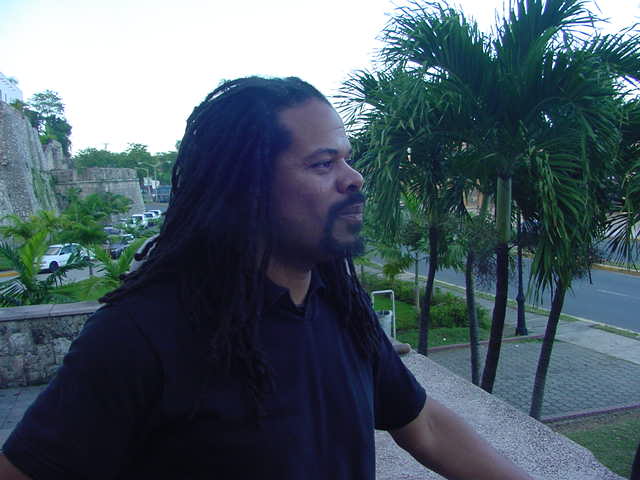
From 2005 or so, during a trip to DR

When I think back on those early years, which were certainly quite full with teaching, mentoring, writing, some administration, and commuting (between New Jersey and Chicago, for ten straight years!), I fill with amazement that I blogged as frequently as I did. There were, of course, days I missed, but I believe I set for myself the task--the regimen?--of blogging at least one thing every day, with my focus on arts and culture of all kinds (and politics less so because there were, I felt, already so many great political bloggers at the time). It was another form of work, but a labor, unremunerated financially at least, but spiritually and socially to a great degree, of love.

Sometimes what emerged were just announcements for events, but other days produced reviews, translations, reportage, basic documentation, my random street photos, and so on, but it has constituted a (partial) record of my life during those years. I also think of the people I was in contact with, especially early on; the community of bloggers, some friends, some acquaintances, some of them people I'd never met in person and still haven't met in person, but whom I was--and still feel, however ghostly the links today, I am still--in dialogue with, I learned and learn from, I collaborated with, and whose influence I continue to feel, in various ways. I do miss that blogging community, those blogging communities, bloggers, readers, commenters, all--what a time that was!

In recent years I have blogged very infrequently and mostly about my own work, if at all, but I do hope to find the time to blog a bit more, and to find new possibilities for this medium, especially as the net is increasingly a walled off, highly monetized and specialized world, with entire platforms in which words in particular are a second thought. So to blogging, and the future, and I hope to make it to 20 years, and more!

Monday, May 02, 2011

Poetry for Labor Event

Many, many thanks to everyone who came out to the Poetry for Labor reading and commemoration on Sunday, which was International Labor Day / May Day. As I noted in my original flyer, this year marked the 125th anniversary of the Haymarket Square Affair, one of the signal events in US and global labor history, which occurred in Chicago right near the site where we met to read and remember. As I noted in my brief and informal remarks that opened the event, the lives of the striking workers who were killed, the policemen who also died, and the accused bombers who were later hanged or murdered were not in vain. The incident and its aftermath led to many things we take for granted today, including the eight-hour workday, and helped to spark the union movement in this country and all over the globe.  As we find ourselves in another precarious moment in terms of labor and labor relations, with unions specifically under fire, an unemployment rate officially at 8.8% but higher and very high underemployment, and a skewed economic system that is rewarding a very few at the expense of billions of people, it's crucial that we not forget events like the Haymarket Square Affair, that we take time out to commemorate those who fought for what we have, and that we continue to fight for our own rights and for those who'll follow us.

I want to offer especial thanks to Jen Karmin and Laura Goldstein, who read, spoke, brought their incredible presences and commitments to the event, and to their affiliated organizations, the Red Rover Series and the Chicago Durutti Skool, who consponsored the event and put the word out about it.  Many thanks also to my partner C, whose support was invaluable, and whom I even convinced to read a poem (by Frank O'Hara: "A Step Away from Them," no less!), and to my cousin Raquel Stallworth and her husband Walter, who came out to show support. Raquel spoke eloquently about her experiences with the contemporary labor market, making personal, as Jen and Laura did, what can sometimes be discussed in abstractions (and thus, as too often happens in our corporate media, dismissed altogether or sensationalized).  Among the writers we read were Muriel Rukeyser, Charles Reznikoff, Rita Dove, Elizabeth Alexander, Carl Sandburg, Joy Harjo, John Ashbery, Martín Espada, Mark Nowak, and William Blake, and we read poetry and prose.  We talked about poetry as labor, the role of metaphor in the way those in power structure our society and capitalism's systems and how what operates in poetry might offer ways of understanding things better, working-class roots and ancestors, and so much more.

It was particularly encouraging to see that among the first people who arrived at the event were tourists from Norway, and a executive trainee (!) from the Basque country (as he put it) in Spain. Both had learned about the event online, and were determined to pay tribute to the site and to hear poetry. And they did stay and listen, which was wonderful.  We also had a sizable contingent of cyclists who, it turns out, were not only gathering at the Haymarket Memorial Sculpture to begin their tour of major local labor sites, but who also wanted to hear poetry. Rick B., one of the cyclists, also offered a brief and thorough recounting of the Haymarket Square Affair events, pointing out that the alley from which the bomb was thrown was still there, just behind us.

Below are some photos from the event. Many thanks again to C, who snapped some great ones!

The new plaque
The new plaque, dedicated April 30, 2011
Reading at *Poetry for Labor*
During the reading
The visitors from Norway & C
The visitors from Norway (they were there at 8:30 am!) and C
Haymarket Memorial Sculpture
The Haymarket Memoria Sculpture, with our set up
Jen Karmin reading
Jen preparing to read
Laura Goldstein reading
Laura reading Muriel Rukeyser's work
C reading Frank O'Hara's "A Step Away from Them"
C reading
A poet & union member speaking
A poet and union member speaking
Rick B. of the cyclers' group speaking
Rick B. of the cyclists' group
Me reading @ *Poetry for Labor*
Me reading

Friday, April 03, 2009

Poem: Philip Levine

Philip LevineThe news on the unemployment front, like a great deal of what we read and see on TV, has been growing grimmer by the day, and the social conditions behind it are certainly grimmer still. Several people I know well, friends and relatives, have lost their jobs, and others are struggling to make ends meet. Alongside the weak job market, other signs of the economy's sickness are evident everywhere: plummeting home values and rising foreclosures; the appearance of Bushvilles; the collapse of the commercial real estate market; personal bankruptcies resulting from people's inability to pay debts; and on and on. These are only a portion of of the social crisis the country faces, and conditions are as bad or worse overseas. We're officially at 8.9% unemployment, though the reality is probably far worse, which is the worst things have been since the recessionary period around 1983. That was the year I graduated from high school, and one of the reasons I'm able to look back on that period without nostalgia is because, despite my fond memories of particular aspects of being 17 and 18 years old, my perception of the national situation was clear-eyed. In case you don't recall, in 1983 the ur-right winger, Ronald Reagan, was in office; a claque of extreme conservatives were frothing in their new government positions; the Cold War still raged; the AIDS pandemic was steadily increasing, with little attention for the federal government; the crack epidemic was picking up steam, and the concomitant drug war and buildup of the penal system were underway; the US was meddling in a war in Iraq (against Iran, no less, while secretly funneling money from Iran to right-wingers in Central America); and on and on. While I, though penniless and the child of a working-class background, was heading off to college and what I hoped would be a decent future, I was quite aware that things were terrible for others. The lack of jobs, particular for the poor and working-class, for black people, for Latinos, for undereducated whites, was a pressing national concern, which the GOP exploited brilliantly. It would be 10 more years and another recession (along with a young and conservative Democratic president) before the country really turned around. I hope it does not take that long this time, though the underlying conditions do appear to be worse than they were in 1983, or 1993.

That said, I've been thinking about poems dealing with work and labor, and in particular poems I have not posted before (thus excluding "Those Winter Sundays") and one came immediately to mind: Philip Levine's "What Work Is." I first came across this poem when I heard Levine read it on public radio; I believe this was after the eponymous collection had won the National Book Award. That would have been back in 1991 or 1992. I remember tearing up when he got to the end of the poem, I was so verklempt, and I sought out his work, which I was utterly unfamiliar with, right away. About five years later, when I was in graduate school, Philip Levine was teaching a poetry workshop that I was unable to take, but he would sometimes sit in the graduate poetics class I audited (which did not, unfortunately, cover his work), something I've never seen another "famous" poet do (he knew the professor, but even still, it rarely happens), and I kept saying that I would introduce myself and praise his work, but I never did muster the courage. I got to hear him read his work live around that time, though, and when I got his autograph in my copy of What Work Is, I offered my little valentine. Here's his poem, which could have been written last week, about what occurred last week.

What Work Is

We stand in the rain in a long line
waiting at Ford Highland Park. For work.
You know what work is--if you're
old enough to read this you know what
work is, although you may not do it.
Forget you. This is about waiting,
shifting from one foot to another.
Feeling the light rain falling like mist
into your hair, blurring your vision
until you think you see your own brother
ahead of you, maybe ten places.
You rub your glasses with your fingers,
and of course it's someone else's brother,
narrower across the shoulders than
yours but with the same sad slouch, the grin
that does not hide the stubbornness,
the sad refusal to give in to
rain, to the hours wasted waiting,
to the knowledge that somewhere ahead
a man is waiting who will say, "No,
we're not hiring today," for any
reason he wants. You love your brother,
now suddenly you can hardly stand
the love flooding you for your brother,
who's not beside you or behind or
ahead because he's home trying to
sleep off a miserable night shift
at Cadillac so he can get up
before noon to study his German.
Works eight hours a night so he can sing
Wagner, the opera you hate most,
the worst music ever invented.
How long has it been since you told him
you loved him, held his wide shoulders,
opened your eyes wide and said those words,
and maybe kissed his cheek? You've never
done something so simple, so obvious,
not because you're too young or too dumb,
not because you're jealous or even mean
or incapable of crying in
the presence of another man, no,
just because you don't know what work is.

Copyright © from Philip Levine, What Work Is, New York: Knopf, 1992.