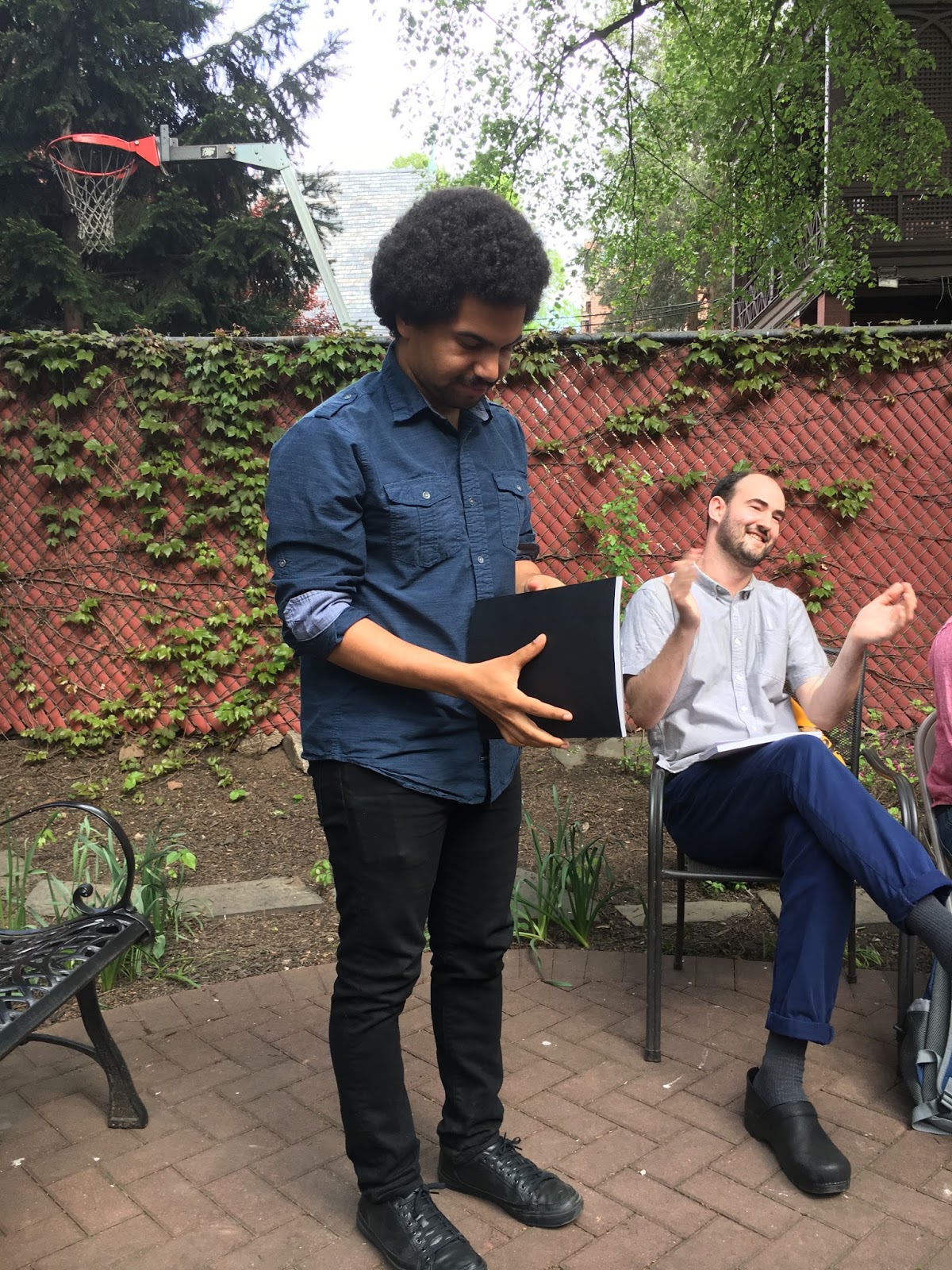
I'm hurtling towards the end of the quarter, thus the absence of posts, but I will try to post more soon. On Monday, two of my undergraduate mentees participated in the university's
Undergraduate Research Symposium and acquitted themselves very well, one presenting a poster presentation on his process of appropriating, translating and adapting an alternative rock band's song lyrics into a short story, while the other one both read his own honors-worthy fiction and acted in a short Beckettian play by a fellow student. Today the departmental held its annual prizes ceremony, and a number of the students I have taught received prizes, including my honors creative writing advisee, who received the department's and creative writing's top prize for his fiction thesis. Congratulations to him and all the students on their excellent work!
***
While filing away materials for the approaching summer transition, I came across two note cards, one inexplicably torn to smithereens yet saved, in its shredded state, from different fiction classes over the last few years. As I do whenever I teach a writing workshop each I'd written down the authors that students stated they had read most recently (before the class) and enjoyed the most, and the ones they'd recently read enjoyed the least. When we discuss these choices, the students often speak passionately about both, though their distaste for their least favorite writers and texts often exceeds their enthusiasm for their favorites.
Rereading these tallies made me recall
the recent reaction by the 2011 Man Booker International Prize judge Carmen Callil, an author herself and publisher of
Virago Books, to the Man Booker committee's decision to award the £60,000 ($98,765) prize to American fiction writer
Philip Roth. Callil, who in passionate dissent withdrew from the panel, initially and quite harshly stated her thoughts about Roth being this year's laureate, saying that
"I don't rate him as a writer at all. I made it clear that I wouldn't have put him on the longlist, so I was amazed when he stayed there. He was the only one I didn't admire – all the others were fine....Roth goes to the core of their [Cartwright and Gekoski's] beings. But he certainly doesn't go to the core of mine ... Emperor's clothes: in 20 years' time will anyone read him?"
I think the answer to that is
yes, without question. As to the others that she did admire, the shortlist for the biennial award included other English-language writers such as
Philip Pullman, Anne Tyler and
Marilynne Robinson, and non-Anglophone writers like "Chinese authors Wang Anyi and Su Tong, the Spanish
Juan Goytisolo, Italian
Dacia Maraini and Lebanese
Amin Maalouf," all of whom Callil thought a better choice than to honor than "yet another North American writer," as the previous winner, in 2009, was
Alice Munro.
Albanian writer
Ismail Kadaré received the 2005 prize, followed by
Nigerian writer
Chinua Achebe in 2007.
Callil elaborated on her position in a May 21, 2011
Guardian essay. She stated
The Man Booker International prize allows for a separate prize for translation. If applicable, the winner can choose a translator of his or her work into English to receive a prize of £15,000. Of the four awards given thus far, only one has been given to an author not writing in English, the Albanian novelist Ismail Kadaré. And now, with the choice of Roth, this money continues unused. I hope the sum is accumulating.
About Roth she continued:
There are great moments in Roth's work. He is clever, harsh, comic, but his reach is narrow. Not in the Austen, Bellow or Updike sense, because they use a narrow canvas to convey the widest concepts and ideas. Roth digs brilliantly into himself, but little else is there. His self-involvement and self-regard restrict him as a novelist. And so he uses a big canvas to do small things, and yet his small things take up oceanic room. The more I read, the more tedious I found his work, the more I heard the swish of emperor's clothes.
I think she's using a mill when gentler critique would suffice, though I do agree that one can gather the subject of nearly all Roth's novels from just one. Roth is not alone in doing this, but it is the case that again and again he covers the same ground, with considerable skill and stylistic panache. He has, however, even critiqued his own self-obssessiveness, in and through the
Zuckerman novels. He has also ranged a bit more widely than Callil suggests, having addressed history more than once, and it's fair to say that while he is not a philosophical novelist, he has posited a personal philosophy of the world, and made clear his ideological compass. Roth is an ideological liberal. One area where Roth is perhaps less inventive is in the form of the novel itself, though he has played skillfully with novelistic genres. To offer a comparison, contemporary peer writers like
Milan Kundera, J. M. Coetzee, or
Roberto Bolaño have essentially written the same novel multiple times, yet in the case of these three, there is tremendous formal variation and daring, something that one cannot say of a great deal of Roth's work. Another way of stating it is that he puts the arts of fiction and storytelling themselves, in play, in the ways that some of the other authors in the shortlist have. This is not to say that Roth shows no formal or generic variety; books like
Operation Shylock (my favorite Roth novel) and
The Plot Against America (which I have not yet read) attest to this.
As soon as I read the shortlist, the author on it I thought most deserving was
Juan Goytisolo, one of the greatest living writers in the Spanish language and the author, in 1970, of a landmark book in Hispanophone, European and contemporary literature,
La reivindicación del conde don Julián,
known in English as
Count Julian. It is the second in a trilogy of novels, under the rubric of the
Álvaro Mendiola trilogy, and comprises an unrelenting attack on Spain, Spanish history and culture, its hypocrisies and traducements, its blindness at the heart of its self-regard. The speaker, ostensibly viewing the southern coast through blinds (if I recall correctly) from northern Africa, unleashes his mesmeric torrent, and sustains it for 200 or so pages. When I read it, having been astonished by its 1966 predecessor
Señas de Identidad (Marks of Identity), I did not know even how to process it; how, I wondered, could someone have written the previous remarkable book and then ramped things up by several orders to write this one?
Goytisolo's
oeuvre continues, and he is now in his late career, having published a number of books of poetry, essays, autobiographies, and so forth, but a few years back, in 1997, he astonished me again with a strange little novel that goes to the very heart of storytelling. I have not found a class in which to teach it, but one of these days I will. It is called
La semanas del jardín (The Garden of Secrets), and, on the English-language cover of the book, Goytisolo's name is nowhere to be found. For the book takes as its central principle the very question of authorship, of orature and literature, and explores this in an inventive and refreshing fashion. I have thought for some time that Goytisolo would win the
Nobel Prize, but instead it has gone to authors who I would not put in his rank:
J. M. G. LeClézio, Elfriede Jelinek (I still cannot figure out this one),
Herta Müller, and the most recent laureate, admitted a superb storyteller but problematic on many levels,
Mario Vargas Llosa.
One of the other judges,
Rick Gekoski,
has now made it clear in his own Guardian essay of May 25, 2011, that because he cannot read in other languages and thus ascertain the quality of the prose in the original, all of which he conveys through a rather garbled discussion of the difficulties of translation, the authors in translation had no chance. As someone who translates from several different languages I take aspects of his commentary to heart, in that translation is always a fraught process resulting in a new work rather than a direct approximation of the original. On the other hand, he essentially ruled out all the non-English texts from the beginning. This was neither ethical nor fair, especially for someone charged with awarding an "international" book prize, especially one so lucrative. I should add that while Spanish for someone who does not speak or read the language is hardly easy, it is also not impossible, with a dictionary at one's fingertips, to at least attempt to gauge a few passages of the prose to see what the author is up to. Doing so might have given him a sense of the genius of Goytisolo's work, at least the very best of that work, in comparison with Roth's.
And so, Roth is the winner. His name, however, rarely if ever turns up on my students lists, affirmatively or negatively. When I have mentioned his work, they will nod with recognition at the name, but when I query, only a few of the undergrads appear to have read his work, and are not partisans either way, and perhaps half the graduates have, and may like one of his books over another, but rarely does he emerge as a top choice. I have not yet ever had a student cite Goytisolo's work either way; I have never had a student, at least in a creative writing class, who has mentioned reading Goytisolo, and on those rare occasions when I have mentioned him, no one has ever heard of him. Among the
other shortlisted writers, students have mentioned several of the Anglophone ones (
James Kelman, Philip Pullman, Marilynne Robinson, and Annie Tyler) but never
John LeCarré, David Malouf or
Rohinton Mistry, and not a single student has ever mentioned
Wang Anyi, Amin Maalouf, Dacia Mariani (whom I admit I'd never heard of), or
Su Tong (whom I also was unfamiliar with).
That brings me back to those notecards I found. Who are my students reading (outside my classes) and enjoying and not enjoying? Here you go, straight from their mouths to my notecards:
Class #1:
Authors the students had most recently read and enjoyed:
George W. Bush (!-this student was not able to register for the class, though)
Paulo Coelho
David Eggers
Jonathan Safran Foer (2x)
E. M. Forster
Jay-Z
Barbara Kingsolver
Jon Krakauer
Nicole Krauss
Toni Morrison
Orhan Pamuk
Marilynne Robinson
David Sedaris
Robert Louis Stevenson
Kurt Vonnegut
David Foster Wallace
+
The Bible
Least Favorite Author Recently Read
Emily Brontë
Dan Brown (2x)
William S. Burroughs
James Conroy
Nathaniel Hawthorne
Ernest Hemingway
Zora Neale Hurston
Gary Kowalski (- I had never heard of this author before)
Erik Larson
Herman Melville
Lorrie Moore
Salman Rushdie
J. D. Salinger
Robert Louis Stevenson
Leopold von Sacher-Masoch
Mark Twain
Class #2: Most Favorite Recent:
Dan Brown
Roald Dahl
Jonathan Safran Foer (2x)
Nicole Krauss
Gabriel García Márquez
David Mitchell
Toni Morrison (2x)
George Orwell
David Foster Wallace
Least Favorite Recent:
Emily Brontë (2x)
Joseph Conrad
Charles Dickens
Thomas Hardy
Nathaniel Hawthorne
James Joyce
Madeleine L'Engle
William Shakespeare
George Bernard Shaw
H. G. Welles
About these lists I'll say only a few things. Roth appears on none of them, but then neither do other authors that many literary scholars and journalists frequently cite as enduringly popular, like
Jane Austen and
Franz Kafka. Non-Anglophone authors are rare. Pre-contemporary authors are more common on the disfavored than favored list, and I strongly suspect the students read them in English and American literature classes rather than of their own volition. (I try to make a case for all of these canonical writers and their works.) Though my classes usually consist of more women than men, more male authors' names appear on both lists. The students, male and female, tend uniformly to
love Jonathan Safran Foer, an author whose fiction I do not like, and abhor Dan Brown, an author whose fiction I do not like. From both lists in my fiction workshops, in which we primarily read short stories, I only regularly assign Hemingway and Joyce, but in literature classes I have taught these two authors as well as Hurston, Morrison, Orwell, Robinson, Shakespeare, and Wallace. Finally, as much as my experience teaching literature classes has demonstrated to me that students (except poets) tend to like reading poetry in literature classes far less than fiction, creative nonfiction or plays, no poets (save Shakespeare) appear on the dislike lists, but several playwrights sit amidst the fiction and nonfiction writers. Poets, for once you are spared--or, I hate to say it, not being read as much--so I do what I can!