For a long time I've loved the poetry of
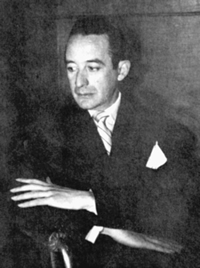
Xavier Villaurrutia (1903-1950), one of the greatest poets in
Mexican and
Latin American literature, and I've read translations of his work that I liked, but I've only tinkered with translating one or two poems of his, publishing none of them on here. Back in September 2005, however,
I did publish one of Rachel Benson's translations, of his poem "Love Is an Anguish, A Question," and also posted my typical potted biography of the poet as an introduction.
Recently during this tiny breather between classes I decided to tackle one of his masterpieces that I mentioned in that post, the haunting "Nocturno de Los Ángeles," one of a group of poems in this genre, the "nocturne," that Villaurrutia published in his collection "Nostálgia de Muerte" in 1938. He had previously published an entire collection in 1933 entitled "Nocturnos." This exceptional example of the form is, as you will see, more openly homoerotic than its predecessors, though all of the ones he wrote, as well as many of his other poems, possess a queer thematic undertow.
The very idea of a poem invoking and celebrating the night and nocturnal life suggests and opens up queer possibilities for a gay poet, especially one such as Villaurrutia, who wrote before the more widespread acceptance, in Mexico and elsewhere, of LGBTIQ literature. In the poem "Nocturno," he offers a definition of sorts, beginning "Todo lo que la noche/dibuja con su mano/de sombra;/el placer que revela/el vicio que desnuda" (Everything that the night/draws with its shadowy/hand;/the pleasure it reveals/the ugliness it lays bare." There is Villaurrutia's thematics of the "nocture" in a stanza. Turning darker in tone and imagery towards the end of life, they also point to his chief strategy for revealing and concealing at the same time his interests, as a man and poet, among them an abiding cosmopolitanism, a probing interest in metaphysics and the deeper realities behind and beyond the surface of things, and, rather obviously, queer desire and sociality.
Often in Villaurrutia's poems the rhetoric and discourse cut, at differing angles, through the abstractions; what is not said, "the secret" he broaches below, "shatters" into revelation nevertheless through its presence and invocation. We know it; he chooses to share it with by not sharing it openly. Except below, and in a few other poems. He did not need to hide among his circle of friends, the important group of modernist poets centered in Mexico City, nor was he hiding much when he was translating foreign writers including
André Gide and
Langston Hughes. His student
Octavio Paz, among others, was in on the secret. As all of us who read his poems eventually are.
"Nocturno de Los Ángeles" is one of his most beautiful. It is as strange (with angels, no less) as Rilke, but distinctly Villaurrutia's gem. I recommend reading the English and Spanish aloud, to get the fullest sense of what he's doing. The Spanish, unsurprisingly, casts a greater spell than (my workmanly) English (translation) ever can, at least to my ear. Still, enjoy!
NOCTURNO DE LOS ÁNGELES
to Agustin J. Fink

You could say the streets flow sweetly into the night.
The lights are not so bright that they actually reveal the secret,
the secret that men who come and go know,
because everyone is in on the secret
and nothing would be gained by shattering it
     into a thousand pieces
if, on the one hand, it is so sweet to keep
and share it only with the one you choose.

If each one were to say at a given moment,
in only one word, what he thinks,
the six letters of DESIRE would form
an enormous, luminous scar,
a constellation more ancient, more brilliant
     than any other.
And that constellation would be like a sex organ burning
in the deep body of the night,
or, better, like the Gemini who for the first time
     in their lives
saw themselves brow to brow, eye to eye,
and then took each other in their arms forever.

Suddenly the river of the street peoples with thirsty beings,
they stroll, they pause, they walk on by.
They exchange glances, they dare smiles.
They improbably couple up.

There are shadowy bends and banks,
edges of indefinable and bottomless forms
and sudden blinding shafts of light
and doors that give way to the slightest pressures.

The river of the street stands deserted for a moment.
Soon it seems to rearrange itself by itself
longing to begin again.
For a moment it stays paralyzed, mute, yearning
like the heart between two orgasms.

But a new pulsation, a new beat
casts into the river of the street new thirsty beings.
They cruise, intermingle, lift off.
The fly above the earth.
They swim on foot, so miraculously
that no one would dare to say they were not walking.

They're angels!
They've come down to earth
by invisible ladders.
They come from the sea, that mirror of the sky,
in ships of smoke and shadow,
to find themselves, conjoin themselves with mortals,
to surrender their brows to the thighs of women,
let others feverishly caress their bodies,
as other bodies search for theirs until they find them
as they find them when closing
their lips on the same mouth,
wearing out their mouths unused for so long,
setting free their tongues of flame,
chanting the songs, the pledges and the cursewords
in which men concentrate the ancient mystery
of flesh, blood and desire.

They take assumed names, divinely simple.
They call themselves Dick or John, or Marvin or Louis.
In no way way beyond their beauty can they be
    distinguished from mortals.
They stroll, they pause, they walk on by.
They exchange glances, they dare smiles.
They improbably couple up.

They smile maliciously ascending
the hotel elevators
where they can still practice slow and vertical flight.
On their nude bodies are heavenly marks--
signs, stars, blue tattooed letters.
They fall back into bed, drown themselves in pillows
that make them recall, for a moment, the clouds.
But they close their eyes in order to give themselves up
to the pleasures of their mysterious incarnations,
and, when they sleep, they dream of mortals, not angels.

Los Angeles, California

Copyright © Estate of Xavier Villarrutia. All rights reserved.
Copyright © Translation by John Keene, 2013.


NOCTURNO DE LOS ÁNGELES
a Agustín J. Fink

Se diría que las calles fluyen dulcemente en la noche.
Las luces no son tan vivas que logren desvelar el secreto,
el secreto que los hombres que van y vienen conocen,
porque todos están en el secreto
y nada se ganaría con partirlo en mil pedazos
si, por el contrario, es tan dulce guardarlo
y compartirlo sólo con la persona elegida.

Si cada uno dijera en un momento dado,
en sólo una palabra, lo que piensa,
las cinco letras del DESEO formarían una enorme
      cicatriz luminosa,
una constelación más antigua, más viva aún que las otras.
Y esa constelación sería como un ardiente sexo
en el profundo cuerpo de la noche,
o, mejor, como los Gemelos que por vez primera en la vida
se miraran de frente, a los ojos, y se abrazaran
      ya para siempre.

De pronto el río de la calle se puebla de sedientos seres,
caminan, se detienen, prosiguen.
Cambian miradas, atreven sonrisas,
forman imprevistas parejas...

Hay recodos y bancos de sombra,
orillas de indefinibles formas profundas
y súbitos huecos de luz que ciega
y puertas que ceden a la presión más leve.

El río de la calle queda desierto un instante.
Luego parece remontar de sí mismo
deseoso de volver a empezar.
Queda un momento paralizado, mudo, anhelante
como el corazón entre dos espasmos.

Pero una nueva pulsación, un nuevo latido
arroja al río de la calle nuevos sedientos seres.
Se cruzan, se entrecruzan y suben.
Vuelan a ras de tierra.
Nadan de pie, tan milagrosamente
que nadie se atrevería a decir que no caminan.

¡Son los ángeles!
Han bajado a la tierra
por invisibles escalas.
Vienen del mar, que es el espejo del cielo,
en barcos de humo y sombra,
a fundirse y confundirse con los mortales,
a rendir sus frentes en los muslos de las mujeres,
a dejar que otras manos palpen sus cuerpos febrilmente,
y que otros cuerpos busquen los suyos hasta encontrarlos
como se encuentran al cerrarse los labios de una misma boca,
a fatigar su boca tanto tiempo inactiva,
a poner en libertad sus lenguas de fuego,
a decir las canciones, los juramentos, las malas palabras
en que los hombres concentran el antiguo misterio
de la carne, la sangre y el deseo.
Tienen nombres supuestos, divinamente sencillos.
Se llaman Dick o John, o Marvin o Louis.
En nada sino en la belleza se distinguen de los mortales.
Caminan, se detienen, prosiguen.
Cambian miradas, atreven sonrisas.
Forman imprevistas parejas.

Sonríen maliciosamente al subir en los ascensores de los hoteles
donde aún se practica el vuelo lento y vertical.
En sus cuerpos desnudos hay huellas celestiales;
signos, estrellas y letras azules.
Se dejan caer en las camas, se hunden en las almohadas
que los hacen pensar todavía un momento en las nubes.
Pero cierran los ojos para entregarse mejor a los goces
     de su encarnación misteriosa,
y, cuando duermen, sueñan no con los ángeles sino con los mortales.

Los Angeles, California