Showing posts with label hypergentrification. Show all posts

Saturday, January 27, 2018

De Blasio's Donors, Luxury Housing on NYCHA Land + Comics (Dante's Magic Afro)

This is a rendering of the proposed building
 at 120 3rd Ave. in Brooklyn.
Two more major de Blasio donors
have been picked for the project.
(AUFGANG ARCHITECTS)
© via New York Daily News

Yesterday brought the news that two wealthy real estate companies that were donors to New York mayor Bill de Blasio's campaign last year, where he was re-elected to his second four-year term in a landslide, received New York City approval to build luxury housing on land belonging to the underfunded New York City Housing Authority (NYCHA). The numerous housing projects currently run by NYCHA continue to be plagued by a host of problems, but with neither the city nor state, let alone the federal government able to find or raise funding, de Blasio has turned to private entities as a way of purportedly raising support for NYCHA's existing housing stock.

According to The New York Daily News, the new housing, to be built by developers the Arker Companies and Two Trees, is supposed to include 500--or half of its total--"half-market rate" apartments, which in practical terms means that in addition to the luxury rentals, the landlords will be able to get $3,900 (or $46,8000/year) for two-bed apartments, or half-market rate, on public land. NYCHA will lease the land, for 99 years, in return for payments to address its extensive low-income housing problems. The Daily News points out that this is the second such sweet deal involving a de Blasio donor.

In recent years, I've noted often harsh dismissals of labeling of actions like the developers' deal as neoliberalism, but this strikes me as a textbook example of it. Instead of seeking and finding government funding, via taxes, fees, etc. to support a public housing organization, the government is turning to private entities, which will benefit its lease of government subsidized, lower-cost land, to support private businesses, with some peanuts thrown back to the government in return. This is about as far from the "Sandinista" tag, with which opponents associated Blasio during his first run in 2013, as you can get.

Meanwhile, as the The Daily News article also points out:

Two de Blasio donors have said they raised money for the mayor to gain access to City Hall.

De Blasio disputes claims City Hall intervened on behalf of donor Restaurateur Harendra Singh pleaded guilty to conspiring to bribe de Blasio, stating that he gave to get favorable treatment on back rent he owed for his restaurant on city-owned land.

Prosecutors said a senior aide to de Blasio arranged a meeting for Singh “in an effort to pressure the agency to make its proposed settlement terms more favorable to Singh.”

Developer Jonah Rechnitz said he spelled out to a top de Blasio aide that he was giving money to gain access. After Rechnitz paid a fine over an illegal hotel he owned, the city stopped responding to another year’s worth of complaints about the place.

The Manhattan US Attorney chose not to press pay-to-play charges against de Blasio, however. Nevertheless, according to the paper, "Prosecutor Joon Kim...made a point of stating that his investigation had determined that the mayor had intervened or directed subordinates to intervene on behalf of donors."

Here's a comic I drew around the time that de Blasio was campaigning five years ago. I often joked with C about how de Blasio's teenage son Dante's afro seemed to be a talisman, working its magic on voters (and de Blasio himself), and then played with it a bit in the frames below. It is the "afro," not Dante, who's speaking.


If my handwriting isn't clear the frames (beginning with #3) say: 
VOTE FOR MY DAD!
HE'LL ADDRESS INEQUALTY & POVERTY!
HE'LL DO SOMETHING ABOUT STOP & FRISK!
HE'LL IMPROVE SCHOOLS & RAISE TAXES ON THE RICH!
HE IS THE ONLY PROGRESSIVE WHO CAN WIN!
& HE'LL HAVE MY SPECIAL POWER TO GUIDE HIM!

More recently, during the lead-up to the 2017 mayor's race, I revisited my Magic Afro drawing. At one point the younger de Blasio, now a student at Yale University, had shaved his afro off, but as the recent campaign picked up, and during recent appearances with his father, Dante has sported that spectacular afro again. 

Unfortunately, it doesn't seem to have any magic to work against neoliberalism, the real estate industry, inequality, homelessness, or any of the other ills plaguing New York City. But hey, Bill de Blasio has another four years to figure it out, no?
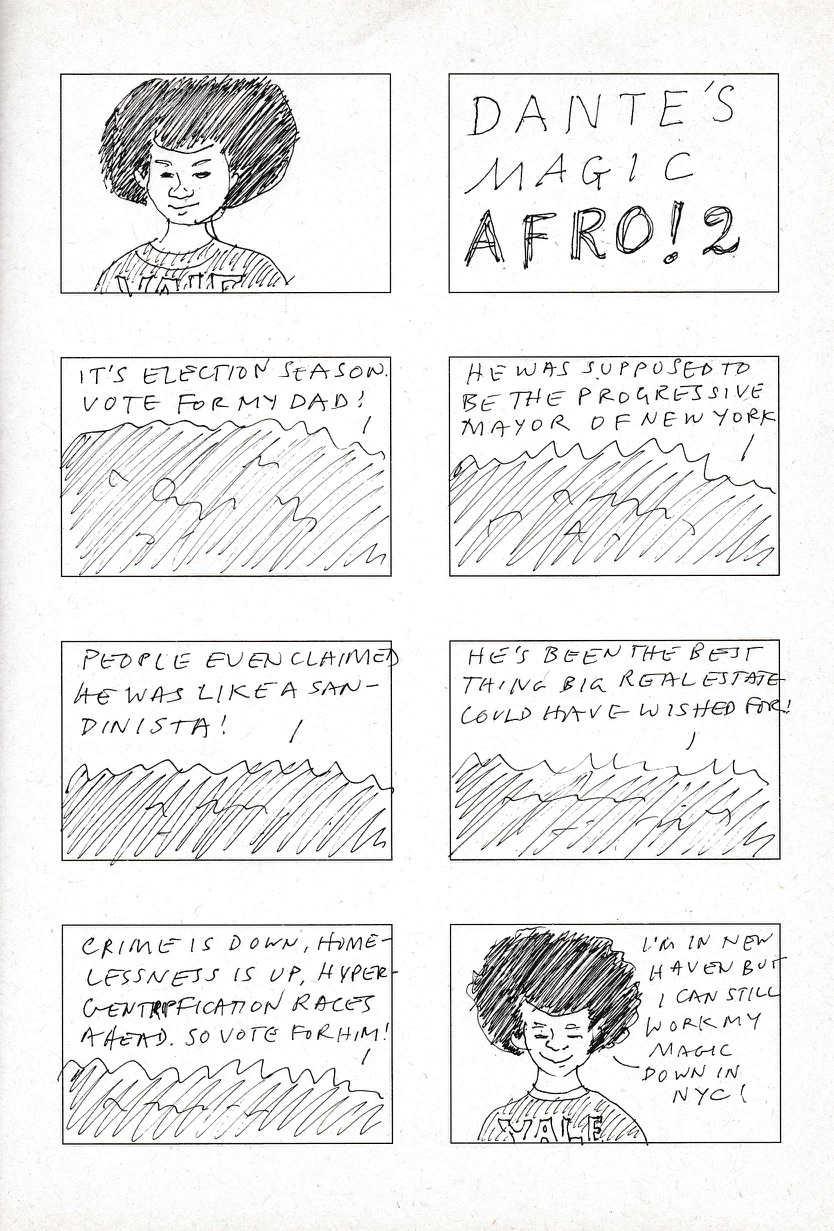

If my handwriting isn't clear the frames (beginning with #3) say: 
IT'S ELECTION SEASON. VOTE FOR MY DAD!
HE WAS SUPPOSED TO BE THE PROGRESSIVE MAYOR OF NEW YORK
PEOPLE EVEN CLAIMED HE WAS LIKE A SANDINISTA!
HE'S BEEN THE BEST THING BIG REAL ESTATE COULD HAVE HOPED FOR!
CRIME IS DOWN, HOMELESSNESS IS UP, HYPERGENTRIFICATION RACES AHEAD. SO VOTE FOR HIM!
I'M IN NEW HAVEN BUT I CAN STILL WORK MY MAGIC DOWN IN NYC!

Thursday, August 31, 2017

Random Photos

Unlike previous summers, this has been mostly a quiet one, with recuperation from the semester (and a bit of surgery), and preparation for what looks to be a very busy fall. Here are a few photos from the last few months.

Our front gate, after a car
crashed into it again
(it's since been repaired) 
The vaulted ceiling at the still-under-repair
Hoboken rail station (remember
the terrible crash there earlier this year?)
New York City and some of the
flotsam on the Hoboken site 
Famous First Baptist Peddie
Memorial Church, Newark 
New towers steadily rising (Trump's
second tower in the middle), downtown
Jersey City
Translator Alicia Maria Meier,
at the Us&Them Reading,
Molasses Books, Brooklyn
Translator Bonnie Huie at
the Us&Them reading 
A sculpture at the plaza where 8th Street,
6th Avenue and Greenwich Avenue meet,
Manhattan
Service Changes,
on the PATH 
The Sistine Chapel exhibit,
PATH World Trade Center station 
The Sistine Chapel exhibit,
PATH World Trade Center station 
Scaffolded walkway, which
could be almost anywhere in
endlessly-under-construction New York
Boohoo.com, West Village
CA Conrad, reading and performing
at the White Review Issue 20 launch,
McNally-Jackson, Manhattan 
Sophie Robinson
at the White Review Issue 20 launch,
McNally-Jackson, Manhattan 
Another one of our new luxury towers
in Jersey City 
The Upper West Side, near Columbia University
Outside Book Culture, Upper West Side 
At the Women in Translation Cocktail Hour
reading, with Susan Bernofsky, Ann Goldstein,
and Nathan Xavier Osorio, Book Culture 
At the Women in Translation Cocktail Hour
reading, with Susan Bernofsky, Ann Goldstein,
and Nathan Xavier Osorio, Book Culture 
L-r: Nathan Xavier Osorio, Ann Goldstein,
and Susan Bernofsky, Book Culture 

Susan Bernofsky signing copies
of the books she's translated,
Book Culture, UWS 
Lower Manhattan
Chelsea restaurant BEC
(Bacon Egg & Cheese)
A Twitter office (I assume
from that logo), Chelsea
A building site, Jersey City
Impromptu poetry, Jersey City street
UN Building, west side of Manhattan
Two stilt walkers, Jersey
City Pride, 2017 
Sugar & Spice (?), performers at
Jersey City Pride, 2017
Wrestling an umbrella, Jersey City 
Lunch al fresco, Jersey City

Thursday, June 22, 2017

The Pen Behind Jeremiah Moss (Vanishing New York) + 27 Cooper Square Dedication

Add caption
For a decade, a blogger writing under the nom de plume Jeremiah Moss has been chronicling the Bloomberg and post-Bloomberg era gentrification--hypergentrification--of New York City, primarily through posts that tally the disappearance of countless small and medium-sized, often longstanding businesses. While not always avoiding nostalgia and though he has mostly focused on Manhattan, Moss's blog, Vanishing New York, has set the standard in consistently demonstrating city and state policies favoring plutocratic real estate interests, in combination with the national and global neoliberal economic system, have had a devastating effect on so much of the city's social ecology, its distinctive neighborhoods, and its diverse cultural vibrancy, let alone affordability, all of which have drawn creative people in particular to New York for more than a century.

Though gentrification in New York is hardly new, Moss has detailed how over the last 10 years, particularly in the lead-up to and through the Great Recession, whole sections--and increasingly boroughs--of New York have transformed into hollowed out museums of themselves. (Lost City was another blog that contemporaneously recorded the loss of many New York landmarks, from 2006 through 2014. Gothamist also provides updates amidst its general news about the city.) Among the terms I've learned from Moss's blog are yunny (young urban narcissists), zombie urbanism, and hypergentrification, to name just a few.  From my first encounter with Moss's lamentations--appropriately enough, an early entry from 2007 bore that title--and jeremiads, I became a fan, finding in his posts arguments that compellingly articulated what I saw happening as far back as the period right after 9/11, in 2001, and also underway simultaneously and without explanation, in Chicago.

From Jeremiah's
Vanishing New York
Certainly many have written persuasively about gentrification and its effects, and we can always use more informed takes. But Moss has also urged readers to go beyond mourning and support the pro-small business, cultural landmarking, anti-chain approach of SAVE NYC. Moss also has tried to address readers' questions, including why he began the blog, whether gentrification is (ever) good for working-class and poor people, how Bloomberg's tenure really affected New York (for the worse), and how New York City has become increasingly suburbanized, or a dense, vertical simulacrum of the suburban--an elite suburb, that is. Notably, he also has not shied away from addressing questions of race, class, and political access, among other topics key to the problem of hypergentrification.

For his efforts he has received a great deal of press, and some awards. Until now, Moss has not compiled his thoughts in book form, but that is set to change with Vanishing New York: How a Great City Lost Its Soul (HarperCollins), which will hit bookshelves shortly. A book party is set for July 27, in SoHo.

What also has remained unknown to most readers of Moss's blog is who the writer really is. (In fact I have to admit I was quite willing not to have his real identity revealed.) Recently, however, in a New Yorker "Talk of the Town" piece by Michael Schulman, Moss does share with the world who he really is: Griffin Hansbury, a transgender psychoanalyst, social worker, and aspiring novelist who has lived in New York for more than a quarter of a century. He lives in the East Village, and has shifted, as Schulman points out, from elegist to activist, when he rallied readers behind the attempt to save Midtown's Café Edison, which did not succeed but which fed into the #SAVENYC campaign.
So why did Moss (Hansbury) unmask himself?

[He] decided to reveal himself, he said, so he can show up at his own rallies and on panels. Also, “Vanishing New York” is now a book. Walking down St. Mark’s Place, past a dark-glass building that he called the Death Star, he mentioned a study that measured pedestrians’ skin conductivity outside a sleek Whole Foods and on a more diversified street. “They found that blocks that are all this glass stuff actually shorten the lives of senior citizens, because they’re so depressing,” he said.

And, as I can attest, they can turn into giant magnifying glasses, scorching the ground around them. I hope to share this and other thoughts--like the increasingly disturbing lack of adequate infrastructure in New York and New Jersey, especially to handle all of the building, new arrivals, or catastrophic contingencies like a worse version of the 2003 blackout (which I experienced firsthand) or another tropical storm as strong as or stronger than 2012's Hurricane Sandy-- in person with him, at his book event or another, but either way, I'll be picking up a copy of Vanishing New York, the book version, while continuing to read his blog.

***


A few days ago, another New York City blog I regularly browse, EV Grieve, posted about a plaque dedication at 27 Cooper Square on June 21. Though increasing swaths of Manhattan and New York City have been or are being leveled or built over in favor of the kinds of cookie-cutter designer glass luxury towers that Moss has decried on his blog, 27 Cooper Square managed to survive the wrecking ball, mainly because, as EV Grieve points out, two of the building's resident, including acclaimed poet and memoirist Hettie Jones, balked at moving out so that the Cooper Square Hotel could be built next door. Jones and her fellow tenant had secured artist loft status in the 1980s, and thus had the law on their side. Now, as the luxe Cooper Square Hotel looms beside them and an increasingly hypergentrified Downtown New York surrounds them, the Greenwich Village Society for Historic Preservation (GVSHP), in partnership with Two Boots Foundation, will commemorate 27 Cooper Square's importance as a cultural node during the 1960s.

The 1845 building, as the plaque announces, was the home of several key artistic figures during the 1960s. Quoting EV Grieve (and the email the site received from GVSHP):

In the 1960s, this 1845 former rooming house became a laboratory for artistic, literary and political currents. Writers LeRoi [later Amiri Baraka] and Hettie Jones, their Yugen magazine and Totem Press, musician Archie Shepp and painter Elizabeth Murray all had homes here. The vacant building was transformed into a vital hub of cultural life, attracting leading figures including those from the Beats and the world of jazz. It was also the childhood home of a second generation of East Village artists and thinkers.

GVSHP and Two Boots Foundation will install a plaque on the building at 27 Cooper Square to mark the significance of the site in the artistic legacy of the East Village.

The event's slated speakers included Archie Shepp's son Accra Shepp, a noted photographer, and Hettie Jones, as well as a representative of the GVSHP, and poet and Bowery Poetry Club co-founder Bob Holman. You can watch a video of the dedication on YouTube, and see photos on Flickr. Though cultural producers still live in the area, as Jones pointed out in the 2008 New York Times article on her successful battle against the Cooper Square Hotel, "This used to be an area where people got their start. Now it’s a place to land once you’ve made it." And it's only more so these days, but the plaque will remind people, at least those who stop and read it, that the area was once more, much more, than a hub of global lucre.

Saturday, March 28, 2015

Jeremiah Moss's #SaveNYC


One of my regular blog reads is New Yorker Jeremiah Moss's Jeremiah's Vanishing New York. Since 2007 through today he has relentlessly chronicled the changes to the city's social, political and economic ecology, noting the disappearance of longtime businesses, the increasing waves of hypergentrification, and the homogenized cityscape that has resulted. While it's true that gentrification in New York is hardly new, or that the city has never been static, the pace of the changes (towers rising, small businesses vanishing) has become dizzying, as Moss shows again and again. Also, while too much nostalgia dissolves in sentimentality and the blame for the city's changes lies at no one doorstep, it is nevertheless important to document, as Moss does, how the absence of laws or a system to counter the pro-elite zoning that began under former mayor Rudy Giuliani and accelerated into hyperdrive under billionaire plutocrat Michael Bloomberg, has deleterious effects on many aspects of what people think of as New York (distinctive, economically diverse neighborhoods, particular sub-cultures, and so forth). When every neighborhood in Manhattan increasingly becomes a combo high-end condo district coupled with luxury outdoor mall, what kind of city remains?

Moss has decided to launch a project, with a website, entitled #SaveNYC. As he says on the website:

#SaveNYC is a grassroots, crowd-sourced, DIY movement to protect and preserve the diversity and uniqueness of the urban fabric in New York City. As our vibrant streetscapes and neighborhoods are turned into bland, suburban-style shopping malls, filled with chain stores and glossy luxury retail, #SaveNYC is fighting for small businesses and cultural institutions to remain in place. Our mission is to bring attention to the plight of Mom and Pop, and to lobby state and city government to implement significant and powerful protections for small businesses and cultural institutions across the five boroughs of New York City. The devastation has been overwhelming. Protecting what remains will require a multi-pronged approach. 
The projects first steps including raising awareness by collecting video and photographic testimonials from people everywhere who love New York and want to see its diverse culture and heritage protected. One component involves using social media, via the hashtag #SaveNYC, and a concomitant Facebook group. On the political front, Moss is pushing to pass the Small Business Jobs Survival Act (0402-2014), which he says "will make it possible for small businesses to negotiate fair lease renewals with landlords, thus stemming the tide of mass evictions and catastrophic rent hikes." Currently, landlords' ability to hike up rents, by doubling or tripling the going rate, has meant that businesses that had survived for decades or even a century have been shoved out in favor of chains.

Of course anyone paying attention to the asset-based economic logic of Wall Street, whose power and goals fuel these changes, will grasp what's happening here, as there's always more money to be made by expanding private and publicly traded corporations than in an environment in which there are lots of small businesses and well-rewarded labor. Money, for a very few people, is all Wall Street cares about. Another issue is the rising cost of real estate, and laws that favor certain kinds of elite and corporate investors and spur appreciation, to the disadvantage of the vast majority of renters and homeowners. Although New York mayor Bill de Blasio campaigned on behalf of the city's majority, his actions to save small businesses have been not matched the rhetoric, nor have those of the City Council. Meanwhile, chain stores, businesses like bespoke barbershops, frou-frou restaurants and spinning (not of yarn but weight-focused wealthy people) proliferate.

I urge J's Theater readers to explore Jeremiah's main site, linked above, and #SaveNYC. If you're a New Yorker, you can:
Pass the Small Business Jobs Survival Act (SBJSA) to create fair negotiations of commercial lease renewals, so landlords can’t use insane rent hikes to evict dependable and beloved business people.

Jeremiah outlines other steps as well for those in NYC. Even if you don't live in the city, you can add a video or a photo showing your support for Jeremiah's initiative and offering visual support on behalf of the New York that is being subsumed by a shiny, super-expensive new and increasingly dull version. The more Mayor de Blasio and the New York City Council hear from New Yorkers and those who participate in this initiative, the more likely the SBJSA, as well as other approaches, like emails and daily tweets to public officials to control the spread of chains (as has been done in San Francisco), taking away the over-generous tax breaks for megacorporations and aid small businesses; and penalize landlords to maintain empty storefronts to gain the highest commercial rents possible (i.e., from chains or luxury boutiques).

One need only look at the evisceration of the West Village's 8th Street between 5th and 6th Avenues, once Bookstore and later Shoe Row, but which is now a dull, depopulated street dotted with a few high-end restaurants and boutiques, a fancy hotel, and empty storefronts, that could be anywhere, to see the direction things are going. Now I need to post a photo, since I'm not so adept at making and editing personal videos!