Showing posts with label Van Jordan. Show all posts

Monday, June 23, 2014

"Mannahatta" Cited in HuffPost + Colleagues' & Students' Honors

A contemporary illustration showing Juan Rodriguez (holding pan)
establishing a trading post with Native Americans
on Manhattan Island in 1613. (Copyright © 
Charles Lilly Art
 and Artifacts Division, New York Public Library,
Schomburg Center for Research in Black Culture)
You never know what may appear in your email inbox, but unexpected good news is, at least for me, always welcome. I recently received some when Sandi Wisenberg, longtime co-director of Northwestern's graduate MA/MFA program, and literary advisor to TriQuarterly, wrote to say that my story "Mannahatta," which appears in Triquarterly's Issue 145, Winter/Spring 2014, was selected by Maddie Crum, for her Huffington Post list, "Read 15 Amazing Works of Fiction in Less Than 30 Minutes." With all the stories she quotes the opening line, and all are brief enough to take in, well, under half an hour. I'm always glad when my work merits some public acknowledgement, but I'm doubly happy that this story was name-checked, because I wrote it last fall, in the midst of demanding teaching (the writing-and-reading intensive undergraduate "Introduction to Literary Studies") and administrative duties (as acting Chair of African American and African Studies), and because it tells a far too little known story, about the histories of the African Diaspora and of New York.

When I read the story at Rutgers-Newark last winter during an event with my colleague Rigoberto González, I noted that doing so represented a personal and public 400th anniversary tribute to the story's protagonist, Juan (Jan) Rodríguez (Rodrigues). I hope the story whets readers' appetites for the rest of the collection, and for learning more about the rich and complex histories of our country; as was the case with Juan Rodríguez's story, "Mannahatta" is but the beginning.

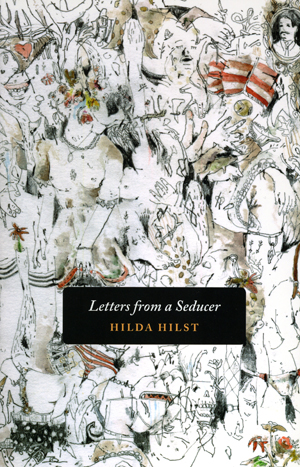
UPDATE: I just saw on Facebook that Entropy, "a new website featuring literary & non-literary content," selected the translation of Hilda Hilst's Letters from a Seducer for its "Ultimate Summer Reading List." It's a wild ride, that will definitely take you places you usually don't venture in contemporary American literature! Definitely check out their list of other summer must-reads, by writers such as Hugo Ball (translated by Catherine Schelbert), Anne Carson, Joshua Corey, Hervé Guibert (translated by Nathanaël), Ray Johnson, Douglas Kearney, Kevin Killian, Édouard Levé (translated by Jan Steyn), Fred Moten, Sawako Nakayasu, Alejandra Pizarnik (translated by Yvette Siegert), and others.

***

I work with truly extraordinary people who regularly receive honors of all kinds, so I thought I'd mention a few of the literary awards and citations they've received (this is not comprehensive and I surely will be missing something). Rigoberto, whom I mentioned above, received this year's Lambda Literary Award for Best Gay Poetry, for his collection Unpeopled Eden (Four Way Books, 2013). His beautiful collection was in one of the tightest competitions, with poetry books by Frank Bidart, Rafael Campo, David Groff, Randall Mann, Carl Phillips, and Brian Teare all in the running. Rigoberto also was a finalist for the Publishing Triangle's Thom Gunn Award for Best Gay Poetry for Unpeopled Eden, and was just named a full Professor of English.

Tayari Jones was one of the writers selected by Edwidge Danticat for Elle Magazine's "12 Great Female Authors Recommend Their 40 Favorite Female Authors," and O, The Oprah Magazine, chose her 2011 novel Silver Sparrow as one of its 2014 Summer Reads. Underlining these selections, back in April Flavorwire picked Silver Sparrow as one of its "50 Best Southern Novels Ever Written."

Akhil Sharma recently published his second book, Family Life (W. W. Norton, 2014), and it has received consistently high praise, including being featured on the front page of the New York Times Book Review.

RN MFA Program Director, Jayne Anne Phillips, whose stories in Black Tickets I first remember reading with excitement around the time I joined the Dark Room Collective, saw her 2013 novel Quiet Dell (Scribner), which has received stellar reviews, named one of the "Top 10 Fiction Books of 2013" by the Wall Street Journal, one of the Best Books of 2013 by the notoriously tough Kirkus Reviews, and one of last year's best books by The Saint Louis Post-Dispatch.

Finally among my colleagues--and I probably have left out something--one of the newest arrives with a particularly high honor: A. Van Jordan, a poet I've known and admired for many years and a fellow Cave Canem Graduate Fellow, will be RN's first Henry Rutgers Presidential Professor, joining the English department and MFA Program in Creative Writing this fall.

Among my students, one who received his RN MFA last year, Vincent Toro, and another whom I had the great pleasure of teaching a few years ago during her undergraduate study in creative writing, Jeannie Vanasco, received 2014 Poets House Emerging Poets Residencies. I was away so I was unable to attend their residency reading earlier this month, but both are writers to watch, and not just for their poetry. Vincent is an accomplished playwright whose plays have been staged around the New York-New Jersey metropolitan area, and Jeannie is a talented nonfiction writer who is currently working on a book that I can foresee garnering a good deal of acclaim.

Lastly, Drew Ciccolo, who received his RN MFA this year and who will begin the RN PhD program in American Studies this fall, has won Talking/Writing's Nonfiction Contest with his very fine piece "Paige." Drew was also one of 10 MFA students from across the US who had a story--"The Behemoth"--selected as a finalist by The Masters Review.

A hearty congratulations to all of them!

Saturday, October 20, 2007

Black Arts Movement in Chicago + Jordan & Jess at Poetry Center

This fall, the university has been especially lucky to have Ed Roberson as the Visiting Writer in Residence at the Center for Writing Arts, an autonomous division headed up by my distinguished colleague, author Reg Gibbons. Ed's residency is a huge deal, as the Center infrequently invites poets, and in the past (before Reg's tenure) seldom (never?) had a writer of color for a full quarter. (Mary Ann Mohanraj will be in residence in the spring.)

Ed, whom I think of as a sage, is teaching two classes, and as part of his visit and the courses, he planned a one-day conference on the Black Arts Movement in the Broader Legacy of the Civil Rights Movement, with special emphasis on its history in Chicago. The event brought three of the central figures from the Chicago branch of that movement, writers Angela Jackson, Carolyn Rogers, and Sterling Plumpp, to campus to talk about their experiences as poets and activists. (This was pretty significant in that Chicago, where the Organization of Black American Culture (OBAC), was established in 1966, was an important center for Black Arts poetry and the Black Power movement--one of the key Black Panthers branches was in the city; Fred Hampton and Mark Clark were assassinated in a joint FBI Cointelpro-Chicago Police Department assault in 1969--and yet it is often passed over in scholarly and artistic discussions on this topic.) In addition, Ed invited his friend Sala Udin, who took many of the ideas he'd gained in the movement back to his hometown of Pittsburgh, where he's been an actor in the plays of his friend and fellow poet, and later one of the greatest American playwrights, August Wilson, while also serving as a city councilor and arts and community activist. One of his successes is Pittsburgh's August Wilson Center for African American Culture.

Hearing the speakers talk about the history of the movement in Chicago filled in so many gaps in my knowledge. All spoke of the crucial roles that Gwendolyn Brooks and Hoyt Fuller played in encouraging artists, artmaking and activism. Sterling Plumpp's comments about his friendship and work with Dennis Brutus, then teaching at the university, and the relationship between African-American and South African poets, who were battling for freedom and an end to the oppressive apartheid system, was revelatory. He spoke at length about the intricacies of Left-politics and how these played a role in the positions people took, both in terms of the Black Arts movement members and the African National Congress. (I sometimes have to remind myself that at one point, Brutus, Jan Carew, and Leon Forrest all taught at the university--but simultaneously? I think of this constellation of Black creative writer-intellectuals with considerable awe.) Plumpp also noted that he wished he and others had taken on the issues of gender and sexism, and, as he put, "gender and sexual choice" (I think I transcribed that right) more forcefully. This led one of Ed's students, who prepared an excellent overview of the movement, to ask the panelists about their feelings on Fuller, who was gay, and despite the extremely problematic nature of the term "sexual choice," they all argued there was no hostility towards Fuller (who, Jackson noted, most did not know was gay), nor homophobia among any of them.

Concluding the event, my colleague Alex Weheliye gave a brief yet thorough response to the talks and panel discussion.

Ed Roberson introducing the speakers (Sam Greenlee and Sterling Plumpp are the two poets in the foreground)

Angela Jackson, offering a history lesson on the Black Arts Movement in Chicago

Carolyn Rogers, who Ed characterized as a "metaphysical" poet, talking about her experiences with the local poets

Ed, and the panelists (Rogers, Salah Udin of Pittsburgh, Jackson, Plumpp)

My colleague Alex Weheliye, who gave a fitting response

***

In addition to slipping in briefly to today's late afternoon conversation between Haki Madhubuti and Sonia Sanchez, whom I could listen to for hours (and who was one of the best workshop leaders I ever had) at Chicago State University's annual Gwendolyn Brooks Conference, I went to hear two poets I admire tremendously, A. Van Jordan and Tyehimba Jess, present their work this past Wednesday at the Poetry Center of Chicago's reading down at the School of the Art Institute of Chicago. It was a rainy night, I'd had a long day, and it took forever to get downtown from Evanston, and parking is scarce downtown, but I did get to hear Van and spend some time with both poets, as well as Tasha Tarpley and Toni, who brightens any room she enters. Cue the photos:

Van on stage, Jess in the foreground

Van answering a question from Francesco of the Poetry Center

Jess and Toni

Van signing books