Showing posts with label Kehinde Wiley. Show all posts

Tuesday, February 13, 2018

Obamas' National Gallery Portraits Unveiled

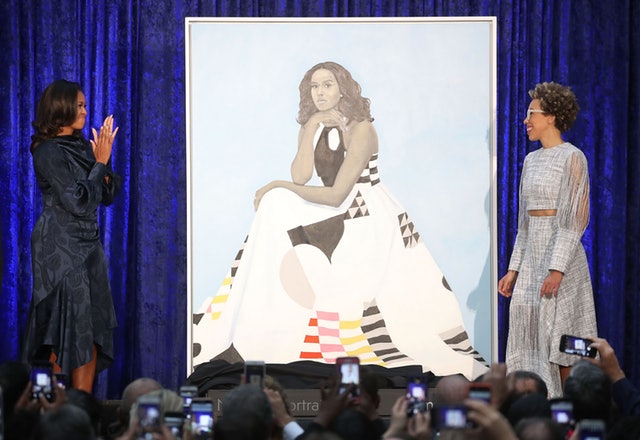
Michelle Obama, by Amy Sherald
Yesterday ago a public ceremony, former President Barack Obama and former First Lady Michelle Obama unveiled their official portraits for the Smithsonian's National Portrait Gallery in Washington, DC. The artists who painted the portraits, Kehinde Wiley and Amy Sherald respectively, were present at the event, and, like the Obamas, each artist spoke about the process and experience of painting these works, which, as the images reveal, will not only honor the first African American US President and First Lady, but also mark a distinctive aesthetic shift in terms of the ways they represent these major historical figures. It should also be noted that Wiley is the black man and first out, black gay artist to paint a presidential portrait, and Sherald is the first black woman ever to paint one. Amidst the foliage surrounding him, Barack Obama's portrait contains flowers with specific reference to and resonance for the 44th President of the United States. Michelle Obama's image shows a dress specially designed by designer Michelle Smith, under her company Milly, for her Spring/Summer 2017 collection. The dress has the aura not only of a unique flag, but also evokes the long African American and American tradition of quilt-making.

Mark Wilson/Getty Images News/Getty Images

The Obamas selected the artists who painted them. As both Obamas shared, they had discussed their portraits with the artists before the painting process, so neither was a surprise. Each artist had two sittings with the Obamas, and from those the created the portraits revealed yesterday to the public, each taking roughly one year. Both portraits went on display today, though they will not be shown together. President Obama's will become part of the official presidential portrait gallery, while Michelle Obama's will be visible through November 2018 in the National Portrait gallery's corridor of recent acquisitions. Wiley, 40 and a native of Los Angeles, is already quite well known as one of the leading painters of his generation, with shows and work in collections at museums and galleries all over the US and world. Moreover, Wiley had already received a US Department of State Medal of Arts in 2015, which meant that his work would be displayed in US embassies across the globe. Amy Sherald, 44, is less well known, but has had an ascendant career in recent years, winning the Outwin Boochever Portrait Competition at the National Gallery in 2016. She has suffered from congestive heart failure, which was diagnosed at the age of 31, and successfully received a heart transplant in 2012.

Mark Wilson/Getty Images News/Getty Images

Barack Obama, by Kehinde Wiley
I don't have an elaborate critique of either portrait, but in the case of Barack Obama image, I wish it had featured his beautiful smile. The encroaching foliage also struck me as having the potential for parody, though I read it as symbolic of his steps, often forgotten, to address the pressing challenges of environmental conservation and climate change, both of which are targets of reversal by the current occupant of the White House. In the case of Michelle Obama's image, I understand Sherald's recourse to grayish color for black skin tones, which she has discussed in various interviews and profiles, but I do wish she had nevertheless mixed things up and featured the former First Lady's beautiful hues. The dress fascinates me; its flatness and intersecting planes remind me of Gustav Klimt's and Ferdinand Hodler's work, as well as other Art Nouveau artists (is there a resurgence of interest in their work?), and folk art in its muted color and solid background, and both paintings, in certain ways, put me in mind of the work of peer artists Mickalene Thomas while also harkening back to their earlier black predecessor Barkley L. Hendricks. In both cases, I think we have portraits for the ages, and new standards for all subsequent presidential artists to aim for.

Wednesday, November 19, 2008

Sports + Barkley L. Hendricks at Studio Museum in Harlem

Okay, at first I was thinking, nothing literary today. The "apparatus with which I think" (Bierce) is tired. So: sports. And specifically: baseball.

Yesterday, St. Louis Cardinals first baseman Albert Pujols was named the MLB's 2008 National League Most Valuable Player. Pujols hit .357 with 37 home runs and 116 RBI, and had an on-base percentage of. He beat out the World Champion Philadelphia Phillies' (and native St. Louisan) strapping slugger, Ryan Howard, who hit 48 homes (first in the league) and drove in 146 runs (first), while hitting only .251.


Albert Pujols, aka El Hombre (or Prince Albert, Phat Albert, The Machine, and my personal tag for him, Big Papa, Photo: Emily Rasinski/P-D)

Pujols was easily a more consistently dangerous threat at the plate, with an on-base percentage of .462, and a .653 slugging average, both well ahead of Howard. He was second only to Atlanta's Chipper Jones (.364) in the batting title race.

This is Pujols's second MVP award, making him the first Latino and Dominican player to achieve this status; his first came in 2005. He has been in the top five every single year he's been in the league, save last year, and is the only player in MLB history to have 30 home runs and 100 RBIs in this first 8 seasons. It's not unlikely that if he had better protection in the lineup he could have hit even better. As it was, despite being out 12 games because of injuries, he still helped kept the Cardinals in contention for most of the season, until their late fade, when they finished in 4th place.

Other MLB awards: AL MVP, Dustin Pedroia (Boston); AL Cy Young, Cliff Lee (Cleveland); NL Cy Young, Tim Lincecum (San Francisco); AL Rookie of the Year, Evan Longoria (Tampa Bay); NL Rookie of the Year, Geovany Soto (Chicago); AL Manager of the Year, Joe Maddon (Tampa Bay); NL Manager of the Year, Lou Piniella (Chicago).

***

Bernie T.
pointed out this amazing story to me, and Reggie H. posted about it yesterday, so I'll send you to his blog to read more. Take it away, Reggie:

Since my partner and I got hooked on Rugby thanks to watching the Wallabies, the All-Blacks, and the Tri-Nations tournament on Fox Sports, I can't resist pointing to this video and article about The Hyde Leadership Public Charter School in Washington DC, from the New York Times.

When the team starts the post-game singing of "Lift Every Voice and Sing," I get all choked up....

Aim High, boys!
***
I seldom read Newsweek magazine, but I did flip through it today while waiting at the pharmacy, and saw Sarah Bell's article, "Urban Outfitters," which among other things asks why Kehinde Wiley, whose gorgeous new paintings are lighting up New York (in the exhibit "Down" at Deitch Projects and elsewhere) hadn't acknowledged his debt to Barkley L. Hendricks.

Who is Barkley L. Hendricks? Well, interesting that you ask, because today the New York Times offered a brief focus on Hendricks that's worth checking out. Hendricks is an important but little heralded painter whose work from the 1970s on has mapped out a new area in African-American and American vernacular, photorealist portraiture. To give one example of his work, I've posted of my all-time favorite of his works, "North Philly Nigga (William Corbett)," [1975. Oil and acrylic on cotton canvas, 72 ½ x 48 ½ inches. Collection of E. Blake Byrne, Los Angeles], which resoundingly evokes a world I and many others know and recall so well. Many of his most famous paintings, full-size in scope, depict urban black male subjects, sometimes in dandyish fashions, sometimes in street wear, but he also has painted numerous portraits of black women and group images, some inspired by prior works in the Euro-American art tradition, others drawn from his own photos and mass media imagery, as well as from his personal life. He also has exhibited some of his photography, which mines a similar vein.

Hendricks, it turns out, is having his first major retrospective exhibit this year; titled Barkley Hendricks: Birth of the Cool, it's now at the Studio Museum in Harlem (it runs from November 12, 2008-March 15, 2009). (You can hear the great art historian Richard Powell on Hendricks' work, from the exhibit's previous stop at the Nasher Museum of Arts at Duke University website.) A graduate of the Pennsylvania Academy of Fine Arts and Yale's art school (BFA, MFA), and a longtime professor at Connecticut College, he has been making his art almost concurrently with the rise of late 20th century vernacular forms such as hip hop, funk and r&b, and his work is the epitome of soul, wit, grit, rawness, queerness, and realness. Although work of this kind hardly seems revolutionary now, especially with the "return" of painting, especially representational and realist painting over the last few years, Hendricks is and should be acknowledged as an important pioneer. His DNA is all up in Wiley's and others' work. So give some props, bruh. And let's all get up to the Studio Museum (and Deitch) if we can!

Hendricks on YouTube (doesn't he sound a little like Chris S.?)

He received a United States Artist award as well this year (congrats to all the other winners, including folks I know, like Harryette Mullen, A. Van Jordan, Tayari Jones, and Forrest Gander, and many I've long admired, like Muhal Richard Abrams, Henry Threadgill, Joy Harjo, William Greaves, Jawole Wille Jo Zollar, Ela Troyano, and lê thi diem thúy!)

(Also running simultaneously with this exhibit is AACM philosopher-musician George E. Lewis's Travelogue, a SMH StudioSound exhibit that he writes was "twenty years in the making.)

Friday, October 24, 2008

Video: Two Artists

A little Alison Saar and Kehinde Wiley for the weekend!


Alison Saar, Interview for Otis College of Art Legacy Project (Saar, Otis '81)


Kehinde Wiley, The World Stage: Lagos-Dakar

Wednesday, September 26, 2007

Classes + Myanmyar + Strike Over + Kehinde Wiley Busts

CLASSES BEGIN
It's the first day of classes, and so far, so good! Such smart students, all of them are avid readers, and among the writers they listed as their favorites were Dostoyevsky, Ellison, Hemingway, Kerouac, Flaubert, Melville, Vonnegut, Murakami, and Salinger. Who teaching writing wouldn't want to start with such a baseline!

(That's me at right, in my office, in front of the Luis Luma painting and Ella Turenne's Neg Maron print.)

MACARTHUR AWARDS
Congratulations to the 24 recent recipients of MacArthur Foundation "Genius" Fellowships! One is my colleague at the university, the rightly esteemed and remarkable fiction writer and poet Stuart Dybek; another is the New York-based artist Whitfield Lovell, who follows his partner Fred Wilson in receiving this honor (thanks for the h/t, Bernie); another is the blues musician Corey Harris; the playwright Lynn Nottage, whose Intimate Apparel received excellent reviews when it debuted several years ago; and vocalist Dawn Upshaw, best known for her work in opera and contemporary art song. Congratulations to them and to all the other recipients!

2007 CAVE CANEM PRIZE TO RONALDO WILSON
Ronaldo Wilson, one of the founders of the Black Took Collective, is the 2007 Cave Canem Prize Winner! Congratulations, Ronaldo! His prose-poetic manuscript, The Narrative of the Life of the Brown Boy and the White Man, was selected by judge Claudia Rankine. Serena! F.I.E.R.C.E.ness, and I think it's fair to say that Cave Canem has shown how expansive its aesthetics are with this and last year's selection, of Dawn Lundy Martin's first book of poems! This year's runners up were R. Erica Doyle (!!!) and Nicole Terez Dutton. Congratulations to both of them too, so much fierceness in one year.

PROTESTS IN MYANMAR
The protests in Myanmar, which I highlighted a few days ago, continue to gain international attention, especially now that the government's security forces have started to brutally suppress them. Again, I am impressed and moved by the courage of the Buddhist monks, held in the highest esteem by their society, to put their lives on the line to challenge the horrible, oppressive conditions and the military dictatorship that has imposed them in that country.

The US has propose new sanctions, but I keep hearing that China is the lone country that can put pressure on the ruling junta and its government, and supposedly China may have already done so, but after the defense forces attacked, shot and arrested a number of the monks yesterday, it's clear that China's input may have its limits, though perhaps harsher penalties, such as cutting off arms sales, political support, and other forms of cooperation may do the trick. But does China want to buttress pro-democracy efforts in a neighboring country when its own record is so horrible? Would it, and wouldn't that be telling its own people to try something according to the Tianenmen Square rallies and protests again, despite the country's economic successes? Would the business élite even support such a move, or are they too intimately linked these days to the Chinese government?

So what is to be done to help the people there? What can the rest of the world do? Will US sanctions have any effect at all?

UAW STRIKE OVER
I woke to the NPR news that the United Auto Workers (UAW) had called off its strike against General Motors (GM) because the two sides had reached a compromise during their all-night negotations. Supposedly the agreement hinges on GM creating a retirement health care benefits trust fund, to be administered by the UAW, that will relieve a huge financial burden from the carmaker's books. Hearing this I immediately thought that if we had single-payer, government financed, comprehensive, cradle-to-grave health care, there'd be no need for such a trust fund, and GM, thus relieved of one of its major competitive setbacks, would face having to produce better, more affordable, and more appealing cars. Note to Democrats: this is another gift horse staring you in the face. It also makes me wonder about the old pension system, which many corporations exploited for their own gain and little penalty, at the expense of retirees and US taxpayers. If GM had a real, well-invested, well-managed pension, this turn of events also would not have come to pass. But the world of pensions of old is gone; in fact, as we saw in 2004, we can never relax our vigilance about making sure that Social Security remains viable and properly funded. I'm glad, though, for the GM workers who were about to face a terrible hardship; at least for now they can sleep a little easier.

SCHIP + WAR FUNDING
Yes, this isn't an original argument and it's so obvious it could be in a Bob Herbert column--I enjoy reading him, but you get my drift--but it looks like W will veto the SCHIP bill, which doesn't have a veto-proof majority in the House, because of the GOP, claiming that the $35 billion is too costly and that more American middle-class families will avail themselves of a public, government-funded program, and yet he's sent his Secretary of Defense, Robert Gates, up to Capital Hill to request $190 billion in additional funding for the debacles in Iraq and Afghanistan. Meanwhile, if SCHIP fails to be funded, poor American children would be the first to suffer.

Gall, shamelessness and arrogance don't come close to describing this man and his government!

Senate Majority Reid vowed the other day not give in to more of Bush's shenanigans. I'll believe it when I see it, but as a Republican Senator suggested about SCHIP, the House should keep reintroducing the bill over and over, and forcing the president to veto it. Eventually enough Republicans will be embarrassed enough that rather than tethering themselves to his sinking ship, they'll join the Democrats to provide enough votes for an override vote. As for the war funding, tell the president absolutely NOT until the information and testimony the Democratic chairs have requested on a range of Iraq-related issues, such as the gross corruption, Blackwater's actions, the faulty equipment (this week brought the news that the infantry must contend with guns that frequently jam, unlike their opponents!), and so forth, are adequately addressed. And don't worry about the American people; we're quite aware of the scare tactics and demagoguery this administration is going to tuse.

KEHINDE WILEY BUSTS AT CEREAL ART
Wiley PaintingKehinde Wiley's work, drawing as it does upon current artworld and critical-theoretical trends and discussions around appropriation, the archive, Black and popular cultural studies and performance, and sexuality and gender studies, has fascinated me since I first saw it, but also confounded me somewhat as well.

His paintings (at right, a photo I took of his "Saint Andrew," oil on canvas, 7'x8', 2006 when C and I went to his "Scenic" show at the Rona Hoffman Gallery in River East, in Chicago) are physically breathtaking, especially when viewed up close, and increasingly polished in terms of their technique, while also deeply suffused with an irony-edged eros, but I feel like he's found a socially and commercially viable strategy and keeps, well, exploiting it, a strategy that's meant to appeal, rather obviously, to the powers that be in the artworld, while please the Folks along the way.

His evidently and playfully ironic use of Eurocentric references, both as ground (composition, figuration, etc.) and in the titles--which I think of as falling in a long and broad lineage, but in a specifically queer way to Bob Thompson, for example, though Wiley is very interested in aspects of mimetic realism and expressionism, whereas Thompson, who wasn't gay, was far more grounded in abstraction and the emerging color-field school--underlines this so forcefully for me. Nothing unusual there, and he's well within the mainstream, both of the past and of today. But were he engaged in a more resistent form of détournement, say, or using classical Chinese models, for example, would his work, whose technical achievement is undeniable, be as celebrated? Would it be dismissed as Afro-Chinoiserie, or not discussed at all? (And what would that kind of work, a more complex and provocative anti-Afro-Orientalism, say, look like?) As I said, Wiley's not the only person, in visual arts or any other area of the arts, who's doing this, but I can't stop thinking about it when I consider his work. We all to some extent work with the terms set before us, but where does the limit lie? Is it unfair for me, an admirer of his work, to introduce these questions into the debate?

I'm still very drawn to his work, and so when I received a recent email from Cereal Art in Philadelphia about the availability of a new set of his busts, including his "After La Negresse, 1872," I had to check them out. I've never seen this in person, but they appear to replicate the formal and thematic concerns of the large paintings in this new form, which I think increases the layers of irony (cast marble and resin busts, all white, etc.) and humor--to what end? I don't think I have an answer, but I'm enjoying looking at them.

Cereal Art is selling them as a "special project" at $1400 a pop. What do you think?