Thursday, May 20, 2010

Abramovic Portraits + Super Tuesday + RIP Arakawa + Boycott Arizona!

Is it mid-June yet? Nope. Oh well.

On another tip: a while ago I wrote about attending Marina Abramovic's show, "The Artist Is Present" at the Museum of Modern Art. Today a student, Rachel K., sent me a link to Marco Anelli's portraits of Abramovic and her sitting participants, all 20 pages of them: Marina Abramović: The Artist Is Present—Portraits.

The Artist Is Present, from above, MoMaHere's the young woman I captured a photo of on the day I went. As has been reported, some notables (Colm Toibín, who wrote about his experience on the New York Review of Books' blogsite; Agnes Gund; James Franco; Lou Reed; Rufus Wainwright; Björk (and her daughter); Tehching Hsieh, etc.) have participated. Some, like this gentleman, participated multiple (10+?) times. Some have been brought to tears by and during the experience. Another tried to bring Abramovic energy through humor, even painting a red dot on her nose. And perhaps, most dramatically, Abramovic's former partner, Ulay, joined her as the third participant, on the first day, and took her hand, bringing her to tears.

Finally, it seems, even the museum guard who appeared to have been a bit bemused about it all the day I was there got into the act. Oh well. If you can't dismiss them, join them!

Monday, May 17, 2010

IDAHO (Int'l Day Against Homophobia and Transphobia) + Harvey Milk Week of Action in Chicago

It's May 17, which means it's also International Day Against Homophobia and Transphobia, or IDAHO. The brainchild of Dr. Louis-Georges Tin, a black gay scholar, writer and activist (with whom I conducted an interview several years back, accessible here), IDAHO began 5 years ago, after Tin began an initiative, in August 2004, to create a truly global International Day Against Homophobia. His aim was for "universal recognition" of this day, and he proposed that it be fixed on May 17, "to commemorate the World Health Organisation’s decision to remove homosexuality from the list of mental disorders." Since May 17, 2005, numerous countries and groups within those countries have called for an end to homophobia and transphobia, and a push to decriminalize "homosexuality" has also spread. The idea behind today is an important one: what would it mean to fight against fear and hatred of and end legal oppression of LGBTQ people?

Central to the logic of the day is that it is homophobia that is the problem, and should be "deconstructed in its social logic and done away with." On the map below, in countries colored blue, there have been or will be events--marches, celebrations, parades, kiss-ins, public speeches--to commemorate IDAHO.

Sunday, May 16, 2010

Music Keeps Me Sane

Another day, another day deep in a document mine. I did agree to participate in Jen Karmin's launch of her new book, Aaaaaaaaaaalice (Flim Forum Press) this evening, so I'm heading over to Cole's Bar (the event is free, 21 & older) for that and a bit of poetry fuel. If you're in or around Chicago, please do stop by!

In between reading, I've been alternating between listening to lots of great podcasts and watching lots of YouTube videos. (Remind me again why I pay for monthly cable TV service?) Here are a few I've been listening to over and over. Enjoy.

The Younger Lovers, "Sha-Boo-Lee"


Janelle Monáe, "Tightrope"


Yin Yang Rita Indiana, "El Blu de Ping Pong


Baden Powell, "Tristeza"


Dope Sagittarius, "Dope Sagittarius"


Anthony Hamilton, "The Point of It All" (Live)


Raheem DeVaughn (feat. Ludacris), "Bulletproof"


The More Assured, "All In Your Head"


Casiotone for the Painfully Alone, "White Corolla"


Lena Horne, "Love Me or Leave Me & The Eagle and Me"

Friday, May 14, 2010

Update + Recent Drawings

The steamrolling weeks continue, but there have been some highpoints. (I also want to acknowledge the passing of pioneers Lena Horne and Dorothy Height, two strong, smart, beautiful, visionary black women whose courage, determination and grace have made so very much possible for all who follow in their footsteps.)

On Wednesday, Nathalie Stephens/Nathanael, whom I'd seen read last Saturday at Las Manos Gallery's Uncalled-For Reading Series (photos coming!), with Kareem Khubchandani (a grad student at the university, working with the brilliant E. Patrick Johnson), and Trish Bendix, came to speak to my class about her remarkable recent book, Absence Where As: Claude Cahun and the Unopened Book (Nightboat Books, 2009), which was revelatory in so many ways. Then, right after class concluded, I went to M. Nourbese Philip's reading, which was sponsored by the university's Poetry and Poetics Working Group and the Humanities Center. She read/performed--quite extraordinarily, I testify--from her recent work, Zong! (as told to her by Setaey Adamu Boateng) (UPNE, 2008), which I believe the UniVerse of Poetry and Chicago Public Radio audiotaped, meaning that it will be available very soon, I hope. On Thursday afternoon, she participated in a conversation sponsored and attended by members (students, faculty) of the Poetry and Poetics Working Group and scholars from outside the university.  It was as Barbara Tucker sang: I got lifted.

Amidst everything else, I've been trying to funnel my artistic yearnings into something productive, which has meant a bit of sketching whenever I can. Below are some very recent drawings. A certain developer I know very well (Mr. C-thank you!) passed on a first generation iPad, so I've been trying that out too, though I haven't figured out if the iPhone drawing app I like, Sketchbook, is fully functional, especially with layers. I'll post some of those soon.  Miriam asked in a previous comment whether I completed these all at once, and I'd say that I usually finish the monochrome ones fairly quickly, but with the full-color ones I tend to get as much done as I can the first pass through, then I return to work with them a bit more. I also tried a few different styles this time through, as will be evident. The fastest drawing of this group is the one of Gerard Cadava (a colleague in history), at his father's talk. I was taking notes assiduously, so as soon as I found a lull of sorts, I sketched him, then returned to my note-taking. The base pen tool color was blue, so that's what I went with. The two black-and-white drawings are the first I've ever done in one pass, while standing (I was waiting in line at a restaurant, so I drew people standing right near me). And then there are the drawings of the artists: Cristina (I haven't shown this to her yet), Chris Ware, and Anders Nilsen. If I can get the latter two figures email addresses, I think I'll forward them directly.

iPhone drawing
Drawing from today
iPhone drawing
Drawing from today
Gerardo Cadava: iPhone drawing
Gerardo Cadava
Cristina Henríquez: iPhone drawing
Cristina Henríquez
Chris Ware: iPhone drawing
Chris Ware (did you ever wonder what he looked like?)
Anders Nilsen: iPhone drawing
Anders Nilsen

Friday, May 07, 2010

Some Talks & Music (Garcia, Cadava, McGurl, the Drawers)

I'd actually forgotten that I'd posted a blog entry to start May off, so I was about to apologize for just now acknowledging the month had arrived, but it's been slamming me and beyond classes and my syllabi I barely can keep up with what day it is, let alone month. I thought this week was going to be slower, but it's been just as rough, but June is, thankfully, just around the corner....

Amidst all the reading, I have attended a few events at the university, all of which have been edifying in different ways. Starting backwards, tonight I went to hear the musician Paulinho Garcia present a short (1 1/2 hour) tour of Brazil.  Truthfully, as all who know me will readily acknowledge, anything having to do with Brazil gladdens me immensely, and this didn't fail in that regard. The interactive performance felt like the best way to end a busy week. Garcia, a native of Belo Horizonte and 3-decade long resident in the US, was introduced by my great colleage Ana Thomé-Williams (above at right, with Garcia) also from Brazil, who had also helpfully created a slideshow featuring not only a map of Brazil but featuring song authors, titles, and lyrics, to which we could all sing along with Garcia. And sing people did as Garcia walked us through the samba (giving us information on its origins in Bahia and before that the Congo region, and word's Bantu etymology), then several different sertanejo (from the sertão, the harsh scrubland interior or backlands of the northeast) forms, and then the choro and chorinho, then a caipira (another type of folk song--and the source of the word, on through bossa nova.  Tracing it via songs and musicians, he sang (beautifully, touchingly) Ari Barroso's "Aquarela do Brasil," Luiz Gonzaga's "Asa Branca," Tom Jobim's "Andança," Pixinguinha's "Lamento," Zequinho de Abreu's "Tico-Tico no Fubá" (one of the earliest Brazilian songs to achieve fame in the US, and which made Carmen Miranda famous), Pixinguinha's "Carinhoso" (so achingly moving), Renato Teixeira's "Romaria" (which Ana graciously led us through in chorus), Tom Jobim's and Vinícius de Moraes's "Eu sei que vou te amar," Jobim's and Vinícius's "Chega de Saudade" (from Marcel Ophuls's Orfeu negro/Black Orpheus), João Bosco's and Aldir Blanc's fairly contemporary "Coisa Feita" (with its strong Afro-Brazilian storyline), and finally, to end the event, Ana and Garcia sang the always stirring Carnaval melody, "Tristeza," a snippet of which I captured on camera. Afterwards I chatted briefly with Garcia, who was explaining the ins and outs of Brazil to some undergraduates and other attendees, and I ran into a former student, from my earliest days at the university, who was doing really well. I also spoke with a young math student from Belo Horizonte, who suggested I tell a friend now conducting research in Niterói, just across the Guanabara Bay from Rio, about the Institute of Pure and Applied Mathematics that sits between Rio's Botanical Garden and its Tijuca Forest. How on earth could you get any work done in such a remarkable setting? I'd like to find out.

Sunday, May 02, 2010

Congrats to Wilson & Martin & Dowdy + Glissant Book Launches + Mille Grazie to Gukira

Congratulations to the one and only Ronaldo V. Wilson, who received the Publishing Triangle's Thom Gunn Award for Gay Poetry for his lightning bolt of a second collection, Poems of the Black Object (Futurepoem Books, 2009)! This is an extraordinarily important collection embodying what's most exciting these days in poetry. It's great to see it and Ronaldo, who also won the Cave Canem Poetry Prize for his first book, so honored.

Congratulations also to Ronaldo's fellow Black Took Collective member Dawn Lundy Martin, whom I got to hang out with a little at AWP, for winning the Nightboat Books Poetry Prize, for her new collection, Discipline, which will be published in 2011. Fanny Howe was the judge. If you know Dawn's work, including her first book, which also received the Cave Canem Poetry Prize, you can be sure this new collection will leave you thinking about it every time you set it down. Props to a brilliant and blazing poet.

Congratulations to my cousin, Dawn Cecilia Dowdy, whose new Christian Romance three novels-in-one, Chesapeake Weddings (Barbour Books, 2010) is now available! I remember back when Dawn began actively seeking a publisher for her first novel, and her persistance, determination and vision have paid off; she's the author of 6 volumes, totally 10 or so works of long fiction, and her talent and prodigiousness never cease to impress me!

Also, congratulations on Nightboat Books' recent publication of Edouard Glissant's Poetic Intention, translated by Nathalie Stephens/Nathanaël. As part of the book's official launch, Glissant and Stephens participated in a public discussion with NYU Professor J. Michael Dash last week at the Maison Française. Glissant's Caribbean Discourse and The Poetics of Relation are seminal works, and Stephens is a superb translator, so I'm really looking forward, when I have a breather (months from now), to get a copy and dive in.

Lastly, I would like to thank Keguro Macharia, the dazzlingly sharp thinker and scholar whose blog, Gukira, is an indispensible read. He is one of those people for who loftiness, in the best sense, comes readily and compellingly, and I'm very glad that he continues to blog even as his career in academe takes off. Some years ago he wrote a short meditation on my first book, Annotations, that was so profound and lyrical it left me speechless.  I don't think that's up any longer, but I recently learned from Chris Stackhouse that last year, around this time, there appeared on Gukira a review of Seismosis. About it will say no more, since it speaks for itself, but I do want to thank Keguro from the bottom of my heart, not only for how positive it is, but for full of insight, really deep reading, and knowingness it is. Chris and I have been lucky to have received praise for various quarters for the work, and have also seen it taught in various places (and by people who aren't friends), but as with a good deal of the things I have done, it has also met with great bafflement, to put it mildly, and relative silence in terms of reviews (though we have also received some very good ones), particularly from fellow black and queer writers and thinkers. I will not go into the history of my discouragement about such things, but I do want to make it clear I am aware that there are numerous works out there, including works of this sort, and that scholars in particular have pressing concerns they must address, so for a young scholar to devote his critical eye and acumen to our work is a great honor, and I think it's fair to say on behalf of Chris, once again, thank you!

On Immigration

As I mentioned in my post yesterday, for over a week I've been wanting to write about the issue US immigration, a contentious topic that has festered for years before exploding over a week ago, on April 23, when the GOP-dominated Arizona legislature passed one of the most extreme and extremely racist anti-immigrant laws the US has witnessed in decades. Republican Governor Jan Brewer signed it into law the next day.  To quote the New York Times, this law "would make the failure to carry immigration documents a crime and give the police broad powers to detain anyone suspected of being in the country illegally." In fact, it basically requires them to do so if they suspect someone is in the country without documentation; in fact, Republican Congressman Tom Bilbray (CA) suggested, without irony, that you could tell undocumented immigrants by how they dress!

This element of the law particularly sparked a furor, leading to boycotts, yesterday's marches, withdrawals from the state's higher educational system, and cancelations of events scheduled to take place in Arizona, yet Brewer and those behind the law have claimed, in bad faith in my opinion, that it would not lead to racial or ethnic profiling. The White House, many leading Democrats and some Republicans have condemned the law, as has Mexico's government. The overly broad law caused such an uproar, in fact, that the Arizona legislature passed amendments, signed by Brewer this past Friday, that qualify the pretext for stopping potential suspects, requiring that it occur only if the police were enforcing a law or ordinance. Nevertheless, the ACLU and others note that the law still allows racial and ethnic profiling, while also making it a crime to live in or pass through the state without documentation (meaning that everyone had better have a passport, birth certificate, or other required government ID, such as proper visas on them, at all times). On top of this law, the Arizona Education department will now bar teachers with pronounced accents (!) or who speak ungrammatically from teaching classes for students still learning English, and is sending out auditors to evaluate teachers. While I do agree that people teaching English, especially English as a Second Language (ESL), should be able to convey standard, proper English-language grammar, the arbitrariness of this dictate smacks of yet more racism and ethnocentrism.  Yet another bill, pushed by Republican attorney general candidate Tom Horne, now the Arizona superintendent of public education, awaits Governor Brewer's signature: it aims to ban ethnic studies classes in public schools, and specifically any courses that promote the overthrow of the US; promote resentment toward a race or class of people; are designed primarily for pupils of a specific ethnicity; and advocate ethnic solidary instead of treating students as individuals. So inane and dangerous is this bill that it could bar American history classes that discuss not only the practice of genocide against Native Americans, the enslavement of African Americans, the mass deportation of Latinos under Herbert Hoover, and the internment of Japanese Americans, but the centuries-long political and economic disenfranchisement of White women or the White working class!

Yesterday all over the United States, people marched to protest the truly horrendous new Arizona law, which violates civil rights, human rights, and, as I imagine will be proved when legal challenges play out, the United States Constitution, but also to call attention to the attitudes behind it, and to push for comprehensive, fair, and forward-looking immigration reform.  The current muddle serves no one except powerful business interests, who benefit from open and unsecured borders, disempowered and undocumented workers, lower wages and salaries, and a government that talks out of both sides of its mouth.  This has got to change, and we must demand that the President and Congress, whether they have the courage or stomach for doing so, act instead of dithering and passing the problem down the road, so that it can be demagogued for the benefit of extremists. We're all harmed the longer this goes on.

Almost exactly four years ago on this blog I posted a longish series of thoughts on the immigration issue. (I've posted many times on the immigration issue, and searching the blog will pull these up.) Though we have a new administration, the issues remain almost the same as when George Bush was president, though the rhetoric has gotten harsher in some ways. We still are witnessing foot-dragging from the federal government, conflicting messages instead of policies that will benefit US citizens and undocumented immigrants, and a rhetorical vacuum that racialists and supremacists, many of them rooted in the Republican Party, freely take advantage of.  Here's what I wrote years ago (note the commentary about the anti-Latino component), and unfortunately, nearly all of it still is relevant.
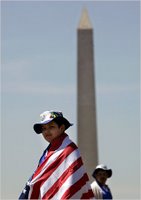
Thoughts on the Current Immigration Discussion (2006)

Today, over 1 million immigrants and their supporters rallied across the country, in cities from Atlanta to New York (the photo at left is from the Washington rally, Evan Vucci/AP). My own thoughts on the immigration issue are simple and may be naïve, but here they are:

1) All of the immigrants who are already here should be offered a simple and clear path to naturalization. The INS (or whatever it's called now) should address the problem of anyone who has serious criminal convictions (and I don't mean traffic violations or marijuana possession) here or in their native country, but in general, everyone else should be given a clear and realizable opportunity to become a citizen. All. Of. Them. The last I looked, all of the nativist Republicans in the House or Senate who were pushing for draconian penalties against the immigrants (Sensenbrenner, Tancredo, etc.) were descended from European immigrants, some of whom arrived no more than a century ago (and in many cases were given all kinds of opportunities at the expense of Native Americans and African-Americans), and some of whose ancestors were the objects of harsh anti-immigration sentiment and actions. How quickly and completely they forget.

2) If most Americans are concerned with the economic impact of uncontrolled immigration, and studies on the issue are mixed, though it does appear that adult American citizens who did not graduate from high school are most negatively affected (and this would include white, black American natives, and latinos), then the criticism and penalties should be laid at the doorstep of US businesses that flout the laws and continue to employ undocumented workers, which does depress wages in specific industries while increasing profits. On almost every other measure, immigrants benefit the economy. So long as the US economy keeps growing and businesses keep employing undocumented workers in large numbers without penalty, immigrants seeking jobs will try to get here. The economics seem clear to me, though I could be quite wrong in this.

3) The guest-worker program is a long-term mess waiting to happen. The guest workers will be counted for voting purposes, like Native Americans, African-American enslaved people and women once were, without voting rights and few other civil rights. This is already happening with undocumented workers, and the guest-worker program would write it into law. Again. Employers will continue to employ undocumented workers despite the numerical limits (of 400,000--is this supposed to be a cruel joke?). None of the guest workers will want to go home unless things improve in their home countries or they earn enough to create a viable life back there. Their children, if they have any on US soil, will be American citizens, further tying them to the US. Nothing will be solved. The German and other European models for this sort of program should give everyone pause, though the president [Bush], with his negative capital, was hoping that his lackeys in Congress would pass it, though they had another plan altogether in mind.

4) Since the US government, both the White House and Congress, claims to to take national and border security seriously, it needs to show that this is more than rhetoric and shadowplay. I'm not sure what's going on with the multimillion-dollar boondoggle that we call the Department of Homeland Security, but four years after 9/11, it doesn't appear that there's any real or concerted effort to control the flow of people into the country, unless they are baseball players from Cuba or a European Islamic scholar against whom the current administration has a particular ideological animus. If people can enter the country freely, legally or otherwise, they will, especially if there are available jobs here. For those immigrants who are looking for work, this is a no-brainer.

5) The US needs to revisit the NAFTA agreements and any other pro-free market international trade programs that have devastated particular sectors of treaty members' economies. Mexico's agricultural sector suffered terribly after NAFTA went into effect, and continues to suffer. Neither "free trade" nor the "free market" are "free," despite the neoconservative and neoliberal orthodoxies that the Republican party and much of the Democratic party, especially the DLC wing, subscribe to. Planned, closed economies cannot be the countermeasure, but every US "free-trade," "free market" program needs to be revisited and reworked carefully, particularly if it's only benefitting corporations and shareholders, while millions of working-age people no longer have any realistic employment options. Citizens across Latin America have woken up to the failures of neoliberalism, and Americans need to open our eyes as well.

6) Much of the hysteria involving the immigration issue is focused on Latinos, and in particular, on Mexicans. I'm sure there's no one out there who doesn't already know this, but almost the entire Southwest was under Spanish control, and then was part of Mexico, before it became US territory. Mexicans and people of Mexican heritage have lived in parts of the West and Southwest for centuries. As I pointed out about a month or two ago, Herbert Hoover oversaw the mass deportation of Mexican immigrants and Mexican-Americans, i.e., US citizens, during the Depression, and only recently was there any apology or acknowledgment of this. This is not to imply that the current Mexican immigration is a kind of karmic payback, but I do want to note that Mexicans in particular have longstanding historical, cultural and social ties to the US. Mexicans, like Canadians and the citizens of other countries that are geographically or historically linked to the US are going to come to the US for job opportunities if they're here, as will people from elsewhere in the world. How many undocumented Canadian citizens are there in the US? I don't see any outcry against Canadians, because most Canadian immigrants to the US are, I would imagine, white.

In fact, there is almost no outcry against undocumented immigrants from Europe (and it's as if the immigrants from Africa, the Caribbean [except for Cuba] and Asia are not acknowledged at all), even though our major cities, and many industries, are full of them. The men working on the lot next to our home in New Jersey are from Eastern Europe. Are they documented? Before I bought my car, half of the cab-drivers I encountered in Chicago were from Romania. Were they documented? Yes, the majority of immigrants to US come from Mexico, but this shouldn't surprise anyone, because the US and Mexico are historically and economically linked and many Mexicans have long had ties to the US. There are numerous immigrants from other countries--in my neighborhood and throughout Chicago, I regularly come across immigrants and refugees from Nigeria, Sudan, Haiti, El Salvador, Dominican Republic, Poland, Romania, Russia, and so on. In fact, from 1990 to now [2006], as I reported before, more immigrants from Africa came to this country than all the Africans brought to the US during the period of the slave trade. The immigration issue is not a Mexican or even Latino issue--even if most of the immigrants are from Latin American countries--but a human rights issue.

6) The nativists fail to look at another issue that we should be talking about, which is that if the ideology of neoliberalism and free market globalization are what they are going to keep pushing, they need to rethink issues of nationalism, national sovereignty, citizenship, and the concept of borders altogether. We are quite far from a situation of Kantian perpetual peace pervading a united, one-nation state, yet economic free-trade ideologues seem to believe that goods and services can and should cross borders at will, but fail to acknowledge the real-world national and local issues and crises that arise when real people do so. What do national sovereignty, nationalism, citizenship, constitutionally guaranteed rights, and borders of all sorts mean in an age of globalization, transnationalization, and global and transnational capital?

7) Criminalizing anyone who assists undocument workers is wrong. Building a 700-mile wall is ridiculous. Changing the law to eliminate birth-citizenship is outrageous. Expelling 12-20 million people is absurd and would be impossible anyway even if it weren't.

8) Finally, African Americans individually and as a whole really ought to be thinking carefully about the current immigration situation and its effects on this country. In most of the largest waves of immigration prior to 1965, immigrants of African descent were in the minority, and in places where there was a sizable African-American population, whether Boston, Philadelphia, Savannah, Charleston, New York, etc., African Americans were usually been pushed to the back of the line in favor of the new, mostly European immigrants. Immigrants of African descent usually blended into the African-American population within a generation or two. With the arrival over the last three decades of millions of Africans and people of African descent from Latin America, as well as millions of other Latinos, Asians, Arabs and European people (of all races), I think that we need to revisit and challenge static views of racial prerogatives, race and racial authenticity as they've has traditionally functioned in the US. I also hope the recent waves of immigration provoke a rethinking among African Americans about how we stage racial and ethnic identities in the economic, political and social spheres. Who is black and how do we speak about blackness, and race in general? What is authentic blackness? What is the black real today? How do we and can we represent it? Must one history or set of historical narratives, or racial, national or ethnic (or any other, for that matter) identity or identification trump or cancel out another, or mustn't we begin to think with complexity about who we are? (And this is the case not only for African Americans, but all Americans.) Barack Obama is us. I also hope it will provoke active coalition building to address a number of crucial issues the country faces, and in particular, that African Americans and black people in general face. White supremacy is not going anywhere anytime soon, so thinking of ways to promote countersocialization and counter-processes of identity formation and identification that do not yet again make and reify African Americans as the absolute negative Other, and that foster dynamic cross-racial alliances and means of identification across and within ontological racial boundaries with replicating the current racialized social hierarchies, are some of our current major challenges.

Saturday, May 01, 2010

Moderating Posts + Life These Days + iPhone Drawings

I hate to be forced to go this route, but I'm going to have to moderate comments (few though they be), because Blogger, one of Google's many arms, has fallen prey to aggressive spammers and malware that signal to each other which blogs are good targets. I hadn't realized how much of a problem this was until I saw that composer and critic Greg Sandow's blog, like all the Arts Journal blogs, had to disable comments because of the torrent of spam. I'm starting to get it too. According Sandow, the spammers play people to type in the "captchas" (the letter-number combos that had served to prevent autobot spammers). As I said, I hate to go this route, but for now I'll have to.  I will strive to approve comments, if any come in and they aren't spam, in a timely manner.

+++

As a review of my April posts shows, I wasn't too successful this year with my Poetry Month posts. I still have not had an opportunity blog the photos from this year's AWP conference in Denver, some of which I really like, though I did upload them to Flickr. (Blogger now automatically saves computer-uploated photos to Picasa, which I suppose is another Google tentacle.) I was thinking yesterday, how did I manage even to post poems and commentary while in Cuba last spring, and then I recalled that I wasn't here for our wonderful Writing Festival (I just need to finish those posts, really), and my workload, while always very heavy, wasn't what it is right now. I won't begin a lamentation, but I realized I was feeling something akin to mental whiplash yesterday when talking to C--as I was about to go meet with one of my grad students to discuss his novel-in-progress--because I kept thinking that half the tasks or events I participated in this past week had occurred several weeks ago.  It can get a bit...crazy-making, to put it mildly.

And so, if anything has to go, it's the blogging.  I rarely Facebook, but even my tweeting has diminished to occasional squeaks, as the update at right make clear. Given all the major public events unfolding right now, from the horrificly racist new anti-immigrant laws in Arizona to the unfolding oil rig disaster in the Gulf of Mexico to the British election campaign to debates over financial reform, it's been tough not to be able to post. But such is life, at least right now....

===

On a brighter note, here are a few iPhone sketches I've worked on since returning to Chicago (I already posted the one of Marina Abramovic). Enjoy!

Man in Starbucks, Chicago
Man in Starbucks
Young man on train, Chicago
Man on train, Chicago
Young woman in library cafe (Evanston)
Woman in library cafe, Evanston
Young woman on PATH train, New York
Woman on PATH train, NYC (her Rihanna-esque hairstyle immediately made me want to draw her)

Saturday, April 24, 2010

Sewer Blues + In the Garden

A little over half a decade ago, during the housing bubble's upward rise, President Bush, like countless other people on cable TV, at banks, at mortgage lenders, in the media, actively promoted home ownership. It was touted as a basic right, almost, anchor its centrality to the mythic American dream. (The more pressing issue of affordable housing, whether private or public, for everyone, was removed from public discourse.) As we now know, the bubble has burst completely, hundreds of thousands people have lost their homes and millions are underwater and unable to pay for them, hundreds of domestic banks have failed, and the US and global economies have taken a severe hit. I can't say I was prescient about or fully understood the housing bubble, though C and I were always skeptical of the ease with which so many people were snapping up homes, flipping them, and spending down their equity (I hadn't even realized the HELOC madness was going on until years later, though a close friend of mine lost his home in part because he'd used it like a charge card), given the hurdles we had to vault to purchase our house. I used to launch on this topic to people, and I'm sometimes wondered whether they were thinking, What a bore and so wrong too. On top of this, and again, I wasn't aware of the various schemes people were using to remodel, renovate, and rebuild homes, I also couldn't understand how nonchalant people were about the expenditures involved, based on our experiences with having to shell out small fortunes to address basic problems a house may eventually present, including but not limited to: addressing a leaking roof by having to completely re-tar and re-flash it; replacing a hot water heater; having a chimney properly lined; replacing an air conditioning and heating unit; and, this weekend, the replacement of a basement underground, 100-year-old ceramic drainpipe, breached in multiple places by a a giant sycamore's roots, that leads to the sewer line out front. This is only part 1; part two will involve tearing up the street out front and replacing the rest of the badly cracked pipe where it enters the sewer. (We've fortunately avoided two other nightmares many owners of older homes face: replacing the windows, and rewiring the house. The previous owner took care of those crises at some point in the 1970s and 1980s.) In all the huzzah about buying houses, there's never--or seldom, from what I can tell--any discussion of potential multiple costs beyond the mortgage and possibly remodeling, and no matter how well a house is built or has been maintained, the problems start to rack up with age. Of course if you told most people about these costs, they might decide not to go through with the purchase, but then again, you can't predict what'll need fixing, and unless you're a contractor yourself or have oodles of time on your hands, you may need to pay other people to do the job properly for you. (We went through four roofers, including one who wanted to cover the leaking chimney with stucco and chicken wire (!), one who went insane, and another, an Australian, who was crazy as a loon, but actually did what was needed and stopped water pouring into the walls.)  It leads me to say that home ownership is a wonderful thing, especially if you can afford it, but even if you can (just barely): buyer beware!

That said, one of the joys of owning a home can be having and cultivating a garden . Since I had to be home for the major repair, C and I spent part of today in the garden and did some new planting for this year. He'd already planted tomatoes, which are growing steadily.  Some of the perennials, like the roses; the rosemary bush, as tall as a tree; the African sage; the strawberry patches; the blackberry bushes; the azaleas; the lilac bush; the rhododendron; the butterfly bush; and the honeysuckle vines, are back, at superstrength. Curiously, the collard greens, which returned late in the summer and early fall, and which we didn't harvest, are growing again, with striking yellow flowers adorning the fence. We decided to change our herb and vegetable mix this year by planting oregano; tarragon; parsley; lavender; dill; and basil; and habanero peppers; sweet peppers; eggplants; cucumbers; zucchini; yellow squash; broccoli; snap peas; and heirloom and regular beets. (We'll have to put some red cabbage, carrots, and onions into the ground at a later date.) Working in the garden always is enjoyable, and today was calming counterpoint to watching the basement jackhammered and dug up, though its floor is now partially repaved and the new pipe is in, at least up to the sidewalk. After we pay for the rest of the necessary work, those homegrown herbs and produce will definitely come in handy.

Friday, April 23, 2010

Marina Abramovic @ MoMa

A few weeks back I posted about Marina Abramovic's (1946-) doppelgänger, Brooklyn-based artist Anya Liftig, and since Abramovic's Museum of Modern Art show, "The Artist Is Present," began last month (March 14), I've been intending to catch it, and after one of my conceptual art/writing students described her experiences at the show, I vowed not to miss it. Though the nude artists reeneacting Abramovic's prior performances and the spectators misbehaving while interacting with to them have garnered the most attention, the centerpiece of the show is Abramovic's reprise of her durational performance piece on MoMa's second floor, "The Artist Is Present," in which she sits, motionless except for eyeblinks, facing any museum patron who wants to sit across the table from her.  She has performed this piece every day since the exhibit began, and will continue it through the end of the show, on May 31.

In the post I'd referenced above, Liftig dressed up as Abramovic, down to the single braid falling over her shoulder and proceeded to mirror her, sitting across from her motionlessly for the entire day, leaving only when the guard's ushered her out at the museum's closing. She labeled her corps-à-corps with Abramovic "The Anxiety of Influence," after Harold Bloom's famous study and theory.  I was curious to see if someone else would try Liftig's approach while I was at the museum, but no such luck. Nevertheless, when I arrived at the exhibit, amidst a large crowd drawn not only by the Abramovic show but by concurrent shows focusing on Tim Burton (sold out), Picasso (a crowd pleasure), and William Kentridge (which I also viewed), a young woman was sitting facing Abramovic intently, almost as if throwing down the gantlet, and I watched Abramovic and her for a while, trying to register any response on Abramovic's part while also trying to discern the ferocity I perceived on the young woman's face, in her posture, in her affect. It was almost as if she were viewing the performance as a form of mild combat, and her rigidity and stillness did not ebb in the slightest for the entire time that I watched them; Abramovic, for her part, slumped a bit forward, moving only her eyes, present in body and mind, a presence writing herself into the consciousness of everyone there. I was, almost in spite of myself, riveted by them.

My iPhone sketch of Marina AbramovicThere wasn't a long line, so I could have gotten in it and possibly faced Abramovic, but I wasn't sure I was ready to do so--if you do face her, you consent to being both photographed and filmed by the museum and her--and I wanted to see the rest of her exhibit, on the 6th floor, so I asked the guard how long the young woman had been sitting there, and he told me with weariness that she'd been there for about 20 minutes. I'd taken a few photos, which were verboten, and the guard saw me about to take yet another and stopped me, so I showed him that I could draw on the phone, and he carefully watched me for a while as I did a quick sketch of Abramovic, which I posted below, then headed upstairs.  It was definitely worth it.

Monday, April 19, 2010

Poem: Tristan Tzara

One of the things I would hear people say when I was growing up was, "There's not enough time to breathe." I sometimes feel that way, especially during these crowded and crazy academic quarters. I do breathe, and teach, and read, and any number of other things, but sometimes I do feel like I have only a few seconds' head start.

Today in my Conceptual Art/Writing class, we looked at the works of Marcel Duchamp and Tristan Tzara (at right, LilithGallery).  We'd already talked about Duchamp's infamous "Fountain" of 1917, and related it to the theoretical texts we'd read, while also placing it within a history of art and schools and styles (that included the work of Michelangelo, Rembrandt van Rijn, Hokusai, Monet, Yves Klein, Adam Pendleton, and others), and today we returned to it, and his other works ("Nude Descending a Staircase #2," "The Bride Stripped Bare By Her Bachelors Even (The Large Glass)," "Three Stoppages," etc.) before placing him in relation to Dada, which he discusses both in "The Great Trouble with Art in This Century," "The Creative Act" and "'Regions which are not ruled by time and space...'" among other pieces, and Surrealism, which led, I think quite nicely, to Tristan Tzara (1896-1973), who issued a number of Dada manifestos, including the (in)famous one of 1918.

At any rate, Tzara also has a lovely little poem that doubles as a do-it-yourself Dada poem instruction kit, called "To Make a Dadaist Poem." So we read the 2nd Manifesto of 1918, and then the Dada poem, and then we began the process of making a Dada poem.  So here's Tzara's poem. I brought in scissors and copies of the Chicago Tribune and New York Times, which was full of interesting articles today (in just the Arts section alone there were pieces on Howard Dodson's retirement from the Schomburg Center for Research in Black Culture; fiction Pulitzer winner Paul Harding's trajectory from multiple rejectee to prize awardee; a piece on Timothy McVeigh's taped prison tapes; making art at the speed of the Net by pairing techies and, well, artists; junior dance companies at the 1,2,3 Festival; and much more), students snipped and will now go create poems.

You can try it too. Here's Tzara's poem. I'll append my Dadaist poem later tonight.

HOW TO MAKE A DADAIST POEM

Take a newspaper.
Take some scissors.
Choose from this paper an article of the length you want to make your poem.
Cut out the article.
Next carefully cut out each of the words that makes up this article and put them all in a bag.
Shake gently.
Next take out each cutting one after the other.
Copy conscientiously in the order in which they left the bag.
The poem will resemble you.
And there you are—an infinitely original author of charming sensibility, even though unappreciated by the vulgar herd.

Copyright © Tristan Tzara, 1920. No rights reserved.

Tuesday, April 13, 2010

Poem: Frank Bidart

This week the university is holding its annual Writers' Festival, which this year commemorates the 30th anniversary of the undergraduate writing major program. As part of the festival, three major figures in their respective fields--poet Frank Bidart, fiction writer George Saunders, and creative nonfiction writer Jo Ann Beard--are in residence, holding master classes, conferences with senior undergraduate writers, and giving readings. The weeklong celebration will conclude with a reading by program alumni, including highly regarded writers Dan Chaon, Joshua Weiner, and Cristina Henríquez.

This morning Bidart (1939-) led a master class in which he read his famous poem "Ellen West," from The Book of the Body (1980), and spoke about his process of coming to understand how to write a longer work in verse. My first introduction to Bidart was during my college years when I read "The War of Vaslav Nijinsky" in The Paris Review, sparked in part by curiousness and by the general trend, among some of my friends, of seeking out what the various journals were publishing, as I too was on the board of one of the college literary journals, and I was struck dumb. I had never seen a poem like this. It seemed so new, so strange, with its alternating voices, one of which was clearly Nijinsky's, another his wife's, another impersonal diary entries concerning his hospitalization and commitment, its prose sections, its intensity of feeling, signified by the capitalizations and punctuation, its abruptions--; it looked and read like little else I'd seen at the time. On the basis of this poem alone I became an enthusiast. Some years later I found a copy of his second book, The Book of the Body (FSG, 1977), at the Avenue Victor Hugo bookstore, and what I had suspected, that this was a poet of great significance. Bidart has gone on to publish a handful more of his slender volumes, including In the Western Night: Collected Poems, 1965-1990 (1990), which gathered  the volumes up to that point, as well as newer work, Desire (1997), Star Dust (2005), and Watching the Spring Festival (2008). One of Robert Lowell's former students, Bidart co-edited with David Gewanter The Collected Poems of Robert Lowell (Faber, London, 2002).

Monday, April 12, 2010

Congrats to Rae Armantrout + Poem: Rae Armantrout

A busy, busy week so far, and it's only Monday, so let me take time, even briefly, to congratulate poet Rae Armantrout, a longtime and important figure among several innovative writing communities in the US, for winning this year's Pulitzer Prize for Poetry, for her newest book, Versed (Wesleyan University Press), which was also a finalist for the 2009 National Book Award. (She was in Chicago a month ago, and I did get to meet her and secure her autographs; I hope she's back through town soon.)

In several of the Pulitzer categories, this was a banner year for small presses; the other poetry nominees were Tryst by Angie Estes, published by Oberlin College Press, and Inseminating the Elephant, by Lucia Perillo, published by Copper Canyon Press. The fiction category winner, Tinkers, by Paul Harding, was published by Bellevue Literary Press, another small press, and the other nominees included Lydia Millet's Love in Infant Monkeys, published by Soft Skull Press, and Daniyal Mueenuddin's In Other Rooms, Other Voices, a highly touted debut published by the venerable mid-sized publisher and distributor W. W. Norton.

Other Arts & Letters winners included (Drama) the musical Next to Normal, music by Tom Kitt, book and lyrics by Brian Yorkey; (History) Lords of Finance: The Bankers Who Broke the World by Liaquat Ahamed (The Penguin Press); (Biography) The First Tycoon: The Epic Life of Cornelius Vanderbilt by T.J. Stiles (Alfred A. Knopf); (General Nonfiction) The Dead Hand: The Untold Story of the Cold War Arms Race and Its Dangerous Legacy by David E. Hoffman (Doubleday); and (Music) Violin Concerto by Jennifer Higdon (Lawdon Press).  Also, the late Hank Williams Sr. was honored for "his craftsmanship as a songwriter who expressed universal feelings with poignant simplicity and played a pivotal role in transforming country music into a major musical and cultural force in American life." ??? Uh, okay.

Saturday, April 10, 2010

RIP + Poem: Carolyn Rodgers

This weekend, a friend at AWP passed on to me the sad news that Carolyn M. Rodgers  had passed away. She was either 65 or 69*. A few years ago, in the fall of 2007, I wrote about a mini-symposium that my colleague Ed Roberson had hosted at the university focusing on the Chicago branch of the Black Arts Movement. One of the revelations for me and others at that event was Rodgers, whom Ed described as one the BAM's "metaphysical" poets. Rogers had studied with Pulitzer Prize-winner Gwendolyn Brooks, and had helped to found the Third World Press, before starting her own press, Eden Press, some years later.  A graduate of Roosevelt University and the University of Chicago, she had taught at a number of schools in the area, including Malcolm X and Harold Washington Colleges, and Columbia College Chicago. Though less well known than many of her peers, she was an accomplished poet, and published 9 books, including Paper Soul, Songs of a Black Bird and how I got ovah.  At John Murillo's book party, poet Randall Horton told me he was working with Rodgers on putting out a new chapbook of her work, and spoke of how excited she was that and other, future projects.

According to the Huffington Post, there will be a memorial celebration for her on May 4 (6 p.m. , at the eta Creative Arts Foundation, 7558 S. South Chicago Ave., Chicago), during which poets will read her work, and I hope to attend it.

Tell CNN, No Propaganda + AWP Doings + Poem: Yusef Komunyakaa

I'm at the AWP Conference in Denver, and have been listening, learning, reading, thinking, writing, meeting, greeting, signing, notetaking, photographing, reconnecting, remembering, laughing, buying (too many books), acclimating, eating, sleeping, draggling, and walking--lots of walking, through, as I count it, five distinct neighborhoods of the Mile High City. I have several entry stubs I plan to post soon, but let me note before I do that or complete this entry that, to shift gaits (as opposed to gears--recall, I've been walking):

Once again, CNN is considering participating in a scare campaign to gut Social Security. They are planning to run IOUSA, a testeric deficit-fright documentary funded by the Peter G. Peterson Foundation. Recall also that when George W. Bush was president, Vice President Dick Cheney famously stated that "deficits don't matter." They never do when Republicans are running the country, into the abyss. Now that we once again have a Democrat in the White House and Democratic control of Congress, the deficit frenzy is approach and surpassing the same pitch as it did in 1992, when Bill Clinton was in office. (Yes, it happened then.) Clinton left the country with a surplus, which Bush-Cheney promptly burned through like kindling, before amassing a $1 trillion+ deficit to underwrite unfunded tax cuts, his wars, and so much else. Unfortunately, Obama seems both prone to listening to the Washington echo chamber and to splitting the difference at every step, meaning that he appears to have bought into this frenzy. CNN, trying its best to mimic Fox News (and shedding viewers in the process), is also striving to do its part. But let's join the Campaign for America's Future and tell CNN, nope, you aired IOUSA once; we don't need this propaganda disseminated anymore. We have more than enough pressing problems, and while the deficit isn't the least of them, it's also not the most important either.

Since Obama and the Democrats will not make the basic argument--intuitive though it is, and economically sound--that the more people who're employed the more quickly the deficit will drop, because employed people PAY TAXES--the rest of us will have to make to everyone who is unaware of this basic fact. There is no need to gut or slash Social Security, or privatize it using casino financial system typified by Wall Street and much of the global economy. Medicare will undergo necessary restructuring as a result of the recent health insurance reform bill. So, please, tell CNN, no thank you. Please also urge others you know to do the same as well.  We all owe the USA, but the deficit scare project isn't the answer or one we want them to contribute to.

Monday, April 05, 2010

Unemployment Benefits Cut + Baseball's Back + Poems: Shin Yu Pai

I hate to start on a down note, but today 400,000 Americans will lose their unemployment insurance, because members of the Senate GOP--first Kentucky's former baseball player Jim Bunning (see below), and now Oklahoma's gift to the country, Tom Coburn, MD, who reportedly committed Medicaid fraud and also reportedly performed a tubal ligation on a woman against her will--see fit to play games with their lives. Their hobbyhorse, never once raised during the votes for the unfunded Bush tax cuts, which destroyed the surplus President Bill Clinton left and added over $1 trillion to the deficit, or the rush to send troops to raze and occupy Iraq, or blow money on Medicare Advantage, a multibillion-dollar boondoggle, is that any spending must be "paid for."

As anyone who has ever been unemployed and relies on unemployment insurance knows, this little bit of money can be the only thing keeping a roof over your head, food in your stomach, and your lights on. But to Tom Coburn, Jim Bunning, and others in the GOP, the suffering of hundreds of thousands of people, including their children and elderly relatives, who'll also suffer, doesn't matter.

Won't you join me and urge others in calling Tom Coburn to let him know that he is playing games with people's lives, and you don't like it?

Phones:
Washington: Main: 202-224-5754
Tulsa: 918-581-7651
Oklahoma City: 405-231-4941

And if you have a Democratic Senator or two, why not call them and tell them to stop whining and take drastic action to stop the suffering of fellow Americans. They can give tax cuts to the richest people at the drop of a hat, but can only cry and rend their garments and complain about the the terrible GOP when people really need help--and the money that's due them. And you can always call GOP Senators, if they represent you, to urge them to put pressure on Coburn to stop his dangerous, cruel games.

***

Bunning's mention, acrid though it is, provokes another, more pleasant thought: baseball's back. Yes, the national and now an international pastime began last night with the Boston Red Sox--of all teams--defeating the defending World Series Champion New York Yankees 9-7.  Ugh!  I won't read the Red Sox victory as a (bad) omen, especially for the Yankees, who stayed right in the thick of the game, but rather as the stats suggest, as a breakdown by middle-reliever and former starter Chan Ho Park. 161 more games to go, guys, it can only get better.

Sunday, April 04, 2010

Poem: Steve Halle

I'd never met Steve Halle nor had I encountered his work before we read together tonight, at the invitation of Larry Sawyer, at Myopic Books in Chicago.  Steve is 30 years old, lives and is a doctoral student in southern Illinois, and is very active as a poet (he has several books and chapbooks), blogger (I count 4 blogs he runs or is part of), and all-around person of mind and letters. One of his blogs, Fluid/Exchange, has lots of interesting material on it, including critiques of ongoing online discussions in the blogosphere, links to his reviews and poems in print and audio form, readings of various essays and ideas, and much more.  The poems he read tonight were often funny, wrestled successfully with their influences, offered rich sonorities and polysemous pleasures, and, at the start, were decidedly scatalogical, though he ended with a poem that, in addition to being positively Platonic in its engagement with the body and its fluids also, I mentioned to him afterwards, struck me as embodying many of the ideas currently animating the conversations in the now-trendy cognitive neuroscience and studies/evolutionary biology wings of English and American literary studies. It was one of those seemingly simple, but actually quite complex productions that poets--artists--can pull off that anticipate, by years, decades, centuries, what scholars will finally come up with. Such is art, and such was Steve Halle. I'm looking forward to reading more of his work soon.

Steve Halle reading, Myopic Books, Chicago

Saturday, April 03, 2010

Poem + Photos: John Murillo (Book Launch)

Earlier tonight I headed over to Logan Square to Elastic Arts, where Tres Colony (Krista Franklin, Sandra Ivelisse Antongiorgi and Shirley Alfaro) hosted a book party for poet John Murillo, whose new book, Up Jump the Boogie has just been published by Cypher Books (New York). The collection's cover features one of Krista's collages, and the great Martín Espada pens a foreword that gives real insight into what John's poetry is up to., As the title suggests, hiphop flows through these poems like electricity, though soul and soul's spirit is also here, la alma de vida, and life here takes on tremendous textures in these lyrics, these lyric voices. As Martín says in his intro, John is "young and urban," "African American and Chicano," a "wordsmith and a song-maker": he's a true musician, operating on multiple levels, mixing and breaking, taking his crossfader sensibility to the very edge. These are powerful poems, whether the sequence for Etheridge Knight, or the crown of sonnets about growing up and breakdancing, or the poem, which made me go "whoa," in which John rolls up, for real, like a gangster. Tres Colony brought together a hot roster of poets and performers, including Toni Asante Lightfoot, Kevin Koval, Rachel Eliza Griffiths, Avery R. Young, Randall Horton, and Roger Bonair-Agard, who not only offered their words but set things off live, for John to bring to a fitting conclusion with his very live and alive poems. Congratulations, John, and what follows below are some photos and one of John's poems.
Poet John Murillo
John Murillo reading

John Murillo reading one of his poems, "Hustle"

Friday, April 02, 2010

Poem: Gary Soto

Back when I was teaching schoolchildren about poetry, one of the poets I would dip into was Gary Soto (1952-), a poet they instictively grasped and could both follow and model their own work after.  I started reading Soto intensively then, and really grew to appreciate his work. I also learned that some 20 years before, during the mid-to-late 1970s, Fresno-native Soto had become one of the best known and most popular Latino poets, in no small part because of his powerful skills as a scene-setter, his story-telling skills, his simple but never simplistic and effective use of imagery, his deft and subtle control of meter and rhythm, and the deep feeling that infuses his best work. I hadn't looked at his work in many years, but when I knew my poetry month postings would be rolling around, I made a note to post a Soto poem. So here you go, "A Red Palm," which includes all of the elements I mention above, and more. Enjoy!

A Red Palm

You're in this dream of cotton plants.
You raise a hoe, swing, and the first weeds
Fall with a sigh. You take another step,
Chop, and the sigh comes again,
Until you yourself are breathing that way
With each step, a sigh that will follow you into town.

That's hours later. The sun is a red blister
Coming up in your palm. Your back is strong,
Young, not yet the broken chair
In an abandoned school of dry spiders.
Dust settles on your forehead, dirt
Smiles under each fingernail.
You chop, step, and by the end of the first row,
You can buy one splendid fish for wife
And three sons. Another row, another fish,
Until you have enough and move on to milk,
Bread, meat. Ten hours and the cupboards creak.
You can rest in the back yard under a tree.
Your hands twitch on your lap,
Not unlike the fish on a pier or the bottom
Of a boat. You drink iced tea. The minutes jerk
Like flies.

It's dusk, now night,
And the lights in your home are on.
That costs money, yellow light
In the kitchen. That's thirty steps,
You say to your hands,
Now shaped into binoculars.
You could raise them to your eyes:
You were a fool in school, now look at you.
You're a giant among cotton plants.
Now you see your oldest boy, also running.
Papa, he says, it's time to come in.

You pull him into your lap
And ask, What's forty times nine?
He knows as well as you, and you smile.
The wind makes peace with the trees,
The stars strike themselves in the dark.
You get up and walk with the sigh of cotton plants.
You go to sleep with a red sun on your palm,
The sore light you see when you first stir in bed.

"A Red Palm," from New and Selected Poems by Gary Soto. Copyright © 1995 by Gary Soto. Used by permission of Chronicle Books.

Thursday, April 01, 2010

(Inter)National Poetry Month + Poems: Lucille Clifton & Ai

It wouldn't be (Inter)National Poetry Month without some J's Theater poems, would it? So, to start us off, here are poems by Lucille Clifton (1936-2010) and Ai (1947-2010), both of whom have left us with their words this year. I won't post bios, as those are widely available; I'll let their artistry, so differently and amply demonstrated in these works, speak for them.

wishes for sons

by Lucille Clifton

i wish them cramps.
i wish them a strange town
and the last tampon.
i wish them no 7-11.

i wish them one week early
and wearing a white skirt.
i wish them one week late.

later i wish them hot flashes
and clots like you
wouldn't believe. let the
flashes come when they
meet someone special.
let the clots come
when they want to.

let them think they have accepted
arrogance in the universe,
then bring them to gynecologists
not unlike themselves.

Lucille Clifton, "wishes for sons" from Next: New Poems. Copyright © 1987 by Lucille Clifton. Reprinted with the permission of BOA Editions, Ltd.

Source: Next: New Poems (BOA Editions, Ltd., 1987)

***

Nothing But Color

by Ai

for Yukio Mishima

I didn’t write Etsuko,
I sliced her open.
She was carmine inside
like a sea bass
and empty.
No viscera, nothing but color.
I love you like that, boy.
I pull the kimono down around your shoulders
and kiss you.
Then you let it fall open.
Each time, I cut you a little
and when you leave, I take the piece,
broil it, dip it in ginger sauce
and eat it. It burns my mouth so.
You laugh, holding me belly-down
with your body.
So much hurting to get to this moment,
when I’m beneath you,
wanting it to go on and to end.

At midnight, you say see you tonight
and I answer there won’t be any tonight,
but you just smile, swing your sweater
over your head and tie the sleeves around your neck.
I hear you whistling long after you disappear
down the subway steps,
as I walk back home, my whole body tingling.
I undress
and put the bronze sword on my desk
beside the crumpled sheet of rice paper.
I smooth it open
and read its single sentence:
I meant to do it.
No. It should be common and feminine
like I can’t go on sharing him,
or something to imply that.
Or the truth:
that I saw in myself
the five signs of the decay of the angel
and you were holding on, watching and free,
that I decided to go out
with the pungent odor
of this cold and consuming passion in my nose: death.
Now, I’ve said it. That vulgar word
that drags us down to the worms, sightless, predestined.
Goddamn you, boy.
Nothing I said mattered to you;
that bullshit about Etsuko or about killing myself.
I tear the note, then burn it.
The alarm clock goes off. 5:45 A.M.
I take the sword and walk into the garden.
I look up. The sun, the moon,
two round teeth rock together
and the light of one chews up the other.
I stab myself in the belly,
wait, then stab myself again. Again.
It’s snowing. I’ll turn to ice,
but I’ll burn anyone who touches me.
I start pulling my guts out,
those red silk cords,
spiraling skyward,
and I’m climbing them
past the moon and the sun,
past darkness
into white.
I mean to live.

Ai, “Nothing But Color” from Vice: New and Selected Poems. Copyright © 1999 by Ai. Reprinted with the permission of W. W. Norton & Company, Inc., www.nortonpoets.com.

Source: Vice: New and Selected Poems (W. W. Norton and Company, Inc., 1999)