Tuesday, October 25, 2005

2000 Dead

Smoke2,000 US soldiers killed in Iraq between March 13, 2003-October 25, 2005
(1,863 killed between 1957-1965 in Vietnam)
Who are the fallen soldiers?
198 Other US coalition soldiers killed

15,000+ US soldiers wounded in Iraq

26,000-30,000 Iraqi civilians killed in Iraq

100 journalists killed in Iraq

No WMDs found
No links between Saddam & Osama bin Laden (still free)
N
o greetings with flowers and flags
Plamegate/Treasongate
More global terrorism each year since the 2003 invasion of Iraq
M
ore sophisticated attacks against US and coalition troops each year
A
divided Iraqi state with a strong, Islamicist Shiite government linked to Iran
$203,463,100+ in US funds spent so far on Iraq....

CAUSA BELLI by Andrew Motion

They read good books, and quote, but never learn
a language other than the scream of rocket-burn.
Our straighter talk is drowned but ironclad:
elections, money, empire, oil and Dad.

Copyright © 2003, Andrew Motion, on PoetryInternational.com
--
Andrew Motion is the Poet Laureate of the UK

Monday, October 24, 2005

RIP: Rosa Parks

Rosa Louise McCauley Parks
(b. 1913, Tuscaloosa, Alabama - d. 2005, Detroit, Michigan)

Rosa

Rosa

Sunday, October 23, 2005

World Series: White Sox vs. Astros

UribeOkay, the World Series is already underway, so why am I just now posting? In fact, the Chicago White Sox (including SS Juan Uribe, at left, courtesy of Chicago Comcastsportsnet) are now up 2-0 over the Houston Astros, having won the opening game behind José Contreras 5-3, and tonight's game in the final inning in dramatic fashion 7-6. Now both teams head down south to play under less trying weather conditions (it was chilly last night, and cold and rainy tonight in Chicago) in the Astros' stadium. I guess it took me a few days of recovery after the Cardinals' NLCS loss to Houston to focus on the this matchup, which appeared initially to be akin to the 1966 or 1968 World Series, that is, all about starting pitching, but which has turned out to be a test of whose bullpen won't collapse.

The White Sox vaunted starters so far have been average. In game 1 Contreras gave up three runs, hardly dazzling. In game 2, Mark Buehrle, a native St. Louisan, surrendered 4 runs in 7 innings. So how did they win both games? In both games, the Astros relief corps, one of the best in the major leagues, has been sketchy at best, turning Roger Clemens' hamstrung 2-inning performance 1 into a loss, and in this game, blowing what was a superb start by Astro Andy Pettitte, who only gave up 2 runs in 6 innings. Chicago has been able to get singles and home runs when needed, including tonight, when outfielder Scott Posednik, who hadn't hit even a single home run during the regular season (a shocking statistic for an outfielder), smacked one off Houston reliever and iceman Craig Lidge in the bottom of the 9th. I could hear the ecstatic cheers all the way up here on the far North Side.

As for the Astros, I understand that they've never won a World Series, though several of their individual players (Clemens, Pettitte) have. Most, however, have played for years without ever getting this far. (An observation: Houston appears to have the fewest people of color of any team in Major League baseball. Only one starter, cute top rookie Willy Taveras (below right, courtesy of Yucatan.com.mx) is not White, and there appear to be almost no non-White people on their bench, which is a little odd in 2005. There is, moreover, not a Black American anywhere to be found on their roster, which is not that strange, since 4-5 teams this year didn't have a Black American starter or hardly any Black American players.)

I don't think Houston, a very good team, is going to defeat Chicago this year and I hope they won't; but if the former First Couple, Poppy and Barf, decide to start mugging at and smooching on camera, I'll be very actively rooting against them. If Prince of Incompetence W himself shows up....well, let's just say a 4-game Chitown sweep wouldn't be consolation enough. Something tells me, though, that with Fitzmas/Fitzukkah imminent and the pending indictments set to be decided on Tuesday (and perhaps issued soon thereafter), our Feckless Leader won't be leaving Washington anytime soon, not even for yet another Gulf Coast photo op, though his brother and fixer Jeb beckons him down to Florida for some the Hurricane Wilma walkarounds to try to raise W's Faux News/Gallup poll numbers off the ocean floor.

During the regular season I more than once harbored (and occasionally expressed) a private hope that the White Sox would at least make the playoffs, in part because I wanted them to knock the self-mythologizing Red Sox off their bandbox, and because I would have loved to see them play the Cardinals in the World Series. They did satisfy the former desire, but the latter was out of their hands. As for their not winning a World Series since 1917, their infamous "Black Sox" scandal, and their not even being in the Series since 1959, I could care less. My fandom doesn't run that deep, among American League teams I support the Yankees first and foremost, and the Angelheimers were a lot easier on the eyes.
Taveras
But I have derived additional satisfaction from the fact that among Chicago's baseball teams, it was the White Sox, and not the even more outrageous self-mythologizing Chicago Cubs (of Wrigley Field, that quaint museum and beerhall on Clark and Addison), who now have a chance to break a long streak of bad luck, missed changes, a curse, the gods know what. The Cubs, in addition to being the Cardinals' chief rivals, usually have Chicagoland (not just the Hog Butcher of the world, mind you, but the teeming Midwestern nerve center of more than 9 million people!), knotted around their finger. For the last few weeks, and perhaps a while longer, the White Sox will keep that knot untied, and perhaps begin to lace up some love of their own.

So the Chicago White Sox in 5 (or 4 if those two show their faces too much)!

Saturday, October 22, 2005

Quote: Octavia Butler

Choose your leaders
with wisdom and forethought.
To be led by a coward
is to be controlled
by all that the coward fears.
To be led by a fool
is to be led
by the opportunists
who control the fool.
To be led by a thief
is to offer up
your most precious treasures
to be stolen.
To be led by a liar
is to ask
to be told lies.
To be led by a tyrant
is to sell yourself
and those you love
into slavery.

--Octavia Butler, an excerpt "From EARTHSEED: THE BOOKS OF THE LIVING," in The Parable of the Talents (New York: Seven Stories Press, 1998), p. 167.

Friday, October 21, 2005

Slavoj Zizek on "The Subject," Racism, and Hurricane Katrina

ZizekWho says critical theorists, even famously abstruse ones like the Slovenian post-Lacanian critic and professor, Slavoj Zizek, don't or can't make valuable contributions to the (American) public discourse? Here's one: in "The Subject Supposed to Loot and Rape," in In These Times, he reads the "racism" in the hyperbolic claims of violence and looting that were made as the Hurricane Katrina tragedy unfolded. Though subsequent studies of the supposed orgies of bloodthirstiness (including child rapes and cannibalism!) have been debunked, Zizek is more interested in the psychological mindset that constructs the "subject who is supposed to..." and this case, "the [Black] subject who is supposed to [commit violent acts when unloosed, by events like Hurricane Katrina, from the constraints of civilization]...." You know, those _______ gangbangers who were firing at helicopters, conducting street-by-street serial rapes, etc.

(Hundreds of thousands of people were displaced, and thousands starved and thirsted, suffered from lack of medicine and adequate medical treatment, lost everything and were subjected to a horrifically cruel oversight by the federal government which, astonishingly (or not) is still paying "Brownie-you're-doin'-a-heckuva-job!" even though he was more concerned with getting his eat on than dealing with the dire conditions in the Superdome and elsewhere....)

Zizek goes on to link this to a larger discussion of globalization and the fall of walls meant to keep people in (as in the Berlin Wall), which led Francis Fukuyama, recently a critic of neoconservatism and the W debacles, to declare, pompously, "the end of history." Ah, such vision, such genius. Only, as Zizek points out, what has followed is the rise of new walls, such as the one in Ceuta, to keep the ______ Others out of the wealthy, liberal states (Spain, France, Italy, etc.) of the West, as well as the continuing existence of internal, often "invisible" socioeconomic walls and barriers which separate the impoverished, mostly Black (but also poor Whites, Asians, Latinos, and others) from the middle and upper-classes and industrial base in New Orleans, which in any case depend upon low-cost labor for capitalism to flourish. (And so far, no one wants those poor folks, especially all those poor Black folks, to come back anytime soon.) He even includes that monstrous hypocrite Bill Bennett in his reading (who says foreigners aren't paying attention to our barbarism?). Says Zizek:

This brings us back to rumours and “reports” about “subjects supposed to loot and rape:” New Orleans is one of those cities within the United States most heavily marked by the internal wall that separates the affluent from ghettoized blacks. And it is about those on the other side of the wall that we fantasize: More and more, they live in another world, in a blank zone that offers itself as a screen for the projection of our fears, anxieties and secret desires. The “subject supposed to loot and rape” is on the other side of the Wall—this is the subject about whom Bennett can afford to make his slips of the tongue and confess in a censored mode his murderous dreams. More than anything else, the rumors and fake reports from the aftermath of Katrina bear witness to the deep class division of American society.


It's also worth reading the comment section, where several posters go at each other and misread Zizek, which is hardly surprising. (The denial of racism, unsurprisingly, factors in here.) That Sublime Object of Ideology requires at least two or three readings, almost Straussian in focus, to be understood fully.

Thursday, October 20, 2005

Three Reviews

Noah's ArkThough I'd badly wanted to see Patrik-Ian Polk's Noah's Arc, the first Black gay (male) series on TV, which premiered last night on Logo, the new gay channel, my local cable company does not yet have the station (in this most cosmpolitan city that is the heart of the Heartland). But my partner C. did catch it. He left me a phone message after catching only a few minutes, and then sent me this e-mail review, which made me laugh out loud before I headed off this morning to my introductory fiction class (in which we read a Richard Bausch story that also contained lines that were outrageously funny--an achievement I am always willing to praise). Rereading the review this evening made me laugh again.

NOAH'S DRECK

Opening Scene; 4 dizzy queens clumsily rollerblading on some boardwalk in Cali. Doris Day, I mean, Noah, breathlessly, lips pursed, clutching his chest runs into a "friend" who the other gurlz don't know and spends the next 2 minutes breathlessly, lips pursed, clutching his chest introduces said queens to said friend all of whom stumble over themselves like cats in heat to make an impression on him, he being Wade.

Turns out man is straight but heavily mackin' Doris, I mean Noah. Entire episode revolves around should he or shouldn't he, can he or can't he sleep with Wade and... his girlfriend, which is the only way Wade will slip it to him.

Other themes in this episode; Slut friend sleeps with male employees, Dame Edna friend discovers partner of 7 years has online sex life, Rudolph Byrd friend moves in with lover after only 6 months of dating. And so it goes. Empty stereotypical characters, HORRIBLE acting from everyone but especially Doris Day, I mean Noah, who can only communicate breathlessly, lips pursed and, clutching his chest and sighing while running around in some of the most frightening early 80's madonna outfits I have ever seen. The entire episode, though contemporary, seems somehow stuck in 1983. The only characters who seemed interesting were Dame Edna's partner, Wade, and the thugged out brother the slut plays around with in the store.

They reeeeeeeally need to re-tool this.. i think that's the lingo...

Did anyone else catch the premiere? What do you think? C. also pointed me to this Post-Gazette review, "Noah's Arc is racy fun but shallow," which took a similar stance. (One question: why is the character on the far right featuring a Liza Minnelli do and wearing what looks like lipgloss? Do Black gay men in Los Angeles run around looking like this? They certainly don't in New York, Chicago, Washington, Boston, Atlanta...or is it an LA thing?) The outtakes on the Noah's Arc website give a little bit of its flavor and lots of shots of sexy men, but little of the what the series' narrative arcs might look like, the fullness of the characterizations, the overall quality of the writing.... A friend of mine, whom I'll call J., was in communication with Polk at one point, and J. has written spec scripts and is a great writer, so maybe he can take up C.'s challenge and help with the re-tooling. I want this series not only to be as good as the standard HBO has been setting, but to succeed and perhaps last a few years. If it's as shallow as it sounds, it might not last that long, especially once the novelty wears off.

***

Other reviews: In today's Salon, Andrew O'Hehir harshly reviews Steve Martin's new film, Shopgirl, which he adapted from his best-selling novella of the same name. (Once while in a Waldenbooks in New York, I picked this book up, read a page, and then experienced a moment of despair that this trite crap would sell unaccountably more copies than 10 other, better written books ringing on the bookshelves.) O'Hehir really, really dislikes it. But what he especially dislikes is Martin's performance. He calls it a bad film. A very bad film. He even devises an analogue for Martin's character/performance, and it ain't pretty:

I'm not quite sure what has happened to Steve Martin; I was never his biggest fan, but some of his early movies are silly and fun and some of his mid-period ones, like "Roxanne" and "L.A. Story," are enjoyably sweet. If I were his therapist, I would no doubt applaud his desire to reinvent himself as an author of worldly-wise fiction. I haven't read "Shopgirl" and am hopeful that it's better on the page than on-screen (although Martin's snippets of voice-over narration are not encouraging: "...he had hurt them both, and he cannot justify his actions except that, well, it was life"). But his character in the film, resembling more a Madame Tussaud waxwork of Steve Martin than the real thing, crystallizes all the discomfort below the surface of "Shopgirl" and turns a dreary movie into an awful one.

Ray is supposed to be the suave older guy with money and taste who sweeps Mirabelle from behind the glove counter at Saks (if indeed the Saks store in L.A. even sells gloves) and makes her feel appreciated, in body and spirit, for the first time. First of all, this is a trite and slightly unpleasant theme that cries out for original handling and doesn't get it here. Martin's performance is one of implacable, rubberized unhappiness; you get the feeling he saw Bill Murray in "Lost in Translation" and thought, "I can do that."

He can't, though. Is Ray a damaged divorcé who falls in love with Mirabelle, after his own fashion, but can't express his feelings? I guess that's the idea, but you can't really tell. He could also be planning to add her to his collection of chopped-up girlfriends beneath the pool. He could be a narcoleptic. He could be the reanimated corpse of Richard Nixon, nervously sweating embalming fluid. He could be shot so full of Botox it's a wonder he can speak at all.


Yikes! "The reanimated corpse of Richard Nixon!" Oh well. Jason Schwartzman, a really annoying, unattractive actor is in this film. He's not Jon Cryer, but he comes close. I know he's well-connected, but he's really not very photogenic nor is he particularly talented (he was good in Rushmore, and that's about it). So please, Hollywood, let's use him sparingly in films. Very, very sparingly. Also, O'Hehir points out that this is yet another "aging celebrity's unpleasant" personal fantasy that's been made into a major Hollywood film, and for this, I thank him. In fact, one of the reasons I loathe most Hollywood films is because far too many of them are drawn from a very narrow racial, class and gender perspective, or from an equally narrow bank of fantasies--which is to say, most of the original screenplays for major Hollywood films that get churned out strike me as the products of a small set of people who appear to have little knowledge of the vast majority of people out in the country, of regions outside a few enclaves on either coast, of anything beyond their immediate ken. And the older, male, hetero fantasies, from screenwriters, celebrities, directors, and producers, and those that fit all four categories, are also grating. Please, no more such films. We know you lust after nubile, adolescent and post-adolescent, preferably blonde females (or in Spike Lee's case, lesbians of color). It's neither fresh nor interesting any more, if it ever was. It hasn't been for years. So please spare us. Seriously.

***

Ryan

Yesterday the award-winning poet and University of California, Irvine professor Michael Ryan came and read at the university. I was only mildly familiar with his work, and totally unaware that he too was a native of St. Louis (till the age of about 7). After a sparkling introduction by my colleague Robyn Schiff, he read for only about 35 minutes or so, beginning with a light and humorous poem, "Airplane Food," that actually made the phrase "baby bundt cake" work, and then turned towards some of his darker materials, which included a poem addressing a murdered young woman ("A Dead Girl"), an injured sister ("Ashpits, St. Louis, 1951"), a voyeur watching a "Brazilian-thong clad courier" ("Open Window, Truck Noise, 3 AM"), a character known as "Dickhead" ("Dickhead"); larger themes included sexual desire, suffering, disappointment, death. A number of the poems, which dealt with everyday lives and pedestrian subjects (on the surface at least), were in 16-line quatrain form, and all featured not only vivid and memorable lines

"Last night I got shot in the head...." ("Flimsy")
"Cruelty turns to astonishment." (ending of "Dickhead")
"Maybe you're a verb / or some lost part of speech" ("God")
"As Chekhov put it, compassion down to your fingertips" ("Reminder")
"Their light — their light — / pulls so surely. Let it." ("Reminder")

but a sure grasp of narrative drama, portraiture and concision. I vowed after Ryan was finished to pick up his New and Selected Poems, and when I see a bit more of a clearing to read new work, I plan to do so. (I also will post my little drawing of him here soon.)

Wednesday, October 19, 2005

MLCS Over, Chisox to Face Stros in Series

Tonight I did something I rarely do, participated in a reading, which went well, but half my attention was on Major League Baseball's Championship Series ended tonight. In fact, the baseball game was playing in the main room of the Chicago bar where the reading was taking place.

As I learned when the literary festivities ended, the Houston Astros defeated my favorite team, St. Louis Cardinals 5-1, behind the excellent pitching of Astro Roy Oswalt, and timely hits, to take the National League pennant. The Astros, who finished with a 4-2 record against the Cardinals, now go to the world series for the first time in their 44-year-history. Though the Redbirds had defeated Houston in their season series, they failed at what had been their chief strengths from April to September: starting pitching, clean fielding and steady hitting. Their starters led the team to the lowest ERA in the league (even better than Houston's pitchers), but this year the team only won the games started by Chris Carpenter. Tonight, Jim Edmonds misplayed a ball in the field, and in several of the games the Cardinals flubbed plays, allowing the Astros chances they could not afford. Outside of Albert Pujols's monster bat, and his dramatic, game-winning home run two nights ago, in Houston, the Cardinals couldn't hit their way out a wet-paper bag, which sadly and disturbingly mirrored their performance last postseason. Meanwhile, Houston got superb pitching from the starters, middle-relievers and closers, made almost no errors, and despite being blanked repeatedly during the regular season, ate the Cardinals' pitching up. Tonight's starter Mark Mulder threw a ball behind Craig Biggio, leading to one run, then served up a home run to Jason Lane, leading to two more. Cardinals reliever Jason Marquis, a starter all season, served up another run, and reliever Julián Tavares did his part, giving Houston its 5th tally. More bad officiating, which has plagued the divisional and championship series, did not help; the Cardinals had mustered a rally, but Yadier Molina was called out at second, ending what was the Redbirds' best scoring opportunity. Now, the Astros regroup and head to the Windy City to face the Chicago White Sox.

The Chicago White Sox haven't won a World Series since 1917, and haven't been in one since 1959. They got this far this year mainly on the dazzling arms of their starters. José Contreras, Mark Buehrle, Jon Garland, and Freddy García pitched four straight complete games to take the American League Champion Series pennant from the Los Angeles Angels of Anaheim, and they are as good as matchup as exists to challenge the Astros' Andy Pettitte, Roger Clemens, and Oswalt. Contreras has been the best pitcher in the AL over the last two months, and he demonstrated his control in his winning start against the Angels. Buehrle and Garland were the workhorses of the 2005 season, and neither has shown any ill effects in the playoffs. García faltered a bit, but won his start and appears to be ready to help bring Chicago its first World Series championship since the era of World War II. The Chicago batters, however, will have to keep hitting, and manager Ozzie Guillén, whose emotions guide his compass, will have to rein them in and use some strategy if his hitters aren't knocking in runs.

I think Chicago has the better team, so I give it to them, in 6. I'm rooting for them this go round. Go White Sox!

Tuesday, October 18, 2005

Today + IIT's Koolhaas Gem

I always feel so drained on days when I have my graduate seminar. I love the class, but the demand of provoking and sustaining discussions for three hours, at a high analytical level, that wears me out more than if I was doing other things (and I have done other things in life, from working at an amusement park to being a waiter to teaching people whose first language was not English how to write papers on debt service, etc.). I often marvel at professors I had who were able, in graduate literature courses, to launch rafts of both information and key points of knowledge endlessly, especially when it was not directly related to 1) their dissertations, 2) their past books, 3) their current books or projects, or 4) their future books or projects. And then there was HB, of course, who knew the entire corpus of Western lit, but that's another story.... Today I decided to conclude the discussion by reading some passages from Wittgenstein aloud, which actually was appropriate since the (African-American) author we were reading riffs off his ideas--in fact, her book represents an enactment of his difficult concept of the "language game" in several ways--and that brought things to a good close. But then once I was on the train, heading to pick up my newly bewindowed car, I thought of about ten things I could have pointed out, and was too tired to jot them down (though I finally did)....

***

Back to Mies (not Miers) and IIT: one of the most interesting buildings on IIT's campus was OMA principal, Harvard GSD professor and Pritzker Prize-winner Rem Koolhaas's McCormick Tribune Campus Center, which is the new student center. Because of the campus layout, Koolhaas had to site the building partially beneath Chicago's Green Line El tracks, so he devised an ingenious solution, which was to wrap the tracks in a huge sound-dampening tube, and then curve the roof of the center under the tube, while grading the space beneath the roof so that once inside the building, the dip in the roof isn't as noticeable. I was curious to see this, so I went into the building, walked around, snapped pictures, and I can say it is a marvel. The only other Koolhaas building or space I've ever been in is the Prada Store in New York's Soho, which was a revelation when I first visited it, with its marvelously sloping floor, step-benches, liquid screens, and so on. I have not seen the new library in Seattle, but hope to one of these days. This building uses color, unanticipated angles and spaces, shifting sightlines, dispersed spaces for congregation, and a rich mixtures of colored glass, buffed metals and concretes, and advanced plastics, to create a space that feels both profoundly futuristic and virtual--it's almost like the embodiment and performance of Deleuze and Guattari's concept of "smooth space," but not merely as concept, but at experienced, situated, temporally grounded space.

Here are some photos of this center, which I think is one of the most interesting college or university buildings I've been in (some of my favorites were at MIT, though that was before they had begun their new wave of buildings that includes the Gehry, Holl and other masterpieces).

Tube
The tube(s), and the slanted (side) façade and entryway of the McCormick Tribune Campus Center
Facade
The side entryway up close. The tube hovers behind me. The slanting roof is hardly perceptible from this vantage.

Game Room
The game room area, with the shimmering floor, the defamiliarizing angles, and the flowing contrasts of light and color.

Bar
There's a juice bar/café, with an aquamarine color motif, as well as the recurrent human symbols that appear all over the building, including on the glass walls facing State Street, where from a distance they form coherent images

Computer Bank
The pumpkin-colored computer bank (which only featured PCs). The photo hardly captures the dramatic lines and color of this space.

Radio
The radio station, and the space behind the State Street façade, with its orange-tinted windows. The orange light was almost spellbinding, but this photo hardly does it justice.

Cafeteria
The multicolored, multifloored cafeteria. Again, the photo hardly does it justice, since there are multiple spaces that constitute it, and depending upon where you are, you might be looking out onto or down or up into another area altogether.

State Street Façade
A view of the State Street façade, with its orange-tinted windows. The slanted roof again has become invisible, though the Tube hovers in the background above the center of the building.

I'll end here. Koolhaas is about 60 or so, and has a number of projects underway, but I sincerely hope he gains or wins commissions for other US buildings. This one is hardly as experimental and dramatic as either the Prada Store or the images I've seen of the Seattle Library, but it's still a gem.

Monday, October 17, 2005

Very Brief Post + Quote: Fran Ross

I was all set to write about how I'd done my part in conserving gas by not driving for the last three days, but then I went out to my car this afternoon, and someone had smashed in the back passenger vent window to steal...quarters! Yes, that's all that was missing. Quarters. The radio and CD player, a wireless transmitter, a AC/DC converter, a toolkit, Dentyne Ice, my insurance card all lay strewn across the front seat, along a coin compartment where I'd stored the quarters. Was it a kid or a crackhead? Not taking the radio, they must really have needed to do laundry or get a fix. And I'd just walked past my car yesterday afternoon and smiled because it was sitting so tranquilly, having burned no high-priced gas in three days....

***

She was once inadvertently in the state of hwip-as when she was riding in her uncle's car. A man standing on a corner as the car passed had seen her and had made sucking noises to denote his approval of her apperance. Oreo did not consciously know she had heard these primitive sounds, but as she was getting out of the car, she was in such an advanced state of hwip-as that when she yanked at the ashtray, mistakenly thinking it was a door handle, she heedlessly created for her uncle the only three-door club coupe in America.
--Fran Ross, Oreo (Boston: Northeastern University Press, 1974), p. 55.

Sunday, October 16, 2005

Boykin Barred from Speaking at MMM + Miller/Plamegate

I was going to post more photos from my visit to IIT and my El ride, but I'm going hold off now because there are two more pressing things I want to write about.

***

First, this weekend, the highly controversial Nation of Islam leader's Rev. Louis Farrakhan's Millions More March (MMM) was scheduled to take place in Washington, DC. (It did, and drew far fewer people than organizers expected.) The MMM aimed to commemorate and capitalize on the ten-year anniversary of the Million Man March by reigniting a grass-roots conversation on the problems faced by Black people, and especially Black men, in America. We have the highest levels and rates of incarceration, the highest rates of unemployment, and some of the highest rates of HIV seroconversion in this country; Black families also disproportionately suffer from poverty, Black children have disparate rates of educational attainment compared with Whites and others groups, and on and on. The aftermath of the Hurricane Katrina tragedy laid bare so much of this for not only America, but the entire world, to see.
Keith_and_Farrakhan
One element of this conversation that had gotten some recognition was the possibility of a dialogue involving Black LGBT people; Black LGBTs were present at the march in 1995, but one of the things that some Black LGBT leaders and organizations, like the National Black Justice Coalition (NBJC), had hoped for was that a real Black LGBT leader and activist could address the attendees. So over the last years, representatives from Farrakhan's camp and the march organizers had been in dialogue with the NBJC. They also were in dialogue with another Black LGBT organization, the Black Men's Exchange (BMX), a bicoastal outfit that began in Oakland in the 1990s. BMX's leader, who has advanced the term "same-gender-loving" (sgl) as a cultural-specific term to counter what he views as the White-normative implications of "gay," "queer," and other frequently used terms (on this page and elsewhere), appeared to have cemented an agreement to speak at the MMM. (He did, and I'm going to see if I can link to any video on CSPAN's site.)

Rod 2.0 and others, however, reported that noted LGBT activist, author, lawyer, and former Clinton White House staffer Keith Boykin (pictured above, at left, with Donna Payne, Farrakhan, and NBJC's H. Alexander Robinnson), along with representatives of NBJC, had spoken personally with Farrakhan, and was also set to speak at MMM. Keith not only has written two authoritative books on the Black LGBT experience, the first an excellent overview with lots of personal history (One More River to Cross), and the most recent one addressing issues related to the "down-low" (DL) identity and performance (On the Down Low), but has served as a leader on Black LGBT issues for years. (I should add that C. and I have known Keith since his law school days.)
Farrakhan_Wilson
According to
Pamindurham's diary today on the Website DailyKos, however, when Keith attempted to speak at the MMM yesterday, he was preventing from doing so by the homophobic Reverend Willie Wilson, who had previously made homophobic statements this summer (his particular fixation, like Senator Tom Coburn's (R-OK), appears to be lesbianism...), prevented Keith and the Human Right Campaign's Donna Payne, who'd accompanied him, from speaking. Pamindurham quotes several different sources, including MetroWeekly's Will O'Bryan, TerrenceDC's Million More March (Not) Missed, and Keith's own blog to fill out her account. According to Keith:
This is what happened today. After I arrived at the VIP tent shortly after 8 in the morning, my colleague Donna Payne spoke directly to Rev. Willie Wilson backstage, and he informed her that no one from the National Black Justice Coalition would be speaking today. Donna told Rev. Wilson that he was violating our agreement, and Wilson replied that the agreement was void because the Coalition had not responded by Friday. That was not true.
Rev. Wilson's excuse seemed a mere pretext to prevent us from speaking. Sadly, I am not surprised. He has been an obstacle to this process all along. Ever since his controversial July 3 sermon in which he blamed the rise of lesbianism for the problems in the black community, Rev. Wilson seems to have developed ill feelings toward the black gay community for responding to his attack. That was three months ago, and I had hoped to use my speech today to extend an olive branch to Rev. Wilson to move beyond our differences and heal our wounds, but his actions this morning made that impossible.

The powerful speech he was not allowed to deliver is here. The Washington Post reports today that Black LGBTs present then turned what was supposed to be a "unity rally" into a vocal protest and march at Keith's exclusion. More power to them! Meanwhile, did Farrakhan know from the beginning that this was a set-up? Was he acting in bad faith? As for the Talevangelist types people like Wilson, who call themselves "Christians," do they have any concept of what the Gospels say or of Christ's example of love and tolerance? And where are the masses of mainstream Christians who should be calling them out on their hatefulness and obsession with sexuality and homosexuality in particular? Why, in the midst of all that that Black people are facing, are people like Wilson so fixated on sexuality and homosexuality in particular? What are they afraid of or hiding from?

I also have to wonder, since Wilson and others allowed the BMX representative speak, what did he (since it's an all-male group) have to say, about the topics at hand, about sexuality, and about Keith's exclusion? Or did he collude, through silence and oversight, in our oppression and exclusion? I'm not wasting an iota of gray matter trying to figure out the answer to that question.

As for the Millions More March, I had not seriously considered attending, and am glad I didn't. I'm also glad to hear that "millions" didn't waste their time. (I do wonder if a good friend went, though.) While the focus on the issues facing Black Americans, Black men and women, Black families, is critical and crucial, and must translate into more than rhetoric or misguided reaction, Farrakhan, by affording Wilson so much power and allowing BMX to assert its very slanted viewpoints as any kind of statement about the experiences of Black LGBT or same-gender-loving people (BMX, what about Black lesbians, bis and transgender people?), proved that was the person to organize or foster the necessary discussions and conversations that have to occur, and underscored MMM wasn't the venue in which they'd take place.

***
Miller
By now, one would have to be hiding under a rock not to know at least the rudiments of the Treasongate-Plamegate-Traitorgate drama that is steaming towards a finale of sorts at the end of this month (or perhaps sooner), when Special Prosecutor Patrick Fitzgerald is expected to issue a series of indictments against individuals believed to have committed any number of crimes that arose from the outing in the summer of 2003 to journalists of and Robert Novak's publication of classified information in a newspaper column about Valerie Plame Wilson, a covert CIA operative whose husband, Ambassador Joseph Wilson, had emerged as a vocal critic of the W administration's propaganda efforts to build the case for the War in Iraq.

One key cog in the wheels of the outing has been New York Times reporter Judith Miller. As is also well known, she spent 85 days in a Washington jail for refusing to testify before an empaneled grand jury in Fitzgerald's probe. Although she presented her stance as a honorable example of journalistic integrity and honor, it has since emerged that in fact, Miller's role in this entire mess is much, much murkier. But then, for those who'd followed Miller's career and her close ties to neoconservatives and powerful Republicans, this isn't suprising. In the lead-up to the Iraq War, she wrote a series of articles touting exclusive, sourced information about Saddam Hussein's weapons of mass destruction capabilities and capacity; the articles and the information in them were later proved to be grossly wrong. In addition, she went to Iraq as an embedded reporter with the MET Alpha group after the fall of Hussein's rule to report on the discovery of those WMDs, which President W, Vice President Dick Cheney, Secretary of Defense Donald Rumsfeld, then National Security Advisor Condoleezza Rice, and Secretary of State Colin Powell had all claimed would be found. As critics of Miller--including yours truly--imagined, no proof--not just no conclusive proof, but no proof whatsoever--of an extensive WMD arsenal or of programs to weaponize the nonexistant nuclear materials, and biological and chemical agents that the W administration terrified the public into believing were in Iraq, was found, by any of the figures (David Kay, Charles Duelfer, etc.) charged with finding them. Those WMDs and the fact that they were readily weaponizable were, let us never forget, the W administration's chief and often-stated rationale and pretext for toppling Saddam Hussein and occupying Iraq. W pressed this point in his 2003 State of the Union address, and his officials reiterated it again and again in public appearances and speeches. Not to liberate the Iraqis from a tyrant with whom Reagan and HW had cooperated intimately for 8 years, not to spread democracy, not to protect Israel, not to remake the Middle East. It was to destroy the man who had all those WMDs AND avenge the 9/11 attacks, though, as the president himself subsequently admitted, there were no established ties between Saddam and Al Qaeda and its leader Osama bin Laden, the person behind the 9/11 suicide attacks.

After the truth of the nonexistant WMDs came to light, Times editor-in-chief Bill Keller had to issue a public mea culpa apologizing for the shoddy reporting and the paper's role in further the W administration's agenda. Five of the six faulty articles that Keller cited were written or co-written by Miller, who bizarrely claimed at the time claimed that events somehow vindicated her. Huh? Keller nevertheless took her off the WMDs beat shortly after taking over, but as he notes in the long, new quasi-mea culpa published in today's Times, the self-described "Miss Run Amok" (?) "drifted" back into "the national security realm." In fact, as recently as early this summer, before her stay in the hoosegow, she was again carrying water for the administration by pushing its slanted take on the United Nations' Oil-for-Food scandal. The scandal's chief investigator, former Federal Reserve chairman Paul Volcker, actually ended up implicating the US government's laissez-faire-to-negligent approach as a contribution the scandal, though Miller's articles said little about this. But back to Miller, how was she able to do what she felt like? Why wasn't there more--any?--control over this employee?

Meanwhile, the Fitzgerald probe has been cranking along since it got underway, after the strong push from CIA agents, in the fall of 2003. Slowly but surely, a number of Washington and New York journalists, including Miller, Time's Matthew Cooper, the Washington Post's Walter Pincus, and TV personalities Tim Russert, Chris Matthews and Andrea Mitchell, as well as high-level administration officials like W's political marioneteer and fixer Karl Rove and Vice President Cheney's chief of staff I. Lewis "Scooter" Libby, found themselves part of Fitzgerald's dragnet. Even the President, Vice President, and past and former Secretaries of State have testified; Condoleezza Rice admitted "cooperating" with Fitzgerald this morning. Although Libby, who was thought to be Miller's chief source, provided her with a waiver through his lawyer in 2004, Miller dramatically took a stand, after being ordered by a federal judge to testify in the case, that she would not reveal her supposedly "lone" source. (Libby later wrote a personal letter again giving her a waiver, but the drama queen refused to or pretended to believe it wasn't coerced.) The Times dramatically decided to back her, viewing and promoting her as a confidentiality champion, and consistently did so all through this past summer. Well, well, well, what a difference a year, some time in jail, a raveling story, and a competent lawyer named Patrick Fitzgerald make.
Miller
Miller is now out of jail and has testified twice before the grand jury. Supposedly she decided to sing like a canary (or should I say nightingale?) after Libby spoke with her via conference call and suggested she testify. This was after she realized that Fitzgerald might charge her with criminal contempt and that the grand jury could be extended, thus meaning she'd stay in jail for potentially 16 more months. Even the steady stream of important people (including major journalists, the problematic UN Ambassador John Bolton, and others) didn't lighten her time in the slammer very much; there is only so much bad food, thin mattresses, and monitored phone calls that most non-masochists can take. Not only has Miller sung (though she's ludicrously claimed she can't recall if Libby outed Plame to her), but she supposedly "found" a notebook from a June interview with Libby that she'd forgotten to pass onto the prosecutor; and, with her criminal attorney, Bob Bennett (brother of white supremacist-gambling-addict-hypocrite Bill Bennett), she may have cut a deal of some sort with Fitzgerald to keep her bony backside from returning behind bars.

Meanwhile, the august Gray Lady, the Newspaper of Record, the journalistic organ than ironically announces--despite its roles in the Whitewater fiasco, the relentless destruction of Al Gore that aided W in being able to stage his 2000 coup, the jayson Blair brouhaha, and the Iraq War buildup--that it publishes "all the news fit to print," had long remained silent about Miller, its disastrous coverage of the Plame outing, and the potentially criminal aspects of the affair. Other news organizations and innumerable blogs have repeatedly scooped the Times about its own reporter and the grand jury deliberations. So today, it served up a tepid bucket of spit (to modify Vice President John Nance Garner's phrase) by staff reporters, a long and hole-ridden story that posed more questions than it answered. A number of the statements in it simply did and do not make sense or square with each other, as if there were some major point that either the reporters or the Times itself was not telling us. (Which made me wonder--is or was Judith Miller a CIA or Pentagon or government agent herself?)

It also published a strange, evasive, self-serving, 3,500 account by Miller that should serve as grounds for her immediate dismissal, unless it was meant to be a joke or was the opening to her book proposal. One particularly troubling issue she raises in her piece was the fact that despite her self-proclaimed espousals of the sanctity of her role as a journalist and defender of the truth, she had a security clearance*, meaning that she was starting from the premise that she couldn't report on classified information she came across and was basically working as an operative. Say what? Did the Times know about and condone this, or did she hide it from them? And are other Times reporters operating under similar ethical and professionally dubious constraints? Can we trust them if they claim there aren't?

What both pieces underlined for me was that Times has displayed yet again that it cannot be taken seriously any more as a legitimate source of news regarding politics and national affairs (it still has interesting high arts, science, fashion, etc. coverage). Indeed, I was so personally disgusted that I wrote the following letter ending my brief experiment with TimesSelect. I sent it not only to their "cancel" e-mail address, but also to the Executive Editor, the Managing Editor, the Public Editor, and their Help Desk, just in case someone else there might see the piece. (I have already received an automatic response from the new public editor, Byron Calame.) I tried not to go overboard:

Dear New York Times:

I am writing to unsubscribe from TimesSelect.

While I have relied on the New York Times for many years as one of my main news sources and have long treasured your reporting, I am so dismayed and unnerved by the newspaper's long account surrounding the Judith Miller reporting scandals on WMDs and Iraq and the failure to address fully and truthfully her role in outing CIA operative Valerie Plame that I am going to have to unsubscribe from TimesSelect for now. Neither the long "mea culpa" nor Ms. Miller's self-serving sidebar answers a number of basic questions, including WHO WAS HER SOURCE and why can a Pulitzer Prize-winning journalist not recall who told her something so incredibly politically significant and valuable. Also, neither account explores why I. Lewis Libby would have been discussing Ambassador Joseph Wilson and his wife with her well in advance of his Op-Ed in the New York Times, who the mystery editor was who did not allow her to publish her story on the topic, what role UN Ambassador John Bolton may have played in this whole saga (since she had previously reported faulty information conveyed by him, like the illusory links between Iran and Cuba on WMDs, in the New York Times), and what her true connection was to the late Dr. David Kelly, who'd been exposed as the source on the "sexed up" intelligence in the Blair "white paper" that later turned about to be full of falsehoods.

Why has the New York Times not only given us the full account of what Ms. Miller was up to, but linked all these dots? I mean, this is one the great newspapers in the world, so I'm unclear about why it hasn't been able to make these connections.

But back to my first question, how is it that she cannot recall who told her the name "Valerie Flame" (or later "Victoria Wilson"), and why didn't the New York Times editors and writers press her on this?

When the New York Times's editor-in-chief, Bill Keller, and some more of your reporters completely clarify what really went on, when they explain why Ms. Miller is still employed at the newspaper after her series of dreadful, grossly wrong reports about WMDs, when they justify her defiance of her editor's decision to pull her off the WMD beat, when they explicate why she cannot say decisively who told her about "Valerie Flame," and so on, I will strongly consider signing up again.

For the time being, however, I cannot comprehend the damage that you have allowed to be done to your journalistic integrity. I can't comprehend it, but then I am not a journalist, just a very concerned citizen who wishes that a newspaper like the New York Times would live up to its potential and reputation, and serve as a beacon of the free press. Instead, it has repeatedly allowed Ms. Miller (like Elizabeth Bumiller, Frank Bruni, and so many others) to turn it into yet another propaganda weapon on behalf of the Bush administration. The effects of this on our politics, our public discourse, our standing in the world, and our country in general are incalculable.

Plame_WilsonMany of the issues I raise in this unsubscription letter have been raised by others, but I really would love for the Times or Miller to answer the basic question of WHO told her the name "Valerie Flame" and later, I presume, "Victoria Wilson?" How could she not recall who did so, or is it more likely the case that she's lying to protect someone? If it wasn't Libby, then who was it? Why did she tell her editor that she hadn't been one of the people to whom this information was leaked? Why did she also try to have her lawyer get Fitzgerald to limit his questioning of her to the issue of Libby as her source if she says Libby didn't give her this name and someone else did? And why doesn't the Times piece ask these basic facts? I am not a journalist, as I note, nor a lawyer, and like all human beings, I transpose and mix up facts. (Hell, I can't even get names right anymore.) But isn't a journalist expected to remember who said what and when, and be able to use notes as a guide to backing up supposedly truthful statements? (Also, her odd recitation of what her "notes" confirm made me wonder, what does she recall? Because she surely didn't and couldn't let the notes speak for her to Fitzgerald and the grand jury.) Fiction writers, no. But people working in non-fictional genres, especially journalists, have this burden, don't they? Don't they?

I think this case will prove more than yet another bad but survivable storm in the winter of W's 2nd term discontent; it may be the opening gambit into a larger and more comprehensive examination of how the American people were systematically duped into supporting an unnecessary, possibly illegal, and certainly poorly conducted war. Supposedly Fitzgerald is mulling obstruction, conspiracy and perjury charges in addition to indictments based on the 1917 law forbidding the leaking of classified information by government officials and the more recent law expressly prohibited identifying undercover CIA agents. Given how frequently the GOP leaders have lied over the last five years, I wouldn't doubt that they thought they could get away with a few more concerning this case. (Rove was "not involved" in the leak; Rove learned about Plame "from" Matt Cooper; Lewis Libby "did not reveal" Plame's name to any of the reporters he spoke to; etc.) It is somewhat depressing to consider that our GOP-controlled Congress, which is charged with serving as our representatives in the government, refuse to do their job, and that our media, especially powerful independent organs like the Times, also will not assume their role as independent guardians of the truth. But we still do have a justice system; the radical right, Straussian neocons, and Talevangelists have not totally wrecked it yet, and if Fitzgerald can do his job even halfway competently, we will see some of the most dangerous officials who've been manipulating the public at will finally pay a price--even modest ones--for having done so. As to whether we'll ever get the full truth, or whether the Times will ever recover, who can say? I don't want to say I doubt it, but over the last fiveyears, the cynical attitude has increasingly seemed to be the aptest one.

Update 1: Actually, I decided to finish Judith Miller's article in the New York Times, and I have to say, its ending is sooooo bizarre, I'm not sure what to make of it.


Mr. Fitzgerald also focused on the letter's closing lines. "Out West, where you vacation, the aspens will already be turning," Mr. Libby wrote. "They turn in clusters, because their roots connect them."

How did I interpret that? Mr. Fitzgerald asked.

In answer, I told the grand jury about my last encounter with Mr. Libby. It came in August 2003, shortly after I attended a conference on national security issues held in Aspen, Colo. After the conference, I traveled to Jackson Hole, Wyo. At a rodeo one afternoon, a man in jeans, a cowboy hat and sunglasses approached me. He asked me how the Aspen conference had gone. I had no idea who he was.

"Judy," he said. "It's Scooter Libby."

Say what? She doesn't recognize a man she'd interviewed in person twice and said she trusted? How does her question answer Fitzgerald's, or address that creepy, cryptic passage of Libby's? And what on earth could it mean? Okay, it could be a straightforward comment about aspen trees, which are deciduous, but then it very well could be code, a sort of verbal steganography (the encoding of secret messages in Net-based images), letting Miller know...what? They're all linked, and uh, the roots of one tree, if felled, could bring down the others...???

*Update 2: This Franklin Foer article from New York magazine actually explores in detail Miller's sordid background, her links to the neocons, a hint at the whole security clearance business, and her colleagues' marked dislike of her. It explains why she was "running amok" before Bill Keller took over, but not why, after he'd had to defend the paper against her depradations, he didn't play a stronger hand, especially after the administration's lies become increasingly more transparent.

***

Okay, here are two photos that have nothing to do either with either of the pieces above, but everything to do with baseball mania in Chicagoland.


A young "Green" Chicago White Sox fan on the southbound Red Line train


Cellular One (New Comiskey) ballpark, from the Gate 4 side, home of the Chicago White Sox (South Side!). If they win tonight, they'll return here for the World Series. If they don't win tonight, they'll return here to close out the ALDS. Either way, the place'll be mobbed!

Saturday, October 15, 2005

Photos: IIT's Crown Hall

(Blast Blogger! Once again, I lost a long, complete post; I don't know if it was Blogger or my Mac, which just freezes at times when opening too many pages in Mozilla Firefox, but there was no way even to do a screen copy or anything to save it....)

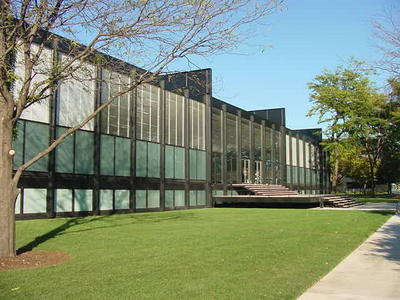
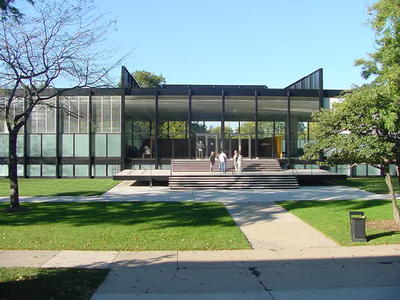
So here's another try, on the brevity tip. Today I traveled via the El to see some of one of the most famous collections of architecture in one of American architecture's capitals, Chicago. The Illinois Institute of Technology, located at State Street and E. 35th, just across the Dan Ryan Expressway from the Chicago White Sox's Cellular One (New Comiskey) ballpark, was the US homebase for one of 20th century's greatest architects, Ludwig Mies van der Rohe (1886-1969). A emigré from Germany, where he'd pioneered an original avant-garde "functionalism" that synthesized elements of the deStijl school, the unornamented façades of Austrian Secessionism, and Frank Lloyd Wright's Prairie Style to novel effect, and led the Bauhaus School in its final days before the Nazi takeover of the government, Mies assumed the leadership of the architecture school at what was then the Armour Institute of Technology. He devised a new, comprehensive masterplan for the campus, designed many of its buildings, and went on to develop the highly influential International Style, whose apotheoses are his Farnsworth House (1946), 860-880 Lake Shore Drive apartments (1948), the Seagrams Building in New York (1954-1958), Neue Nationalgalarie in Berlin (1965-1968), the Illinois Center in Chicago (1967). It is perhaps true to say that a Miesian vocabulary, however, has defined much skyscraper building from the late 1940s on, with architects all across the world drawing upon his various exposed truss, "glass boxes." (He was among the first architects to propose the glass skyscraper, as far back as 1919).

One of his true masterpieces is Crown Hall, which was built from 1950-1955/56, after Mies had designed a number of important campus buildings, such as Alumni Memorial, Perlstein and Wishnick Halls, and established his signature style. Crown Hall underwent a complete external and internal renovation over the last few years, and supposedly looks even more beautiful today than it did when it first opened. As the Chicago Landmarks website says

A defining structure of 20th-century modern architecture, this is one of the masterpieces of the world-reknowned architect Ludwig Mies van der Rohe. Designed to house Illinois Institute of Technology's departments of architecture, planning, and design, the building's dramatic, structurally-expressive form resulted from the need to create an open interior space that could be flexibly adapted for changing needs and uses. Instead of interior columns, the roof is hung from exposed steel trusses bridging the depth of the building. It was named for S. R. Crown, a co-founder of the Material Service Corporation.

Here are some of my photos:

Crown Hall, Front/Side
Crown Hall, from the front, southwest corner

Crown Hall Front
Crown Hall, frontal view, facing the main entryway

Crown Hall Rear
Crown Hall, rear view (from State Street side)


Interior shot of Crown Hall (Not being affiliated with IIT in any way, I was prohibited from setting foot in this building, though I did wander through the Rem Koolhaas-designed McCormick Tribune Campus Center, which I'll post photos of tomorrow--so I had to photograph it through the front door's panes, thus the reflections of the trees hovering, like phantasms of Mies, atop the shadowed interior).


A similar building in the Miesian style is Hermann Hall, the student union building, which Walter Netzsch of Skidmore, Owings and Merrill designed in 1962. It strongly resembles Crown Hall, yet it lacks the earlier building's purity of line, formal symmetry, and innovative internal structure. From a distance, though, it would hard to tell them apart.

One of the first things I thought after seeing these and the other Mies buildings up close was, even though they're 50 years old, they don't look dated and they still look modern. In fact, they look as contemporaneous as the Koolhaas and Jahn buildings across State Street. I wish Mies had laid the buildings out so that instead of turning outwards from each other--they cluster around the walkways that are are extensions of the surrounding streets (Dearborn, etc.)--they formed an inwards-turning axis so that from the front of one you could see the entrances to the others. From the rear of Crown Hall you can see some of the older buildings, but it faces a dreary building that might have been a Mies toss off, or something built in the Mies style that doesn't make the grade.

Friday, October 14, 2005

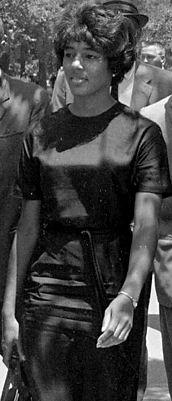
Profile in Courage: Vivian Malone Jones

Tonight's entry is a brief one, honoring the courage of Vivian Malone Jones, who passed away today at the age of 63. In 1963, she and James Hood attempted to enroll in the University of Alabama, an act of bravery and resistance that sparked one of the most famous scenes in the long and brutal history of racism in this country; Alabama's then-governor, Democrat George Wallace, infamously stood in the doorway of Foster Auditorium, with state guard troops, to block the two black students' entry, fulfilling a campaign pledge to halt integration "at the schoolhouse door"; at his inauguration, he had proclaimed "Segregation now, segregation tomorrow, segregation forever." Since a federal judge had ordered that the students be allowed to enroll, Deputy Attorney General Nicholas Katzenbach, following a script that had been choreographed by his boss, Robert F. Kennedy, with Wallace, approached the governor and asked that the students be admitted, which Wallace publicly defied. Four hours later, National Guard troops who'd been federalized by President John F. Kennedy, Malone and Hood, with Katzenbach and other administation officials, were able to enter the building, go to their dormitories, and enroll.

The day after they'd enrolled, Mississippi civil rights leader Medgar Evers was murdered in his driveway by Byron de la Beckwith and others. Malone, vowing to show no fear, went to classes that day, and despite the extreme social isolation--White students would neither speak nor socialize with her--as well as the constant threat of violence, including bomb threats (three actually detonated not far from her dorm room at one point during her two years there), she completed the coursework for her degree in 1965, becoming the first Black graduate in the University of Alabama's 143-year history. (Hood dropped out after two months to preserve his sanity and didn't return to Alabama until more than 30 years later, to receive his doctorate in education.) Malone, who'd subsequently married the young student driver, Mack Jones, from nearby HBCU Stillman College that the university had contracted for her, returned in the 1990s to receive a masters in education from the university. For the rest of her life, she was active in civil rights organizations, including the NAACP, the SCLC, and the National Council of Negro Women. In 1996, when the Wallace Family Foundation awarded her the Lurleen Wallace Award for Courage, she met with George Wallace, and, according to the Washington Post, asked him directly about his actions some 33 years before:

"I asked him why did he do it," she said. "He said he did what he felt needed to be done at that point in time, but he would not do that today. At that point, we spoke -- I spoke -- of forgiveness."

On WBEZ yesterday, I heard Malone Jones, in an interview from a few years, say that she was conscious of making history, but what was more important to her was that her courage would make it possible for the generations of Blacks who would come after her. And it did. Black students are now enrolled at every one of Alabama's public institutions of higher education, and at public universities across the South, as well as private institutions that once admitted very few to none. A widow (her husband, Dr. Mack Jones, died in 2004), she leaves her two children, three grandchildren, a number of siblings and family members, and a tremendous legacy. Thank you, Vivian Malone Jones, and those of your generation whose courage and sacrifice made our own freedoms possible!

Thursday, October 13, 2005

Pinter Wins Nobel

Harold Pinter (pictured at left in his play One for the Road, on the right, with Lloyd Hutchinson, photo by Sara Krulwich, New York Times), one of the most prolific and influential dramatists in English-language literature, received the 2005 Nobel Prize in Literature. The London native was cited for a lifetime of writing that "uncovers the precipice under everyday prattle and forces entry into oppression's closed rooms." In essence, the citation aptly characterizes Pinter's chief style, a clipped, repetitious, often pause-ridden series of verbal exchanges, (sometimes shading into lyricism especially in some of the later works) between his dramatis personae, that initially appear banal or innocuous on the surface but which usually portend his great theme, which was the lurking evil and horror that lie both outside the rooms in which his plays are set, and also lurk within the characters themselves.

His dramatic successes are numerous: they include his famous early plays The Birthday Party (1957), which was a critical failure at its initial opening but which was later acclaimed as one of the signal plays of the mid-20th century, The Dumb Waiter (1957), and The Caretaker (1960); plays from the early and mid-1960s, including The Tea Party (1962), The Homecoming (1964), Landscape (1967), Silence (1968), and Old Times (1970); and Betrayal (1978), which was made into a noteworthy film, and which inaugurated a string of plays dealing more overtly with political and social themes, including A Kind of Alaska (1982), One for the Road (1984), The New World Order (1991), Party Time (1991), Ashes to Ashes (1996), and Celebration (1999).

Pinter's work shows the influence of English dramaturgy, and in particular the plays of the Anglo-Irish Anglophone and Francophone absurdist writer Samuel Beckett (Nobel Laureate in 1969), who befriended Pinter while he was still alive. It also bears the strong effect of his having grown up as the son of a Jewish tailor in working-class pre and post-war London, amidst the atmosphere of everyday, pedestrian speech and routine, and of living through the Second World War; he experienced anti-Semitism directly as a young person, and witnessed firsthand the effects of the fascist state in the destruction caused by the aerial raids on Britain's cities, as well as the tragedies both of country's killed and wounded citizens and soldiers, but also of the millions who died in the death camps. Violence, evil and death recur frequently in his work, sometimes by allusion, implication and assertion, at other times, as in The Birthday Party or Ashes to Ashes, more directly in the plot. Pinter's experiences led him to conscientious objection, and later to open activism on behalf of peace. He has remained a vocal activist and critic of war, imperialism, social and economic conservative schemes (especially as enacted by the Thatcher woman), and as recently as a few years ago, issued blistering denunciations of the W administration's march towards war in Iraq.

One other very important aspect of Pinter's long and distinguished career has been his screenwriting, which is not usually honored or even noted by authorities like the Swedish Academy. He has written a number of important screenplays, both original and adaptations, from the 1950s to very recently. They include scripts for the films The Quiller Memorandum, The Last Tycoon, Langrishe Go Down, The Go-Between, Reunion, The French Lieutenant's Woman (I love Meryl Streep in this film), The Heat of the Day, The Comfort of Strangers, and The Trial. Even more remarkably, he wrote several of the screenplays for the noted director Joseph Losey (The Servant, Accident, The Go-Between) as he was also writing his stylistically different and distinctive plays.

Several years ago he suffered from throat cancer, and vowed to cease writing in order to devote his energies to peace. Perhaps this august award will persuade him to resume his playwriting, or work in other genres, as he's also an accomplished poet and fiction writer (The Dwarfs, a fascinating little novel from the late 1950s, I believe, is a book I read many years ago). Congratulations, Harold Pinter!

Update: On RadarOnline, the wretched old bat John Simon dissents from the praise chorus and dilates nastily on Pinter's Nobel win. In his own words: "Harold Pinter has just won the Nobel Prize for Literature? I would have gladly accorded him the Nobel for Arrogance, the Nobel for Self-promotion, or the Nobel for Hypocrisy—spewing venom at the United States while basking in our dollars—if such Nobels existed." But wait--the Swedish Academy awards the Nobel Prize, not the United States. And theaters, directors and actors across the country--and in many parts of the world--are free to choose the plays they want to stage, and of their own volition they choose Pinter. And why shouldn't a brilliant playwright be proud and promote herself or himself? Simon patronizingly praises Pinter's acting and directing, but those plays...well, they just don't meet Simon's critical standards. I guess Pinter should be glad he's not going as far as he did with John Ashbery back in the early 1960s, when he noted an appraisal of that author's revolutionary The Tennis Court Oath was "garbage"...plus ça change, plus ça reste.

Wednesday, October 12, 2005

Oulipo Story: The Agent's Oversight

THE AGENT'S OVERSIGHT
Escher's High and Low
Puzzling over the map, he slows down and drifts to the side of the road, where the oaks lining the curb are casting a cool shadow like a tarp, restraining the blazing July sun. He likes to be early--you can't do this job properly if you're rushing--so he left the house a little before noon, but once again his plan has raveled as he's gradually found himself lost in a neighborhood he's never visited before, and it's now after 2. The imagery is so indistinct, the landscape so featureless--every detached house similar in size, shape and color, the same flat green-brown lawns, trim juniper hedges, black driveways--he feels like he's been driving into and out of an immense mirror. When he finally does find the house he's looking for, a development he's sanguine about, he intends to draw a large, red circle around the exact spot on the unfolded chart before him, like he's done every other time he's ended up in a similar situation, though he realizes it's unlikely he'll ever have to come back here; he never does, he's so good that once is always enough. Which is why he's got like models carefully stored away in his basement from previous trips to any number of destinations, in countless cities, but the targets in the suburbs are always a trial, and the exurbs are the worst. He's like to pull out his afro in many of them, because it's as if the surveyors and planners simply clipped fragments of various other pictures, ideas and concepts of what a town ought not to be and then, using the assembled mess as a template, gave developers and homeowners the go ahead. His head is starting to hurt so he turns back to the map and scans the crumpled squares and squibbles, fathoming that their like is blurring into a colorful abstraction. The shade shifts, so he starts the car, his chances of finding the place perhaps moot at this point, he thinks, and advances like ten feet, to where the light relents. Then he glances up, through a window in the wall of trees, and experiences a quantum moment of insight: like, hello, the house he's been searching for is directly before him, to his right, straight through the driver's side window, and when he squints, he can see the person's he's looking for, whose future hovers on the tips of his fingers, passing back and forth behind the grail of blinds....

Copyright © John Keene, 2005.

Question: Two different verbal games are operating in this ultrashort story.
One is obvious, one not so obvious. Can you figure them out?

Tuesday, October 11, 2005

Stackhouse on Rattapallax + Nobel Judge Resigns

Friend, artist and collaborator Christopher Stackhouse appears on Rattapallax literary journal's audio feed site, reading his poem "Fabrication." Check it out!
Rattapallax
Rattapallax's most recent issue (12) includes works by Stackhouse, as well as Saul Williams, Rick Moody, Paul Beatty, Ernesto Cardenal, Kenneth Goldsmith, Patricia Spear Jones, Mohammed Khair-Eddine, Marilyn Hacker, Samuel Menashe, Dael Orlandersmith, Margert Ryan, Jerome Rothenberg, Virgil Suarez, Raul Zurita, Li-Young Lee, Cid Campos, Augusto de Campos, Haroldo de Campos, Carl Hancock Rux, and a special section on South African Poetry After Apartheid. (Thanks for the heads up, Mendi!)

∞∞∞

According to a report in the BBC News, Knut Ahnlund, an 82-year-old member of the Swedish Academy, which awards the Nobel Prize in Literature, resigned today in protest over last year's awarding of the literary world's most important international prize to Elfriede Jelinek. According to Ahnlund, Jelinek's works, which include novels, plays and essays, are "a mass of text shovelled together without artistic structure." In fact, he stated that "last year's Nobel Prize has not only done irreparable damage to all progressive forces, it has also confused the general view of literature as an art." Talk about a delayed response; did he just learn about last year's award today?

I also think he protesteth too much. Jelinek's works, which he also called "pornographic" (which is partially right) are also held in high esteem by other writers and readers. Her most famous book, the violent and disturbing The Piano Teacher, became an internationally celebrated movie under Michael Haneke's direction in 2001. Ahnlund suggested that the Academy had not read most of Jelinek's works, so were they basing the award on the movie and Isabelle Huppert's extraordinary performance? In which case, will the award to this Thursday to Canadian author and poet Michael Ondaatje (The English Patient), Britons John LeCarré (The Constant Gardner), A.S. Byatt (Possession) or Kazuo Ishiguro (The Remains of the Day), or Japanese novelist Haruki Murakami (Tony Takitani)? Those Jelinek books aren't easy reading, but then Ondaatje is even tougher....

Monday, October 10, 2005

Clarice Lispector, Mother of Blogs

LispectorPerhaps someone has already written (about) this, but I was thinking today as I rereading sections of the Pernambucan author Marilene Felinto's The Women of Tijucopapo for tomorrow's class, and also preparing for the the visit tomorrow of Hélène Cixous, who has done so much to popularize and promote the work of the late Brazilian author Clarice Lispector (1920-1977), that what Lispector in particular accomplished with her crônicas, or daily/weekly newspaper pieces on a variety of topics, was to anticipate the blog form before there was the technical means to do so. (Of course one could trace out other antecedents going even further back, but Lispector's style and approach provide, I think, one very important originary point.)

New Directions published a selection of Lispector's translated crônicas (Selected Crônicas) in 1996, and what is fascinating to note as you read them is how much like (and yet different from) many contemporary blog entries they are. Instead of satisfying the demands of the traditional opinion column, which she had done years earlier, or the more formally consistent regular pieces by her male colleagues, Lispector's crônicas comprised sometimes meandering, autobiographical, often confessional musings, short stories and sketches, dream narratives, poems, gossip, and so on from 1967 to the early 1970s in the Jornal do Brasil, one of Rio de Janeiro's major newspapers. Many of the works hold a mirror up to Lispector's amazing but occasionally difficult life: as an immigrant (born in Tchechelnik, Ukraine, her family arrived in the northeast of Brazil--first Alagoas, then Pernambuco--when she was only two months old); as the wife of a diplomat who didn't truly understand her aims in life; as a single mother of young children; as a survivor of a terrible accident (she nearly burned herself up when she fell asleep smoking and her mattress caught fire); as a person interested in the eternal verities of life, love, suffering, and death; as someone struggling to write herself into language and a literature.

Lispector's SignatureThe works often served as leads for her published literary short stories and novels; fragments, obsessions, explorations, theses occur in the journalistic pieces and then reappear in similar and altered form in the longer works. Though Lispector's prose fiction has won international acclaim for its metaphysical profundity and feminist focus, another of its most noteworthy qualities is its earthiness, its openness, its indeterminacy, its literal rawness at times, which can be found in abundance in the crônicas. There is also a concern with the poor, who then, as now, constituted a majority in Brazil, and who appear most famous in her longer work in the character of the northeastern immigrant to the big city, Macabéa, whose brief life, humiliation and transcendence lie at the center of one of Lispector's most unforgettable works, The Hour of the Star (A hora da estrela). In that remarkable work, as in the crônicas, the author breaches the traditional authorial wall, the sociological or anthropological distance often employed (or deployed) when writing (about) the Other, to implicate the narrator, and by extension herself, a radical act of resituation and location. Lispector creates the preparatory space for this in her earliest works, but also in the pieces she wrote as a cronista, as the Ur-blogger. No Narcissus, no navel-gazing, but before the reading public (still smaller then as now than the total population in Brazil), she inspected the self, often with great clarity, creativity, and force.

I sometimes wonder what she might have written had she not died from cancer the day before her birthday in 1977, and tonight I wonder what she might have thought--and done--had she lived long enough (she'd be 85, so it's not inconceivable) to experience the birth, growth and ubiquity not only of the Internet, Websites, and e-mail, but of the (We)blog itself. Perhaps she might have taken an interest in trying the medium out, and those would have been fascinating crônicas indeed.