Showing posts with label MFA program. Show all posts

Friday, May 19, 2017

2017 Rutgers-Newark Commencement

Some of our MFA students before the Graduate
Hooding. I had the immense pleasure of having nearly
all of them in a workshop or literature class! 
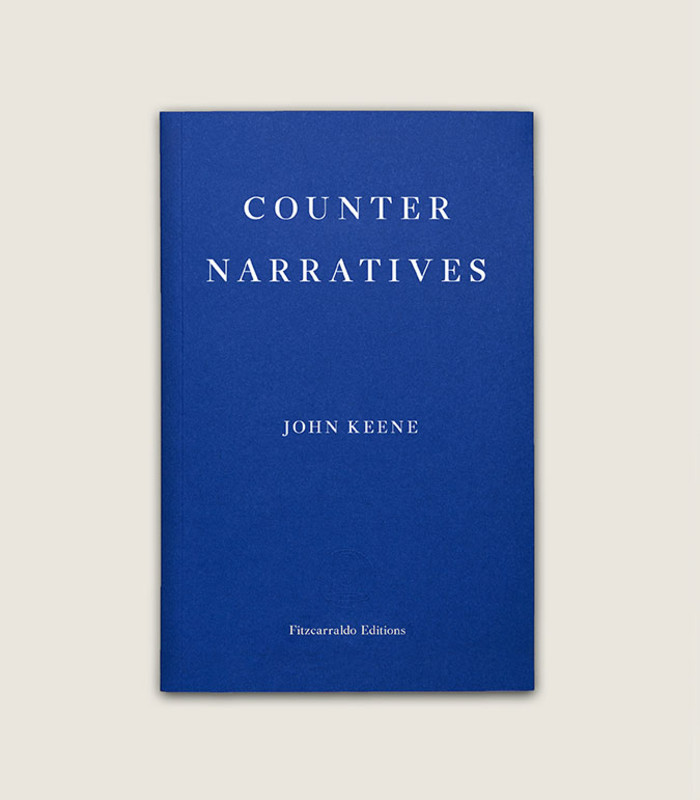
It has been eons since I've blogged, I know, but this year so far has easily been my busiest in a while, perhaps ever. I've recited the litany so often I think friends and associates, and most certainly my colleagues, are tired of hearing it, but in addition to my departmental chair duties, teaching, mentoring graduate students (3 MFAs, 1 independent study, 1 TA, two different doctoral committees), undergraduates (2 honors students), multiple search committees, and university committees, as well as various non-university profession-related duties, I also spent a good portion of the semester traveling to continue promoting Counternarratives and my other books, and while I love doing so, the physical and psychic toll of travel, especially these days, is always steeper than I envision.

As the scant entries this year testify, my blogging has especially fallen by the wayside this year. This  saddens me because I enjoy writing on here, and I feel like there's a particular need for it now. (I can also recall how just a few years ago, we were told that Twitter was becoming irrelevant and that blogging would soon be joining the ranks of the dodo bird and the woolly mammoth.) My several entries on the current resident of the White House remain stubs, however, and every day--sometimes it feels like every hour--brings so many new political revelations, bombshells, and shocks that, as was the case during the George W. Bush years, if you miss a week, you might as well wait for the next cluster of horrors and outrages. I think you can reasonably describe the White House's attempted Muslim Bans, its health care bills, its assault on regulations, its draconian budget, and so on horrors and outrages, even for some of Donald Trump's supporters....

But my aim with this entry was not to talk about Trump, but rather to congratulate the Rutgers-Newark (and Rutgers more broadly) Classes of 2017, undergraduate and graduate, and by extension, all who graduated this spring and year.  I'm very glad the semester and academic year have come to a close, but I already miss the students I worked with this year. As I mentioned, I supervised three MFA fiction students, Soili Smith, Matt Weir (whom I'd taught when he was a beginning creative writing student at Northwestern!) and Magally "Maggie" Zelaya, all of whom successfully completed their theses this spring. In addition, Soili applied and was admitted to Rutgers-Newark's PhD program in American Studies.

I also supervised two honors undergraduate students, both of whom successfully submitted fiction theses, Secilia Flores and Madani Sheikh. Madani graduated summa cum laude, received a senior prize from the English department, and gained admission into Rutgers-Newark's MFA program. He even was recently the subject of a thoughtful profile on Rutgers-Newark's website, and had previously received coverage as part of a social entrepeneurship team that made it to the regional finalist stage when he was a freshman.

All of these students, as well as others I mentored and taught, were a joy to work with, and I will definitely miss them, though I'll get to see Soili and Madani this upcoming academic year. Congratulations to all of them and all of this year's graduates!

Below are a few photos from Rutgers-Newark's various end-of-the-academic-year and Commencement events. For the Graduate Hooding ceremony and the actual Prudential Center campus-wide commencement, I wore a purple robe (for my graduate degree from NYU), but a creative writing colleague told me that I need to get the fancier, final degree model, with the fancier hat. Will do!

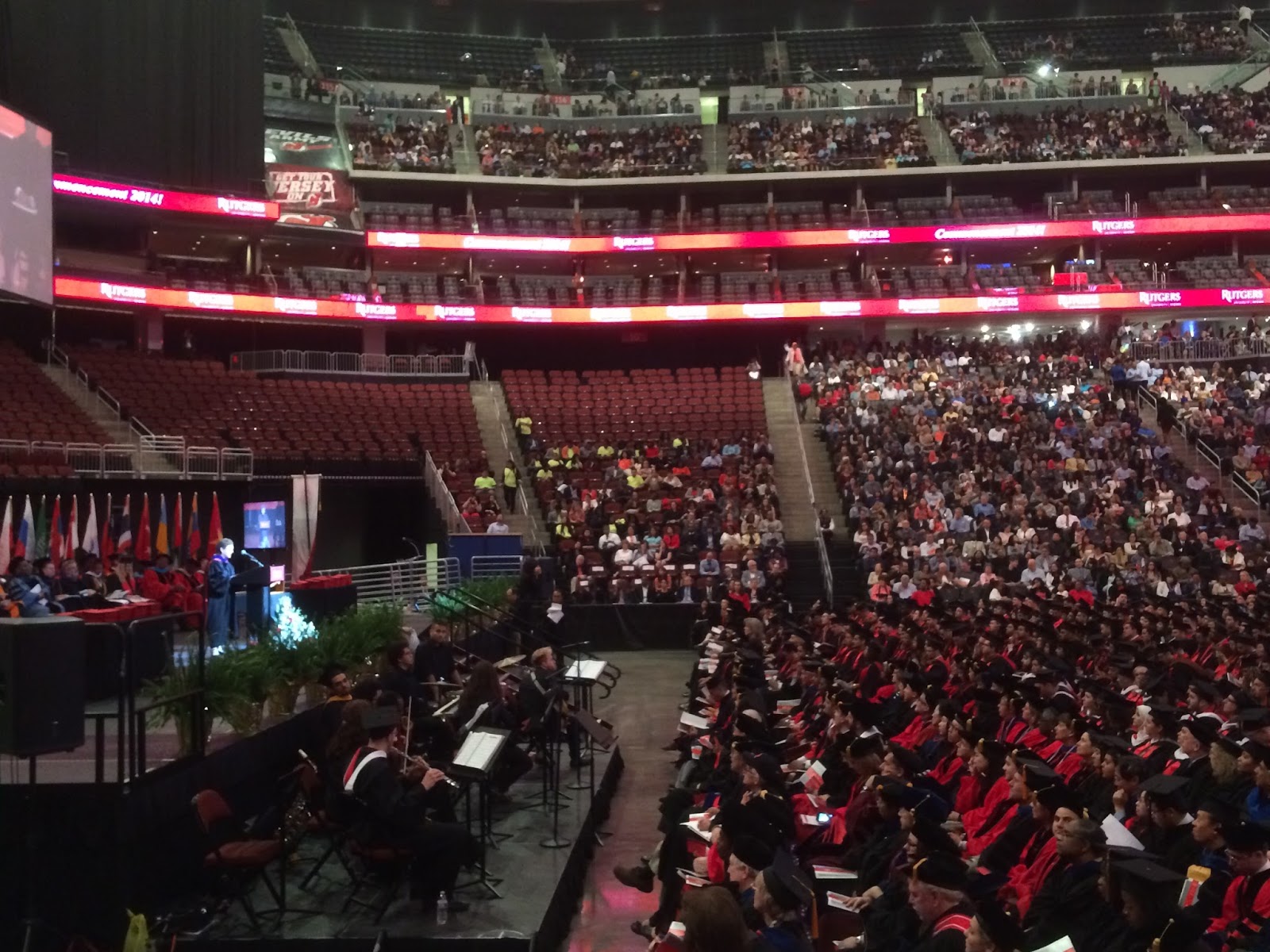
The big shebang, at the Prudential Center! 
Yours truly, one of our talented MFA graduates,
Darise Jean-Baptiste, and my wonderful
colleague Tayari Jones, after Commencement
The MFA graduates, during their end-of-year
reading at the MFA house
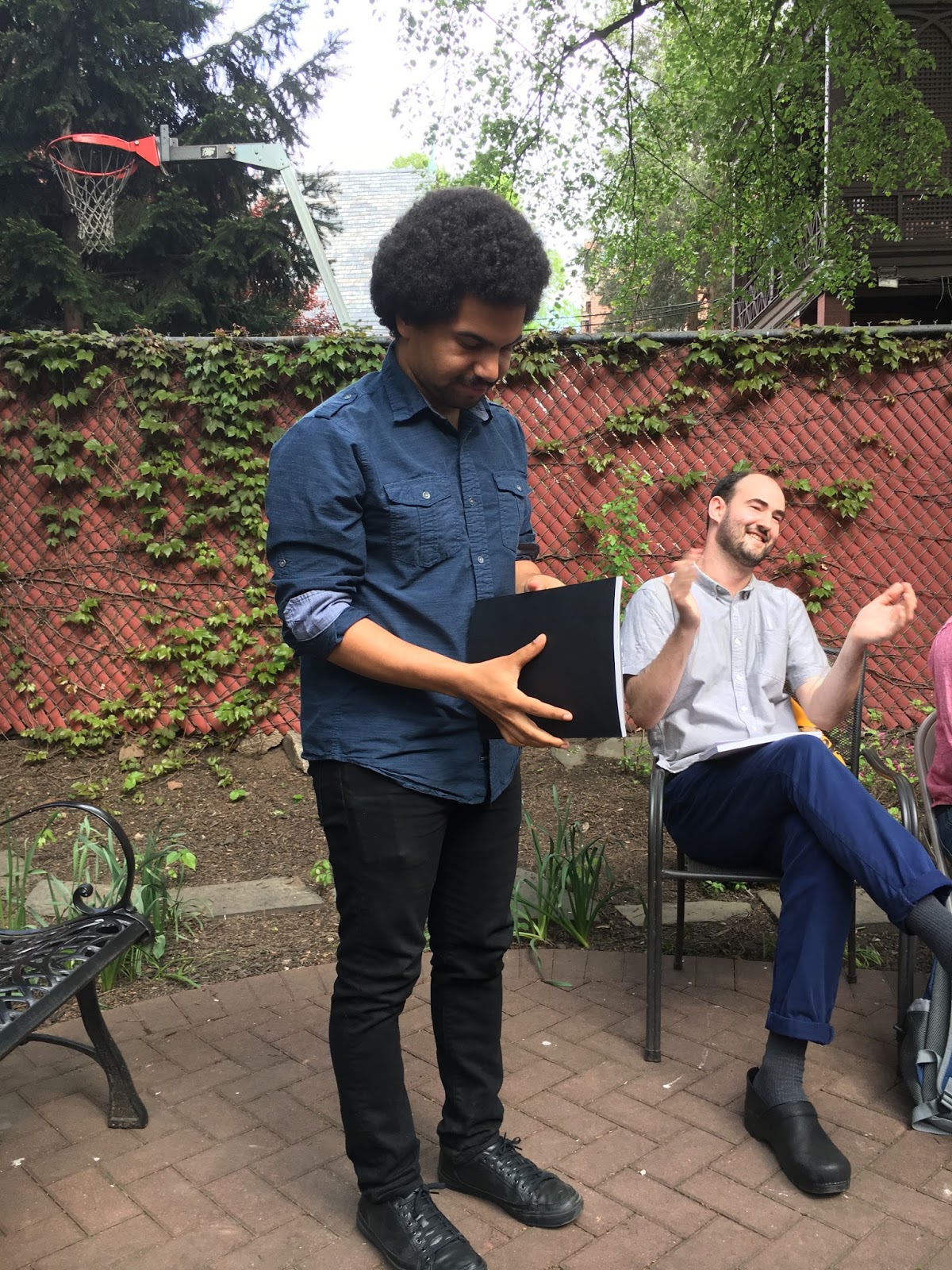
Matt Weir, one of my MFA advisees,
reading from his hilarious thesis
Poet Jeremy Clark, with Matt at right 
Darise Jean-Baptiste, reading from
her fiction thesis
Leslie Jones, reading from her
fiction thesis--well, showing its cover
before reading from it 
Maggie Zelaya, sharing her cover before
reading from her thesis, which I saw take
shape over her time at Rutgers-Newark
Aarthi Monteiro, another student I finally
got to work with last fall, reading from
her fiction thesis
Soili Smith, one of my MFA advisees,
reading from her fiction thesis, Sasquatch,
which did not include the story featuring Sasquatch
(though I hope the full collection will)
Students in the book arts course,
with their art-text projects, which they
discussed before sharing a bit of work
The faculty and students listening to the readings
Faculty and students enjoying the readings

Friday, May 13, 2016

Semester's End & Congrats to the Graduates

The Rutgers-Newark full commencement
ceremonies, at the Prudential Center
UPDATED: Rutgers-Newark held its Commencement ceremonies on Wednesday, May 18, 2016. The Commencement speaker was journalist and author Soledad O'Brien, and the honorary degree recipient was human rights activist and diplomat Radhika Coomaraswamy. I've included a few photos from the event. Congratulations to all the graduates and their families!

My absence from this blog is testimony to many things, one of which is the very busy semester I just concluded. Chairing, even a small department, is no joke, but many good things have happened, so I'm glad to have played a part in facilitating them. But back to more immediate things: Let me begin by congratulating all of Rutgers-Newark's 2016 graduates! Yesterday I had the tremendous honor of serving as the hooder for all 12 of our MFA fiction students who walked in the Graduate School's ceremonies. Our campus-wide ceremony will take place next Wednesday!

Our MFA graduates lining up before
our procession into the Essex Room
at Robeson Campus Center, Rutgers-Newark
Congratulations to all of these fine fiction writers, including the three phenomenal authors whose theses I advised, Mustafa Gatollari, Mel King and Anisa Rahim, and to all our graduating poets! I am glad I had an opportunity to teach many of them in workshops either last year or this one, and certainly will miss them!

Our MFA graduates and faculty (acting director
Rigoberto González is in the back row, at center,
and Brenda Shaughnessy is standing to his left/
viewer's right)
Congratulations also to my English department honors student Angelíc Forde, who completed a marvelous collection of poems entitled Limestone on My Feet, drawing upon her experiences as an immigrant from Barbados. It was always a pleasure to turn to Angelíc's poems, which included poems written in traditional fixed forms and ones drawn from the Bajan and African American traditions. (At Commencement exercises on Wednesday, I learned that Angelíc graduated summa cum laude, so even more kudos to her for a stellar undergraduate career!)

Soledad O'Brien giving her
Commencement address
Congratulations also to Tasha Hawthorne, now Dr. Hawthorne, on whose committee I sat, and who successfully completed and submitted her dissertation on African American pulp fiction at the very end of last year. Tasha will receive her Ph.D. in English from Northwestern University this June! Congratulations, Tasha!
Soledad O'Brien on
the big screen

Tuesday, May 19, 2015

Congratulations to the 2015 Graduates

2015 Commencement at Rutgers University-Newark,
at the Prudential Center, Newark, NJ
(photo © Rutgers University-Newark Facebook)
When I switched back from teaching on the quarter to the semester system in 2012, I wasn't sure how long it would take me to readjust, but in truth it took no time to reacquaint myself with the fact that May, rather than June, would bring a swift conclusion to the academic year, with final exams and grading compressed into a rapid-fire period, and graduation following swiftly thereafter. (I confess that I do like semesters more--a lot more!--than quarters.)

This year, my sabbatical-sick leave has kept me away from campus for most of the last five months, so the spring academic calendar has remained fairly hazy, but when May rolled in, I knew graduation events would also arrive soon. This past Saturday evening I was able to drop by the celebration for our graduating Rutgers University-Newark MFA students, who received their hoods at a ceremony that afternoon. They, like the rest of the graduating students from all the university's constituent divisions walked at the university-wide Commencement ceremony, which was held at the Prudential Center in Newark on Monday.

Rutgers University-Newark's 2015
Commencement speaker, Earl Lewis,
President of the Andrew W. Mellon Foundation
(photo © Rutgers University-Newark Facebook)
Because of the sabbatical I did not advise any MFA or undergraduate students this spring, but I was fortunate to have many of the graduating writers in classes that included last spring's Writers at Newark and last fall's fiction workshop, and I taught some of the departing undergraduates in courses ranging from Foundations of Literary Study to my courses on contemporary African Diasporic Fiction and the Black Arts Movement. Both groups were diverse in every way, and I feel fortunate to be able to say that I have learned as much from them as they from me.

To all of the 2015 Rutgers-Newark MFA graduates, as well as my many undergraduate students who have received their degrees this week, I offer my heartiest and warmest CONGRATULATIONS! I look forward to staying in touch in the years to come, and as I always say to the writers among you, please keep writing!

***

Over the decade that I taught at Northwestern, I supervised quite a few students: 13 MFA theses as first reader; 11 as second reader; 15 MFA student independent studies; 11 undergraduate creative writing honors theses; 4 undergraduate literature or African American Studies theses; 2 undergraduate internships; 1 MA independent study (which was curtailed when the student was injured in a car accident); and 7 undergraduate creative writing or literature independent studies. These superb students have gone on to do wonderful things in the literary and other worlds, and I treasure having had the opportunity to work with all of them, as I do with all my students, going back to NYU, Brown, and of course, now at Rutgers-Newark.

Yet it was not until a few weeks ago that I could offer congratulations to my last NU MFA thesis advisee, Whitney Youngs, who submitted as her thesis an excerpt of a novel she is writing. I was delighted to serve as her first reader, to read the manuscript through again, and to be able to sign off on her behalf. As a result, Whitney will receive her MFA degree in June! I have watched Whitney grow as a writer and person since she enrolled in an MA/MFA workshop I taught many years ago, and it has been a special pleasure to work with her in shaping and polishing her fiction, especially this novel, which I hope she completes and publishes.

To Whitney, congratulations many times over, and to all my students, including the Northwestern MA/MFA and undergraduate students with whom I worked and who are also receiving their degrees this June, CONGRATULATIONS AND THANK YOU!

Monday, March 02, 2015

Ryan Boudinot's Essay on MFA Programs


A few days ago I came across a link to Ryan Boudinot's February 27, 2015 essay in The Stranger, "Things I Can No Longer Say About MFA Writing Programs Now that I No Longer Teach in One," on Facebook, and immediately read it based on the vehemence of the responses on the post thread that linked to it. Most of the commenters took umbrage at Boudinot's contemptuous and sometimes cruel tone, at his regal pronouncements, and at his dismissive attitudes towards student writers, and I did not disagree with any of these criticisms. Boudinot is harsh and dismissive of all but the most gifted student writers, suggesting that he probably should not have been (or ever again be) anywhere near an MFA program, including the very best ones out there, or students of any sort for that matter. His comments, in fact, convey a level of disdain for students that suggests they will not be entering a welcoming, constructive space, however critical, when studying with him. Yet what also struck me reading his byline was that he leads an organization called Seattle City of Literature, which, I learned online, hosts an annual book festival celebrating the kinds of small presses that often publish the very sorts of MFA-alumni writers he is writing about, and which probably attracts not just readers, but writers who aspire to study at creative writing at the graduate level. I posted a short comment supportive of Boudinot's critics, but said to myself that I'd add a few more comments here.

Boudinot's key points in his article, based on his teaching experience and writing career, are:
  1. Writers are born with talent.
  2. If you weren't serious about writing by adolescence, you don't have a chance.
  3. If you complain about no time to write, drop out.
  4. If you aren't a serious reader, don't expect anyone to read your work.
  5. No one cares about your life issues, in written form, if you are a bad writer.
  6. You don't need the professor's help to get published.
  7. It's not important that people think that you're smart.
  8. It's important to woodshed.
On one level, a few of these at least sound sensible enough on the surface. Starting with number 8, of course you should spend time writing and polishing your work, though all writers do so at varying speeds, with some emerging in print fairly polished more quickly than others. But there's no set timeline to this process, and it all depends upon what someone produces, whether there's a market for it, luck, and so on. Number 7 also is hardly controversial, though it is the case that certain writers, particularly white male writers, do receive outsized attention based on how smart they are thought to be, and women and writers of color, or working-class writers, whom Boudinot does not discuss, are not infrequently read and discussed as less "smart" or "intellectual." (In fact, any mention of race, gender or class is missing from Boudinot's article.) The burden of being thought to be less smart, or less intelligent or intellectual, and thus not taken as seriously, is a real counterpoint to what Boudinot is talking about. As a teacher I try to keep in mind the varying forms of intelligence and sophistication students may bring to works; what might not look so "smart" to one person might be really impressive if viewed from a different perspective.

Thinking in particular about the writer that Boudinot mentions, David Foster Wallace, he was talented, prolific, and wrote at least one book that will stand the test of time. But critics frequently invoke his brilliance--his philosophy degree often comes up, as does the complexity of his prose, etc.--specifically in the service of highlighting his intellectual power, and given how highly he is regarded among students, it makes sense that some of them, reading his work, would want to emulate him and impress in the very ways he appears to. I find much of his work after the early stories in The Girl With Curious Hair and a few of the later ones in Brief Interviews with Hideous Men unpalatable, and Infinite Jest, which I ploughed through to supervise a student's research project, was brainy but unbearable (with terribly written black vernacular). I have taught many of students drawn specifically to the "smartness" of Wallace, Leo Tolstoy, Donald Barthelme, Jorge Luis Borges, etc. That said, a writer's intellectual firepower may be a primary consideration for some readers, as with certain kinds of experimental writing, for example. For a writing teacher, it's incumbent to discuss with a student if cleverness is becoming an end in itself or is overwhelming other aspects of the work, and there's a way to do this that can be productive and need not be harmful.

Boudinot's 6th point also is reasonable. While many writers I know have benefited from a professor's or mentor's assistance, many have not. Some of the very fortunate ones have been given jobs or placed in them, had their worked shared with or selected for journals, agents and publishers, and so on. The majority of writers I've known, however, have mostly functioned on their own or through the help of writing peers when it comes solely to publication (careers are another matter). As a professor I try to help students whenever I can by alerting them to opportunities that cross my desk, publicly praising their work when it merits it as a means of helping it gain wider attention, writing letters of recommendation or offering to serve as a reference on their behalf, and so on, but also I do this for fellow writers as well. In terms of publishing, I have managed to publish my all my books without the intercession of a professor or writing mentor, though a number of them have supplied various kinds of support along the way, including blurbs, letters of recommendation, and so on, and I certainly could not have gotten the jobs I have, or tenure, or other good things like prizes I've enjoyed, without their help. Perhaps among some MFA students there is an expectation that professors will help them gain publication, but I think this may also result from the economic pressures most students in graduate writing programs, and graduate school in general, now face. Given how costly many programs are, especially private ones, and how little financial support many institutions provide, it makes sense that some students might (wrongly) expect this to be part of their educational compact. What Boudinot says about apprising students of the expanding array of publication options is key, and when I used to teach the undergraduate-level "Situation of Writing" class at Northwestern, I regularly relayed this new publishing landscape to the creative writing majors, but I also shared it and continue to do so with my MFA students when possible.

Boudinot's other points, however, are much more problematic. The annals of literature testify to the fact that not every writer is "born with talent"; what separates those who get published from those who don't is often persistence and luck. Sometimes the most talented writers may struggle while others with far less talent, but more skill, connections, etc., soar. Not to single out anyone, but let's take a writer like E. L. James. I did scan Fifty Shades of Grey--I admit it, out of fascination with its success--and I can say without hesitation that it is not well written, or original, or, in my mind, all that interesting. I can see how it drew a large readership, because it plugs into certain conventions of romance and erotica, with "edge," though I admit to being baffled at its global success. James is a writer, but does she have "talent"? She certainly has a talent for drawing readers and selling books, but I don't think this is what Boudinot means. Was she born with the "talent" she does have, or did she learned to develop it? Could others? She did have a desire to see her work published, first online, and then in print, and the determination to see the publication process through to its end, which is impressive. That is a talent. But what role did luck and context, let alone platform (online first, then in print, etc.) play in it selling millions of copies to readers across the world?

You could argue that E. L. James, or a writer like her, was unlikely to apply to an MFA program, but I have taught writers who both possess a talent-and-skill set akin to hers, and at least one who wanted to write work like hers. I was not dismissive, because as I have told students in the past, there are many reasons people write, and aiming to make money is certainly one of them. Or, to flip that, as Dr. Samuel Johnson reported says in Boswell's The Life of Samuel Johnson, "No man but a blockhead ever wrote, except for money." It is also the case, I think it's fair to say, that anybody, under the right circumstances, can become a writer, of some sort, though the Toni Morrisons or William Faulkners--or E. L. Jameses, let alone P. D. Jameses and Henry Jameses--will be few and far between. But in response to Boudinot, I'd add that any writer who is serious enough to apply to and enroll in an MFA program, whatever her talent or his skill set, can benefit from the kinds of experiences that a workshop environment, properly conducted, can provide.

To respond to his other points, you can start writing at any point; it helps if you have been reading for a while and are aware of certain conventions, but this can be a hindrance too, in that predecessors can overshadow or stunt your original voice. Encouraging reading, encouraging the reading of writers that students might otherwise not read, encouraging your own wider reading, should all be part of the MFA experience, though writing teachers and students approach this in different ways. I remember a few MFA classmates complaining about having to read Dante, for example, and I have had students complain about having to read work they don't like, or work that's stylistically different from their work, but over the years I also have repeatedly had students thank me directly, and in their evaluations, for the broad range of material we read, some of it their first introduction to writers that others have read since their adolescence. Over the years when I have taught undergraduate and graduate creative writing classes, I often have asked students to write their favorite book, their least favorite book, and the book they're currently reading not for a class. There are certainly trends (I can recall the Harry Potter moment, for example), but I am always amazed at how wide a range most oft the students in my classes are reading.

Boudinot's comments assume that everyone comes from a similar background and has had the same access to literature, which also suggests that "writers" can only come from a particularly narrow vein of experience. Yet as the history of literature, especially American literature, shows, writers can come from all kinds of backgrounds and places, which is one reason that our literature over the last 125 years, if viewed broadly and not simply in terms of what has been valorized in New York publishing houses and high-end organs, has become so vibrant. When Horace Engdahl of the Nobel Committee criticized American literature's provinciality, I don't think he was truly looking at what American literature really has been and is. A writer like Jimmy Santiago Baca, who did not learn to read until prison; or the great, recently deceased Philip Levine, who was working in a factory when he was a teenager, and did not grow up with a house full of books, are two who according to Boudinot's prescription, could not have become writers because of their late starts. They did, and many others have as well.

Boudinot's comment about writing students complaining about not having the time to write also strikes me as unfair; having taught in two programs with large numbers of students who have to work full or part-time, have families, and may face financial challenges, it seems both ingenuous and ungenerous to assume that students will be able, at least at first, to find the necessary time to write. In my experience, most enrolled in MFA programs I've taught in do--but they still may complain about their struggles to write. This is no different from established writers who complain as well. Again, encouraging writers to make time to write, helping them to establish schedules to write, and helping to teach them how to be productive when they are no longer in an MFA environment are all crucial. I had to learn many of these things myself, and sometimes it is an issue of circumstances. When I got a job back home and was no longer commuting, and when I began teaching once again on a semester schedule as opposed to a trimester one, even though had far larger classes than in the past, I was able to get much more writing done, and more swiftly than ever. Thus the new book. In any case, I try to be understanding when students discuss their schedules, their various life challenges, and their ability to juggling everything so that they can focus on their writing. Figuring out what will work to get your work done is an easier process for some than others.

I'll ending by noting that I am always amazed by certain texts that rise to wider public acclaim, but it is probably true that if good writing will make anything at least worth glancing at, great writing can make almost anything worth sticking through part of the way through. Bad writing about uninteresting things, whatever the genre, is probably best kept for the writer's benefit, but there is a way to alert students that you don't find either the subject matter or the writing compelling. Even then, the work may catch the zeitgeist, however repetitive you find it, as the number of highly praised nonfiction and fiction books about highly educated, wealthy young artist(e)s indicates. The point is that if you can help the student improve a work, no matter what its genre, if you're employed in an MFA program, you aim to do so. That does not mean the student will listen to you, or will understand your advice, or appreciate it. That doesn't mean the student will grasp what beneficial and less beneficial help you and her classmates are offering. But it is part of your job. Constructive, useful criticism isn't always easy to figure out or give, but it's not impossible. Wishing that students who write about their suffering had suffered more is the sign of a crank; there is a place for people like that, but an MFA program (or any classroom) is not it. Which brings me to my final point: perhaps anyone can be writer, if not a best-selling or award-winning or literature-resetting one, but Boudinot makes it clear that everyone clearly cannot be a teacher, no matter how talented and well read they are.

Thursday, May 22, 2014

Graduation Photos

Here are a few photos from yesterday's Rutgers-Newark's 2014 Commencement, the first I've attended (I was out of town last spring), and the first ever held in the Prudential Center, where the New Jersey Devils ice hockey and other sports teams play. It also was the first Commencement that our new chancellor, Nancy Cantor, presided over.

It is always so inspiring and invigorating to see students graduating, and given the challenging journeys that many of my current students have made to get to and through school, I am so deeply proud of and happy for them. I saw a number of them as I marched in with the faculty, and got to congratulate them in person on receiving their degrees; I beamed and cheered as several received graduation honors.

As is widely known, there was considerable controversy surrounding the selection of former US National Security Advisor and Secretary of State Condoleezza Rice, one of the architects of the disastrous Iraq War and a chief actor in the disgraced George W. Bush regime, as Rutgers' New Brunswick commencement speaker. She was to receive not just an honorary degree, but $30,000 as well. Student, faculty (including yours truly) and alumni petitions and protests over her selection and way she was selected, as well as the fee she was to receive, however, led her to withdraw.

At Rutgers-Newark, there thankfully was no brouhaha at all surrounding our commencement speaker, Don Katz, an noted author, former journalist and the CEO of Newark-based Audible, Inc., the largest global producer of downloadable audiobooks. (If you listen to any, you probably have an Audible, Inc. product flowing through your ears. And yes, it is an Amazon company....) He received an honorary Doctor of Laws degree. Ironically because of the arena's audio situation, which created a doubling effect for certain speakers, including Katz, I could not make out much of what he said.

The ceremony itself went very long (degrees were conferred by school, with the names of students from every division, save the Law School, read aloud), but we received an assurance that this approach is thankfully under review.

Afterwards the MFA Program in Creative Writing held a party for this year's graduates, and all three of my wonderful thesis advisees, Adam Bowser, Craig Chanin and Serena Lin, and their families and friends, along with all the other MFA graduates I've had the opportunity to work with, were present, so although I had risen very early to get to the Prudential Center by 7 AM and had been flagging, I felt momentarily revived.

To the 2014 graduates and their families, congratulations again!

Lining up before the march in,
faculty at left, students at right
Students lined up (including
some I've taught!) 
The Prudential Center, before the students
and faculty enter
Procession of the schools
(led by my colleague Professor Rob Schneider,
head of the American Studies Program
Graduates on screen
A full arena! 
Don Katz, Audible, Inc. CEO
giving his commencement speech
At the MFA party, from left, Adam
Bowser, a friend of Serena Lin's,
 Serena's brother, and Serena 
Another photo of the MFA party,
with my colleague Alice Elliot Dark
in the foreground, and graduates
Jake Slovis (l) and Dana Jaye Cadman (r)
Serena, my colleague Tayari
Jones, and yours truly, in regalia
(and barely standing!)
Photo © Serena Lin

Wednesday, May 14, 2014

Semester's End

Congratulations and best wishes, Class of 2014!

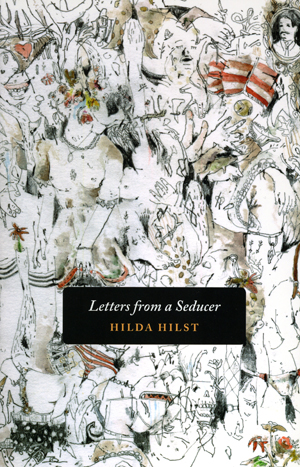
It is mid-May, which means the end of the semester at Rutgers. Courses concluded last week, and exams today, with graduation to follow in Newark next Wednesday. Spring semesters (or quarters, as was the case at Northwestern) have always been my busiest terms, and this year's stretch, from January to now, has been no less so. Between my two courses, my supervision of my great MFA thesis students, all three of whom will be graduating and should very proud of their manuscripts, my work on other university-related projects which appear to be bearing fruition under our new Chancellor, the publication of the Hilda Hilst translation and promotional activities for it (which are ongoing--do pick it up), a number of conferences and similar events and gatherings, and my completion of a new fiction manuscript which has been accepted and will be published next year, I believe, things have not slowed down yet. I am set to present a paper on James Baldwin at the very beginning of next month, in Montpellier, France, so as I am marking up final papers and projects and entering grades, I also am rereading (at the fastest pace I can recall) Baldwin's mammoth final novel Just Above My Head (1979), the copy in my hands the very Dell paperback copy my mother bought right after it came out, as well as some recent queer theory. (It pays to teach undergraduate and graduate classes that push you intellectually; my LGBTQ literature since Stonewall class, one of my last two at Northwestern, provided an excellent opportunity to resurvey the basic theoretical literature from the late 1960s through today). I will be looking forward to the trip, of course but even more so to the garden of time from mid-June through September when I can mentally relax, catch up on reading, and continue work on another fictional project which is much closer than ever before to completion. Then, I hope, even more....

In terms of the two courses, both entailed a lot of new reading, which was both edifying and exhausting, but I am glad I taught both, not least because of the excellent students. In the undergraduate class, "History and Myth in Contemporary African Diasporic Fiction," which fell under the rubric of Topics in African and Caribbean literature, I tried both to frame the course in terms of the parallel themes of history and myth, within the larger conceptual firmament of the African diaspora, and to decenter the United States as a way of thinking about the topic, though it nevertheless kept creeping into the picture. In part because of the disruptions caused by the snow storms, the class felt a bit stitched together, and I learned that it probably is a good idea in the future to mix short and longer fictional works, and to limit the number of long novels, since they proved hard for all the students to finish in a timely manner. The novel several of them cited as their favorite and the most intellectually engaging was, unsurprisingly, Chimamanda Ngozi Adichie's Half of a Yellow Sun (2004), which explores the early post-independence era through the Biafran War in Nigeria. It struck me as quite salient and topical given the recent attention Nigeria has received because of Boko Haram's abduction of over 270 schoolgirls and other attacks on the government and society, and the students and I were able to see in Adichie's novel how colonialism, tribalisms, ethnocentrism, religious chauvinism, nationalism, poor federal leadership, unequal distribution of resources, and corruption from Nigeria's earliest days have set the stage for the terrorist group'srecent horrific actions that have shocked the globe. 

I unfortunately had to snip one book, Zakes Mda's powerful novel Cion, from the syllabus, because of the lack of time, and I will think in the future about balancing texts even better to provide the best experience possible. The inner architectural thread of linked African spiritual practices managed to surprise me; that could easily have been the course's focus, so I may think about that for a future iteration. When we shifted from Ishmael Reed's invocation of the Loop Garoo Kid as a heroic figure to Edwidge Danticat's account, in "Nineteen Thirty-Seven," of a woman being denounced as a "Loup garou" for her heroism as a form of witchcraft, I wondered if I had assembled the readings not simply based on my knowledge of them and how they would work together but on some hidden, unrecognized frequency. Whatever it was, I think it worked. Another thing I have learned is that if you help to prepare students as best you can to do their best work, most will strive to do it. I usually now ask my undergraduate students to write their final papers but given the time constraints, they instead cleared their final topics and theses, and in some cases initial paragraphs, with me. This, coupled with their attentiveness to my marked up versions of their earlier papers--and their midterm exam--has meant much stronger final papers that are enjoyable to read. (And while it is difficult to do for many classes, making them combine unusual, less-commonly explored texts also cuts down on possible plagiarism.)

The graduate course, also a new preparation for me, was Writers at Newark II, the reading and discussion course that accompanies the semester-long reading series. Although I had not say in selecting the texts, one thing I did feel by the midpoint of the course was how well they worked together, and in some cases, as when we read Natasha Trethewey's Thrall and Edward P. Jones's The Known World together, or Matthea Harvey's Modern Life and George Saunders' The Tenth of December side by side, the conversations arising from pairings felt organic, as if the writers themselves had been in conversation with their peers. The students wrote reviews and short writeups of the books, posting the latter online, and in light of their status as creative writing students, I also invited them to produce new short works inspired by the visiting authors. Reading these at the midterm and now at the course's end has been a lot of fun, and I hope all of the students left with an even deeper appreciation not only for the texts we read and their authors, but also for their own deep capacity for insight, inventiveness, and collegiality. Like the undergraduates, these MFA students, some of whom I'd taught before and others I hadn't, were a joy to have in class, and I will miss the imminent graduates tremendously.

I'll end by thanking all of this year's students for another great experience, rounding out my second full year at Rutgers-Newark, and wishing all of them who are graduating, including the ones I taught earlier this year and last, the BA, BS, MA, and MFA recipients, the heartiest congratulations and every best wish for success and happiness in all they do in the future. Please also do stay in touch!


Sunday, October 13, 2013

Will Schutt & Christine Schutt Visit Rutgers-Newark (Writers@Newark)


On October 8, fiction writer Christine Schutt and her son, poet Will Schutt, read as part of the Rutgers-Newark Graduate MFA program's Writers@Newark series. Christine Schutt is an acclaimed fiction writer, with two short-story collections, Nightwork (Knopf, 1996) and A Night, A Day, Another Night, Summer (TriQuarterly/Northwestern UP, 2005); and three novels, Florida (TriQuarterly/Northwestern UP, 2004), a National Book Award fiction finalist; All Souls (Harcourt, 2008), a 2009 Pulitzer Prize for Fiction finalist; and most recently, Prosperous Friends (Grove Press, 2012). I was familiar with her in part because of Florida and because she visited Northwestern during my time there, though I was away on the date of her reading. I was not aware of her son's poetry, however, until I saw his name on the poster for the reading, and even then, I did not dip deeply into until MFA program director Jayne Anne Phillips invited me to introduce him. Both writers read beautifully, Will from his award-winning collection, as well as from new poems, and his mother from her most recent novel. It was a honor to meet and hear both of them.
Here is my introduction for Will:

To compare poetry to portraiture is hardly original, but we might still note that we do not always equate seeing, looking, and thinking--writing--with action, painting's physical labor. Yet poetry by its very nature is a form of action, of shaping, a poeisis, always, entailing mimesis and more that may not be captured in that mirror we hold before nature's complex and ever-changing face. Will Schutt's poems hover in that "middle ground," to use his phrase, between sight and act; they engage and reproduce this tension in their onward-rushing, page-zigzagging lines, and their calm, patient arguments.

"Remembering is nice," Schutt says in "Beach Lane," but the excellent poetry we find in this volume requires more, requires a voracious seeing, akin to hogs devouring a hillside, as Schutt memorably metaphorizes in "Wild Hogs," transformed into verbal art. It demands that Schutt "put everything into it," as his lyric speaker, quoting his father, says in "American Window Dressing," a poem whose title, like many in this collection, embodies this paradox.

Schutt successfully enacts this generative tension, through his attentiveness to the visual, with a painterly precision--

 I go on
looking at the bright bathers as they step
out of the ocean to towel off
with their bright, Testarossa red towels
-- from "Wild Hogs"


--and to the aural, for he is aware, as a poet who quotes rock lyrics and imagines the sad music accompanying his parent's faltering relationship, which he hears by analogy, in glimpsing a snapshot of Peter Lorre and Lotta Lenya, that if a picture can convey more than a thousand words, sound engenders worlds as well:
   I stood eyelevel
with row after row of ducks, like smoker's
lungs, in the restaurant windows
off Confucius Plaza--thick tar up top
swizzed into brown and rose gold.
A metal sling dug under their wings
ended in a hole the heads were put through.
-- from "American Window Dressing" 


Schutt's poems picture not only the privileged middle-class spaces he has inhabited, but what exists just on the peripheries, at those edges these poems are not always ready to view or listen to, but nevertheless try to. More, he is a poet interested in history, and its contiguous connection to the present; in images, in anecdotes, these poems summon the past as a way of entering the present also. The metonymic relationship this empowers gathers form and force through the poem's care with observation, the poet's exact music.

Schutt's meticulousness carries over into his translation work, represented in Westerly by a series of poems that form the volume's center. He brings into English selected short poems by mid-century Italian writers--Sanguinetti, Merini, the great Montale--who too struggle to resolve the quandary posed by the struggle between the eye and the hand, the ear and the heart. What charges the stasis and conditionality of these poems is the fact that they are not mere thoughts, but poems: to write is to act, as Schutt demonstrates throughout.

Will Schutt is the author of Westerly, which was selected by judge Carl Phillips for the 2012 Yale Series of Younger Poets, one of the most prestigious prizes for American poets under the age of 40. A graduate of Oberlin College and Hollins University, Schutt has published poems and translations in Agni, A Public Space, FIELD, The New Republic, The Southern Review, and elsewhere. The recipient of fellowships from the Stadler Center for Poetry and the James Merrill House, he currently lives in New York City.

Copyright © John Keene, 2013. All rights reserved.


Tuesday, September 24, 2013

Introducing Cynthia Cruz + Poem: Cynthia Cruz

IMG_0899
Cynthia Cruz and Ruth Ozeki
Last Tuesday, on September 17, Rutgers University in Newark's MFA Program held its first Fall 2013 Writers @ Newark reading, which featured poet Cynthia Cruz and fiction writer Ruth Ozeki. I was asked to introduce Cynthia Cruz, a poet whose work I was not previously familiar with, but whom I had the pleasure of reading and thinking about in the weeks leading up to the reading.

Below is my introduction, and here is a link to upcoming Rutgers-Newark MFA readings. Please do attend if you can!

INTRODUCTION FOR CYNTHIA CRUZ

Broken, remade: out of the wrack of experience, of language, from life's and the imagination's wrecks and ruins, Cynthia Cruz crafts--poems, moments of lyric intensity so sharp they pierce you, like a necklace of thorns, like a hypodermic needle, like an apperception flooding into your consciousness and overwhelming it such that you will not easily see the same way again. These poems do not say: life is beautiful. They do not say: Life is easy. They do not say: Life is what you want it to to be or what make of it. These poems, in their accounting for anomie, for loss, for death, for the living that can be a kind of dying and the fast steep slope downwards into the recognition of our human limits do say: it is rarely easy to make something beautiful out of what you have lived, what you have imagined, but here is how you might do it.

In Cynthia Cruz's poetry there is a rhyming, of form, condensed to its essence like diamonds, and content, the saying what has to be said and could not be expressed any other way, producing a semantic and aural surplus. Less here is always more:

 His hands were moving like the twin engines
 But his lips unzipped my pants.
 He told me, in a voice of cold pennies,
 You're the prettiest boy I've ever seen.
 In a wasted field of spirit-weed, a few miles
 Off the interstate, a lost trucker gentled me
 With his slow song of longing.
  -- "Traveling Gospel," from Ruin

There is no decoration here, no trying to figure out what to do with evident gifts, but a great deal of music, coruscating, indelible, the imagery and rhetoric consonant with a capacity for imagining and inhabiting, as fully and poetically as possible, other selves, including ones that only language itself can summon. One you have read their prophesies, as in her series of poems in The Glimmering Room called "Strange Gospels," you might not be so sure where you really going or what will come.
The poems say: this is what poetry can do. These poems say: you may want to look away but you cannot, and the knowledge you gain may not save your life but it will make you look and think. These poems say: if you have such a powerful tool as poetry this is one way to use it.

 Sun leaking through
 The open screen like a planet, seething.
 They say the first five years define you.
 The first five years are missing from my memory.
 -- "Strange Gospels," from The Glimmering Room

Cynthia Cruz was born in Germany and raised in Northern California. She is the author of Ruin (Alice James Books), and The Glimmering Room (Four Way Books). She has received fellowships from Yaddo and the MacDowell Colony, as well as a Hodder Fellowship from Princeton University. Her poems have been published in The American Poetry Review, Boston Review, Kenyon Review, The New Yorker, The Paris Review, and other periodicals. She lives in Brooklyn.

And a poem by Cynthia Cruz:

NEW YORK STATE (2)

Pharmaceutica Fantastica, wild
What the mind will do

When memory's delicate template
Has been removed.

Substandard State
Hospital corridors, liquid like

Rubber cement inhaled
By children. Sweet

Sister of the biosphere
Called Nurse Station

Hands out meds
And Halloween candy.

We stand in the Tundra of
Lockdown

Waiting for our lives
Never to begin.

Copyright © Cynthia Cruz, from The Glimmering Room, New York: Four Way Books, 2012, p. 46. All rights reserved.

Monday, August 26, 2013

Quote: Sarah Schulman

Sarah Schulman
(photo by
Monica Simoes)
"At first we [she and Jim Hubbard, at the New York Lesbian and Gay Experimental Film Festival, which they co-founded in 1987, the same year as ACT UP started] showed artists who were experimental. That is to say, they experimented. "Experimental" meant that each artist singularly tried out their own eccentric idea, their own imaginative way, and then they looked at each others' discoveries. They learned how to be artists by making art, talking about art, looking at art, being with artists. Whether or not one went to graduate school was irrelevant (and still is) to whether or ont one was really an artist. But at some point around the height of AIDS/gentrification this shifted. Those true experimenters who needed to earn a living in the rapidly shifting gentrification economy were channeled by inflation into teaching jobs. The increasing number of MFA programs became the only way that artists could earn a living beyond waitressing or copyediting at night at law firms. MFA programs became workfare for writers, as rents skyrocketed, as arts funding--already so elite as to be culturally damaging--was practically eliminated. It was like the role of the artist in society had devolved from WPA to NEA to MFA. Their students started producing inside a now established genre called "experimental". It wasn't actually any longer experimental, but it was a fixed set of derivative paradigms, invented by their teachers--many of whom did not have MFAs." (p. 102)

***

"Of course now that the noose has tightened even further, civilian artists are systematically excluded from teaching, as having an MFA [or Ph.D., for poets] has become mandatory for hiring. Being a product of MFA acculturation is now more important in determining who will influence students than what that person has achieved artistically. So, the frame of information and impulse becomes even more narrow and irrelevant and its product even more banal." (p. 103)

***

"Despite the fact that these programs are homogenizing and corrupting and bad for the culture, I feel that when I am advising working-class or poor students with talent, I have to insist that they go to them. There is simply no other way of getting into the system. As damaging as these programs are when they codify or elevate ruling-class perspectives and middlebrow practitioners, they become the only hope for outsiders to have a chance to be let in. It's a conundrum. Hopefully a talented person can emerge from these programs without a highly distorted sense of their own importance, and if they come originally from the margins this is more likely. But as far as I can see, MFA programs have done nothing to break down the barrier that full-character plays with authorial universes (not performance art, vaudeville, or stand-up) and authentic lesbian protagonists face in the theatrical marketplace. So although they do help certain minority voices who have had the support and sophistication to access and survive the system, overall they reinforce the dominant cultural voice, the clubbiness and repetition and most importantly, the group mentality that is, itself, counterindicated for art making." (p. 108)

-- Copyright © Sarah Schulman, from The Gentrification of the Mind: Witness to a Lost Imagination, Berkeley: University of California Press, 2012, pp. 102-3. All rights reserved.

Sunday, October 14, 2012

Rutgers-Newark Reading at Dodge Poetry Festival

Established in 1986 and formerly taking place in suburban Morristown, New Jersey, the biennial Geraldine R. Dodge Poetry Festival has moved to Newark, with most of the festival events occuring at the New Jersey Center for the Performing Arts (NJPAC). I have not been able to attend since the late 1990s, but now that I'm back in the area I did attend one of the events yesterday, a reading by some of the graduate student poets in Rutgers-Newark's MFA program in writing. The event was held at the Aljira Gallery on Broad Street in Newark, and like the festival, I hadn't been in the space in a few years, though I have remained on its mailing list.

Among the students reading I'd only heard one, Maurice Decaul, perform his work, a few weeks back, as part of a superlative event with poet Mike Ladd and pianist and composer Vijay Iyer, Holding It Down: The Veterans' Dream Project, a multimedia cantata addressing memories and dreams among recent US military veterans of color, at Harlemstage, so each reading served as an introduction to the poets and the program. Their reading and performing styles were diverse, the poetry drawing on a wide range of influences, from the high Modernists to spoken-word, and very little of it showed any of the influence of the Language or Conceptual schools of writing. One of the students in my graduate literature course on postmodernism, transhumanism and posthumanism, playwright and teacher Vincent Toro, performed, or should I say embodied, a poem about bodies directly in conversation with the themes and topics we've been discussing in class, so I may ask him to reprise it at some point for those who weren't able to attend.

The reading was not just a fine introduction to the graduate poetry students, but to the Dodge Festival and Newark, a city with far more treasures than people acknowledge. The Aljira Gallery is one of them.

Grisel (Toro)
Grisel, the poetry event's MC
Vincent Toro
Vincent Toro
Maurice Decaul
Maurice Decaul
Rutgers MFA student Ines Lopes
Ines Lopes
Dana J. Catlett
Dana J. Catlett
Aaron Michael Klein
Aaron Michael Klein
Sean Battle
Sean Battle