Showing posts with label administration. Show all posts

Thursday, January 02, 2020

My 2019 (Semi-)Hiatus

A photo from our contract rally at
Rutgers-Newark, April 2019
As J's Theater readers--if there still are any!--may have noted, last year (2019) was a very lean one in terms of my presence here. I believe I managed six entries (with perhaps double that still in draft mode), and that was pushing it. One, which I only recently published, featured a review I undertook for Art in America on last year's Whitney Biennial, which I found fascinating on multiple levels, in contrast to many mainstream critics, including one who summed it for me at lunch late in the year, as "predictable." As it turns out, it was anything but--and, as I argued in that piece, really multiple Biennials, including one transformed by the protests that not only the Biennial's artists, but outside activists, supporters and artists, and the Museum's staff, launched. To be able to watch it unfold and write about it was a pleasure, but alas, I had almost no time to focus on it here.  I also had no real time--or rather no time to focus--to complete memorials to figures who have been incredible important to me, whom we lost in 2019, and I am thinking in particular of Toni Morrison, Paule Marshall (who was one of my favorite teachers in grad school), and Ernest J. Gaines, among many others. They are but a few of the people who left this human plane last year, and perhaps at some point I can either finish my mini-tributes and turn those live or write new ones this year. We will see.

My day jobs are, as readers know, a writer, and a professor of English and African American and African Studies (AAAS). Over the last six years (roughly since 2013), however, I've also served first as Acting Chair and then full-time Chair of AAAS, a post I have enjoyed deeply, but which also has entailed a very different level and kind of time commitment, since chair duties, I had to learn quickly, run every day of the week and all year long, and involve all kinds of matters, from curricula to student needs and concerns to staff and faculty personnel issues to other kinds of university service to general administration to tasks defying categorization. 

What I also learned was that there often is little training, except on the job, for the challenges that present themselves. Soliciting the advice of one's peers, especially other chairs or former chairs, and colleagues, listening to them carefully, addressing pressing and longer-term issues, and encouraging and engaging not only in an ethos but a practice of collaboration are all key, but administrative duties can be very stressful, and run along timelines parallel to but different from those of the academic year. Add this to my regular (teaching, mentoring, advising, my own life and writing) and irregular duties (letters of recommendation, tenure, judging panels, etc.), and it's fair to say that my blogging has been one major area to suffer some of the the greatest blows as a result.

This past fall was also a particular challenge because, on top of everything else, I was serving on four search committees. Serving on one search committee is a high hurdle; four is almost impossible to describe, though I grasped why I was asked to serve, and was cognizant throughout of what my presence could help to effect and why I committed to each. I can say, breaking no confidences, that each went quite well, and 2020 should bring good news to my institution and some excellent people who, I hope, will be wonderful leaders in their various ways and invaluable colleagues. That, as all such work tends to be, is the hope and goal, making people, programs and departments, the institution itself, better and stronger than they were before, with added benefits not yet foreseen but which will redound and resonate long after the moment of the work has ended. That is the core of so much of what we do in life, though, isn't it, or at least hope to?

2020 brings a competitive leave sabbatical--courtesy of several fellowships I received in 2018--so I hope to be able to post here more often. I have been thinking quite a bit about how blogging has changed in the 14 (soon to be 15!) years since I began this blog, and though I am ever more convinced that we live in an increasingly post-literate, let alone post-post-modern world, where the power of the regime of images grows ever stronger, the role of the oral has become more central and dominant, public prose is transforming into a shadow of itself, and social media's forces and forms are reshaping not only language as an exterior medium but our interiorities in ways we have not fully recognized or reckoned with,  I do believe there is a place for this blog and others, even if it ends up looking somewhat different than it did in the past, so I will strive to post semi-regularly here, even if, as I have at times, primarily with quotes and notices from others, including citations of and links to blogs I still follow, like Keguro Macharia's, to name one of my favorites and one of the very best. (And speaking of which, his remarkable study Frottage: Frictions of Intimacy Across the Black Diaspora is now out from NYU Press!)

So, here's to 2020, more blogging (I hope), and the excitement to come!

Tuesday, December 22, 2015

Fall Semester's Embers

It's nearly January, which is another way of saying that the fall semester has raced past and is now over. In addition to marking my return from my spring sabbatical, this term also included my first stint as full-time chair of African American and African Studies. At the same time, as I've chronicled to some extent here, these last few months have also included a mini-book tour, which encompassed stops on both coasts. The combination--and pace--of the teaching, administration and travel has worn me out, so I'm truly grateful for the holiday break, though as I was able to share during the final course meeting with my students in "Foundations of Literary Study," the undergraduate course I taught this fall, no matter how tired I felt on the Monday following my trips or reading through a stack of papers, I experienced a surge of exhilaration once I entered the classroom. I also had the benefit of an exceptional teaching assistant, award-winning writer Drew Ciccolo, who graduated from Rutgers-Newark's MFA program and is currently pursuing his Ph.D. in American Studies at the university. To Drew, a million thanks many times over!

Although I'd taught this course once before, in the fall of 2013, I decided to update it with some new works and slightly modify my approach, using post-colonialism as our underlying theoretical approach, since it struck me as salient in light of contemporary national and global events. We looked at five genres, in the following order: creative and critical nonfiction; poetry; drama; fiction; and graphic novels. Among the new works I added were Akhil Sharma's acclaimed novel Family Life, poems by Mónica de la TorreMonica Ong, and Edward Baugh (who read on campus this fall), and stories by Ernest HemingwayJames JoyceToni Cade Bambara, and Jaquira Díaz. I also retained components that had worked before, like the transcription-and-commentary exercise involving Emily Dickinson's texts online at the Boston Public Library's Flickr page, Shakespeare's sonnets as our introduction to the poetry unit, and Elizabeth Bishop's "One Art" to teach the fixed form of the villanelle, but added a new exercise, involving use of Google's n-gram tool, as a way of exploring the field and practice of distant reading. For a change I threw in a few pop quizzes, the first of which appeared to serve as a spur for some in the class to read a bit further in the assigned longer works than they had been.

What worked particularly well was the requirement of multiple short papers (7 in total) and research and creative exercises (4) in building up my students' critical and literary skills. The two-stage final, in which they submitted half their final papers to me in order to ensure that their arguments were on track, also worked well. For those students who failed to submit the first half of their papers, however, the results were less positive. Nevertheless, many of the final papers did show some evident improvement in some way over their authors' initial submissions in the course's early weeks, and even in those cases where the technical aspects of the writing were still shaky, I could at least perceive an improved sense of confidence in argumentation.

Emily Dickinson,
Ms. Am. 1093(3),
Boston Public Library
(Flickr.com)
To conclude the class I decided to try something new this time. Since I was teaching an intro to literary studies course for English majors, I held a book raffle of extra copies of wonderful books on my office shelf, with everyone picking a number attached to a book, and then calling out the numbers, with each student receiving a book. Since some did not show up, I allowed everyone who'd gotten a book to exchange it at the end of class. A few did, and they snapped every single poetry text (by Van Jordan, Tyehimba Jess, Allen Ginsberg, Kristiana Rae Colón, etc.), along with fiction books by Junot Díaz, Michael Lukas, and others. Sadly, no one appeared to want the volumes by Raymond Carver or Ray Bradbury!

I also asked the students to write a letter to future students, detailing what they found useful in the course and what they would change or wanted more of. (I'd just seen someone else suggest this.) I was curious to see their assessments, in order to incorporate them into future iterations of this class.
Among the comments: "I would like a bigger selection of poetry only because I love poetry and diving into poetic devices and how they're used in other forms of literature (or vice versa)." And: "I started [to] love authors like Junior Díaz and I loved reading the Shakespeare play and I wish we could have studied more on those authors, but then I would have never learned what a travel narrative is or even given a chance to graphic novels that are not comic books. Odd assignment like the Emily Dickinson [manuscript] decipherment was brilliant." And: "Thankfully we do not only read white, male, cis, heterosexual authors!" And: "Side effects may include: interest in literary research; improved writing; appreciation/admiration for what at first seemed boring; drowsiness/fascination by Roland Barthes' theory regarding 'The Death of the Author'...."

And now, it's just a matter of entering those final grades!

Thursday, January 02, 2014

The New Year + Great Early News About Hilst Translation

It feels both strange and exciting to note here that we are now in 2014; this past year seemed to unfold glacially, with ample amounts of time cocooning everything (MLA, AWP, the spring semester, writing this summer, etc.). Perhaps time felt this way because I was still in the midst of transitioning to new--or returning to prior--life rhythms and, like everyone around me, also  recovering from the psychic effects of the fall 2012 hurricane. Time at various points seemed to stand still. This past fall, however, accelerated much more quickly than last year (again, perhaps because we avoided nature's violent, watery intermission), and December in particular raced by so fast it was over before I knew it.

The year brought good news, some of which I'll talk about soon, but very sad news closer to home as well. Three friends, all under 50, passed away: Donald Agarrat, whom I memorialized several months ago, and more recently, my former colleague José Estéban Múñoz, with whom I served on the board of the Center for Lesbian and Gay Studies (CLAGS) in the late 1990s, and Gerard Fergerson, for many years one of my dearest friends, and among the smartest and most dynamic people I have ever known in life, who incidentally, among the many wonderful things he did for me, introduced me to CLAGS. I will post tributes to both of them very soon. Another person that I knew from the time I was in my early 20s, the activist, writer, editor, journalist, and bookstore founder, John Mitzel, also passed away after a long illness in Boston.

As of the second week of December, classes concluded, and as of January 1, I relinquish my post as Acting Chair of AAAS to my predecessor. The fall undergraduate English course, "Introduction to Literary Studies," provoked my usual pangs of apprehension when I learned I'd be teaching it, but it turned out quite well in the end, if my students' coursework, responses and comments are any indication. As far as the Acting Chair stint went, it turned out to be a lot more work than I'd envisioned (though isn't that always the case?), but it was also an excellent introduction to the university system's innards, and I had the opportunity to tackle a few important projects, which I resolved successfully, as well as initiate some exciting events for this upcoming semester.

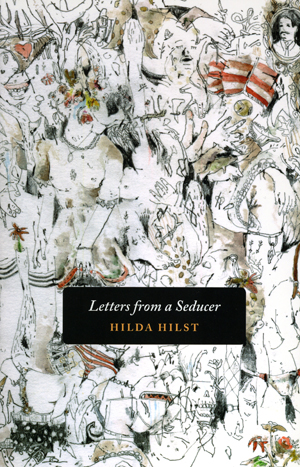
Somehow or other I completed not just the translation but multiple revisions of the Hilda Hilst novel, Letters from a Seducer (Cartas de um sedutor), jointly published by Nightboat Books and A Bolha Editora, and it has not only been repeatedly proofed, blurbed (by Dodie Bellamy, Samuel R. Delany, and Ronaldo V. Wilson!), but has gone to the printer and should be out very soon (the schedule date is now February 4, 2014). (You can even order it from distributor University Presses of New England/UPNEBarnes & Noble or that other behemoth site that I will pass on naming. You know which one I mean.) I have said publicly that it probably was a bit insane to have agreed to translate that book, which even in the Portuguese is no two-step, during a period when I had two sizable classes and lots of other pending duties, but looking back I'm glad I did, and am even happier about the resulting text.


I do wonder how readers who have been enthusiastic about the first Hilst novel that appeared in English, The Obscene Madame D (A obscena senhora D), beautifully and collaboratively translated by Nathanaël and Rachel Gontijo Araújo, will respond to this one, especially given that it is far more sexually transgressive and explicit, the language thornier--there are moments in the text that look wrong even in Portuguese, à la Clarice Lispector, though they are exactly what Hilst intended--and the structure of the novel far more experimental.

In fact, in Letters from a Seducer Hilst produces an anti-novel . I was trying to think of a musical comparison, and instantly and interestingly enough, at least to me, the post-modern work of the late Russian composer Alfred Schnittke came immediately to mind; he is best known for combining an conventional styles (for example, preexisting or pastiche versions of baroque compositions) with one or more very different, disparate styles, holding them all together via a compelling associative vision, profound craft and wit, and, to a huge degree, the willingness of the listener to accept, if not fully grasp, what he's up to and go along. That's what Hilst does in and with this novel, though in it she attempts and achieves many other things as well. In fact the book feels like it could serve as a source text for a course I taught years at at Northwestern on contemporary aesthetics and what I called "danger zones"; in it she treats in various ways aspects of conventional aesthetic theory, as well as those touchier areas I specifically focused on, including pornography, sentimentality, horror, conceptualism, and, to a lesser degree, the posthuman.

Although the translation is not yet on bookshelves it has received some early praise in draft form. Translator, editor, program director, and scholar Daniel Medin wrote the following in the December 17, 2013 edition of Three Percent: a resource for international literature at the University of Rochester:

Occasionally, a work of brilliance will make it possible for a virtuosic translator to outdo, line for line, a great deal of what’s recently appeared in her target language. In 2012, the English of George Szirtes for Satantango’s Hungarian struck me as superior to the sentences of most novels written that year in English. The same’s true of John Keene’s version of Letters from a Seducer by Hilda Hilst. Scheduled to appear this month, it was perhaps my most unforgettable reading experience of 2013. I’m terribly eager to read more Hilst now—and impatient to get my hands on Keene’sAnnotations too.

Medin and Scott Esposito also discuss the translation in their podcast at Two Lines Press. A snippet of the translation will appear in an upcoming edition (No. 10, I believe) of the The White Review.

I am looking forward to discussing and possibly reading from it at an upcoming panel on translation that will take place in Chicago, on January 10th, during the Modern Language Association's annual convention. The event, New Writing in Translation, a roundtable, will take place at 7:30 PM in the Sharp Building of the School of the Art Institute of Chicago, 37 S. Wabash Avenue. As the organizer describes it, "this roundtable event will consist in a self-guided survey of recent translation projects by leading contemporaries in the field. Rather than being led by generalizable themes in the theory and practice of translation, each participant will read a brief excerpt from a recent translation project and then discuss the vicissitudes of working on it." The Writing (MFAW) Program of SAIC will host the event, and other participants include Daniel Borzutzky, Jen Scappettone, Anna Deeny, and Joshua Clover.

Lastly, I will be reading with Vincent Czyz at Word-Jersey City on January 15, 2014. I believe we both will read a little poetry and I'll be reading from the Hilst as well, so if you are in Jersey City, please join us.