Showing posts with label Nightboat Books. Show all posts

Friday, April 17, 2015

Hilst Translation Makes Longlist + New Counternarratives Review in Harper's

Hilda Hilst
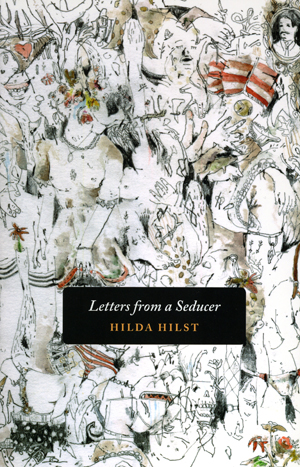
Last February Nightboat Books published my translation of Hilda Hilst's Letters from a Seducer (Nightboat Books), and despite its formal daring and thematic outrageousness (it contains an insatiable character named "Little Butthole," which should give you a clue about how wild it is), I have worried from time to time that it might fall into the literary publishing rabbit hole. So many books, and not so many translations, but without a champion a book can and may disappear. Any positive news about it, therefore, is welcome. It was extremely positively and welcome news to learn, then, that the book had made the Longlist for the 2015 Best Translated Book in Fiction Award, which is sponsored by the Center for translation at the University of Rochester. Many thanks to the Center, and especially to editor, curator and critic Daniel Medin, a member of the judges' panel, who has written and spoken favorably about the translation in the past and again for this award.

As part of the process of selection for the next stages, including the finalist list, which will be named on May 5, and the award, to be given out on May 25, judges present arguments, in a variety of formats, for why certain books deserve to advance and win. Daniel interviewed me about Letters, and you can read the entire exchange here. It isn't very long, and gives a brief overview of Hilst's work, including my favorite passage in Portuguese. (NB: A stray apostrophe crept into the word "wont," though I meant the older adjectival form, meaning "likely," not the contracted future verb form.) A snippet:
DM: Letters from a Seducer is a part of Hilst’s famous “pornographic tetralogy.” How are these works different from what she was had been doing before? What distinguishes Letters from the others? 
 JK: Let me begin by saying that all of Hilst’s prose fiction is experimental, from her initial fiction text, Fluxo-Floema (1970), on, and is informed by her prior primary focus as a poet and a playwright. (She continued writing poetry throughout her life, I should note.) Her earliest poetry, published in the 1950s, is fairly conventional, but by the 1960s you can detect subversive notes, experiments with earlier Lusophone (and Iberian) forms, etc., so that when she began writing prose, it was hardly surprising that she would not follow the standard route. Yet I think it’s fair to say that her fiction is distinctive even from parallel experiments that were happening in Brazilian literature at the time, as a comparison between her texts of the 1970s and those of her close friend, Lygia Fagundes Telles, one of the major fiction writers of Brazil and in the Portuguese language, will suggest. While a book like The Obscene Madame D (1982) does overtly treat sexual themes, in the “porno-chic” works, as she called them, she more openly and directly uses and plays with pornographic language and discourse, and the works themselves turn in part on themes that might be considered pornographic, except that Hilst’s artistry, irony and wit transform them into something quite different. Letters (1991) is the second novel and masterpiece of the four texts; one of them, Contos d’Escarnio: Textos Grotescos (1990) is a collection of stories; Bufólicas (1992) comprises poems; and O Caderno Rosa de Lory Lamby, or Lory Licky’s Pink Notebook (1990), as I think the brilliant translator Adam Morris dubbed it, is an extremely ludic, graphic precursor to Letters written in the voice of a child. (And possibly not publishable in the US, despite its relentless humor.) With Letters, Hilst reaches the pinnacle of the tetralogy and, I think, her art, fusing all the strands that have come before into a profound text about writing, living, sex, human mortality, and so on. It is also quite funny; she never sheds her humor, even at some of the most outrageous moments in the text, which is one of the things I really appreciate about her work.
Getting to the finalist stage and winning are both tremendous long shots, and the other long-list books represent exalted company, many by some of the best translators out there, of major living and deceased writers, but I am very happy that the book is getting some recognition, and if this brings more readers not just to this translation, but to the others, by Rachel Gontijo Araújo and Nathanaël, and to the one by Adam Morris, that will be a very good thing! Que fique mais da Hilst em inglês!

***

Miss La La at the Cirque
Fernando,
Edgar Degas, 1879
(National Gallery, London,
Oil on canvas.)
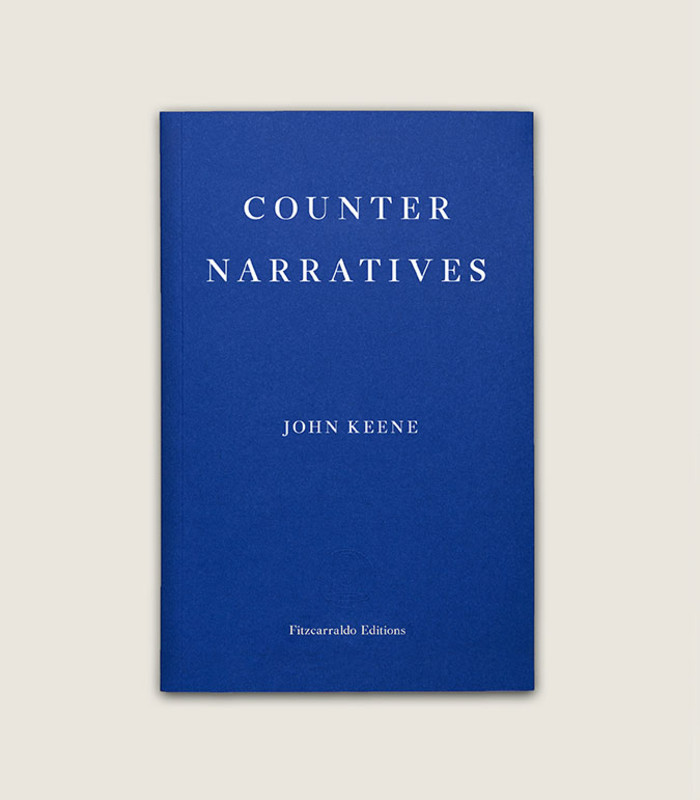
Reviews continue to come in for Counternarratives, and the most recent is the best by far. In the May 2015 Harper's Magazine, Christine Smallwood pens a thoroughgoing, engagingly thoughtful review of the book. (Her review unfortunately is only available for subscribers to Harper's, but it's in the newsstands now.) Framing the review with images of the Mississippi near Vicksburg, Mississippi, and Edgar Degas's famous 1879 painting Miss La La at the Cirque Fernando (the subject of my story "Acrobatique"), Smallwood begins with a discussion of Mark Twain's The Adventures of Huckleberry Finn and the homoerotics and racial dynamics of that text, noting its contemporary survival in the form of "bromances" (and, I'd add, the curdled buddy films that once starred Eddie Murphy and Danny Glover, and now feature Kevin Hart), as a way of shifting into a discussion of how my approach to Twain's text (and The Adventures of Tom Sawyer), "Rivers," like the rest of the collection, represents and embodies the concept of a counternarrative.

Smallwood writes, "John Keene takes aim at this sacred cow and shoots it straight in the hip," describing the story's plot and noting that this could have come off as "corny," but its execution transforms it into something else. (And I should note that I was a little nervous about taking on the Jim and Huckleberry story, and was surprised that almost no other black writers had done so--because it is so iconic? Because Twain's fame and reputation looms so large? Because it wasn't worth the time of doing so?--but also felt that imagining some aspects of Jim's life after that novel, a few glimpses, would be worth the risk.) She goes on offer the following beautiful assessment of the entire collection, for which I will forever be grateful: "Counternarratives is an extraordinary work of literature. Keene is a dense, intricate, magnificent writer," before going on to discuss my background a bit (though Christopher Stackhouse accidentally becomes "Charles") and more of the stories, even quoting several of them.

One quote:

In "The Aeronauts," for example, a Philadelphia freedman with an uncanny memory joins the Union Army Balloon Corps. The story ends with him in the balloon, feeling "something not quite fear and not quite elation, I can't put a name to it, I try to utter it but cannot." Naming it, Keene suggests, would only contain the moment, and make it less than what it is. His characters refuse to accept freedom that is given by others--they either take it by force or resist it altogether. In this way they are the avengers of Twain's Jim, who wasn't aware of his freedom until he had gone to great trouble to gain it a second time.

Again, many thanks to Harper's both for reviewing the book and for the superlative review, and I urge J's Theater readers to preorder a copy! The corrected galleys have been submitted, will be out now on May 21, 2015!

Sunday, April 12, 2015

My AWP 2015


Posing with the Mary Tyler
Moore statue (downtown
Minneapolis)
(Photo by John Domini)
I've just returned from the year's biggest annual American--and perhaps global?--creative writing gathering, the Associated Writing Programs (AWP) conference, which concluded yesterday after four days in Minneapolis. Over 10,000 (or was it 11,000?) writers, readers and publishers packed the rooms and auditoriums of the Minneapolis Convention Center, nearby hotels, restaurants, bars, clubs, libraries, and a variety of offsite venues, to deliver papers, talks and presentations, and to read their work, buy books, talk about writing, and just hang out with other literary folks.

Inside the Convention Center
As an officially academic conference AWP primarily convenes people in academe or who want to be in it, focuses a sizable portion of its panels on educational issues, and represents one of the major networking opportunities for those seeking jobs within educational institutions. Yet despite this it is above all a writers' and writing conference. To me AWP's real emphasis, unlike that the Modern Language Association's annual conference or the Book Expo America, remains on conversations on and around writing and literary practices and production, and the presentation of literary works; the opportunities to participate in and attend the onsite and offsite readings and book-signings, and the immense book fair are chief among the reasons many writers scare up the funding to attend. Another key benefit is running into new and old friends and acquaintances, and meeting new ones, with the added possibility of hearing them read and talk about their work.

One of the skyways leading
to the Convention Center
A post-snowy morning
outside my hotel

Giving and attending readings and seeing people I otherwise would not get a chance to were mu reasons for attending this year, and my visit didn't disappoint. I should note that during the worst days of my knee troubles earlier this year, I was not sure at first that I would be able to attend, but hope springs eternal and physical therapy works, and since the trip to Missoula, I have grown increasingly more mobile, so I was able to make my daily way from my hotel, the Marriott City Center, to the convention center mostly on foot, and most outdoors, even during one of the sleet/snowfalls that occurred during the conference's run, and I even spent a good several hours every day I was there in the immense hall hosting the book fair, walking as much as 6 miles on Friday alone. I did feel all the walking while there and once I go back, but I was resolute in not wearing any knee braces and in not carrying around a backpack or bookbags full of books, so I avoided straining my knees and utilized UPS's services several times, and now my campus office has heavy, stuff troves waiting for me.

Inside the AWP Book Fair
At the Book Fair
The perambulations around the book fair afforded many serendipities, including running into countless writers I seldom get the opportunity to see and hang out with, as well as happening upon books I had been intending to buy, with the writers nearby to sign them, as well as ones I had no idea about but am incredibly I happened upon. I saw and chatted two of the publishers I have worked with (New Directions and Nightboat Books), and learned that at the former a steady stream people were asking for my book, which will be out on May 21, 2015 (a few weeks later than originally). I took that as a very positive sign. Other highlights were the lunches and dinners with friends and colleagues, including former students, and one amazing book party I attended where I had the opportunity to meet yet more writers. While I prefer the scale of smaller conferences like Thinking Its Presence, AWP definitely has its charms, and rather than feeling overwhelmed as I sometimes have at  the sheer size of the crowds, the surfeit of texts on display, and the undertow of competitiveness, this year felt more manageable and enjoyable. (Was it the 10,000 or 12,000 fewer people than a year or two ago?)

At New Directions table; Tynan Kogane
is seated at table; to the right is Archipelago
Books, where I learned a former student,
Eric Wilson, is now working
Lorenzo Herrera, poet and publisher
of Kórima Press, which shared a table
with Lisa Moore's RedBone Press
For the first time ever I was a featured reader, on a panel sponsored by the Cave Canem Writers Foundation that featured four poets who received the Mrs. Giles Whiting Foundation's annual writing awards: Thylias Moss, Tyehimba Jess, Atsuro Riley, and I. Before the conference I learned from a colleague that there was tremendous concern over the paucity of openly gay featured readers and LGBTQ-focused panels, and another friend told me that I was the only out featured reader, though I learned that another fellow member of my reading slate, the poet Atsuro, is openly gay, so that doubled the total, and also meant that two men of color were intersectionally representing for LGBTQ communities at AWP. Instead of poetry I read the lyrical opening to my story "Blues," in which Langston Hughes and Xavier Villaurrutia meet up in Depression-era New York. The story is a tribute to both poets, but especially Hughes, as well as Richard-Bruce Nugent, author of "Smoke, Lilies and Jade," whose style and themes provided the template for mine. Supposedly we were visible on a Jumbotron monitor, which I thankfully could not see or I'd never have been able to take the podium! Many thanks to CC, the Whiting Foundation, and to AWP for the event!

Lisa Moore and I
A panel on creative writing as a second career,
headed by Tayari Jones (at right), with Evie
Shockley seated at the table at center
The following evening I read at an offsite event to promote the new Volta Book of Poets, edited by Joshua Marie Wilkinson and published by Sidebrow Books, between whose covers I have a few poems. The 3-hour reading was at Harriet Brewery in St. Paul, and many of the poets in the anthology were present, including Eric Baus, Susan Briante, Julie Carr, Don Mee Choi, Arda Collins, C. S. Giscombe, Fred Moten, Yona Harvey, Dawn Lundy Martin, J. Michael Martinez, Andrea Rexilius, Evie Shockley (my cab and Uber mate), Matthias Svalina, TC Tolbert, and Lynn Xu. (I probably have left someone off, so my apologies.) The beer hall was loud and packed, and some patrons seemed more eager to hear poetry than others, but the readers in general were on their game and I aimed to have fun and read an Internet-app based poem that elicited a good deal of laughter, in keeping with the venue's tone. I had to head out to another event, so I missed the evening's final readers.
At the Harriet Brewery reading,
Fred Moten seated at center
The Obsidian panel, with (1-r) Kwame Dawes,
Duriel Harris (editor), and Sheila Smith McKoy
I also got to attend several panels, including one devoted to the literary journal Obsidian, which I have read for years and now serve as one of its fiction and hybrid forms editors, and the invigorating words and atmosphere of fellowship in that room underpinned for me, as so many other experiences did, of why I attend AWP.  Next year's conference will take place in Los Angeles, and I'm already looking forward to it. Below, a few more photos!

The Convention Center
Lynn Xu at the Volta reading
Fred Moten at the Volta reading
Don Mee Choi, translating, and Valerie
Mejer, reading in Spanish,
at the Volta reading
Susan Briante at the Volta reading
Yona Harvey at the Volta reading
Cecil Giscombe at the Volta reading
and:

An arrest Tyehimba Jess and I witnessed
one night walking back from dinner

Thursday, March 13, 2014

Nightboat Books Launch Photos

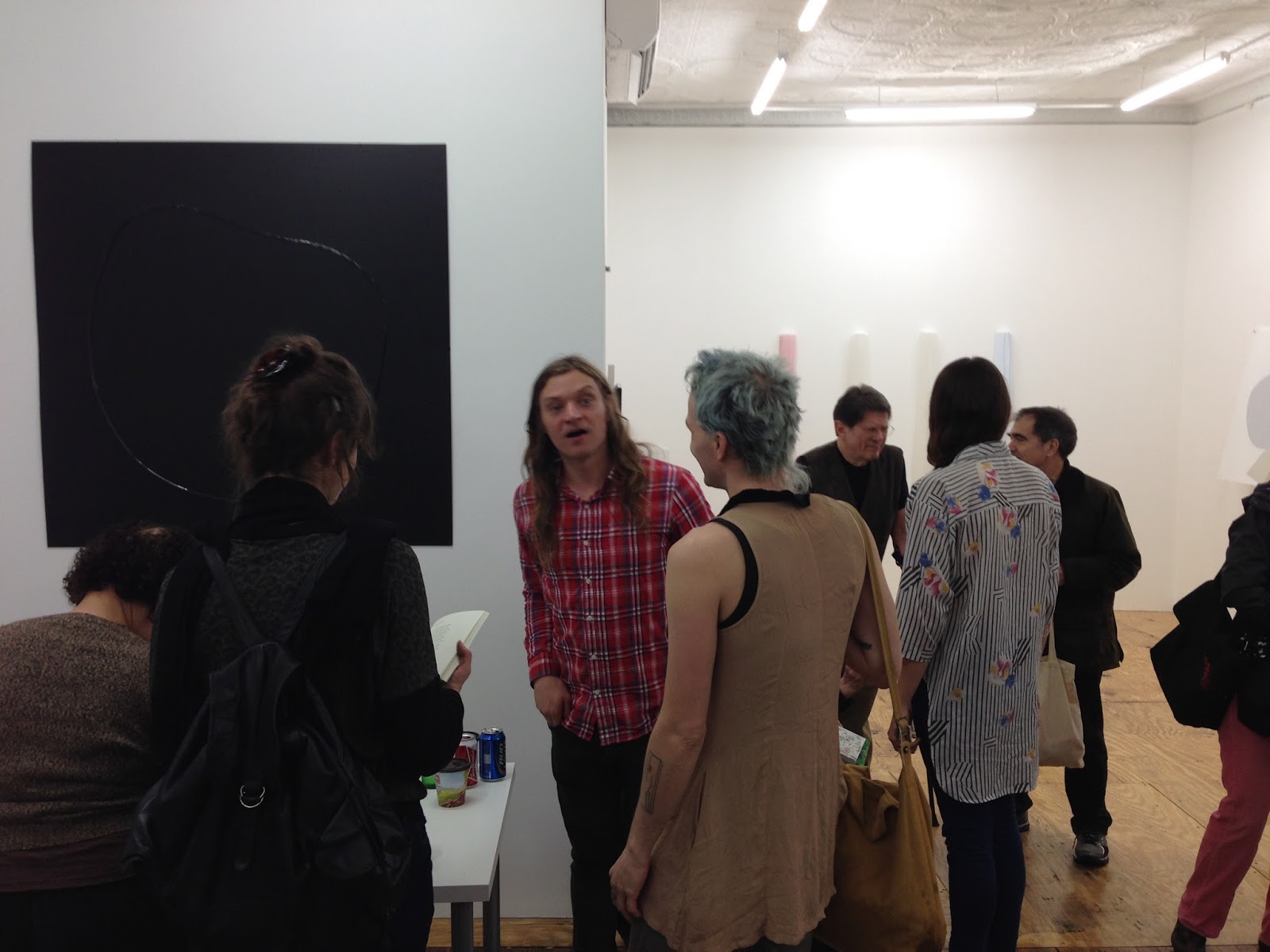
Below are few photos from last night's Nightboat Books new publications launch at Callicoon Fine Arts on the Lower East Side. Many thanks to everyone who came out to hear and celebrate the release of Gracie Leavitt's first full collection of poems, Monkeys, Minor Planet, Average Star, which features a self-portrait by the late Emma Bee Bernstein on its cover (and a moving tribute poet, "Reverse," to Bernstein inside), and my translation of Hilda Hilst's Letters to a Seducer, which Nightboat published in conjunction with Brazilian publisher A Bolha Editora

Joining us were two friends and fellow writers, Claire Donato and Reggie Harris, who each read an incisive poem in the spirit of the books. We had a good crowd by the time the event began, and it was even fuller when artist Thomas Kovachevich, whose show is currently underway at Callicoon, presented his poem-without-words, a slow, remarkable, profound piece involving autonomously curling lens paper on blue fabric amidst a bed of water.  It felt especially fitting given the work already presented. Many thanks to everyone who came out and thanks also for buying the books!

I urge you to check out Thomas's exhibit at Callicoon if you're on the Lower East Side; it runs until March 30, 2014. Also, if you can, please do purchase (or urge your local public, college or university library to order!) copies of Gracie's collection and the Hilst novel.

At Callicoon before the reading
(poet & publisher Stephen Motika
at center) 
Some of the attendees before
the reading 
Stephen introducing the event
Thomas's collaborator
in the event pouring the water 
The laying out of
the azure fabric sheets
The collaborator places the
pieces of lens paper on the fabric
The paper begins its dance 
More paper 
A bearded, bowtied blogger
reading from the Hilst
(photo by C) 
Making a point of some
sort about Hilst
(photo by C)
Another photo of yours truly
and the full crowd
(Photo by Andrew Blackley--thanks!)

Sunday, March 17, 2013

Book Launches @ Poets House

Though still recovering from AWP I headed over to Poets House last Sunday to catch Nightboat Books's book launch party to celebrate the publication of Coming Events (Collected Writings) by Susan GevirtzMusic for Porn by Rob Halpern; and Sisyphus, Outdone. Theatres of the Catastrophal by Nathanaël. Poet and Nightboat Books publisher Stephen Motika introduced all three writers, who read snippets of their work, and then all three participated in a conversation that poet Douglas A. Martin moderated.

As the names of the writers suggest, these were three challenging texts that defy conventional genres. Nathanaël's text, which incorporate its footnotes as side notes and takes on a number of themes and topics, circled around the question of translation, in particular a prior text of hers, even as it unfolded as an autonomous text-critique in its own right. Halpern's work aimed, in his words, to explore "the allegorical figure of a soldier's wound," redressing Whitman's similar project via Charles Olson and the strategies of Genet. Gevirtz first delivered a talk aimed in part at addressing the relationship between poetry and thought, challenging Socrates's statement in the Ion that "For not by art [techne] do the poets sing, but by divine inspiration." Fluidity of genre--gender, as Nathanaël pointed out, in tracing back the root of the English word to its French antecedent--appeared central to her thinking. She followed the short essay with a selection of one of her poems from her collection.

The question and answer session ranged over these issues and others, proceeding from Martin's initial questions, which cited Gertrude Stein and Martin Heidegger, who had already arisen in Gevirtz's essay. The concept of mystery (Geheimnis) was one Martin mentioned and that several of the writers returned to, though Nathanaël deftly avoided invoking that philosopher and instead talked about other figures in her work, a chief one being that the seisme, or earthquake/aftershock, suggesting--while also avoiding explaining or defending her work--that, if I understood this correctly (and I might not have), that its implicit anteriority informed Sisyphus. For Halpern, the potential problem his text sparked in its abstraction of the soldier's body (and specificity), as well as that of the migrant worker (among others), was one he mentioned he had attempted to address on his text's first page, but he admitted he was not sure if he had resolved it. I had already purchased a copy of Nathanaël's book, so I bought Halpern's and Gevirtz's, and imagine spending a while reading and thinking about all three of them.

Poet and publisher Stephen Motika
Poet and publisher Stephen Motika, introducing the reading
Nathanaël
Nathanaël reading
Rob Halpern
Rob Halpern, reading
Susan Gevirtz
Susan Gevirtz, reading
Douglas Martin, Rob Halpern, Nathanaël, and Susan Gevirtz at the Nightboat Books reading and book launch @ Poets House
Douglas Martin, Rob Halpern, Nathanaël, Susan Gevirtz

Yesterday, I headed back to Poets House for a reading by three poets published by Los Angeles's Red Hen Press: Dan Vera, Eloise Klein Healy, and Jane Hirshfield. In terms of poetic form, this reading was at the other end of the spectrum from the Nightboat books reading, but all three poets, like those at the reading last Sunday, took up political issues and questions in their work. Poet and Letras Latinas editor Francisco Aragón opened the event by introducing Dan, who read from his second book, Speaking Wiri Wiri, which won Red Hen Press's inaugural Letras Latinas/Red Hen Press Prize (2013). I'd picked up Dan's book at AWP, so I especially enjoyed hearing him bring the words to life in his own voice ("that property produces progeny").

Red Hen Press's Kate Gale followed by introducing Healy, named last year to be the first ever Poet Laureate of Los Angeles. She read from her just-published book, A Wild Surmise: New & Selected Poems (2013), drawing from her earliest to her most recent poems. I especially happy that she read several poems from Artemis in Echo Park (1991), the first book of hers I read and the one I most associate with her. Last up was Hirshfield, whose poetry I am not that familiar with, though I enjoyed what I heard. What I took most from her work was a feeling of concision, and striking metaphors ("shoaling bees"). Unlike last week's reading there was no question and answer session, but Red Hen did host a nice reception upstairs.

Francisco Aragon, introducing Dan Vera
Francisco Aragón, introducing Dan Vera
Dan Vera reading
Dan Vera reading
Eloise Klein Healy, at the Red Hen Press reading
Eloise Klein Healy introducing her poetry
Jane Hirshfield, about to sign a book
Jane Hirshfield, about to sign a copy of one of her books