Showing posts with label novel. Show all posts

Tuesday, February 20, 2018

Annotations, Soon In Portuguese

Annotations, my first book, appeared 23 years ago, when New Directions published it in the fall of 1995. In the intervening years, the brief, dense, lyrical novel--or poetic memoir, if you like--has, I'm thankful to say, attracted a steady readership and remains in print. Until recently, however, neither the book nor any portion of it has ever been translated into another language, as my other work has. An attempt shortly after the book was published in the US failed because the foreign publisher felt Annotations was perhaps too culturally specific. For my part, based on my own experience as a reader and translator, I have long wondered if the dense web of allusions, and the intricate, often lilting quality of the prose was the barrier. But unless you hear from the publisher and potential translators, you may never know what is or was going on.

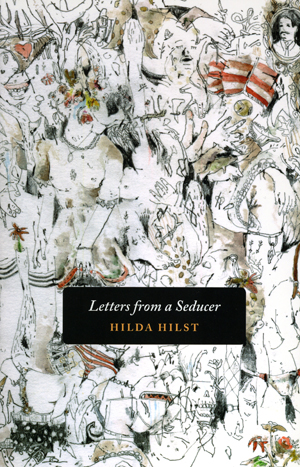
A few years ago, however, I learned that a planned publication of Annotations in Portuguese, or Anotações, was going to go forward. The publisher is A Bolha Editora, who co-published my translation into English of Brazilian writer Hilda Hilst's novel Letters from a Seducer in 2014 with Nightboat Books. Guided by writer, editor and genius Rachel Gontijo Araújo, A Bolha Editora is one of Brazil's exciting small presses, publishing both domestic and international authors, and have been based in the downtown Botafogo neighborhood of Rio de Janeiro since their founding (though I believe they may have recently moved to Brasília, the federal capital). Among the other authors and artists on A Bolha's roster are a number of prose and poetic experimentalists, including Claude Cahun, Kammal João, Bhanu Kapil, Tove Jansson, Douglas A. Martin, Adriano Motta, Jesse Moynihan, Nathanaël, Virgílio NetoGail Scott, and Studs Turkel.

Anotações' translator is Daniel Lühmann, originally from Poço de Caldas, Minas Gerais, Brazil, and now living in Lisbon. Daniel has previously translated the noted graphic novel, Snowpiercer (A Perfura de Neve) by Jacques Lob, Benjamin LeGrand and Jean-Marc Rochette, and Philip K. Dick's A Scanner Darkly (Um Reflexão na Escuridão), into Portuguese, and also makes intriguing performance videos, under the title "Pasarela" (Catwalk), which you can view on YouTube. If you read Portuguese, you can enjoy Mayra Azzi's short, informative profile of him on Revista Trip (the same site that featured the Thiago Borba images) going about his morning routine, with accompanying photos. Or if you are feeling especially tl;dr, you can see Azzi's photo series "Despertando com Daniel Lühmann" (Waking Up with Daniel Lühmann) at Cargo Collective.

Anotações, from A Bolha
Editora (image © A Bolha Editora
and Rodrigo Martins)
In terms of the translation process, he was a pleasure to work with, possessing not just a fine ear but a subtle eye, and we resolved some thorny issues involving vernacular terms and syntax, assonant, consonant and rhyming prose, and obscure references that American readers might be able to guess but Brazilians probably could not. (As was the case with the original version, it will have a glossary, though much expanded from the one I provided at the request of James Laughlin.)

Daniel even devised a solution to "Scaredy cat, scaredy cat, too scared to know where your shadow's at" that mirrors but is hardly an echo of the original. In the process, he even reminded me that I'd invented a few words in that text. His version will be of incalculable help to anyone translating Annotations into any other language, and, like the best translations, he creates a music akin to the original, but distinctively (Brazilian) Portuguese. To him, publisher, author and visionary Rachel Gontijo Araújo, and everyone at A Bolha Editora, I offer my deepest abraços e obrigadões.

The volume is slated to be out later this year, I think, and I think it's OK to show part of one of the covers (there may be two), which uses a original painting by Rio native Rodrigo Martins (cf. above).

Wednesday, February 07, 2018

Tayari Jones' Novel Oprah's Book Club Pick + Elizabeth Alexander To Lead Mellon Foundation


A million congratulations to my Rutgers-Newark colleague Tayari Jones, on the publication of her new, fourth novel, An American Marriage, now out from Algonquin Books of Chapel Hill! Tayari's novel has been receiving rapturous reviews (Entertainment Weekly, LA Review of Books, New York Times Book ReviewSFGate, and USA Today, to name a few) since its appearance, as well as praise from readers on Amazon, Goodreads, and elsewhere. To add to the excellent news, Oprah Winfrey selected An American Marriage as her newest Oprah's Book Club pick, which she announced on CBS Morning News yesterday morning.

Tayari on CBS, as Oprah announces
her book as its newest Book Club selection

Oprah has said of the book, "I have to tell you, it is intriguing. It's a love story that also has a huge layer of suspense. And it's also so current and so really now that I could not put it down and I've already passed it on to lots of my friends and so I know – certainly believe – that you're gonna love it." On her website, Tayari, a writer of numerous gifts, offers a summation of An American Marriage:

Newlyweds, Celestial and Roy, are the embodiment of both the American Dream and the New South. He is a young executive and she is artist on the brink of an exciting career. They are settling into the routine of their life together, when they are ripped apart by circumstances neither could have imagined. Roy is arrested and sentenced to twelve years for a crime Celestial knows he didn’t commit. Though fiercely independent, Celestial finds herself bereft and unm oored, taking comfort in Andre, her childhood friend, and best man at their wedding. As Roy’s time in prison passes, she is unable to hold on to the love that has been her center. After five years, Roy’s conviction is suddenly overturned, and he returns to Atlanta ready to resume their life together.

I have had the pleasure of hearing Tayari describe the book as she was writing it over the last few years, and have now purchased my copy and intend to dive into it very soon! I also expect the praise to continue and prizes to shower this book too. CONGRATULATIONS AGAIN, TAYARI!

You can purchase a copy of An American Marriage here!

***

Elizabeth Alexander
Yesterday brought more good news: poet, scholar, critic, and generally extraordinary person Elizabeth Alexander has been named the next head of the Andrew W. Mellon Foundation! Elizabeth will assume the Mellon presidency in March 2018, replacing Earl Lewis, who has served since 2013. Currently she is the Wu Tsun Professor in the Humanities at Columbia University, and had served as Director of Creativity and Freed Expression at the Ford Foundation. Before this, she was the Frederick Iseman Professor and had previously held the post of Thomas Donnelley Professor and chaired the African American Studies Department at Yale University, where she taught for 15 years. At the Ford Foundation, Elizabeth "co-designed the Art for Justice Fund, a $100 million fund seeded by philanthropist Agnes Gund to transform the criminal justice system and all of its inequities through art and advocacy."

At Mellon, Elizabeth will preside over a foundation that has long been dedicated to work in the humanities and culture, particularly the liberal arts, from supporting scholarship to scholarly publication to the training and development of future educators, as well as considerable work in the museum world. It will be fascinating to see how her interests, as someone who has long promoted equality, social justice and civic participation in the arts and humanities intersects with Mellon's current agenda, and how she as its leader will guide and develop its focus. Inside Philanthropy offers five to consider in terms of Elizabeth's new tenure. Key will be defending not just the humanities, but universities and higher education in general, from those on the right and, to a different degree, from some critics on the far left. As Elizabeth notes, "The value of free expression, of arts and culture, is not something that’s always shouted from the rooftops, right now."

Elizabeth is one of the major American poets, serving as a Chancellor of the Academy of American Poets, as well as on the boards of the Pulitzer Prize and the African Poetry Book Fund. She also is a prolific author and critic. In 2009, she was President Barack Obama's first inaugural poet, her poem captured in the volume Praise Song for the Day. Her 2015 memoir The Light of the World, a powerful tribute to her late husband Ficre Ghebreyesus, which was a 2016 finalis for the Pulitzer Prize and the National Book Critics Circle Award. She is also the author of six books of poetry, including The Venus Hottentot, Body of Life, Antebellum Dream Book, American Sublime, and Crave Radiance: New and Selected Poems. She also has penned two collections of critical prose, The Black Interior and Power and Possibilities: Essays, Reviews and Interviews, as well as a book for children, with Marilyn Nelson, entitled Miss Crandall's School for Young Ladies and Little Misses of Color.

Congratulations to Mellon for making this superlative choice, and CONGRATULATIONS, ELIZABETH!

Friday, January 13, 2017

Kenward Elmslie's *The Orchid Stories* Book Launch

In 1973, Doubleday published Kenward Elmslie's (1929-) experimental, poetic prose collection The Orchid Stories. It is almost impossible to imagine Doubleday, or any of the large international or New York publishers, issuing such a work today. Exuberant as the hothouse orchid from which its title derives, complex, unspooling according to a logic all its own, and decidedly anti-commercial, it's no wonder that the collection, which might also be read as novel or novel-in-stories, went out of print, depriving readers of the opportunity to experience this series of provocations by Elmslie, one of most talented but also lesser known of the  New York School-affiliated writers.    

In The Orchid Stories Elmslie weaves together many strands of his long career, as a poet, fiction writer, librettist and song-writer, editor, and performance artist, creating a tapestry of compelling strangeness. It is a coming-of-age story narrated by a figure whose exact name eludes the reader the entire way through. Certain characters possess more than one name, and The exuberance, unflagging playfulness, and musical currents swirling within the prose make the text one to read and re-read--or rather, it may require rereading--aloud. And that is what several writers, I included, did on Wednesday night at the Poetry Project at St. Mark's Church, to launch the reprint, by New York publisher The Song Cave, of The Orchid Stories. (BOMB features a selection here.)

This new edition features an introduction by radio interviewer and critic Michael Silverblatt, who served as the evening's master of ceremonies, and introducing him was another member of the New York School's second generation, poet, fiction writer, essayist and critic Ron Padgett. The lineup included a number of luminaries who'd long known and even performed with Elmslie, including Ann Lauterbach, who read with breathless brio a section of prose set in Arkansas; Anne Waldman, performing another section as chant and song with Devin Waldman on saxophone and Ambrose Bye on piano, before she shared a song she'd performed more than once with Elmslie himself; and songwriter and longtime Fugs member Steven Taylor, who sang one of Elmslie's songs.

Not only had I never met Elmslie or heard him present his work live, but before I received a copy of The Orchid Stories, I'd only read several dozen of his poems. The collection has intrigued me and led me to read more of Elmslie's work. Although I did know that he had been described as the fifth--or sixth, if Barbara Guest were placed before him--I also had not realized that he was in the same cohort with John Ashbery and Frank O'Hara at Harvard, graduating in 1950, or that he'd been the partner of John LaTouche for a period of time, a fact that Silverblatt recounted in his introductory remarks. (You can read a shorter version of his introduction to The Orchid Stories at the Paris Review's site.) Lastly, as Silverblatt also shared, the great Nat King Cole recorded one of Elmslie's songs, "Love-wise," which appeared on Cole's 1959 album To Whom It May Concern. (I did learn on Wikipedia that Elmslie is the grandson of Joseph Pulitzer.) In additional to copies of the book the publishers also brought a number of Elmslie's LPs. I read a brief selection from the short section or chapter entitled "Waking Up"; it required attention to various kinds of formal and stylistic shifts but thankfully, given my inability to hold a note, no singing. Unfortunately Elmslie was unable to attend the event, but I imagine someone told him how well-attended it was and how enthusiastically the audience responded.

Here a few photos from the event, all borrowed courtesy of the Poetry Project's Facebook page. Please check out Elmslie's work, consider supporting the Poetry Project and enjoy the photos.

Steven Taylor
Devin Waldman, Anne Waldman, and Ambrose Bye
Ann Lauterbach
Michael Silverblatt
Ron Padgett
Yours truly

Monday, August 24, 2015

Reviews: Lee's Go Set a Watchman & Miranda's Hamilton: An American Musical

Harper Lee and her novel cover for Go Set
a Watchman
(Photo by Chip Somodevilla/
Getty Images. Courtesy of VICE & HarperCollins)
As I wrote yesterday, during my quiet stretch here I have been writing for other publications, and just before my last July blog entry, the double obit for E. L. Doctorow and Ornette Coleman, I posted a review of Harper Lee's new (old) novel at VICE, "Harper Lee's Go Set a Watchman Reveals the Limits of the Liberal Imagination." Two paragraphs:
As a counterpoint and complement to the compelling fantasy of MockingbirdGo Set a Watchman possesses real value. What was often latent in the later novel is on full display here, ranging from the middle-class whites' classism, self-absorption, and entitlement to a racial-epithet-packed screed that would not appear out of place on a forum like Stormfront. Reading Go Set a Watchman also made me wonder how it might have been received by critics and the public if it had appeared in the late 50s, and whether there exists another work of fiction from these years by a young white Southern writer that so baldly lays bare the complicity of the mass of white Southerners, particularly the social elites and middle class, in maintaining white supremacy.

In its focus on liberalism's limitations, and its conclusion in Jean Louise's sentimental emotional accommodation with her father's and family's views—"I can't beat him, and I can't join him"—the book also feels very contemporary, since we still encounter unironic invocations of America as a "post-racial" society in the public discourse, despite constant  indications to the contrary.
There's more at the link above. Oh--and I definitely recommend reading Lee's new (old) book.

***

Ensemble and Lin-Manuel Miranda (at right)
in Hamilton (photo by Joan Marcus)
Recently I had the excellent fortune to see Lin-Manuel Miranda's masterpiece, Hamilton: An American Musical, which has made a smooth transition from the Public Theater, where it debuted to acclaim, to Broadway, at the Richard Rogers Theater. I could rhapsodize about Miranda's artistry at length, but VICE fortunately has word limits and editors, so you can read my distilled thoughts about this work at "The Best Musical of the Year Is a Hip-Hop Show About Alexander Hamilton."

Not only do I talk about all the kinds of hip hop (from freestyle to chopper) Miranda manages to incorporate, but I also devote a few paragraphs to the multiple political implications of this work. It's not a long review so please do check it out.

One quote:
Hamilton also offers one of the best and most compelling counternarratives to the increasingly extreme conservative rhetoric around immigration. Alexander Hamilton, Miranda never lets the audience forget, was an immigrant from a small island, with a sketchy education, no money, and few prospects, and became the target of constant social and political antagonism. Even factoring in the neoliberal undercurrent of the hardworking, self-made man the musical espouses, Hamilton artfully hammers away at the idea that power should be concentrated in the hands of an elite, or that opportunity should not be extended as widely as possible, repeatedly connecting this thread to larger ideas about race and class. Many of the musical's catchphrases, including "We are a movement," "Rise up," and "The world turned upside down," would sound as fitting at a protest as they do on Broadway.
Above all, GO SEE HAMILTON! It just may rock your bells, and your world.

Thursday, March 13, 2014

Nightboat Books Launch Photos

Below are few photos from last night's Nightboat Books new publications launch at Callicoon Fine Arts on the Lower East Side. Many thanks to everyone who came out to hear and celebrate the release of Gracie Leavitt's first full collection of poems, Monkeys, Minor Planet, Average Star, which features a self-portrait by the late Emma Bee Bernstein on its cover (and a moving tribute poet, "Reverse," to Bernstein inside), and my translation of Hilda Hilst's Letters to a Seducer, which Nightboat published in conjunction with Brazilian publisher A Bolha Editora

Joining us were two friends and fellow writers, Claire Donato and Reggie Harris, who each read an incisive poem in the spirit of the books. We had a good crowd by the time the event began, and it was even fuller when artist Thomas Kovachevich, whose show is currently underway at Callicoon, presented his poem-without-words, a slow, remarkable, profound piece involving autonomously curling lens paper on blue fabric amidst a bed of water.  It felt especially fitting given the work already presented. Many thanks to everyone who came out and thanks also for buying the books!

I urge you to check out Thomas's exhibit at Callicoon if you're on the Lower East Side; it runs until March 30, 2014. Also, if you can, please do purchase (or urge your local public, college or university library to order!) copies of Gracie's collection and the Hilst novel.

At Callicoon before the reading
(poet & publisher Stephen Motika
at center) 
Some of the attendees before
the reading 
Stephen introducing the event
Thomas's collaborator
in the event pouring the water 
The laying out of
the azure fabric sheets
The collaborator places the
pieces of lens paper on the fabric
The paper begins its dance 
More paper 
A bearded, bowtied blogger
reading from the Hilst
(photo by C) 
Making a point of some
sort about Hilst
(photo by C)
Another photo of yours truly
and the full crowd
(Photo by Andrew Blackley--thanks!)

Thursday, October 10, 2013

"Re-Thinking" Literature @ NYU

As part of my preparatory remarks before my reading at Naropa University, I noted a "horrible" conference I'd attended only a week before. I also invoked the same event during my comments at the &Now Festival at the University of Colorado. In both cases I mentioned only that the conference took place at New York University. I didn't elaborate, but that's in part what a blog is for, isn't it? The international conference I was referring to at both events was "Re-Thinking Literature," and it ran from September 19th through the 21st this fall. Oxford (New College) faculty member Donatien Grau and NYU professor Tom Bishop were the organizers, and nearly 20 writers, critics, scholars, academicians, and theorists spoke over the three-day gathering.

So what was my beef? You probably know what's coming. In three days of pontificating about "literature," the conference featured not a single author, scholar or theorist of color, from the US or overseas, on a single panel, nor did a single panel or panelist, as far as I could tell, directly address or discuss literature by non-Europeans or non-Euro-Americans. Not one. Why? I don't know. It was not as if this French-slanted conference, one of whose organizers is a professor in NYU's French department, had no colleagues who could conceivably participate. The esteemed writer and critic Assia Djébar was, until a few years ago, a professor of French at NYU, as was the historian Sylviane Diouf, and among the NYU French department's current faculty there is J. Michael Dash, a major scholar of Francophone Caribbean literature, with Manthia Diawara, the scholar, critic, film-maker, and former head of NYU's Africana Studies department an affiliate. And that's just NYU's French department. (I can't speak about Oxford's faculty.) Perhaps he asked all of them, or one of the (m)any other faculty members of color working in and around literary studies in (m)any of NYU's other departments, whether they wanted to participate, and perhaps they all said no. Perhaps they all were busy.

At the "Re-Thinking Literature" conference, NYU
Shelley Jackson (l) and Ben Lerner at the podium

But say they were not. One might then argue that the organizers intended that the conference, which included papers and conversations on a range of topics, including the relationships between literature and: art criticism and installations; religion; affect; cognition; and textualities, to name just a few of the topics, be primarily about what they saw as literature, which is to say, mostly European and Euro-American literature, unmarked by anything beyond and occupying nothing not somehow captured by the unnamed, unacknowledged and unacknowledgeable signifier of whiteness. I mean, it stands to reason that when one says the word "literature," a Platonic abstraction, one means only, can only mean, the literature of Europe and (some parts of) European America, no? Yes? So be it. But then why not just call the conference "Re-Thinking Euro-American Literature" or "Re-thinking Elite/High Literature by White People" or something similar, since the organizers made it clear that the vast corpus of literatures by everyone else across the world did and does not matter? There is privilege, there is entitlement, there is blindness, there is arrogance, and there is the expectation that because you have told yourself and others for centuries that you--or certain ones of you--are all that matter, that's all that's supposed to matter.

I should add that after a day of this stuff--and a report, by a friend, who attended and was aghast at the rambling mess served up by the conference's opening night speakers--I had had enough of what I have encountered for much of my adult life. I left them to their intellectually and hermetically sealed white room. It very well could have been the case on the final day, which I did not attend, that, even if all the speakers--and I should be clear that I do respect and admire the work of many of the participants--were white, perhaps one or several of them did look and speak past the self-constructed wall of Euro-American literary comfort, to acknowledge that there was and is quite a bit of other very vibrant work, in literature, literary and cultural criticism, philosophy, translation, etc., out there not centered on or produced by Europeans and Euro-Americans. If so, great for them.

I do wonder if any of them asked themselves why there were only white people on the panels. Did anyone verbalize this to Grau or Bishop? Did they see this as a problem and even mention it to each other? The audience certainly was not only white. If no one did ask such a question, I do wonder, what would lead them even to the threshold of doing so of their own accord? At any rate, my adult experience has been and continues to be that when it comes to the literary and the academic literary world, this sort of thing, a kind of de facto aesthetic and critical apartheid is still too prevalent.  Sometimes there are one or two tokens, or a panel in which all the people of color are bunched up together and only expected to talk about certain expected things. It's this way still in various pockets of American society, including popular culture. And in any case, as I noted about the "Re-thinking Poetics" conference at Columbia University a few years back, it represents a particularly perverse irony in a city like New York, the most diverse in the United States. Some "re-thinking" really does need to occur, but it's not just about literature.

That said, I did hear one talk I found quite intriguing, by Ben Lerner, whom I approached afterwards and briefly chatted with. I specifically noted the conference's whiteout cast to him, and he agreed it was not good. (I did not expect him, as an invitee and panelist, however, to say anything to Grau or Bishop, but perhaps he did.) Ben's paper was titled "Virtual Ekphrasis: Fiction as Criticism and Curation," and explored the idea of the novel--as opposed to poetry, a genre in which he has distinguished himself--as a curatorial site, a space "in which you can embed other artworks," and a "testing ground for aesthetic experience." An introduction of sorts both to his first novel, To the Atocha Station, and his forthcoming one, his talk was full of insights, but it circled around the key point that in "speculative" fiction, and not just in the commonly understood science fictional sense, you could write about "artworks not yet realized" or, to go further, that were and are "unrealizable."

As one example from the canon, he cited Henry James's famous story "A Madonna of the Future," a narrative about an artist producing a blank canvas (and which I thought of as I assigned John Ashbery's famous sestina "The Painter" as part of my fall undergraduate class's poetry component). This James story is often thought to dramatize the tyranny of artistic influence and resulting failure. In Arthur Danto's reading of the story, however, the philosopher and critic views James's character's Theobald's artistic production or lack thereof as a masterpiece, and a curator version attempts to convince the artist that his work is a harbinger of later artists like Robert Ryman, Alexander Rodchenko, Kasimir Malevich, and Robert Rauschenberg, and that what appears as failure in one age harbors potentiality for the future.

Ben linked this concept to contemporary novels written in the current moment of the "postmedium," which is to say, after the stability of particular media as we've known them, and also to our current aesthetic and social ontologies, where the status between art and life often blurs. He identified Rachel Kushner's National Book Award-nominated novel The Flamethrowers as exemplary in exploring this unstable status. In Kushner's novel the main character, Reno, is deeply interested in the artist Tony Smith and his idea of abandoning art in favor of situationism, experience. Kushner describes Reno's experience of temporality at times as a "trace of a trace of a trace," but Lerner was especially interested in the novel's depiction of her attempts to collapse art into life, and the links with 1970s art and earlier precursors, including Italian futurism and industrial design, via the figure of T. P. Valera, and the Valera bike--which occasioned, though Ben didn't discuss this, a prickly review from motorcycle enthusiast Frederick Seidel--which entailed entangling and collapsing art into life. Kushner, he said, organizes her novel around the dream of dissolving the line between art and life. Unlike recent works by Sheila Heti or Tao Lin, however, it doesn't stylistically or generically collapse the distinctions but virtualizes them.

As part of the Q&A portion, I asked Ben a question about the limits of liberal discourse, particularly in the face of incommensurable, globalizing alterities and competing rationalities--ideas I've been writing through a bit myself in my current fictional projects and thinking about after reading some of David Palumbo-Liu's critical work--and the novel's capacity to address and possibly resolve this crisis. He responded thoughtfully by talking about the relationship between novels and politics, though he did not really answer whether the contemporary American realist novel, so favored by the publishing industry and American literary culture-makers, could do what Palumbo-Liu has argued certain works, by writers such as J. M. Coetzee and Ruth Ozeki, have managed to. His talk nevertheless really got me thinking about questions of representation and futurity, the imagination and the possibilities or impossibilities--challenges--of depicting the possible, in art, and that, I guess, does entail "re-thinking literature," which ultimately did make attending the conference, for all its limitations, worthwhile.

At the "Re-Thinking Literature" conference, NYU
Camille Laurens (l), Tom Bishop (center), and Jean-Pierre Toussaint (at podium)

Tuesday, March 26, 2013

The Next Big Thing

THE NEXT BIG THING

What is the working title of the book?
There are several, but I'll mention two. One is a book I just finished translating, entitled Letters from a Seducer, by the Brazilian author Hilda Hilst (1930-2004). Another, which still has a bit to go, is a novel entitled Palimpsests. And there are other projects (fiction, poetry, etc.), as always, in the crockpot.

Where did the idea come from for the book?

The translation was suggested by the Brazilian publisher, as I'd written the introduction to a translation by her and an author, and greatly admired their work. (This is the second book I have translated from Portuguese; the first, by the out gay Brazilian legislator and reality TV star, Jean Wyllys, remains unpublished, except for a few individual stories here and there.) For my own novel, the idea came from attending an OutWrite conference in Boston many moons and skies ago, and seeing a tiny historical note. It took me years to figure out what I wanted to do with the idea, and then it has taken a while to write it.

What genre does your book fall under?

Fiction and fiction.

What actors would you choose to play the part of your characters in a movie rendition?

I would say no one is going to make a film of Hilst's novel anytime soon, except that if 1) Lars von Trier, 2) Bruce La Bruce, or 3) Rosa von Praunheim could find a screenwriter to do it, it might at least have a chance. The text is beyond the American cinematic imagination, for the most part. As for the novel I'm writing, Idris Elba would be my first choice for the main male character, and Kimberly Elise would be great as his sister, who is a significant figure in the work. Anthony Mackie would probably be very good as the third major character. I could fill entire blog post with actors for the other parts, but will just ask you to imagine any number of talented actors and actresses, ranging from Mahershala Ali to Angela Bassett.

In terms of the major white characters, I have no idea whatsoever, save for the 20-something daughter of the main character's nominal boss. That should be played by someone with a somewhat grave, fragile face, and an ability to show tremendous acting restraint.

There are a range of characters, so it would give an array of actors, especially black and brown ones, some jobs.

What is the one sentence synopsis of your book?

A man has a stranger appear on his doorstep one night, and he has to help him create a new life.

How long did it take you to write the first draft of the manuscript?

Almost forever, minus a kaput computer and a half.

Who or what inspired you to write this book?
With the translation, my inspiration is always Langston Hughes, who was a true person of letters, with translation as one aspect his prolific practice. It's an aspect of his career that people often leave out, but it is one I have taken to heart. Melvin Dixon was also a great translator, writer, and scholar, and someone I deeply admire still, and I would add my former colleague Reginald Gibbons, as well as Marilyn Hacker and Nathanaël, among many, as inspiring writer-translators that come immediately to mind.

With my novel the historical note I came across was the major inspiration. Also years ago my partner's late aunt gave him a book about early African American literature, and it turns out that the real-life person on whom my character is based was a figure notable enough to appear in that book, and even appears in this book. So that was inspiration too. Then there are so many writers and artists and thinkers I have read, followed, admired, known, many of them no longer with us, many lost to AIDS or psychological troubles, and I often think that either with this book or another, I will eventually follow Clarice Lispector's strange little introductory method in The Hour of the Star and list all these "imaginary artist friends,"as Sheila labeled them in her response, either at the beginning or the end of the book. Also, see Delany, Samuel R., Jr.

What else about your book might pique the reader’s interest?

The Hilst book is the very definition of genre-breaking, and required me to learn more words for sexual terms in Portuguese than I know in English. English is vocabulary-rich, but comparatively sex-vocabulary poor.

My novel is set in 1804. How often do you read a book set in that year in America? And there are no electric lights, no cars, no airplanes, no TVs, nothing of the sort. They wear smallclothes and Empire-style dresses and ill-fitting shoes. Everything carries a thin veneer of candle smoke, and the fragrance of urine. There were coaches and the beginnings of plumbing and a museum exhibiting little wax statuettes of Othello and Harvard College and free black people, some queer, too. It was quite a time!

Will your book be self-published or represented by an agency?
The Hilst book is to be published this fall by Nightboat Books, based in NYC, in conjunction with Abolha Editora in Rio de Janeiro (I believe). They published the first translation into English of Hilst, and I highly recommend it. I do have an agent, so with my novel we shall see.

My tagged writers for next Wednesday are:
Reginald Harris
Lee P. Jones

Friday, May 25, 2012

Another Great Gatsby + Egan's Twitterature Experiment

Some people have too much money handy. What am I talking about? Baz Luhrman's initial trailer for his version of F. Scott Fitzgerald's The Great Gatsby.

Watching this, I have one question, whose answers I already know (A: "Because he can; because the producers imagine dollars flowing in based on the name, stars, style; because Hollywood is intellectually bankrupt and seems to have forgotten that there are countless novels written since The Great Gatsby that might make interesting films; because etc."). Why?


***  

Jennifer Egan, who received the 2011 Pulitzer Prize in Fiction for her novel A Visit from the Goon Squad, has decided to share the beginning of her new novel, Black Box, via Twitter, as a series of Tweets via The New Yorker's feed @NYerFiction. She began doing so on Thursday night, and the first section is up on the magazine's site, as "Black Box." More than anything it reads to me less like Egan's other prose fiction that I've read--and she does write in a variety of voices, as A Visit from the Goon Squad exemplified--than a poetic experiment, the enforced concision of the 140 character pushing her towards a condensation whose result is aphorism, or something akin to it.  Think G. C. Lichtenberg, or E. M. Cioran. Were she wrapping these nuggets in ampler verbiage, I'd even cite the Walter Benjamin of One Way Street.

Take the opening lines:

People rarely look the way you expect them
to, even when you’ve seen pictures.

The first thirty seconds in a person’s
presence are the most important.

If you’re having trouble perceiving and
projecting, focus on projecting.

Unlike a prior experimenter in this microserialist format, Rick Moody, who in the late fall of 2009 tweeted a 153-tweet story, over 3 days, entitled "Some Contemporary Characters" for Electric Literature, she isn't allowing the sentences to run past the 140-character (Twitter's) limit, which is to say, to enjamb them. Or is the verb for sentences flowing past their technologically-enforced boundary "superlineate"? I asked on Twitter earlier whether "Twitterature" itself was a word (I imagine it is), and whether this text by Egan might not be a noteworthy contribution to it.

Japan has an entire fictional genre born of text messages; others, beyond Moody, like John Wray, have written stories and novels on Twitter; and our most recent inaugural poet, Elizabeth Alexander, like many predecessors, conceived of using the platform as a means for poetry.  Its asseverative quality seems especially apt for that oldest of literary forms. If Egan plans to proceed stylistically like this, I find it hard to believe she'll sustain this beyond a chapter or two. But she's as talented a writer as you'll find out there, so she probably has a larger design up her sleeve. I will certainly read the final version.

Saturday, October 29, 2011

Murakami's 1Q84 + New Lispector Translations for ND


Once upon a time, when I was younger, and certain writers published new books, if I could afford to, I would rush to the nearest bookstore to purchase the books as soon as they hit the shelves. I grew out of that around the time I went to graduate school and found myself with little money for anything beyond rent, food, basic clothes, and so on, and in the years since that kind of attentiveness to favorite writers' new works has never returned, but occasionally the announcement of particular books will spur me, if not the day they're released, then shortly after, to buy them. If, of course, I can afford to. I had heard murmurs about Haruki Murakami's extraordinary new novel(s), 1Q84, published in multiple volumes in Japan and in one giant volume this month by Alfred A. Knopf, but in the hurlyburly of preparing for and then beginning classes this fall, I'd forgotten about it, until a university colleague and fellow Murakami-phile, Nathan M., reminded me of it.  Our discussion of Murakami's new book jogged my memory of having seen it a few times when I was at Kinokuniya in New York this past summer. A branch of that store, which features in Murakami's works, including this one, sits right across 6th Avenue from Bryant Park and has a perfect little cafe for taking a library break, but I wasn't thinking at all about when the English translation would appear. And then, shortly after talking about the book and invoking Murakami in my undergraduate class (though we're not reading him this year), I was in Unabridged Books in Boystown and saw the book, and said, budget buster or not, I ought to get it. Only the hardcover (and perhaps the e-book, I haven't checked) version is out, and at 932 pages it's as big as a paving stone and as heavy. And it costs a cool $30.50. Perhaps I should have waited until the paperback(s) appear...next spring? Two translators, the acclaimed Jay Rubin (Books 1 and 2) and Philip Gabriel (Book 3), have brought it into English, and I don't read any Japanese, but my cursory glance suggests the prose flows as fluently, with Murakami's signature quirks, as ever. I don't know when I'll get to it; though I blogged about Roberto Bolaño's 2666 even before it was published it took my another year to purchase the English translation (the three-volume boxed paperback set) and several more years to read it the first time, after which I reread it again this summer. I hope to get to this Murakami volume this spring, but I have a very heavy required reading load right up through April, and a K-2 of books backing up before this so perhaps I will complete my rendez-vous during the summer. Every peep has revealed something strange and interesting, so I might not be able to wait that long. If you're curious about the novel, you can get a précis here.

A day or so after I bought 1Q84 I read Sam Anderson's somewhat problematic but still intriguing New York Times Magazine article "The Fierce Imagination of Haruki Murakami," his account of his encounter with Murakami and (Murakami's) Japan. I say "problematic" because the article opens with the sort of annoying orientalism that should have gone the way of the Mikado. It's like Lost In Translation but without the interesting actors or acting or mood. Had he really never seen any films about Japan, read any other Japanese authors, never read a single history or sociological or anthropological or travel book about the country? At any rate, once you get past that bit, it really is an interesting, relatively brief record of an encounter--a portrait, though not really a profile, unless that terms suggests not getting beneath the surface or seeing other angles--of Murakami's life and work, and of Anderson's recognition of how distinctive he is in relation to Japan, yet how deeply rooted in aspects of Tokyo, at least, Murakami also is. Most of what even semi-regular Murakami fans already know about him receives a bit of treatment here, but I did find his account of how a trip on one of Japan's main highways led to the opening scene of the new book. In that scene, playing in the taxi is Leos Janacek's 1926 tribute to his country, his Sinfonietta, a piece of music that Murakami describes as "'probably not the ideal music'" for the experience. He goes on to say that its "weirdness" was the reason he chose it, and that "that is not a popular music at all." In Japan, I suppose, though it's nationalistic and militaristic Czech music--Janacek removed the "military" from the original title, brass fanfares tend not to be unpopular, and there are folkloric elements woven in, so I would imagine it's probably a bit more popular, at least in the Czech Republic and elsewhere, than Murakami credits it. Anderson, who I gather has never heard it before either (ugh!), describes it as: "busy, upbeat, dramatic--like five normal songs fighting for supremacy inside an empty paint can. This makes it the perfect theme for the frantic, lumpy, violent adventure of 1Q84." What? I rather like the Sinfonietta myself, and once even played a CD featuring the rousing opening for C (who wasn't impressed), but I was thinking of all the dreary cab rides I've been in over the years, some with awful pop music, some with chatty cab drives, one (and C will attest to this) with a religious fanatic who kept taking his hands off the wheel and assuring us that God would take care things, etc., and in any of those cases, I would much rather hear a lively brass fanfare than what I experienced. At any rate, one fascinating aspect of Janacek's piece is that he derives all of the subsequent movements from the cheerful opening motif, which is scored for brass and percussion, and never sounds like, well, John Philip Sousa (not without his charms either). I also have now heard several radio discussions of Murakami's new book, which hav included bemusement about Janacek's music (as well as the mangling of his last name--yah-NAH-chick!), so I include a Youtube video below of the opening two movements, with Rafael Kubelik conducting the Bavarian Radio Orchestra. Does this sound like music in a paint can? Really?


‡ ‡ ‡

While at the bookstore I noticed what looked like a new New Directions edition of Clarice Lispector's penultimate, and best known novel, The Hour of the Star, which appeared just before she passed away, in 1977.  What I spotted turns out not only to be a new edition, but a new translation of this remarkable work, by Benjamin Moser, who wrote the authoritative English language biography of Lispector, Why This World: A Biography of Clarice Lispector (Oxford University Press, 2009). In it he traces not only Lispector's life and work, but the development of her thought, showing how her early engagement with Baruch Spinoza deeply marked not just the content of her works, but also its forms and its language. Moser, who also writes for Harpers and The New York Review of Books, has now brought into English what appears, at least from my reading of it, a version of Lispector's novel that is much closer to the original Portuguese. One thing that most readers do not know, but as I believe I've mentioned on this blog before, is that the longstanding English translation, by Giovanni Pontiero, I believe, not only changed key bits of text, but left out portions. A scholar of Brazilian literature and a scholar of Hispanophone literature who was reading the text for a paper both confirmed that this editing and bowdlerization had occurred, though most readers, including I, have fallen in love with the earlier English version of the text. Moser's Lispector is a bit wilder, and he discusses this in a thoughtful afterword that helps to orient the reader to the text. I almost wish it could have been exchanged with the foreword, by Colm Tóibín, which doesn't really add that much in a prefatory sense, though it would be fine after one read the book. 

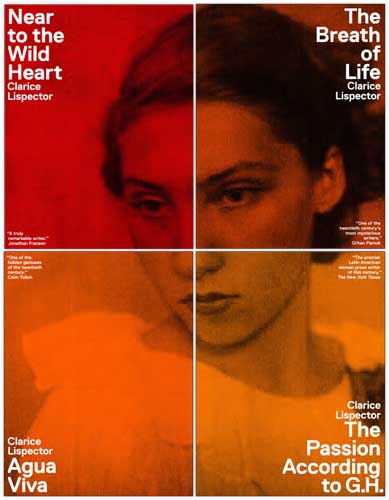
The next 4 newly translated volumes
to be published, which
will form a portrait of
Lispector when placed together
From Moser's postscript and from the front matter it appears that New Directions will be publishing new translations of several more of the books, which Craig Morgan Teicher's September 27, 2011 article in Publishers Weekly confirms. New Directions will issue new translations of Lispector's highly praised début, Near to the Wild HeartThe Passion According to G. H., Lispector's greatest existential and spiritual exploration; A Breath of Life (Um sopra de vida: pulsações, her last, posthumous, highly abstract, metafictional book, which has not been translated into English); and Água Viva, which Elizabeth Lowe and Earl Fitz translated as The Stream of Life, and published with University of Minnesota Press in 1989. Hélène Cixous, who brought worldwide attention to Lispector, wrote the introduction this earlier version; I wonder who New Directions will get to introduce it. Thank you, New Directions, and, as with Murakami's tome, when these appear, if I have the scratch, I will be getting them, and urging the university and other local libraries to do so as well. Fellow readers and teachers, take note!

From Moser's "Translator's Afterword" (p. 80):

Clarice Lispector's weird word choices, strange syntax, and lack of interest in conventional grammar produces [sic] sentences--often fragments of sentences--that veer towards abstraction without ever quite reaching it. her goal, mystical as well as artistic, was to rearrange conventional language to find meaning, but never to discard it completely. 
Paradoxically, the better one's Portuguese, the more difficult it is to read Clarice Lispector. The foreigner with a basic knowledge of Romance grammar and vocabulary can read The Hour of the Star with ease. The Brazilian, however, often finds her extremely difficult. This is because her subtle rearrangements of everyday language are so surprising that they often baffle the reader, particularly the reader with little experience of her work. 

And from his new translation, here is the narrator, the often strange, sometimes repellent, always beguiling Rodrigo S. M., describing the novel's protagonist, heartbreaking, hapless Macabéa (p. 29):

She had what's known as inner life and didn't know it. She lived off herself as if eating her own entrails. When she went to work she looked like a gentle lunatic because as the bus went along she daydreamed in loud and dazzling dreams. These dreams, because of all that interiority, were empty because they lacked the essential nucleus of--of ecstasy, let's say. Most of the time she had without realizing it the void that fills the souls of the saints. Was she a saint? So it seems. She didn't know that she was meditating because she didn't know what the word meant. But it seems to me that her life was a long meditation on the nothing. Except she needed others in order to believe in herself, otherwise shed'd get lost in the successive and round emptinesses inside her. She meditated while she was typing and that's why she made even more mistakes.

There's so much more. From Copyright © Clarice Lispector, The Hour of the Star translated from the Portuguese by Benjamin Moser, New York: New Directions Publishing Corporation, 1977, 2011. Translation Copyright © Benjamin Moser, 2011.

Tuesday, May 22, 2007

Spent + Cicadas Serenade Us + Banksy Revealed + Comedy & the Novel

After finishing marking up the 102nd page of one my undergraduate students' independent study projects today (I have one more undergraduate one, an enthralling 300+-page novel; and two graduate ones, a series of stories and another novel, as well as a thesis project of stories to go before the quarter's over, and have been long finished with the honors projects, all of which have been great projects to supervise, as well as the various application files and other kinds of submissions), I realized I should risk the cliché and admit that my mental prose processing mechanism, or wick, or filament, or whatever the appropriate metaphor is, has basically burned out. Or as Vladimir Sorokin might write: BURNED OUT. I bet there are psychological and cognitive science studies on how much the average person can read in a given period, and I think I am usually exceeding whatever the outermost limit is. This evening I tried to pick up Alain Mabanckou's African Psycho and Roberto Bolaño's Savage Detectives, two books I have been reading for and with great pleasure, and could only make it one paragraph in the former and a few sentences in the latter before I had to put both down. With poetry I can do little better. I read a gorgeous few cascading stanzas of a Robert Duncan poem ("radiance"), and then my eyes started to roll. Even reading anything on the Internet is exhausting. As for my own writing... I just keep reminding myself, the summer is just around the corner.

***

Once upon a time I was entomologically challenged. When I was younger I really, viscerally disliked most insects, especially roaches, and many arthropods, particularly centipedes. I was fortunate that in the various houses where my extended family lived, roaches were rare. But when they made their appearance, it was if I were plunged into my own personal horror film, and if I didn't scream, it was a miracle. Ants, grasshoppers, praying mantides, earwigs, waterbugs, silverfish, and countless other creatures, especially of the sort that abound in the suburbs, were ever present, and in small numbers I could deal with them. (My brother once had to have a beetle--or was it an earwig--removed from his ear after we'd been to camp and lay in the grass a lot. That stopped me from that bit of leisurely activity for a while.) Wasps and hornets often built hives under the front porch awning, or in the corners of this dilapidated carport that separated the front and back yards at my parents house, and more than once I was stung while cutting the grass. (I regret ever wishing that the too-numerous bees, attracted by the tree nursery that eventually became a park behind my parents house, would be gone.) And i will never forget the experience, during my early teen years, of going downstairs in our suburban home and seeing this cloud of tiny insects all over the washing machine and dryer, and thinking, this looks really bad. I made a guess, and was right: termites! An exterminator or two paid visits, tore out some of the rotten wood, sprayed extensively, and all supposedly was well. I kept swearing that there were still things inhabiting the wood down there, but my parents assured me that, no, the termites were gone. The house is still standing, so I guess they knew what they were talking about. There are all kinds of flying and crawling creatures that slip through the screens in Chicago, or that ply the garden in Jersey City, but in general, none of them bother me at all.

My dislike--fear--of roaches persisted into adulthood, and ended--sorry, C, I have to retell this story--when, one afternoon in Charlottesville, at a Mexican restaurant that was on the famous "Corner," I bit into what I thought was a lemon wedge in my iced tea, and it turned out to be a semi-waterlogged roach, which is to say, dead as an ice cube, but still--a roach. While my impulse probably would have been to leap through the ceiling (and land somewhere in southern Maryland), I calmly set the plastic tea mug down, called the waiter over, and let him know that in fact, I had just bitten into a roach. He was obviously horrified and worried that I might start announcing this fact loudly, but I didn't; I was invited in back to speak with the manager, who apologized profusely and promised me a free meal the next time I returned. Of course I didn't. But from that point onwards, roaches have never bothered me. I had an opportunity to prove this supposition when I stayed with a person I knew who lived in Philadelphia, who had, to put it mildly, a very bad roach problem. In fact, it was so bad that as soon as you turned on the lights, roaches went scrambling in all directions, like a crowd evacuating a burning building. In my youth, such would have been my terror that I would have been forced to tell my host, as politely as I could, that I absolutely had to stay in a hotel (or motel), so as not to put him out, but on this occasion, I calmly elevated all my bags and shoes, made sure none of the blankets touched the floor, and slept without a problem. In the morning, I shook out my clothes, bags and shoes to ensure that I wasn't bringing any unwanted guests back, and that was that. In general, I'm fortunate that, as in the past, I rarely encounter roaches of any sort, in Chicago or Jersey City or anywhere else I happen to be.

As for cicadas, one of those common urban/suburban insects, I'm of two minds. I don't find them terrifying at all, but then I haven't seen one in years. I even invoked one (well, because of a rhyme) in an old, bad poem. But I have recently been reading about and hearing the gleeful descriptions of the imminent cicada swarm--labeled "Cicada-palooza" by one of Chicago's sorry excuses for a newspaper, the Sun-Times--that will soon hit whole portions of the US east of the Mississippi, and I have to admit, I am dreading it. Supposedly these cicadas, as opposed to the annual cicadas, have hibernated underground for 17 years and will emerge in droves (5 billion in Northern Illinois alone!) and cover everything in sight or on site like a quivering, electrified shroud. To ensure their future swarming they emit a series of mating noises that have variously been described as a trill, a muffled foghorn, and loud static. (Audiologo, do you know if anyone is planning to record the cicada's cries?). The males "sing" from dawn until dusk, at 104 to 106 decibels. According to something I read today, a swarm once interrupted a speech by Teddy Roosevelt--who I doubt even flinched--and one Chicagoland ice sculptor is so worried about them that he is declining requests for outdoor marriages, for fear that a cicada-furred sculpture might cause lasting trauma for a poor young couple. Instead of making people want to get in their cars and head for fields of Iowa (which are allegedly cicada-less), the radio and online commentators are giddy about these pests, and some are even describing how they will catch the mature adults and larva, and engage in culinary pursuits. Watching all those contests on Fear Factor and Survivor and countless other shows may have lowered Americans' gastronomic thresholds, but I seriously doubt people are going to be feasting on cicada skewers or cicadas Rockefeller or omelettes à la cicade, despite all the boosters. But then I am more concerned about having to bat these things off my car, or worse, pull them out of my hair. But then again, maybe that would cure my lingering unease about them. A cicada (or 100) in the hair is worth two in the....

***

Banksy Cut OutEileen wrote in the comments section to let me know that Banksy has been unmasked. (If you don't want to see what he looks like, do not visit the link.) I was hoping that Banksy was really a distributed collective of people, based in Britain and other parts of the world, who operated as anarchic, autonomous cells. Oh well. I agree with one of the commentators on the site above that Banksy remains one of the most exciting artists of the last 10 years, though as the New Yorker article-profile on him exemplified, he's now quite famous and being written about in the likes of the contemporary New Yorker (we're not talking about the Robert Gottlieb-edited New Yorker, which expounded for pages on the likes of Richard Evans Schultes, for example), and collected by the likes of Brad Pitt, among others, so despite his politics, any claim to functioning outside the wretched big-money art system no longer carries any weight. What was it that Marx (and Benjamin and Adorno and Marcuse and Althusser, etc.) said about use value and exchange value?

At right is a cut out from Complex.com. If you click on it, you can get to be your own personal Banksy (see, I knew there was a way to encourage anarchic autonomous art!). Spray can not included.

(Thank you, Eileen!)

***

Finally, speaking of things I have been trying to read, I came across this article, "Divine Comedy," by Julian Gough, on the dominance of tragedy over comedy in contemporary fiction. He calls modern novels "worthy and dull," but I have to disagree on the latter. Was of his assessment is right: comedy is rarely treated as seriously as tragedy these days (ironic, huh?), whether one's talking about academe or mainstream literary institutions. (And comic poetry is widely considered to be even more beyond the horizon than comic fiction or prose.) Yet in an effort to make his point, he's goes a bit overboard. It's also the case that too much humor, especially of the ironic and satirical sort, loses its edge without the intermittent relief of other modes, especially the tragic, or turns into something supercilious and tart. We were supposedly in the post-ironic age after 9/11, though the people who uttered such pronouncements had obviously forgotten about what was going on in Washington, DC, which has been so tragic it's worthy of treatment in ancient comic form.

Of course he says a lot more, including things that will make no religionist and few people teaching literature and creative writing in the academy very happy, such as:

The literary novel, by accepting the embrace of the universities, has moved inside the establishment and lost contact with what made it vital. It has, as a result, also lost the mass audience enjoyed by Twain and Dickens. The literary novel—born in Cervantes's prison cell, continued in cellars, bars and rented rooms by Dostoevsky, Joyce and Beckett—is now being written from on high. Not the useful height of the gods, with its sharp, gods'-eye view of all human classes, all human folly, but the distancing, merely human height of the ruling elite, just too high up to see what's happening on the street below.

Luckily this situation is self-satirising. Campus authority generates campus comedy. The senior academic novelist is trapped in the small world of the university, cut off from the big world, embodying authority yet still driven to write. In this situation the novel, if it is to live, must turn against the novelist. Malcolm Bradbury and David Lodge, writing novels at night, attacked their day-selves, their academic selves, as absurd buffoons whose work was meaningless. And the novelist in them was right.

The university model, any teaching model, of necessity implies that there is a Platonic ideal novel in some other dimension, which has all the characteristics that make for novelness and that the more of these attributes a novel has, the more like a perfect novel it is. This concept works for the tragic, it works for the epic, it works (less well, but it works) for the lyric, it does not work for the novel because, as Mikhail Bakhtin has pointed out, the novel is the only post-Aristotelian literary form. It is not bound by classical rules. It is not bound by any rules. The novel is not a genre. The novel is always novel. The novel is always coming into being. The novel cannot be taught, because the novel does not yet exist.

This professionalisation will make poor writers adequate. And will make potentially great writers adequate. Great novelists write for their peers. Poor novelists write for their teachers. If you must please the older generation to pass (a student writing for an older teacher, a teacher writing to secure tenure), you end up with cautious, old-fashioned novels. Worse, the system turns peers into teachers. Destroyed as writers, many are immediately re-employed, teaching creative writing. This is a Ponzi scheme.
And:

The damage this is causing to novel, writer and audience is particularly advanced in America. The last 30 years have seen the effects of turning novel writing into an academic profession with a career path. As they became professional, writers began to write about writers. As they became academicised, writers began to write about writing.

And the language of the American literary novel began to drift away from anything used by human beings anywhere on earth. Thirty years of the feedback loop have led to a kind of generic American literary prose, instantly recognisable, but not as instantly comprehensible. Professions generate private languages designed to keep others out. This is irritating when done by architects. But it is a catastrophe for novelists, and the novel.

Lastly, a series of thesis units, which is your writing time guided by your thesis committee members, will fulfil the required 36 units....

Much of their fiction contains not so much tragedy as mere anxiety. Pushed to look for tragedy in lives that contain none, to generate suffering in order to be proper writers, they force themselves to frown rather than smile; and their work fills with a self-indulgent anxiety that could perhaps best be called "wangst."

He's not talking idly...

After I read Gough's article, I had to ask myself, who was the last comic or satirical writer I taught, and I was able to name several immediately: Donald Barthelme (the inexhaustible), Franz Kafka and Amiri Baraka (who both often straddle the line, edging into the tragic), and Victor Pelevin, and the first and last are consistently among the most popular with my students. In past years I have used comic, satirical and parodic works by a range of writers, from Ishmael Reed to Mikhail Bulgakov to Ben Katchor to Mark Leyner to Edgardo Rodríguez Juliá, though I admit to tending towards the tragic crowd. One of the humor writers I've taught that I most enjoyed learning about and whom students fell in love with was Fran Ross, whose Oreo is one of the masterpieces of 20th century American comic writing. And it was, unfortunately, her only published work. If you haven't read it, run to the bookstore or library, pick it up, and enjoy!