Showing posts with label comparative literature. Show all posts

Sunday, March 01, 2015

The Volta / Evening Will Come's Poetry Translation Issue

It has been a while since I've posted a translation on this site or written about the topic here, so I am happy to link to a special Poetry Translation Issue that poet, critic and translator Rosa Alcalá has edited at The Volta's site Evening Will Come. The issue features essays on translation and translations by Kazim Ali, Don Mee Choi (translating Kim Hyesoon, from Korean), Kristin Dykstra (translating Ángel Escobar from Spanish), Forrest Gander (translating Gozo Yoshimasu from Japanese), Johannes Göransson, Jen Hofer and John Pluecker, Erin Moure (translating Wilson Bueno from Portuñol/Portunhol), Jeffrey Pethybridge (on radical imaginings of Homer's The Iliad), Molly Weigel (translating Oliverio Girondo from Spanish), and me, translating the poetry of Claudia Roquette-Pinto from Portuguese.

The focus of the Modern Language Association's annual conference a few years ago, and still salient in comparative literary studies circles, translation as the contributors here make clear is far more than the rendering of literary texts from one language into another, but a social, political, economic, and ethical set of actions that is increasingly important both within national contexts and globally. As Rosa notes in her introduction,

Translation is seen not as something simply cloistered in the realm of the literary, but as a civil act, a means of justice. It is often intimate, playful, transgressive, both faithful and radical. The work included here also reminds us that translation has the potential to disrupt, re-dress, and reconfigure the simplistic aesthetic divides of contemporary poetry in the U.S. It isn’t just a window outward to another culture or literary tradition, but a two-way mirror that reflects back on our own, as Jen Hofer writes in her introduction to Sin Puertas Visibles: An Anthology of Contemporary Poetry by Mexican Women.
As scholars like two of my former colleagues (to name a few of many) Harris Feinsod and Andrew Leong argue persuasively in their work, translation and non-English language literature has played a profound role on American poetry, though this I would argue that this is not acknowledged enough. American literature's debt to British literature, to non-white literary cultures and systems, including African American, Latinx, Asian American, Native American, and immigrant literatures, is increasingly part of the conversation, but outside of specific writers' (like Ezra Pound's (mis-) translations, to give just one example) engagement in and with translation, I would argue that even today in undergraduate and graduate literature programs in American literary studies, there probably still is not enough discussion of the role of translation in the ongoing development of American literatures. (And to be fair, the further one goes in this direction, the more complicated the designation "American" becomes.)

Returning to this translation issue, I am ever grateful to Rosa for including me, not least because I had originally considered contributing either an essay on race and translation, a topic that has not received enough treatment, as far as I can tell from research on the topic (but for a number of reasons, I was not able to complete my essay in time), or my translations of Claudia's poems, and Rosa felt the poems worked fine. I originally undertook these translations in the fall of 2011, when Claudia came to Northwestern University as a guest of the Poetry and Poetics Colloquium, which I had the great pleasure of being a part of. The four poems in this issue, "Space Writing," "Chair in Mykonos," "In Sarajevo," and "Pirate Heart," were among a handful that I worked on, and presented in English as part of Claudia's visit, which included her reading in Portuguese. Afterwards, she participated in a seminar on her work that helped elucidate the work even more--and I thank my colleague Reg Gibbons in particular for asking about the word "obdurator"--and I returned to each of the poems to refine them further.

Before I submitted these translations to Rosa, I shared them with Claudia, who felt they worked well. I can say that some of my more recent changes did bring out even more of the subtlety, I think, of Claudia's Portuguese. In the case of "Space Writing," those final three lines have a powerful rhythm and sonorous quality in Portuguese that a literal English translation cannot convey:
espasmo    o “olho armado” o
rapto
do obturador
In the original the final word both echoes (obdu/rapt) and reconfigures (rapto / odura) the prior line's term "rapto" ("capture", which I'd originally translated as "rapture"), and in all three lines, there is the echo of that "o" ("oo" in Portuguese), as well as repeating "r" and "d" sounds , like the camera's eye or shutter. So I realized that if I made "spasm" in English "shudder" it would carry forward something akin to the "u," "r" and "d" sonic landscape--"shudder"/"shutter"/"capture"--while also embodying the sound of that shutter opening and closing, and bearing the sense of Claudia's poem here.
An excerpt from Gozo
Yoshimasu's "A Whistle
from the other shore, translated
by Forrest Gander

Two of the poems I translated have overt political subject matter; resolving the difficulties posed by the ending of "In Sarajevo," that "hole" Claudia writes of whose multiplicity of meaning is key to the entire poem's argument, was a challenge, but I think what results in the English carries forward the poetic force of the original. All four together give a glimpse of the range of her work, though it truly would take an entire selected volume to truly mirror the richness of her poetic output.

In the translations by the other poets, as well as in the rich array of essays, any reader will get a sense of critically dynamic approaches contemporary US writers are taking toward translation, particularly poetry, and the importance they believe it holds not only for American literature, but for literatures across the globe.


Saturday, March 22, 2014

"White Silences": The Lyric Theory Reader Panel @ ACLA 2014

Lyric Theory Reader
Panel at ACLA 2014
Back in November 1999, the Poetry Society of America, in conjunction with then-US Poet Laureate Robert Pinsky and the New School Writing Department, presented a festival entitled "What's American About American Poetry." In preparation for the festival, the organizers queried a wide and diverse array of US poets on this very question, with the results posted on the PSA's website. (A decade and a year later, they surveyed another swath of contemporary US poets.) I was living in the metro area at the time and attended the festival, which offered numerous memorable and forgettable presentations.  One of the more confounding and unforgettable ones, which I believe I'm recalling correctly, occurred when poet Thylias Moss was describing the origins of poetry--hers, and one might say a good many others--and pointed not just to music and song, but everyday exchanges, in the kitchen, among family members, over fences, at church, and so forth. Which is to say, everyday speech, the vernacular, in the regular, often quotidian social performances of language.

On that same panel, the late John Hollander dismissively challenged Moss's assertion, suggesting that poetry's origins were loftier, and certainly not to be found in anybody's kitchen or conversations through a back door, but rather in European traditions going back millennia, to Ancient Greece. None of the other people on the panel--all white--openly or overtly challenged Hollander, which I found disappointing at the time and still do. Among my friends who were also there, I know I was not the only one who took umbrage at Hollander's tone and reply. I do know, however, that it was not until a later panel that day, I think, that Sonia Sanchez, in her gentle but forceful way, challenged Hollander's comments. The exchange led me to write a semi-found poem, weaving in quotes and notes I had taken that day, in one of my little black notebooks, which I believe I still have somewhere. I titled the poem "What's American About American Poetry," and shared an early draft with the Cave Canem listserve, which I was still then on. Among the lines directly dealing with the Moss-Hollander contretemps were:

a white silence
which is metaphysical
and a black silence
which is political and social

and, as aptly,

we keep coming back
to Eliot and Pound
to rebel against
the street and jazz

I thought of that conference and the Moss-Hollander exchange, as well as the "white silences," of that panel and so much more, as I sat at a panel on the new Lyric Theory Reader, edited by Virginia Jackson and Yopie Prins yesterday at the American Comparative Literature Association's (ACLA) annual conference in New York, titled "Capitals," at New York University. Though I am not a member of the organization nor a comparativist by training or pedigree, and have never been to an ACLA conference (unless by happenstance), I thought I should attend since I do write and teach poetry and poetics, and am always interested in current and ongoing conversations both within and outside academe about both. During my entire stay at Northwestern I was involved in various ways with the poetry side of the undergraduate creative writing program (less so the graduate poets), and once the Poetry and Poetics Colloquium began during the last few years of my time there, I actively participated in many conversations around and discussions about lyric poetries and the "new lyric studies." I even made a point of setting aside and reading through the issue of PMLA which presented papers by Jackson and others, so as to be cognizant of this new turn in poetry and poetics studies. That PLMA section was an intellectual preview of the Lyric Theory Reader (Johns Hopkins University, 2014) which gathers a range of essays, many from the last 75 years of writing about American and European poetries, some as recent as the last few years, theorizing "the lyric" and lyric poetry. It is, by any measure, a compendium anyone teaching poetry today should consider perusing. 

A review of its contents, however, immediate point up a glaring problem that the composition of the panel, which included Jonathan Culler, Heather Dubrow, Herbert Tucker, and Charles Altieri, as well as Jackson and Prins, mirrored. (One panelist, Marjorie Perloff, could not attend, we were all told, because of a family issue.) In both the anthology itself there are, I think, only two essays by scholars who are not white (one is by an Iranian-American scholar whose recent work does explore poetries by poets who are not white, the other a non-US, South Asian scholar writing about Indian poetics), and perhaps others in the volume do go beyond the perfunctory in discussion poetries and poets who are not white. But it struck me that yet again, in 2014, both with this anthology and with this panel, on a topic that by its very nature is necessitates an attention to the historical, which in the US, as well as Europe, which entails thinking about Latin America, Africa, Asia, the Pacific world, and so forth, the topic and thematics of RACE WERE A GLARING OMISSION. It was what I think poet Harryette Mullen has called "aesthetic apartheid," which I will broaden to "literary critical apartheid" and "intellectual apartheid," since it is not just a matter of aesthetics, but an unconscious and conscious series of gestures and acts, of thought and speech, at the individual, institutional and structural levels, that keep up this process and practice of omission, exclusion and erasure. 

I will note Jackson did very briefly broach this omission as part of her concise remarks that concluded the panel discussion. She suggested that supplements to the anthology and the discussion which had just occurred might be necessary, in the process also noting queerness's absence from the panel's interlocutors (though "sexual difference" does merit a section of the book), as well as a lack of mention of "digital" writing as well, though one of the panelists, Heather Dubrow, as part of her remarks, did offer some sparkling insights on how scholars and critics might think expansively about social media in relation to public readings of poetry. She also mentioned a potential way of reconsidering the horizon of "address" in poetry that queer studies had opened up (I immediately thought of the idea of Michael Warner's work on "counterpublics," and of José Estéban Múnoz's work on "queer utopianism" as read through figures like Frank O'Hara, etc.), but did not, however, mention the topic of race. It was the unmentionable topic, by the panel and, it appeared, the mostly white audience. I attended with a friend, the scholar Dorothy Wang, whose brilliant new study, Thinking Its Presence: Form, Race and Subjectivity in Contemporary Asian American Poetry, which was published late last year by Stanford University Press, treats this very topic in assured, nuanced fashion, from its introduction through each individual chapter, and we each realized that the other would have to be the person to speak up if it was going to happen.

Before I detail how that unfolded, I should note that all of the panel presentations did provide grist for thought, some more than others. Interestingly, I felt at times as if I were in a time warp, circa 1986-87 as an undergraduate at Harvard, since more than one of the panelists mentioned not only Paul de Man, who was still a much bruited, not yet publicly unmasked intellectual presence then (and a graduate of Harvard's comparative literature doctoral program in the early 1960s), but also Helen Vendler, who had, I believe, just arrived shortly before I graduated (and is also a Harvard Ph.D.), and, quite interestingly to me, New Critic Reuben Brower, whose famous Humanities 6 program had been the training ground for both Vendler and de Man, among many other major literary scholars of that era. On top of this, I had my sophomore history tutorial seminar (required of all students in every major, I think) in the Brower Room in Harvard's undergraduate residential hall Adams House! So, a high priest of literary theory, most specifically deconstruction (de Man), a critic whose work might be thought of as atheoretical in the post-1960s sense of that term (Vendler)--though any attempt to read and understand literature that entails any level of abstraction is, by another name, theoretical engagement--and a New Critic mostly forgotten today were central players in the exchanges that unfolded. All in all, it felt quite bizarre. A shockingly aggressive paper by Jonathan Culler, in which he directly attacked Virginia Jackson for what he claimed was an elementary error of formalist reading (mistaking a sonnet for a prose poem) by Charles Baudelaire, as part of a critique of a misreading of de Man, added to the bizarrerie. Jackson, in a gentle but incisive way, called him on his unaccountable aggression.

Afterwards, Dorothy and I approached Jackson and politely queried her about the complete absence of any overt treatment of race, or of any American scholars or critics other than one who were or are not white, in the Lyric Theory Reader, perhaps as clear a reflection of literary critical apartheid as one can get, and she was quite apologetic, going so far as to tell us that a highly regarded African American poet and critic had slammed the volume down in disgust after seeing its reinscription of critical and aesthetic erasure, and that two noted African American male scholars had been contacted to provide essays, but had been unable to do so. I noted to Jackson that Dorothy herself had just published a book addressing many of the issues we were pointing out--and providing a powerful way of reading Asian American poetry, as well as other poetries by writers of color, and white writers, who are, despite all evasions to the contrary, are racialized subjects too. There are any number of other Asian American, Latino/Latina, Native American, mixed race, and white critics, let alone African American scholars, who have written on lyric poetry and race, or who could have been persuaded to do so, for this volume. (I should note that I have not yet purchased or perused the reader, but have only viewed it and its table of contents online.)

Jackson responded by asking if we thought the panel reflected a particular critical oversight, and we both noted that the panel, like the anthology, was symptomatic of far deeper problems that white scholars and critics badly need to address. The US is not getting any whiter; American poetry has hardly been all white since its beginnings (the second published US poet was a black woman, Phillis Wheatley, and there have been a range of US poetries for over several hundred years), and criticism by scholars and poets and about poets who are not white, lyric poets, can be found with even a minimal amount of searching, even on Google. Yet as was the case with the "The Future of Literature" conference at NYU, this sort of racist blindness--and I am not going to ascribe bad faith to Jackson or Prins or anyone else, but what else do you call an approach which erases almost completely the very presence of people whose existence of constitutive of the thing being discussed, which is to say, lyric poetry in the Anglophone world, which by its very nature involved, as countless literary scholars and others have pointed out, colonialism, chattel slavery, imperialism, white supremacy, ethnocentrism, and so much more? I accept Jackson's apology, and acknowledge that she did appear quite distressed at the oversight, but the anthology is in print, it will circulate not just in the US but perhaps throughout the Anglophone world and beyond, and anything not in it will exist as a supplement, a material testament to the erasure the anthology enacts and embodies.

One might ask why anyone cares at all about an anthology that a group of scholars affiliated with the ACLA has compiled. I would answer that all one needed to do was look at the packed audience, filled with numerous young and many established scholars, not all of them white, and consider the future generations of students and scholars who, in the absence of more broadminded doctoral exam lists and committees, are internalizing the premise that the study of the lyric, of lyric theory, of lyric poetry in the Anglophone world, let alone elsewhere, by its very nature brackets off questions and issues of race. Anyone who has even a passing familiarity with American history, society and poetry knows how absurd this premise is, yet this theory reader suggests that this absurdity is just the opposite, a way of proceeding such that yet again, the element thing lying at the heart of the structures of American society and culture, our politics, our economics, our very being, does not exist, just as it did and does not exist in British or Commonwealth poetry (which is of course equally absurd). To the countless poets of the past and present who are elided and erased, of course, there is the recourse of doing their work and making the case for themselves. For the critics who are ignored or omitted, they must speak out. Yet at base, I come back to the following point: there is a name for why this sort of thing keeps happening. The people doing it need to name it, address it and own it.

Thursday, October 10, 2013

"Re-Thinking" Literature @ NYU

As part of my preparatory remarks before my reading at Naropa University, I noted a "horrible" conference I'd attended only a week before. I also invoked the same event during my comments at the &Now Festival at the University of Colorado. In both cases I mentioned only that the conference took place at New York University. I didn't elaborate, but that's in part what a blog is for, isn't it? The international conference I was referring to at both events was "Re-Thinking Literature," and it ran from September 19th through the 21st this fall. Oxford (New College) faculty member Donatien Grau and NYU professor Tom Bishop were the organizers, and nearly 20 writers, critics, scholars, academicians, and theorists spoke over the three-day gathering.

So what was my beef? You probably know what's coming. In three days of pontificating about "literature," the conference featured not a single author, scholar or theorist of color, from the US or overseas, on a single panel, nor did a single panel or panelist, as far as I could tell, directly address or discuss literature by non-Europeans or non-Euro-Americans. Not one. Why? I don't know. It was not as if this French-slanted conference, one of whose organizers is a professor in NYU's French department, had no colleagues who could conceivably participate. The esteemed writer and critic Assia Djébar was, until a few years ago, a professor of French at NYU, as was the historian Sylviane Diouf, and among the NYU French department's current faculty there is J. Michael Dash, a major scholar of Francophone Caribbean literature, with Manthia Diawara, the scholar, critic, film-maker, and former head of NYU's Africana Studies department an affiliate. And that's just NYU's French department. (I can't speak about Oxford's faculty.) Perhaps he asked all of them, or one of the (m)any other faculty members of color working in and around literary studies in (m)any of NYU's other departments, whether they wanted to participate, and perhaps they all said no. Perhaps they all were busy.

At the "Re-Thinking Literature" conference, NYU
Shelley Jackson (l) and Ben Lerner at the podium

But say they were not. One might then argue that the organizers intended that the conference, which included papers and conversations on a range of topics, including the relationships between literature and: art criticism and installations; religion; affect; cognition; and textualities, to name just a few of the topics, be primarily about what they saw as literature, which is to say, mostly European and Euro-American literature, unmarked by anything beyond and occupying nothing not somehow captured by the unnamed, unacknowledged and unacknowledgeable signifier of whiteness. I mean, it stands to reason that when one says the word "literature," a Platonic abstraction, one means only, can only mean, the literature of Europe and (some parts of) European America, no? Yes? So be it. But then why not just call the conference "Re-Thinking Euro-American Literature" or "Re-thinking Elite/High Literature by White People" or something similar, since the organizers made it clear that the vast corpus of literatures by everyone else across the world did and does not matter? There is privilege, there is entitlement, there is blindness, there is arrogance, and there is the expectation that because you have told yourself and others for centuries that you--or certain ones of you--are all that matter, that's all that's supposed to matter.

I should add that after a day of this stuff--and a report, by a friend, who attended and was aghast at the rambling mess served up by the conference's opening night speakers--I had had enough of what I have encountered for much of my adult life. I left them to their intellectually and hermetically sealed white room. It very well could have been the case on the final day, which I did not attend, that, even if all the speakers--and I should be clear that I do respect and admire the work of many of the participants--were white, perhaps one or several of them did look and speak past the self-constructed wall of Euro-American literary comfort, to acknowledge that there was and is quite a bit of other very vibrant work, in literature, literary and cultural criticism, philosophy, translation, etc., out there not centered on or produced by Europeans and Euro-Americans. If so, great for them.

I do wonder if any of them asked themselves why there were only white people on the panels. Did anyone verbalize this to Grau or Bishop? Did they see this as a problem and even mention it to each other? The audience certainly was not only white. If no one did ask such a question, I do wonder, what would lead them even to the threshold of doing so of their own accord? At any rate, my adult experience has been and continues to be that when it comes to the literary and the academic literary world, this sort of thing, a kind of de facto aesthetic and critical apartheid is still too prevalent.  Sometimes there are one or two tokens, or a panel in which all the people of color are bunched up together and only expected to talk about certain expected things. It's this way still in various pockets of American society, including popular culture. And in any case, as I noted about the "Re-thinking Poetics" conference at Columbia University a few years back, it represents a particularly perverse irony in a city like New York, the most diverse in the United States. Some "re-thinking" really does need to occur, but it's not just about literature.

That said, I did hear one talk I found quite intriguing, by Ben Lerner, whom I approached afterwards and briefly chatted with. I specifically noted the conference's whiteout cast to him, and he agreed it was not good. (I did not expect him, as an invitee and panelist, however, to say anything to Grau or Bishop, but perhaps he did.) Ben's paper was titled "Virtual Ekphrasis: Fiction as Criticism and Curation," and explored the idea of the novel--as opposed to poetry, a genre in which he has distinguished himself--as a curatorial site, a space "in which you can embed other artworks," and a "testing ground for aesthetic experience." An introduction of sorts both to his first novel, To the Atocha Station, and his forthcoming one, his talk was full of insights, but it circled around the key point that in "speculative" fiction, and not just in the commonly understood science fictional sense, you could write about "artworks not yet realized" or, to go further, that were and are "unrealizable."

As one example from the canon, he cited Henry James's famous story "A Madonna of the Future," a narrative about an artist producing a blank canvas (and which I thought of as I assigned John Ashbery's famous sestina "The Painter" as part of my fall undergraduate class's poetry component). This James story is often thought to dramatize the tyranny of artistic influence and resulting failure. In Arthur Danto's reading of the story, however, the philosopher and critic views James's character's Theobald's artistic production or lack thereof as a masterpiece, and a curator version attempts to convince the artist that his work is a harbinger of later artists like Robert Ryman, Alexander Rodchenko, Kasimir Malevich, and Robert Rauschenberg, and that what appears as failure in one age harbors potentiality for the future.

Ben linked this concept to contemporary novels written in the current moment of the "postmedium," which is to say, after the stability of particular media as we've known them, and also to our current aesthetic and social ontologies, where the status between art and life often blurs. He identified Rachel Kushner's National Book Award-nominated novel The Flamethrowers as exemplary in exploring this unstable status. In Kushner's novel the main character, Reno, is deeply interested in the artist Tony Smith and his idea of abandoning art in favor of situationism, experience. Kushner describes Reno's experience of temporality at times as a "trace of a trace of a trace," but Lerner was especially interested in the novel's depiction of her attempts to collapse art into life, and the links with 1970s art and earlier precursors, including Italian futurism and industrial design, via the figure of T. P. Valera, and the Valera bike--which occasioned, though Ben didn't discuss this, a prickly review from motorcycle enthusiast Frederick Seidel--which entailed entangling and collapsing art into life. Kushner, he said, organizes her novel around the dream of dissolving the line between art and life. Unlike recent works by Sheila Heti or Tao Lin, however, it doesn't stylistically or generically collapse the distinctions but virtualizes them.

As part of the Q&A portion, I asked Ben a question about the limits of liberal discourse, particularly in the face of incommensurable, globalizing alterities and competing rationalities--ideas I've been writing through a bit myself in my current fictional projects and thinking about after reading some of David Palumbo-Liu's critical work--and the novel's capacity to address and possibly resolve this crisis. He responded thoughtfully by talking about the relationship between novels and politics, though he did not really answer whether the contemporary American realist novel, so favored by the publishing industry and American literary culture-makers, could do what Palumbo-Liu has argued certain works, by writers such as J. M. Coetzee and Ruth Ozeki, have managed to. His talk nevertheless really got me thinking about questions of representation and futurity, the imagination and the possibilities or impossibilities--challenges--of depicting the possible, in art, and that, I guess, does entail "re-thinking literature," which ultimately did make attending the conference, for all its limitations, worthwhile.

At the "Re-Thinking Literature" conference, NYU
Camille Laurens (l), Tom Bishop (center), and Jean-Pierre Toussaint (at podium)

Monday, April 23, 2012

Poem: Kamau Brathwaite

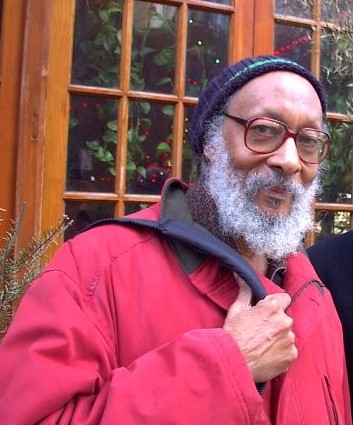
Edward Kamau Brathwaite (from repeatingislands.com)
I was trying to remember if I had featured Kamau Brathwaite (1930-) on J's Theater before, and I was pretty sure I had, but it turns out that while I have mentioned him many times, including in my very first post, the only work of his that I've ever featured is his highly anguished call for help to save CowPastor/Cow Pasture, the large open areas near where he lives in Christ Church, Barbados, that the government and private entities seized control of through which to lay roads. Not to aestheticize the letter, but it bears many of the hallmarks of Brathwaite's poetry, from its orthography to its reconstitution of language itself. As it turns out, poet Tom Raworth set up a site, Save Cowpasture, that's still up, and last fall Brathwaite wrote Raworth to thank him for keeping the site up. He also mentions the TIME OF SALT, and there's a link to +++SaVing CowPastor & the KB Cultural Lynching 2004-2011+ by clicking this link, which is, to put it mildly, an extraordinary document, a setting of the letters, accounts, recountings, the stories, of the fight for CowPastor/CowPasture and Brathwaite's struggles in New York and Barbados.

Extraordinary really only scratches the surface when it comes to Brathwaite. I know. I studied with him, and count the experience among the most fortunate in my life. I'm not just talking about him as a teacher, critic, theorist, historian, or raconteur, nor as the sort of person who, almost out of nowhere, announces that a graduate class should begin preparing to go to a foreign country for a class trip (he did this), or who tells of how he witnessed another famous writer's wife walking through a wall (he did this). I don't want to start delving into mysticism, metaphysics and the supernatural, but let me just say that when you spend some time around someone operating at this level, a true konjur man with a mind like the libraries of Alexandria and an ability to see into the hidden heart of things you tend not to doubt them. He pulled off that trip. That transmural passage as a result didn't seem so inconceivable. There are keys all throughout his work that he operates or accesses many different channels. You really could spend a lifetime teasing some of these keys out, following the threads, raveling and reraveling them again, and if you read him carefully enough he points them out. A sharp graduate student will probably elect to do this at some point down the road.

To put it another way, he is the one of the most important and original living Caribbean poets, one of the major poets writing in English, a signal figure of African Diasporic poetry and poetics, and a living treasure. He has proved this over nearly 40 books of poetry, critical prose, and memoirs, many of these works constituting works of hybrid genre that defy easy categorization. Through this rich body of work, he has developed a language drawn from his native Barbados, the Caribbean and Latin America, his readings, studies and experiences in Britain and the US, strikingly singular and personal, but also transnational and universal. To fully capture this language, informed by the principle, in part of nommo (from the Bantu) and nam, he created typography/textual form, the Sycorax Dub script (I believe that's the name). He has garnered, among his many awards, the Neustadt International Prize for Literature, which used often to be a tip for the Nobel Prize; the Griffin Poetry Prize, one of the highest awards for world poetry, handed out in Canada; and Premio de la Casa de las Américas, awarded by the Cuban government for an exceptional from the Caribbean.  I know him because he has served for two decades as Professor of Comparative Literature at New York University.

This potted intro hardly does him justice, though. There is no substitute for his poetry, which is so verbally and visually powerful it dazzles. The poem below, which I recalled from a journal I had in my office, is a distillation. If you can, read it aloud, and you will feel the bird rising off this screen; it might even guide you to places you had not ever imagined.

BIRD RISING

Until it come to the time for the great bird the Mithurii .
    to begin its ascent
its challenge against the eart . the paradoxical oracle of wind . the
    the wings beating
unchaining. out. boarding as seamen might say . the gret beast
    ruffled & rising
as in all the great legends

and this happening here before me now under me now wonderfully
    surrounding me
the white silver louvered feather shift & chevron stretching out
    across the sunlight
the great terrible beauty & beating we have always heard about
beating beating upward & forward . the planks of its shape
    shivering at first like a ship

like a dhow . then spheering down into smooth as we scool
    up. wards

Now the first hills at the darker mountains of english . the sea
    below all shard
& silver like our shadow . the beacon topaz eyes unblinking even
    through all the shudder
the wings now stretched across all space openly & awesomely . so
    that we are not beating
any. more but ahh sailing something like singing . because at last
    I have been able

to use all the wounds in the language . as long as I lay them out
    softly & carefully
like these unfluttering feathers of song . like the sea below
    turning into a grey ball of wine
without fishes or sperm . like the darkness no longer lingering
    above us
but we moving towards it as part of its fuse & its future . the àxé
    & ayisha of sails

one last time in our ears . the earth gone a long time now from
    green spur arrogance
of john crow mountain. strange
not even the memory of a veiled carefree river in these high
    places . too far up now
for sunsets through all this rain & distance in our eyes. in our
    sleep. in our silence

the metaphor at last afloat almost alight in the darkness
 
Copyright © Edward Kamau Brathwaite, "Bird Rising," in Conjunctions: Bi-Annual Volumes of New Writing, No. 27, The Archipelago: New Writing From and About the Caribbean, Edited by Robert Antoni and Bradford Morrow, pp. 89-90. All rights reserved.