Showing posts with label Equality. Show all posts

Wednesday, February 07, 2018

Tayari Jones' Novel Oprah's Book Club Pick + Elizabeth Alexander To Lead Mellon Foundation


A million congratulations to my Rutgers-Newark colleague Tayari Jones, on the publication of her new, fourth novel, An American Marriage, now out from Algonquin Books of Chapel Hill! Tayari's novel has been receiving rapturous reviews (Entertainment Weekly, LA Review of Books, New York Times Book ReviewSFGate, and USA Today, to name a few) since its appearance, as well as praise from readers on Amazon, Goodreads, and elsewhere. To add to the excellent news, Oprah Winfrey selected An American Marriage as her newest Oprah's Book Club pick, which she announced on CBS Morning News yesterday morning.

Tayari on CBS, as Oprah announces
her book as its newest Book Club selection

Oprah has said of the book, "I have to tell you, it is intriguing. It's a love story that also has a huge layer of suspense. And it's also so current and so really now that I could not put it down and I've already passed it on to lots of my friends and so I know – certainly believe – that you're gonna love it." On her website, Tayari, a writer of numerous gifts, offers a summation of An American Marriage:

Newlyweds, Celestial and Roy, are the embodiment of both the American Dream and the New South. He is a young executive and she is artist on the brink of an exciting career. They are settling into the routine of their life together, when they are ripped apart by circumstances neither could have imagined. Roy is arrested and sentenced to twelve years for a crime Celestial knows he didn’t commit. Though fiercely independent, Celestial finds herself bereft and unm oored, taking comfort in Andre, her childhood friend, and best man at their wedding. As Roy’s time in prison passes, she is unable to hold on to the love that has been her center. After five years, Roy’s conviction is suddenly overturned, and he returns to Atlanta ready to resume their life together.

I have had the pleasure of hearing Tayari describe the book as she was writing it over the last few years, and have now purchased my copy and intend to dive into it very soon! I also expect the praise to continue and prizes to shower this book too. CONGRATULATIONS AGAIN, TAYARI!

You can purchase a copy of An American Marriage here!

***

Elizabeth Alexander
Yesterday brought more good news: poet, scholar, critic, and generally extraordinary person Elizabeth Alexander has been named the next head of the Andrew W. Mellon Foundation! Elizabeth will assume the Mellon presidency in March 2018, replacing Earl Lewis, who has served since 2013. Currently she is the Wu Tsun Professor in the Humanities at Columbia University, and had served as Director of Creativity and Freed Expression at the Ford Foundation. Before this, she was the Frederick Iseman Professor and had previously held the post of Thomas Donnelley Professor and chaired the African American Studies Department at Yale University, where she taught for 15 years. At the Ford Foundation, Elizabeth "co-designed the Art for Justice Fund, a $100 million fund seeded by philanthropist Agnes Gund to transform the criminal justice system and all of its inequities through art and advocacy."

At Mellon, Elizabeth will preside over a foundation that has long been dedicated to work in the humanities and culture, particularly the liberal arts, from supporting scholarship to scholarly publication to the training and development of future educators, as well as considerable work in the museum world. It will be fascinating to see how her interests, as someone who has long promoted equality, social justice and civic participation in the arts and humanities intersects with Mellon's current agenda, and how she as its leader will guide and develop its focus. Inside Philanthropy offers five to consider in terms of Elizabeth's new tenure. Key will be defending not just the humanities, but universities and higher education in general, from those on the right and, to a different degree, from some critics on the far left. As Elizabeth notes, "The value of free expression, of arts and culture, is not something that’s always shouted from the rooftops, right now."

Elizabeth is one of the major American poets, serving as a Chancellor of the Academy of American Poets, as well as on the boards of the Pulitzer Prize and the African Poetry Book Fund. She also is a prolific author and critic. In 2009, she was President Barack Obama's first inaugural poet, her poem captured in the volume Praise Song for the Day. Her 2015 memoir The Light of the World, a powerful tribute to her late husband Ficre Ghebreyesus, which was a 2016 finalis for the Pulitzer Prize and the National Book Critics Circle Award. She is also the author of six books of poetry, including The Venus Hottentot, Body of Life, Antebellum Dream Book, American Sublime, and Crave Radiance: New and Selected Poems. She also has penned two collections of critical prose, The Black Interior and Power and Possibilities: Essays, Reviews and Interviews, as well as a book for children, with Marilyn Nelson, entitled Miss Crandall's School for Young Ladies and Little Misses of Color.

Congratulations to Mellon for making this superlative choice, and CONGRATULATIONS, ELIZABETH!

Monday, January 15, 2018

Happy Rev. Dr. Martin Luther King Jr. Day

The July 10, 1966, march to City Hall
from Soldier Field.
 (Chicago Tribune
 historical photo)
Today, on Rev. Dr. Martin Luther King Jr. Day, I thought I would post a short passage from one of Rev. King's most controversial speeches, which was the centerpiece of one of his most difficult campaigns, the Chicago Freedom Movement, in 1966. Not only did Dr. King remark on the virulence of the racism and white resistance he encountered, but at the time of his death three years later, it probably appeared to many people that the campaign had failed.

Dr. and Mrs. Coretta Scott King had visited Chicago and some of its suburban towns several times over the years, and in 1966 they even moved to Chicago to demonstrate the disparate conditions Black people were enduring under the tenure of Mayor Richard J. Daley. As part of the Chicago Freedom Movement, Dr. King urged Black voters to come out in droves and challenge the Democratic machine, controlled by Richard J. Daley. He decried white supremacy and Northern racism. He urged challenges to the Chicago power structure, better schools, housing, representation in government, everything. He also espoused Black pride and support for Black businesses, though he also criticized the nascent Black Power movement. Much like his namesake, Dr. King even presented his demands in person at City Hall, first by taping them to one of the outer doors, and then the following day in person to Mayor Daley, who was enraged by the campaign.


In the long run, despite the problems Black Chicagoans still face, things did change for the better from the status quo just over 50 years, and for lifelong and longtime Black Chicagoans now in their 70s and 80s, the changes were visible and measurable. Here are a few articles about the struggles Dr. King faced, his actions during that tough summer and year, and some of the changes that did happen. Also, I've posted an image from the speech he gave (readers can find the entire speech at the King Center's site), in which he uses the phrase "the fierce urgency of now." It is one of his memorable lines, and as applicable today as then or ever. (I'd also note that, in light of the ongoing crises Puerto Rico faces, it is notable that he mentions Puerto Ricans and the discrimination they face in Chicago in the speech's final paragraph.)

Chicago Tribune: "50 Years Ago Today: MLK Jr.'s speech at Soldier's Field, march to City Hall with demands for Daley"

Chicago Tribune: "Martin Luther King in Chicago"

WGNTV: "Web Extras: Martin Luther King and the 1966 Chicago Freedom Movement"

Chicago Magazine: "The Longest March"

From Dr. King's Chicago Freedom
Movement Speech (courtesy of the King Center)

Saturday, March 07, 2015

President Obama at Selma's 50th Anniversary

Yesterday President Barack Obama traveled down to Selma, Alabama to participate in the commemoration of the 50th anniversary of "Bloody Sunday," March 7, 1965, which was the day on which roughly 300 Civil Rights marchers, who had been planning and organizing for several years to launch their attempt to march, on behalf of voting rights, from the smaller city to the state capital, encountered a horrifying brutal response from white Alabama State troopers and local posse members. As they proceeded over the Edmund Pettus Bridge, marchers, who included organizers Southern Christian Leadership Council (SCLC) Director of Action James Bevel and Amelia Boynton, as well as future US Representative John Lewis (D-GA), encountered beatings with nightsticks, horses trampling them, and near-suffocation by tear gas. TV cameras captured the attacks, including Boynton clubbed and lying unconscious, broadcasting them across the nation and globe, which helped to make possible two subsequent marches, the third successful and both led by the Reverend Martin Luther King, Jr., and also spurred President Lyndon Johnson and Congress to pass the Voting Rights Act of 1965, as Ava Duvernay's Oscar-nominated film Selma, depicts with great skill.

In his remarks, which I watched today and found to be among the best speeches he has given since becoming president, the President outlined how far we as a society have come since the events of 50 years ago while noting the journey left before us. His emphasis on voting rights is especially important given the challenges black voters--and voters in general, especially the poor, and the young and elderly--still face as a result of changes enacted by state legislatures, and court rulings, including the US Supreme Court's 2013 decision in Shelby County v. Holder, which held that the coverage formula delineated in Section 4(b) was unconstitutional, since it no longer responded to current conditions in the US, thereby rendering Section 5 of the Act, which apply to specific jurisdictions singled out in Section 4(b), legally unenforceable. The stakes of voting rights are huge, and as the President and other speakers at the event asserted, the future not only of the blood-stained, tear-drenched gains of the past hang in the balance, but of our democracy in general. We have come so far, as a nation, but we still have a way to go.


Later, the President, Mrs. Obama, their daughters, and Mrs. Robinson, the First Lady's mother, marched with participants, including many veterans, across the Edmund Pettus Bridge as a symbolic gesture to those who had bravely done so 50 years before, and who have done so many times since. Commemorative marches also took place all over the country, including over the Brooklyn Bridge.

U.S. President Barack Obama (3rd L) participates in a march
across the Edmund Pettus Bridge in Selma, Alabama, March 7, 2015.
Also pictured are first lady Michelle Obama (L), U.S. Representative
John Lewis (D-GA) (2nd L), former first lady Laura Bush (2nd R)
and former president George W. Bush (R). The event comes
on the 50th anniversary of the 'Bloody Sunday' march
at the bridge, where police and state troopers beat
and used tear gas against peaceful marchers
who were advocating against racial discrimination
at the voting booth. REUTERS/Jonathan Ernst
To build upon the events of 50 years and today, and of the hundreds of years of struggle over the right to vote, over social, political and economic equality and freedom, I hope everyone commits to contacting her Congressperson to urge them to vote for new legislation to address the Supreme Court's ruling; to pushing all our state legislators to expand, rather than restricting voting rights, including greater access, extending voting periods, and the franchise to former felons; and to championing the repeal of the SCOTUS's monstrous 2010 decision in Citizens United vs. FEC, which has gutted regulation of campaign spending laws and unleashed an ocean of money, masquerading as "speech," into our election system at all levels.

Monday, January 19, 2015

Rev. Dr. MLK Jr. Day: His 1965 Interview with Alex Haley

Selma-Montgomery March: Rev. Dr. Martin Luther King leading march
from Selma to Montgomery to protest lack of voting rights for
African Americans. Beside King is (l-r), Ralph Abernathy, James Forman,
Reverend Jesse Douglas and John Lewis, March 1965.
(Photo Credit: Steve Schapiro/Corbis)
Today on Rev. Dr. Martin Luther King, Jr. Day, I thought I'd post a link to one of the best interviews Rev. Dr. King (1929-1968) ever gave, with journalist and author Alex Haley, of Roots fame. The interview took exactly 50 years ago today, in January 1965, the year of the Selma-to-Montgomery March--and of the story underpinning Ava Duvernay's highly acclaimed new film Selma--and appeared in Playboy magazine, preceding the famous Alabama march and the assassination of Malcolm X, but following many other landmark moments in Rev. Dr. King's and the Civil Rights Movement's long march towards social, political and economic equality and freedom.

It's worth reading the entire interview (linked from AlexHaley.com), which gives a far fuller portrait of Rev. Dr. King's mindset in the mid-1960s. In it he talks about mistakes he felt he made, his disappointment of the lack of support and righteousness from white Christian ministers and churches in the cause of Black equality, the moving resistance of young people, the concept of "militant nonviolence," strategizing for the future for Civil Rights, a critique of the Nation of Islam and Malcolm X, the challenges of nonviolence and the dangers of violence as a solution, racist science and white supremacy, the relationship between African Americans and Black people around the globe, and so much more. Here is one quote:
King: I mean to say that a strong man must be militant as well as moderate. He must be a realist as well as an idealist. If I am to merit the trust invested in me by some of my race, I must be both of these things. This is why nonviolence is a powerful as well as a just weapon. If you confront a man who has long been cruelly misusing you, and say, “Punish me, if you will; I do not deserve it, but I will accept it, so that the world will know I am right and you are wrong,” then you wield a powerful and a just weapon. This man, your oppressor, is automatically morally defeated, and if he has any conscience, he is ashamed. Wherever this weapon is used in a manner that stirs a community’s, or a nation’s, anguished conscience, then the pressure of public opinion becomes an ally in your just cause.

and here is another, concerning the Civil Rights Act, which Rev. Dr. King didn't think went far enough:

King: One of these decisive developments was our last major campaign before the enactment of the Civil Rights Act—in St. Augustine, Florida. We received a plea for help from Dr. Robert Hayling, the leader of the St. Augustine movement. St. Augustine, America’s oldest city, and one of the most segregated cities in America, was a stronghold of the Ku Klux Klan and the John Birch Society. Such things had happened as Klansmen abducting four Negroes and beating them unconscious with clubs, brass knuckles, ax handles and pistol butts. Dr. Hayling’s home had been shot up with buckshot, three Negro homes had been bombed and several Negro night clubs shotgunned. A Negro’s car had been destroyed by fire because his child was one of the six Negro children permitted to attend white schools. And the homes of two of the Negro children in the white schools had been burned down. Many Negroes had been fired from jobs that some had worked on for 28 years because they were somehow connected with the demonstrations. Police had beaten and arrested Negroes for picketing, marching and singing freedom songs. Many Negroes had served up to 90 days in jail for demonstrating against segregation, and four teenagers had spent six months in jail for picketing. Then, on February seventh of last year, Dr. Hayling’s home was shotgunned a second time, with his pregnant wife and two children barely escaping death; the family dog was killed while standing behind the living-room door. So S.C.L.C. decided to join in last year’s celebration of St. Augustine’s gala 400th birthday as America’s oldest city—by converting it into a nonviolent battleground. This is just what we did.

and a third, concerning the relationship between Black Americans and Black Diasporic peoples:
King: Yes, I do, in many ways. There is a distinct, significant and inevitable correlation. The Negro across America, looking at his television set, sees black statesmen voting in the United Nations on vital world issues, knowing that in many of America’s cities, he himself is not yet permitted to place his ballot. The Negro hears of black kings and potentates ruling in palaces, while he remains ghettoized in urban slums. It is only natural that Negroes would react to this extreme irony. Consciously or unconsciously, the American Negro has been caught up by the black Zeitgeist. He feels a deepening sense of identification with his black African brothers, and with his brown and yellow brothers of Asia, South America and the Caribbean. With them he is moving with a sense of increasing urgency toward the promised land of racial justice.
Do read the entire interview; so much of what he says still pertains today, a sign of his extraordinary vision and of the challenges we still face.

Monday, January 20, 2014

Rev. Dr. Martin Luther King Jr. Day


Rev. Dr. Martin Luther King Jr., from "The Impasse in Racial Relations," from The Trumpet of Conscience, San Francisco: Harper & Row, Co., 1968.

Update: You can listen a newly released audio version of an address Rev. Dr. King Jr. gave in 1962 to the New York State Civil War Centennial Commission at the Park Sheraton Hotel in New York City. He spoke to commemorate the 100th anniversary of Abraham Lincoln's Emancipation Proclamation (issued on January 1, 1863), enumerating the history of human rights in the US, and criticizing the nation for not living up the ideals of the Declaration of Independence or Lincoln's proclamation. The New York State Museum has now made the address available.

Thursday, May 10, 2012

Obama Again Supports Marriage Equality + NC Again Denies Equal Rights + Garry Wills on the Myth of Marriage

A busy week, with a big deadline, so these posts will be brief.


I was very glad to see President Barack Obama cease his seesawing and finally (once again) back marriage equality, i.e., same-sex marriage yesterday morning in his conversation with Good Morning America's Robin Roberts. Ever the politician, he qualified it by noting his avowal was only his personal belief and not a policy statement for his administration. He also made no larger or broader statements about the gross inequality that now exists between states that permit same-sex marriage and those, like North Carolina, that have now doubled down on banning it. (It was already outlawed in the Tarheel State; the new law also cancels out civil unions and domestic partnerships.) Popular opinion, however, trends on towards greater acceptance of same-sex marriage, and it eventually will exceed 75% or more, in my lifetime, I believe, which is an amazing thing to consider. And as I said, Barack Obama in a sense is coming home. In 1996, when he ran for the Illinois State Senate he supported same-sex marriage. To become US Senate from Illinois, however, he began his backwards shimmy, and has been dancing around ever since. Until yesterday.

---

As I noted above, Amendment One, banning same-sex marriage and stripping away even more equal rights, passed in North Carolina, 61% to 39%, on Tuesday. I'm not surprised this occurred; civil rights should never be put up to a vote, and while North Carolina is not and has never been the most conservative Southern state by any measure--and even during the US Civil War nearly sided with the Union--it is still not so progressive that Amendment One would have been defeated. I particularly feel for all the North Carolinians who now face having their government-sanctioned relationships voided, because of a bigoted majority.  One question I have for the Democratic Party, which has chosen to hold its presidential convention in Charlotte later this year: why?  North Carolina's recent history with unionized labor was bad enough, but it adds insult to injury--to use that cliché--to hold the event there now.  I'm sure there are other cities that could swing into gear; the Democrats should consider Buffalo, or Cleveland, or return to Denver. Anything but Charlotte, which admittedly provided many votes against the heinous Amendment.  But still...Democrats: Pittsburgh, maybe?

---

A footnote: the eminent historian and my colleague, Garry Wills, with a brief, historically informed commentary, "The Myth of Marriage," on the New York Review of Books' blog.

A quote:

Those who do not want to let gay partners have the sacredness of sacramental marriage are relying on a Scholastic fiction of the thirteenth century to play with people’s lives, as the church has done ever since the time of Aquinas. The myth of the sacrament should not let people deprive gays of the right to natural marriage, whether blessed by Yahweh or not. They surely do not need—since no one does—the blessing of Saint Thomas.

Monday, January 16, 2012

Happy Rev. Dr. Martin Luther King Jr. Day

Happy Rev. Dr. Martin Luther King Jr. Day! 


Here is the Rev. Dr. Martin Luther King Jr.'s commencement speech at the historically progressive Oberlin College in the year of my birth. So much of what he said all the way back then has come to pass, but so much still awaits our hard, dedicated, unflinching work.  From the Oberlin College archives:

"Remaining Awake Through a Great Revolution"

Commencement Address for Oberlin College
By Rev. Dr. Martin Luther King, Jr.
June 1965, Oberlin Ohio

"[Oberlin College] President Carr, members of the faculty, and members of the graduating class of this great institution of learning, ladies and gentlemen:

I can never come to this campus without a deep sense of appreciation and gratitude for all that this great institution has done for the cultural, political, and social life of our nation and the world. By all standards of measurement, Oberlin is one of the great colleges, not only of our nation, but of the world. I am also deeply honored to share the platform today with so many distinguished citizens of our nation - particularly our great secretary of state who, through dedicated and brilliant service, has carved for himself a niche in the annals of our nation's history.

Now to the members of the graduating class: today you bid farewell to the safe security of the academic environment. You prepare to continue your journey on the clamorous highways of life. And I would like to have you think with me on this significant occasion on the subject, "Remaining Awake Through a Great Revolution".

I'm sure that you have read that arresting little story from the pen of Washington Irving entitled Rip Van Winkle. The thing that we usually remember about this story is that Rip Van Winkle slept 20 years. But there is another point in that story that is almost always completely overlooked: it was a sign on the inn in the little town on the Hudson from which Rip went up into the mountain for his long sleep. When he went up, the sign had a picture of King George III of England. When he came down, years later, the sign had a picture of George Washington, the first president of the United States. When Rip looked up at the picture of George Washington, he was completely lost; he knew not who he was. This reveals to us that the most striking fact about the story of Rip Van Winkle is not that he slept 20 years, but that he slept through a revolution. While he was peacefully snoring up on the mountain, a great revolution was taking place in the world - indeed, a revolution which would, at points, change the course of history. And Rip Van Winkle knew nothing about it; he was asleep.

There are all too many people who, in some great period of social change, fail to achieve the new mental outlooks that the new situation demands. There is nothing more tragic than to sleep through a revolution. There can be no gainsaying of the fact that a great revolution is taking place in our world today. It is a social revolution, sweeping away the old order of colonialism. And in our own nation it is sweeping away the old order of slavery and racial segregation. The wind of change is blowing, and we see in our day and our age a significant development. Victor Hugo said on one occasion that there is nothing more powerful in all the world than an idea whose time has come. In a real sense, the idea whose time has come today is the idea of freedom and human dignity. Wherever men are assembled today, the cry is always the same, "We want to be free." And so we see in our own world a revolution of rising expectations. The great challenge facing every individual graduating today is to remain awake through this social revolution.

I'd like to suggest some of the things that we must do in order to remain awake and to achieve the proper mental attitudes and responses that the new situation demands. First, I'd like to say that we are challenged to achieve a world perspective. Anyone who feels that we can live in isolation today, anyone who feels that we can live without being concerned about other individuals and other nations is sleeping through a revolution. The world in which we live is geographically one. The great challenge now is to make it one in terms of brotherhood.

Now it is true that the geographic togetherness of our world has been brought into being, to a large extent, through modern man's scientific ingenuity. Modern man, through his scientific genius, has been able to dwarf distance and place time in chains. Yes, we've been able to carve highways through the stratosphere, and our jet planes have compressed into minutes distances that once took weeks and months. And so this is a small world from a geographical point of view. What we are facing today is the fact that through our scientific and technological genius we've made of this world a neighborhood. And now through our moral and ethical commitment we must make of it a brotherhood. We must all learn to live together as brothers - or we will all perish together as fools. This is the great issue facing us today. No individual can live alone; no nation can live alone. We are tied together.

I remember some time ago Mrs. King and I had the privilege of journeying to that great country, India. And I never will forget the experience - it was a marvelous experience - to meet and talk with the great leaders, with the hundreds of thousands of people all over the cities and villages of that vast country. These experiences will remain dear to me as long as the cords of memory shall lengthen. But I say to you this morning, my friends, that there were those depressing moments, for how can one avoid being depressed when he sees with his own eyes evidence of millions of people going to bed hungry? How can one avoid being depressed when he sees with his own eyes millions of people sleeping on the sidewalks at night; no beds to sleep in; no houses to go into. How can one avoid being depressed when he discovers that out of India's population of more than 400 million people, some 380 million make an annual income of less than $90 a year. And most of these people have never seen a physician or a dentist. As I noticed these conditions, something within me cried out, "Can we in America stand idly by and not be concerned?" And an answer came, "Oh no! because the destiny of the United States is tied up with the destiny of India and every other nation." I started thinking about the fact that we spend millions of dollars a day in our country to store surplus food, and I said to myself, "I know where we can store food free of charge - in the wrinkled stomachs of the millions of God's children in Asia and Africa, in South America, and in our own nation who go to bed hungry at night."

All I'm saying is simply this: that all mankind is tied together; all life is interrelated, and we are all caught in an inescapable network of mutuality, tied in a single garment of destiny. Whatever affects one directly, affects all indirectly. For some strange reason I can never be what I ought to be until you are what you ought to be. And you can never be what you ought to be until I am what I ought to be - this is the interrelated structure of reality. John Donne caught it years ago and placed it in graphic terms: No man is an Island, entire of itself; every man is a piece of the continent, a part of the main... And then he goes on toward the end to say: any man's death diminishes me, because I am involved in mankind; and therefore never send to know for whom the bell tolls; it tolls for thee. And by believing this, by living out this fact, we will be able to remain awake through a great revolution.

I would like to mention, secondly, that we are challenged to work passionately and unrelentingly to get rid of racial injustice in all its dimensions. Anyone who feels that our nation can survive half segregated and half integrated is sleeping through a revolution. The challenge before us today is to develop a coalition of conscience and get rid of this problem that has been one of the nagging and agonizing ills of our nation over the years. Racial injustice is still the Negro's burden and America's shame. We've made strides, to be sure. We have come a long, long way since the Negro was first brought to this nation as a slave in 1619. In the last decade we have seen significant developments - the Supreme Court's decision outlawing segregation in the public schools, a comprehensive Civil Rights Bill in 1964, and, in a few weeks, a new voting bill to guarantee the right to vote. All of these are significant developments, but I would be dishonest with you this morning if I gave you the impression that we have come to the point where the problem is almost solved.

We must face the honest fact that we still have a long, long way to go before the problem of racial injustice is solved. For while we are quite successful in breaking down the legal barriers to segregation, the Negro is now confronting social and economic barriers which are very real. The Negro is still at the bottom of the economic ladder. He finds himself perishing on a lonely island of poverty in the midst of a vast ocean of material prosperity. Millions of Negroes are still housed in unendurable slums; millions of Negroes are still forced to attend totally inadequate and substandard schools. And we still see, in certain sections of our country, violence and man's inhumanity to man in the most tragic way. All of these things remind us that we have a long, long way to go. For in Alabama and Mississippi, violence and murder where civil rights workers are concerned, are popular and favorite pastimes.

Let nobody give you the impression that the problem of racial injustice will work itself out. Let nobody give you the impression that only time will solve the problem. That is a myth, and it is a myth because time is neutral. It can be used either constructively or destructively. And I'm absolutely convinced that the people of ill will in our nation - the extreme rightists - the forces committed to negative ends - have used time much more effectively than the people of good will. It may well be that we will have to repent in this generation, not merely for the vitriolic works and violent actions of the bad people who bomb a church in Birmingham, Alabama, or shoot down a civil rights worker in Selma, but for the appalling silence and indifference of the good people who sit around and say, "Wait on time." Somewhere we must come to see that human progress never rolls in on wheels of inevitability. It comes through the tireless efforts and the persistent work of dedicated individuals. Without this hard work, time becomes an ally of the primitive forces of social stagnation. So we must help time and realize that the time is always right to do right.

There is another reason why we must get rid of racial injustice. Not merely because it is sociologically untenable or because it is politically unsound, not merely to meet the communist challenge or to create a good image in the world or to appeal to African and Asian peoples, as important as that happens to be. In the final analysis racial injustice must be uprooted from American society because it is morally wrong. Segregation is morally wrong, to use the words of the great Jewish philosopher, Martin Buber, because it substitutes an I-it relationship for the I-thou relationship. Or to use the thinking of Saint Thomas Aquinas, segregation is wrong because it is based on human laws that are out of harmony with the eternal natural and moral laws of the universe. The great Protestant theologian, Paul Tillich, said that sin is separation. And what is segregation but an existential expression of man's tragic estrangement - his awful segregation, his terrible sinfulness? And so in order to rise to our full moral maturity as a nation, we must get rid of segregation whether it is in housing, whether it is a de facto segregation in the public schools, whether it is segregation in public accommodations, or whether it is segregation in the church. We must see that it is morally wrong. We must see that it is a national problem. And no section of our country can boast of clean hands in the area of brotherhood. We strengthen our nation, above all we strengthen our moral commitment; as we work to get rid of this problem.

Now there is another problem facing us that we must deal with if we are to remain awake through a social revolution. We must get rid of violence, hatred, and war. Anyone who feels that the problems of mankind can be solved through violence is sleeping through a revolution. I've said this over and over again, and I believe it more than ever today. We know about violence. It's been the inseparable twin of Western materialism, the hallmark of its grandeur. I am convinced that violence ends up creating many more social problems than it solves. This is why I say to my people that if we succumb to the temptation of using violence in our struggle, unborn generations will be the recipients of a long and desolate night of bitterness. There is another way - a way as old as the insights of Jesus of Nazareth and as modern as the techniques of Mohandas K. Gandhi. For it is possible to stand up against an unjust system with all of your might, with all of your body, with all of your soul, and yet not stoop to hatred and violence. Something about this approach disarms the opponent. It exposes his moral defenses, weakens his morale, and at the same time, works on his conscience. He doesn't know how to handle it. So it is my great hope that, as we struggle for racial justice, we will follow that philosophy and method of non-violent resistance, realizing that this is the approach that can bring about that better day of racial justice for everyone.

In international relations, we must come to see this. We must find some alternative to war and bloodshed. In a day when man-made vehicles are dashing through outer space, and guided ballistic missiles are carving highways of death in the stratosphere, no nation can win a world war. It is no longer a choice between violence and non-violence; it is either non-violence or non-existence. The alternative may well be a civilization plunged into the abyss of annihilation, our earthly habitat transformed into a tragic inferno that even Dante could not imagine. So this is our challenge: to see that war is obsolete, cast into limbo.

I do not wish to minimize the complexity of the problems to be faced in achieving disarmament and peace. But we shall not have the courage, the insight, to deal with such matters unless we are prepared to undergo a mental and spiritual change. It is not enough to say we must not wage war. We must love peace and sacrifice for it. We must fix our visions not merely on the negative expulsion of war, but upon the positive affirmation of peace. We must see that peace represents a sweeter music, far superior to the discords of war. Somehow we must transform the dynamics of the world power struggle from the negative nuclear arms race which no one can win to a positive contest to harness man's creative genius for the purpose of making peace and prosperity a reality for all of the nations of the world. In short, we must shift the arms race into a peace race.

All that I've said is that we must work for peace, for racial justice, for economic justice, and for brotherhood the world over. We have inherited a big house, a great world house in which we have to live together - black and white, Easterners and Westerners, Gentiles and Jews, Protestants and Catholics, Moslem and Hindu. If we all learn to do this we, in a real sense, will remain awake through a great revolution.

I urge you to continue the tradition that you have followed so long, for this institution has probably done more than any other to support the struggle for racial justice. You have given your time, you have given your earnings, you have given your bodies, you have participated in demonstrations, you have participated in the determined struggle to keep this issue in the forefront of the conscience of the nation. I urge you to continue to do so as you go out into your various fields of endeavor. Never allow it to be said that you are silent onlookers, detached spectators, but that you are involved participants in the struggle to make justice a reality.

We sing a little song in our struggle - you've heard it - We Shall Overcome. And by that we do not mean that we shall overcome the white man. In the struggle for racial justice the Negro must not seek to rise from a position of disadvantage to one of advantage, to substitute one tyranny for another. A doctrine of black supremacy is as dangerous as a doctrine of white supremacy. God is not interested in the freedom of black men or brown men or yellow men. God is interested in the freedom of the whole human race, the creation of a society where every man will respect the dignity and worth of personality. So when we sing We Shall Overcome, we are singing a hymn of faith, a hymn of optimism, a hymn of faith in the future.

I can still sing that song because I have faith in the future. I believe that we, as Negroes, are going to gain our freedom in America because the goal of America is freedom. Abused and scorned though we may be, our destiny is tied up with the destiny of America. Before the Pilgrim fathers landed at Plymouth we were here; before Thomas Jefferson etched across the pages of history the majestic words of the Declaration of Independence we were here; before the words of the Star-Spangled Banner were written we were here. For more than two centuries our forbears labored here without wages. They made cotton king; they built the homes of their masters; in the midst of the most oppressive conditions they continued to grow and develop. Certainly if the inexpressible cruelties of slavery couldn't stop us, the opposition that we now face will surely fail. We will win our freedom because both the sacred heritage of our nation and the eternal will of God are embodied in our echoing demands.

Yes, we shall overcome because the arc of the moral universe is long, but it bends toward justice. We shall overcome because Carlyle is right: "No lie can live forever." We shall overcome because James Russell Lowell is right:

Truth forever on the scaffold,
Wrong forever on the throne,
Yet that scaffold sways the future,
And behind the dim unknown
Standeth God within the shadow,
Keeping watch above his own.


We shall overcome because William Cullen Bryant is right: "Truth, crushed to earth, shall rise again." With this faith we will be able to hew out of the mountain of despair, the stone of hope. With this faith we will be able to transform the jangling discords of our nation into a beautiful symphony of brotherhood, and speed up the day when, in the words of the prophet Amos, "Justice will roll down like waters; and righteousness like a mighty stream."

Let us stand up. Let us be a concerned generation. Let us remain awake through a great revolution. And we will speed up that great day when the American Dream will be a reality. We, in the final analysis, can gain consolation from the fact that at least we've made strides in our struggle for peace and in our struggle for justice. We still have a long, long way to go, but at least we've made a creative beginning.

And so I close by quoting the words of an old Negro slave preacher who didn't quite have his grammar right, but uttered words of great and profound significance:

Lord, we ain't what we oughta be;
We ain't what we wanna be;
We ain't what we're gonna be;
But thank God we ain't what we was! "

Friday, December 23, 2011

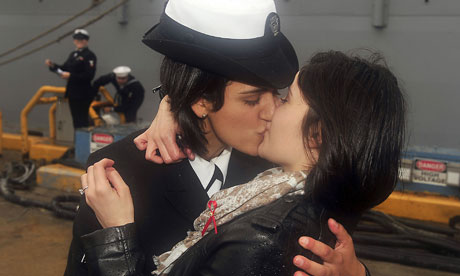
Photo: The Kiss

V-J Day in Times Square © Alfred Eisenstaedt (Life, 1945)


Marissa Gaeta (left) kisses fellow US naval officer Citlalic Snell Photograph: MC2 Joshua Mann/AFP/Getty Images


Sunday, June 27, 2010

Happy Gay Pride + US Exits World Cup 2010

Today in New York, Chicago, Toronto, and other cities across the US and globe, people are celebrating Lesbian, Gay Bisexual, and Transgender Pride, crowning what has been LGBTQ Pride Month. Other cities and municipalities have already held Pride celebrations, and others will be taking place throughout the summer and fall. It's been 41 years since the Stonewall Rebellion and similar uprisings, and 40 years since New York's first Gay Pride parade, which marke a new, public self-regard among gays and lesbians in the US. There have been tremendous civil, political and social advances for lesbian, gay, bisexual, and transgender people in the US and many parts of the world, but there are many more barriers to overcome, one of the most basic being complete and full equal and civil rights under the law. That, along with greater economic, political and social equality for LGBTQ people remains an issue in the US, as it does all over the world. 

***

So the USA national soccer team is out of the 2010 FIFA World Cup after losing, once again, to Ghana.  The team's great but brief run included tying England 1-1 in its first game, drawing (and defeating, though the goal was denied) Slovenia in its second game, and defeating Algeria 1-0, quite dramatically, on Landon Donovan's goal in stoppage time, on Friday, to finish atop its group, C, over England. This number 1 finish in the opening round was a national first.  In the first two games, the US fell behind, only to come back--and, in the case of Slovenia, pull ahead. Facing Ghana in this Round of 16, the US again fell behind, on a defensive error, their weakest area, and went down 1-0, on a goal by Kevin Prince Boateng, until a successful penalty kick by Landon Donovan brought them even. But a tie doesn't suffice in the second round, so the US and Ghana went to overtime, and, once again, the US slipped, on another defensive misplay, when Asamoah Gyan struck on a breakaway.  The Americans couldn't come back again, falling 2-1 to the Ghanaians and out of the tournament.  At the game's start, the US team looked tentative; they appeared to lack any real strategy to press the Ghanaians, to manufacture a goal or two, or to at least expose their opponent's flaws, while the Ghanaians appeared to be relentlessly on the hunt. Yet by the beginning of the second half, the US, perhaps after a locker room dressing down, the realization that they were sending themselves home, or an emergence from 45 minutes of stupor, came out with effervescence, and kept pressing the Ghanaian defense and goalkeeper.  This led to the Ghanaian foul against Dempsey that set up Donovan's penalty kick. Jozy Altidore, Maurice Edu, Benny Feilhaber, and Dempsey all took shots on goal, but as has been the case with the US in World Cup games, they were off-target, straight at the goalkeeper, or had no followup. Sadly, there rarely seems to be a US player ready to pick up a rebound or errant ball the way Donovan did against Algeria. I'm not sure why, but it's been a recurrent problem for US teams each World Cup tournament. On top of this, the US looked exhausted by the end of the second half, and by the beginning of overtime, they were unable to connect passes or make decisive plays against the Ghanaians. They didn't give up, but it was clear that despite all their efforts, their tanks were empty.  Ghana, the only African team left in the tournament, advances to the quarterfinals.