Showing posts with label comedy. Show all posts

Thursday, August 23, 2012

Phyllis Diller, My Homegirl + Artists Battle for Home in Rio

Phyllis Diller (UPI)
Shortly after my parents moved us from the city of St. Louis to the suburb of Webster Groves and we joined Holy Redeemer Roman Catholic Church, I began attending its parish school. It was a little over half a mile from my house, and there was no bus service, and my parents both worked so they couldn't drive me to school, which meant I had to walk. (This was in the 1970s when such things were a matter of course.) There were two main routes to get there. One took me past a crossroads straight up a long, curving street, over which a train trestle ran--so I literally lived on the other side of the tracks, on the black (with a few white people) side of Webster--until I reached the next main cross street, Lockwood Avenue, which was the main commercial strip of Webster, and on which sat from one end to the other, the old business district (Old Webster), full of stores; the City Hall; the cinema where I saw The Exorcist and Jaws and Star Wars and countless other movies; the Y; Holy Redeemer Church and school; Webster Groves Public High School; Webster University; the Eden Theological Seminary; Nerinx Hall, a Catholic school for girls; and then, where Lockwood turned into Big Bend Avenue began the Old Orchard business district, which also had lots of shops and restaurants. That was the long but safe route. The quicker route took me across the other major cross-street near me, which included crossing a creek, then up through a maze of increasingly nicer neighborhoods, with some very large homes, including one that belonged to the family that owned the Tums factory (and I would learn, as an adult, that it was in this part of Webster that Jonathan Franzen, among others, had grown up), until I reached the back lot and playground of Holy Redeemer.

In the summers I would ride my bike up through this way; during the school year, it was strictly by foot. One of the houses closest to the playground area, on Mason Avenue, was, like the others, imposing, but my new classmates liked to point it out; I was told that it had once been a shocking salmon color. Most of the other homes in this part of Webster were white, dark green, brick, Tudor-style: classy. The house's prior outré coloring was probably apocryphal, but it stuck in my memory. I was also told, by a knowing classmate, that a famous comedian--comedienne--had lived there. I didn't believe it, but I told my parents, and perhaps they knew that this comedian was from St. Louis. I can't recall. Every so often, when I'd pass the house, I'd think of the story of it having been a sight to look at, and how now it was just another house very close to school and across from other large houses that belonged to my classmates, mostly considering how much larger they were than the houses on my side of town. (I had yet to see some of the mansions in other St. Louis suburbs that my future classmates at Priory lived in.) Years later I did learn that the house had belonged to the famous comedian, that she had lived in St. Louis, in Webster Groves, beginning in the 1960s, and that she always considered not just that house, but the area one of her true homes. I am talking about Phyllis Diller (1917-2012), one of the pioneering women of 20th century American comedy, who passed away the other day.  She gave me many occasions to laugh over the years, and the lore of her outrageously painting house is a little story to treasure that I still carry with me. I hope Webster Groves, which was famous for being so representatively middle American it was even the subject of a documentary in the 1960s (16 in Webster Groves) and the setting for a TV show in the 1970s (Lucas Tanner) too sees fit to honor this often unconventional but important figure. She gave America enough laughs, and future comedians new opportunities, to merit it.

More: Jason Zinoman's tribute to Phyllis Diller in The New York Times.

+++

For Rio de Janeiro to host the Olympic Games in 2016, I knew that as in every other place where the Olympics had been held, including the most recent host, London, there would be private and government battles surrounding the economically working-class and poor areas of the city, with the aim of seizing control of them, and Jonathan WattsGuardian article "Rio artistic collective's sweet deal ends as Olympics development spreads" confirms one example, of which there certain to be many--cf. the favelas. In the case Watts describes, the 50 or so artists working in a former Bhering (Behring?) confectionary factory in Rio are fighting not to be evicted from their studios and offices, which appears increasingly likely as the city gears up for the games and a larger £21 billion ($33 billion, €26 billion) development plan. The former factory, converted over the last three years into a creative hotspot by the artists, sits in Rio's port area, one of the oldest, more run-down and most affordable parts of the city, yet accessible to all of its fashionable neighborhoods and the Guanabara Bay, making it prime real estate for the Olympics-related development.

One thing the artists in this building, called Orestes 28 for its street address, have going for them is that in similar situations in other cities, such as Beijing, the site of the 2008 Olympic Games, artists in certain repurposed spaces were able to claim the mantle of being a cultural treasure and center, and were thus spared eviction and the effects of development and gentrification. The Orestes 28 artists hired a lawyer, made an appeal to Rio's government, and received a judicial revocation of the 30-day eviction order, but even with the Chinese precedent there's no guarantee they'll win out in the end, especially given Rio's lack of space, the development already underway, and the money developers and those politically connected to them stand to make both for the World Cup in 2014, and then two years later for the Olympics. As Watts notes, the artists have a front-row seat at the changes underway, which include not just a new name, "the Marvelous Port," but luxury hotels rising nearby and soon enough, new rail and roadways.  I actually know one of the writers Watt mentions, Rachel Gontijo (Araujo), a poet and publisher (A Bolha Editora), mentioned before on this blog, and for whose English translation of Hilda Hilst's The Obscene Madame D, translated by Nathanaël I have written the introduction. Rachel has been organizing a weekly happy hour at Orestes 28, which has included observing the transformation of the area, but as Watt says it's not clear how much longer this will occur.  I hold out hope, I really do, but...

Saturday, September 24, 2011

Political Impressions (Saturday Silliness)

Some serious silliness for a Saturday.  Unfortunately for all of us, so much of the current rhetoric echoes what's being ridiculed and spoofed below (note how the recent GOP debates echo the UK conservative candidate impressions featured at the bottom of the page.) Plus ça change, plus ça reste, but nevertheless, enjoy!

From SNL: The real Ronald Reagan (Phil Hartman)
From SNL: George H W Bush (Dana Carvey) debating Michael Dukakis (Jon Lovitz), with Diane Sawyer (Jan Hooks) moderating
From Dana Carvey show: H. Ross Perot (Dana Carvey) on Larry King's (Phil Hartman) show, 1996
From SNL: Bill Clinton (Phil Hartman), running for the Presidency, in 1992, stops in at a McDonald's
From SNL: Al Gore (Darrell Hammond) debating George W Bush (Will Ferrell) in 2000, on Bush's tax cuts and the "lockbox"
From SNL: Joe Biden (Jason Sudeikis) debating Sarah Palin (Tina Fey) in 2008, moderated by Gwen Ifill (Queen Latifah)
From SNL: Sarah Palin (Tina Fey) discusses her politics with Katie Couric (Amy Poehler) And from the UK:
Margaret Thatcher (Janet Brown), the day after she became the UK's Prime Minister
Gordon Brown invades Dead Ringers Laurie & Fry, on Young conservative contest (watch till the end)
Rowan Atkinson, at a Conservative Party (UK) conference

Friday, August 26, 2011

Irene On the Way + What Obama's Read(ing) + Gawker's 50 Worst States

photo
Lower Manhattan, from Hoboken, or The Calm before the Storm
Irene, if I recall correctly from my long-ago high school Greek classes, means "peace." This imminent, ironically named Hurricane Irene, which has already slammed Puerto Rico, DR, Haiti, and the Bahamas, is now hurtling northwards towards the Outer Banks of North Carolina, and weather forecasters expect it to tear into coastal New Jersey and the densely populated New York metro area beginning Saturday evening through Sunday morning. I try not to take storms of this sort too lightly, but I've observed more than once that over the years, the New York-area meteorologists and news reporters in general have tended to overplay them, predicting typhoons and cyclones when what's shown up are, well, bad but not world-ending calamities. If the tenor of the brouhaha is at all credible, all living along the Eastern seaboard should be on trains, planes, buses or in cars to Montana.

New York City's emperor, Mike Bloomberg, began talking about mandatory evacuations from the city's low-lying coastal areas and all its islands yesterday, with similar calls coming from Long Island's two county executives, and New York's governor, Andrew Cuomo, has ordered the MTA trains to stop running tomorrow at noon, the first time there's been such a pre-storm related shutdown in the system's history. (We kept saying that the subway trains ran no matter what the weather problems, but of late that has not been the case. What happened? No one has answers.) The Port Authority is shutting down all the local airports and the PATH trains by midday tomorrow, and New Jersey Transit trains and the light-rail will also be on ice.  Hospitals, eldercare centers, and many other facilities are being evacuated, but not, it seems, Rikers Island, which seems particularly cruel under the circumstances. Here in New Jersey, our Youtube performer masquerading as a governor, Chris Christie, has told people to flee the shore, which apparently is in the direct path of the storm and be nothing more than exposed rock, coral, hulls, siding, syringes, and empty water bottles by the time this storm has passed through, and Jersey City's colorful mayor, Jerramiah Healey, after mulling whether to say something today or tomorrow, has decided to issue a voluntary evacuation order from neighborhoods too close to the Hudson River, New York Harbor, the Hackensack River, or Newark Bay, i.e., anywhere downtown or on the Newark side of Jersey City. We thankfully are not in a flood plain or zone, though if we were, I have yet to see where we're supposed to go (the nearest shelter is at the Izod Center in East Rutherford, in the low-lying, marshy Meadowlands, but maybe they know something I don't). I haven't heard any mention at all of nearby Bayonne, which is in the direct path of the storm (the various evacuation maps leave blank all other municipalities, so New York City's left LI and NJ blank, while Jersey City's stops at the borders with Secaucus, etc.). Do the Bayonnaise not count? Nearly all of Hoboken's waterfront sits fairly low, so it could be a ghosttown come midday tomorrow. And a very pretty, expensive little ghosttown it will be.

photo
NY JET Nick Mangold, signing autographs in Bryant Park today
The local Gay Pride celebration has been moved to...October. The Jets-Giants preseason game will take place on Monday instead of Sunday. Several music festivals are being postponed or canceled outright. No Dave Matthews, no The Roots. (I've seen the latter, live, years ago, in a moshpit in Charlottesville.) I didn't go to the store to but rather to my daily redoubt, the library, but C did go to one on the Jersey side of the river and said that it was a madhouse. No surprise there; people have been whipped up into a frenzy of shopping for provisions, essentials, and things they didn't realize they needed, like Fritos. I guess if Irene does pan out, we can say we were prepared. If it doesn't, the economy gets a needed, though temporary, boost. And all who could afford to will have extra canned goods--and lots of plastic water bottles. Now, what about all the people who cannot afford to evacuate and what about all those prisoners at Rikers?

--

It's no surprise our president is a reader, because he's a damned good writer. Given how much Barack Obama has had to deal with since before taking office, though, I'm amazed he reads anything that isn't a Congressional bill or a précis of one; a PDB; a Blackberry SMS text; snippets of whatever his staff culls from social media sites, newspapers, and so forth; and mash notes from some billionaire or corporation. But he does read books. Not a University of Chicago Law School prof-level any more, but nevertheless an impressive amount, at least compared to most people out there, I'd imagine, who do not have to read books as part of their job, and who have very busy full-time jobs that include dealing with lots of crazy people and quite a few very demanding billionaires and corporations. Recently I came across this list of books that President Obama has read since 2008.

Several things immediately struck me: there is only one book by a woman, and only two by writers of color. Not good. Not good not just because his reading really ought be diverse, but because there are lots of excellent books by women, by people of color, by women of color, by all kinds of people, that he could be reading, and which might even give him a bit of a wake-up call and a reminder of who voted for him. (Lots of women and people of color!)  There's a book by Tom Friedman, as ridiculous a member of the punditocracy as exists (he's the very, very, very wealthy person who suggested the US invade Iraq to show them, or someone, something, in response to 9/11. Real brainiac.) That is not good, unless it's to assist him in his cultivation of negative capability. But I think Barack Obama has demonstrated that he has more than enough negative capability, and deeply grasps the concept.

Also, there's only one book of poetry. This president could stand to read some more poetry. Like, by Langston Hughes and June Jordan and his inaugural poet and a whole lot of other poets, living and only living in print. Hell, given what he's dealing with, John Milton's Paradise Lost wouldn't be a bad place to start. And it's an enjoyable, if long, read too. A so-so novel by formalist poet Brad Leithauser ain't gonna cut it. There're no books about science or technology, especially the net. There are far too few books about economics, and zero about the causes of the economic meltdown. Many are the very good books about that damned economic collapse which most of us are still living through. Someone near the president should gently and firmly pass one to him.

And he doesn't seem to be taking many pointers from the books on or bios of Abraham Lincoln, Teddy Roosevelt, or Franklin Delano Roosevelt. Yes, John Adams was a remarkable person, but not such a good president. (His son was remarkable too, but even worse in that office. He was quite good as a Congressperson, though.) But then it seems the ghost of Herbert Clark Hoover, also a remarkable person and a terrible economic steward, hovers over this administration for various reasons, so perhaps those biographies have gone down like the fiction (Franzen, Mitchell, etc.).

Today I came across this list of books he's taken on his current vacation: "The Bayou Trilogy by Daniel Woodrell, a series of crime stories; Rodin's Debutante by Ward Just, a novel set in Obama's hometown of Chicago; Cutting for Stone, a novel by Abraham Verghese; To the End of the Land, a novel by David Grossman; and The Warmth of Other Suns...by Isabel Wilkerson." Somewhat better, though still mostly men. He is planning to read Wilkerson's superb book on the Great Migration, which is a very good thing. At least one person each has recommended the Grossman and Verghese books to me. Now, more poetry (someone on his staff could go through my April Poetry Foundation twitter feed for names of poets--I quoted over 150 contemporary and past ones, of all backgrounds), more books on science and technology, something on the people that caused the meltdown (hint, hint, Mr. President, they're giving you lots of money now), and some more books on US presidents who figured out how to turn things around for the better; i.e., nothing on James Buchanan, please!

---

I meant to post a link to Gawker's descending ranking of our "Worst 50 States" a few weeks back, but better late than never.  I take some issues with some of their rankings, having lived in about 6 of these states and visited many others, but the writeups are often hilarious, and the comments sections on at least one brims with the kind of craziness that proves the Web can be both an amazing and dismaying reflection of who we are as a society. Just a few points: New York state should not be ranked as the least worst, by far. Also, New Jersey should not be in the top 5 worst. That is just pure New York chauvinism (Ernest has a better word about such things, but I'm not going to use it). As is often the case in some of these lists, people just don't know what to say about certain states at all--South Dakota, Missouri, etc.  I admit that I wouldn't know what to say about South Dakota, though I would know what to say about Missouri. But the puckish paragraphs on Mississippi, South Carolina, Ohio, Delaware, Alabama, Texas, FLORIDA!, and a few others are worth the rest of the entire effort.

Monday, May 30, 2011

Memorial Day's Origins + The 50 States (Stereotypes & More)

What are the origins of Memorial Day, during which we as a nation honor those who've fallen in wars past and current? I always thought I'd known, and would readily have stated it publicly if asked. Yale historian David Blight, however, enlightened me--and thousands of others, perhaps millions--with his article in today's New York Times, "Forgetting Why We Remember," on the holiday's origins and likely earliest celebration. It, as I have repeated several times on here about the Times's Disunion pieces, moved me mightily.

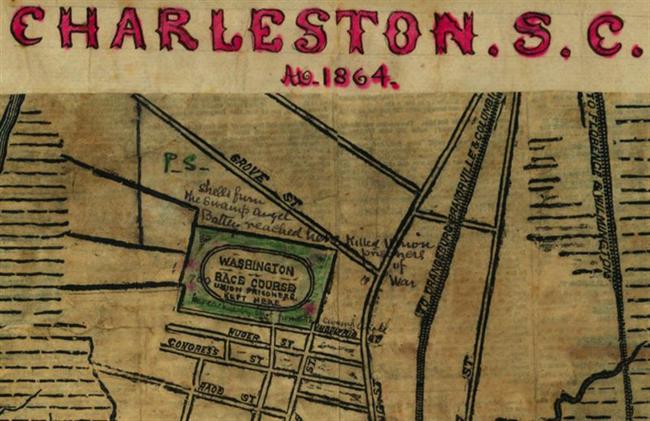
As it turns out, the first Memorial Day celebration probably took place in the South, amidst the ashes of the defeated Confederacy, in Charleston, South Carolina, ironically and poetically, as that was the political and cultural headquarters of the states' plantocracy, who pushed secession from the Union, and the vantage from which soldiers under General P. T. Beauregard first the shots at Fort Sumter, launching the war.  The celebration occurred in, on and around a race track that the Confederates had transformed into a prison and eventual morgue for Union soldiers. Blight writes:

The largest of these events, forgotten until I had some extraordinary luck in an archive at Harvard, took place on May 1, 1865. During the final year of the war, the Confederates had converted the city’s [Charleston's] Washington Race Course and Jockey Club into an outdoor prison. Union captives were kept in horrible conditions in the interior of the track; at least 257 died of disease and were hastily buried in a mass grave behind the grandstand.

After the Confederate evacuation of Charleston black workmen went to the site, reburied the Union dead properly, and built a high fence around the cemetery. They whitewashed the fence and built an archway over an entrance on which they inscribed the words, “Martyrs of the Race Course.”
Note for a second the presence of ritual here--the whitewashing of the fence, and the renaming of the race course, a sports site transformed in a site of horror, and now, a place of remembrance, grieving, and honor. (The 1864 map of the Washington Race Course above comes from the Preservation Society of Charleston's website.)
The symbolic power of this Low Country planter aristocracy’s bastion was not lost on the freedpeople, who then, in cooperation with white missionaries and teachers, staged a parade of 10,000 on the track. A New York Tribune correspondent witnessed the event, describing “a procession of friends and mourners as South Carolina and the United States never saw before.”

The procession was led by 3,000 black schoolchildren carrying armloads of roses and singing the Union marching song “John Brown’s Body.” Several hundred black women followed with baskets of flowers, wreaths and crosses. Then came black men marching in cadence, followed by contingents of Union infantrymen. Within the cemetery enclosure a black children’s choir sang “We’ll Rally Around the Flag,” the “Star-Spangled Banner” and spirituals before a series of black ministers read from the Bible.
Note here more significant elements: the cross-racial union to make the celebration possible, in defiance of the very grounds on which the Confederacy was founded; the presence of teachers, another countersignifier in relation to what African Americans had been subjected to under slavocracy's tenets; children in the forefront of the march, a recognition of their role as the future and vanguard, of the race and nation; the singing and evocation of abolitionist John Brown, a freedom fighter and pre-war martyr whose memory was well known to and not lost on these newly freed people; and then the freedmen followed by, not following, the Union troops, some of them African Americans, as Blight notes. Then come the celebrations of patriotism and, alongside them, religion.

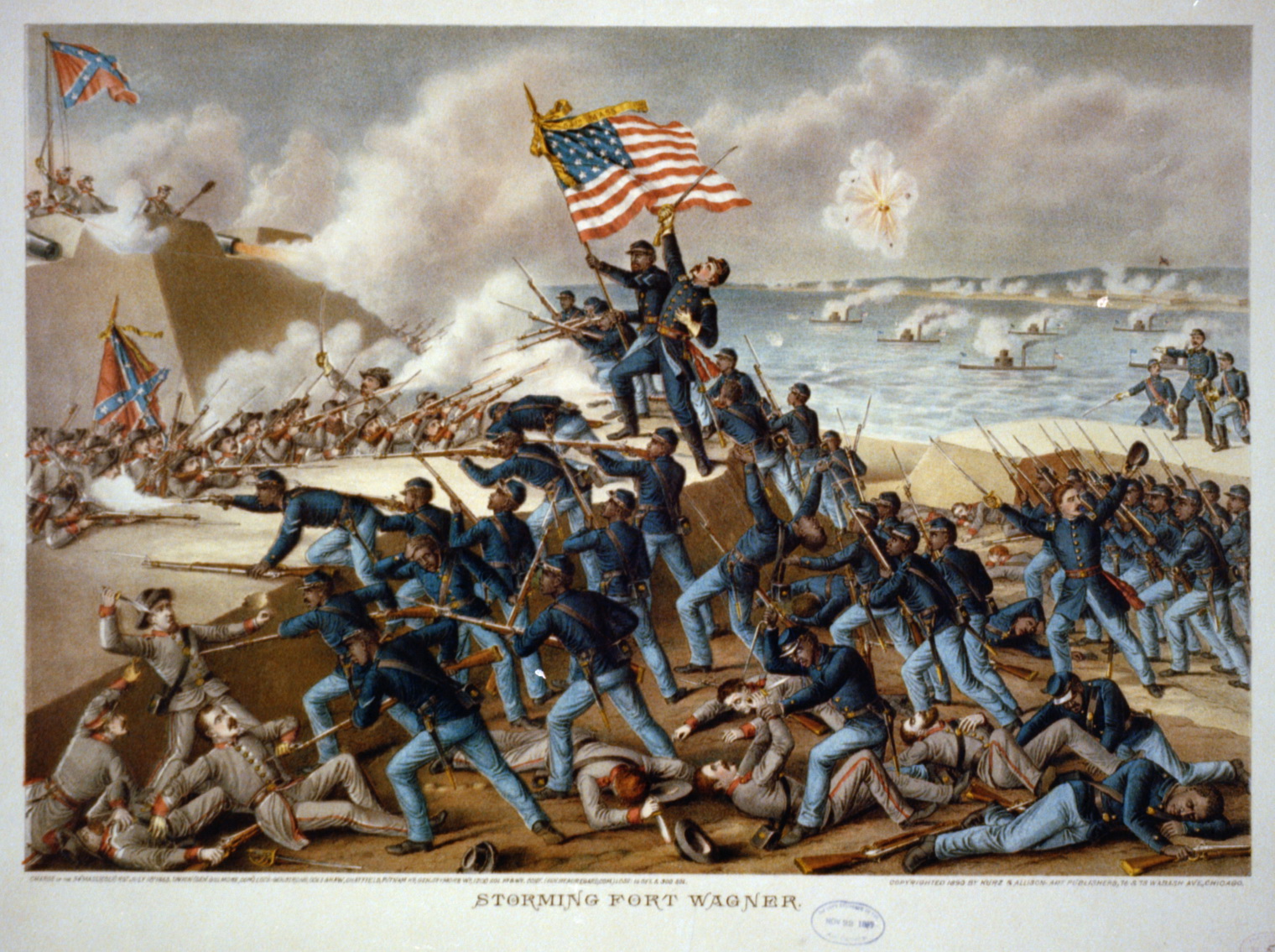
Blight goes on to note that after the processions and tributes, the blacks and whites then began picknicking--sharing food and drink, enjoying each others' companies--and watching military drills by the African-American regiments, including the famous 54th Massachusetts Volunteer Infantry Regiment, one of the first official all-black Union regiment in the war, the subjects of Edward Zwick's 1989, Academy Award-winning film Glory. (At the top of the article is a detail from Augustus Saint-Gaudens' famous Robert Gould Shaw memorial, which sits at a corner of Boston Common, at Park and Beacon Streets, and which Robert Lowell memorialized in his famous poem "For the Union Dead." The second image is an 1890 lithograph by Kurz and Allison of the 1863 storming of Ft. Wagner in South Carolina, the battle at which Shaw died.)

Black Union soldiers, US Civil War, from Civil War Academy
This history somehow got lost to the wider world, though, interestingly enough to me, the Preservation Society of Charleston does mention it, noting it to be the first Memorial Day celebration, on their website at the link above.  Blight does not tarry over the process by which this history has evanesced or its implications, though I would imagine that like so much of our national history, especially anything involving African Americans, cross-racial alliances, and so on, it has suffered both active and passive omission until, voilà, it has been waiting for someone to bring it to wider attention. It is, as I said, on the website above and perhaps on many more too. [I should note that while I have read a great many books of and on American history, I have never heard of this event, though historians very well may have written extensively about it. I have many times heard about the various early Northern and Southern commemorations of the war and those who died in it.] At any rate, as we go about our business today and on every memorial day hereafter, we might keep a kernel of this re-membering of the our polity, led by these brave freed people after the worst war US soil has ever known (and I hope will ever know), fastened to our memories.

+++

On a lighter note regarding the states, I was reading Huffington Post's Comedy page and chuckled at author Chuck Jury's "50 State Stereotypes in 2 Minutes" video, which is a promo for his new book of the same name.  He's tagged some of the states perfectly, though with others it appears he just tossed out whatever he could think, anything he could think of, quickly.  Cf. Indiana. (I also love that he probably filmed the entire 50 entries in California, but chose landscapes that mirrored (or not) those of the states he invokes.


Jury certainly has Illinois down, I'll give him that. (But is he talking about Governor Pat Quinn or Mayor Rahm Emanuel. Hmm.)

With a far different aim, last July I posted an animated tour of the 50 states, primarily for children to learn their years of entry into the United States. Of course I did not advertise it anywhere, so it has gotten about 10 viewers or something, but anyways, after the laughter above, check this out, with your little ones if they haven't already learned this information. It's quite rough, but then I'm no pro at this stuff. But it was fun to do!


Thursday, June 03, 2010

Printers' Ball Project + Escritorio Publico + Gulf Tragedy Video + Apatowed Out

Last night I dropped by Columbia College Chicago's Center for Book and Paper Arts to participate in a project organized in part by Fred Sasaki, of the Poetry Foundation, pairing writers and print artists from the Printers Guild.  In combo, we'll be creating original pieces that will be displayed in an art book during the 6th Annual Ball, which takes place on July 30.  I've never attended, but I'm excited to have something included in the event. We were asked to bring an object which the printers would select to select us; I bought a baked good, a cookie (in the shape of a star). Food and a metaphor all at once. We were also suggested to bring a previously unpublished poem, something perhaps old but serviceable, so I brought a poem I've never published, but have tinkered with for years, "Serenade," finally getting it close to right, I believe, last December where I read it in English and, in translated Italian, at the poetry festival. It's a simple enough idea: each stanza of quatrains represents a season, represented by the naming of a month, seasonal tropes or metaphors, and an appropriate image; and it's a love poem and a serenade, so the words "I love you" repeat in each one. I used to worry that it was a bit sentimental, but as I get older I care less, I think (and reading up a bit on sentimentalism has also shifted my position a little). My Italian hosts got immediately that it was a "New York" poem--I have written poems or stories set in every place I've lived, save Charlottesville (none is forthcoming, and perhaps never will be)--which I hadn't really focused on, so it may be a bit jarring in a Chicago setting, but Big Shoulders, with its skyscrapers and business bustle and cosmopolitan diversity and slumlords and corrupt pols and rivers and sea-like lake and all can hang, so it should fly. I had my camera at the ready, so here're a few shots, one featuring two particularly great poets:

At the Center for Book and Paper Arts, Columbia College
The printers' selection of our unique "objects" which led to their selection of us
Ed Roberson and Mayakovsky
Ed Roberson and Vladimir Mayakovsky
Ed and Fred Sasaki
Ed and Fred Sasaki
Poets and print artists
More poets and printers (poet Lisa Janssen is in the purple dress)

§§§

This sunny but cool afternoon I dropped by the first part of poet and translator Jen Hofer's "Escritório Público: public letter writing," at the 6-corner intersection near Chicago's Blue Line Damen Station. There she was, folding table bearing a typewriter before her, composing off the top general letters ($2), love letters ($3), and illicit love letters ($5), in English or Spanish, based on the participant's wishes and directions. She even offered a choice of colored papers and stamps, and provided a standard-size envelope. I sat, chose blue, and went with a combo of the first and second, recounting the events of the day and C's role in them, so the letter was to him. It was fun, Jen's skillful renderings really turned my thoughts into something poetic, and as we sat there, she typing and I watching, we drew a lot of attention, including some eager young people who filled the chair as soon as I got up. All the while, the temperature steadily dropped and music blared from restaurant speakers above us, and the El trains rumbled in the near distance. As for the contents of my letter, only a certain few people will see them!

Jen Hofer typing
Jen Hofer, composing away
Participating in Part 1 of Jen Hofer's Escritorio Público performance piece
The letter writer and yours truly
Wicker Park passersby
Wicker Park Passersby
> > >
The rest of this program continues on Saturday evening, with more participatory events to come. The info:

Red Rover Series
{readings that play with reading}

Experiment #37:
Public Words - Letters & Interviews

Featuring:
David Emanuel
Jen Hofer
Anne Elizabeth Moore


PART TWO: SATURDAY, JUNE 5th
7-9pm at Outer Space Studio
1474 N. Milwaukee Ave, 3rd floor
suggested donation $4

David Emanuel asks participants to assemble and write letters onto the pages of their own handbound chapbooks or zines. Materials will be supplied.

Anne Elizabeth Moore invites Chicagoans down to do a short interview about their city, lives, and what they think about the world. Know someone with a great Chicago story? Bring them or prepare to tell yours!

Tuesday, May 22, 2007

Spent + Cicadas Serenade Us + Banksy Revealed + Comedy & the Novel

After finishing marking up the 102nd page of one my undergraduate students' independent study projects today (I have one more undergraduate one, an enthralling 300+-page novel; and two graduate ones, a series of stories and another novel, as well as a thesis project of stories to go before the quarter's over, and have been long finished with the honors projects, all of which have been great projects to supervise, as well as the various application files and other kinds of submissions), I realized I should risk the cliché and admit that my mental prose processing mechanism, or wick, or filament, or whatever the appropriate metaphor is, has basically burned out. Or as Vladimir Sorokin might write: BURNED OUT. I bet there are psychological and cognitive science studies on how much the average person can read in a given period, and I think I am usually exceeding whatever the outermost limit is. This evening I tried to pick up Alain Mabanckou's African Psycho and Roberto Bolaño's Savage Detectives, two books I have been reading for and with great pleasure, and could only make it one paragraph in the former and a few sentences in the latter before I had to put both down. With poetry I can do little better. I read a gorgeous few cascading stanzas of a Robert Duncan poem ("radiance"), and then my eyes started to roll. Even reading anything on the Internet is exhausting. As for my own writing... I just keep reminding myself, the summer is just around the corner.

***

Once upon a time I was entomologically challenged. When I was younger I really, viscerally disliked most insects, especially roaches, and many arthropods, particularly centipedes. I was fortunate that in the various houses where my extended family lived, roaches were rare. But when they made their appearance, it was if I were plunged into my own personal horror film, and if I didn't scream, it was a miracle. Ants, grasshoppers, praying mantides, earwigs, waterbugs, silverfish, and countless other creatures, especially of the sort that abound in the suburbs, were ever present, and in small numbers I could deal with them. (My brother once had to have a beetle--or was it an earwig--removed from his ear after we'd been to camp and lay in the grass a lot. That stopped me from that bit of leisurely activity for a while.) Wasps and hornets often built hives under the front porch awning, or in the corners of this dilapidated carport that separated the front and back yards at my parents house, and more than once I was stung while cutting the grass. (I regret ever wishing that the too-numerous bees, attracted by the tree nursery that eventually became a park behind my parents house, would be gone.) And i will never forget the experience, during my early teen years, of going downstairs in our suburban home and seeing this cloud of tiny insects all over the washing machine and dryer, and thinking, this looks really bad. I made a guess, and was right: termites! An exterminator or two paid visits, tore out some of the rotten wood, sprayed extensively, and all supposedly was well. I kept swearing that there were still things inhabiting the wood down there, but my parents assured me that, no, the termites were gone. The house is still standing, so I guess they knew what they were talking about. There are all kinds of flying and crawling creatures that slip through the screens in Chicago, or that ply the garden in Jersey City, but in general, none of them bother me at all.

My dislike--fear--of roaches persisted into adulthood, and ended--sorry, C, I have to retell this story--when, one afternoon in Charlottesville, at a Mexican restaurant that was on the famous "Corner," I bit into what I thought was a lemon wedge in my iced tea, and it turned out to be a semi-waterlogged roach, which is to say, dead as an ice cube, but still--a roach. While my impulse probably would have been to leap through the ceiling (and land somewhere in southern Maryland), I calmly set the plastic tea mug down, called the waiter over, and let him know that in fact, I had just bitten into a roach. He was obviously horrified and worried that I might start announcing this fact loudly, but I didn't; I was invited in back to speak with the manager, who apologized profusely and promised me a free meal the next time I returned. Of course I didn't. But from that point onwards, roaches have never bothered me. I had an opportunity to prove this supposition when I stayed with a person I knew who lived in Philadelphia, who had, to put it mildly, a very bad roach problem. In fact, it was so bad that as soon as you turned on the lights, roaches went scrambling in all directions, like a crowd evacuating a burning building. In my youth, such would have been my terror that I would have been forced to tell my host, as politely as I could, that I absolutely had to stay in a hotel (or motel), so as not to put him out, but on this occasion, I calmly elevated all my bags and shoes, made sure none of the blankets touched the floor, and slept without a problem. In the morning, I shook out my clothes, bags and shoes to ensure that I wasn't bringing any unwanted guests back, and that was that. In general, I'm fortunate that, as in the past, I rarely encounter roaches of any sort, in Chicago or Jersey City or anywhere else I happen to be.

As for cicadas, one of those common urban/suburban insects, I'm of two minds. I don't find them terrifying at all, but then I haven't seen one in years. I even invoked one (well, because of a rhyme) in an old, bad poem. But I have recently been reading about and hearing the gleeful descriptions of the imminent cicada swarm--labeled "Cicada-palooza" by one of Chicago's sorry excuses for a newspaper, the Sun-Times--that will soon hit whole portions of the US east of the Mississippi, and I have to admit, I am dreading it. Supposedly these cicadas, as opposed to the annual cicadas, have hibernated underground for 17 years and will emerge in droves (5 billion in Northern Illinois alone!) and cover everything in sight or on site like a quivering, electrified shroud. To ensure their future swarming they emit a series of mating noises that have variously been described as a trill, a muffled foghorn, and loud static. (Audiologo, do you know if anyone is planning to record the cicada's cries?). The males "sing" from dawn until dusk, at 104 to 106 decibels. According to something I read today, a swarm once interrupted a speech by Teddy Roosevelt--who I doubt even flinched--and one Chicagoland ice sculptor is so worried about them that he is declining requests for outdoor marriages, for fear that a cicada-furred sculpture might cause lasting trauma for a poor young couple. Instead of making people want to get in their cars and head for fields of Iowa (which are allegedly cicada-less), the radio and online commentators are giddy about these pests, and some are even describing how they will catch the mature adults and larva, and engage in culinary pursuits. Watching all those contests on Fear Factor and Survivor and countless other shows may have lowered Americans' gastronomic thresholds, but I seriously doubt people are going to be feasting on cicada skewers or cicadas Rockefeller or omelettes à la cicade, despite all the boosters. But then I am more concerned about having to bat these things off my car, or worse, pull them out of my hair. But then again, maybe that would cure my lingering unease about them. A cicada (or 100) in the hair is worth two in the....

***

Banksy Cut OutEileen wrote in the comments section to let me know that Banksy has been unmasked. (If you don't want to see what he looks like, do not visit the link.) I was hoping that Banksy was really a distributed collective of people, based in Britain and other parts of the world, who operated as anarchic, autonomous cells. Oh well. I agree with one of the commentators on the site above that Banksy remains one of the most exciting artists of the last 10 years, though as the New Yorker article-profile on him exemplified, he's now quite famous and being written about in the likes of the contemporary New Yorker (we're not talking about the Robert Gottlieb-edited New Yorker, which expounded for pages on the likes of Richard Evans Schultes, for example), and collected by the likes of Brad Pitt, among others, so despite his politics, any claim to functioning outside the wretched big-money art system no longer carries any weight. What was it that Marx (and Benjamin and Adorno and Marcuse and Althusser, etc.) said about use value and exchange value?

At right is a cut out from Complex.com. If you click on it, you can get to be your own personal Banksy (see, I knew there was a way to encourage anarchic autonomous art!). Spray can not included.

(Thank you, Eileen!)

***

Finally, speaking of things I have been trying to read, I came across this article, "Divine Comedy," by Julian Gough, on the dominance of tragedy over comedy in contemporary fiction. He calls modern novels "worthy and dull," but I have to disagree on the latter. Was of his assessment is right: comedy is rarely treated as seriously as tragedy these days (ironic, huh?), whether one's talking about academe or mainstream literary institutions. (And comic poetry is widely considered to be even more beyond the horizon than comic fiction or prose.) Yet in an effort to make his point, he's goes a bit overboard. It's also the case that too much humor, especially of the ironic and satirical sort, loses its edge without the intermittent relief of other modes, especially the tragic, or turns into something supercilious and tart. We were supposedly in the post-ironic age after 9/11, though the people who uttered such pronouncements had obviously forgotten about what was going on in Washington, DC, which has been so tragic it's worthy of treatment in ancient comic form.

Of course he says a lot more, including things that will make no religionist and few people teaching literature and creative writing in the academy very happy, such as:

The literary novel, by accepting the embrace of the universities, has moved inside the establishment and lost contact with what made it vital. It has, as a result, also lost the mass audience enjoyed by Twain and Dickens. The literary novel—born in Cervantes's prison cell, continued in cellars, bars and rented rooms by Dostoevsky, Joyce and Beckett—is now being written from on high. Not the useful height of the gods, with its sharp, gods'-eye view of all human classes, all human folly, but the distancing, merely human height of the ruling elite, just too high up to see what's happening on the street below.

Luckily this situation is self-satirising. Campus authority generates campus comedy. The senior academic novelist is trapped in the small world of the university, cut off from the big world, embodying authority yet still driven to write. In this situation the novel, if it is to live, must turn against the novelist. Malcolm Bradbury and David Lodge, writing novels at night, attacked their day-selves, their academic selves, as absurd buffoons whose work was meaningless. And the novelist in them was right.

The university model, any teaching model, of necessity implies that there is a Platonic ideal novel in some other dimension, which has all the characteristics that make for novelness and that the more of these attributes a novel has, the more like a perfect novel it is. This concept works for the tragic, it works for the epic, it works (less well, but it works) for the lyric, it does not work for the novel because, as Mikhail Bakhtin has pointed out, the novel is the only post-Aristotelian literary form. It is not bound by classical rules. It is not bound by any rules. The novel is not a genre. The novel is always novel. The novel is always coming into being. The novel cannot be taught, because the novel does not yet exist.

This professionalisation will make poor writers adequate. And will make potentially great writers adequate. Great novelists write for their peers. Poor novelists write for their teachers. If you must please the older generation to pass (a student writing for an older teacher, a teacher writing to secure tenure), you end up with cautious, old-fashioned novels. Worse, the system turns peers into teachers. Destroyed as writers, many are immediately re-employed, teaching creative writing. This is a Ponzi scheme.
And:

The damage this is causing to novel, writer and audience is particularly advanced in America. The last 30 years have seen the effects of turning novel writing into an academic profession with a career path. As they became professional, writers began to write about writers. As they became academicised, writers began to write about writing.

And the language of the American literary novel began to drift away from anything used by human beings anywhere on earth. Thirty years of the feedback loop have led to a kind of generic American literary prose, instantly recognisable, but not as instantly comprehensible. Professions generate private languages designed to keep others out. This is irritating when done by architects. But it is a catastrophe for novelists, and the novel.

Lastly, a series of thesis units, which is your writing time guided by your thesis committee members, will fulfil the required 36 units....

Much of their fiction contains not so much tragedy as mere anxiety. Pushed to look for tragedy in lives that contain none, to generate suffering in order to be proper writers, they force themselves to frown rather than smile; and their work fills with a self-indulgent anxiety that could perhaps best be called "wangst."

He's not talking idly...

After I read Gough's article, I had to ask myself, who was the last comic or satirical writer I taught, and I was able to name several immediately: Donald Barthelme (the inexhaustible), Franz Kafka and Amiri Baraka (who both often straddle the line, edging into the tragic), and Victor Pelevin, and the first and last are consistently among the most popular with my students. In past years I have used comic, satirical and parodic works by a range of writers, from Ishmael Reed to Mikhail Bulgakov to Ben Katchor to Mark Leyner to Edgardo Rodríguez Juliá, though I admit to tending towards the tragic crowd. One of the humor writers I've taught that I most enjoyed learning about and whom students fell in love with was Fran Ross, whose Oreo is one of the masterpieces of 20th century American comic writing. And it was, unfortunately, her only published work. If you haven't read it, run to the bookstore or library, pick it up, and enjoy!