Showing posts with label labor. Show all posts

Saturday, February 26, 2022

17th Blogiversary

Somehow, some way, I've made it to 17 years on here. Barely. As post tallies from the last several--7 especially--years have demonstrated, my blogging has dwindled almost to nil, but this period has coincided first with my increasing university workload--I have been a department chair or acting chair now for roughly 8 years, among all of my other duties--alongside all the life itself, so blogging has taken a back seat to all else. 

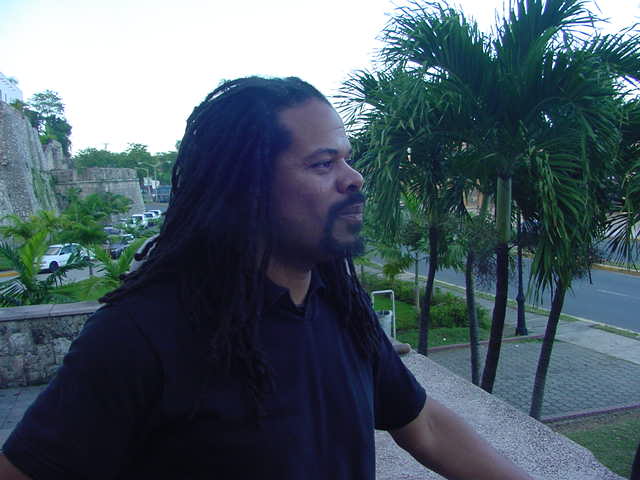
From 2005 or so, during a trip to DR

When I think back on those early years, which were certainly quite full with teaching, mentoring, writing, some administration, and commuting (between New Jersey and Chicago, for ten straight years!), I fill with amazement that I blogged as frequently as I did. There were, of course, days I missed, but I believe I set for myself the task--the regimen?--of blogging at least one thing every day, with my focus on arts and culture of all kinds (and politics less so because there were, I felt, already so many great political bloggers at the time). It was another form of work, but a labor, unremunerated financially at least, but spiritually and socially to a great degree, of love.

Sometimes what emerged were just announcements for events, but other days produced reviews, translations, reportage, basic documentation, my random street photos, and so on, but it has constituted a (partial) record of my life during those years. I also think of the people I was in contact with, especially early on; the community of bloggers, some friends, some acquaintances, some of them people I'd never met in person and still haven't met in person, but whom I was--and still feel, however ghostly the links today, I am still--in dialogue with, I learned and learn from, I collaborated with, and whose influence I continue to feel, in various ways. I do miss that blogging community, those blogging communities, bloggers, readers, commenters, all--what a time that was!

In recent years I have blogged very infrequently and mostly about my own work, if at all, but I do hope to find the time to blog a bit more, and to find new possibilities for this medium, especially as the net is increasingly a walled off, highly monetized and specialized world, with entire platforms in which words in particular are a second thought. So to blogging, and the future, and I hope to make it to 20 years, and more!

Tuesday, August 07, 2018

Boots Riley's *Sorry To Bother You*


Codeswitching, and more specifically the act of African Americans using a "white voice," including accent, intonation and pitch, to meet the expectations of white teachers, employers, colleagues and the broader society, is a culturally and politically informed practice now extensively discussed in the public discourse. Any number of writers, politicians, rappers, and other figures have explored codeswitching; there is even an NPR program with that title. It also provides a thread in numerous current TV and cinematic shows--think of Issa Rae's Insecure, Kenya Barris blackish or Donald Glover's Atlanta--but Boots Riley, a 47-year-old musician, artist and filmmaker from Oakland, makes it the central premise of his first full-length feature, Sorry to Bother You, and what a dope film he has dreamt up! It requires no hyperbole to say that Sorry to Bother You is easily the most original and unpredictable feature of this year--or many years. In it, Riley takes the idea and practice of his premise literally, so literally in fact that it quickly shifts into productively absurd territory, only to keep ramping things up from there. (Riley makes great use of literalism's formal and conceptual possibilities.) The result is a speculative, progressive, Afrofuturist, fantasia that manages to produce laughter, provoke thought, and present far-too-rare onscreen plight of working-class people, transracial and ethnic labor solidarity, the voraciousness and utter lack of ethics of US conglomerates, and the perverse, almost science-fictionally rotten core of contemporary capitalism.

Lakeith Stanfield as Cash Green
& Tessa Thompson as Detroit
Sorry to Bother You unfolds in an parallel-universe Oakland (and dystopic US) and centers on the experience of underemployed Cassius "Cash" Green (the super-lowkey LaKeith Stanfield), residing in the garage of his uncle Sergio's (Terry Crews) single family house. Living with him is his performance artist/guerrilla activist girlfriend, Detroit (chill Tessa Thompson), who exudes charm in deuces. Cash is four months behind in rent, compounding Sergio's danger of losing his house, which  now in arrears. In the story's foreground, a commercial spurs Cash and his best friend Salvador (Jermaine Fowler) to find jobs as lowest-level telemarketers at Regalview, with Detroit eventually ending up there as well; in its background, viewers see ads for and signs underpinning the conglomerate WorryFree Corporation, whose businesses operate as latter-day slave systems, providing housing and other amenities for works, but requiring a lifetime, unbreakable contract. Reilly also shows viewers that the socioeconomic and political crises that allow a WorryFree Corporation to exist in the first place can coexist, as they do today, with working-class and poor people making do--eking out whatever living is possible--as best they can.

Omari Hardwick
as Mr. ________
Becoming an effective salesman, let alone "Power Caller," stumps Cash, as many a novice salesperson has quickly figured out. Cash rides one elevator up to his floor, yet spots the golden portal to the realm of the "Power Callers" off to the right. Stanfield's hunched posture and furtive glances convey more effectively than dialogue how he views himself and the plight of so many blue collar workers today. What galvanizes Cash is a tip, both bizarre and reasonable, from his neighboring telemarketer, Langston (Danny Glover), who urges Cash to use his "white voice" to make the sales. Here, codeswitching isn't just metaphorical, nor the "white voice" merely literal. Glover suggests something aspirational, performative in the deepest senses of that word, brandishing a ludicrously stereotypical-sounding white voice that spurs Cash, with some coaxing, to conjure his own (fulfilled by David Cross), which proves to be a winner. What follows is success beyond his wildest dreams, including meeting the eye-patch sporting Mr. ______ (played with brio by Omari Hardwick, his voice squeaked onto screen by Patton Oswalt), who serves as a guide, mentor and fellow traveler, but he is able to help Sergio pay off his debts and buy his own lavish apartment. Out of the garage, into an aerie, literally.

Stanfield and Armie Hammer,
as Steve Lift
Many a filmmaker might have stopped there, in terms of the concept, to examine how a black working class figure, now suddenly empowered, maintains the exceptional instruments--voice, personality, psyche, etc.-- that have furthered his advancement, in the face of constant and countless work-place challenges. In effect, it could have been a more woke, black Office Space. For Riley, however, the stakes of the larger picture, even if somewhat in caricature, is at play. Cash's co-worker and eventual friend, Squeeze (Steve Yeun), is a union organizer, and his goal is to bring all of the first floor telemarketers into the union shop. To press the case, he organizes a strike, a plot touch that feels so appropriate as conservatives and billionaire donors continue to push for "right-to-work" laws in state after state. Yet by having Cash ascend the ladder, the film raises important existential and ethical questions, underscoring the black exceptionalist scenario that has been so common in innumerable fields. Where do Cash's lie? With management and the elites whose bidding RegalView is undertaking, or with his working-class girlfriend, Detroit, and buddies Salvador and Squeeze. His "white voice" takes on new resonance as the emblem of his growing estrangement from his past. The film poses questions that have long seem foreclosed in our media? Can workers still unionize? What are unions good for? Can unionized labor really gain workers a better deal? Returning to our protagonist, will Cash cross the line and whose side is he really on, especially after he crosses the picket line, and ends up with a head wound, bandaged so evocatively that it becomes a symbol of the wounds festering inside him.

LaKeith Stanfield as Cash
As Squeeze's labor organizing efforts unfold, viewers learn about the unnerving ties between the telemarketing firm and WorryFree; I found them almost too neat, but they serve the plot's purposes. At the same time, Regalview's "Power Callers," Cash fathoms, are engaged in nefarious work on behalf of WorryFree, meaning that he will be helping to wreak global havoc. Star that he is, he joins a truly exclusive group that includes Mr. ______ (his name, like he, is a cipher in the screenplay), and gets invited to a party at the mansion belonging to WorryFree's owner, Steve Lift (Armie Hammer), the name a play on Apple's legendary former leader and guru. WorryFree's virtual slavery practices are only one component in its evil efforts across the globe, and Cash picks the wrong bathroom door and happens upon a horrific scene that shifts the film into a different narrative gear, Lift shares with Cash not just an apparent mega-line of cocaine but his plans for even worse, transhuman corporate vision that would make Victor Frankenstein or Dr. Moreau jealous. I am being somewhat vague here so as not to give away too much, but I do want to say that Riley manages to wrap nearly everything together by the film's end, including the unionized, striking Regalview workers, Detroit's pro-African art, the national and global financial system's links to WorryFree, and literal revolt, while adding yet another twist that he had expertly set up during Cash's bathroom encounter and subsequent meeting-confrontation with Lift.

Steve Yeun as Squeeze
Riley, a self-described Communist, has produced one of the better and coherent--despite its antic quality--overtly political satires I have seen in a while. I would label it less a Communist work of art than a Democratic Socialist one, because in its vision for the future, Sorry to Bother You centers a reformed and reformable capitalism instead of the system's end, with workers having greater say as opposed to the proletariat destroying the rotten system wholesale. One can see this in Left Eye participant Detroit's art, from her wry earrings to her performance piece, a masochistic on-stage event protesting the mining of coltan in the Congo, that turns the focus inward on her, instead of outward. Even the film's chief guerrilla organization, Left Eye, a clever femmage to the 1990s R&B group TLC's beloved late singer and, more obviously, a Left-perspective activist group, seem more interested in playful critique and subversive performance than in armed revolution, more in line with the Situationists than Bolsheviks. Perhaps, I surmised, Riley is suggesting that before the endgame there might be alternatives in the war against the violence of capital--and the capitalist system--than just more violence, though that occurs here as well. But a spirit more poetry than prose runs throughout the film, and it is hardly a surprise that six years before Sorry to Bother You was made, because Riley struggled to find funding, he and his Afro-punk/hip hop band released a version of the screenplay in musical form, on his 2012 album The Coup, that gives glimpses of the richly imagined world, in Oakland and in his mind, he would eventually portray onscreen.

Thompson, featuring Detroit's
amazing earrings
That playfulness seems informed at times by cartoons--there's even a claymation instructional film embedded in it--and at others by music videos, but Sorry to Bother You has the heft and complexity of a very short novel, and feels informed as well by the long history of African American satirical literature. As is the case with its exploration of class, its deft treatment of race, often wry and light-handed, deserves high praise. One such moment, at the WorkFree Party that is one of the film's highlights. Lift asks Cash to perform, and after the new star salesman demurs, Lift and the nearly all-white party attendees start to chant "Rap! Rap! Rap! Rap!" Cash finds the perfect way to satisfy them, allowing Riley to critique the inanity of certain strains of contemporary rap and the insistent desire among some white people to utter the "n-word" with impunity. It is but one of several such moments or touches, verging on silliness or slapstick yet which turns out to have real bite, that underline Riley's gifts as a writer and thinker.  Another way in which Riley flips the script racially is by including the presence of a key Asian-American character, presented without stereotype, and a Black-Asian American romantic encounter so rare that it astonished me. (On the other hand, strangely enough, though a number of characters have Spanish first names and Tessa Thompson is herself an Afrolatina, this alternative Oakland seemed strangely devoid of Latinxs--Chicanxs especially--though perhaps I should see it again. But this was one thing I--and C--noticed separately as watched. Hmm.)

Jermaine Fowler as Salvador,
Yeun and Stanfield
One might argue that despite its successes, the film does not fully cohere. I would counter by saying that given all that Riley sets out to do in this one film, fully aware, one suspects, of the long and ugly history of black filmmakers' struggles with Hollywood to make more than a brilliant one-off, or two films if very lucky, in careers that should include dozens of offerings, he pulls it all off. The shifts in tone are central to the film's aesthetics. Its political vision goes further than almost any recent comedy I can think not directed by Ken Loach. The actors all embody their characters with an effective combination of the comic and serious. From the film's opening frames, Riley establishes a foundation for speculation that could go in any direction, so the final transmogrification, while surprising, is one he and Sorry to Bother You earn. The film, in sum, makes the sale, while also accounting for how much it also may disturb us; both in its title, as throughout its 111 minutes, Riley never takes the simple route, and I for one hope that we will see more from him, much more, in whatever forms his vision takes him.

Thursday, July 05, 2018

Andrés Manuel López Obrador (AMLO) Wins Mexican Presidency

Andrés Manuel López Obrador speaks
at a press conference in Mexico City, July 3,
2018 (Photo: Manuel Velazquez/Getty Images)
from New York Magazine
Three times can sometimes produce a seismic charm, or so it appears for Andrés Manuel López Obrador (AMLO) (1953-), who was finally elected President of Mexico on July 1, this past Sunday. Though a longtime member the leftist Partido de la Revolución Democrática (Democratic Revolution Party, or PRD) and a failed candidate in the contested 2006 and 2012 national elections, AMLO, a former Governor of the Federal District, ran under the aegis of a new left-leaning coalition, Juntos Haremos Historia (Together We Will Make History), that comprised the progressive Movimiento de la Regeneración Nacional (National Regeneration Movement/MORENA) and Partido de Trabajadores (Labor Party/PT) parties with a socially conservative party, Partido Encuentro Social (Social Encounter Party/PES). AMLO will assume office on December 1, 2018, which, given Mexico's current parlous state, will not be a moment too soon.

AMLO's chief rivals in this year's presidential election were Ricardo Anaya of the Partido Acción Nacional (National Action Party/PAN), the center-right party of former president Vicente Fox (who served from 2000-2006) an antagonist of US Republican presidents George W. Bush and Donald Trump; José Antonio Meade of the Partido Revolucionario Institucional (Institutional Revolutionary Party/PRI), the neoliberal, longtime ruling party to which incumbent president Enrique Peña Nieto (2012-2018) belongs; and two independent candidates, Jaime Rodríguez Calderón, who had previously become the first independent candidate to win a state governorship when he helmed Nuevo Leon; and Margarita Zavala, a noted lawyer, and the wife of former president and PAN figurehead Felipe Calderón (in office from 2006-2012).

In essence, AMLO was not just leading a visibly left coalition but represented the only left-leaning option for Mexican voters in this presidential election. As the campaign progressed, Mexico's political and social elites grew increasingly alarmed, and perhaps rightly so. Yet the hiccuping economy, metastasizing violence, which even marked the lead-up to the election, and continuing allegations of extensive, high-level government corruption, blunted the right's blizzard of "Mexico will turn into Venezuela"-scare tactics, some with racist and classist tones, including advertisements, robocalls, videos, and social media attacks, not unlike ones that had doomed AMLO's chances in the prior two elections.

In one instance, a PRI operative named Enrique Ochoa Reza tweeted that PRI politicians who switched parties to MORENA were "Prietos que no aprietan" (Dark-skinned/black people who can't get a hold), playing on the double meanings of "moreno/a" (brown/black man/woman) and "prieto" (dark/black person), as well as the feminine form of the former word (morena=brown woman/black woman) and the verb aprietar (not being able to keep somebody). Ochoa Reza did apologize for the racist aspect of his slur, but not the misogynistic one. Additionally, there were allegations of US and Guatemalan meddling in the campaign, and Ochoa Reza accused Russia of interfering on behalf of AMLO, a charge the eventual victor laughed off.

The attacks, however numerous and outrageous, could not overcome Mexican voters disgust at the current state of affairs. AMLO won in a landslide, defeating Anaya by 21 percentage points while winning 53% of the total vote and popular vote. The final tally in an election that saw a 63.6% turnout (or 56.6 million voters out of 89.9 registered voters) was as follows, with AMLO winning 31 of Mexico's 32 states, and the first outright majority for a presidential candidate since 1989:

2018 Mexican Presidential Candidate & PartyVote Total
AMLO (National Regeneration Movement/Juntos Haremos Historia)30,112,109
Ricardo Anaya (PAN/Por México al Frente)12,609,472
José Antonio Meade (PRI/Todos por México)9,289,378
Jaime Rodríguez Calderón (Independent)32,743
Margarita Zavala (Independent)31,983

While his ideology has long been diametrically opposed to what we see with a figure like Donald Trump, they share a vocal populist nationalism, AMLO's rooted in the left and democratic socialism instead of Trump's ethnonationalist and racist authoritarian approach. What this might mean for the cozy relationship between Mexico's large corporations and land owners and the government and for an approach to a renegotiated North American Free Trade Agreement (NAFTA) that privileges international structures and rules over the country's laws remains to be seen, but given the Juntos Haremos Historia/MORENA's capture of 312 of 500 seats in the Chamber of Deputies, and the strong popular mandate for the coalition and new president, AMLO could throw wrenches in Mexico's steady march towards privatization and economic (classical) liberalization, in favor of policies that more effectively and immediately address the rising economic inequality and insecurity that millions of Mexicans are facing.

During the campaign AMLO announced that he would push to reform some of the perks of the presidency, including cutting his salary and that of top officials, selling presidential planes, creating a public park out of the presidential grounds, and ending the lifetime pension former presidents receive, with the savings being directed towards Mexican seniors, who have a far less secure and comparatively robust retirement savings system than US's fixed pensions, 401K savings plans, and Social Security (which itself is admittedly always under threat from US conservatives and neoliberals). He also attacked the International Monetary Fund as an enabler of and participant in Mexico's corruption, suggesting he might pull back not just from the IMF but from other international financial systems that have long kept Mexico under yoke. One key question would be how projected new NAFTA negotiations might change as a result of this approach.

As Nathaniel Parish Flannery argues in a recent Forbes article, "The AMLO Era: Why Mexico's 2018 Election Matters," nearly half of Mexicans live in poverty, and despite the country's prowess in manufacturing, wages remain abysmal. Stemming governmental corruption and addressing the country's sluggish growth rate, rising economic and social inequality, the persistent lack of jobs in the formal economy, and low, stagnant wages across all labor sectors could have beneficial, ramifying effects on all aspects of Mexican society. The question for AMLO and Mexico's congress is how to spur all of this such that all the wealth does not continue to flow upwards to the relatively tiny sector of rich elites. Strategies to create a viable and vibrant middle class, which would necessitate a retreat from the neoliberalization of the prior PRI and PAN administrations, transformed tax and business policies, support for public education and farmers, and a strengthened safety net, could be among AMLO's and the new left-leaning Congress's potential steps.

Some of this, beyond NAFTA talks, will hinge on the "new relationship" AMLO has vowed to forge with Mexico's often domineering neighbor the United States. While the US and Mexico are among each others' largest trading partners and cooperate extensively in a range of areas, the two current leaders, Trump and Peña Nieto, have been at loggerheads, in part because of Trump's persistent attacks on Mexico and Mexicans, beginning the day he announced his presidential campaign and slandered Mexican immigrants, and because Peña Nieto understandably has refused to pay for Trump's desired border wall. AMLO has already challenged the border wall idea in a pamphlet he published, entitled Oye Trump (Listen Up, Trump). One goal AMLO outlined was development of Mexico's "internal market," so that "Mexicans can work and be happy where they were born, where their family is, where their customs and cultures are." Creating an expanding middle class is crucial to ensuring this market can flourish, and to transforming the migrant flows.

Another challenge for AMLO will be to figure out a way to lower the violence that has plagued Mexico. Neither Calderón's nor Peña Nieto's approaches worked; corruption remains endemic at all levels, and organized crime is strong as well. In addition, since September 2017, 130 political figures, from the municipal to the national level, have been murdered, and journalists across Mexico have been targeted for investigative and critical work. AMLO supposedly has suggested amnesty for low-level drug offenders, which sparked criticism, but it also is the case that Peña Nieto's initial policy approach of militarized attacks on the cartels failed, as did prior attempts to negotiate with organized crime. Rising pay for all workers, and better wages for domestic security and military forces could help to thwart the power of organized crime to infiltrate them, but AMLO also has suggested a "peace plan," involving human rights organizations, religious organizations, among others, to negotiate a decline in the murder rate.

I see less of a parallel with Hugo Chavez, to who AMLO has been repeatedly compared, and more of one with the presidency of Luiz Inácio "Lula" da Silva, Brazil's now imprisoned but still widely popular former president. Formerly a firebrand leftist from his country's Worker's Party, Lula lost three elections before finally becoming president in 2003, and governed for two terms. Lula moderated his platform in his successful campaign, presiding over a series of liberalized economic policies that on the one hand led to considerable growth, but which included a range of social policies that helped lift millions of Brazilians out of poverty, increased Brazil's safety net, and created a visible if fragile middle class. Unfortunately, Lula did not target systemic corruption with the same zeal, and now finds himself crucified not only because of his opponents' vengeance, but as a result of his and his successor's failure to truly wrestle with the beast of corruption during the height of their successes. With AMLO, domestic economic policies and global financial trends could prove his ally or enemy, but a failure to address systemic corruption, impossible a task as that may be, could destroy not only the tremendous support he now enjoys, but damn his and his coalition's future, let alone Mexico, for decades to come.


Tuesday, September 13, 2016

Classes Have Begun + The LIU Brooklyn Lockout (UPDATED)

Rutgers-Newark
Labor Day has come and gone, and in its wake the school year is off and racing. In addition to chairing African American and African Studies again this year, I have a graduate English seminar on my slate. Last Thursday I taught my first class meeting for this course, which runs under the rubric "Topics in Literature," with the subtitle "Postmodern: Beauty, Ideology, Power." What I'd envisioned was a course exploring key aesthetic concepts, both old and new, as means of apply critical pressure to a wide array of late 20th and 21st century works, in the genres of poetry, fiction and drama, that fall broadly underneath the category of post-modern.

Some of these will be by writers visiting Rutgers-Newark's Writers at Newark reading series this fall: Rickey Laurentis, Robin Coste Lewis, Eileen Myles, Chinelo Okparanta, Kristin Váldez Quade, and Ocean Vuong. Other works include texts that I have taught before, like Adrienne Kennedy's Alexander Play The Ohio State Murders (I love this work!) and poetry by Kenneth Koch, Mei-Mei Berssenbrugge, as well as books I have never taught before but long wanted to, including Peter Weiss's (in)famous play Marat/Sade, Cormac McCarthy's award-winning and popular dystopia The Road, Bret Easton Ellis's masterpiece of visionary satire, American Psycho, and Nnedi Okorafor's stunning novella Binti.

Of course for every text I chose there were many handfuls I had to forgo, but I am teaching an undergraduate African Diasporic fiction class this upcoming spring, so I am going to be aim to include some of the works I could not use this fall in that class--while also being mindful not to overload those students. I hope to post a bit more about the in-class discussions as the semester progresses.

***

UPDATE:
As the New York Times reports, LIU Brooklyn's faculty lockout has finally ended, after 12 days, on September 14. The university's administration and its faculty union agreed to extend the existing contract, which had expired on August 31, to May 31, 2017, or the end of the current academic year. During this period administrators and union officials will negotiate a new contract and the faculty union will not authorize a strike. The end of the lockout averts what was quickly becoming a fiasco for LIU Brooklyn's hardline president and the university, as students staged walkouts and public demonstrations against the policy. Chalk up one loss, however temporary, for the ongoing neoliberal corporatization of American colleges and universities.

While Rutgers-Newark faculty and most of our colleagues are back in classrooms or will shortly be, unionized faculty at Long Island University-Brooklyn find themselves locked out by their current administration. Since their contract expired on August 31, LIU president Kimberly Cline has kept all 400 members of the faculty union off campus. In addition to cutting their pay, Cline and the university have also cut blocked their campus email accounts, dropped their health insurance, and replaced them with temporary scab teachers. Although Cline pledged to students that the lockout would not cause disruptions, it has allegedly transformed LIU-Brooklyn into a site of chaos, with some classes being led by faculty members lacking expertise in their assigned subjects and other classes barely being taught, if at all. In one particularly egregious case, Democracy Now reported, LIU's Chief Operating Officer, Gale Haynes, a political scientist, was slated to teach a yoga class; the university has since called this an "error."

The chief point of contention centers on LIU's new proposed contract for its Brooklyn unionized faculty, which would not only lower their pay and benefits relative to their colleagues at LIU's C. W. Post satellite campus on Long Island, but also gut pay for adjuncts. Once their contract expired, LIU-Brooklyn's unionized faculty barely had time to read and vote on the contract, and probably would have struck for better terms, as they had in the past, but Cline preemptively locked them out when the contract expired. When they voted roughly a week later to reject the contract, Cline did not reopen dialogue, and has given no signal that she or the administration plan to back down, leaving LIU-Brooklyn students, who pay anywhere from $30,000 to $50,000 per year confused and enraged. COO Haynes claims that the university is negotiating in good faith, though neither she nor anyone else in the administration has yet officially proposed more equitable terms. The Long Island University Faculty Federation has filed a complaint over unfair labor practices with the National Labor Relations Board, and, according to a report in Common Dreams, the LIU Faculty Senate has issued a no-confidence vote for Cline.

Were the faculty to accept the current contract, they would be ratifying a two-tier system not just for themselves in relation to their colleagues at C. W. Post, but especially for new Brooklyn faculty members, and in particular, adjuncts. Cline, however, has yet to sign a labor contract with any of the unions at LIU, and rejected outright the possibility of extending the previous contract for five weeks while the university and union negotiated the new one. Instead, as publications such as Common Dreams, The Nation and The Atlantic have pointed out, Cline's goal since becoming president appears  slashing costs at any cost, and cementing neoliberal, anti-labor policies to improve the school's financial picture and credit rating in the short term. The danger for the institution is manifold: its reputation is taking a serious hit; it will be hard, even at a time of academic job scarcity and precarity, to field quality faculty in the future; and it may be driving away current and future students, and alienating alumni. Two hundred LIU students protested yesterday, and there have been rolling protests since the lockout began. Perhaps Cline's goal is to shut the campus down for good in favor of the wealthier Long Island branch, which would be loss for Brooklyn and New York's academic ecology. Right now, though, that doesn't seem such a far-fetched idea.


Democracy Now: "Everything Was Immediately Cut at LIU"

Saturday, September 13, 2014

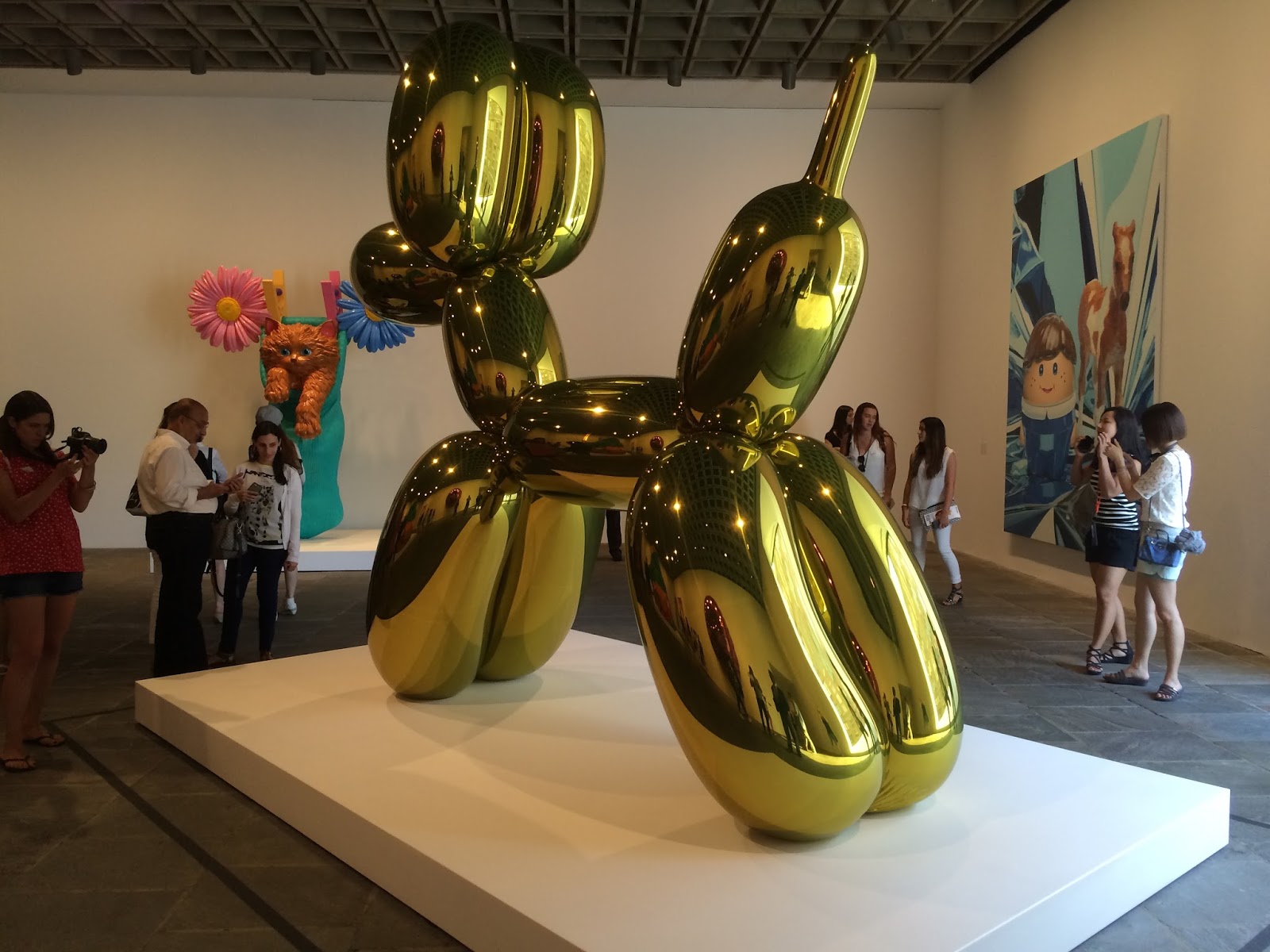
On Jeff Koons at the Whitney Museum


What is art? What is "good" art? What do we mean by "good" when we speak of art? Does "good" here equate with quality, if we consider the roots of the concept of art in the West lying in the concept of techne? Is this even a relevant question any more, in 2014? Who determines what is good and not good? Or beautiful, or resonant, or sublime, or, conversely, bad, horrible, not worth expending even an epithet on? Are these characterizations a matter of a work of art's holistic aesthetics? Sociopolitical relevance? Technical virtuosity and mastery? Does the fact that a particular institution or an institutional field assigns such values make them valid? Does it matter that their decisions may be based not only on personal views drawn from expertise in the history of and criticism about art, but other institutional values, broader historically, politically, economically, and socially discourses about art, and contemporary market values? How much should any viewer know or factor in that there are immense financial stakes for collectors and connoisseurs?Is that what we mean today by the sensus communis? Does such a term have any meaning at all in the wake of the multiple stratifications and atomizations of the society in which we live? Does the sensus communis perhaps primarily and most aptly apply today to the artistry of Beyoncé Knowles, say, or Seinfeld during its heyday, or the current HBO hit Orange Is The New Black, rather than anything produced by some of the artists who now occupy the upper reaches of the contemporary US and global artworlds?  How important are these issues in thinking about art, about beauty, about aesthetic value?


What is it "good" art for? What makes it worth viewing? Is there any correlation between its aesthetic value and its market value? What do we even mean by "aesthetic value" today? Or use value for that matter? Do any of the additional aesthetic qualities proposed by critics like Sianne Ngai in books like Our Aesthetic Categories: Zany, Cute, Interesting (Harvard University Press, 2012), such as "zaniness" or "cuteness" or "interestingness" factor in at all in terms of this idea of "goodness" and its purpose? Does purposiveness? Does placing a work of art or multiple ones, by the same artist or different ones, within a given context like a gallery or museum, especially one of the major ones in the world, (not) legitimate an artwork and its author? Does it validate them and her? Are legitimation and validation the same thing? Can market value, which is now the primary value in contemporary art, be the only significant value an artwork possesses? What is or are relations between the acceptance of aesthetic and personal commodification and works of art's non-financial values? What do we say about artists who view themselves and their artwork not simply as commodities, which could be said to every degree about every artist creating today who is conscious of the world in which she lives, but as financial instruments? Can such artists ever again be said to approach their art with disinterest, and thus isn't that a category which might be jettisoned today? Which is to say beyond a basic barter system, can a painting or a sculpture also be considered as form of currency, or a derivative? What happens when we speak of works of art as derivatives or financial instruments? What does one call exchange value that is now so inflected? Is there a new name for this contemporary state of aesthetics, and would be be an(ti)aesthetics, commodesthetics, financesthetics, or something else?


Does such value (do such values or non-values) invalidate at a basic level the question of aesthetic, political, social or any other form of "goodness," "beauty," and so on? What is the relationship between this way of thinking, and Duchamp's readymades? Should we assign the the start of this thinking at the doorstep of Duchamp--or perhaps in more recent decades, Andy Warhol--or go back to Plato's ideas about second and third orders of artmaking, or Kant's formalism, as well as the aesthetic writings of Karl Marx? Does it unfairly raise the significance of a work of art and its author that I or anyone invokes such names? Is there a danger in doing so, and how does this relate to legitimation and validation? Does doing so also help to increase the "values" of certain works of art, even if I think they do not deserve it? Does it matter that an artist may or may not be aware of such questions? Or that, even if aware, she neither understands them or even cares?


Can't an artist focused primarily on making money make good art? Why does Jeff Koons make art other than to make money and make things? Does Jeff Koons know what "good" art is? Does Jeff Koons care? Should Jeff Koons care if a museum like the Whitney apparently does not? Does Jeff Koons' background as a Wall Street commodities broker as well as a graduate of an art school factor to a greater degree in the way in which his work appears often to be primarily a financial instrument or derivative? Isn't it fair to use the term "derivative" in relation to Jeff Koons's work, given that he was a broker, and, based on his show at the Whitney Museum, he, like many other artists, "derived" his early practice heavily from the work of Marcel Duchamp? Is it fair to say that Jeff Koons had a significant or noteworthy conceptual understanding of art, and of Duchamp's work, even at the start of his career? Has he had one since? Why does so much of Jeff Koons' work, its technical mastery excepted, look like something that might merit a harsh critique at an art school? Is technical mastery enough?


How do we speak of art that is at one level hard to look at and at another to turn away from, like Koons'? Does the monumentality of so much of Koons' work endow it with a significance it might lack if it were smaller in scale? Would we want to look at a golden balloon dog in cast metal if it were the size of one might find at a children's party rather than larger than a Cadillac Escalade? What about a heap of Play-Dough? What about a room or six or five floors of such work? Do such questions even matter? Would Jeff Koons have the career he has if he were not an educated white man from a middle-class middle-American background? Would such artwork be possible for someone not from such a background? What does this say about the roles of power, privilege and possibility in the contemporary art world, or in our society in general? Does it matter that in asking these questions so far I have not even broached questions of labor, production, and who in fact produces this art that has garned Jeff Koons such incredible fame and wealth?


Has the shift to a digital world of images, a world not of artworks but of platforms, as David Joselit has noted in his book After Art (Princeton, 2012), rendered Jeff Koons's work, especially his pornographic images with his ex-wife*, Ilona Staller, La Cicciolina, say, more or less valid? Are there words in the English language to capture my unpleasant physical response to see Jeff Koons naked and simulating or having sex? Is it not, however, a virtue, that works of art can make a viewer like me laugh out loud repeatedly, though not with the artwork's intended meanings, but in spite of and against them? Can an artwork, even in the age of mechanical and now digital reproducibility and infinite expansion and transformation, be said, when viewed either in person or online, to have no aura, and why does this seem to hold for so many (most?) of Jeff Koons' works?


Conversely, does not the possibility of infinite digital reproducibility render certain Koons' works even more auratic? Isn't it perhaps better, to put it another way, to see them on the Internet or some other digital space, as opposed to up close? Isn't there an aura of ratchetness (wretchedness) in contemporary American life to which more than a few aspire? Isn't this a negative aesthetics but a very different one from what Theodor Adorno proposed? Isn't this ratchet auratics a poetics that suffuses so much current popular culture and American culture more broadly? In identifying it am I not also implicating myself in my enjoyment in certain forms (such as reality shows, say) and examples (Mediatakeout.com) of it? What happens when one places Real Housewives of New Jersey alongside Jeff Koons? Hasn't someone already done this? Why did the Whitney choose Jeff Koons' as its final show in its Marcel Breuer space, and what does this say about the Whitney Museum and its role and place in contemporary American and global art? Can any fields but cultural criticism and the history of art account for such an occurrence? Is Jeff Koons not the perfect artist for contemporary America, and if the answer is affirmative, doesn't this answer all the preceding questions?


___
* Many thanks to Andrew Blackley for correcting this error; Ilona Staller was Jeff Koons' wife, not just his girlfriend, which raises a number of related issues that Andrew also pointed out, such as: 

The degree and orientation of both of their agencies shifts within their marriage - regardless of personal respect(s) or equality of sorts or means individually in that there is a more or less an ideological "fair use" clause to the body of the other, and the inability (or difficulty) of protesting against or working counter to the other or the union as a whole ( say, in court.)

Is she the porn star girlfriend (working, or knowing how to work with and through her body) or is she the wife "at work," under an established consent between the two of them as people or "at work" under and as part of an institutional allowance?

And, if the above: what does that say about Jeff Koons and the rest of his "collaborations" with any number of cultur

Monday, October 10, 2011

Occupy Chicago + Poem: Carl Sandburg

One of the signs @ Occupy Chicago
One of the signs from yesterday #occupychicago
I've posted a few times about the Occupy Wall Street (#OWS) and other Occupy Financial Districts protests, but I had not been able to get down to the Occupy Chicago gathering until yesterday. (Today participants will join the Mass Mobilization to Take Back Chicago by marching from their main site at Jackson and LaSalle across the street from the Federal Reserve Bank of Chicago and the Chicago Board of Trade to the Art Institute of Chicago at 4:45 pm, where a reception for the Futures Industry Association and the Mortgage Bankers Association will be held.)

For those in Chicago, this is Take Back Chicago week, which will include several events each of the next few days. Today's mobilization:

TAKE BACK OUR JOBS
@4PM: Jobs March
Federal Plaza @ Adams/Dearborn
Daley Plaza @ Washington/Dearborn

On Tuesday, October 11, 2011
TAKE BACK OUR HOMES
@4PM: Homes March
Hyatt Regency @ Wacker/Stetson

On Wednesday, October 12, 2011
TAKE BACK OUR SCHOOLS
@4PM: Schools March
Hilton Chicago @ Balbo/Michigan
Chicago Board of Trade @ Jackson/LaSalle

As I wrote to friends today, when I heard Congressperson Eric Cantor's (R-VA) comments the other day referring to Occupy Wall Street and similar protesters as "mobs," I immediately thought of several poems by Carl Sandburg (1878-1967), the great poet of the Midwest, industrial America and labor.  Perhaps the best of these Sandburg poems specifically mentioning "the mob" is "I am the People, the Mob," of one poems I read earlier this year at the Poetry for Labor event I organized down at the Haymarket Memorial Sculpture on May Day.  "I am the People, the Mob" grounds the meaning of the latter term in the historical and material conditions of working people, suggesting that without the labor, the intellects, the bodies of workers, the vaunted corporations-persons would have been and would be nothing. Here is Sandburg's poem (I must remember to bring a copy with me in case I want to read it at an event) in case you don't have it handy:

    I AM THE PEOPLE, THE MOB

   
I AM the people--the mob--the crowd--the mass.
    Do you know that all the great work of the world is
         done through me?
    I am the workingman, the inventor, the maker of the
         world's food and clothes.
    I am the audience that witnesses history. The Napoleons
         come from me and the Lincolns. They die. And
         then I send forth more Napoleons and Lincolns.
    I am the seed ground. I am a prairie that will stand
         for much plowing. Terrible storms pass over me.
         I forget. The best of me is sucked out and wasted.
         I forget. Everything but Death comes to me and
         makes me work and give up what I have. And I
         forget.
    Sometimes I growl, shake myself and spatter a few red
         drops for history to remember. Then--I forget.
    When I, the People, learn to remember, when I, the
         People, use the lessons of yesterday and no longer
         forget who robbed me last year, who played me for
         a fool--then there will be no speaker in all the world
         say the name: "The People," with any fleck of a
         sneer in his voice or any far-off smile of derision.
    The mob--the crowd--the mass--will arrive then.

Copyright © Carl Sandburg. All rights reserved.

Below are a few photos from yesterday's gathering.  What impressed me was not only the enthusiasm of those present, but of so many people driving, walking and riding--in Chicago's double-decker tour buses--by. Perhaps because the rally was smaller than some prior ones have been, the day of the week and the hour determining attendance, everyone who wanted to could command the microphone for as long as she or he saw fit and speak, and many of those who stepped up did have thoughtful things to offer the crowd. (There was one person who shrieked out a call for violence then fled--agent provocateur, no doubt, for a true anarchist would have been willing to defend his views, no?) I did not attend the General Assembly, which began at 7 pm, but the notes from previous ones are available at the Occupy Chicago website.  I will heading back this upcoming weekend and at any other times that I can.

The Federal Reserve Bank of Chicago, across from the Occupy Chicago event
The Fed Bank of Chicago across from the protest site
Occupy Chicago participants beneath Bank of America banners
Occupy Chicago, beneath Bank of America banners
A picture worth a thousand bad policies
A photo worth 30 years of bad policies
One the Occupy Chicago rally's speakers
A speaker (he spoke about corporations' pushing "plastic sh*t" on us)
One of the musicians @ Occupy Chicago
One of the participants, a musician
People @ Occupy Chicago
Making music as someone else sang-rapped political aims
People @ Occupy Chicago
Participants across from the Chicago Board of Trade & Library
The crowd @ Occupy Chicago
Occupy Chicago particants ("End Corporate Welfare")

Friday, July 08, 2011

End-of-Week Roundup + Memories of Chekhov

A girl holds a South Sudan flag with stripes symbolising the people, their blood and the land. Photograph: Ho/Reuters
After decades of war, South Sudan is now an independent country! It broke away from Sudan, has its new capital at Juba, and its new president is Salva Kiir. Eight facts about the new Republic of South Sudan. Congratulations!


Elizabeth Ann Bloomer Warren Ford, better known as Betty Ford (1918-2011), the wife of late 38th president (1974-77), Gerald Ford (1913-2006), has passed away. She was more progressive on many issues, such as equal rights for women and abortion rights, than her husband, and probably would have made a better president than either he or his predecessor.

A certain Nobel Laureate economist thinks the President (OK, quickly, did we elect a Republican in 2008, just asking?) is really off track. Said economic genius ain't alone....

Television is truly imaginatively bankrupt: TNT is resurrecting Dallas, a program appropriate to its era, for a new generation of viewers. Why not, say, Tent/Car City California, or Orlando: Foreclosureville, or, if a show must be set in Texas, San Antonio? Oh, I know, those would require...IMAGINATION.

The situation grows worse and worse regarding the hacking scandal at Rupert Murdoch's News International soon-to-be-nonexistent newspaper The News of the World. Its former editor, Conservative-Liberal Democratic former minister Andy Coulson, has been arrested.

The NFL lockout, in which the very rich owners are locking out the very rich players, who belong to a union, continues, as the US 8th Circuit Court of Appeals refuses to overturn the lockout. The NBA is also locking out its players. The assault on organized labor continues apace, even in its upper reaches.

The MLB All Star Game takes place next week, in Arizona. It should either have been canceled or moved rather than be played in a state with overtly racist anti-immigration laws, especially considering how many immigrant players fill the league's rosters and its stadiums. As a result, this is one of the first years in many that I can recall in which I did not cast a single vote for any of the players, though if I had, the New York Mets' José Reyes would have been at the top of my list, and I'm no fan of the Mets. (Sorry, Albert Pujols...).

+++

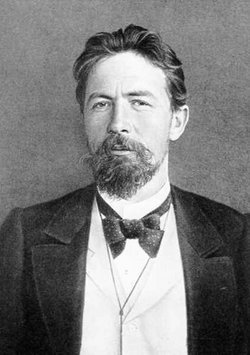
Every year I include on my undergraduate fiction workshop reading list at least one story by Anton Chekhov (1860-1904), who, as I need not tell any reader of this blog, I'm sure, was an exceptional playwright and one of the greatest short story writers ever. His influence flows through many a current of short and even longer fiction of the last century, and he is a writer whose gifts for characterization, scene-setting, tone, stylistic fluidity, varieties of irony, thematic openness and ambivalence, and narrative concision, displayed in all his mature works, offer a lesson any writer can learn from.  As I once mentioned to one of my advanced fiction writing classes, the basic argument in Francine Prose's Reading Like a Writer: A Guide for People Who Love Books and For Those Who Want to Write Them (HarperCollins, 2006) is, if all else fails, read and learn from Chekhov. The late Roberto Bolaño says as much (read and learn from Chekhov or Raymond Carver) in one entry I glanced at in Between Parentheses, New Direction's (June 2011) new book of his collected prose.

The current online New York Review of Books offers excerpts from a new book, Memories of Chekhov, edited by Peter Sekirin (Mcfarland and Co. Inc. Publishing), featuring memories of Chekhov by his peers, some of them, like Ivan Bunin (1870-1953), received the Nobel Prize in Literature in 1933. (Chekhov likely did not live long enough to merit consideration, though had he survived a few more decades, he ought to have been a leading candidate.)

Below is Bunin's excerpt; there are many more at the NYRB site:

I got to know Chekhov in Moscow at the end of 1895. I remember a few specifically Chekhovian phrases that he often said to me back then.

"Do you write? Do you write a lot?" he asked me one day.

I told him, "Actually, I don’t write all that much."


"That’s a pity," he told me in a rather gloomy, sad voice which was not typical of him. "You should not have idle hands, you should always be working. All your life."


And then, without any discernible connection, he added, "It seems to me that when you write a short story, you have to cut off both the beginning and the end. We writers do most of our lying in those spaces. You must write shorter, to make it as short as possible."
Sometimes Chekhov would tell me about Tolstoy: "I admire him greatly. What I admire the most in him is that he despises us all; all writers. Perhaps a more accurate description is that he treats us, other writers, as completely empty space. You could argue that from time to time, he praises Maupassant, or Kuprin, or Semenov, or myself. But why does he praise us? It is simple: it’s because he looks at us as if we were children. Our short stories, or even our novels, all are child’s play in comparison with his works. However, Shakespeare… For him, the reason is different. Shakespeare irritates him because he is a grown-up writer, and does not write in the way that Tolstoy does."

Monday, May 02, 2011

Poetry for Labor Event

Many, many thanks to everyone who came out to the Poetry for Labor reading and commemoration on Sunday, which was International Labor Day / May Day. As I noted in my original flyer, this year marked the 125th anniversary of the Haymarket Square Affair, one of the signal events in US and global labor history, which occurred in Chicago right near the site where we met to read and remember. As I noted in my brief and informal remarks that opened the event, the lives of the striking workers who were killed, the policemen who also died, and the accused bombers who were later hanged or murdered were not in vain. The incident and its aftermath led to many things we take for granted today, including the eight-hour workday, and helped to spark the union movement in this country and all over the globe.  As we find ourselves in another precarious moment in terms of labor and labor relations, with unions specifically under fire, an unemployment rate officially at 8.8% but higher and very high underemployment, and a skewed economic system that is rewarding a very few at the expense of billions of people, it's crucial that we not forget events like the Haymarket Square Affair, that we take time out to commemorate those who fought for what we have, and that we continue to fight for our own rights and for those who'll follow us.

I want to offer especial thanks to Jen Karmin and Laura Goldstein, who read, spoke, brought their incredible presences and commitments to the event, and to their affiliated organizations, the Red Rover Series and the Chicago Durutti Skool, who consponsored the event and put the word out about it.  Many thanks also to my partner C, whose support was invaluable, and whom I even convinced to read a poem (by Frank O'Hara: "A Step Away from Them," no less!), and to my cousin Raquel Stallworth and her husband Walter, who came out to show support. Raquel spoke eloquently about her experiences with the contemporary labor market, making personal, as Jen and Laura did, what can sometimes be discussed in abstractions (and thus, as too often happens in our corporate media, dismissed altogether or sensationalized).  Among the writers we read were Muriel Rukeyser, Charles Reznikoff, Rita Dove, Elizabeth Alexander, Carl Sandburg, Joy Harjo, John Ashbery, Martín Espada, Mark Nowak, and William Blake, and we read poetry and prose.  We talked about poetry as labor, the role of metaphor in the way those in power structure our society and capitalism's systems and how what operates in poetry might offer ways of understanding things better, working-class roots and ancestors, and so much more.

It was particularly encouraging to see that among the first people who arrived at the event were tourists from Norway, and a executive trainee (!) from the Basque country (as he put it) in Spain. Both had learned about the event online, and were determined to pay tribute to the site and to hear poetry. And they did stay and listen, which was wonderful.  We also had a sizable contingent of cyclists who, it turns out, were not only gathering at the Haymarket Memorial Sculpture to begin their tour of major local labor sites, but who also wanted to hear poetry. Rick B., one of the cyclists, also offered a brief and thorough recounting of the Haymarket Square Affair events, pointing out that the alley from which the bomb was thrown was still there, just behind us.

Below are some photos from the event. Many thanks again to C, who snapped some great ones!

The new plaque
The new plaque, dedicated April 30, 2011
Reading at *Poetry for Labor*
During the reading
The visitors from Norway & C
The visitors from Norway (they were there at 8:30 am!) and C
Haymarket Memorial Sculpture
The Haymarket Memoria Sculpture, with our set up
Jen Karmin reading
Jen preparing to read
Laura Goldstein reading
Laura reading Muriel Rukeyser's work
C reading Frank O'Hara's "A Step Away from Them"
C reading
A poet & union member speaking
A poet and union member speaking
Rick B. of the cyclers' group speaking
Rick B. of the cyclists' group
Me reading @ *Poetry for Labor*
Me reading

Tuesday, April 26, 2011

Chicago Reading: Poetry for Labor, May 1, 2011

This upcoming Sunday, May 1, 2011, International Labor Day / May Day, in conjunction with Red Rover Series and Chicago Durutti Skool, I am organizing an informal public reading on behalf workers everywhere, and in commemoration of the 125th Anniversary of the Haymarket Affair, which occurred in 1886.

The event will run from 9 am to noon, in the West Loop at 165 N. Desplaines Street at W. Randolph Street. It's reachable by CTA trains. If you are in or around Chicago, please drop by, bring your own poems, those by writers you admire, or journal entries and prose pieces about workers and labor!

Come read, recite and perform your and others' poems!