Showing posts with label critique. Show all posts

Wednesday, September 11, 2019

A Tale of Two Exhibitions: The 2019 Whitney Biennial

Earlier this summer, I had the immense pleasure of viewing the 2019 Whitney Biennial, which is still running, for a few more weeks (until September 22, 2019), at the Whitney Museum of American Art in New York. It was not only a better show than the 2017 installment, I thought, but in essence two different exhibits in one, I ultimately argued, in a review now out for Art in America. The second of the two exhibits became possible, however, only after the Whitney resolved a festering crisis that had underpinned the exhibit--and the institution itself as a whole. In fact, the revolt that occurred, creating the new exhibition, necessitated that I rewrite the laudatory first review I'd drafted.

The qualitative differences between the two exhibits, whether visually evident or not, resonate throughout the work on display, throughout the museum's spaces itself, as a shift in ethos and an aura, however temporary. I won't replay my entire essay, which underwent a great deal of editorial distilling (so many thanks to Will Ratik and his editorial team at Art in America), so here is the link to the full essay, "The Whitney Biennial: A Tale of Two Exhibitions," and a paragraph from it, in which I argue for further action by the exhibits artists and, I would assert, artists working in all media, including literature.

I believe we are at the moment when the artists should be encouraged to actively trouble the “circuits of valorization,” as prior generations of artists have done. I say trouble rather than disrupt, since the latter term has taken on particular connotations in the language of neoliberal capitalism, particularly in Silicon Valley and Wall Street. But what might the effects be of such a troubling on the lives and careers of today’s artists, especially those who, like many of this year’s biennial participants, come from groups, intersectionally understood, that have been traditionally excluded from participation in exhibitions such as this, as well as from elite art schools and institutions, and from the global gallery, art fair, and auction networks? What would more extensive rethinking, dismantling, and transformation of those circuits look like? How much energy and effort can and ought they expend in understanding and critiquing the ecosystem in which they are working? From an ethical standpoint, can they forgo such an undertaking, whatever the cost?
If you can, please see the exhibit before it goes, and do leave your thoughts on the Biennial and my review in the comments section if you'd like.

Wednesday, February 28, 2018

"Words" on Academy of American Poets' Poem-A-Day


Today Twitter (naturally) brought some very good news: one of my poems, "Words," which the brilliant poet and critic Dawn Lundy Martin selected for the Academy of American Poet's "poem-a-day,was featured today on the last day in February and thus Black History Month. Many, many thanks to Dawn for contacting me about new poems, and thanks also to Mary Gannon and Maya Phillips at the Academy of American Poets for their work in publishing it on the site!

Though I have been writing and publishing poems for over 25 years, and though I have several books of poetry (two in collaboration with wonderful artists), I have never had any of my poetry featured on any of the US's major poetry organization sites (beyond Cave Canem). Essays? Yes. Biographical notes? Yes. References to my fiction? Yes. But poetry? No such luck. So this is a first and again, many thanks to Dawn, Mary and Maya.

The Academy's site also includes an audio track of me reading the poem, and my brief statement about it:

“I initially conceived this poem while participating in the Vulnerable Rumble, an amazing reading-performance organized by Laura Goldstein, Jennifer Karmin, and Laura Mullen, as part of the Red Rover Series at OuterSpace Studios in Chicago in January 2014. In the midst of the excellent poetry everyone was reading, I thought carefully about where the United States was in 2014 and where we might be heading. I started to mull over how we have been struggling to communicate with and understand one another—even at the level of basic language and art-making. We have misvalued and disvalued the power of words and their social, political, and economic meanings and effects. From this kernel I drafted the poem and, learning quite a bit from an Italian translator’s attempts to wrangle it into that language, I have revised it over the last couple of years.”

It feels especially appropriate for where we are today. I should add that the Vulnerable Rumble ranks amongthe most singular and thrilling readings I have ever participated in, and I wrote it up on this blog shortly after participating. I highly recommend that post and will share this paragraph:

Indication by raising the hand or shaking one's head. Duets and choral readings. Self-halting and disabling. Strategies to encourage reader time. Failure. What principles, and I say that without irony. Oh, if only more poets would internalize many of these! What became clear as the evening proceeded was that many of us did, and rather quickly; there were some who read briefly, some who leapt in and then out, some who paired up more than once but never too long, some who added a theatrical or performative element to change the reading dynamics, and a few who seemed to step right back into the usual holding-of-the-floor at length, as if any other approach would not do. But, as Jennifer [Karmin] said and underlined, even failure at these "codes" was acceptable, so anything went.
Out of that event came "Words"--and more.


Thursday, February 01, 2018

Black History Month/Langston Hughes Day + Poems: Nicolás Guillén & Langston Hughes

Langston Hughes in Harlem,
1959. (The LIFE Picture
Collection/Getty Images)
Happy Black History Month! February ushers in the month on the US calendar when the history, culture, and experiences of people of African descent, African Americans and all other Black peoples, in America and across the globe, occupy the foreground. As readers of J's Theater know well, every day, every month, every year here offers an opportunity to highlight the artistry, past and present experiences, and rich cultures of Black people, and to the extent that I can do so this month as every month, I intend to.

February 1 is also the birthday of arguably the greatest and most prolific African American poet, (James) Langston (Mercer) Hughes (1902-1967), a Joplin, Missouri native whose poetry transformed Black American and American literature, and who was one of the central figures in the Harlem Renaissance and a link to many of the Black American and non-US literary traditions that followed. One of the many aspects of Hughes' career that has deeply influenced me is his work as a translator; he brought into the English the drama of Spain's Federico García Lorca, the poetry of the Afrocuban luminary Nicolas Guillén, and the prose of Haitian writer Jacques Roumain.

I've previously posted one of his translations of Guillén's poems from Motivos de Son (1938), the collection that made the Cuban poet's reputation. I shared it in conjunction with my trip to Cuba,  which though 9 years ago feels like it was just yesterday. Hughes visited Cuba three times, in 1927, 1930 and 1931, before the Revolution, and as Ervin Dyer discussed in a CBS News piece, the American poet played a role in helping the country connect to its African roots, engaging in conversations with and championing the work of Afrocuban artists and writers at a time when racial discrimination there, as in the US, was rife. One of the poets he met and whom he encouraged was Guillén, who interviewed him for Diário de Marina, according to Dyer. Many stars aligned: Hughes was already famous and being translated in Cuba, Guillén's career was ascendant, and the newspaper had a page dedicated to fighting racism. Hughes would go on to translate Guillén's poetry and cultivated their friendship to the end of his life. At the same time, his presence in Cuba and his art continued to galvanize an array of Afrocuban artists working across genres.

Here is Hughes' translation of Guillén's "Little Song for the Children of the Antilles," which I screenshot from The Translations: Federico García Lorca, Nicolás Guillén, and Jacques Roumain, by Langston Hughes, edited and with an introduction by Dellita Martin-Ogunsola, Columbia: University of Missouri Press, 2003.


And here is a poem Dyer mentions in his article, one of Hughes' tributes to Cuba, "To the Little Fort of San Lázaro on the Ocean Front, Havana." It is also a humorous and sarcastic critique of capitalism, especially of the predatory US kind, which had reached its tentacles deep into Cuba before Fidel Castro and the Revolution hacked it away.  We also might think of it as a fitting epigraph for a good deal of what gentrification and global capital are laying waste to today.

TO THE LITTLE FORT OF SAN LÁZARO
ON THE OCEAN FRONT, HAVANA

by Langston Hughes


Watch tower once for pirates
That sailed the sun-bright seas —
Red pirates, great romantics.

  DRAKE
  DE PLAN,
  EL GRILLO

Against such as these
Years and years ago
You served quite well —
When time and ships were slow.
  But now,
Against a pirate called
THE NATIONAL CITY BANK
What can you do alone?
Would it not be
Just as well you tumbled down,
Stone by helpless stone?

From The Collected Works of Langston Hughes: The Poems, 1921-1940, edited and with an introduction by Arnold Rampersad, Columbia: University of Missouri Press, 2001. All rights reserved.

Tuesday, January 05, 2016

Quote: Alexander G. Weheliye

"I emphasize the family ties between political violence and suffering not because they are nobler or more worthy than other forms of suffering, but because they usher us away form the liberal notion of wounding that that is at the core of modern western politics and culture. Given the prominence of political violence within the histories of colonialism, indigenous genocide, racial slavery, internment, de jure segregation, and so on, black studies and other incarnations of racialized minority discourse offer pathways to distinctive understandings of suffering that serve as the speculative blueprint for new forms of humanity, which are defined above all by overdetermined conjurings of freedom. Overall, I am asking whether there exists freedom (not necessarily as a commonsensically positive category, but as a way to think what it makes possible) in this pain that most definitely cannot be reduced to mere recognition based on the alleviation of injury or redressed by the laws of the liberal state, and if said freedom might lead to other forms of emancipation, which can be imagined but not (yet) described."
- Alexander G. Weheliye, Habeas Viscus: Racializing Assemblages, Biopolitics, and Black Feminist Theories of the Human, Durham: Duke University Press, 2014, pp. 14-15.

Monday, March 30, 2015

Chomsky on the Death of American Universities

(Copyright © Flickr / WorCehT)
In a recent issue of Jacobin magazine, scholar, theorist, critic and activist Noam Chomsky, whose work needs no introduction, offers one of the most succinct and powerful critiques of the direction of contemporary universities and colleges that I have read in quite some time: "The Death of American Universities." Much of what Chomsky says here, which is an edited transcript (prepared by Robin J. Sowards) of remarks Chomsky delivered in February to members and allies of the Adjunct Faculty Association of the United Steelworkers in Pittsburgh, will be familiar to anyone in higher education, as well as any who have experienced--or closely followed--the travails of students and parents, contingent and permanent faculty, and institutions struggling to deal with budgetary cuts and economically unsustainable cost inflation, narrowing educational goals, the imposition of market-based ideologies, the effects of technological shifts, and various forms of anti-intellectualism, some of very long standing as the late Richard Hofstadter, Susan Jacoby, and others have argued persuasively, that have taken root in our contemporary society.

Perhaps the only area he does not touch upon is athletics, a subject he has commented on in the past. But in every other area what he says applies to every institution in the US, including the richest and most elite--think Harvard, Yale, Princeton, Stanford, Duke, etc.--though in some areas, such as renewing a focus on the arts and humanities, feeling the pinch of federal and state cuts, and trustees who are more concerned with how the football team does rather than whether students are receiving the highest quality education for the complex world in which we live, a world which they will help to shape and transform, these institutions are still somewhat insulated. 

But even Chomsky's former home base, MIT, is not immune to the critiques he lodges or challenges he describes (the MIT Sloan School of Management is one of the major incubators of high-level business thinking in the US), and as he always does, he makes sure to broaden his discussion to larger issues in the society, noting how the "precariat" is not just an issue for higher education, but central to contemporary asset-based globalized capitalism. You might quibble with some of his assertions, but in general, I think he gets things very right, and I wish more than anything that upper-level university administrators and leaders, legislators and other public officials, college and university trustees, and members of the media would read this piece without blinders or prejudice, whether they ultimately disagree or not. I see up close what he'd talking about; getting those in positions of power to acknowledge and address what's going on is another matter. 

Here are a few quotes, but do read the entire article.

This idea is sometimes made quite overt. So when Alan Greenspan was testifying before Congress in 1997 on the marvels of the economy he was running, he said straight out that one of the bases for its economic success was imposing what he called “greater worker insecurity.” If workers are more insecure, that’s very “healthy” for the society, because if workers are insecure they won’t ask for wages, they won’t go on strike, they won’t call for benefits; they’ll serve the masters gladly and passively. And that’s optimal for corporations’ economic health. 
At the time, everyone regarded Greenspan’s comment as very reasonable, judging by the lack of reaction and the great acclaim he enjoyed. Well, transfer that to the universities: how do you ensure “greater worker insecurity”? Crucially, by not guaranteeing employment, by keeping people hanging on a limb than can be sawed off at any time, so that they’d better shut up, take tiny salaries, and do their work; and if they get the gift of being allowed to serve under miserable conditions for another year, they should welcome it and not ask for any more.

and

In fact, if you look back farther, it goes even deeper than that. If you go back to the early 1970s when a lot of this began, there was a lot of concern pretty much across the political spectrum over the activism of the 1960s; it’s commonly called “the time of troubles.” It was a “the time of troubles” because the country was getting civilized, and that’s dangerous. People were becoming politically engaged and were trying to gain rights for groups that are called “special interests,” like women, working people, farmers, the young, the old, and so on. That led to a serious backlash, which was pretty overt. 
At the liberal end of the spectrum, there’s a book called The Crisis of Democracy: Report on the Governability of Democracies to the Trilateral Commission, Michel Crozier, Samuel P. Huntington, Joji Watanuki, produced by the Trilateral Commission, an organization of liberal internationalists. The Carter administration was drawn almost entirely from their ranks. They were concerned with what they called “the crisis of democracy” — namely, that there’s too much democracy.

and

First of all, we should put aside any idea that there was once a “golden age.” Things were different and in some ways better in the past, but far from perfect. The traditional universities were, for example, extremely hierarchical, with very little democratic participation in decision-making. One part of the activism of the 1960s was to try to democratize the universities, to bring in, say, student representatives to faculty committees, to bring in staff to participate. 
These efforts were carried forward under student initiatives, with some degree of success. Most universities now have some degree of student participation in faculty decisions. And I think those are the kinds of things we should be moving towards: a democratic institution, in which the people involved in the institution, whoever they may be (faculty, students, staff), participate in determining the nature of the institution and how it runs; and the same should go for a factory. 
These are not radical ideas, I should say. They come straight out of classical liberalism. So if you read, for example, John Stuart Mill, a major figure in the classical liberal tradition, he took it for granted that workplaces ought to be managed and controlled by the people who work in them — that’s freedom and democracy. We see the same ideas in the United States. Let’s say you go back to the Knights of Labor; one of their stated aims was “To establish co-operative institutions such as will tend to supersede the wage-system, by the introduction of a co-operative industrial system.”

Saturday, September 13, 2014

On Jeff Koons at the Whitney Museum


What is art? What is "good" art? What do we mean by "good" when we speak of art? Does "good" here equate with quality, if we consider the roots of the concept of art in the West lying in the concept of techne? Is this even a relevant question any more, in 2014? Who determines what is good and not good? Or beautiful, or resonant, or sublime, or, conversely, bad, horrible, not worth expending even an epithet on? Are these characterizations a matter of a work of art's holistic aesthetics? Sociopolitical relevance? Technical virtuosity and mastery? Does the fact that a particular institution or an institutional field assigns such values make them valid? Does it matter that their decisions may be based not only on personal views drawn from expertise in the history of and criticism about art, but other institutional values, broader historically, politically, economically, and socially discourses about art, and contemporary market values? How much should any viewer know or factor in that there are immense financial stakes for collectors and connoisseurs?Is that what we mean today by the sensus communis? Does such a term have any meaning at all in the wake of the multiple stratifications and atomizations of the society in which we live? Does the sensus communis perhaps primarily and most aptly apply today to the artistry of Beyoncé Knowles, say, or Seinfeld during its heyday, or the current HBO hit Orange Is The New Black, rather than anything produced by some of the artists who now occupy the upper reaches of the contemporary US and global artworlds?  How important are these issues in thinking about art, about beauty, about aesthetic value?


What is it "good" art for? What makes it worth viewing? Is there any correlation between its aesthetic value and its market value? What do we even mean by "aesthetic value" today? Or use value for that matter? Do any of the additional aesthetic qualities proposed by critics like Sianne Ngai in books like Our Aesthetic Categories: Zany, Cute, Interesting (Harvard University Press, 2012), such as "zaniness" or "cuteness" or "interestingness" factor in at all in terms of this idea of "goodness" and its purpose? Does purposiveness? Does placing a work of art or multiple ones, by the same artist or different ones, within a given context like a gallery or museum, especially one of the major ones in the world, (not) legitimate an artwork and its author? Does it validate them and her? Are legitimation and validation the same thing? Can market value, which is now the primary value in contemporary art, be the only significant value an artwork possesses? What is or are relations between the acceptance of aesthetic and personal commodification and works of art's non-financial values? What do we say about artists who view themselves and their artwork not simply as commodities, which could be said to every degree about every artist creating today who is conscious of the world in which she lives, but as financial instruments? Can such artists ever again be said to approach their art with disinterest, and thus isn't that a category which might be jettisoned today? Which is to say beyond a basic barter system, can a painting or a sculpture also be considered as form of currency, or a derivative? What happens when we speak of works of art as derivatives or financial instruments? What does one call exchange value that is now so inflected? Is there a new name for this contemporary state of aesthetics, and would be be an(ti)aesthetics, commodesthetics, financesthetics, or something else?


Does such value (do such values or non-values) invalidate at a basic level the question of aesthetic, political, social or any other form of "goodness," "beauty," and so on? What is the relationship between this way of thinking, and Duchamp's readymades? Should we assign the the start of this thinking at the doorstep of Duchamp--or perhaps in more recent decades, Andy Warhol--or go back to Plato's ideas about second and third orders of artmaking, or Kant's formalism, as well as the aesthetic writings of Karl Marx? Does it unfairly raise the significance of a work of art and its author that I or anyone invokes such names? Is there a danger in doing so, and how does this relate to legitimation and validation? Does doing so also help to increase the "values" of certain works of art, even if I think they do not deserve it? Does it matter that an artist may or may not be aware of such questions? Or that, even if aware, she neither understands them or even cares?


Can't an artist focused primarily on making money make good art? Why does Jeff Koons make art other than to make money and make things? Does Jeff Koons know what "good" art is? Does Jeff Koons care? Should Jeff Koons care if a museum like the Whitney apparently does not? Does Jeff Koons' background as a Wall Street commodities broker as well as a graduate of an art school factor to a greater degree in the way in which his work appears often to be primarily a financial instrument or derivative? Isn't it fair to use the term "derivative" in relation to Jeff Koons's work, given that he was a broker, and, based on his show at the Whitney Museum, he, like many other artists, "derived" his early practice heavily from the work of Marcel Duchamp? Is it fair to say that Jeff Koons had a significant or noteworthy conceptual understanding of art, and of Duchamp's work, even at the start of his career? Has he had one since? Why does so much of Jeff Koons' work, its technical mastery excepted, look like something that might merit a harsh critique at an art school? Is technical mastery enough?


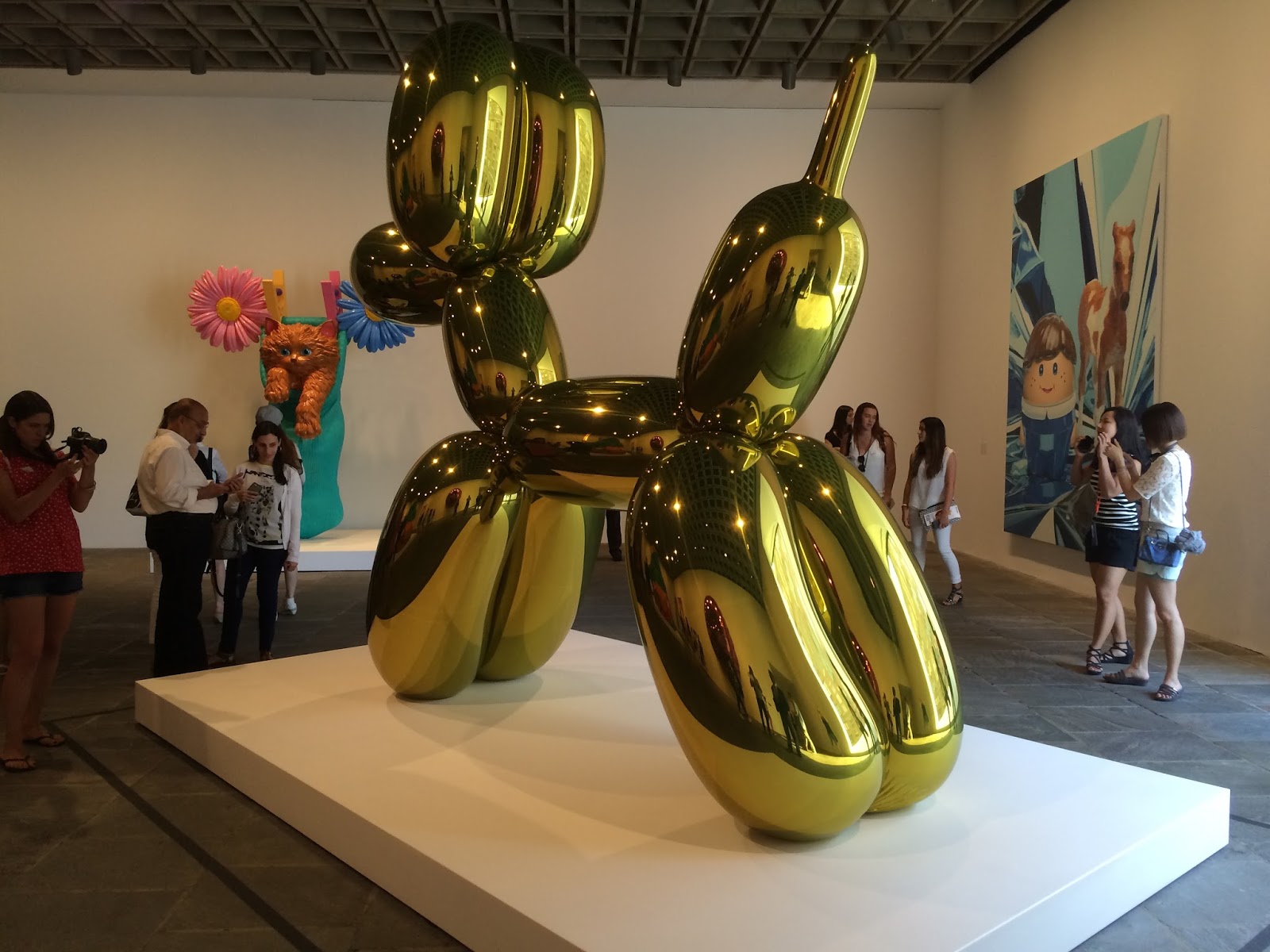
How do we speak of art that is at one level hard to look at and at another to turn away from, like Koons'? Does the monumentality of so much of Koons' work endow it with a significance it might lack if it were smaller in scale? Would we want to look at a golden balloon dog in cast metal if it were the size of one might find at a children's party rather than larger than a Cadillac Escalade? What about a heap of Play-Dough? What about a room or six or five floors of such work? Do such questions even matter? Would Jeff Koons have the career he has if he were not an educated white man from a middle-class middle-American background? Would such artwork be possible for someone not from such a background? What does this say about the roles of power, privilege and possibility in the contemporary art world, or in our society in general? Does it matter that in asking these questions so far I have not even broached questions of labor, production, and who in fact produces this art that has garned Jeff Koons such incredible fame and wealth?


Has the shift to a digital world of images, a world not of artworks but of platforms, as David Joselit has noted in his book After Art (Princeton, 2012), rendered Jeff Koons's work, especially his pornographic images with his ex-wife*, Ilona Staller, La Cicciolina, say, more or less valid? Are there words in the English language to capture my unpleasant physical response to see Jeff Koons naked and simulating or having sex? Is it not, however, a virtue, that works of art can make a viewer like me laugh out loud repeatedly, though not with the artwork's intended meanings, but in spite of and against them? Can an artwork, even in the age of mechanical and now digital reproducibility and infinite expansion and transformation, be said, when viewed either in person or online, to have no aura, and why does this seem to hold for so many (most?) of Jeff Koons' works?


Conversely, does not the possibility of infinite digital reproducibility render certain Koons' works even more auratic? Isn't it perhaps better, to put it another way, to see them on the Internet or some other digital space, as opposed to up close? Isn't there an aura of ratchetness (wretchedness) in contemporary American life to which more than a few aspire? Isn't this a negative aesthetics but a very different one from what Theodor Adorno proposed? Isn't this ratchet auratics a poetics that suffuses so much current popular culture and American culture more broadly? In identifying it am I not also implicating myself in my enjoyment in certain forms (such as reality shows, say) and examples (Mediatakeout.com) of it? What happens when one places Real Housewives of New Jersey alongside Jeff Koons? Hasn't someone already done this? Why did the Whitney choose Jeff Koons' as its final show in its Marcel Breuer space, and what does this say about the Whitney Museum and its role and place in contemporary American and global art? Can any fields but cultural criticism and the history of art account for such an occurrence? Is Jeff Koons not the perfect artist for contemporary America, and if the answer is affirmative, doesn't this answer all the preceding questions?


___
* Many thanks to Andrew Blackley for correcting this error; Ilona Staller was Jeff Koons' wife, not just his girlfriend, which raises a number of related issues that Andrew also pointed out, such as: 

The degree and orientation of both of their agencies shifts within their marriage - regardless of personal respect(s) or equality of sorts or means individually in that there is a more or less an ideological "fair use" clause to the body of the other, and the inability (or difficulty) of protesting against or working counter to the other or the union as a whole ( say, in court.)

Is she the porn star girlfriend (working, or knowing how to work with and through her body) or is she the wife "at work," under an established consent between the two of them as people or "at work" under and as part of an institutional allowance?

And, if the above: what does that say about Jeff Koons and the rest of his "collaborations" with any number of cultur

Saturday, April 20, 2013

Poem: Prageeta Sharma

Prageeta Sharma,
Lantern Review's Flickr
photo stream
These are troubled times, but then one could easily say all times are so, depending upon one's perspective. There is an unsettled air that Prageeta Sharma (1972-) captures in her poem below, which also feels very appropriate to this moment, particularly in terms of its thematization of violence, particularly in the presence, in this sonnet, of firearms, and in the interpersonal violence it depicts, beginning in a dream (not, curiously, a nightmare), that bleeds out of that oneiric space into the lyric itself, into the speaker's interiority.

Read more broadly, it touches upon the underlying fear of the unknown--events, persons, the Other--that undergird our contemporary moment, this society, with its "dark-skinned male" or "Muslims" or "immigrants" a stand-in for any and every evil, every problem, every crisis, and state and corporate violence and surveillance, the violence of elites and capitalism itself, elude sustained mass, public critique. Only unlike the poem, whose 14-line sonnet form can contain the excess that threatens to spill over, there is no similar container for everyday reality. We would do well to listen to Prageeta here: "things are unexpected, people are terrible / sometimes," and "Events that are pleasantly unnoticed / are not about adventures."

This is the kind of knowledge that poetry often can best convey: like a lens that zooms in and simultaneously can pan all the way up and out. But you have to look through it. Look.

ACTION-PACKED SONNET

This rather tall Indian man shot me in a dream;
I thought I could just mosey up on him
and say in a protective but assertive voice,
I am a Hindu and he would put down his gun.
But he said you are my enemy and my unmarried hands
stung only for an instant, realizing this immensity
was fake immensity. And it goes to show you
that things are unexpected, people are terrible
sometimes. Events that are pleasantly unnoticed
are not about adventures, not about paranoia or silk turbans.
If you are my gun, put it between the mattresses, it will rest
underneath us like a holiday inside eternity. A firefly
    admits to light,
a ray gun, obfuscated, we both tumble before I look
the rather tall man in his angry Indian face.

Copyright © Prageeta Sharma, from The Opening Question, New York: Fence Books, 2004. All rights reserved.

Wednesday, January 02, 2013

The X-Ray of the Poem

(From desktop.freewallpaper4.me)

Back in 2001, in an email to poet Joel Dias-Porter via the Cave Canem listserve, I offered a way to analyze poems that I characterized as "x-raying." The poem originated with one email account that went defunct, was forwarded to another that became inoperative, and ultimately was lost, or so I thought, when my computer crashed in 2003. I tried searching for it on my extant Cave Canem listserv emails, but with no success. And so I thought I'd lost it.

As I'm wont to do, I did print out a copy of the email, but instead of filing it in a clearly labeled manila folder, it ended up at the bottom of a series of papers that I misplaced, and only just found today, as I was organizing my study for the umpteenth time, this burst of cleaning prompted by the canyons of folders and papers that had arisen, like Atlantis, from the seabed of my study's main rug after this past fall semester, the move home this summer, and a decade of commuting and haphazard filing. But none of this is of interest to J's Theater readers, I'm sure. Instead, I am going to post the brief essay, if it can be called that, with a few modifications.

I want to apologize in advance to poet friends who have asked me for a copy over the years, and especially to Joshua Marie Wilkinson, who was soliciting pieces on reading poetry a while back only to receive a (polite was my intent) demurral from me. For his anthology I tried to reconstruct "The X-Ray of the Poem," but that newer version sounded far too pedantic and pompous, perhaps the result of too many years in academe, whereas when I initially penned this, I was still mostly outside the door. The naïeveté of tone shines through every sentence. I also realized with a bit of adaptation it might be useful for reading other literary genres as well, and despite my lack of access to the text below, have employed a rudimentary, working form of it in some of my classes.

It is perhaps best for a creative writer to use after a few drafts, as opposed to before them--and to be set aside, as sometimes needs to happen, in the best interest of the poem.  For many writers, the more obviously linguistic elements are often intuitive. But it also can serve as a useful tool too to see what you're up to, if you want to look, and thus know.

At any rate, here it is. Please feel free to use it, but do give credit where due, if you do.

***


The X-Ray of the Poem

by John Keene

One way I've thought about critically reading and analyzing a poem is to x-ray it, which is to say, to peer deeply beyond its surface level into its depths, to find out what might be hidden there, by the poet, the poem or both. Perhaps given the current state of physics, rather than "x-ray," a term that would allow us to see everything and anything from the most outward appearances to the sub-sub-atomic level (Higgs bosons or pi-mesons or whatever they're called, as opposed to capturing x-rays) might be more appropriate. Or maybe a better metaphor from science is the assay, which is what occurs when blood is passed through a centrifuge, so that the various elements and substrates are separated out, without losing the basic fact that all these elements together constitute the blood itself. Or perhaps a geographic exercise, sampling a very long, thin section of rock or soil, and viewing each of these layers to see what they reveal. Something along these lines, at any rate.

This is structuralism to a certain degree, but I think it may be useful in terms of organizing one's reading and analysis. I also think that one ought read these various elements in concert with and against each other, to gain a fuller appreciation of the poem. Meaning is one thing, or many things, but appreciating what the poem is doing and can do rewards a more attentive reading.  Sometimes a poem may appear to be straightforward, as Robert Frost's or Lucille Clifton's often do, and they can be appreciated as they are, and yet when one looks more carefully, when one looks and listens, something more may come to the fore, since this is the gift of any good to great poem: it always contains more than it offers on first glance.

A very basic poetic x-ray (which would be non-hierarchical) might include looking at the:


   Phonemic level (sounds, phonemes/words, the music created by these; why are certain vowels, sounds employed, how are they working in concert with each other, what do they seem to be doing in concert with each other);
   Prosodic level (meter/beats, rhythms, whether there are measurable, regular feet, or other kinds of rhythms, is it free or blank verse, how does the prosody play from line to line, stanza to stanza, what does it evoke, invoke, suggest, convey)
   Rhetorical level (types of rhetorical devices and figures of speech, such as anaphora, forms of repetition, ellipses, zeugma, used in the poem, and what are they doing, why are they present, how do they work, etc.)
   Symbolic level (related to content and rhetoric--are there symbols, tropes, figures, imbedded in the words, in phrases, across lines and stanzas--can the poem be read on multiple symbolic registers and what are those?)
   Stylistic level (what are the stylistics of the poem, its tone, its voices, is it consistent with the author's other works, does it echo or parallel the works of other authors, does it read as original, imitative, and if either or both, how?)
   Formal level (is the poet writing in a fixed or standard form you recognize, such as a sonnet, a sestina, a roundel, a bop, or is it vers libre--is the poet employing any of these and if so, how? Why? What is the significance of this form?)
   Genre level (to which poetic genre does the poem belong? Is it an elegy, for example? An ode? Is it a blues poem? What is the poet doing in terms of the genre? How is she writing within or against the genre, and what are the effects of her approach?)
   Thematic level (content--what is the poem about, what is or are its statements, if you were to paraphrase what it's saying as opposed to how it's saying or doing it, what would or could you say?)
   Ideological level (what is the poem's ideological stance, or is one discernible? If not, what does that say about its ideology? Does the poem comment on the conditions of its production? Its (author's) labor?)
   Historical-Contextual level (when was the poem written? what do other poems from that period look like? how does this poem function in relation to other poems of its time? What is its relation to the historical traditions in which it is written, and its relation to the poetic, literary, cultural and other discourses of its time? Does it look to the past or point a way to the future, or stay mostly within its historical-temporal horizon?)
   Holistic level (this entails reading the poem, especially aloud, and appreciating in toto, as an entire piece, even if its particulars get lost at first; reading the poem from start to finish, even a long poem, should always be the first and last step, so that its overall shape and contours, its totality, be grasped and appreciated for what it is)


One might quibble with any of these characterizations, refine or discard them, select only a few for a given analysis, or focus on only one, as the Russian structuralists did in terms of their reading of phonemes, or new historicists might in looking at the historical moment in which a poem is written, the various versions and drafts of poem, its author and the politics and society out of which it emerged. But the x-ray of the poem provides a starting poem for the beginning reader, as well as the more sophisticated one. Above all, they suggest the multiple pleasures, some involving work on the reader's part, which every poem can provide.

Copyright © John Keene, 2001, 2013.

Tuesday, October 16, 2012

Quote: Mordechai Noah

"Wall-Street is a kind of commercial barometer, and I always observe the countenances of men of business in passing through this bustling street. Very lately I was stopped by a commercial quidnunc, who informed me that Mr. A, B, C, D, E and F, had failed within three days; that times were uncommonly bad and prospects very gloomy, and the result could not be foreseen. Independent of the hazards of commerce, I could account for these failures. These houses, of some ten year's standing, had commenced with small capitals, some with no capital; and instead of uniting industry, prudence, and rigid economy, a contrary course had been pursued, and the first shock overwhelmed them. Look into the houses of some of the merchants, and see them furnished with a splendour equal to that of British nobility; look at their mode of life and actual expenses, and say whether any business can bear such extravagance. Several of these broken merchants have expended for ten years past, nearly 10,000* dollars per annum, in their houses, carriages and wines; can it, therefore, be surprising, that an accumulation of such expenses should lead to ruin?

"I have long observed with regret, the wanton extravagance of our merchants and traders.  A store is rented at 1200 or 1500 dollars per annum, and a dwelling-house at 1000 or 1200 dollars; and a system of living corresponding with such establishments is adopted, which sets economy at defiance, and leads to ruin--and, by a pernicious example, attracts others into the same dangerous vortex. Why should men waste money? why should more money be expended than what may be necessary for the decent contours of life? why will families plunge themselves into ruin, merely to live a few years in luxury? Is not such a course at war with common sense, and with the duty which a man owes to society and his family? Can any business prosper under an annual domestic expenditure of 10,000 dollars, together with losses in trade?...

"If these things are not checked, we may complain of the times without producing reform, and now is the period to commence the work of regeneration, and to use firmness where persuasion fails."

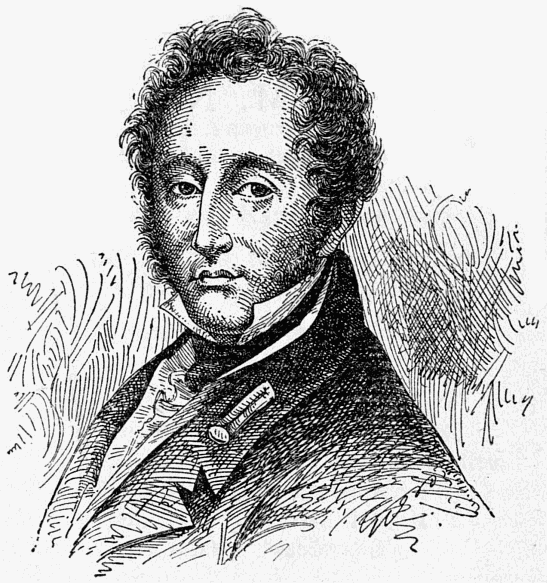
-- playwright, diplomat, journalist, and sheriff of New York Mordechai Noah (1785-1851), "May 6, 1819. [Wall Street Men and Wives]," in The Selected Writings of Mordechai Noah, Michael Schuldiner and Daniel J. Kleinfeld, editors, Westport, Connecticut: Greenwood Press, 1999.

--
*According to the Measuring Worth's website US currency calculator, in 2010 dollars $10,000 would be equal to between $177,000 and $202,000.