Showing posts with label presidency. Show all posts

Thursday, July 05, 2018

Andrés Manuel López Obrador (AMLO) Wins Mexican Presidency

Andrés Manuel López Obrador speaks
at a press conference in Mexico City, July 3,
2018 (Photo: Manuel Velazquez/Getty Images)
from New York Magazine
Three times can sometimes produce a seismic charm, or so it appears for Andrés Manuel López Obrador (AMLO) (1953-), who was finally elected President of Mexico on July 1, this past Sunday. Though a longtime member the leftist Partido de la Revolución Democrática (Democratic Revolution Party, or PRD) and a failed candidate in the contested 2006 and 2012 national elections, AMLO, a former Governor of the Federal District, ran under the aegis of a new left-leaning coalition, Juntos Haremos Historia (Together We Will Make History), that comprised the progressive Movimiento de la Regeneración Nacional (National Regeneration Movement/MORENA) and Partido de Trabajadores (Labor Party/PT) parties with a socially conservative party, Partido Encuentro Social (Social Encounter Party/PES). AMLO will assume office on December 1, 2018, which, given Mexico's current parlous state, will not be a moment too soon.

AMLO's chief rivals in this year's presidential election were Ricardo Anaya of the Partido Acción Nacional (National Action Party/PAN), the center-right party of former president Vicente Fox (who served from 2000-2006) an antagonist of US Republican presidents George W. Bush and Donald Trump; José Antonio Meade of the Partido Revolucionario Institucional (Institutional Revolutionary Party/PRI), the neoliberal, longtime ruling party to which incumbent president Enrique Peña Nieto (2012-2018) belongs; and two independent candidates, Jaime Rodríguez Calderón, who had previously become the first independent candidate to win a state governorship when he helmed Nuevo Leon; and Margarita Zavala, a noted lawyer, and the wife of former president and PAN figurehead Felipe Calderón (in office from 2006-2012).

In essence, AMLO was not just leading a visibly left coalition but represented the only left-leaning option for Mexican voters in this presidential election. As the campaign progressed, Mexico's political and social elites grew increasingly alarmed, and perhaps rightly so. Yet the hiccuping economy, metastasizing violence, which even marked the lead-up to the election, and continuing allegations of extensive, high-level government corruption, blunted the right's blizzard of "Mexico will turn into Venezuela"-scare tactics, some with racist and classist tones, including advertisements, robocalls, videos, and social media attacks, not unlike ones that had doomed AMLO's chances in the prior two elections.

In one instance, a PRI operative named Enrique Ochoa Reza tweeted that PRI politicians who switched parties to MORENA were "Prietos que no aprietan" (Dark-skinned/black people who can't get a hold), playing on the double meanings of "moreno/a" (brown/black man/woman) and "prieto" (dark/black person), as well as the feminine form of the former word (morena=brown woman/black woman) and the verb aprietar (not being able to keep somebody). Ochoa Reza did apologize for the racist aspect of his slur, but not the misogynistic one. Additionally, there were allegations of US and Guatemalan meddling in the campaign, and Ochoa Reza accused Russia of interfering on behalf of AMLO, a charge the eventual victor laughed off.

The attacks, however numerous and outrageous, could not overcome Mexican voters disgust at the current state of affairs. AMLO won in a landslide, defeating Anaya by 21 percentage points while winning 53% of the total vote and popular vote. The final tally in an election that saw a 63.6% turnout (or 56.6 million voters out of 89.9 registered voters) was as follows, with AMLO winning 31 of Mexico's 32 states, and the first outright majority for a presidential candidate since 1989:

2018 Mexican Presidential Candidate & PartyVote Total
AMLO (National Regeneration Movement/Juntos Haremos Historia)30,112,109
Ricardo Anaya (PAN/Por México al Frente)12,609,472
José Antonio Meade (PRI/Todos por México)9,289,378
Jaime Rodríguez Calderón (Independent)32,743
Margarita Zavala (Independent)31,983

While his ideology has long been diametrically opposed to what we see with a figure like Donald Trump, they share a vocal populist nationalism, AMLO's rooted in the left and democratic socialism instead of Trump's ethnonationalist and racist authoritarian approach. What this might mean for the cozy relationship between Mexico's large corporations and land owners and the government and for an approach to a renegotiated North American Free Trade Agreement (NAFTA) that privileges international structures and rules over the country's laws remains to be seen, but given the Juntos Haremos Historia/MORENA's capture of 312 of 500 seats in the Chamber of Deputies, and the strong popular mandate for the coalition and new president, AMLO could throw wrenches in Mexico's steady march towards privatization and economic (classical) liberalization, in favor of policies that more effectively and immediately address the rising economic inequality and insecurity that millions of Mexicans are facing.

During the campaign AMLO announced that he would push to reform some of the perks of the presidency, including cutting his salary and that of top officials, selling presidential planes, creating a public park out of the presidential grounds, and ending the lifetime pension former presidents receive, with the savings being directed towards Mexican seniors, who have a far less secure and comparatively robust retirement savings system than US's fixed pensions, 401K savings plans, and Social Security (which itself is admittedly always under threat from US conservatives and neoliberals). He also attacked the International Monetary Fund as an enabler of and participant in Mexico's corruption, suggesting he might pull back not just from the IMF but from other international financial systems that have long kept Mexico under yoke. One key question would be how projected new NAFTA negotiations might change as a result of this approach.

As Nathaniel Parish Flannery argues in a recent Forbes article, "The AMLO Era: Why Mexico's 2018 Election Matters," nearly half of Mexicans live in poverty, and despite the country's prowess in manufacturing, wages remain abysmal. Stemming governmental corruption and addressing the country's sluggish growth rate, rising economic and social inequality, the persistent lack of jobs in the formal economy, and low, stagnant wages across all labor sectors could have beneficial, ramifying effects on all aspects of Mexican society. The question for AMLO and Mexico's congress is how to spur all of this such that all the wealth does not continue to flow upwards to the relatively tiny sector of rich elites. Strategies to create a viable and vibrant middle class, which would necessitate a retreat from the neoliberalization of the prior PRI and PAN administrations, transformed tax and business policies, support for public education and farmers, and a strengthened safety net, could be among AMLO's and the new left-leaning Congress's potential steps.

Some of this, beyond NAFTA talks, will hinge on the "new relationship" AMLO has vowed to forge with Mexico's often domineering neighbor the United States. While the US and Mexico are among each others' largest trading partners and cooperate extensively in a range of areas, the two current leaders, Trump and Peña Nieto, have been at loggerheads, in part because of Trump's persistent attacks on Mexico and Mexicans, beginning the day he announced his presidential campaign and slandered Mexican immigrants, and because Peña Nieto understandably has refused to pay for Trump's desired border wall. AMLO has already challenged the border wall idea in a pamphlet he published, entitled Oye Trump (Listen Up, Trump). One goal AMLO outlined was development of Mexico's "internal market," so that "Mexicans can work and be happy where they were born, where their family is, where their customs and cultures are." Creating an expanding middle class is crucial to ensuring this market can flourish, and to transforming the migrant flows.

Another challenge for AMLO will be to figure out a way to lower the violence that has plagued Mexico. Neither Calderón's nor Peña Nieto's approaches worked; corruption remains endemic at all levels, and organized crime is strong as well. In addition, since September 2017, 130 political figures, from the municipal to the national level, have been murdered, and journalists across Mexico have been targeted for investigative and critical work. AMLO supposedly has suggested amnesty for low-level drug offenders, which sparked criticism, but it also is the case that Peña Nieto's initial policy approach of militarized attacks on the cartels failed, as did prior attempts to negotiate with organized crime. Rising pay for all workers, and better wages for domestic security and military forces could help to thwart the power of organized crime to infiltrate them, but AMLO also has suggested a "peace plan," involving human rights organizations, religious organizations, among others, to negotiate a decline in the murder rate.

I see less of a parallel with Hugo Chavez, to who AMLO has been repeatedly compared, and more of one with the presidency of Luiz Inácio "Lula" da Silva, Brazil's now imprisoned but still widely popular former president. Formerly a firebrand leftist from his country's Worker's Party, Lula lost three elections before finally becoming president in 2003, and governed for two terms. Lula moderated his platform in his successful campaign, presiding over a series of liberalized economic policies that on the one hand led to considerable growth, but which included a range of social policies that helped lift millions of Brazilians out of poverty, increased Brazil's safety net, and created a visible if fragile middle class. Unfortunately, Lula did not target systemic corruption with the same zeal, and now finds himself crucified not only because of his opponents' vengeance, but as a result of his and his successor's failure to truly wrestle with the beast of corruption during the height of their successes. With AMLO, domestic economic policies and global financial trends could prove his ally or enemy, but a failure to address systemic corruption, impossible a task as that may be, could destroy not only the tremendous support he now enjoys, but damn his and his coalition's future, let alone Mexico, for decades to come.


Sunday, December 10, 2017

The Postmodern Dystopic: One Year/Year One of the Trump Presidency

President Donald J. Trump & former FBI
Director James Comey, January 22, 2017
(Photo © NBC News)
On January 20, 2017, Donald J. Trump became the 45th President of the United States of America. His presidency really began, however, on the night of the national election last fall on November 8, 2016, when he defeated Hillary Rodham Clinton, by a 77 vote margin in the Electoral College and despite a loss of nearly 2,868,691 popular votes. Or, one might even argue, it began before he was formally elected, while Barack Obama was still the legal president, when Trump's rise signaled a shift, long underway, in our election process and public discourse that his victory only confirmed. In saying this I am not referring to the now steadily amassing body of evidence that suggests that Russia involved itself extensively in the 2016 election, and had numerous ties of various sorts to the Trump campaign. What I am suggesting is that Trump's ascent, from his declaration of his candidacy in the summer of 2015 forward, marked him out as the emblem not only of the contemporary Republican Party, for which he is the standard bearer, but underlined where our politics and society had begun to head during latter years of Bill Clinton's and all of George W. Bush's presidency, and which has found its true tribune in him.

Before I say anything more, let me note that I have found these last 12 months so exasperating, depressing, maddening, and absurd to the point of outright laughter by turns--though I have also been trying to convey in personal conversations that in some ways they still do not approach the insanities of 2001-2008, a period this country has still not recovered from, which in part has made Trump's rise possible--that I have not registered here, as I once might have, every significant outrage committed by this president or his allies and defenders. First, there are too many and they come in such steady and heavy flurries that they would make a snow-cloud jealous. Second, it really would require someone with the patience of Job--or an army of fact-checkers--to keep up with the daily tide of lies, misstatements, half-truths, and misinformation, let alone the innumerable questionable and potentially actionable violations of rules and laws that this administration seems to engage in. We currently have one major political party, the Republicans, who hold all the reins of federal power, utterly in his thrall, and a second, the opposition Democrats, who still have not reckoned with the opponent they face nor with the shifts in the broader social and public discourse that demand that the the Democrats change how they function in order not just to remain a viable party for the future, but a potential backstop against the complete dismantling of our society.

On October 2016, as I watched the election unfold, I wrote a post entitled "Our Postmodern Election(s)." (Jeet Heer later wrote an article in New Republic that expounded on some of these themes while exploring other ones in relation to this president.) It had its limitations, and on the key point of Trump's electability, I was wrong. One of my dear colleagues recently decried the idea that Republicans, let alone this president, have taken up postmodernism and run with it, though I think it is a foregone conclusion that they have, and as I tried to assert in that earlier blogpost, the postmodern condition (and, in many ways, an essentially neoliberal framework) underpins our entire society, including our politics, so it is not merely the GOP that has adopted and warped a postmodern worldview, but, more broadly, it defines this society itself to an estimable degree. I won't restate that post, but I think it's fair to say that "truth" has no fundamental relationship to how Donald Trump operates, unless one takes the Platonic (in the sense of his The Republic) and, perhaps more correctly, Nietzschean views that truth is what the ruler--or Übermensch--or similar corporate entities declare it to be.

In fact, as Trump has made clear for decades and especially over the last few years, especially with his championing of the Birther conspiracy, verifiable factualness, material evidence, reasoned argumentation, and science-based statistics have no bearing whatsoever on what he believes, let alone how he acts and moves through the world. Yet it is not Trump, but large numbers of Americans who reject verifiable facts, appeals to any authority but that of their feelings and those who agree with them, even what we might call objective reality itself. Additionally, both the mainstream media, by manufacturing consent (as Noam Chomsky brilliant argued years ago) and "normalizing" Trump's actions, and numerous parallel organs of reportage and pseudo-reportage, have served to make a muddle, at least for a sizable number of people, of what "truth" might look like. Figures like Steve Bannon and Mike Cernovich are quite aware of the tenets of postmodernism, as the latter pointed out in a New Yorker profile earlier this year, and have made great use of them. This is a feature, not a bug, of how they and the Right have come to operate.

Housing and Urban Development Secretary
Dr. Ben Carson, at his confirmation hearings
(Copyright © NBC News)

In that earlier post, I did not believe that American voters would elect Trump. Or rather, that enough white voters would not be so appalled by his campaign and behavior that they would vote against him. (My predictions about the Senate were closer to how things actually turned out.) As I say above, I was wrong. Despite admitting that he had forcibly kissed women and groped their private parts without their permission, while also pursuing married women "like a bitch," he received 52% of white women's votes. Since taking office, he has lurched from crisis to crisis, now so numerous it's hard to keep track of them. In this regard, he has made Obama's first year, which included addressing inherited national and global financial crises and multiple wars, while also trying to pass a stimulus bill, a comprehensive health insurance bill, and a bill to rein in Wall Street's excesses, look like paint drying. Trump's first year has also transformed the slow-rolling catastrophe of Bush's inaugural year into a series of surprising but nevertheless dull anecdotes, 9/11 notwithstanding. In January I thought about regularly posting on the Trump administrations scandals, which seemed to be accruing as soon as he entered the Oval Office, and then again, after his first 100 days, which seemed to mark yet another low-point in his tenure. But one could pick any point over the last 11 months, or before, to find evidence of the debacle this presidency is turning out to be, and so it might perhaps be best to say that like the classic figure of synecdoche, any point is representative of the whole, and metonymically, the Trump administration is synonymous with corruption, disruption, and a sense of foreboding and rolling disaster.

If, as Aristotle once pointed out in the Nichomachean Ethics that "Man is the rational animal," while also arguing that there also was an irrational component to human existence, Trump has exemplified that this country's most powerful man is the dominating and dominant "emotional animal" whose main goal is to satisfy his own psychological needs and energize those of his core supporters. This would be worrying in any leader, but it should be especially concerning to have such a person at the head of the most powerful government and military on earth. One effect has been to keep not just his government, but the entire national and globe in a state of disquiet, dis-ease, since the demands and effects of his emotional needs and outbursts cannot be contained within the walls of 1600 Pennsylvania Avenue. Trump campaigned like a right-wing racist nationalist and has seeded his government and presided like an ultraconservative white supremacist authoritarian. He appointments to his Cabinet, save one or two, are to the right of the kinds of people George W. Bush placed in office, and his Supreme Court appointee, Neil Gorsuch, has positioned himself so far to the right that  Antonin Scalia, the justice he replaced, would be envious. Significantly and in Orwellian fashion, many of the people Trump has placed in positions of power actively and openly seek to undermine or destroy the very organizations they are running, and ensure, as his formally dismissed but still potent advisor Bannon championed, the "deconstruction of the administrative state," or rather, the federal government as we have come to know it.

Several Cabinet departments, among them the most important like State, appear to be in disarray and withering on the vine, at a time when world affairs, made so precarious in part through prior US attempts at creating a "New World Order" and "nation building," are approaching a precipice. To take one example, the chief means by which the United States has kept North Korea's nuclear ambitions and aggression in check has been through diplomacy and partnership with allies and, in some cases, hostile countries that have a vested in interest in containing the North Korean government. Under Trump, however, we keep inching nearer and nearer to outright war with the North Korean government, a turn of events that would most certainly lead to cataclysm, including the deaths of hundreds of thousands, potentially millions, of people in South and North Korea, China, Russia, Japan, the United States, and countless other countries if nuclear weapons were involved. Yet Trump at times appears to be undermining his Secretary of State, former oilman Rex Tillerson, who, for his own part, appears to undermining the State Department itself, through a bungled reorganization that has led to numerous empty bureaus and widespread understaffing. One major lever of power the US yields, through its wealth and influence, for good or bad, is soft power via diplomacy, yet even in a crisis zone like Korea, under Trump and Tillerson, we lack an ambassador to South Korea since Trump, in one of may steps against precedent, summarily canned all of Obama's ambassadors shortly after taking office.

Rather than detailing the numerous crises, scandals, failures, and so forth that have occurred under Trump's watch, though a number of sites do have lists, cheat sheets and more notating the Trump administration's mis-actions through this month. It should suffice to note that beyond appointing Gorsuch to the court; striking down many of Obama's executive actions; succeeding in most of his appointments to his administration; and presiding over the growing economy bequeathed by his predecessor, Trump had no major successes in the legislative arena until the recent monstrous tax cutting bill, a massive giveaway to billionaires and corporations, which still requires reconciliation between the House and Senate and could yet end up another of his failures. In his account, by contrast, he has been the most successful president since Abraham Lincoln, though unlike each of the various men to hold the office before him, he is the least popular president at this point in his term, with a majority, upwards of 50% in many polls, disapproving of his governance.

United Nations Ambassador Nikki Haley
(Copyright © CBS News)

Among the low lights thus far of Trump's tenure, and this is hardly an exhaustive list, once could mention:

  • his constant attacks, deflections and projections on and mis-representations of the free press, his opponents, his former campaign opponent Hillary Clinton, his predecessor Barack Obama, the US intelligence services (including the CIA and FBI), and even fellow members of his party;
  • the repeatedly attempted Muslim ban (which, after revision, was finally allowed to take effect); 
  • firing the FBI director, James Comey, initially for one set of reasons proposed by his Attorney General and Deputy Attorney General, only to contradict them on television and later to the Russian Foreign Minister and Ambassador, in the Oval Office (more about this below);
  • his dismissal of Deputy Attorney General Sally Yates, who had warned him about General Flynn;
  • the resignation of his now convicted National Security Advisor, Michael Flynn, after 24 days, for allegedly lying to the Vice President about his contacts with Russia (more about this below); 
  • the repeated failure in his attempts to legislatively repeal the Affordable Care Act/Obamacare (though he continues to shred it by other means); 
  • his equivocation on the white supremacist Unite the Right tiki-torchlight march and subsequent murder of Heather Heyer in Charlottesville;
  • his failed response to Hurricane Maria's battering of Puerto Rico, which remains in dire condition;
  • his flipflops on the DACA policy, leaving countless young undocumented Americans in legal jeopardy, and his rescission of the refugee policies for Haitians and Salvadorans;
  • his illiberal pardoning of Arizona prison chief and avowed racist Joe Arpaio, who had been convicted on a misdemeanor charge for contempt of court, because he was disobeying a judge's order to stop racial profiling.
Also:
  • his attacks on Black football players and other athletes protesting state and police violence on and racism against African Americans and other people of color;
  • his establishment of a Presidential Advisory Commission on Election Integrity, admirably bi-partisan, but headed by a man, Kris Kobach, known for racist views and who has actively worked against expanding democracy and voting rights;
  • abandoning the Paris Climate Accords, leaving the US only one of 2 nations not to sign on;
  • losing two Communications Directors, Sean Spicer and Anthony Scaramucci, within the span of six months, while also forcing out his chief of staff, former RNC head Reince Priebus;
  • his advocacy for the Dakota Access pipeline and the Keystone XL pipeline (which actually burst not long ago, leaking 210,000 gallons of oil);
  • his appointment of new commissioners who are vowing to repeal net neutrality;
  • his use of a slur against Native Americans during a ceremony to honor Native American military heroes, the famous "Code Talkers," while standing before a portrait of President Andrew Jackson, whose record of extensive anti-indigenous policy and violence is well-documented;
  • his promotion of anti-Muslim videos, including one considered to be fake, posted by a fringe, extremist white nationalist British political group;
  • his constant tweeting, through which he has advanced conspiracy theories, false information, and unilateral policy without alerting his administration (such as banning transgender troops in the military without first discussing this or consulting with his Joint Chiefs of Staff)

To conclude the list, Trump is now campaigning for and recording robocalls for a man, Roy Moore, who has been credibly accused of molesting a 14-year-old girl and assaulting another teenager, was twice removed from the bench, and whose ideas are so far out of any mainstream that he repeatedly lost out in prior attempts at runs for statewide positions in a state dominated by his party. And the above list does not even touch upon the administration's possible violations of the Emoluments Clause of the US Constitution; the Hatch Act; the Logan Act; and other ethical or legal landmines. Nor does it include the debacle of the Al Hathla Raid in Yemen, which faces a humanitarian crisis in part because of US-supported actions by the Saudi Arabian military, or the Tongo Tongo ambush, in Niger, which still remains unexplained to the wider public.

Amidst all of this, as a backdrop, Congressional panels in the House and Senate, as well as a Special Counsel, lifelong Republican and former FBI Director Robert Mueller, continue to investigate the Trump administration for obstruction of justice in the firing of James Comey and its ties to Russia before and after the 2016 election. The investigation includes the various revelations in MI5 agent Christopher Steele's "dossier"; alleged Russian hacking of the Democratic National Committee's server and the accounts of other DNC and Democratic officials, as well attempts on state and local voting systems; the Trump campaign's ties to various Russian officials, oligarchs, and emissaries, as well as Russian, Russian-allied and foreign banks and institutions; the Trump campaign's links to Wikileaks; other alleged Russian forms of and attempts at meddling in the US election process; and the Trump campaign and administration officials' financial ties to other foreign entities like Turkey, Ukraine, and so on. (And there may be even more that I have not listed under investigation.) The bizarre scene earlier in the year, involving the Russian Ambassador and Foreign Minister, in which the US press were effectively barred, is just one of many strange moments in this administration's shadowplay with Russian.

(Chris Detrick | The Salt Lake Tribune) Gov. Gary R. Herbert
swears in Jon M. Huntsman, Jr. as U.S. Ambassador
to Russia during an Ambassadorial Swearing-in
Ceremony at the Utah Capitol Saturday, October 7, 2017.
Mary Kaye Huntsman is in the middle.
Among Mueller's actions so far have been to indict former Trump campaign head Paul Manafort and his adjutant Rick Gates on felony charges; to secure a felony guilty plea from former Trump advisor George Papadopoulos; and to gain a felony guilty plea for lying to the FBI from Michael Flynn. Attorney General Sessions, special advisor and Trump son-in-law Jared Kushner, Trump's son Donald Trump Jr., and many other Trump campaign and administration officials, including the President himself, may find themselves caught up in the FBI's net as well, as a fundamental line propagated by Trump from the very beginning of his campaign, that he had no ties to Russia, now looks increasingly like a falsehood, and the President's actions since taking office have not advanced the perception that he views Russia as a hostile foreign power, as his predecessors and most of the US's allies, all have.

But--and this is a major point, beside this backdrop, as I have labeled it, Trump's power to disrupt remains. To give but one very contentious example, he could fire Mueller, it seems, creating a constitutional crisis if the GOP were unwilling to stand up to him, and whereas even some very conservative Senators expressed faith in the investigation months ago, they now appear to be wavering. The conservative head of one Congressional committee, California Republican Devin Nunes (temporarily?) recused himself after troubling contacts with the White House. Although several Democrats, led by Congressman Al Green of Texas, have introduced Articles of Impeachment, nothing can happen unless either the Republican majority decides to act upon them, which is not assured even if the Congressional committees and Mueller identify possible material evidence of collusion, coordination, and financial crimes, or the Democrats win an airtight House majority and a significant enough one in the Senate in 2018. The former is not inconceivable; the latter is much more of a stretch.

In our postmodern political and social climate, there is no guarantee that even in the face of proof of obvious crimes the GOP in Congress, let alone Republicans across the US, would sanction impeachment of Trump, nor agree with attempts by Bob Mueller to indict him or his family members, if it came to that. Nor is it a lock that the Congressional Democrats, unlike those of the 1970s or 1980s, would have to have the will and fearlessness to take Trump and his administration on either. Thus far they have done a mostly lackluster job challenging him publicly or creating a compelling counternarrative to energize voters to oust the GOP. For the Republicans' part, they very well might argue, as some seem to be doing and, as one, a "anonymous source linked to the Bush administration" told journalist Ron Suskind in the October 17, 2004 issue of The New York Times Magazine:

"We're an empire now, and when we act, we create our own reality. And while you're studying that reality—judiciously, as you will—we'll act again, creating other new realities, which you can study too, and that's how things will sort out. We're history's actors…and you, all of you, will be left to just study what we do."

That empire under Bush was a putative failure, but Trump's has quickly taken shape and continues to emerge. Truth may have an implicit "liberal bias," as some wags like to say, but nearly one year of Trump has shown us that the liberal imagination, and liberal, democratic and republican structures remain imperiled when a leader decides, with the support of millions, to create and enact his own reality. At the rate things have occurred this year, we should all, whatever our perspective, be very concerned about what will await us at this point one year from now. 

Friday, January 20, 2017

Trump's Inauguration

Philadelphia-based artist Theodore "Teddy" Harris expresses my thoughts on this tragic farce more succinctly than I ever could in one image: "Vetoed Dreams," a 1999 photo collage print of his I picked up over a decade and a half ago.

To put it simply: Lord help us, and resistance is crucial!

Theodore Harris, "Vetoed Dreams," 1999. Original signed print.

Saturday, September 24, 2011

Political Impressions (Saturday Silliness)

Some serious silliness for a Saturday.  Unfortunately for all of us, so much of the current rhetoric echoes what's being ridiculed and spoofed below (note how the recent GOP debates echo the UK conservative candidate impressions featured at the bottom of the page.) Plus ça change, plus ça reste, but nevertheless, enjoy!

From SNL: The real Ronald Reagan (Phil Hartman)
From SNL: George H W Bush (Dana Carvey) debating Michael Dukakis (Jon Lovitz), with Diane Sawyer (Jan Hooks) moderating
From Dana Carvey show: H. Ross Perot (Dana Carvey) on Larry King's (Phil Hartman) show, 1996
From SNL: Bill Clinton (Phil Hartman), running for the Presidency, in 1992, stops in at a McDonald's
From SNL: Al Gore (Darrell Hammond) debating George W Bush (Will Ferrell) in 2000, on Bush's tax cuts and the "lockbox"
From SNL: Joe Biden (Jason Sudeikis) debating Sarah Palin (Tina Fey) in 2008, moderated by Gwen Ifill (Queen Latifah)
From SNL: Sarah Palin (Tina Fey) discusses her politics with Katie Couric (Amy Poehler) And from the UK:
Margaret Thatcher (Janet Brown), the day after she became the UK's Prime Minister
Gordon Brown invades Dead Ringers Laurie & Fry, on Young conservative contest (watch till the end)
Rowan Atkinson, at a Conservative Party (UK) conference

Wednesday, July 27, 2011

Debt-Limit Ceiling Blues (Or Obama the Moderate Republican, Revisited)

Though the looming disaster of the US Congress's failure raise the debt-limit ceiling, a procedural vote that has been fairly routine in the past, has been a topic I've debated writing about for weeks now, what provoked today's post was seeing yet again in a New York City MTA station--23rd St., at 6th Avenue to be exact--a young mother, with children (this young woman had both a 5-6 year old and an infant who could have been no more than half a year old) begging for cash to feed herself and her children. That, and thinking about the ongoing US 9-16% unemployment/underemployment rate, and reading in yesterday's New York Times about the extremely disturbing racial and ethnic wealth gap, caused to a huge degree by the 2008 economic collapse, the bursting of the housing bubble, and the subsequent explosion of joblessness and underemployment, guided me to today's entry. Seeing yet another young woman, with a child in tow, begging for money to feed herself and her child, on top of reading about the grim economic statistics particularly facing Black and Latino Americans, during this ongoing Great Recession (though it's allegedly "over") and then watching this sickening Grand Guignol play out in Washington, DC over the debt-limit ceiling vote, the deficit and the debt, is enough to make me want to go Robespierre.

Yes, I know the contemporary Republican Party is far to right even of its most recent White House incarnation, George W. Bush, let alone its icon, Ronald Reagan, and includes a raft of fantasists, nihilists and anarchists who would make William Godwin or Mikhail Bakunin jealous. Yes, I grasp that even with a near filibuster-proof majority, the Democrats in the Senate were too fractious to pass much of the legislation that their counterparts in the House, under Nancy Pelosi (D-CA), pushed through over and over. And yes, I know that almost immediately upon taking office President Barack Obama cast himself as a "centrist," hovering above the fray and rejecting what liberal, progressive and even some conservative economists argued were policies to address the employment crisis and rebuild the country after the bursting of the housing bubble and the gross dereliction of the Federal Reserve, ratings agencies, and Wall Street. His approach initially was more of the neoliberal same. Yes, I know that we have an establishment, mainstream media consisting of millionaires and millionaire wannabes, the children and heirs of millionaires or friends thereof, who are insulated from the problems millions of Americans face, and are more eager for "centrism" and "consensus" and splitting the difference and never calling the GOP out, even if these same media types vote for Democrats or call themselves "liberals" in secret.

But even taking all of these things into account, I find myself coming back to a basic question, and it centers on the president: was there any need whatsoever for Barack Obama to yoke the necessary, usually "clean" debt-ceiling limit vote to a crazy attempt to ram through "Shock Doctrine" style deficit cuts, including to vital social safety net programs like Social Security, Medicare and Medicaid, when before and since the 2008 economic collapse two basic economic facts have always been apparent: 1) creating JOBS would have the effect of lowering the deficit and government spending, because more jobs mean more tax revenues AND in the absence of jobs, people necessarily draw more on the invaluable social safety net, thus increasing the deficit and requiring more borrowing; and 2) by allowing all the Bush tax cuts to expire--ALL OF THEM--resetting them to the marginal tax rates under Bill Clinton and with the Affordable Care Act (Obamacare) in place, the country would plug a $4 TRILLION deficit hole over 10 years.  At almost no point since he took office, and certainly at no point whatsoever since the Republicans won the House in 2010 in part by terrifying seniors over claims that Obama had cut Medicare (!) through implementation of Obamacare, has the president made either of these facts clear. The first is so self-evident that it would likely have only needed to take root with a little nurturing, while the second definitely needed to be restated by every liberal in Washington, though it's increasingly clear that neither will get much airing, because the endgame of the current and future circuses involving Obama, the Democrats and the Republicans is to permanently lower taxes on the rich, gut social safety net programs, and transfer more of society's burdens onto the middle-class, working class and poor. Ancien régime, c'est nous!

Back in January 2010, after a year of exasperation at our then-new president, whom I not only enthusiastically voted for but helped to elect (both to the presidency and to his prior seat, as the junior US Senator from Illinois), I posted a blog entry, "Is Barack Obama Really Colin Powell," asking whether in effect we had elected a moderate Republican--Colin Powell--rather than a liberal Democrat to the nation's highest office. As is often the case with these blog posts, it merited little response, but that did not surprise me.  Since Barack Obama's election, I have often felt loath in criticizing the president, and family members and most of my friends have not wanted to hear any criticism from me or anyone else of the president, certainly not from his diehard opponents on the right, nor from those who, appealing from the left and having supported him, have felt great disappointment what portended to be a transformational presidency rapidly slips away.  Despite some early positive signs, such as his appointment of Sonia Sotomayor to the US Supreme Court, which remains, I think, one of the most important achievements of his presidency; his signing of the Lilly Ledbetter Fair Pay Act of 2009; and decision to bail out of General Motors and Chrysler, again and again whenever Obama has tended to choose neoliberal or sometimes even conservative options over liberal or progressive ones, and the former tendency has grown stronger over the last year, particularly after the Republican assumption of the House in 2010.

Even when I wrote my earlier post, was still willing to give Obama an opportunity to show that in fact he was not what I feared, someone seeking not only to extend Bill Clinton's neoliberal economic approaches (i.e., Rubinomics, which was exactly the route he took, appointing as Treasury Secretary Wall Street agent Timothy Geithner and as his chief economic advisor former Harvard University president and notorious bully and deregulatory guru Larry Summers), but many of the worst supply-side economic theories of Ronald Reagan and the neoconservative geopolitical and military approaches of George W. Bush. Well, one year later, I think it's clear that my worst fears have not only been confirmed but exceeded. In that earlier post, I even mentioned that Obama had thus far avoided Herbert Hoover's approach, in 1929, of tepid governmental approaches coupled with austerity, volunteerism, and market-based boosterism, and that a president Powell might very well have taken the earlier Republican president's model as his own, but as of July 27, 2011, it's fair to say, as The New Republic's John Judis argues, that President Obama has doubled down on Hooverism, not only adopting his predecessor's rhetoric, but intensifying the failed economic policies such that he has called for greater spending cuts and inadequate tax increases that exceed even the expectations of the average Republican voter! Obama's Deficit Commission, also known as Simpson-Bowles, was unable to agree on a recommendation because several of its clearheaded Democratic members and more obstinate Republican ones refused to be railroaded into buying into the economically problematic approaches that have long been pushed by the Peter G. Peterson Foundation, the Heritage Foundation, the Cato Foundation, and similar right-wing and libertarian propaganda outfits, whose endgame is, as I suggested above, lower personal and corporate federal marginal tax rates  (Peterson is a billionaire so he benefits handsomely, as would his heirs), privatization or gutting of social safety net programs (privatized Social Security would benefit Peterson, a hedge funder, and also flood Wall Street with cash), and increased economic burdens on middle-class, working-class and poor people (because in the absence of a safety net, we're on our own).

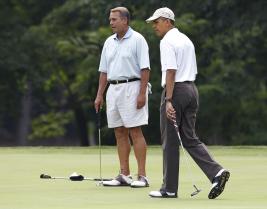
President Obama & House Speaker
John Boehner, R-OH, on the
first green as they golf
at Andrews AFB, MD
Saturday, June 18, 2011.
Charles Dharapak/Associated Press
Now, I read enough blogs and websites (via fastnewsReader and other apps!) to grasp that I was not alone in my appraisal of Obama back in January 2010.  Since then, though, I have read more and more folks coming to a similar conclusion and level of dismay. One of my favorite bloggers (and public intellectuals), who has been repeatedly proved right in his assessments and predictions, is Nobel laureate and Princeton University professor Paul Krugman, who, I should note, was critical of Obama's centrist stances during the primary season. (Krugman has, at the same time, praised Obama when praise is due.) Today, Krugman simply posted on his New York Times Conscience of a Liberal blog, "Obama, the Moderate Conservative." Krugman linked to a Fiscal Times piece by former Reagan economic advisor Bruce Bartlett asking, "Barack Obama: The Democrats' Richard Nixon." There is Salon writer Michael Lind's persuasive "Why the GOP Should Nominate Barack Obama in 2012," which walks through some of the same points I made back in 2010, though we all know that would never happen. Another online writer I regularly read, the brilliant gadfly lawyer Glenn Greenwald, posted months back that in fact Obama was not being forced to push such extreme plans--let's note again, to the right of even average Republican voters--but that he wanted to: "Obama's 'bad' negotiating is actually shrewd negotiating." And, to be fair, as Greenwald notes, some commentators, like Digby of Hullabaloo, warned even before Obama took office that he was pushing for that hideous "Grand Bargain" establishment Washington and New York's elite want so badly: cutting Social Security and Medicare, and lowering personal and corporate taxes to ensure the social safety net can never be adequately funded again. I could go on, but I'll stop here because it's numbing to continue.

So what about that young woman and her two children, seeking money just to eat, or the others I've written about on here, or the millions I haven't mentioned, all around us, barely hanging on? Well, they're nowhere in mind among those participating in the Washington carnival as it's unfolding. All the "fiscal austerity" we're being subjected to means things will get even worse for her--and everyone else, except the billionaires, bondholders, corporate execs, etc.--before they get better.  We may have a something akin to a budget default if the President cannot persuade the two houses of Congress to pass one of the two competing horrid bills they've submitted, or, in the absence of such, refuses to invoke the 14th Amendment to honor the nation's debts. (We should never forget that the Treasury very well could print money until forever if it wanted to.) We may or may not get some of the severe cuts-coupled-with-inadequate revenues that the President/Republicans/Washington establishment/Wall Street are jonesing for, but it's unlikely we're going to see him or any other major Democratic politician (Bernie Sanders, I-VT, is an independent) not only call for a major jobs program but vocally defend the social safety net at the very moment when its existence is proving invaluable. It's unlikely Barack Obama will face a third-party primary challenger from the left or even a viable left-leaning third-party candidate in the general election, since the various third-party organizations now being touted are just more center-right establishmentarianism seeking tax cuts and a gutted safety net, i.e., failed GOP policies. Would I vote for someone primarying Barack Obama? I don't know. Would I vote for a 3rd party candidate like Ralph Nader? I didn't in 2000 and I'm not sure I would in 2012. Would I just not vote at all? On top of this, and I gather the people in the White House just don't care, are clueless or have some hidden strategy I just can't grasp, the possible GOP nominee may run on an economically populist program given the president's intransigence on addressing the unemployment problem, she or he will very likely be even worse, since current GOP plans would do even more severe damage to the fragile US economy, as conservative policies are demonstrating in the UK right now.  In terms of Obama's GOP challenger, I still think John McCain would have been worse on every issue, but then again, other than Justice Sotomayor, can I be sure of that?

Right now, we're stuck, and liberals and progressives might want to think very carefully about how to proceed, given the lack of any channels to anyone running anything in Washington these days. I hate to end on such a down note, but we're in a very ugly place right now, and that young woman and her two children, and millions more like them, will be hanging on by a wing and a prayer and the beneficence of others, while the people in Washington, including the President himself, fight their damnedest to give even more of what's left of this country to those who already have almost all of it.