Showing posts with label protest. Show all posts

Monday, January 15, 2018

Happy Rev. Dr. Martin Luther King Jr. Day

The July 10, 1966, march to City Hall
from Soldier Field.
 (Chicago Tribune
 historical photo)
Today, on Rev. Dr. Martin Luther King Jr. Day, I thought I would post a short passage from one of Rev. King's most controversial speeches, which was the centerpiece of one of his most difficult campaigns, the Chicago Freedom Movement, in 1966. Not only did Dr. King remark on the virulence of the racism and white resistance he encountered, but at the time of his death three years later, it probably appeared to many people that the campaign had failed.

Dr. and Mrs. Coretta Scott King had visited Chicago and some of its suburban towns several times over the years, and in 1966 they even moved to Chicago to demonstrate the disparate conditions Black people were enduring under the tenure of Mayor Richard J. Daley. As part of the Chicago Freedom Movement, Dr. King urged Black voters to come out in droves and challenge the Democratic machine, controlled by Richard J. Daley. He decried white supremacy and Northern racism. He urged challenges to the Chicago power structure, better schools, housing, representation in government, everything. He also espoused Black pride and support for Black businesses, though he also criticized the nascent Black Power movement. Much like his namesake, Dr. King even presented his demands in person at City Hall, first by taping them to one of the outer doors, and then the following day in person to Mayor Daley, who was enraged by the campaign.


In the long run, despite the problems Black Chicagoans still face, things did change for the better from the status quo just over 50 years, and for lifelong and longtime Black Chicagoans now in their 70s and 80s, the changes were visible and measurable. Here are a few articles about the struggles Dr. King faced, his actions during that tough summer and year, and some of the changes that did happen. Also, I've posted an image from the speech he gave (readers can find the entire speech at the King Center's site), in which he uses the phrase "the fierce urgency of now." It is one of his memorable lines, and as applicable today as then or ever. (I'd also note that, in light of the ongoing crises Puerto Rico faces, it is notable that he mentions Puerto Ricans and the discrimination they face in Chicago in the speech's final paragraph.)

Chicago Tribune: "50 Years Ago Today: MLK Jr.'s speech at Soldier's Field, march to City Hall with demands for Daley"

Chicago Tribune: "Martin Luther King in Chicago"

WGNTV: "Web Extras: Martin Luther King and the 1966 Chicago Freedom Movement"

Chicago Magazine: "The Longest March"

From Dr. King's Chicago Freedom
Movement Speech (courtesy of the King Center)

Wednesday, July 12, 2017

Commemorating the 50th Anniversary of the Newark Rebellion

Protesters and guardsman with a bayonet
(Neal Boenzi/The New York Times)
Fifty years ago today, the Newark Rebellion, also known--still too often ideologically misnamed and misread, I would argue, as the "Newark Riots"--unfolded in New Jersey's largest city. The rebellion was one of a wave of uprisings in the US and across the globe, especially during the tumultuous year that followed, 1968, and left Newark deeply scarred, in human and material terms, and in the local and national imagination. Lasting five days, resulting in 26 dead (mostly Black residents of Newark, as well as a White firefighter and cop) and 700 people injured, the riots left numerous streets in the city in ruins, to the cost of roughly $10 million (roughly $73 million adjusted for inflation today).

A coalition of organizations, including ALI - Abbott Leadership Institute, The North, New Jersey Performing Arts Center (NJPAC), People's Organization For Progress New Community Corporation, WBGO News, New Jersey Institute for Social Justice, Newark Public Library, City of Newark, NJ - City Hall, Newark NAACP, and The New Jersey Historical Society, has organized a weeklong 50th anniversary commemoration of the rebellion that began yesterday. Events include a prayer and memorial service; a 50th anniversary march to the monument memorializing the rebellion; a public forum to be aired on local NPR-affiliated radio station WBGO; an intergenerational conversation about the rebellion; and, to conclude the week, a conversation at the Newark Public Library involving people who lived through the rebellion.

Commemoration poster
My Rutgers-Newark colleague Junius Williams, who directs ALI and lived through the rebellion, has created a deeply informative website, RiseUpNewark, that provides a rich background to how Newark came to be the city it was and is, as well as specific sections examining the period leading up the rebellion (1950-60) through the decade in which it occurred.  I would venture to say that the vast majority of Newarkers and New Jerseyans have not encountered the trove Williams's site provides, and though it is specific to Newark, its broad outlines suggest a narrative applicable to many other urban areas across the US. Professor Williams has also written a first-person account, "The Rebellion in Newark," that appears in New Jersey Monthly.

Here's an excerpt (the medical school he mentions eventually became the University of Medicine and Dentistry of New Jersey (UMDNJ), and is now the Rutgers School of Biomedical and Health Sciences (RBHS)):
For weeks, black people had been saying the community was ready to explode. I heard it in bars and at neighborhood meetings. I heard it from speakers protesting the two hot issues of the day: Mayor Hugh Addonizio’s plan to build a medical and dental school on 150 acres in the Central Ward that would displace 20,000 mostly black and Puerto Rican residents; and the mayor’s decision to place James Callaghan, a white man with a high school diploma, in the position of board secretary (business administrator) for the Newark public schools, instead of Wilbur Parker, the first black CPA in New Jersey. “Keep this shit up and there’s gonna be a riot in Newark!” was the word on the street. (Applause meter off the charts; everybody agreed.)

In addition, the New York Times, which covered the rebellion in real time, devotes a feature on the momentous event's anniversary today. Rather than straight reportage, the Times assembles the voices of people who lived through the uprising, creating an oral historical collage that provides a fuller view than standard reportage usually provides. In many of the accounts, the frustration and sorrow at the conditions that led to the uprising, and its aftermath, are front and center. One of the immediate consequences was the acceleration of White flight, already underway since the 1950s, and the departure of numerous businesses, some of which were departing Newark as cities all over the country were deindustrializing, a shift that continues today.

I think it's fair to say that Newark is on the upswing these days under its current mayor, Ras Baraka, but the turnaround has been a long-term process and is nowhere near complete. Some of the key challenges the city faced before 1967 are still in place, and the still pressing issue of decent wage-paying jobs for the city's residents has not abated. Gentrification, evident near Rutgers-Newark and the downtown area, will only exacerbate this problem, though having (some) people in power, particularly in the city, who want to listen and collaborate with Newark's people is a major advance over the situation of 50 years ago.

A man taken from a building in which
sniper fire was coming (Neal Boenzi/New York Times)
Below are a few excerpts from the Times' curated testimonies. I found some of the feature's photos, like the one at the top of this blog post, particularly evocative and moving.
Junius Williams
As the smoke cleared and the last dying embers of the flames receded, some of us realized the power structure was afraid. First time they had ever been afraid of us in this city. So we began to think of, how are we are going to take advantage of this violence that nobody wanted? My group was formed, the Newark Area Planning Association, and we decided we were going to work on the medical school. We had to cut that medical school down. Some people didn’t want it at all, but some of us saw it as something valuable.

The black community was definitely empowered. Nobody wanted that violence. But at the same time, people were politically adept enough to see that we had the opportunity to turn that destructive power into something that was positive for the community, which if they had just allowed us to do in the beginning, it never would have happened.
Jonathan Lazarus
I grew up in Newark when it was a thriving commercial and manufacturing hub, a city of vast parks, strong schools, wonderful branch libraries and viable neighborhoods, all except the Central Ward, the deliberately overlooked ground-zero ghetto. This all went away with the riots. My family moved to the suburbs in 1957, so we escaped the immediacy of the destruction, but felt its impact for a lifetime.
I worked nights in Newark for the remainder of my news career and saw the scarring effects of those four nights of hell linger for decades. But Newark has definitely managed to turn a corner. 
Development, jobs and commerce are improving. The city has become a higher education center. Political leadership, while imperfect, is superior to previous iterations, both black and white. And, after a 40-year absence, the city ended its food-desert reputation by enticing supermarkets to come in.
Mildred C. Crump
There has been significant progress, but not enough, trust me. But there's been progress for African-Americans. Now we’re a black and brown community. Our Hispanic brothers and sisters were part of the progression that we made. For example, my husband and I bought a house in the South Ward where the Jewish community was in prominence. That could never have happened if 1967 had not happened.

Monday, January 16, 2017

Happy Rev. Dr. Martin Luther King Jr. Day

Happy Rev. Dr. Martin Luther King Jr. Day!

Instead of posting a long write-up, I came across a Salon article by Kali Holloway, originally published in Alternet, that features nine quotes that our US media often overlook when invoking the name and career of Rev. Dr. King Jr. You can find it here.

Here is a small quote from Dr. King Jr.'s 1967 speech "The Three Evils of Society," delivered at the National Conference on New Politics:

Again we have deluded ourselves into believing the myth that Capitalism grew and prospered out of the Protestant ethic of hard work and sacrifice. The fact is that capitalism was built on the exploitation and suffering of black slaves and continues to thrive on the exploitation of the poor – both black and white, both here and abroad.
You can read the entire speech here, and hear him deliver it here.

Also, in light of the forthcoming inauguration of Donald Trump as the 45th President of the United States, I think the image below offers one way of honoring Rev. Dr. King Jr.'s legacy. It's going to a difficult fight, and a long four years!

Honor King: End Racism! broadside, April 8, 1968. (Gilder Lehrman Collection)

Thursday, June 11, 2015

The Crisis at Cooper Union

The Cooper Union's Main Building
with student protest signs in
the windows, 2013
For most of its history, The Cooper Union for the Advancement of Science and Art was free for all students who attended. Let me say that again, because I recall the first time I learned this and could not believe it. The Cooper Union, established in 1859, charged no tuition to any of the students who attended. This policy of full scholarships resulted directly from directives by its founder, industrialist Peter Cooper, who wanted to create a school along the model of France's École Polytechnique that would be open to qualified students regardless of their race, religion, sex, social status, or family wealth. This was an incredibly progressive vision 170 years ago, and would certainly qualify as such today, especially at time when most public and private institutions grow increasingly unaffordable for a large portion of the US population, leading to campus economic, social and racial-ethnic stratification and segregation. As a result of the zero-tuition policy and its excellent faculty, Cooper Union had long attracted a stellar student body and boasted of one of the highest enrollment yields in the US. Yet one thing I wondered while attending graduate school at the hyper-expensive university next door to Cooper Union was how long it could maintain its tradition of no tuition, particularly in light of New York's increasing gentrification.

It turns out that Cooper Union might have been able to maintain free tuition but for a series of moves, among them prior sales of land holdings in the West Village, and then the decision under the prior president, George Campbell, Jr., to build an admittedly acclaimed, LEED-certified, $175 million new building at 41 Cooper Square to house its engineering and art schools. This starchitect Thom Mayne-designed building was completed in 2009, and Cooper Union reported took out a fixed-rate mortgage loan, with an $81 million pre-payment penalty, to fund it, at a time when the school's revenue was basically nil beyond revenues from its $723 million endowment and annual payments it received from its ownership of the land beneath the Chrysler Building. (It had also apparently borrowed $51 million more, according to economist Felix Salmon, to fund "all the infrastructure needed to charge all those fees in the first place," along with "$8 million in additional fees to do so!) The engineering faculty had voted twice, it turns out, against the new building, and fundraising to support it came in below forecast. Despite a Wall Street Journal article claiming that Cooper Union had weathered the global financial crisis without problems, by 2011 there were rumors of financial straits, and in 2012 the Board of Trustees approved the policy sift to charge tuition for Cooper Union's graduate programs, beginning in September 2013, which augured the eventual levying of fees on undergraduates.

In May 2013, to protest the likelihood of undergraduate tuition, students occupied administrative offices in the Foundation Building for a week, which brought widespread media attention to the crisis underway, and several protesters stayed in new president Jamshed Bharucha's office for 65 days. The Board of Trustees, in conjunction  Bharucha, who had arrived two years before and immediately begun raising the issue of a serious budget deficit, voted to impose undergraduate tuition, up to $19,500 per year, on a sliding scale, for students admitted beginning in the fall of 2014. (Even this tuition, exorbitant in relation to the prior price policy, would make the school one of the least expensive private schools to attend in the US.) This shift spurred an investigation by the New York State Attorney General, Eric Schneiderman concerning the school's real estate dealings and a lawsuit by an alumni group, the Committee to Save Cooper Union. (I should note that although I have no ties to the Cooper Union, I have supported the Committee to Save Cooper Union advocacy group with small donations, since I think utterly necessary to preserve its unique, progressive vision, tradition and policies.)

Cooper Union's New Academic Building
(Hyperallergic.com)
Under pressure for Schneiderman's investigation, the board voted 13-6 in April 2015 not to renew Bharucha's contract for next year. Two nights ago, five trustees who had supported Bharucha and charging tuition resigned. They were Martin Epstein, real estate honcho and former board chair; Vassar President Catherine Hill; investment banker Monica Vachher; Cooper alumnus and starchitect Daniel Liebeskind; and architect and oil services heir François de Menil. Epstein blasted the rest of the student, faculty and alumni protesters and the board, with Artnet News reporting that he wrote, "I know that there are some in the Cooper Community that will take my resignation as a false victory of some sort....As a donor, I am withdrawing my financial support for the college." For his part, Liebeskind pointed out that "As an alumnus of the school who had joined the Board recently, I expected that in this difficult time of change, there would be a meaningful and open discussion—one which would assure Cooper Union's stability and future....My experience was far from that."

Then yesterday, Bharucha also resigned, and will take up a post next year as Visiting Scholar at Harvard University's Graduate School of Education. In his farewell letter, he argued on behalf of his tenure and the new tuition plan, stating that
The class completing its freshman year was the first to be admitted under the 2013 Financial Sustainability Plan, and the class just admitted will be the second....These two classes uphold Cooper’s unparalleled standard of excellence. With need-based financial aid, we have also been able to increase access to those who can least afford it, as shown by an increase in the proportion of students eligible for Federal Pell Grants.
In response to Bharucha's departure, the remaining members of the board praised his tenure, writing, "The financial exigencies with which [Bharucha] was confronted upon his arrival were not of his making and he deserves credit for sounding the alarm about the need to take urgent action to ensure Cooper Union’s long-term financial sustainability." Cooper Union's’s current vice president for finance and administration William Mea will become interim president until the board can find a replacement for Bharucha. But who in her right mind would take this job?

Felix Salmon has argued that the blame for Cooper Union's financial and administrative difficulties lies squarely not just with the prior president Campbell and with Bharucha, but also with the various rosters of the enabling Board of Trustees. Why, he has asked, did they greenlight a building for which the institution had not raised sufficient funds? Harvard, where Bharucha heads this fall, has an endowment of $36.4 billion as of last June--and rising, as it is now well along in a $6.5 billion fundraising effort that has already raised about 77% of that total--decided at the peak of the global financial crisis, when its endowment dipped temporarily to about $26 billion in 2009, not to build a new museum of contemporary art along the Charles River. Was it neoliberal hubris and a desire to transform Cooper into a very different kind of school that led Campbell, Bharucha and their board supporters to go the route they did? Does this ethos still exist among the remaining board members, and do they have a viable plan for the future?

Perhaps more importantly, who will possibly step into the breach at this point to lead a school that remains so internally riven? Will the next leader have board support to return Cooper Union's undergraduate program, at least, to full scholarship status? Or have the dice been cast such that there is no turning back, such that what was Cooper Union's unique calling card, will be lost for good? (New York (and nearby New Jersey) do have a wide array of high quality public and private art and engineering institutions, with a major one--Cornell Tech--under development.) And what about Cooper Union's students, who were once guaranteed not only relief from worrying about funding their educations but a unique intellectual freedom, within the school's academic constraints, to construct their educations as they saw fit and then, debt-free, to elect careers that did not depend on them having to pay back massive loans? I ask all these questions not to suggest that institutions should not change and evolve, but to ask, in the tumultuous transformation of  the Cooper Union, what have we, and American higher education more broadly, lost?

Friday, January 09, 2015

Some Photos from the Ace Hotel Show

One Night Only: Selections from the Ace Hotel Artists in Residence Program show is still up and running through January 31. Though I wasn't feeling so great earlier in the day, C and I made it out on an arctic night to the opening in the Ace's small but accommodating main floor gallery, which was packed. There were other artworks on display in an display case in the hotel's entryway.

One of the co-organizers, Ben Sisto, was present to greet everyone, and as the work on exhibit showed, everyone took a different approach to their overnight residency, though drawing and painting on paper were the most common approaches. I wasn't sure which of my drawings they'd select, but Ben's was a  good and political choice.

This made the second straight January that I have had work in an exhibit, which was truly heartening, and I really hope to accomplish more artistic projects throughout 2015. Many thanks to those friends who dropped by (including one who arrived before the vernissage began and one, I learned, whow as misdirected by someone to the wrong space in the hotel!--my apologies). Some images from the show (you can click on any to enlarge them).

My "Untitled ('I can't breathe')" at center; 
L-R, top row:: Lizzi Bougatsos, me,
Jason Polan; bottom row: FCKNLZ, 
Stefan Marx, Colin Self.
L-R, top row: Stefan Marx, Colin Self;
bottom row: Philip Birch, JD Samson
Curator and organizer Ben Sisto
Top to bottom: Patrick Higgins (excerpt),
Denise Kupferschmidt, Will Owen
A work by Confection, Ltd.
I believe this was by
NOWORK
The crowd (it grew increasingly packed)
Towards the end
of the evening

Saturday, December 13, 2014

The Ace Hotel Artist-in-Residency

For Eric Garner
It is now almost a week since I spent an evening (too brief!) and morning as Artist in Residence at the Ace Hotel New York, in Manhattan, courtesy of the Ace and of Word Bookstores in Jersey City and Brooklyn. It was, to sum it up in one word, extraordinary. This residency, which I hadn't heard of before, has been taking place since earlier this year (I believe), and courtesy of Jenn Northington of Word, and Ben Sisto, of Ace, I entered the mix, so I gladly and heartily thank them again for the honor.

Since I've never held an artist-in-residency (visiting professorships don't really count, I think, nor do residencies to artists' colonies, like Yaddo, right?), in any of the artistic genres, this was truly a first for me, and though nervous, I was determined to make use of the time, space and resources, to tackle a few projects. One vow I made was to keep the TV off (except for Homeland and The Comeback, which I ended up watching on my iPad, so I didn't violate that); the other was that I'd only work on school-related projects that were absolutely necessary, so I did read my fiction workshop's final submissions.

The desk area, with some of their
and my materials (cf. the guestbook at center)
Some of the art materials
I had to work with
But I spent the rest of the time drawing, something that I do regularly but not in this sort of concentrated manner. I primarily wanted to draw out my visualizations of textual conceptual/performance scores I'd written up earlier, to see what they might look like if I mapped them, almost like choreographic charts. In addition, I worked a bit on the Emotional Exercises project, tinkering with the card design, and trying to think more carefully about the categories of exercises the cards might contain. I also wanted to let my mind draw from my inner well of creativity, and the murders of, horrendous grand jury verdicts concerning, and ongoing protests on behalf of Michael Brown and Eric Garner, among many other black victims of state violence, provided me with more than enough to think about.

As part of the residency, I had to take two Ace Hotel photo booth strips (I haven't done this in years, and it was fun); make use of some of the materials the hotel provided (paper, pens, a drafting board, etc.); leave some materials I'd worked on; write a message in the residency guest book (mine was a Venn diagram that included a drawing focusing on hypergentrification and artmaking, and of course a thanks to the Ace and Word); and not trash the room or engage in destructive hijinks (no problem there). I also received two drink tickets to the hotel's downstairs bar, the Breslin Bar & Dining Room, which was packed when C and I arrived, and later, around 11, when I took a short break and had a beer, and a gift card to a nearby restaurant, which I didn't use.

C and others I know had been to the Ace for meals and events, but I had only passed the hotel in the past, so it was exciting to have a reason to spend some time there. The room options vary, from bunk beds to loft suites, and the affiliated stores and cafe are pretty high end, as most Manhattan businesses appear to be heading these days (is there anything left for middle class people?). My clean, comfortable (small? mid-sized?) room, which looked out on what I think was steadily gentrifying Broadway was outfitted in vibrant hipster fashion, with modern and retro furniture and artifacts in equal measure.

There was a turntable with a selection of LPs, an industrial looking radio, and a refrigerator that might either vintage or vintage-style, but amply stocked, with $11 water (and up!) and more. The bathroom was small but immaculate, and included a Kennedy half dollar-sized square of black soap, supposedly great for one's complexion, as well as anything else you might want and could have forgotten. (Unfortunately, neither in the bathroom or at the front desk, nor at any neighboring businesses could I find the exact USB scanner cable I'd left at home!) To top it off, the main internal wall was covered with New York Times foolscaps from the 1930s; mine featured a strangely high number of images of Adolf Hitler's and other top Nazis' faces! (Obviously newspapers from that era would be likely to feature this murderous gang, but, uh, to know they're looking at you while you're working and sleeping...hmm....)

That's you know who....
Y'knowwhatI'msaying...?
Nazi portraits, page-long accounts of the Great Depression, and reports of the death of the King of the Belgians (yes, he was staring from the wall too!) notwithstanding--which is to say, ironically enough--I had a wonderful, very productive time. Here is the Ace Hotel's Facebook page on my residency. I do hope to perform (or find someone to do so) some of these scores this upcoming summer or at some point in the future, and publicly share the Emotional Exercises cards sooner rather than later. Weather, health and time will determine when and where, I suppose, but in the interim, I can look at these dream maps, as they were, to get a sense of what might be possible.

This upcoming week's Artist in Residence is Deji Bryce Olukotun, the author of Nigerians in Space (Unnamed Press, 2014). Word to Ace and Word, and I'll looking out for what he comes up with.

Some of the score visualizations:


Some of the other drawings:


"I can't breathe" in New York City
Add caption


The desk when I'd begun
packing up


Friday, May 24, 2013

Random Photos

IMG_9846
Main building, Cooper Union (with student
protest graffiti in the windows)
Washington Square Arch
Washington Square Park
Rainy Washington Square Park
Ugo Rondinone Sculptures, Rockefeller Ctr.
Ugo Rondinone sculptures, Rockefeller Center
Ugo Rondinone Sculpture, Rockefeller Ctr.
Ugo Rondinone sculpture, Rockefeller Center (GE Building)
Harmonica Lewinskys, Grove St., Jersey City
Harmonica Lewinskys, Grove Street, Jersey City
Aiport bus queue, Pershing Square, NYC
Airport bus queue, Pershing Square (Grand Central Terminal in rear)
Loading ornamental trees outside Cipriani's, NYC
Loading ornamental trees, outside Cipriani's, Midtown
Backdoor to Cipriani's, NYC
Cipriani's back door, Midtown
Clothes on an impromptu drying rack, Greenwich Village
Impromptu clothes rack, West Village
New Fumihiko Maki mixed-used building
New Fumihiko Maki building, 8th St.
& St. Marks Place (site of the former
Cooper Union Engineering Building and
various coffee shops)
Sidewalk plaque, 41st St. (Library Row)
Literary sidewalk plaque, 41st Street (Library Way)

Wednesday, August 08, 2012

Texas Executes Mentally Impaired, Cites Steinbeck Character + Russian Punk Protesters in Politlcal Show Trial

Marvin Lee Wilson
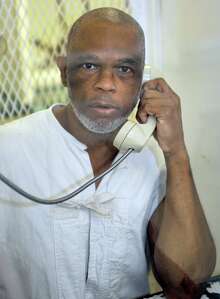
Yet another travesty of justice and a human tragedy, as well as a grotesque misuse of prose fiction, has just unfolded in Texas, where Marvin Lee Wilson, a 54-year-old man with a neuropsychologist-reported IQ of 61 was killed on Tuesday evening, by lethal injection, for the abduction and murder of Jerry Robert Williams, 21, a police department confidential informant, in 1992. Originally the court sentenced Wilson to death in 1994, but the death sentence was overturned in 1996 by the Texas Court of Criminal Appeals. The case went back to court in 1998, and Wilson was sentenced to death on a capital murder charge. The US Supreme Court ruled, in Atkins v. Virginia, that states cannot execute convicts deemed mentally impaired, but has left the standard for such a decision up to each state. Texas has yet to firmly establish such a standard. Morever, in Wilson's case, Supreme Court Justice Antonin Scalia had the opportunity to stay the execution, but chose not to, the Texas Court of Criminal Appeals also chose not to consider any other evidence that might have halted Wilson's execution, and Texas's current governor, Rick Perry, refused to grant clemency (which is distinct from a pardon). Since the Supreme Court's reinstatement of the death penalty in 1976, 1,301 people total and 500 in Texas have died as a result of state-sanctioned execution.

I mention "prose fiction" in Wilson's case, because according to the Beaumont Enterprise, the Texas Court of Criminal Appeals, in a 21-page 2004 ruling detailing what factors could be in considered in capital punishment cases and denoting what it considered mental impairment cited the fictional character Lennie Small, from the late 1962 Nobel literature laureate John Steinbeck's 1937 novella Of Mice and Men. The court stated that
Texas citizens might agree that Steinbeck's Lennie should, by virtue of his lack of reasoning ability and adaptive skills, be exempt. But, does a consensus of Texas citizens agree that all persons who might legitimately qualify for assistance under the social services definition of mental retardation be exempt from an otherwise constitutional penalty?
As it turns out, Steinbeck's son Thomas Steinbeck was unaware of this use of his father's work until he read about it in the Guardian UK newspaper online, and he and his wife have been outraged about it since. Both called for clemency for Wilson. As he notes, the court treats a fictional character as if he were real and arrogates to him the sympathy and mercy of "Texas citizens," yet failed to stop the execution of a real person--in this case Wilson--who is verifiably mentally impaired, under the standards of real-world neuroscience, which is to say, who was not to be accorded the same putative "exemption." Thomas Steinbeck's expounded on the matter

I am deeply troubled by today's scheduled execution of Marvin Wilson ... I had no idea that the great state of Texas would use a fictional character that my father created to make a point about human loyalty and dedication, ie., Lennie Small from 'Of Mice and Men,' as a benchmark to identify whether defendants with intellectual disability should live or die. My father was a highly gifted writer ... and the character of Lennie was never intended to be used to diagnose a medical condition like intellectual disability.

As I said, Wilson died by lethal injection yesterday evening.  A number of people, including nine in Texas alone, are scheduled to undergo state execution in the United States through January 14, 2012. If you do not believe in the death penalty, please take the time to contact state authorities to appeal for clemency.

***

As a result of their March 2012 public protest, an anti-Putin, anti-Kremlin "punk prayer" in Moscow's Cathedral of Christ the Savior, three members of the collective Pussy Riot, Nadezhda Tolokonnikova, 22, Maria Alyokhina, 24, and Yekaterina Samutsevich, 29, have been imprisoned in a Russian jail for the last five months, and are currently on trial, facing between 7 and 3 years of jail, on the charge of "hooliganism." The court decision is planned for August 17. A number of major musicians across the globe, including Madonna, as well as people all over the globe (you can do so here, via Amnesty International), have spoken out and called for these performers, known for their outspoken critiques of the Russian government under Vladimir Putin and their brightly-colored balaclavas, to be released and the blatantly political charges against them thrown out, but so far such calls have met with silence from the Russian authorities. Who are "Pussy Riot"? Here are a few videos, including one from this past spring in which Maria Alyokhina (Alekhina) describes the conditions in which they're being held.

Панк-молебен "Богородица, Путина прогони" Pussy Riot в Храме ("Punk prayer" "Hail Mary, Putin Put," Pussy Riot in the Church)
Alyokhina talks about detention conditions
Группа Pussy Riot жжет путинский гламур (Group Pussy Riot sets fire to Putin's glamor)
Pussy Riot на Красной площади песня Путин зассал (Pussy Riot at Red Square, singing "Putin zassal")

Wednesday, January 18, 2012

Say No to PIPA & SOPA

Wikipedia, like many sites, is offline today to protest PIPA & SOPA
The US Congress is considering two bills, the Senate's Protect IP Act (PIPA) and the House of Representatives' Stop Online Piracy Act (SOPA), that would censor the Web and Internet, constrain everyday users' access to online materials, and place additional, unnecessary regulations on businesses. 

Millions of people on the Internet have already opposed SOPA and PIPA.

The Senate begins voting next week, on January 24, 2011, so please let your two senators know how you feel. Sign the petition at the link below, and urge Congress to vote NO on PIPA and SOPA before it's too late.

Stop SOPA and PIPA!