Showing posts with label Barack Obama. Show all posts

Tuesday, February 13, 2018

Obamas' National Gallery Portraits Unveiled

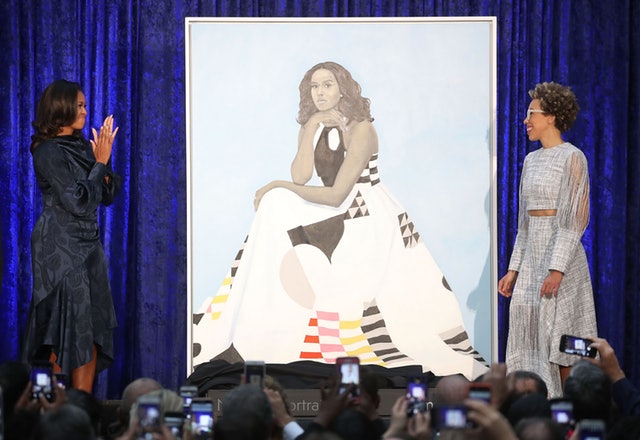
Michelle Obama, by Amy Sherald
Yesterday ago a public ceremony, former President Barack Obama and former First Lady Michelle Obama unveiled their official portraits for the Smithsonian's National Portrait Gallery in Washington, DC. The artists who painted the portraits, Kehinde Wiley and Amy Sherald respectively, were present at the event, and, like the Obamas, each artist spoke about the process and experience of painting these works, which, as the images reveal, will not only honor the first African American US President and First Lady, but also mark a distinctive aesthetic shift in terms of the ways they represent these major historical figures. It should also be noted that Wiley is the black man and first out, black gay artist to paint a presidential portrait, and Sherald is the first black woman ever to paint one. Amidst the foliage surrounding him, Barack Obama's portrait contains flowers with specific reference to and resonance for the 44th President of the United States. Michelle Obama's image shows a dress specially designed by designer Michelle Smith, under her company Milly, for her Spring/Summer 2017 collection. The dress has the aura not only of a unique flag, but also evokes the long African American and American tradition of quilt-making.

Mark Wilson/Getty Images News/Getty Images

The Obamas selected the artists who painted them. As both Obamas shared, they had discussed their portraits with the artists before the painting process, so neither was a surprise. Each artist had two sittings with the Obamas, and from those the created the portraits revealed yesterday to the public, each taking roughly one year. Both portraits went on display today, though they will not be shown together. President Obama's will become part of the official presidential portrait gallery, while Michelle Obama's will be visible through November 2018 in the National Portrait gallery's corridor of recent acquisitions. Wiley, 40 and a native of Los Angeles, is already quite well known as one of the leading painters of his generation, with shows and work in collections at museums and galleries all over the US and world. Moreover, Wiley had already received a US Department of State Medal of Arts in 2015, which meant that his work would be displayed in US embassies across the globe. Amy Sherald, 44, is less well known, but has had an ascendant career in recent years, winning the Outwin Boochever Portrait Competition at the National Gallery in 2016. She has suffered from congestive heart failure, which was diagnosed at the age of 31, and successfully received a heart transplant in 2012.

Mark Wilson/Getty Images News/Getty Images

Barack Obama, by Kehinde Wiley
I don't have an elaborate critique of either portrait, but in the case of Barack Obama image, I wish it had featured his beautiful smile. The encroaching foliage also struck me as having the potential for parody, though I read it as symbolic of his steps, often forgotten, to address the pressing challenges of environmental conservation and climate change, both of which are targets of reversal by the current occupant of the White House. In the case of Michelle Obama's image, I understand Sherald's recourse to grayish color for black skin tones, which she has discussed in various interviews and profiles, but I do wish she had nevertheless mixed things up and featured the former First Lady's beautiful hues. The dress fascinates me; its flatness and intersecting planes remind me of Gustav Klimt's and Ferdinand Hodler's work, as well as other Art Nouveau artists (is there a resurgence of interest in their work?), and folk art in its muted color and solid background, and both paintings, in certain ways, put me in mind of the work of peer artists Mickalene Thomas while also harkening back to their earlier black predecessor Barkley L. Hendricks. In both cases, I think we have portraits for the ages, and new standards for all subsequent presidential artists to aim for.

Wednesday, January 20, 2016

Gukira on Claudia Rankine's *Citizen: An American Lyric* & "microaggressions"

A week ago I posted about two standout examples of literary criticism, a young Barack Obama's super-concise reading of T. S. Eliot's "The Waste Land," and Frank Kermode's extraordinary disquisition on the word and concept of "shudder" in that and other works by Eliot and a range of authors. Neither is exactly a model of traditional literary criticism, which brings me to another stellar example, at Gukira: With(out) Predicates, the brilliant Keguro Macharia's thought-site (to call it a blog barely does it justice).

In his January 19, 2016 post "microaggressions," Keguro shows what another approach to critical writing about literature might look like, exploring Claudia Rankine's highly lauded 2014 collection Citizen: An American Lyric (Graywolf) with a level of discernment, analytical brio and lyric verve that marks all of his writing. I won't try to summarize the piece's argumentation except to say that it takes one on a journey both into Rankine's book and into the aesthetic, social and political discourse surrounding it. He begins by pointing out that the book "circulates as an aesthetic object that documents microaggressions," and then continues:

The “micro” in microaggressions suggests the low hum of noncatharsis Sianne Ngai taught us to call “ugly feelings.”

Nothing explodes. 

Nothing releases. 

An archive builds. 

We are far from anger, far from rage, far from the demands created by the word racism.
Instead, we are in the world of microaggressions, the world of archive building, the world of opportunities created by the aesthetic object to engage in a dialogue on race or a conversation on race, in which we are encouraged to share our stories of racialization, of being marked by race, singled out, unseen in our particularities and embedded within histories we did not create and do not want to own.

Learning from Fanon, we scream that we are not our histories. 

Frantz Fanon is only one of many figures he thinks with--alongside, to, and through--beginning with Elizabeth Alexander and Barack Obama (whom he also critiques). As importantly, Keguro historicizes and defines the term "microaggression," so ubiquitous these days, in order to show what it means--what meanings emerge--from, around and because of the circulation of an "aesthetic object that documents microaggressions." The (current) aesthetic object that documents microagressions--in American society. Is much of the extant criticism about the book about the book or about the discourse that surrounds it--"the wreck and not the story of the wreck / the thing and not the myth that surrounds it," quoting, as he does Adrienne Rich

As I note above, this essay--in the truest sense of the world,  a trying out of thought, an attempt to think into and through ideas--concludes on a powerful note. I'll quote it:

I conclude this writing a week after Obama’s State of the Union speech, on the Monday designated this year as Martin Luther King, Jr. Day. I am arrested by the question of lag, caught by the duration of the pause. The “micro” in “microaggressions” might describe the lag that one must overcome—that return to the untime of unmaking, that disembedding from the human that one overcomes but does not overcome. How long is that pause? How is it measured? What happens in that pause? 

Chester Pierce names that pause as where the cumulative takes hold. What accretes in the pause, and how? A model of resilience reaches for the grit in the oyster, the pearl-making potential of adversity. Recall, the much-lauded Citizen is the aesthetic object that documents microaggressions. White space can be a pause. Pauses are cumulative. Something accumulates in the pause. How long is that pause? How is it to be measured? How does one measure pauses as they accumulate? How does one evaluate the pause that is considered an aesthetic object? 

how does one live—how can one breathe—in the pause

This is one dazzling example of how one thinks--in the pause.

Thursday, January 07, 2016

Two Literary Critics: Barack Obama & Frank Kermode

The other day I came across Columbia professor and W. H. Auden scholar Edward Mendelson's short blog entry at the New York Review of Books on a critique President Barack Obama wrote while still quite young on T. S. Eliot's landmark poem "The Waste Land." (Let me say that though I decry the racially exclusive precincts of New York Review of Books, which only intermittently publishes critical reviews by or about writing by authors who are not white, I nevertheless explore its free blog site, which often offers provocative, distilled commentary by smart people on a range of current topics.) This letter has, as Mendelson notes, sparked a range of commentary, some praising the president's critical judgment and some reading it as incomplete, hasty and deficient in one way or another. It is certainly brief, and not a full essay, so any praise has to account for its partial quality. Additionally, Eliot scholars, Modernist academics and critics of Anglo-American literary might dispute its formulation of how to read and understand the St. Louis-born, High Anglican convert, poet, playwright, and essayist.

What struck me, though, to echo Mendelson, was the acuteness of the assessment, the deep understanding and ability to articulate, in concise, lapidary fashion what Eliot was wrestling with not just in "The Waste Land" but throughout his work, which scholarship over the last 50 years has increasingly revealed. The tensions between the material and sexual, on the one hand, and the spiritual, abstract and ascetic, on the other, are evident not only in a poem like "The Love Song of J. Alfred Prufrock," which opens with a sensuous simile that is also deeply suffused with the morbid--"like a patient etherized upon a table"--and which one could read as an extended negotiation between the "asexual purity" and "brutal sexual realism" (especially evident in some of his bawdy, racist college and post-graduate poetry, or in the anti-Semitic "Sweeney Among the Nightingales," which appears in Poems (1920), to give two examples) that culminates in a broken reverie culminating in the very morbidity with which the poem began--"till mermaids wake us, and we drown." (Can I also just register here how enduring strange--bizarre--Eliot's two 1920 collections, Poems and Prufrock and Other Observations are? I mean, many of these poems, at least in my reading, have lost none of their thematic and linguistic weirdness, even though they are for the most part formally retrograde at this point.)

That Obama was still a young man--a student? I did not read the David Maraniss biography from which Mendelson draws the quoted material--makes this assessment all the more remarkable. Or rather, based on my experience as a teacher of literature and a wide-ranging reader, it is rare. Even my best students for the most part would not be summarizing a work and an author so pithily. That the President, who studied political science, if I'm remembering correctly, can do so, makes it that much more impressive. Mendelson has more to say about Obama's critical reading of Eliot's form of conservatism, which was less idealist and utopian than realist and socially grounded, so I recommend reading his complete entry. It isn't "TL;dr" by any means. He concludes by speaking of his mixed feelings about Obama's tenure given his high expectations in 2008, and notes whether the "fatalism" that the president expresses in the letter, in agreement with Eliot, is even desirable in a politician.

I wonder, however, given Obama's rhetoric in his first term, during which he repeatedly expressed what I sometimes felt to be candy-colored expectations about his ability to work with the GOP, which had vowed--publicly, and we have since learned, secretly--to oppose him at every step, whether that "fatalism" was not a useful opinion that his subsequent political rise dispelled. This was a man who ran for the US Senate at a time in which only two Black people ever had been elected to that body, and in a state in which another Black person--Carole Moseley Braun--had previously been elected almost miraculously then lost her reelection bid. In that election, Obama espoused an agenda that was considerably to the left of his Democratic primary opponents, then stayed left in his policy prescriptions as he faced the Republicans, yet won in a landslide. His speech at the 2004 Democratic Convention was anything but "fatalistic"; it was almost narcotic in its optimism, and unsurprisingly elevated him in the national consciousness. He then dared to run for the presidency after only four in the Senate, knowing full well that no candidate from that house who had not also served as governor had been elected in 48 years, yet he did so against one of the most formidable candidates in politics--who is running again--and, defeating her, then went on to soundly defeat his Republican opponent--again.

One way of looking at Obama's choices would be to point to a laser-sharp opportunism, but even the most opportunistic candidate might have feared taking on Daley's Chicago machine in 2004, or Hillary Clinton in 2008. (I was fortunate enough to meet Barack Obama as he was running for the Senate, and told friends that he was the real thing, and would win in November.) What I think Mendelson misses, but what has become clear during Obama's two terms, is that for all the missteps, the triaging, the cynicism, the tinselly rhetoric that was clearly meant to be just that, the president does possess a capacity to see quite deeply into the hallmark of many issues--not all, but quite a few--and think several steps ahead, which is rare quality no matter what sort of person we're talking about. Part of this may involve calculation, in the negative sense of that word, which means that someone and some things will have to be sacrificed in favor of some larger goal, and that the particulars and niceties may be fudged, but it also has meant that for all of the GOP's opposition, Obama has pulled off a string of successes that will resonate for decades to come. To put it another way, he has been transformative, and his successes have resulted not from intuitiveness or (just) luck, but from being able to see that by achieving certain things--the Affordable Care Act, for example--a range of other things might come into being.

The fact that this is how he has operated has infuriated progressives--I am one--and upset many of his liberal supporters, but it is also the case that conservatives of the utopian kind--not Eliot's crew--and racists have been pushed to levels of rage that make the emergence of a figure like Donald Trump utterly comprehensible. He is the material emanation of that conservative rage, and whether he wins the nomination or not, his political prominence, despite his clear insufficiency for the job, is a sign not just of how effective Barack Obama has been as president, but how many of the policies resulting from his analytical skills, have proved. Whether they or his policies have proved enough is another issue, though by many objective indicators, the country is doing well, even if communities within it are still struggling. I say this not as exoneration but in a spirit of realism; to put it another way that 11th dimension chess approach that some commentators have called joked about and that the squib about Eliot makes clear has worked in some key ways, though it's also led to a blindness about other things.

This blog post's title suggests that I was going to talk not just about Barack Obama but also about the analytical skills of the late critic Frank Kermode (1919-2010), so let me conclude by pointing J's Theater readers to the essay of his that Mendelson cites, "Eliot and the Shudder," which appeared in the London Review of Books shortly before Kermode died at the age of 90. It was originally to be a lecture about William Shakespeare, to be delivered at a lecture for that publication. What resulted, however, is an astonishing piece of literary analysis, so effortless in its learning, so organic (a troublesome word these days, I know) in its argumentation, that it strikes me both as the very best model one could follow and yet almost impossible to reproduce. It is a remarkable tour (de force) of discussion about literature, aesthetics, emotion, faith, sexuality, and so much more that also gives deep insight also into how the word "shudder" itself carries particular kinds of emotional and metaphysical charges in English. This single word, Kermode shows, can convey both an involuntary physiological and emotional response as well as a profoundly sublime one. That strangeness that I noted above in Eliot's poetry is a hallmark of literary effects that can produce a "shudder" in a reader, as Kermode makes clear. A different approach on Eliot than Obama's, certainly, but in the case of both, whether in teardrop or cataract form, two readings--and minds--that, without question, show what a little thinking can do.

Saturday, March 07, 2015

President Obama at Selma's 50th Anniversary

Yesterday President Barack Obama traveled down to Selma, Alabama to participate in the commemoration of the 50th anniversary of "Bloody Sunday," March 7, 1965, which was the day on which roughly 300 Civil Rights marchers, who had been planning and organizing for several years to launch their attempt to march, on behalf of voting rights, from the smaller city to the state capital, encountered a horrifying brutal response from white Alabama State troopers and local posse members. As they proceeded over the Edmund Pettus Bridge, marchers, who included organizers Southern Christian Leadership Council (SCLC) Director of Action James Bevel and Amelia Boynton, as well as future US Representative John Lewis (D-GA), encountered beatings with nightsticks, horses trampling them, and near-suffocation by tear gas. TV cameras captured the attacks, including Boynton clubbed and lying unconscious, broadcasting them across the nation and globe, which helped to make possible two subsequent marches, the third successful and both led by the Reverend Martin Luther King, Jr., and also spurred President Lyndon Johnson and Congress to pass the Voting Rights Act of 1965, as Ava Duvernay's Oscar-nominated film Selma, depicts with great skill.

In his remarks, which I watched today and found to be among the best speeches he has given since becoming president, the President outlined how far we as a society have come since the events of 50 years ago while noting the journey left before us. His emphasis on voting rights is especially important given the challenges black voters--and voters in general, especially the poor, and the young and elderly--still face as a result of changes enacted by state legislatures, and court rulings, including the US Supreme Court's 2013 decision in Shelby County v. Holder, which held that the coverage formula delineated in Section 4(b) was unconstitutional, since it no longer responded to current conditions in the US, thereby rendering Section 5 of the Act, which apply to specific jurisdictions singled out in Section 4(b), legally unenforceable. The stakes of voting rights are huge, and as the President and other speakers at the event asserted, the future not only of the blood-stained, tear-drenched gains of the past hang in the balance, but of our democracy in general. We have come so far, as a nation, but we still have a way to go.


Later, the President, Mrs. Obama, their daughters, and Mrs. Robinson, the First Lady's mother, marched with participants, including many veterans, across the Edmund Pettus Bridge as a symbolic gesture to those who had bravely done so 50 years before, and who have done so many times since. Commemorative marches also took place all over the country, including over the Brooklyn Bridge.

U.S. President Barack Obama (3rd L) participates in a march
across the Edmund Pettus Bridge in Selma, Alabama, March 7, 2015.
Also pictured are first lady Michelle Obama (L), U.S. Representative
John Lewis (D-GA) (2nd L), former first lady Laura Bush (2nd R)
and former president George W. Bush (R). The event comes
on the 50th anniversary of the 'Bloody Sunday' march
at the bridge, where police and state troopers beat
and used tear gas against peaceful marchers
who were advocating against racial discrimination
at the voting booth. REUTERS/Jonathan Ernst
To build upon the events of 50 years and today, and of the hundreds of years of struggle over the right to vote, over social, political and economic equality and freedom, I hope everyone commits to contacting her Congressperson to urge them to vote for new legislation to address the Supreme Court's ruling; to pushing all our state legislators to expand, rather than restricting voting rights, including greater access, extending voting periods, and the franchise to former felons; and to championing the repeal of the SCOTUS's monstrous 2010 decision in Citizens United vs. FEC, which has gutted regulation of campaign spending laws and unleashed an ocean of money, masquerading as "speech," into our election system at all levels.

Tuesday, March 19, 2013

8th Blogiversary + Iraq War's 10th Anniversary

Donald Rumsfeld, George W. Bush, Dick Cheney
(Photo by Chip Somodevilla/Getty Images)
I didn't start blogging until 2005; last month marked my 8th J's Theater blogiversary (I usually am deep in the vortex of teaching when the date rolls around, so I always end up missing it, but I will post a poem by Jay Wright, the subject of my first post, this week.)  In the run-up to the horrendous Iraq War, however, I expended screens of email, countless posts on various sites I belonged to, and time and energy attending and participating marches against what was, clear enough to me, a looming disaster. It was not just the architects behind it--George W. Bush, Dick Cheney, Donald Rumsfeld, Condoleezza Rice, Paul Wolfowitz, Karl Rove, Richard Perle, Ahmad Chalabi,  Colin Powell, everyone involved with the Project for a New American Center and everyone clustered like a nauseating cloud around them--but the timorous and complicit US Congress, including all of the Democrats who cravenly or fearfully fell in line, as well as the still intellectually and ethically bankrupt, compliant, duplicitous US mainstream media and commentariat, all of them who cheerled this neoconservative debacle, from Andrew Sullivan and Peter Beinart to Thomas Friedman and Judy Miller, all of them, who enabled this catastrophe whose immediate effects, 4,000+ US and coalition troops dead, many thousands wounded and suffering from post-traumatic stress syndrome, and hundreds of thousands of Iraqis dead or injured, sectarian lines more sharply drawn than when Saddam Hussein was in power and the decimation of Iraq's minority populations, including Christian Iraqis, trillions of US and Iraqi dollars flushed into the pockets of the military industrial complex, and the destabilization of the entire region (and consequent empowerment, of all countries, Iran!). That is to say, they have blood and lives on their hands, their souls.

What was clear back in 1999 and 2000, that George Walker Bush would be the worst president in my lifetime--I continue to believe that despite several nadirs in American leadership over the last two centuries (Franklin Pierce, Millard Fillmore, James Buchanan, Rutherford Hayes, Herbert Hoover, Richard Nixon, etc.), W Bush will never be matched again if at least 50% of the voting population is even moderately sane--and would lead the country into certain disaster, the nature of which were not yet known then but the certainty of which was as clear as the candidate's stumbling, hazy answers and demonstrably phony cowboy persona, as well as by the toxic political and economic records of the people gathered round him, took material form from the day he assumed office, after the Supreme Court's judicial coup. But even with the California electric blackouts and the Enron collapse and of course, the sort of horrific incident and its aftermath that would have sunk many a presidency, the September 11, 2001 attacks by Al Qaeda, not even I could have imagined that Bush would, on the flimsiest of pretenses, con the Congress, the media, and millions of Americans, into the Iraq War. But he and his gang did. His and his associates' neoconservative, libertarian-laissez-faire fantasies, which included pimping out the US military to get ahold of that "sea of oil," as Wolfowitz once put it, and imposing their failed Randian policies on the new, juy-rigged state they created, predictably turned out badly. Very badly. Very, very badly. Criminally, and criminally badly. But that not of single of one these criminals has served time in jail or even been tried for war crimes speaks volumes to how rotten to the core our political system and media are. That any of the war-cheering pundits, like Friedman or David Brooks, both of whom still pontificate from their perches at The New York Times, also were not cast into the void of silence in the face of repeated critical failure, also is a dead mark on our society.

Tom Friedman's infamous "Suck on This" commentary about Iraq

In part because of all of the great blogs and sites that preceded and then swung into action in criticizing the rush to war, and its inept and corrupt prosecution, or the ones that emerged in the war's run up and wake, I initially vowed that I would not focus on politics, except indirectly, and for the most part, especially during my initial year of blogging, I maintained that stance. But I stepped away from that stricture a while ago, and while this never has become a political blog per se, I realized during the final, awful years of the Bush administration, which included the coup de grace bookend of the bursting housing bubble and global financial collapse (thank you, W!), and during various moments throughout this current administration's tenure, I have spoken out here and elsewhere. (I have often thought back about my early support for Barack Obama, in 2004, when he was running for the US Senate, and how I based that in part on his strong, vocal anti-war stance. I heard him articulate in person his opposition to the war. Perhaps the Presidency does change one, and perhaps his critique of Bush was opportunistic and paper-thin, but it was convincing. He will never be able to convince me of the viability of his drone war, or his stalwart support for the security and surveillance state, or many other issues on which he has shifted considerably to the right since his initial run for presidency, in 2008. (I also have come to realize that were she to run in 2016, I probably would support Hillary Clinton without hesitation, despite how abhorrent and pandering I found her support for Bush's folly.)

Iraq remains a deeply torn, traumatized society and country. While we should be hearing about what is happening there on a weekly or at least a monthly basis, we hear almost nothing about Iraq beyond intermittent posts about bombings, political quarrels, and demands the US continues to make on Iraq. Very few of the war enthusiasts devote more than the most cursory space, if even that, to Iraq today, to the challenges it faces, to its people and their voices, their stories, their lives. It is just another thing chewed on for a period, while it seemed useful, and spat out, without any real concern for the ramifications. In a sense, the war--which I do not want to reduce to the status of an analogy--is a good analogy for so much of what elites and their enablers wreak on this society. Perhaps they do consider the impacts of their actions, and perhaps they do pause, if for a second, but then again, if one goes simply on their actions as opposed to suppositions about their behavior, they act and apparently could care less. Unethical barely scratches the surface of such an outlook and mode of operate. But that's where we are. Ultimately those of us who see through the BS, the lies, the chicanery, the gaming of the system, the cravenness, the corruption, the destructiveness, the looming disasters, must never be silent and still, even if our cries and steps lead us into what looks like a cul-de-sac, a tunnel, a void. And we must be vigilant to call out those who lead us down paths of destruction, no matter how favored or well-placed or powerful they are. They bank on our silence, and our fear, and especially on a combination of both.

Tuesday, January 08, 2013

Richard Blanco, 2013 Inaugural Poet

Richard Blanco (Dodge Poetry site)
As soon as I saw the exciting news that President Barack Obama named Richard Blanco, an out gay, Spanish-born poet of Cuban heritage to be his 2013 Inaugural Poet, I wanted to post about it.  Sheryl Gay Stolberg's New York Times article, "Poet's Kinship with the President," which announced it, manages to give a decent overview of Blanco's life and work. Other links below give much more information on Blanco's life, career and art.

A longtime resident of Miami and a trained civil engineer who practiced that profession for a while before returning to Florida International University to study poetry and writing, Blanco now lives in Maine and writes full-time. He has published three books of poetry, the first of which, City of a Hundred Fires, won the Agnes Lynch Starrett Prize and was published by the University of Pittsburgh Press in 1997.

According to Stolberg's article, he was selected on December 12, and has been drafting three poems, one of which will be selected by Obama and his team for inauguration day. Congratulations, Richard Blanco, and great choice, President Obama!

More links:

Richard Blanco's personal website

Richard Blanco on the Poetry Foundation website

Richard Blanco's poetry, Beltway Poetry Quarterly

An interview with Richard Blanco, Poetry Society of America website

Richard Blanco at Dodge Poetry

Tuesday, January 01, 2013

Emancipation Proclamation Turns 150 + Fiscal Leap Averted

Emancipation
Proclamation, p. 1
Happy New Year!

150 years ago President Abraham Lincoln signed the Emancipation Proclamation, a largely symbolic document that accelerated, in word if not in deed, the process of ending chattel slavery in the United States of America. By 1863 nearly all the formerly slave-holding northern states, save those on the border with the Confederacy (Missouri, Kentucky, Maryland, and Delaware), had ended slavery by statute, and though slaveholders had attempted to implant the seeds of their infernal system in the West, bringing enslaved people to what is now Utah, Nevada, Arizona, and other territories, it was on the wane, throughout the Western Hemisphere (Haiti had extinguished slavery in 1804) and in rapidly industrializing and culturally diversifying America.

The Proclamation affected only those "states" and territories of said states "in rebellion," and none of the border states or northern states like New Jersey, which still had people living in bondage. It would take two more brutal years of war, the Union Army's defeat of the Confederate military, and Republican Congress's passage of the 13th Amendment in December 1865, to stamp out slavery de jure and de facto, but, as I need not tell any J's Theater readers, African Americans' struggle for freedom and social, political and economic equality continues.  Nevertheless one of the Proclamation's tangible effects is our 44th President of the United States, the recent re-elected Barack H. Obama.

Beginning yesterday and continuing through today, the National Archives will display the original 5-page document, written on paper instead of the longer-lasting, conventional parchment and thus extremely fragile, at the National Archives Building in Washington, DC.  If I were in DC I'd be beating a path there, as this document represents and embodies even today, as it did when Lincoln drafted and signed it, an alternative view of what this country, our country, might be, and where we might go. We are not there yet, but we have this document always to remind us that the seeming impossibility of freedom and equality is a possibility if we are willing to engage in the often hard and painful, but also joyful and exhilarating work of making it possible.

***

VP Biden and President Obama announce House passage
of the bill to avert the "fiscal cliff"
Surprise, surprise. The last minute, eleventh-hour scramble by the Congress averted shoving most of the country down the fiscal slope, and setting off the austerity bomb. Or did it? The Senate, by 89-8, passed a bill brokered by the Vice President, sent it to the House, which after a bit of petulant kabuki, passed by a 257 (172 Democrats with 85 Republicans) to 167 vote a concurrence of the Senate resolution, meaning that the bill could go to the President's desk to be signed. The particulars of the deal look decent, at least superficially. Among the bill's details the president's marginal federal income taxation rate threshold of $250,000/year unfortunately rose to $400,000 for single people and $450,000 for couples; there will be slightly higher capital gains, dividends and estate tax rates; it includes an alternative minimum tax fix; it extends unemployment insurance for 2 million people; it addresses the Medicare provider cuts that were to take effect; and, perhaps most beneficial for middle-and-working class families, it continues the 2009 tax credits for five years. The compromise bill avoided any cuts, of any sort, to the earned benefit and social safety net programs. The payroll tax, however, did return to 6.2% of all workers' first $113,700 of income.

It did not address other issues, such as the debt ceiling fight which still looms, or the GOP's likely demands for further spending cuts as part of the sequester. It also was perhaps a less effective bill than the President and Democrats might have gotten had they allowed all the Clinton era rates to return, which would have put the onus on the Republicans to agree to tax cuts for those under to $250,000 in exchange for less burdensome taxes on those above that cutoff, while also agreeing to better terms for nearly everything else this deal brought. Perhaps "the markets" might have freaked out, but we would have gotten past this blip soon enough. The US's finances, despite all the doom and gloom, is quite sound. Instead, we are still zooming towards legislating more austerity, which has proved disastrous in all the other places where it has been implemented (the UK, Spain, Germany, etc.), with the next battle royale to occur around March 1, 2012.

A pyrrhic victory, then? It's better than that, but if the President and Democrats, whose numbers in both the Senate and House will grow, cannot stand strong, we could facing far worse than the usual drang and drama, and the past 4 years offer only tepid confidence. As I always say, though, we shall see. 

Monday, November 26, 2012

Fiscal Cliff/Austerity Bomb/Phantom Crisis


There have been many excellent reports online about the alleged "fiscal cliff," which is not a cliff at all but more of a "slope," and which really merits a far better metaphor of the kind that Paul Krugman and others have devised, the "austerity" bomb. A while ago, I wrote about what was behind the push for austerity, and I urge J's Theater readers who have not already read Krugman's column today, "Fighting Fiscal Phantoms" to review it, because he not only names the chief player behind the "fiscal cliff"/"deficit scold" testeria, but summarizes why it is hardly what we're being told it is, including by the White House, with the complicity of one of Krugman's employers, the New York Times. His column crystallized for me what I've long thought about why we keep running into this crisis around taxes, the social safety net (i.e., "entitlements"), the government's role, and the establishment media's unwillingness to spell out what's really at stake (or its willingness participate in manufacturing consent by playing up the crisis). When you have multimillionaires like Goldman Sachs's chief, Lloyd Blankfein, hopping aboard Trojan horses like "Fix the Debt" despite the fact that his company has gorged at the government's troughs, the game and fix are clear enough to me. Here are my thoughts, adapted from an email I sent to some friends and broken down into numbered points, about what's really behind the current fiscal cliff crisis.

The GOP and conservative Democrats, agents of the plutocracy (or the 1%, or oligarchy, or billionocracy, whatever designation you like), seek to:

1) slash the social safety net now so that there will be less need later to keep marginal and capital gains tax rates, especially for the 1% and corporations, at even the current historically low levels--making it likely that any future necessary tax increases will disparately impact the middle and working classes and the poor;

2) under the rubric of "tax reform," steadily ratchet down marginal rates on the 1%, lower corporate rates, zero out capital gains taxes, eliminate estate taxes, cut all loopholes that do not benefit plutocrats, and allow various territorial tax schemes that allow the 1% and corporations to avoid US taxes and play other federal, regional or territorial tax regimes against each other;

3) lock in spending for the military and any programs (like Fed Reserve spending) that benefit the top 1%, Wall St., military-industrial complex beneficiaries, and if it takes a war or three to guarantee it, so be it; 

4) privatize as much of the remaining government as possible, so that those with the access and assets can feed off all the new revenue streams and what remains of a severely weakened, defunded governmental system;

5) rhetorically demonize government, via the corporate media (which has a stake in picking the bones of the government dry) to blame it for its failure to address the needs of the 99% (or 47%), while destroying and sucking every last dollar out of it.

Speaker John Boehner, President Barack Obama meet
to discuss the "fiscal cliff," November 16, 2012
(Carolyn Kaster/AP, csmonitor.com)

But it doesn't have to be this way at all. There was a Budget of the Congressional Progressive Caucus that progressives in Congress have seemed incapable of championing, and the result is that the GOP, neoliberals and the establishment media see fit not merely to sneer but to bury it altogether. Even short of the Progressive Budget, though, the default of returning to the Clinton-era tax rates, which involve much more than the federal marginal income tax rates (the top being a relatively low 39.5%; top economists Emmanuel Saez and Thomas Piketty recommend a much higher rate of around 70%), but also capital gains taxes, the estate tax, the alternative minimum tax, and payroll taxes, just to name a few, is a better option that the austerity push with safety net cuts we have before us. De jure austerity has been a complete failure in Europe, and de facto austerity here, in the form of government cuts over the last 3 years, has kept the US economy from growing as robustly as it could. Furthermore, there are fairly simple fixes for Social Security that do no involve raising eligibility or reindexing it, while Medicare's and Medicaid's problems, more difficult to resolve, need not entail raising or restricting eligibility; a single payer system or Medicare-for-all would do more to lower health care costs and ensure Medicare's future than the fixes the GOP and Democrats are proposing.

Krugman states very clearly what I learned in introductory macroeconomics. We are not anywhere close to the Federal Reserve's inflation target for full employment. Price stability is not its only mandate, and the people and corporations sitting on cash will put it to better use as we approach the 4% target. Additionally we will not go bankrupt or encounter the problems of Greece or any of the other European peripheral countries because we have our own central bank and control our own monetary policy and currency. US monetary policy over the last five years has had a beneficial effect on the economy, and the libertarian Republican Ben Bernanke is hardly about to turn into Andrew Mellon or Paul Greenspan. We will not encounter the problems South Korea did in its debt crisis because most of the debt is in our own currency, and primarily owed to the US or American creditors. The cries about a weaker dollar overlook the fact that even in a weakened global economy weak dollars help the US with exports, providing a necessary jumpstart for the economy, and improving our balance of trade.

One thing that Krugman has been begging the President and Congress to consider is the basic Keynesian principle of borrowing now, with borrowing costs at near historic lows, to underwrite a massive jobs and infrastructure bill. We can more than make up the costs by increased revenues from higher tax rates and increased employment, and we will set ourselves up for even greater economic prosperity in the future with an improved and expanded infrastructure, a better educated populace, and an economy that is powering forward. Lastly, cram down legislation, which the banks and Wall Street have fought, and which their agent Timothy Geithner has worked hard to prevent, would be the best plan for the housing crisis. It's unlikely to happen, but that coupled with all the other strategies above, and a vibrant safety net that protects vulnerable Americans, would really help the economy in ways all the tax cuts in the world to billionaires never could.

Tuesday, November 06, 2012

Obama & Biden Win Reelection!

President Barack Obama, First Lady Michelle Obama
Vice President Joe Biden and Second Lady Dr. Jill Biden
(Sept. 7, 2012, Portsmouth, NH (AP Photo/Jim Cole))
They did it, we did it! President Barack Obama and Vice President Joe Biden won yesterday's national contest over Republicans Mitt Romney and Paul Ryan, by a margin of 303 electoral votes to 203 for the Romney-Ryan ticket! Our 44th President and his Vice President will have 4 more years to continue the work they began in 2008, with a more liberal US Senate, including new progressive Democratic senators like Elizabeth Warren of Massachusetts and the first out lesbian senator in US history, Tammy Baldwin, of Wisconsin. Despite the Romney's campaign's head games, which beguiled the establishment media, the Obama campaign did enough to energize its DEMOCRATIC coalition, and won the majority of the swing states, including Ohio, Virginia, Florida, Colorado, New Hampshire, Nevada, and VP nominee Paul Ryan's home state of Wisconsin, sealing the victory for the Democratic ticket. Despite the ongoing economic crises, enough voters felt things were turning around to give the President a second chance. Despite billions from secret Super PAC funders, many of them billionaires and multimillionaires, the outright plutocratic Republican ticket lost.

I sincerely hope President Obama will take a few more tips from his predecessor and campaign energizer, former president Bill Clinton, who despite all the gloomy predictions, especially from the right and mainstream media, modestly raised taxes in 1993 on everyone, including the rich, and went on to preside over the most successful economic expansion of any president in the last 50 years. I hope he--and voters, since the media are paid to be obtuse--realize too that as Bill Clinton, who repeatedly accommodated the GOP learned the hard way, there is only so far you can go. They will still try to destroy you, so negotiate from strength, not weakness. Ignore the Washington consensus, and push for what you believe in. Obama will have an increased Democratic majority in the Senate, led by the wily Harry Reid (D-NV), so if a jobs bill requires reconciliation, push it through. If smart-grid funding requires reconciliation, push it through. With bills that might merit bipartisanship, like immigration reform, extend an olive branch to the GOP. Otherwise, do no let them roll you, and keep pushing forward, especially on green technologies, a saner foreign policy, a progressive judiciary, and fiscal plans that shrink the income gap and increase job opportunities for the 99%.

But that all will be work to undertake after being sworn in a second time. With the victories for marriage equality in Maryland and Maine, the positive ballot measure victories in New Jersey and elsewhere, and the defeat of hatemongers like Republicans Joe Walsh of Illinois and Allen West of Florida, the country outside the deep South does appear to have rejected the politics of negation, dissimulation and aristocracy, and is showing it is willing to move forward. It's up to all of us now to maintain that movement, and keep pushing, as hard as it will often seem. Even the Clinton-era rates, set to return in January 2014, won't pry the cold fingers off the millions of those willing to spend everything to rewrite laws to benefit themselves and their elite class.

Congratulations to President Barack Obama and Vice President Joe Biden. You did it, we did it. Now we need to really do it, and keep the country moving the best direction!

A Little of This, A Little of That

Today, after a false morning alarm, which involved the electricity surging on while I was in the shower,    only to shut off not even 10 minutes later, it finally clicked back on as I was scrubbing the refrigerator clean of its foetor, and there was easily enough within its walls and those of the little cooler that became a makeshift mini-fridge to supply biochemistry experiments at every local university and college. So far, it has held. We are expecting a nor'easter or some other serious storm tomorrow, with high winds and waterline surges, so I am praying that whatever the problem turned out to be, our local energy company, PSE&G, has resolved it for the future. We went nearly eight days without electricity, in the absence, at least in our area, of severe flooding or extensive pole damage. The capacitors (?) in the transformers, I heard someone say on the radio. PSE&G has said anything at all about what was wrong, instead referring us to a vague online article. Once the entire city and other towns, the worst hit of which will require many more weeks, perhaps even months, of rebuilding at every level, have power and are on the mend, I plan to suggest to every official I can find that they take into account the recommendations of the American Society of Engineers, who offered useful suggestions in 2009 on how to address the storm Hurricane Sandy turned out to be, with a push for greater regulation of the power companies, and for those at the federal level, I will do my part in renewed efforts to get them to pay attention to global warming and climate change.

===


photo

Unlike many parts of New Jersey, our voting precinct thankfully was functional, so we didn't have to try either the provisional ballot or far more experimental email/fax options, and C and I went to vote first thing this morning. The building, a nearby senior center, had gotten electricity a night or two ago, and was buzzing when we arrived. I have never seen it that busy; perhaps it was in 2008, though because I had to be in Chicago to teach I voted by absentee then, with the benefit that I was able to head down after class to Grant Park, where then President-elect Barack Obama, First Lady Michelle Obama, and the First daughters Sasha and Malia Obama greeted the enthusiastic, festival-like crowd. Tonight I will be at home, I hope with working lights, TV and Internet, and remain cautiously optimistic that the president will be reelected and that the Democrats will not only retain the US Senate but gain a few seats in the bargain. My hopes for the US House are less expansive, but I would love to be surprised in a positive way (the departures of the likes of Michele Bachmann, Allen West, being more important than the lagniappe of Democratic control; or should I make that the reverse? etc.).

I've expressed my thoughts on the last four years on here before, but I do think the President has some real accomplishments, such as the Affordable Care Act, the bailout of the auto industry, Dodd-Frank (as weak as it nevertheless is), the righting (if not the less successful right-winging, i.e., austeritization) of the eoconomy after the debacle of Bush, the two new Supreme Court justices (Sotomayor and Kagan), his glacial affirmation of same-sex marriage and the repeal of Don't Ask, Don't Tell, and the increasing greening of the economy. His record on  a range of other issues, warmaking and warmongering has been more mixed, with the Iraq War's end more of a mulligan and Afghanistan mostly a bloody wash, the horrendous National Defense Authorization Act, the normalization of drone warfare, the demonization of whistleblowers, the continuance of Bush's War on Terror and multi-decade War on Drugs, the magazine-wielding against Iran, and other deleterious policies that crush our civil liberties, extend the worst aspects of the military industrial state, and advance neoliberalism and neoconservatism all reasons to give a voter pause. As has tended to be the case in presidential elections, the Republican nominee, Mitt Romney, a hyper-secretive, ultra-rich Trojan Horse for the plutocracy, is far, far worse. In fact, he might be the worst Republican nominee I had the opportunity to vote against in my lifetime. Almost nothing he says is consistent with what he's said, let alone done, in the past, and his Vice Presidential running mate, Rand-roid Paul Ryan (R-WI), is so far to the right he's almost off the charts.

I don't think even they can steal this election, as occurred in 2000; but every election in the US is always a leap into the dark, with those running things the only ones with strike matches and a map at hand. Still, I think Obama will win reelection, and when that's certified, the real work begins again.

===

The transportation systems connecting the New York metropolitan area are still recovering from the hurricane and its aftermath. As of today, there is no PATH train service originating from the World Trade Center, which is one end of the line whose other is Newark. There is also no Newark Light Rail or subway train yet. Yesterday I took C to the NY Waterway ferry to NYC; the first departure point, at Paulus Hook, had a line easily a half-mile long. The second pier, at Newport, appeared more manageable, and despite his bus hitting a taxi, he got to work. I on the other hand had to drive to Newark, and picked up a colleague who also was teaching on Mondays. Gasoline is still scarce in many parts of this area, but I had filled up the car, which has decent fuel economy, and was able to ferry us to the university without a problem. Getting home was more a challenge; the traffic exiting Newark was slower than molasses in the cold, and I probably burned twice as much gas leaving as arriving. I am glad, though, that I did not get rid of my little car, which carried me, and my cousin when I wasn't in town, all over Chicago and the Midwest. I sometimes think I no longer really need it, and then an event like the hurricane occurs that reminds me how necessary it can be, even if, under regular circumstances, public transportation is a far more ecologically and financial sound option.

Many of my students are still dealing with the effects of the hurricane. Many also lost electricity and either had just gotten it back or were still waiting. One student who lives in Newark told me that her mayor, Cory Booker, had brought her family and others pizza to ensure they ate during one chilly, light-less night. Another who lives in Manhattan told me it took him four hours driving to school via the Lincoln Tunnel. Another is still without electricity and was so worried about his grade he sent me multiple pleading emails not to penalize him for not submitting an assignment. The university has asked us to be flexible, and one of the things I've learned over many years of teaching is that creating a syllabus that you can compress or expand depending upon circumstances--though with lots of notice especially for undergraduates--is the best plan. In the undergraduate Afro-Latin literature class we are now reading Mayra Montero's tragic novel The Messenger, which I trust will draw the students back into the course, and in the graduate class we're talking about Ray Kurzweil's interest in "the singularity" and the possibility of infinite life, or, as Jean-François Lyotard suggests in his famous article, of the survival of the mind after the death of the body, yet another point on the spectrum of the transhuman as well as the posthuman, which this hurricane's terrible effects held up as if under a magnifying glass.  In both courses we are working around the challenges the lost last week and the early part of this one have dealt us. Above all I sincerely hope every one of my students and their families, like everyone else affected by the storm, is on the path to recovery.

===

Congratulations to the San Francisco Giants, who won this year's World Series by defeating the Detroit Tigers in 4 straight games. The Giants, mostly unheralded all season and featuring a bevy of talented batters from Venezuela as well as excellent starting and relief pitching, took the final two games of the National League Championship Series from my St. Louis Cardinals, last year's Series champs, who had already knocked out the top NL team, the Washington Nationals, then proceeded to blank the Tigers in the first three games, allowing runs only in the fourth and final game. Many on this roster were also on the team that won the 2010 World Series, vanquishing the Texas Rangers, and they still have the talent and drive to return next year, though something tells me it'll be a new NL team vying for and winning the crown.

===

Rest in piece, Elliott Carter, after 103 years of innovative composing. An American original!

Friday, November 02, 2012

Surviving Sandy


My apologies for all the errors in the post on the color "blue"! I wrote it after a long, busy teaching day, and only noted well afterwards how garbled it was. It should be less so now. There are no solid sheets of blue above us today, nor have there been for the last few days. Instead, it's been shades of gray, gray clouds, gray sky, all auguring what we're being told is the worst storm to hit this area in a year. I wasn't here last October when Hurricane Irene struck, but Hurricane Sandy, or the Frankenstorm, which blew through the Caribbean, leaving 60 dead and widespread damage, has begun barreling towards barreled onto the shore, exacerbated by a full moon's high tides, and preceded by terrifying winds, some as high as 90 mph, and one of the lowest recorded pressures in decades at 940 milibars.
UPDATED (The storm terminated my original post on Monday.)
photo
The storm subsumed swaths of the Eastern seaboard from North Carolina north to Connecticut, battering coastal New York City, Long Island and New Jersey, where it touched down in devastating fashion. Whole shore towns, as well as inland cities along rivers, were underwater, yet even communities farther away from watercourses suffered flooding and sewer backups. Atlantic City, which finds itself near the eye of the storm, has suffered flooding all along its boardwalk and beaches, and other littoral towns are also drowning. New York mayor Michael Bloomberg ordered the evacuation of low-lying coastal neighborhoods in Manhattan, Brooklyn, and Queens, calling those who could not or refused to leave "selfish," and many of those areas, like Red Hook in Brooklyn, and Bay Terrace in Staten Island, New York City, ended up underwater. The MTA was shut down, as was the PATH and NJ Transit, the airports in Newark and Queens, and many major roads; subway tunnels flooded, the PATH line from the World Trade Center also turned into a swimming pool, and many train lines suffered damage or blockage from downed trees, strewn vehicles, and, in several cases, boats hurled up onto their tracks.  Lower Manhattan experienced a transformer explosion, which extinguished almost all of its power (save that of Goldman Sachs), and the NYU Medical Center had to be evacuated. So far more than 30 people are confirmed dead, and there are others whose whereabouts remain unknown.
photo
Closer to home, the storm's anticipated and current destruction led to flooding all along the Jersey City waterfront, and nearby Hoboken was plunged almost completely underwater. Newark also suffered such extensive damage and flooding that the university was shut down until Monday.  Thankfully we suffered no flooding and no damage to the house or cars, but the storm stripped the siding off many nearby houses; knocked a huge limb into a neighbor's front yard, damaging one of their eaves; peeled the roof of an apartment building off like a sardine can; and removed an awning as if it were a baseball cap. Electricity went out around 7 pm Monday. As of today, Friday, November 2, four and a half days after the shutdown, we are still without electricity, though we thankfully do have gas in the car (and gasoline is scarce all over the bi-state area, not just in our city), hot water (because of a gas-powered water heater installed a few years ago), enough funds to get by, and non-perishable food. Because we did keep an analog phone and an old battery-powered radio we are able to maintain contact with the outside world. Because we had candles, batteries and flashlights in the house, we have light; because we own a cooler, we can keep food outside in the cold weather. Parts of Jersey City's downtown, especially where the financial firms are located, do have power, but large sections of the city do not, nor do large portions of the neighboring cities and towns of Bayonne, North Bergen, Union City, Harrison, Secaucus, Hoboken, and Kearney.
photo
Driving around feels at times like being in a J. G. Ballard (The Drowned World) or Octavia Butler (The Parable of the Sower; The Parable of the Talents) novel. (Or my own novel set in 1804, Palimpsests!) As I said, gasoline is scarce, and many stations that have it cannot meet demand or lack the electricity to pump it. Meanwhile rumors circulate about where one can find it. The cash machines are mostly empty of cash, and since the electricity is still down in many places, stores cannot guarantee that they can accept debit cards. Unless you have access to analog devices, you may not be able even to contact the police or any authorities if something goes wrong. Streetlights remain out, and there are pockets of police in place, but in other areas, only a think veneer separates one from lawlessness. One neighbor confessed to feeling rage and desperation at the lack of contact with authorities, the lack of updates, and the failure of almost every system. She did fortunately have gas in her car and some cash on her, so she and her sons weren't stranded, but her husband and his brother are stuck somewhere and remained unreachable. A friend has lost his car and had to shelter his landlord, whose home was flooded. He is now living with his mother, who lives in a neighboring town, reaching her by walking to her home. Another friend, who teaches at Rutgers-New Brunswick, mentioned the Darwinian air now taking hold in Greenwich Village and other parts of lower Manhattan. Yet another colleague was fortunate to find a train now running to take him and visit his elderly mother who had taken ill while finding herself in the dark down in the middle of the state. And these are only a few of the stories I have heard.
Our light since the storm
What this storm has underlined for me is not just the urge to non-theological providence and prudence that my Depression-era late grandfather always urged, but also a rethinking of so much of my acceptance and internalization of the contemporary shift to the digital, to the electric and electronic, and to any credence I have placed in private companies, especially the large ones like AT&T and PSE&G, on whom so many lives depend, without a healthy dose of skepticism. As of today we continue to have spotty cell phone service, and the power company has been dismal about letting us know with anything approaching a reasonable estimate. Originally we were told that we would get service by next Monday, but as of yesterday the automated response was saying next Friday, November 9! Our voting station is nearby, at a local eldercare center, so will that be operative by Tuesday? Or are there other provisions that are being taken to ensure that we have electricity in this area and will be able to vote? Their actions make one of the best cases for active government regulation. So much of the local and regional infrastructure went kaput, despite assurances that it could withstand such a storm, and despite the prior warnings and the example of last year's Hurricane Irene, previous snowstorms, the 2003 Blackout, and the attacks of September 11, 2001. It seems that instead of taking into account the best science and spending the money to ensure future viability, corporate executives, unless forced to, stuff the money into their pockets. These are the people we are told daily we're supposed to extol. No thanks!
photo
The local officials have been mostly decent; our governor, Republican Chris Christie, was on the air communicating with citizens proactively and has been visible since, even appearing with and praising President Barack Obama, who came to New Jersey to view the wreckage, on Wednesday. (Based on information that hasn't been shared with us, Obama said we would have electricity by yesterday, but so far, that hasn't panned out.) New York's Democratic governor Andrew Cuomo, and New York City's mayor, Michael Bloomberg, also displayed real leadership as the storm was approaching, and both also have spoken out about the need for the US to address the reality of global warming and climate change, an anathema subject among the GOP and many Democrats, and a topic about which the president has grown silent in recent years. Newark's mayor, Cory Booker, already a superhero in the eyes of many, not only was responding directly to requests his constituents tweeted to him, but even opened his home to feed neighbors and provide them a charging station.


Jersey City's mayor, Jerramiah Healy, has appeared to go missing, issuing evacuation orders and the curfew, but otherwise invisible. I have not heard him on the radio even once; his name appears only intermittently, except to be denounced, on online sites focusing on local news. Some downtown residents have even posted signs asking where "Waldo Healy Is?" and labeling the city "All On Our Own Again." He has waltzed into office each time he's run, so perhaps voters will get past the D (for "Developers'-Best-Friend"?) next to his name and give a challenger, a more progressive Democrat or a moderate, a chance. Whatever happens, I just hope the electricity returns sooner rather than later. C, I and the cats are holding up, but a cold house is a cold house. I'm not so ready to be off the grid--yet--but even if I were, I also know now what I've always been urged: be prepared.