Showing posts with label avant-garde. Show all posts

Sunday, February 21, 2016

Black Literary Avant-Garde Syllabus At ND Site

From Isaac Julien's Looking for Langston
A month or so ago on Facebook, I casually mentioned that I'd taught an undergraduate course in Black Literary Avant-gardism at Northwestern, most recently in 2010, and figured that that would be the end of it. The response, however, was enthusiastic, with a number of people asking me to share the syllabus. Northwestern never required us to post syllabi publicly, as Rutgers-Newark does, and I was amenable to sharing it, though I wasn't sure where I might do so. Here was the most likely spot.

Then Mieke Chew of New Directions asked me if I would be interested in presenting it there, and I was. After she distilled it a bit, removing dates and so forth, it went live. I intended it to be neither comprehensive nor exhaustive, and if I were to teach the course today, in addition to a longer calendar, I'd add more and new scholarly texts and draw from the rich store of contemporary innovative black writing, including digital work.


I should note that I do not have an electronic course pack, but a number of the articles and shorter materials can be found in the special issue of Tripwire featuring giovanni singleton's and Renee Gladman's famous conference black innovative writing, as well as The Harlem Renaissance Reader.

Monday, November 04, 2013

Baden-Baden 1927 at Gotham Chamber Opera


The set, designed by Georg Baselitz
and Court Wilson

In 1927, two years before the US Stock Market crash, on the eve of the Great Depression and the eventual fall of Germany's democratic republican government, the organizers of the German Chamber Music Festival invited four young composers each to present a Zeitoper (opera of the current moment/time). Two were German: Kurt Weill and Paul Hindemith; one was Austrian, Ernst Toch; and the fourth, Darius Milhaud, was French. Additionally, Weill, Toch and Milhaud were Jewish composers coming of age in the moment just before National Socialist fascism began infecting the body politic of Germany, and later that of Austria. Three of them also constituted a distinct strand of the contemporary European musical avant-garde: Weill incorporated cabaret tunes, other forms of popular music, and English texts, often inflected by his left-leaning convictions; Hindemith played with structure and daring content, especially in his initial trio of operas; and Milhaud drew from and wove jazz idioms into his scores.


From Mahagonny-Songspiel
(Photo by Richard Termine)

So the future was then, in Baden-Baden. Each of the selected composers brought to the festival's spectators a brief, pared-down operatic work he felt reflected the times. Kurt Weill staged his Mahagonny-Songspiel, a loosely linked six-song prequel to his masterpiece with Bertolt BrechtDer Aufstieg und der Fall des Stadts Mahagonny (The Rise and the Fall of the City of Mahagonny). Paul Hindemith, who had become a young master of the Zeitoper format, presented his palindromic Hin und zurück (There and Back), which was in many ways a preparatory step for his larger three-act Neues vom Tage several years alter. Darius Milhaud, one of the key figures in Les Six, the French Modernist musical collective, offered a violent monodrama, L'enlèvement d'Europe (The Abduction of Europa); and Ernst Toch, who had begun to develop his own polyphonic style, presented the seemingly light confection Die Prinzessin auf der Erbse (The Princess and the Pea).
Thanks to the Gotham Chamber Opera, now in its 12th season, today's opera lovers got a chance to hear all four operas in one evening, as spectators might have in that German spa town in July of 1927. The New York versions, directed by Scotsman Paul Curran, however, which ran from October 23-29, were staged in a distinctly up-to-date fashion, with production design by German artist Georg Baselitz and Court Watson, hinging the theme of "What Is Art?", a question as relevant in the Modernist ferment of the 1920s as it is in our post-post-modern moment. Yet this underlying theme, as it played out in the staging, did not lend itself well to all of the works. On the other hand, the opera company cast--led by star soprano Helen Donath, with soprano Maeve Höglund, mezzo-soprano Jennifer Rivera, tenors Daniel Montenegro and Matthew Tuell, baritone Michael Mayes and bass John Cheek--and the orchestra, led by conductor Neal Goren, did a superb job of bringing each of the works to life musically. My opera companion noted the textural richness the small orchestra captured in each work, and the pianists accompanying the orchestra for the Hindemith piece played with untrammeled contrapuntal fury, giving listeners the sense of a scene exploding forth into being. (I could easily sit through those opening bars again and again.)


From Hin und zurück
(Photo by Richard Termine)

Milhaud's opera, one of his trio of Opéras-minutes and only 8 minutes long, was perhaps the best suited to the theme and set, as the work's singers, appearing as gallery attendees admiring the set's immense canvas featuring a Baselitz-style image, slid from their silent appreciation to a recounting of the musical work's events. Milhaud's lush but tiny score was over before it began, with a dead body as its exclamation point. Toch's literal retelling of the story "The Princess and the Pea," and its dramatic and musical whimsy, transposed onto a reality-show frame, was aesthetically out of joint with everything else. The set, which now included a giant bed atop whose back the prince initially perched, before it turned around to reveal a Himalayan pile of mattresses on which the putative prince capered, wracked my nerves; instead of focusing on Toch's cheery melodies, I found myself praying no one fell from that precarious aerie. The opera company might moreover have done more to explore the deeper idea in the fairytale and in Toch's work, of the beloved needing to possess a particular kind of purity, especially given Toch's background and the looming consequences of racialization in subsequent decades.
After a short break, Hindemith's 12-minute "Sketch mit Musik," as he described it, unfolded in thrilling fashion. Very much redolent of silent movies--then current--and Expressionist works in all genres--visual art, literature, music--Hin und zurück tells the story of a woman who decides to have breakfast with her grandmother when her husband arrives home with with a gift for her birthday. She also receives a letter from her lover, which the husband sees, and he ends up shooting her before jumping out of the window. In 6 minutes! This being an avant-garde work, an angel-like figure appears, sings that nothing matters, and rewinds the entire story, not just dramatically--which means that the wife, her husband, and granny all move backwards--but musically, as a palindrome. It was over almost as soon as it began, but it made me wonder whether it influenced some of the internal musical mirroring in works by Hindemith's peers, including Bela Bartók and Alban Berg, who has palindromes in both his "Chamber Concerto" and his final, unfinished opera Lulu.


From Die Prinzessin auf der Erbse
(Photo by Richard Termine)

My main reason for attending the concert, though, was to hear Kurt Weill's music performed live. I had never heard anything by him in a live setting, so the six Mahagonny-Songspiel songs, several of which I knew pretty well, were a revelation, chief among them Elisabeth Hauptmann's English-language parodies the "Alabama Song" and the "Benares Song." The singers, especially the famous soprano Helen Donath, served up the perfect mixture of beauty and yearning as she crooned, "Oh moon, of Alabama…." The staging, however, did neither the songs nor the concept behind them, no credit. The cast performed one of them on treadmills (?), and as with Toch's opera, I found myself focusing more on their personal safety than on what they were singing. The Mahagonny songs' commentary on the underside of jazz age prosperity--dissolution, poverty, homelessness, the desire for escape with no place, not even Mahagonny, offering anything but illusion--lacked its reflection in the set, not least when a performer wandered around in his underwear (huh?), though the performers did their best to bring the songs to life. The staging was, unfortunately, a lost opportunity. For a very affordable price on a fall evening, though, the opportunity to see four live early 20th century operas, whatever their failings, was an excellent deal.


The cast, with the conductor


Saturday, November 17, 2012

Quote: Jonas Mekas

Still from Andy Warhol's Empire(from Behindthehype.com)
Q: Earlier this year you selected films for a "Boring Masterpieces" series at Anthology [Film Archives].  A few of the 60 or so people that came for Andy Warhol's Empire, stayed for its entire running time of 8 hours and 5 minutes. You were the cameraman for Empire - what was the experience of making that film?

A: It was the spring of 1964. My loft was the Film-Maker's Cooperative office: Film Culture [the magazine Mekas cofounded with his brother Adolfas in 1954) magazine office; and a hangout of underground film-makers, poets, people in transit. Bob Kaufman, Barbara Rubin, Christo, Salvador Dalí, Ginsberg, Leroi Jones, [Gregory] Corso, George Maciunas, Warhol, Jack Smith.... I slept under the editing table while the parties were going. A new issue of Film Culture was out and I had asked John Palmer, a young film-maker, to help to carry bags full of magazines to the nearest post office, in the Empire State Building. As we were carrying our heavy loads, the Empire State Building was our Star of Bethlehem: it was always there, leading us...Suddenly we both had to stop to admire it. I don't remember who said it, John or myself, or both of us at the same time: "Isn't it great?" This is a perfect Andy Warhol movie!"

"Why don't you tell that to Andy," I said. Next day he calls me. "And is very excited about filming Empire. Can you help us?"

So on Saturday, July 25th there we were, on the 41st floor of the Time-Life building. I set up the camera and framed the Empire State Building. Andy was there to check framing. The premiere of Empire had to wait for almost a year. It was a very, very busy period of the Sixties, we kept doing new things, and we had no time to look at what we did yesterday. Ahead, ahead we moved!

***

In 1962 or '64, I met Andy on Second Avenue. I was going to a LaMonte Young concert. He said he would join me. LaMonte played one of those very, very long pieces, four or six hours-long variations on a single note. Andy sat through the entire piece. Andy was already doing serial pictures, repetitions of the same image. Stretching time. Jackson MacLow had already written his script/note about filming a tree for twenty-four hours. It was all in the air, Empire. Andy was very up-to-date with what was happening in the arts. One could say that Empire was his conversation with other avant-garde artists of his day, with minimalists, conceptualists, real-time artists and, at the same time, an aesthetic celebration of reality. As such, it will never date, it will always remain alive and unique.

--Copyright © Jonas Mekas, interviewed by Marianne Shaneen, SFAQ: International Arts and Culture, Issue 11: Nov. Dec. Jan. 2012-13, pp. 52-53.

Jonas Mekas (l) and Andy Warhol (r)

Friday, July 22, 2011

New Directions' 75th Anniversary Reading @ Poets House

James Laughlin's rationale for New Directions Publishing Corp.
"New Directions was founded three years ago to do a particular job: to foster the branches of literature which are being victimized by the excessive commercialization of American publishing--poetry, criticism, translation, belles-lettres, and unconventional fiction."
***

New Directions was founded to counteract, in its small way, the tendency to treat a book as nothing more than a package of merchandise. Perahps the editor is an idealist. But that species is not yet extinct. Our first years have shown there are a great many people in this country who love the best in literature and resent its degradation. Confident of their support and anxious to deserve it, New Directions enters another publishing year." - James Laughlin, 1939

So wrote New Directions Publishing Corporation's founder, poet and steel company heir James Laughlin (1914-1997), three years after the publication, when Laughlin was a 22-year-old Harvard sophomore, of New Directions in Poetry & Prose, an anthology that featured the work of writers, some of whom were already acclaimed but many of whom would eventually be recognized as among the most important in 20th century American literature: William Carlos Williams, Ezra Pound, Elizabeth Bishop, Henry Miller, Marianne Moore, Wallace Stevens, and e. e. cummings.  75 years and countless authors, from the modernist canon and from literary traditions all over the world, later, New Directions is still publishing, having introduced US readers to the work of major American and international writers like H.D., Delmore Schwartz, Gregory Corso, Michael McClure, Robert Duncan, Denise Levertov, Clarice Lispector, Raja Rao, Muriel Spark, Thomas Merton, Anne Carson, Jorge Luis Borges, Allen Grossman, Jerome Rothenberg, Victor Pelevin, Bei Dao, W. G. Sebald, Roberto Bolaño, and Javier Marías, to name just a few.

Last night, Poets House in New York, one of the finest repositories of poetry books in the US, hosted a dodranscentennial celebration and reception for New Directions, to coincide with its debut, on its second floor, of selected materials from New Directions' rich archive. The reading featured eight authors and translators, some from New York and some from farther away, who read from authors published by New Directions or their own work.  After Poets House Program Director and publisher Stephen Motika opened the program, he introduced the first reader, translator Susan Bernofsky, who has translated several works from German by Swiss author Robert Walser, read from her recent translation of Microscripts (New Directions, 2010). Subsequent readers were NYU French professor Richard Sieburth, who read two selections from the work of Ezra Pound; poet, translator, scholar, and Bomb editor Mónica de la Torre, who read translations (by Laura Healy) from poet Roberto Bolaño's funny, provocative Tres (New Directions, forthcoming in September 2011).

After Mónica, Brown professor and translator Forrest Gander read selections from his newest book, published by New Directions; Eliot Weinberger read from Lawrence Ferlinghetti's 1958 volume A Coney Island of the Mind, one of New Direction's and American poetry's best selling volumes; poet and Duke professor Nathaniel Mackey, who received the National Book Award for his New Directions-published collection Splay Anthem in 2005, read from that and a more recent collection, then offered a snippet from Djuna Barnes's 1936 volume Nightwood; and he was followed by the final reader, poet, critic and Buffalo professor Susan Howe, who began with a small selection from William Carlos Williams's Paterson (1946-1958), before finishing with a thrilling little sliver, which included a passage she performed almost like sound poetry, from her most recent book, THAT THIS (New Directions, 2010). New Directions editor and poet Jeffrey Yang concluded the event with brief remarks, and a fine reception followed upstairs.

If you are in New York and want something engaging to do--and afterwards you might stroll along the picturesque riverwalk just a few steps awa--before October 8, 2011, please visit Poets House during their regular hours and view their wonderful exhibit, in vitrines and along the upstairs walls, of New Directions books, manuscripts, correspondence, book cover mockups, and ephemera. There are some real treasures in the vitrines and along the walls; I've posted a few images below, but I intend to go back when it's a bit quieter to explore the wonderful treasures on display.  Poets House also has its 2011 Poetry Book Showcase on display on the first floor, and will be hosting a celebratory event in conjunction with it, with readings by Rachel Eliza Griffiths, Evie Shockley, Albert Mobilio, and Jena Osman next Tuesday!

Poets house program director and publisher Stephen Motika
Poets House Program Director and publisher Stephen Motika, delivering his beautiful introduction of the evening's events
Translator Susan Bernofsky
Susan Bernofsky, who has translated Robert Walser for New Directions, reading from her translation of his Microscripts
NYU Prof. Richard Sieburth
NYU French and Comp Lit professor Richard Sieburth, reading Ezra Pound
Mónica de la Torre
Poet and translator Mónica de la Torre, reading from translations (by Laura Healy) of Roberto Bolaño's prose poems Tres
Brown prof. Forrest Gander
Brown professor Forrest Gander, reading from his poetry
Eliot Weinberger
Eliot Weinberger, before he read from Lawrence Ferlinghetti's A Coney Island of the Mind (1958), one of New Directions' and American poetry's most popular and best selling volumes
Nathaniel Mackey
National Book Award winning poet and professor Nathaniel Mackey, reading from Splay Anthem, the first of his books published by New Directions
Susan Howe
Poet and professor Susan Howe, who began her reading with a selection from William Carlos Williams's Paterson
New Directions editor Jeffrey Yang, closing the event
Poet and New Directions editor Jeffrey Yang, closing the event

Sunday, July 17, 2011

Merce Fair

John Cage & Merce Cunningham
John Cage & Merce
Cunningham
Mercier "Merce" Philip Cunningham (1919 - 2009), choreographer and dance pioneer

:: formed the Merce Cunningham Dance Company (MCDC) at Black Mountain College (1933-1957), in 1953; it is performing its farewell dances this year, 2011; its school and archive will continue

::Merce Fair, July 16, 2011, Frederick P. Rose Hall

Excerpt from MCDC's Squaregame (1976) | Courtesy of Cunningham Dance Foundation - Music: S.E. Wave/E.W. Song by Takehisa Kosugi

In *Andy Warhol's* Silver Clouds exhibit
Andy Warhol's Silver Clouds, mylar balloons in natural light, used as the décor for MCDC's Rainforest (1968), Atrium, Frederick P. Rose Hall, Columbus Circle, New York City

Cunningham's realization of John Cage's painting score *Steps*
Cunningham's realization of John Cage's painting score Steps, in the Benjamin Menschel Arcade, Frederick P. Rose Hall

Merce Cunningham's dance score
Some of Cunningham's dance scores/choreography charts, in the Archive curated by the New York Public Library and Merce Cunningham Dance Company archivist David Vaughan, Edward John Noble Foundation studio, Frederick P. Rose Hall

Rashaun Mitchell
::Among its original corps, dancers Carolyn Brown, Viola Farber, Paul Taylor, and Remy Charlip, and musicians David Tudor and Cunningham's life partner, musician/artist/philosopher John Cage, the MCDC's founding musical director
::Current Music Director: Takehisa Kosugi - Current Director of Choreography: Robert Swinston - Current Executive Director: Trevor Carlson
::Notable collaborators with Cunningham and MCDC over the years have included visual, plastic and fashion artists such as Robert Rauschenberg, Rei Kawakubo, Roy Lichenstein, Bruce Nauman, Ernesto Neto, Frank Stella, and Andy Warhol, and musicians including Gavin Bryars, Gordon Mumma, Conlon Nancarrow, and Sonic Youth
::current company Brandon Collwes, Dylan Crossman, Emma Desjardins, Jennifer Goggans, John Hinrichs, Daniel Madoff, Rashaun Mitchell, Marcie Munnerlyn, Krista Nelson, Silas Riener, Jamie Scott, Robert Swinston, Melissa Toogood, Andrew Weber

Wednesday, July 13, 2011

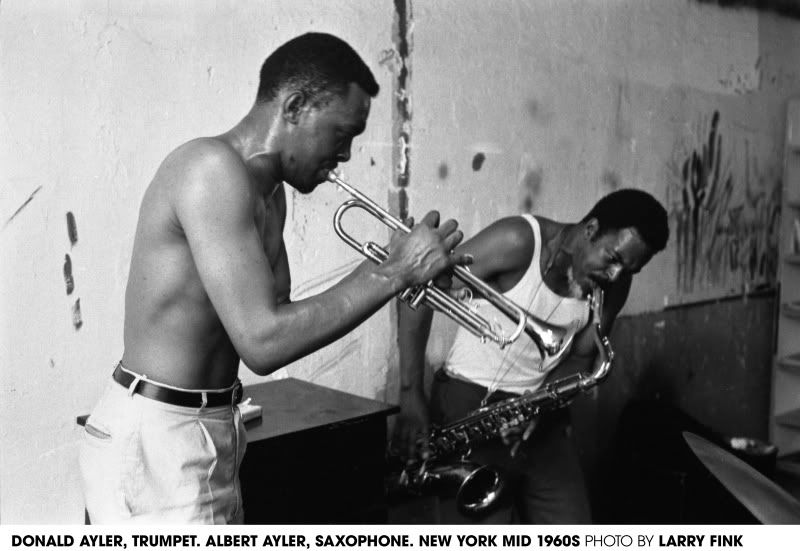
Albert Ayleriana

b. Cleveland Heights, Ohio, July 13, 1936 - d. New York, NY, November 25, 1970

"Love means nothing in tennis, but it's everything in life."
Albert Ayler, "My Name Is Albert Ayler"

"John [Coltrane] was like a visitor to this planet. He came in peace and he left in peace; but during his time here, he kept trying to reach new levels of awareness, of peace, of spirituality. That's why I regard the music he played as spiritual music -- John's way of getting closer and closer to the Creator." - Albert Ayler, in Valerie Wilmer, As Serious As Your Life, p.31

from lyssa.humana.blogspot.com
+ saxophonist, major figure in free, avant-garde jazz, "energy music"
+ music characterized by almost elemental force, piercing, versatile tone and range, startling improvisatory skills, bone-chilling, other-wordly feeling
+ drew from blues, R&B, marches and classical music, Tin Pan Alley standards, rock & roll, and other established and vernacular forms
+ studied at the Academy of Music in Cleveland with Benny Miller
+ US Army veteran
+ played with Little Walker, Stanley Turrentine, Cecil Taylor, Gary Peacock, Sunny Murray, Don Cherry, brother Donald Ayler, Charles Tyler, Lewis Worrell, Bobby Few, Niels-Henning Ørsted-Pedersen

Notable recordings: My Name Is Albert Ayler (Delmark, 1963); Spirits (a/k/a Witches and Devils) (Delmark/Freedom, 1964); Goin' Home (a/k/a Swing low sweet chariot) (Black Lion/Osmosis, 1964); Prophecy (ESP, 1964); Spiritual Unity (ESP, 1964); New York Eye and Ear Control (ESP, 1964); Ghosts (a/k/a Vibrations) (Debut/Freedom, 1964); The Hilversum Session (DIW, 1964); Bells (ESP, 1965); Spirits Rejoice (ESP, 1965); At Slug's Saloon, Vol. 1 & 2 (ESP, 1966); In Greenwich Village (Impulse!, 1966); Music Is The Healing Force of the Universe (Impulse!, 1969); The Last Album (Impulse!, 1969); The Complete ESP-Disk Recordings (ESP, 2006).

Documentary: My Name Is Albert Ayler (2007), Kasper Collin, director and writer.

I once spent an afternoon listening to Bells and felt afterwards like my ears had been reset.

"I feel really free over here. One thing every day will be as it should be." - Albert Ayler, on "My Name Is Albert Ayler"


Albert Ayler, "Billie's Bounce"


Albert Ayler, "Summertime"


Albert Ayler Quartet, at John Coltrane's Funeral, July 21, 1967, "Love Cry, Truth Is Marching In, Our Prayer"


Albert Ayler, "Nobody Knows the Trouble I've Seen"


Albert Ayler, "Ghosts"


Albert Ayler, "Spirits"


Albert Ayler, "Angels"


Albert Ayler, "All Love"


Albert Ayler, "Spiritual Reunion," Nuits de la Fondation Maeght, 1970

Albert Ayler, "On Green Dolphin Street

Sunday, July 03, 2011

Trane's LI House Needs $ + Roscoe Mitchell, Hidden Chi Treasure

Are you a music fan? A rich one? Or one blessed with carpentry and masonry skills?  Rich and skilled enough to help restore and preserve a ramshackle ranch house on Long Island where one of the greatest works of the jazz canon was written and first performed? Where its composer lived, raised a family, and recovered from personal struggles that threatened to overwhelm him, to ultimately create the most transcendant art?

The house has been empty for about seven years. Ravi Coltrane, the musician's youngest son, visited his childhood home.
Credit: Fred R. Conrad/The New York Times

If you are, please contact a jazz enthusiast named Steve Fulgoni, who in 2003 was able to purchase John Coltrane's former home in Dix Hills, which is falling down, saving it and its surrounding acreage from the jaws of local developers. The house has nevertheless continued in its state of dilapidation. Abandoned by human habitation for 8 years to raccoon residents, now gone, it still has termites devouring its timber and cracks snaking up its sides. "A Love Supreme" alone isn't going to revive it.

According to an editorial in today's New York Times, the National Trust for Historic Preservation has already put the home on its "Most-Endangered List." If it were to become a cultural site of importance, it would be among the few focusing on Long Island's long African-American presence. Fulgoni for his part is seeking assistance to turn the home into the sort of museum that Louis Armstrong's former home in Queens has become, and think needs about $1 million total to rescue it fully. I would imagine 10 times that amount, to ensure a small endowment as well, would be the way to go.

So, do you or do you know anyone who can help a jazz fan out?

***

Back in December I featured a photo of composer and musician Roscoe Mitchell from the Association for the Advancement of Creative Musicians' (AACM) 45th anniversary, which took place at Chicago's Museum of Contemporary Art. I assumed J's Theater viewers would know who Roscoe Mitchell is. But if not, artist/archivist Plastic Crimewave at the Chicago Reader's Secret History of Chicago Music site has drawn a tight little graphic to clue you in. Click here to see the image at full size. I hope Roscoe Mitchell is hipped to it too.


Roscoe Mitchell is now the Distinguished Milhaud Professor at Mills College.  His university biography is here.  Mitchell's Art Ensemble of Chicago page is here. His AACM page is here.