Showing posts with label black art. Show all posts

Saturday, April 21, 2018

Poems: giovanni singleton


A few years ago, when her first book appeared, I shared two poems by giovanni singleton, a poet I've known and been a fan of for years. giovanni's collection ascension deservedly won the California Book Award and garnered a great deal of praise from fellow poets and critics, some of whom noted her ability to utilize silence to great affect, and the cumulative power of poems, which, once they set the book down, continued to fizz in their consciousnesses. I wholeheartedly agreed. To this day, I can remember the effect a very short, seemingly simple but powerfully erotic little poem entitled "the chair" had when I heard her read it years ago.

Another direction giovanni has taken, related to those earlier poems, was in exploring poetry's material and graphic qualities. In her most recent book, American Letters: works on paper (Canarium Books, 2018), she reproduces a number of poems that are as much works of art in a visual sense, which is to say, drawings in language, as they are poems made of language. This is not ekphrastic poetry in any of the ways I have presenting it. It is poetry as art, akin to concrete poetry and textual performance (think of the poems I shared by Doug Kearney).

In the case of the second poem-artwork below, it also seems related to asemic writing, though giovanni's calligraphic poem's words are real and do mean something, individually and together, even as they challenge our ability to read them, and bar any easy interpretation. American Letters' poems' sources include African American spirit writing, sacred sound, Tibetan meditation practice, giovanni's study of Japanese language and calligraphy, and the multiple traditions of visual poetry.

The first poem was featured during last year's National Poetry Month by Colorado State University, and as soon as I came across it online, I found myself studying it. One need not read the words to see what giovanni is up to, and yet it is necessary to read them--you can enlarge the image by clicking on it and pinching your trackpad or screen, depending upon what you're using, or even download it, to get a fuller sense of what the poem is doing. Note also how the title, with the marker "Untitled," is similar to many works of visual art.

Poems like "Untitled (Bird Cage)" and the second poem below, from American Letters: works on paper, raise the question of what kind of language is appropriate to discussing the poem, and how to read it. Or rather, it organizes our ways of reading it first, and we have to come to terms with it and how it resets our expectations. That is what poetry and art does, it seems these poems keep reminding us. We can't hear this enough, though.


and from American Letters: works on paper (II):


Source: Poetry (December 2016),

Saturday, April 14, 2018

Poems: Doug Kearney

Douglas Kearney
Posting poems about art works and ones using ekphrasis has been illuminating, because one thing I've always known and even practiced myself but never really articulated publicly is how many different ways one can explore conversations between poetry, literature and visual and plastic art. (Seismosis, my collaborative book with artist and poet Chris Stackhouse does walk through various ways of initiating and sustaining the conversation.)

In his poems in response to the late genius artist and musician Terry Adkins (1953-2014), poet and performer Doug Kearney (1970-) shows yet another way to think and write about and with a fellow artist and the work of art. Doug is not just a brilliant, highly inventive poet, but an excellent performer as well. I don't mean simply that he performs his own poetry well, nor do I mean that he is a performance poet; rather, he understands in a profound way what performance can be, and elevates it to an art in conjunction with his poetry, which sizzles as poetry on the page but also serves as a graphic score, with latent possibilities that Doug activates when he is presenting his work live.

But back to this idea of graphic texts, concretion, and poems' visual components: Doug sees and often explores all of these, which is to say the materiality of the text alongside its semantic possibilities and the connections between the two. His "granted collaboration" with Adkins produced a score for a project entitled Freedom of Shadow, as well as poems that look almost all the ones I've shared on here so far. They started working together in 2013, yet Adkins sadly died but a year later, at age 60, of a heart attack. Doug decided to continue, and the result was a series of works that are as much visual art and poetry.

Doug discusses with moving insight the process of working with Adkins, and how he thought through a variety of approaches, only to lose his collaborator, at least in body, just a few months into the new (2014) year. The folio he presented in Poetry--and Adkins, who had created a persona named "Blanche Bruce," after the first black US Senator, from Mississippi, to serve a full term, during Reconstruction, did not want a "book" as the final product for their work together--is both a powerful tribute to Adkins and their thinking and working together, and yet another example of Doug's manifold gifts as a poet. You can read Doug's thoughts at Poetry's website. Below are the two of the drafts and final pieces (poems) that comprised Freedom of Shadow.


And, lastly, here is an image of Terry Adkins' "Muffled Drums," which spurred Doug's imagination, in conjunction with a different Adkins piece, as Lone Wolf, performing his "Muffled Drum Lynch," a sculpture recital about W. E. B. Dubois and his anti-lynching campaign while creating intelligent propaganda with the NAACP. (Via Atum53 on YouTube.)

Tuesday, February 13, 2018

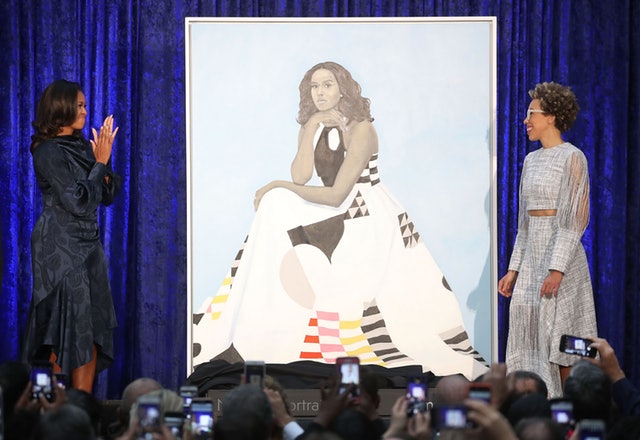
Obamas' National Gallery Portraits Unveiled

Michelle Obama, by Amy Sherald
Yesterday ago a public ceremony, former President Barack Obama and former First Lady Michelle Obama unveiled their official portraits for the Smithsonian's National Portrait Gallery in Washington, DC. The artists who painted the portraits, Kehinde Wiley and Amy Sherald respectively, were present at the event, and, like the Obamas, each artist spoke about the process and experience of painting these works, which, as the images reveal, will not only honor the first African American US President and First Lady, but also mark a distinctive aesthetic shift in terms of the ways they represent these major historical figures. It should also be noted that Wiley is the black man and first out, black gay artist to paint a presidential portrait, and Sherald is the first black woman ever to paint one. Amidst the foliage surrounding him, Barack Obama's portrait contains flowers with specific reference to and resonance for the 44th President of the United States. Michelle Obama's image shows a dress specially designed by designer Michelle Smith, under her company Milly, for her Spring/Summer 2017 collection. The dress has the aura not only of a unique flag, but also evokes the long African American and American tradition of quilt-making.

Mark Wilson/Getty Images News/Getty Images

The Obamas selected the artists who painted them. As both Obamas shared, they had discussed their portraits with the artists before the painting process, so neither was a surprise. Each artist had two sittings with the Obamas, and from those the created the portraits revealed yesterday to the public, each taking roughly one year. Both portraits went on display today, though they will not be shown together. President Obama's will become part of the official presidential portrait gallery, while Michelle Obama's will be visible through November 2018 in the National Portrait gallery's corridor of recent acquisitions. Wiley, 40 and a native of Los Angeles, is already quite well known as one of the leading painters of his generation, with shows and work in collections at museums and galleries all over the US and world. Moreover, Wiley had already received a US Department of State Medal of Arts in 2015, which meant that his work would be displayed in US embassies across the globe. Amy Sherald, 44, is less well known, but has had an ascendant career in recent years, winning the Outwin Boochever Portrait Competition at the National Gallery in 2016. She has suffered from congestive heart failure, which was diagnosed at the age of 31, and successfully received a heart transplant in 2012.

Mark Wilson/Getty Images News/Getty Images

Barack Obama, by Kehinde Wiley
I don't have an elaborate critique of either portrait, but in the case of Barack Obama image, I wish it had featured his beautiful smile. The encroaching foliage also struck me as having the potential for parody, though I read it as symbolic of his steps, often forgotten, to address the pressing challenges of environmental conservation and climate change, both of which are targets of reversal by the current occupant of the White House. In the case of Michelle Obama's image, I understand Sherald's recourse to grayish color for black skin tones, which she has discussed in various interviews and profiles, but I do wish she had nevertheless mixed things up and featured the former First Lady's beautiful hues. The dress fascinates me; its flatness and intersecting planes remind me of Gustav Klimt's and Ferdinand Hodler's work, as well as other Art Nouveau artists (is there a resurgence of interest in their work?), and folk art in its muted color and solid background, and both paintings, in certain ways, put me in mind of the work of peer artists Mickalene Thomas while also harkening back to their earlier black predecessor Barkley L. Hendricks. In both cases, I think we have portraits for the ages, and new standards for all subsequent presidential artists to aim for.

Tuesday, February 23, 2016

Sophia Nguyen on the Dark Room Writers Collective in Harvard Magazine

A few years ago, The New Yorker published an article, "The Dark Room Collective: Where Black Poetry Took Wing," about the Dark Room Collective that left a lot to be desired. Not only did it erase a good number of the members and participants, but it offered a sketchy overview of what the Dark Room was and achieved, in part because its ideological agenda was quite off-target. To put it another way, the ideological agenda it attempt to affix to the Dark Room was incorrect. Even the title was incorrect; "black poetry" had taken wing many times before the Dark Room's appearance, as the Dark Room's readings, awards and tributes more than made clear.

Other pieces about the organization--which I belonged to for many years-- are much better; in 1996, two years after the Dark Room's final reading series occurred in Boston, one of the Dark Room's most honored poets, Cornelius Eady, penned a brief piece with Kwaku Alston, "Reading Ahead," for The New Yorker that was much more on the mark, and in 2013, co-founder and poet Sharan Strange wrote an entry, "Total Life Is What We Want’: A Brief History of The Dark Room Collective," for Mosaic magazine that not only shared aspects of the organization's history but her vision of what its aims were and her sense of its place in the firmament of African American and American letters.

There have been other pieces, but one of the most recent entries, Sophia Nguyen's thoughtful, capacious, beautifully written article in the March-April 2016 issue of Harvard Magazine, "Elbow Room: How the Dark Room Collective made space for a generation of African-American writers," ranks among the best. Not only does Nguyen get the history and names correct and quickly dispel the fact that all the members went to or met at Harvard, but she also offers an overview of what the Dark Room's activities meant in their contemporary moment and might signify today, while not trying to use the writers and their works as a way of bashing particular traditions in the Black literary tradition (the Black Arts Movement, Umbra, etc.), or misreading the literature or cultural effects that have emerged from it.

The impact on the Boston literary scene were visible to anyone who was paying attention. As she notes:
“The Dark Room Collective was one of the more influential movements in the city of Boston,” says fiction writer Don Lee, an associate of the group. Lee, who first moved to the area to pursue his M.F.A. at Emerson College, and then became editor of the journal Ploughshares, observed how they shook up the “lily white” literary scene. “There was terrific energy, and it was contagious.” He helped write a grant application that secured the Dark Room $12,500 from the Lannan Foundation—“not a huge amount, but at the time fairly significant”—which helped cover the travel expenses of writers they were beginning to invite from farther afield.
Nguyen, however, goes further and talks about the "Drive By" readings, and much more, showing that the Collective, more than anything else, helped to create and expand a conversation which involved paying attention not just to what was happening in Boston, to the literary past and to peers around the country.

She also broaches critiques of Dark Room writers' work as "depoliticized" and "conservative," but as she goes on to suggest, as I would underline, works as diverse as Kevin Young's To Repel Ghosts or Natasha Trethewey's Thrall or Thomas Sayers Ellis's Skin, Inc. or Tisa Bryant's Unexplained Presence? These are all deeply political, and formally playful to challenging works, and they're only a small portion of what Dark Room writers have produced. Playwrights, visual artists, musicians, filmmakers, and scholars who were affiliated with the group have gone on to produce work that is both politically engaged and aesthetically challenging as well, and without question, all the various strands of black cultural production, from the past up through the Dark Room's moment, on through today, are visible in the art that has emerged from it.

Here's one more quoted paragraph that gives a glimpse of what the Dark Room was really like:

What the Dark Room gave to its members makes their output difficult to corral. It’s something Ellis has called “elbow room”—a jostling freedom of movement that made Bryant, all those years ago, feel unexpected exhilaration during her 40-minute phone interview with the Collective. Though she at first tried to fake a love of jazz and the blues—at the time, these genres were to her parents’ taste, not hers—she then admitted to being a fan of the Cure, the Smiths, and Siouxsie and the Banshees. “And it was the most miraculous thing, because suddenly we were doing these bizarre medleys of Smith songs and P-Funk and Run DMC and Billy Bragg and Psychadelic Furs and Joan Armatrading. It was outrageous,” she told her interviewer. In “Dark Room: An Invocation,” Elizabeth Alexander declares “the house/came down because/we knew how to read/each other, could code-switch/with the same fast dazzle.” Now it’s a critical commonplace to hear that some Dark Room writer can reference Homer and Tupac in the same space, making virtuoso maneuvers between different expressive registers. At the time, Bryant said to herself with relief, “Okay, I’m not the freak I thought I was.”

Do check the article, and the poems Nguyen quotes. They're a great place in the Dark Room literary corpus to start.

Sunday, January 31, 2016

Bomb Magazine 2016 Recommendation: Clarence Major

Recently BOMB Magazine offered me and other writers and creative types the opportunity to share my thoughts some of the many books we're looking forward to this upcoming year, so I selected poet, novelist and visual artist Clarence Major's forthcoming collection Chicago Heat and Other Stories (Green Writers' Press, 2016).

Major (b.1936 -) is the author of 8 novels, 14 collections of poetry (including the 1999 National Book Award finalist collection Configurations), 2 collections of short fiction (including this one), 8 works of nonfiction, and 4 anthologies, among them 1969's landmark The New Black Poetry. His essay "Necessary Distance," the title of an eponymous collection of nonfiction that Tisa B. turned me onto, is one of many compasses I periodically return to.

Despite his prodigiousness and originality--this is a man who wrote a novel based on the premise that a Connecticut law required husbands to carry their wives across thresholds at home!)--his work remains far too little known, and should be much more heralded, read and discussed, so I am particularly looking forward to this new book. For Bomb I wrote:

One book I’m eager to get my hands on is acclaimed novelist, poet, and visual artist Clarence Major’s forthcoming collection of short fiction Chicago Heat and Other Stories. Though far less known than he should be, Major, as original as anyone writing today, has been successfully experimenting with the formal possibilities of fiction for over four decades, and has developed a distinctive, accessible, and unforgettable style. I’m enthusiastic to read and learn from what he accomplishes in this new gathering of stories.
About the new book Major's publisher writes:

Chicago Heat and Other Stories by Clarence Major, employs a gorgeous purity and simplicity of language in a series of masterful analyses examining human interaction. Each narrative voice comes forward all at once, individual and complete, without obstacle or complication, enabling the reader to see the characters and feel their emotions. Major does not shy away from the bitter or the harsh; we get to hear it all. Like paint on an easel he blends lyricality with moxie and the blunt with the beautiful. The characters come together as easily as they part; people leaving, coming back, going, staying—it all sticks and fades like heat on your skin. The imagery is completely accessible and generously given. Toni Morrison comes to mind. His work is like jewels.
Based on what I know of Clarence Major's work, this description barely touches the surface. Check it out this year.

More book 2016 recommendations by Dawn Lundy Martin, Albert Mobilio, Alan Gilbert, Chelsea Hodson, Justin Taylor, Ander Monson, Ken Chen, and Lawrence Giffin at the BOMB Magazine site!

Tuesday, January 26, 2016

Art & Context Interview with Mendi + Keith Obadike


In addition to being friends Mendi + Keith Obadike are among my favorite contemporary artists. At one of their online sites, BlackArtNet, has been part of my blogroll for a decade now, and I have had the pleasure of writing about them critically in a paper set to appear later this spring. Collaborators and partners in life and art, and true multidisciplinary visionaries, Mendi+Keith have created a series of iconic artworks and performances across a range of platforms for over a decade and a half.

Recently, at Art & Context, Erin Sickler interviewed them about their work and lives, and the interview is full of insights on their practice, their aesthetics, and their goals.

Here are some quotes:
We moved through many zones to arrive at this sound centered practice that we have today. When we began we wanted to find our own way for music, language, and media to work together. We thought we might make a new kind of opera. We started talking about this around 1993, but we were already heavily involved in separate practices. Informed by a lot of experimental music and video work from the 60s & 70s and our experience with computers, we started seriously working online in the mid 90s. Working online was a simple way for us to combine our work in music, art and literature in one accessible frame. We were not living in New York at the time, so it was also a way for us present our projects to a large audience little or no institutional support. As we learned the language and nuances of the early world wide web, we began to explore all of the ways one might perform in this new space. We did live streams, animated gifs, text-based email projects, and sound pieces. All of those lessons (about communicating scale, giving a sense of register/tone, and projecting your energy in media) informed and enabled the work we would later do in brick and mortar spaces.
And:
In the 1990s we began calling the technologies of race (among other things) “social filters,” to think through the ways that technological and social dynamics on Internet and in digital culture were grounded in older cultural patterns. While racial discourse is of course implicated in our projects about social filters, we have always been interested to think about who gets to belong and who does not and what the barriers are to belonging. Race is one of the many technologies that delimit this belonging, but because our work is sometimes allegorical, there are also other issues explored in the work. That said, we’re often using the resources offered by African diasporic thinkers -- Igbo, African-American and other African writers.
And finally:
We think in times like these it becomes even more important to choose your media and limit your intake carefully. The flow of bad news can be overwhelming if you forget to step out of the stream. We stay focused because we know we are here to do this work. We know what art can do, and we are empowered by the lasting energy of the folks who came before us.
Do read the entire interview too, and don't miss them if they are speaking, performing or part of an exhibition near you.

Here are three videos featuring their work, including 2015's "Blues Speaker [for James Baldwin]," at the New School for Social Research.

Mendi + Keith Obadike's "4 Electric Ghosts" (2009)

Mendi + Keith Obadike's "The Earth (for Audre Lorde and Marlon Riggs)," Obadike Studio (Side A: "If the Heavens Don't Hear (A Roller Skating Jam for Marian Anderson)" + remix by Gordon Voidwell, and Side B: "The Earth Will Hear (for Audre Lorde and Marlon Riggs)"

Sunday, January 19, 2014

Amiri Baraka's Homegoing Celebration

Here are some photos from Amiri Baraka's (1935-2014) homegoing ceremony at the Symphony Hall on Broad Street in Newark. It was a remarkable affair, as much celebration as memorial, and drew major figures from across the Black artistic, cultural and political spectrum, including Amina Baraka, all of Baraka's children, Asha Bandele (who acknowledged Baraka's children by Hettie Cohen Jones, who were there with Jones, and Baraka's daughter with Diane DiPrima), Michael Eric Dyson, Danny Glover, Savion Glover, Haki Madhubuti, Tony Medina, Jessica Care Moore, Sonia Sanchez, Sister Souljah, Glyn Turman, Cornel West, and Saul Williams. Baraka's son, mayoral hopeful Ras Baraka, delivered an elegy for his late father that was, hyperbole excused, soul-stirring. 

I went in part because though I have not always agreed with--and have even outright rejected them--Baraka's positions and rhetoric, I can say without hesitation that he was and remains one of the most influential and important Black--American--writers of the 20th century, a towering figure whose stature, based on his creative and cultural work, will only grow. His poetry, his essays, his plays, his fiction, his central role in the development of the Black Arts Movement, his position as a founder of landmark institutions, his teaching and mentoring, and his long and sustained activism and resistance are all worthy of the highest consideration. I had the opportunity to hear and spend time with him several times during his life, including a car ride from Newark to NYU that nearly cost me my job (though he did what he could to ensure I kept it, as our delay was not my fault), and each time he demonstrated why he was the commanding figure people know him to be. 

May his soul rest in peace, poetry and power, and may the best of his words, the ones that offer visions of a better tomorrow, live as long as words live in and with us.

You can read my eulogy for Amiri Baraka, posted a week ago, here.

You may read others reflections on his life and work at First of the Month.


Saturday, January 11, 2014

RIP Amiri Baraka (1934-2014)

Amiri Baraka (at right), at NYU,
May 3, 2014


"What will be / the sacred words?" - Amiri Baraka

A great light, a fire, a forge has gone out of our literatures, our cultures, our society: Amiri Baraka has passed away. There are many important and a few major living poets, writers, social critics today; fewer still have assumed the mantle of change-agents, have put and continue to place themselves at center of social, political and economic, as well as aesthetic transformation, and done so continuously for most of their lives. The risks are tremendous, the payoff perhaps invisible and too small in personal, let alone broader terms. But Amiri Baraka did. He lived what he thought and believed, even when it was problematic or outright wrong, and in the process he played crucial roles in reframing how we think and see. If we think of him primarily as a poet, we should also consider that his poetry, and a poetics of the self, of the mind, of action, flowed through everything he did, whether it was producing literature across a range of genres (poetry, drama, fiction, essays, speeches, collaborative works, etc.), creating institutions and fighting to keep them alive, serving as a teacher, a professor, an editor, a mentor, a paterfamilias and parent, a polemicist, a friend, a cultural connector, a mage, working with activists of his generation and younger ones, being and living as a revolutionary and liberationist. He took very seriously, embodied, the charge of the ancestors and the principles espoused by W. E. B. DuBois in his famous essay, "Criteria of Negro Art." For Baraka, art and culture were not value-free or worthless, but, as the great Cape Verdean-Guiné-Bissauan poet and freedom fighter Amílcar Cabral pointed out, often weapons, and Amiri Baraka wielded them, when necessary, towards goals and aims far beyond himself or his career.

I first read Amiri Baraka's work in childhood, in an anthology (was it Black Fire!) that my godparents had in their library. In junior high, I am amazed to say, we read his poem "In Memory of Radio (for Lamont Cranston)," which I did not really understand--the radio's centrality to American culture having given way by then to TV--though I did grasp that at some elemental level I was picking up a frequency I had to pay attention to. By the time I graduated from high school I had decided to include a quote by Baraka on my high school senior yearbook page (along with quotes by Gwendolyn Brooks, T. S. Eliot (!) and Archibald MacLeish). Yet again I did not fully grasp what I was quoting--and did not realize until this past spring, when I was teaching my course on the "Black Arts Movement" at Rutgers-Newark that the words came from his introduction, as "Imamu Ameer Baraka," the first name he chose after ceasing to be Everett LeRoi Jones, as he was born in Newark in 1934, to Black Fire!, the landmark anthology of Black Arts Poetry--but something in his words spoke directly to me, almost like a life-force, and if I cannot remember much poetry by heart these days, those words, or a version of them, took root deep inside me.

An excerpt from Amiri Baraka's
"Foreword," from Black Fire!
Later, in college and after, I read quite a bit of Baraka's work, and found some of it deeply upsetting, confounding, enraging, especially his sexism, misogyny and patriarchy, his homophobia, his anti-Semitism; sometimes all of these can be found in just a single of his works, like "Black Art" or the play Mad Heart. Yet I also learned to read Baraka as a person of his time--my own father shared many of the same feelings and ideas, even if he never, expressed them as furiously or eloquently as Baraka, or became a Black Nationalist, Marxist, a Maoist--and to appreciate his deep love of black people, of working and poor people, of people engaged in the struggle whatever their race or ethnicity or gender or sexuality; I came to appreciate his ongoing self-criticism and self-correction, however stuttered it sometimes was, his capacity for reading himself and rethinking his views, and for his courage--and this is one of the greatest gifts Baraka has given us, in addition to the work--his remarkable courage, at speaking out, and then even greater courage in revising and recalibrating his views.
The Black Renaissance Noire panel
at NYU (Barrett, Ismaili, Baraka, Johnson,
Dill, Jess), May 3, 2014
As a writer and artist, I admire his tremendous prodigiousness and fluency, the richness and variability of his works, their capacity to engage the mind and the heart in multiple ways. I admire his critical acuity and facility, his ability to merge creativity and critique in ways that still hold value long after the moment of a given work's conception has passed. I admire the range of his learning and his ability to infuse his art with it. I admire his use of his own life, in multiple ways, as the ground for his art, and his fusion of times of life and art, his performance of his life as a work of political art. Had he merely continued writing only poetry, he still would have been a significant literary figure in the poetic firmament, his first five books alone worth dozens by other poets of his generation. Had he shifted to plays and stopped there, he would have ranked with Adrienne Kennedy as one of the most innovative American and African American playwrights of the 1960s, and with his revolutionary plays that appeared in the late 1960s, he would have cemented his fame alongside Ed Bullins and others. Had he written more fiction, he could have gained significant currency as an innovator in that genre. As a music critic he wrote one of the still salient--foundational--texts on Black music, Blues People: Negro Music in White America, and could have rested on those laurels for the rest of his life. As an essayist he was original from the start, and could have packaged all his essays together and used their afterlife as a calling card, if not to a cushy position somewhere--his battles in and with academe are legendary, though it is in part through his struggles and those of other black literary pioneers that I and many others have our jobs today--then to the lecture circuit. 

Outside of the literary realm, as one of the co-founders of the Black Arts Movement, as one of the political artists engaged in real-world politics in pushing for a national black political convention, as a force in New York and in Newark (New Ark, he labeled) it who helped to elect the latter city's first African American mayor, Kenneth Gibson, he could have operated primarily in the political and social arenas, with identifiable success in his track record. Yet Baraka did all these things and more. It is both the particularities and the holistic quality of his life and work that commend him to us and to the ages. He was that rare thing, the real thing, and even in the works that were less successful--some of the poetry of the 1970s, for example--the force of his drive to work through his vision and understanding, even if a misunderstanding, of the world still burns through.


"Ka 'Ba," from The Amiri Baraka Reader

I feel very fortunate to have met and spoken with Amiri Baraka several times. One story involving him that I have told many times (forgive me for repeating it again) involves a job I had at NYU in the late 1990s, which entailed sometimes going to pick up important visitors for a weeklong summer faculty development program. I was thus sent, via car service, to Newark, to go pick up Amiri Baraka at his home. Off we drove, we arrived at his house, I went in, and met his assistant, and then, we waited. He was getting ready, I believe--I don't think he was feeling his best then--and various people, all friendly, came and went from the living room. I cannot remember if Mrs. Baraka was there, or if I spoke with any of his children--I had met Ras Baraka some years earlier, when I was in my early 20s and with the Dark Room Writers Collective--but I vividly recall him finally appearing from upstairs, and then, we were off. Only we weren't. We had to stop to get his books and pamphlets, from another residence. I began to worry because given the awfulness of New Jersey and New York traffic at the best of times, but especially near rush hour, I could see us being late, possibly very late, and I knew my boss, and my boss's boss, the then-Senior Vice President at NYU, were not going to be happy. But I also had to accommodate our speaker. So as things proceeded at a glacial pace, our car eventually on the road and crawling from Newark through Jersey City to the Holland Tunnel, I sat there beside Baraka, and tried, despite my mounting anxiety, to make small talk with him and his assistant. (I wish I could remember his name.)

What did we talk about? His work, my admiration for him, Ras, black writing, NYU, all sorts of things. It was light and nothing went beyond the surface of my nerves or his politeness. He was not warm, but he also was not rude. I even summoned the brazenness to give him a copy of my first book. At some point, one of my bosses called my cellphone and said, "Where are you? You're late, and the big boss is thinking of firing you on the spot." I pleaded with him and tried to explain what was going on, but knew it was out of his hands. On we crept, inching forward, and Baraka could feel my anxiety, so he asked me what was wrong. I told him, and he urged me not to worry. Finally we arrived at NYU's Cantor Film Center, where he was to give his talk. All my colleagues were lined up at the curb, including the Senior Vice President. (Even she knew how important Baraka was.) The first thing he uttered after getting out of the car and greeting everyone was to defend me and explain why we were so late. He assumed all the blame, and even said something to the effect of "Do not fire him," quite forcefully, as if to preempt what at least one of the higher ups was considering. I apologized profusely and quickly, and then my direct boss said, "Just find out what he needs and bring him into the lecture hall." I accompanied him inside, he said he had to go to the bathroom, I made sure he was okay and he asked me if I was okay, and with that, he went into the packed hall where faculty members from all over the country were waiting, and brought the house down. It was one of the best lectures the program had witnessed, I was told, in its history. I kept my job.
Amiri Baraka, at NYU, May 3, 2014
Last spring I saw Baraka for the last time this past spring when I attended a May 3, 2014 launch reading for the Spring/Summer 2013, Vol 13.1 issue of the journal Black Renaissance Noire, edited by Quincy Troupe. Among the readers were Tyehimba Jess, A. Igoni Barrett, Rashida Ismaili, Lesley Dill, and Jacqueline Johnson. And Amiri Baraka. I thought I had blogged about this, but when I searched my posts it turned out that I hadn't, nor had I at the very least included the photos in my "Random Photos" post. He was fiery, feisty, full of life, referring to the provocative essay he had written on the anthology Angles of Ascent, but more than anything, he was vintage Baraka, a figure who in a few words could bring a room to life. All of the readers were superb, and I was glad that I caught the reading, but I especially wanted to speak with Baraka afterwards, because, since I was teaching his work, so wanted to say hello to him in person after the reading, express on behalf of my students their enthusiasm for him and the ideas of his and the other Black Arts figures that they were encountering, and ask if he would be willing to come speak to my class in the future. Without hesitation, he told me, "Yes." I asked a gentleman who was standing nearby to take our picture, and he only captured our hands, in a shake, though I didn't realize this until afterwards.  I think of that handshake now, and of all that I have gotten from Amiri Baraka, all that we all have received from him over the years, and without hesitation, I can say, Thank you. Thank you. Thank you.

Rest in piece, Amiri Baraka (1934-2014).

Amiri Baraka's hand, and mine 

Sunday, November 17, 2013

Jamal Cyrus & Benjamin Patterson @ Performa 13 (High Line, NYC)

Benjamin Patterson, attaching
my thought headband
This year's November in New York has brought many things, not least among them Performa 13, the biennial event-filled celebration of live, inventive performance in and around the city. Many of the events, like Rashid Johnson's staging of Amiri Baraka's landmark play Dutchman in an East Village bathhouse have been sold out since they were announced (or mentioned on nytimes.com or in The New Yorker), but one aspect of Performa that deserves unending praise are the public, free pieces that occur in large enough spaces that anyone who can get herself or himself there will be able to enjoy and participate in them.

Some years ago, the scholar Fred Moten gave a brilliant talk at Northwestern University on Fluxus pioneer and music innovator Benjamin Patterson (b. 1934-). Fred's descriptions of Patterson's work deeply intrigued me, and so when some of his compositions and other creations appeared at the Studio Museum in Harlem not long after that, I hightailed it up the island to see them. But viewing a conceptual and performance artist's works in a museum, enriching and inspiring though this may be, does not compare with witnessing the work being performed live, especially by the artist herself or himself, nor, better yet, with being an active participant oneself.

The High Line announcement
of the afternoon's events
As part of Performa 13 and in conjunction with the Radical Presence: Black Performance in Contemporary Art, curated by Valerie Cassel Oliver and presented in two parts, at New York University and at the Studio Museum in Harlem, Patterson was scheduled to perform a number of his works, both in gallery and performance spaces, and in public. Several of these events, like Pond, at NYU's Grey Art Gallery, quickly sold out, or, like Action as Composition: A Retrospective Concert, occurred on a night (and in Brooklyn) when I had to be on campus. But I did see--thank you, Performa 13!--that Patterson and a few other artists would be offering free public performances on the High Line, I vowed to take a break from my herculean grading duties and other pressing responsibilities (galley editing, etc.) and be there.

Originally I had also planned to see Jamal Cyrus's Texas Fried Tenor, a piece he developed in 2012 in which he fries a tenor saxophone, with a poem, and mixed and live instrumental soundtrack as part of the experience, but my lunch companion, Dorothy Wang, and I were running a little behind, so I figured I'd missed it. My friend also thought it sounded like avant-garde hijinks taken a bit too far, but the idea of frying not just anything, but everything, especially a saxophone, struck me as a particularly apt gesture for our contemporary culture, as well as a fitting tribute to Texas, African American, jazz, and black Texas musical culture. Rather than installing it in a museum, why not drop it all in burning oil? And, perhaps with a bit of Beuys behind the ears, there was no way anyone could directly consume it, except ephemerally, in the moment, or in documented form. No hardened arteries from this indelible inedible.

Yet when we reached the High Line at 14th Street, we could smell something burning, and lo, a crowd was gathered around a column of smoke, amplified crackling sounds were audible, and I spotted a brother dressed in all white that I figured must be Cyrus. It was he, and while we missed his recitation of a poem based on the tenor sax tradition, we did see his event's denouement, with incense, a bell, and a very different mode of saxophony than I'd ever witnessed before. That scorched instrument, lying in a metal trough, was playing itself something ferocious. Texas fried saxophone, in New York, indeed. The clips at the bottom of this page below the jump should give a sense of what it all looked and sounded like.

Jamal Cyrus, at his mixing board
Jamal Cyrus placing the fried saxophone
in an amped trough
Cyrus, mixing away
At a certain point, as Cyrus's performance was approaching its conclusion and in my search for a better vantage to photograph him, I happened upon an elderly gentleman sitting at a table with a flipboard sign announcing his event, "Penny for Your Thoughts," and just from his face alone I recognized him as Benjamin Patterson. I introduced myself and he invited me to have a seat, as I would be the first to participate in his performance. I wanted to let my friend know that I'd seen him, so I went over to where she'd sequestered away, to make headway into her own stack of student work, and led her to where Patterson was. By the time we'd returned, someone else, a scholar I know from the New York Public Library and an old friend of Patterson's, had taken a seat in preparation for the start of his performance, so I gladly decided to go second.

Benjamin Patterson, before his event
His idea was simple enough, but fascinating nevertheless. For 1¢ (a penny) he would buy thoughts from participants, which we would write down on a sheet of paper (I wrote 6, though it looked like 5), and then we could buy thoughts, also for 1¢ from him. I bought 10 cents' worth, which he deposited in his piggy bank. A mini-market for a neoliberal artworld and society, no? As a token of our exchange and purchase, we received a headband with new thoughts, culled from various magazines and newspapers Patterson had brought with him. He created it on the spot, using pink ribbon, strips of paper and staples, and then attached it to our heads.

He read the ideas we contributed, but diced them up into thin strips, which he may or may not have reused at some point. I wondered about that, though I was delighted to be able to think on the spot and let him know some of what was in my mind at the time. We kept up a sotto voce patter the whole time, and when I had received my headband and was walking away, several people stopped me to inquire what we were talking about. One person may even have jotted down my name and what I said; I should have asked where that was going, but perhaps onto another blog like this one.

I wore my headband for a little while, and the feeling of delight--and new thoughts--didn't wear off even after I'd taken it off, nor did the realization that I had an opportunity not just to meet one of the most original and still living figures in the Fluxus movement, but that I'd been fortunate enough to participate in one of his performances. For a free afternoon, that was invaluable. There's still two more weeks worth of Performa 13 performances, so catch them if you can!

My thoughts
My payment for the thoughts
Patterson making the headband

The two of us, chatting as he
makes one for the first participant
Receiving my thought headband
The next vendor of
her thoughts
Videos after the jump!

Saturday, July 06, 2013

Photos from This Winter & Spring II

Some photos from events I never got around to blogging. Enjoy!

Phyllis Levin, talking about John Donne
Phillis Levin, at the "John Donne, Re-Done" reading
and discussion at the New York Public Library
Levin, Donnelly, Cespedes, Dubrow and Jay Barksdale, at NYPL
Levin, Timothy Donnelly, Helen Cespedes,
Heather Dubrow, and Jay Barksdale, at "John
Donne, Redone" at NYPL
Fred Moten, Segue Series @ Zinc Bar
Poet, scholar and thinker extraordinaire
Fred Moten at the Segue Series, Zinc Bar
Tonya Foster, Segue Series @ Zinc Bar
The one and only Tonya Foster, reading
at the Segue Series, Zinc Bar
Anthony Gonzales drawing
Drawing by Anthony Gonzales,
Leslie Lohman Museum of Gay and Lesbian Art
Basement Gallery, Erotic Art Fair
Two artists, Erotic Art Fair, Leslie Lohmann
Two artists, Erotic Art Fair
(Anthony Gonzales, at right)
Paintings and drawings
Hallway, Leslie Lohman Museum of Gay and Lesbian Art,
Basement Gallery, Erotic Art Fair
Paintings and drawings
Some of the art on display, Erotic
Art Fair, Leslie Lohman Museum
Royal Shakespeare Company after their performance of *Julius Caesar* at BAM
Some of the cast members, Royal Shakespeare Company's
performance of Julius Caesar at Brooklyn Academy of Music
Nayland Blake two-way cabinet
Cabinet display, Nayland Blake, "What Wong Wreng,"
Matthew Marks Gallery
Nayland Blake sculpture
Standing behind one of Nayland
Blake's sculptures, Matthew Marks Gallery
Matthew Marks Gallery, photo of Nayland Blake installation
One of the displays, Nayland Blake's
"What Wont Wreng," Matthew Marks Gallery
At the Jean-Michel Basquiat show, Gagosian Gallery
Jean-Michel Basquiat show,
Gagosian Gallery (h/t to Mr. Reggie H!)
(photos were prohibited, so....)
IMG_9At the Jean-Michel Basquiat show, Gagosian Gallery268
At the Basquiat show, Gagosian Gallery
Nick Cave and dancer, HEARD NY
Artist and professor Nick Cave, with one of his
dancers, at his HEARD•NY performance,
Grand Central Terminal
The dance, HEARD NY
HEARD•NY performance,
Grand Central Terminal
Gary Simmons mixed media works
Gary Simmons installation, Metro Pictures
Artwork, Gary Simmons show, Chelsea
Gary Simmons paintings and installation,
Metro Pictures
Artwork, Gary Simmons show, Chelsea
Gary Simmons installation, Metro Pictures
Artwork, Gary Simmons show, Chelsea
Gary Simmons installation, Metro Pictures
Artwork, Gary Simmons show, Chelsea
Gary Simmons installation, Metro Pictures
Artwork, Gary Simmons show, Chelsea
Detail, Gary Simmons installation,
Metro Pictures
Self-portrait in front Gary Simmons' artwork
Self-Portrait with Gary Simmons installation,
Metro Pictures