Showing posts with label review. Show all posts

Friday, December 01, 2017

A Few New Interviews

This summer, I had the pleasure of chatting in person with Madison McCartha, who is currently a student in the MFA Program in Creative Writing at the University of Notre Dame. Madison had previously held conversations other writers, including the amazing Douglas Kearney and Rachel Galvin, to discuss topics under the rubric Polyphone: Interviews with Diasporic Poets. We ranged over all manner of things and people, and I really enjoyed meeting Madison and am looking forward to his work as it appears in the world. Recently the journal Full Stop published the interview, which you can find here. Many thanks to Madison for the excellent questions and thoughts, and to Full Stop for running this discussion.

Here's a snippet:

In an essay on the Poetry Foundation’s Harriett Blog, Ken Chen says he always finds himself “met with troubles [as] to how to fit something infinite like death energy of grief or the death energy of Empires within a box that is finite like a book of poems or a book of fiction.” I’m wondering what has been the difficulty for you in translating the sublime trauma of imperialism, as he calls it, and whether that process (of translation) expanded or complicated your thinking about it?

By all means. It’s extremely difficult, and part of the challenge is presenting it in a way that is comprehensible to people today. Because on one level, yes, we can try to imagine what it would be like to be a black soldier in a battle in the US Civil War. On the other hand, I think it’s quite difficult to ever imagine what that experience was like. I mean consider the multiple layers of precarity that that person was embodying, but also, at the same time, their extraordinary bravery: to put oneself in extraordinary danger, not just for one’s own home but so many others. What does that mean? What does such a radical practice of freedom look like? How do we depict it?

There are multiple ways. Creating scenes, and creating characters, to tap into emotions elusive to us and yet that we know intimately: that is a form of translation. That’s something art can actually do, that other forms of writing can’t, or not exactly. Moreover, there is the question of the larger canvas, of colonialism and empire: how does a fiction writer convey these larger systems and structures without didacting, without essentially writing an essay (though there are hybrid fictional-essay forms that would work well)? What does it mean to put pressure on the usual recourse to the individual, when what we need is this larger backdrop, which tends to go missing in so many of our public discussions?
***

A few years back, perhaps shortly before Counternarratives was published, I met up with writer, scholar and activist Rochelle Spencer to discuss the topics of Afrofuturism and speculative Black writing and poetics, but I'd forgotten about it until she alerted me that our exchange was set to appear in Chicago Literati, and it did this past spring (April). Here's a link to the piece, which Rochelle titled "'Like Currents in a River': A Conversation with Speculative Writer John Keene." Since this discussion occurred before the many since Counternarratives appeared, it was a bit more free-wheeling in many ways. Many thanks to Rochelle (now Dr. Spencer, I believe!) and Chicago Literati for running it.

Here is one Q&A exchange from that conversation that centers on the Black Arts Movement:

RS: You just alluded to the Black Arts Movement. How did the Black Arts Movement influence the Dark Room?

Keene: The DNA of the Black Arts Movement is in every contemporary Black American poet and in Black poets all over the world, whether they acknowledge this influence or not. The ideas of self discovery, black pride, connection, to do something on your own rather than waiting for someone else to do it—those ideas were central to Dark Room Collective writers in their youth, so I feel we wouldn’t have been possible without them, without the crucial well of Black Arts Movement poets. They are invaluable, and they remain invaluable, though people sometimes talk about the Movement as if it failed. I think counter to that: their influence will continue well into the first century and beyond.

***

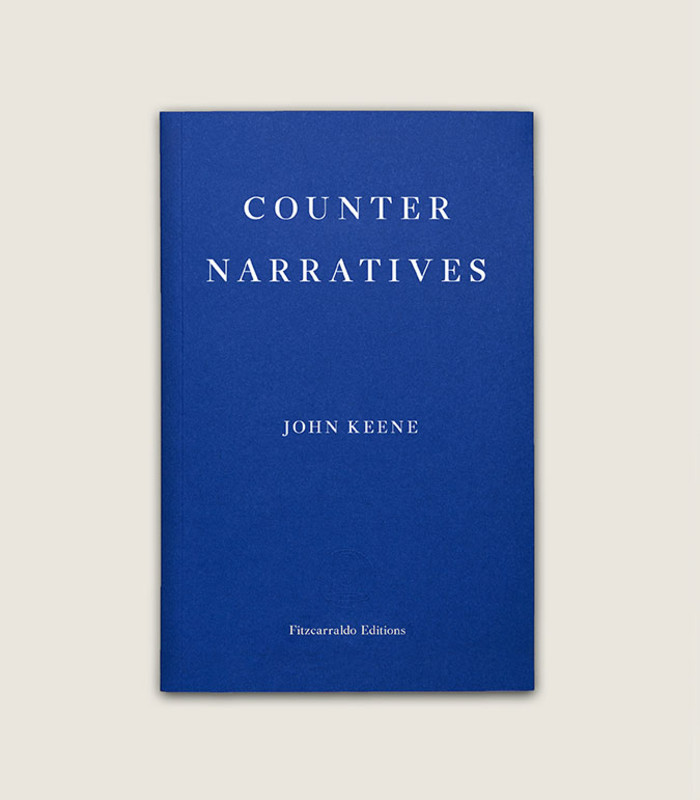
Lastly, I don't think I'd mentioned on this blog that, by some strange turn of events, Counternarratives finally received a review, two years after its hardcover debut, and a glorious one at that, in The New York Times Book Review this past September. I extend my profound thanks to writer and critic Julian Lucas, who authored the long and insightful review essay, one of the finest and most in depth the book has received. Titled "Epic Stories That Expand the Universal Family Plot," it situates the collection in relation to the history of fictional family sagas in order to show how it performs, as it were, a kind of queer affiliation and relationality, how it embodies a different understanding of history and kinship, that might offer a way forward for the future. (I have decided not to expend any additional energy trying to figure out why the Times completely ignored the book when it appeared in 2015.)

Here is how Lucas ends his review, a fitting tribute to the book and to many who are tending similar literary and artistic gardens:
Entranced by the ancestor who crossed on the Mayflower, escaped from the plantation or started anew in a hostile foreign city, we too often limit our retrospective gaze to those predecessors who made provisions for a future we recognize in our own present. We deprive ourselves of people whose visions were never realized, who left no obvious legacy. More people have lived on earth than the tendentious nets of genealogy — inevitably tangled in the chronologies of faith, race, nation — can catch, and we are connected to them by threads more subtle, and resonances more profound, than have yet been explored. Imagining those lives, deeply and without the prejudice that they must be prologue to our world, can be both radical and beautiful.

Wednesday, September 14, 2016

Contrenarrations: the French Edition of Counternarrations On Bookshelves

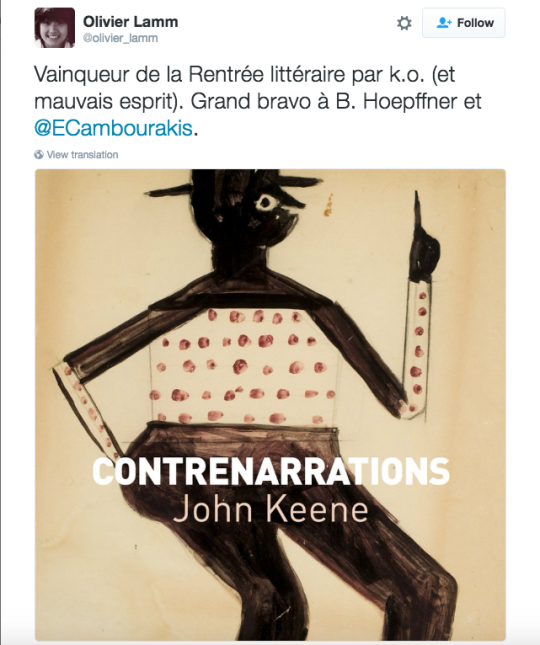
On August 24, the French edition of Counternarratives, published by Éditions Cambourakis, retitled Contrenarrations and superbly translated by Bernard Hoepffner, hit bookstores. (As I may have written before, Hoepffner was one of the most perspicuous editors I have ever worked with, and perfectly complemented my excellent New Directions editor Barbara Epler.) Cambourakis chose a painting by the great Bill Traylor to grace the cover, maintaining the theme and style of the New Directions cover, but endowing it with its own distinctive look:


There have been several short prose reviews so far; the first, by Emmanuel Requette, on the website of Librairie Ptyx, was one that the translator, Hoepffner, forwarded directly to me. It's very good. A brief quote:

Ce n’est pas Le Noir, La Négritude, L’opprimé qui est le cœur de Contrenarrations, mais sa parole. Brimée, bridée, brisée, mais jamais éteinte, conservant dans la possibilité de son advenue toute sa force. Mieux encore, enfouies sous des couches de silence forcé, semblent y avoir mûri des manières plus subtiles et fécondes de rendre compte. Jamais inutilement post-moderne, ni victimaire, ni doloriste, Contrenarrations consacre génialement le rôle impertinent et salvateur de la forme.
[Rough translation: It isn't the Black Person [or Blackness], Blackness, the Oppressed that is the heart of Counternarratives, but their speech. Bullied, constrained, broken, but never extinguished, keeping all its force in the possibility of its occurrence. Better still, buried under layers of enforced silence, seeming to have ripened in more subtle and fruitful ways of taking account of things . Never uselessly postmodern, nor playing the victim, nor lugubrious, Counternarratives brilliantly consecrates the impertinent and saving role of form.]
On their Facebook page, Éditions Cambourakis also features this review by Damien Aubel from the French monthly magazine Transfuge's coverage of the August rentrée littéraire:


I also came across the following tweet, by Olivier Lamm, about Contrenarrations' appearance at a recent Rentrée littéraire in Paris (I think): he says that the book was winner by knockout (and evil spirits--referencing several characters in the collection)! It's nice praise and I'll take it!

Monday, January 12, 2015

Review: Empire (on Fox)

Terrence Howard and Grace Grealey
(Photo still © Chuck Hodes)
Like almost everyone we know, C and I made time to catch Empire, the new midseason drama that debuted on Fox on January 7.  Extensively ballyhooed on Facebook, Twitter and elsewhere, Empire is the creation of Academy Award-winning director Lee Daniels and Danny Strong, and aims, as some accounts I have read suggest, to be a fusion of Dynasty, the 1980s evening soap opera, hip hop, and King Lear. And don't forget The Sopranos. It definitely has Dynasty's melodrama and larger-than-life acting, a good deal of original hiphop in its soundtrack, and Shakespeare's three battling children (including a queer Cordelia figure), as well as the former New Jersey show's cast of semi-domesticated gangsters, but whether it all works together--though it most definitively is the work of Lee Daniels, as anyone standing in the next room overhearing could tell without much effort--is another matter.

Empire tells the story of music mogul Lucious Lyon (Terrence Howard), who has raised his three sons Andre (Trai Byers), Jamal (Jussie Smollett) and Hakeem (Bryshere Gray) by himself as his ex-wife Cookie (Taraji P. Henson in an every-scene-stealing performance) has served time for a drug conviction, though when the series starts, she's just been released, of course without anyone else's foreknowledge. It's unclear how old Lucious is supposed to be--yes, black don't crack but the man doesn't appear a year over 45, even though his eldest son could be nearing 30 (it is biologically possible, I know)--but he is thinking about his eponymous empire, which he is about to take public, and about his potential successors. By the end of the pilot episode, he also receives health news that will eventually take him off the show (unless it turns out to be a misdiagnosis; the writers have written themselves in a bit of a corner with this one). He also commits a mortal crime (I don't mean the hair), but it's so clumsily handled that it can only lead to serious problems.

In Lear fashion, the sons don't exactly delight in each others' time. Andre, the eldest and CFO of Lyon Entertainment, feels he doesn't get enough respect from his father because of his lack of musical ability, suffers from bipolar disorder (I'm almost cringing to see how this is depicted), and is married to his white college sweetheart, Rhonda. Jamal, who possesses enough music skills to make Prince jealous, is openly gay, anti-corporate, estranged from his father--who, in a scene taken from Daniels' life but nevertheless horrifying, throws the child in a trashcan (!) when he appears in drag during a family party--and lives with his Latino boyfriend, Michael (Rafael de la Fuente). Hakeem, who struck me as the least well drawn character so far, parties too much, loves older woman (Macy Gray, Naomi Campbell, etc.) and holds deep hostility towards his mother for having abandoned him (prison, remember). He would send the "Empire" down the drain if left with it for too long.

Bryshere Gray and Jussie Smollett
(Photo still © Chuck Hodes)
That leaves Cookie, who blows out of prison like a tornado and heads first to see her children, to reconnect with them if not exactly to make amends. She wants to manage Jamal. She wants respect from Hakeem, whom she beats with a broom (!) to show him she still Mama and boss. (Cookie don't play that....) She wants her piece of the company. She wants to head the company's AR division. She...well, fill in the blank. Henson is a talented actress, with a capacity for small-scale to megadrama-style acting, and so it was no surprise that once she made her appearance, especially in this role, she would turn things out. One problem with her scenes, though, is that it's not clear Daniels has found the right surrounding frame for her yet, throwing everything off and rendering the proceedings a bit cartoonish. The general tinniness of the dialogue--though there are some great moments--does not help. 

Other characters include Grace Grealey as Anika Calhoun, Lucious's lover and head of Empire Entertainment's AR division and thus Cookie's rival; Malik Yoba as Vernon Turner, a longtime friend of Lucious' and chairman of the company; and Antoine McKay as Bunkie Campbell, a longtime homeboy of Lucious and Cookie from back in the day who ends up paying a serious price for speaking up for himself. Also filling out the cast is actress Gabouré Sidibe, with blond highlights no less, playing Becky, Lucious' assistant. None of these characters was especially compelling, though something tells me that in addition to Bunkie's seeming demise, we may witness some of these other characters taken out or with their hands on a trigger of some sort. I sincerely hope Yoba gets to do more than sit and take insults, and that Sidibe isn't racing breathlessly behind Howard in future episode.

The show raises lots of questions, including whether focusing on a faltering industry, and in this way, is the right setting for a 2015 series; were this show set in 1990 (or had it been made then), it might have resonated much more in every way, but today while there are still music companies, both indies, semi-independents and those fully attached the conglomerates, we can see a cavalcade of their members and participants with minimal varnish and maximum drama on Real Housewives of Atlanta or Love and Hip Hop Atlanta, New York or LA. Are the technical aspects of music-making that this series features anachronistic today? Indeed, the entire landscape of music as an enterprise, along with related industries like music journalism, music TV, etc., has been transformed. Other than Henson's or Smollett's characters, was anyone on the show half as interesting or compelling as Stevie J and Joseline, Li'l Scrappy, Erica Mena and Sin, Joe Buddens and Tahiry, Peter and Amina Buttafly, or Ray J and anyone else on that LA mess factory?

Taraji P. Henson and Terrance Howard
(Photo still © Chuck Hodes)
That the show traffics in stereotypes also rankled, but I know that drawing with broad and familiar strokes is Daniels' purview, and seeking too much subtlety probably was asking too much. Nevertheless, given the paucity of shows about contemporary Black life, anyone traveling this road should make the best effort possible. Respectability isn't the answer, but neither is a lack of complexity. But we will see. The treatment of homophobia, also played into stereotypes. A harshly homophobic Black father isn't such a stretch, of course; I've lived that scenario myself. But did Cookie have to refer to her son as a "queen" and his boyfriend using a feminine pronoun? It was a positive step that the boyfriend ended up being Latino (and we learned that an earlier one had had dreadlocks, if I heard correctly), so the gay = white equation didn't hold. But I will be interested to see how the series plays with Jamal's character, and whether in the interests of pleasing the broad audience, homonormativity becomes Jamal's norm. As is, he's refreshingly distinctive as TV show portrayals go.

One last question that I could not stop asking was: WHY is Terrance Howard running around with a conk? I kept trying to think of figures he might be based on, but since the show is set after 1965, I confess to bafflement. I could even see an old head with 1) a high-top fade--late 80s still and forever, 2) a fro, 3) a Jheri curl, 4) even dreadlocks or a Quo Vadis, but that pressed hair seems straight out of someone mistaken fantasy. His clothing choices also seemed off, as did Hakeem's, but that could just my finickiness. That said, all the houses, cars, and bling do seem appropriate, so perhaps a bit of recalibration can get the show to where it needs to be. But this is just my opinion; it turns out, unsurprisingly, that a good portion of viewers are starved for representations of anything involving Black people or other people of color, and Empire's first night ratings were through the roof. I enjoy watching beautiful people, especially black people, doing their thing, as well as a good soap opera, so I will be tuning into Empire next week too.

Thursday, November 24, 2011

Happy Thanksgiving!

A happy Thanksgiving Day to all, and I wish the best to all J's Theater readers. Wherever you are, whatever you are doing, try to take time out to consider what you have to be thankful for, as tiny or tremendous as it is, and also consider how you might help someone else out there who might be struggling in some aspect of life.

For those who are preparing holiday meals, if you want a thorough and easy-to-read guide to holiday cooking with a soulful edge, consider C's Holiday Kitchen, which is now available as an ebook on the Amazon Kindle, B&N Nook and iTunes stores.

There's also an iPhone/iPad app version as well.

I can attest to the deliciousness of every dish in this book. But don't just take my admittedly biased advice: as Maggie Da Silva writes in her Examiner.com review,  the author

is no snob and helps us out with painless instructions for turkey roasting, “one of the easiest meals to prepare,” he writes. “Try it!”  He also provides simple recipes for dishes I had assumed were beyond my reach – like lemon curd! Who knew it was a snap? In fact, most of the recipes in this delectable ebook reveal what all experienced cooks know: food doesn’t have to be complicated to be great.

So true!

I am going to make an apple pie, so if it turns out okay, I'll post a photo of it!

Update: The apple pie! It turned out well, and everything about it, from the crust to the filling, is homemade!

Apple pie I baked for Thanksgiving Day

Thursday, December 06, 2007

Congrats to Tisa & Renee + Johnson Slammed + Shakespeare's Cognitive Art + LGBTT Conf. in Brazil


Since I can barely read computer screens these days or type more than one sentence without a major spelling--which becomes a grammatical--error, I almost thought about using images like the one above, somewhat like what I used in an online piece eons ago. But I'd probably mix those up too. I'm too trifling to get my act together to film it properly, but if I could, I'd film the hibernation I hope to engage in in a little more than a week's time.

***

Congratulations are in order to two friends, Tisa Bryant, and Renee Gladman, who have just published new books. Tisa's book, Unexplained Presence (Leon Works, headed up by none other than Renee (=fierce)), is a daring hybrid work incorporating literary and film criticism, autobiography, and fiction that opens up an array of reading possibilities and pleasures, and you even get to converse with Othello, Julie Christie, Afro-English-women, and Caribbean and California Negroes, to name just a few.

Renee's new volume, Newcomer Can't Swim (Kelsey Street Press--and yes, her title, like Tisa's, is signifying!), is listed as poetry by Small Press Distribution but like Tisa's text, though in a different way, it deliciously breaks genre wide open and reconstitutes it. I'll be nourishing my neurons with these two texts, and I hope--know!--you'll check them out too.

***

After having read Denis Johnson's stories in Jesus' Son many times with delight, I decided to start teaching some of them, and for the last few years have been using "Emergency," a horrifyingly compelling tale, in my intro class. It never fails to spark amusement, awe, conversation, and imitation, though the students' personal knowledge one of the story's central elements, mind-altering drugs, is thankfully much more greatly reduced--at least based on what they tell me and what their responses indicate--than would have been the case with students of my generation. I have not read the prolific Johnson's plays, poetry collections, novellas or novels, however, since Fiskadoro, which would have been, well, back when I was the age of my students (yes, that long ago), but I keep saying I'm going to read at least one of his novels published since then, and I recently thought that I'd start with the most recent, Tree of Life, which has received rave reviews and this years's National Book Award.

But there's someone out there who thinks rather differently about Johnson's new novel, and s/he's not mincing words, the one-and-only, which is to say, notorious, R. B. Myers, in this month's Atlantic. You have to read the stunningly waspish "A Bright Shining Lie" to get the full dose, but here's a sting:

Not being religious myself, I do not feel personally insulted by any of this, and lest other tempers flare, let me make clear that free-thinking Skip, the man who wants the truth to wet him, cuts the silliest figure of all. Besides, most of Johnson’s prosethe metaphor of the jungle as screaming mosque, for exampleis too imprecise and empty even to give offense. One closes the book only with a renewed sense of the decline of American literary standards. It would be foolish to demand another Tolstoy, but shouldn’t we expect someone writing about the Vietnam War to have more sense and eloquence than the politicians who prosecuted it?

Those two qualities are linked. There can be no deep thought without the proper use of words, as our current president never fails to demonstrate. This is why it is dangerous to hold up bad English as good and why Philip Roth should know better than to announce that Johnson writes “prose of amazing power and stylishness.” There are people who will take that seriously. Less worrying, because so obviously lunatic, is Jonathan Franzen’s blurb: “The God I want to believe in has a voice and a sense of humor like Denis Johnson’s.” Really? Then God help Jonathan Franzen.

Ouch!

Anyone else want to weigh in on Johnson's new tome? Or least offer a counterweight to Myers's sledgehammer?

***

On a related note, since I mentioned Shakespeare the other day, I have to post a link to this short piece by Philip Davis, editor of the Reader (?) magazine. He surmised that Shakespeare's verbal artistry might have cognitive effects, and decided to test things out with several brain researchers. His specific experiment examined the effects of what linguists call "functional shifts" or "word-class conversions," which is to say, those moments when Shakespeare substitutes one part of speech for another, with minimal change to the sentence's shape or syntactic arrangement. He cites three examples: in King Lear, "He childed as I fathered" (nouns shifted to verbs); in Troilus and Cressida, "Kingdomed Achilles in commotion rages" (noun converted to adjective); Othello, "To lip a wanton in a secure couch/And to suppose her chaste!"' (noun "lip" to verb; adjective "wanton" to noun). And the result was...well, I'll let you read it, but it's pretty fascinating. One interesting aspect of the piece is that although Davis is an editor and a teacher, he doesn't mention "rhetoric" once in the piece, though the particular effect he's describing is called "anthimeria" and is a form of the rhetorical device of "enallage." Please correct me, Shakespeare readers and scholars, if I'm incorrect, but anthimeria appears frequently in the later plays, which leads me to believe that once the Bard latched onto this wonderful device, like so many others (one of my favorites, which I started noticing in a few of Elizabeth Alexander's poems a few years ago, is epizeuxis) he wasn't going to let it go given its ability to...well, you'll have to read the article! But it appears in other authors, and especially in great frequency in e. e. cummings's poems, where he elevates it to a central aesthetic principal. Think of his famous poem, "anyone lived in a pretty how town," for example. (Does anyone teach cummings any more?) I'm curious to see what other research projects using Shakespeare or other authors Davis undertakes, and what the results are. Meanwhile, start paging your Macbeth...

***

Recently the Noctuaristocrat Reggie H. (who convinced me to start reading Alex Ross's The Rest is Noise, which I can't put down), forwarded an article about Bahia, Brazil's "Black Rome," becoming a key travel destination for African-American tourists interested in that state's strong and enduring African cultural retentions (shaped, of course, by their development in Brazil over centuries). (João deS. forwarded the same article later that day, so thank you.) Authenticity, baby. I've written a bit on here about this topic, and the post led me to check out Brazzil.com, which had another interesting article, on Brazil's first nationwide LGBT conference, which will take place in May 2008 and be sponsored by the Brazilian government, a Latin American first. (Actually, it'll be conference on Lesbians, Gays, Bisexuals, Transvestites and Transgenders.)

Brazil's Socialist president, Lula, is firmly supporting it, and has decreed that it will be held

under the auspices of the Special Secretary of Human Rights of the Presidency of the Republic, with the objectives of 1. proposing the directives for the implementation of public policies and the national plan for promoting the citizenship and human rights of gays, bisexuals, transvestites and transsexuals - GLBT, and 2. evaluate and propose strategies to strengthen the program Brazil Without Homophobia.


How refreshing, and what a stark contrast with US politicians, including many of the supposedly "progressive" presidential candidates, who for the most part still can't help but speak out of both sides of their mouths when it comes to LGBT issues. So consider attending it along with a visit to Bahia; I had to check another site to find out that it's taking place in the post-urban capital Brasília, a city I've never visited, though I hope C and I get to see it one of these days soon.