Showing posts with label jazz. Show all posts

Friday, August 17, 2018

Aretha Franklin, Queen of Soul


Though I knew she had been ill for some time, it was still a shock to hear that Aretha Franklin (1942-2018) had moved to hospice care earlier this week and that yesterday, she passed away in Detroit. One of the greatest, most vocally gifted and agile singers of her generation or any other, with a rich, layered mezzo-soprano voice that could project with tremendous power and draw emotion out of each note, she set the standard for her peers and all who followed her, earning the title of the Queen of Soul in 1964. But as she proved throughout her career, in addition to possessing major talent as a pianist, she also could sing gospel, the musical genre she grew up hearing and learning in the church, New Bethel Baptist, led by her legendary father, Rev. C. L. Franklin; R&B, in which she became a superstar; pop, leading to her early fame; the blues, which suffused all of her music; rock & roll, as she proved in the 1970s; jazz; and even classical operatic music, as she demonstrated to the world (though close friends like Grace Bumbry knew it) when she stepped in for Luciano Pavarotti on national TV and sang "Nessun Dorma" at the 1998 Grammys

A path blazer as a woman in the music industry who at age 12 joined her father on his "gospel caravan" tour, Franklin also received acclaim as a strong supporter of the US Civil Rights Movement and of Rev. Dr. Martin Luther King, Jr., joining him on tour when she was 16, and singing at his funeral after his assassination in 1968. She attempted to post bond for Angela Davis after her arrest, and remained an ardent supporter of the Black fight for civil rights and equality, not just in the US but in South Africa and across the globe. After moving back to Detroit to take care of her ailing father, who had been shot twice at point blank in his home, she kept the city as her chief residence, supporting local artists and its communities through her philanthropy. LGBTQ equality was among the many other causes Franklin championed. (This summary only scratches the surface of her life, which included considerable challenges from childhood on through her final illness.)

Her catalogue includes over 40 studio-produced albums, twenty Billboard Number 1 singles, beginning with "I Never Loved a Man (The Way I Love You)" in 1967 through "Freeway of Love" in 1985, and countless awards and honors, including 17 Grammys in categories ranging from Best Female R&B Performance to Best Soul Gospel Performance to Best Traditional R&B performance; Grammys Legend, Lifetime Achievement and MusiCares Person of the Year awards; American Music Awards; NAACP Image Awards; Kennedy Center Honors (she was the youngest person to receive the award when honored in 1994); the first woman inducted into the Rock & Roll Hall of Fame, in 1987; induction into the Rhythm & Blues Music Hall of Fame and GMA Gospel Music Hall of Fame; and a 1981 star on the Hollywood Walk of Fame. I would be remiss if I did not mention her brief but unforgettable turn in the iconic 1980 movie The Blues Brothers, in which she sang "Think," which won her a whole new slew of younger fans. Though she has now left the mortal plane, her music, perennial and enduring in its beauty and power, will always be with us as testimony to her greatness. 

Here are some videos of Aretha Franklin performing some of her countless hits. May she rest in peace and sing on in the great beyond.


Aretha Franklin ‎- Spanish Harlem (Single Version 45rpm / 1971) / HD 720p


Luther Vandross & Aretha Franklin - A house is not a home (live)


Aretha Franklin - Amazing Grace (Live 2014)


Aretha Franklin at Barack Obama's Inauguration, January 2009


Aretha Franklin - I Say A Little Prayer: her very best performance, October 9, 1970


Aretha Franklin Nessun Dorma Grammys 1998


Aretha Franklin & James Brown - Please, Please, Please - Soul Session - 1987


Respect - Aretha Franklin, 1967


Aretha Franklin - Chain Of Fools Live (1968)


Aretha Franklin - Think (feat. The Blues Brothers) - 1080p Full HD


Aretha Franklin - Bridge Over Troubled Water


Watch Aretha Franklin Make President Obama Emotional, Kennedy Center Honors, 2015


Aretha Franklin - Mary Don’t You Weep - Soul Train - 1979


Aretha Franklin - Freeway Of Love (Video)


 Who's Zoomin' Who?, 1985, Sony Music Entertainment


Aretha Franklin - Rolling in the Deep / Ain't No Mountain Live Adele Cover Version

Aretha Franklin "(I Can't Get No) Satisfaction", 1st Festival international de jazz à Antibes, ORTF, 1970.


Aretha Franklin, Jimmy Lee, 1986, Sony Music Entertainment

Thursday, August 16, 2018

Annotations Playlist (by Keith Ridgway)

One of the joys of the internet, and of Twitter--horrible social media platform though it sometimes can be--is the serendipity of coming across positive public notes and links, among them responses others might have to your work and you that you might otherwise not see. I appreciate these especially at a time when letters and even emails are less common than they once were. (I have never received many letters from readers, positive or negative, let alone emails, concerning my work, at least without something else being involved, like an invitation to read or a request for a blurb.)

The other day, after signing on to Twitter, I saw that I had about 8 notifications, and once I clicked on the button, I saw the following post, by the great Irish author Keith Ridgway, whose Hawthorn & Child (New Directions, 2013) I thought was one of the best and most original novels of that year. It is an anti-detective novel in the best way, and exquisitely written, with sections of such striking strangeness I had to read them again. For whatever reason--its freshness? its queerness?--it did not receive the attention it deserved when it appeared. (Perhaps some forward-thinking British director will make it into a feature film, with David Oyelowo, David Gyasi, Daniel Kaluuya, Ashley Walters, Aml Ameen, Gary Carr, David Ajala, or Jimmy Akingbola, to name just a few the talented British actors out there, starring as the eponymous Child, and Max Rhyser, Simon Woods, Jeremy Sheffield, Kieron Richardson, or Andrew Hayden-Smith, to name some of their counterparts, as Hawthorn.)

Scrolling through the thread, I saw he'd posed a prior question:


As he realized, no one had recently--I seem to recall someone doing many moons ago, perhaps in the mid-00s?--so he compiled one himself, on Spotify, the streaming music service I have to admit to having never signed up for. (I only signed up for Last.fm among the more recent streaming services, and, some years back, Naxos, which basically streams album clips of classical European and American art music with some jazz.) He culled most of the musical references, and this is the marvelous playlist he came up with:


You can access it here even if you aren't signed up for Spotify.

Keith Ridgway expertly includes references from the direct mentions of standards, like Ahmad Jamal's "Poinciana" and Thelonious Monk's "Pannonica" to more subtle ones like "Afro Sheen," which is both the hair product and a song, as he shows, by Stephen Sechi. Another reference he susses out is "Dance of the Infidels," by Bud Powell, and he selects Josephine Baker's stirring "De Temps En Temps" in response to a reference to Baker in the text. (She was a native St. Louisan.)

There are some not on the list, like John Coltrane's "Naima," though "Ruby, My Dear" is here, and the R&B references, to Marvin Gaye and The Stylistics, are also in the mix alongside all the jazz. Reading his list and listening to the snippets was almost surreal, as it carried me back to my father's immense record collection when I was growing up in the late 1960s and throughout the 1970s and early 1980s, the exact time span of Annotations. It also gives deeper insight into the sound- and cultural world of the novel-memoir, and for that, I offer my deepest thanks to Keith Ridgway, and urge Spotifiers to check it out!

Tuesday, April 10, 2018

Cecil Taylor (1929-2018)


Another one of the greats, Cecil Taylor, is gone. He passed away on April 5. As longtime J's Theater readers know, I've posted about Taylor many times, including on his 86th birthday, back in 2015; when he appeared on NPR back in 2012 (along with my poem about him and his music, "Dark to Themselves," which appeared in Jazz Poems, edited by Kevin Young); my afternoon in 2007 watching the marvelous documentary Imagine the Sound with Northwestern colleagues Kevin Bell and Ed Robersonback in 2005, on his 75th birthday; and again in 2005, when I saw him perform live at the Blue Note, in Manhattan ("Apraxia, apraxia, apraxia!"). (I wanted to meet him then but only got a glimpse of him peering out through the crack in his green room door.)

I described how he opened the performance like this (the Keith I mention is Keith Obadike, who was there with his wife and fellow artist Mendi, as were Christopher Stackhouse, his partner Kelly Kivland, and a friend of theirs named Lute):

Taylor, as Reggie H. and others have described, entered dramatically, this time in his striped socks after his bassist and drummer had opened the set as a duo, Balgochian doing some interesting moanful bow-work with the lowest portion and register of his bass strings. Then he extracted a handwritten score/graph/chart, which I assume, in my gross musical ignorance, contained the melodic kernel he was going to develop and improvise off of, as well as some harmonic guides and cues, some text and the gods know what else (scribbles? quotes?), CT proceeded to recite an opening poem that riffed off "Chinampas 1," which I listened to again today. Then he and the trio launched into this long and furious set. Afterwards I told Mendi and Keith that it reminded me of a player piano that had caught the Spirit (and spirits) and was revved up by multiple motors. Keith put it more succinctly: "A player piano speaking tongues." Krall, who appears on CT sessions from around 1996 forward, seemed to flow well with CT, sometimes pacing, other times mirroring, other times chasing CT's polymetric races along the keyboard, but Balgochian sometimes seemed out of sync as if he couldn't catch up or missed some of his cues (sometimes his expression betrayed this) or just wasn't up for it, though he gave it a valiant effort. He did know enough to stop on a dime, like Krall, when CT (maybe giving a visual cue) ended the pieces.


Reading some of the obituaries of Taylor, I appreciated how they captured differing facets of who he was and what he accomplished. He was, as the 2005 performance demonstrated, at his very core a poet--experimental, searching, daring, profound, uncompromising, his medium and grammar extending from words into space, and onto the keyboard, via notes themselves. Sound and time were his true media. Pushing the evolving jazz conventions from the very beginning, Taylor kept developing and trying out new possibilities, individually and with ensembles. A native of Queens, he deftly combined a wide array of influences, drawing from the blues, other African-American, Euro-American and European sources--he studied at the New York College of Music and the New England Conservatory--to an often sublime invention, and though one could draw throughlines from his early career to the works of the last few year, Taylor almost never repeated himself.

Among the musicians Taylor recorded with are innumerable greats: Earl Griffith, Steve Lacy, Buell Neidlinger (who passed earlier this year), Sunny Murray (who passed late last year), John Coltrane, Gil Evans, Jimmy Lyons, Andrew Cyrille, Mary Lou Williams (!), Max Roach, Dewey Redman, Elvin Jones, and Peter Brötzmann. He also performed with dancers, including Min Tanaka and Mikhail Baryshnikov. Taylor's detractors, including Miles Davis (another great innovator) and Branford Marsalis, were legion, but so were his admirers, including former President Jimmy Carter, who invited him to perform at the White House. (Just imagine the current resident even vaguely considering such a thing.) One of my favorite albums of his is Great Paris Concert of 1966, which includes the masterpieces "Student Studies (Part 1)," "Student Studies (Part 2)," and "Niggle Feuigle." I also love his late-career trio recording with Dewey Redman and Elvin Jones, Momentum Space, particularly the songs "Is," "It," and "Spooning." One commemoration I especially appreciated was Jason Moran's discussion of Taylor's artistry, and how it took him years to grasp what Taylor was up to.

Cecil Taylor was outed by the critic Stanley Crouch, and became one of the most high-profile gay figures in jazz, though he sidestepped that term while remaining unapologetically himself. His oeuvre, I would argue, queered jazz as we know it, and its influence continues to ripple out in instrumentalists who may or may not appear to have any direct ties to him. Taylor's relationship to his blackness was solid and complex, and was a topic about which he could be combative, as when, back in 1964 while participating in a "Jazz Weekend" at Bennington College, he defined  what jazz was and could be, avowing its roots in African-American life, culture and experience, to the displeasure of some on a panel discussion and in the crowd. In 2013, he received the prestigious Kyoto Prize; the Inamori Foundation, the award's grantor, praised his life's work, though "free jazz" only scratches the surface:
One of the most original pianists in the history of free jazz, Mr. Cecil Taylor has developed his innovative improvisation departing from conventional idioms through distinctive musical constructions and percussive renditions, thereby opening new possibilities in jazz. His unsurpassed virtuosity and strong will inject an intense, vital force into his music, which has exerted a profound influence on a broad range of musical genres.
A contractor he had befriended stole nearly the entire amount, before being caught, tried and convicted.

A few videos about Taylor, including one of my favorites, "Les grandes répétitions":

"Les grandes répétitions"

A fragment from Ron Mann's Imagine the Sound

Interview, from the Snapshots Foundation (full interviews here)

Cecil Taylor performing at Ornette Coleman's memorial, in 2015

Dark to Themselves

As I concluded in my poem tribute, "Their ears are still learning." 

Friday, January 26, 2018

Hugh Masekela, Trumpeter & Activist, Passes

South African trumpeter and musician
Hugh Masekela at St. Lucia Jazz
festival, May 2012.
(Reuters/Andrea De Silva)
This past week brought a number of homegoings, taking from us the South African musician and activist Hugh Masekela (April 4, 1939 - January 23, 2017), a trumpeter of impressive talent, and a freedom fighter against apartheid and for full equality for Black and brown South Africans. A native of KwaGuqa Township, Witibank, Masekela began his musical career at age 14, after seeing Kirk Douglas in the Hollywood film Young Man with a Horn, and his first trumpet was a gift from Louis Armstrong, via an anti-apartheid Anglican archbishop, Trevor Huddleston.

Masekela would go on to an internationally renowned career, traveling the continent and globe and playing with many of the most important jazz, pop and world-music musicians of his generations, but he never ceased agitating for his people's freedom. Throughout his oeuvre are numerous pieces that address the toxins of apartheid, racism, slavery, social, political and economic inequality, poverty, and other ills. After the 1960 Sharpeville Massacre, in which South African authorities killed 69 protesters in cold blood, Masekela went into exile, and settling in New York, where he befriended US musicians and activists, and was able to study at the Manhattan School of Music, graduating in 1964, and briefly marrying the marvelous singer Miriam Makeba shortly thereafter.

Among Masekela's musical achievements were the chart-topping 1968 instrumental song "Grazing in the Grass," and his star turn with the pop R&B/jazz group The 5th Dimension, on their unforgettable hit "Up, Up and Away," in 1967. He also recorded with musicians ranging from Paul Simon to Abdullah Ibrahim to Kalahari, making a special point to engage other African and Black Diasporic, musicians, including Fela Kuti and Jorge Ben, and musical forms in his work. Throughout, he  enriched the century-long traditions of jazz music. Masekela founded the Botswana International Music School (BIMS) in 1985, an institution that continues, in different form but which still brings together young and established musicians from across Africa.

My introduction to Masekela's music came from hearing my father play both albums featuring his work and ones he issued, and then, in early adulthood, when he was one of the highlighted artists who participated in Paul Simon's famous album Graceland tour, which also included Miriam Makeba and brought to wider attention groups like Ladysmith Black Mambazo. (I may even have the Graceland LP in my collection!)

May he keep blowing his horn and creating beauty wherever he is now, and may we keep listening. In tribute to him, here are a few clips from YouTube. Enjoy!


Hugh Masekela, "Grazing In The Grass"


Hugh Masekela, "Afro Beat Blues"


Hugh Masekela, "Don't Go Lose It Baby [Rare Version]


Hugh Masekela, "Stimela" (with Graceland)
Hugh Masekela, "Blues for Huey"


Hugh Masekela, "Bring Him Back Home (Nelson Mandela)"

Sunday, January 03, 2016

RIP Natalie Cole

The new year brought with it the saddening news that the golden-voiced Natalie Cole (1950-2015) had died of congestive heart failure, at Cedars-Sinai Medical Center in Los Angeles, at the age of 65. One of the most talented singers of her generation, Cole debuted in 1975 with Inseparable, which was an instant success, with both the title song and "This Will Be" charting and confirming that she was not just the daughter of one of the greatest singers of all time, Nat King Cole (1919-1965), and former Ellington Orchestra Maria Hawkins Cole, but a major talent in her own right.

Nominated 21 times for a Grammy Award and recipient of 9, Cole posted platinum-level sales several times and scored many hits, including "Sophisticated Lady," "Mr. Melody"(one of my favorites of all her songs), "I've Got Love On My Mind," "Our Love," "Miss You Like Crazy," "Pink Cadillac," "I Live for Your Love," and the remarkable "Unforgettable," her duo with her late father, which would go down as one of her most popular recordings (and LPs) of her career.

In addition to her 4-decade musical career, Cole also acted on TV and in films, and published a memoir in which she discussed her struggles with drugs and challenges from a range of illnesses throughout her career. I grew up listening to Natalie Cole as a child and have been a lifelong fan, but her record Unforgettable touched me deeply, in part because by the early 1990s I had started to re-immerse myself in jazz, and her decision, after refusing for much of her career to cover her father's songs, struck me as a gesture of tremendous grace and tribute. The result was a treasure for the entire world, like so much of Natalie Cole's music.

Here are a few videos featuring Natalie Cole. Enjoy!

Natalie Cole singing "Inseparable" and "This Will Be," November 5, 2014, Hard Rock Café.
Natalie Cole singing "Stardust," LIVE at the Singapore International Jazz Festival 2014.
Natalie Cole singing one of her father's first hits, the folk tune "Straighten Up and Fly Right," in 1991.
Natalie Cole singing "Mr. Melody" live, from Natalie Cole: Love Songs
A heartbreaking duo, featuring Natalie Cole and Whitney Houston (RIP), singing "Say A Little Prayer"
Natalie Cole, at the "Unforgettable" concert in Los Angeles, 1992 Natalie Cole's complete concert from Bergen PAC, Englewood, NJ April 25, 2014 (in 1080p/24fr).

Friday, June 12, 2015

Remembering Ornette Coleman

(Randolph Denard) Ornette Coleman (March 9, 1930 - June 11, 2015) succeeded, through his extraordinary musical gifts and linguistic inventiveness, in introducing a new term and form into American music: free jazz. It was the genre for which Ornette--whose first name alone sufficed as his calling card--was best and will always be known, and it exploded upon the landscape with such force that some major figures have still not fully reckoned with it. He did not, however, introduce free jazz alone; his collaborators, beginning in the late 1950s, were the heralds of, as Coleman's albums announced, "Something Else!!!!," "The Shape of Jazz to Come," "Tomorrow is the Question!," and of course, "Free Jazz."

Ornette Coleman was born and grew up in segregated Fort Worth, Texas, and never formally studied music, though he began playing the saxophone while still in high school. He allegedly was dismissed for improvising during a performance of John Philip Sousa's famous march, "The Washington Post"--the shape of things to come!--and later performed R&B and bebop, then the dazzling, dominant trend in jazz, first with his own band and then with a traveling R&B show. After a brutal physical attack in Baton Rouge, Louisiana, Coleman switched to the alto saxophone, which would become his primary instrument for the rest of his life.

Beginning with Something Else!!!: The Music of Ornette Coleman and continuing through the landmark albums of the early 60s, which paralleled Ornette's gigs at major venues across the US, he developed what would become quickly viewed as a revolutionary approach to jazz. I am obviously not a musicologist, but I can say that when I listen to these records I hear the variations of the blues and bebop expressed as a series of wails, plaints, chants, extended runs; dissonance liberated, melodies stretched like rubber bands, and harmony pressed beyond its limits in improvisatory and daring ways in solos and instrumental combinations; and a sense of ever-new discovery of what a (plastic, initially) saxophone individually and in combination with small ensemble, can do. Coleman labeled his approach harmolodics, which he defined as "the use of the physical and the mental of one's own logic made into an expression of sound to bring about the musical sensation of unison executed by a single person or with a group."

Coleman drew supporters, among this collaborators such as Don Cherry, Paul Bley, Billy Higgins, Charlie Haden, and even Lionel Hampton and Leonard Bernstein, but also harsh critics; Miles Davis, another of the greatest musicians of his era and a bebop veteran who was pioneering his own new style in the late 50s, "cool jazz," in some ways perhaps the musical antithesis of Coleman's development, mocked the saxophonist, saying he "was all screwed up inside," though he allegedly subsequently retracted this statement.  The effects of Coleman's and his collaborators' performances and pressings, however, would ripple out with free jazz becoming a genre in its own right. From the mid-1950s through the mid-1960s, he was married to the great poet Jayne Cortez, and their son, Denardo Coleman, eventually became an important musician in his own right.

Later Coleman shifted to working with bigger ensembles, particularly string orchestras, as well as electronic instrumentation, and tended to record his own compositions. One of my favorite albums by him is his 2005 LP Sound Grammar, which features tunes that quote standards by Richard Rodgers, among others. The album received a 2006 Grammy nomination for Best Jazz instrumental Performance, and went on to receive the 2007 Pulitzer Prize in Music, making Coleman the first and only person to receive a Pulitzer Prize in music for a jazz recording, and only the second African American winner in this category. Among his other honors were the 2001 Praemium Imperiale from the Japanese Imperial family, the 2004 Gish Prize, the 2009 Miles Davis Award, and a 2007 Grammy for Lifetime Achievement.

Though he is gone, his music--and free jazz, in its many permutations today--will live on. Here are a few recordings. Enjoy!


The Shape of Jazz to Come (full album), 1959

Free Jazz, 1960

Tomorrow Is the Question (Full Album), 1959

 Dancing In Your Head (Full Album), 1976
Sleep Talking, from Sound Grammar, 2005

Wednesday, March 25, 2015

Happy 86th Birthday & Cecil Taylor à Paris

Cecil Taylor
Today is pianist and composer Cecil Taylor's 86th birthday. One of the true originals of late 20th century American music, a pioneer in free jazz and a master in exploring the intersections between improvisation and notated European classical traditions, Taylor has been sparking admiration and dissent since founding his own band in the mid-1950s. Some years ago on this blog I wrote a short review of hearing him live at the Blue Note. On YouTube there are numerous videos of Taylor playing away, and several documentaries or trailers about, as well as interviews with him.

One of my favorites is Cecil Taylor à Paris: De l'autre côté du chemin de fer (mislabeled Les grandes répetitions 1968 on Youtube). This was one of five documentaries on contemporary music, under the title of Les grande répétitions, that were filmed for French TV in 1965 and 1966, and as the video shows, it was directed by Luc Ferrari and S. G. Patris, and produced by the great electronic musician Pierre Schaeffer. The short film features Taylor in several poetic, revelatory exchanges about his music and life, including some clever, controversial mythmaking by Taylor, bizarre clips by the filmmakers, and vibrant performances by Taylor's quartet, with Jimmy Lyons on saxophone, Alan Silva (misnamed Ron Silva in the credits) on bass, and Andrew Cyrille on drums.

Ferrari and Patris filmed the documentary shortly after Taylor had completed recording one of his greatest albums (and one of my favorites), Student Studies (The Great Paris Concert), and he and his combo are in exceptional form. Taylor's assured, percussive playing is especially thrilling, and it's clear that the excitement of the groove extends to all members of the combo, who rock the walls of their set in a room in the Place des Vosges, in Paris's Marais district.  I would have embedded the video but the original poster has removed that option, so please click on the title above to see the video, and here are some screen caps of Cecil Taylor and the film. Enjoy! 


Thursday, January 03, 2013

In Memoriam + Poem: Jayne Cortez

Jayne Cortez (1934-2012), has passed away after a long illness. She was a original among the Black Arts Movement poets, as likely to wield striking, surrealistic yet vernacular images as invoke nationalist credos, though sometimes, as with a poem like the infamous "Race," she could also serve up half-baked homophobia with the best of them (Amiri Baraka, Everett Hoagland, etc.). Nevertheless, Cortez's larger oeuvre, even in her first book of poems, also included a distinctive feminist strain that challenged the misogyny that sometimes underpinned the ethos and cultural production of her black male peers. If she did not do it through direct critique of their hypermasculinist rhetoric and practices, she did articulate a vision grounded in the firm belief of aesthetic, political and social freedom for black women, and more broadly, the equality and liberation of all woman, all black people, and all oppressed people, in the US and across the globe.

I saw Jayne Cortez perform her work several times during my youth; she was one of the poets who always seemed to be doing her own thing while still keeping tune with the choir. She performed with musicians but it didn't feel perfunctory or staged. I appreciated that. I appreciated her cool, her poise, her love of and invocation and embodiment of jazz in its multiple dimensions, her lightness of spirit and spiritual depth, her commitment to the struggle, which is ongoing. I appreciated how she deployed language as if it were something fun, but also dangerous as a weapon. I liked how she avoided editorializing through wit and artistry. I don't know that I fully appreciated her poetry then, but I have grown to understand and appreciate it much more now, and to appreciate its influence on several generations of poets who followed her.

Here is a poem that captures some of what I have been speaking about above, with a healthy dose of humor included. Enjoy, and RIP, Jayne Cortez (with condolences to your family, including your husband, artist Mel Edwards, your ex-husband, Ornette Coleman, and your son, drummer Denardo Coleman):

I AM NEW YORK CITY


I am New York City

i am new york city
here is my brain of hot sauce
my tobacco teeth my
  mattress of bedbug tongue
legs aparthand on chin
war on the roofinsults
pointed fingerspushcarts
my contraceptives all


look at my pelvis blushing


i am new york city of blood
police and fried pies
i rub my docks red with grenadine
and jelly madness in a flow of tokay my huge skull of pigeons
my seance of peeping toms
my plaited ovaries excuse me
this is my grime my thigh of
steelspoons and toothpicks
  i imitate no one


i am new york city
of the brown spit and soft tomatoes
give me my confetti of flesh
  my marquee of false nipples
my sideshow of open beaks
 in my nose of soot
in my ox bled eyes
in my ear of Saturday night specials


i eat ha ha hee hee and ho ho
i am new york city
never change never sleep never melt
my shoes are incognito
cadavers grow from my goatee
look i sparkle with shit with wishbones
my nickname is glue-me


take my face of stink bombs
my star spangled banner of hot dogs
take my beer can junta
my reptilian ass of footprints
and approach me through life
approach me through death
approach me through my widow's peak
through my split ends my
asthmatic laughapproach me
through my wash rag
half anklehalf elbow
massage me with your camphor tears
salute the patina and concrete
of my rat tail wig
face upface downpiss
into the bite of our handshake


i am new york city
my skillet-head friend
my fat-bellied comrade
citizens
break wind with me 

Copyright © Jayne Cortez, all rights reserved.(

Thursday, May 17, 2012

Cecil Taylor on NPR + Poem

Cecil Taylor (from All About Jazz)
Via his Twitter feed and New Black Man's blog, a very appropriate tribute for today, International Day Against Homophobia, one of jazz's and contemporary improvisatory music's greatest living and rare out queer figures, one of my heroes, Cecil Taylor (1929-). Over the last two weeks he's been honored with a series of concerts in New York City, and was the focus today of a segment NPR's All Things Considered. As someone posted today on Twitter, honor folks while they're still with us. So I am. For those in New York City, he'll be giving a rare solo concert at Harlem Stage tonight. I've seen him play and there's nothing like it.


Here's a poem I wrote about him (and of course, more broadly, all innovative artists), that appeared in Jazz Poems, edited by Kevin Young (Everyman's Library, 2006), and which cultural worker Fred Joiner featured on his blog. Thanks so much, Fred!

  Cecil Taylor Poem
Cecil
Jazz Poems

Wednesday, July 13, 2011

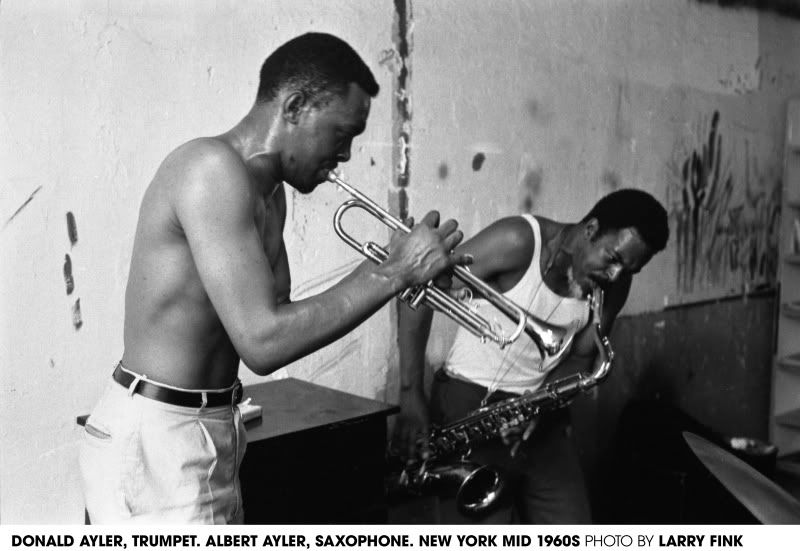
Albert Ayleriana

b. Cleveland Heights, Ohio, July 13, 1936 - d. New York, NY, November 25, 1970

"Love means nothing in tennis, but it's everything in life."
Albert Ayler, "My Name Is Albert Ayler"

"John [Coltrane] was like a visitor to this planet. He came in peace and he left in peace; but during his time here, he kept trying to reach new levels of awareness, of peace, of spirituality. That's why I regard the music he played as spiritual music -- John's way of getting closer and closer to the Creator." - Albert Ayler, in Valerie Wilmer, As Serious As Your Life, p.31

from lyssa.humana.blogspot.com
+ saxophonist, major figure in free, avant-garde jazz, "energy music"
+ music characterized by almost elemental force, piercing, versatile tone and range, startling improvisatory skills, bone-chilling, other-wordly feeling
+ drew from blues, R&B, marches and classical music, Tin Pan Alley standards, rock & roll, and other established and vernacular forms
+ studied at the Academy of Music in Cleveland with Benny Miller
+ US Army veteran
+ played with Little Walker, Stanley Turrentine, Cecil Taylor, Gary Peacock, Sunny Murray, Don Cherry, brother Donald Ayler, Charles Tyler, Lewis Worrell, Bobby Few, Niels-Henning Ørsted-Pedersen

Notable recordings: My Name Is Albert Ayler (Delmark, 1963); Spirits (a/k/a Witches and Devils) (Delmark/Freedom, 1964); Goin' Home (a/k/a Swing low sweet chariot) (Black Lion/Osmosis, 1964); Prophecy (ESP, 1964); Spiritual Unity (ESP, 1964); New York Eye and Ear Control (ESP, 1964); Ghosts (a/k/a Vibrations) (Debut/Freedom, 1964); The Hilversum Session (DIW, 1964); Bells (ESP, 1965); Spirits Rejoice (ESP, 1965); At Slug's Saloon, Vol. 1 & 2 (ESP, 1966); In Greenwich Village (Impulse!, 1966); Music Is The Healing Force of the Universe (Impulse!, 1969); The Last Album (Impulse!, 1969); The Complete ESP-Disk Recordings (ESP, 2006).

Documentary: My Name Is Albert Ayler (2007), Kasper Collin, director and writer.

I once spent an afternoon listening to Bells and felt afterwards like my ears had been reset.

"I feel really free over here. One thing every day will be as it should be." - Albert Ayler, on "My Name Is Albert Ayler"


Albert Ayler, "Billie's Bounce"


Albert Ayler, "Summertime"


Albert Ayler Quartet, at John Coltrane's Funeral, July 21, 1967, "Love Cry, Truth Is Marching In, Our Prayer"


Albert Ayler, "Nobody Knows the Trouble I've Seen"


Albert Ayler, "Ghosts"


Albert Ayler, "Spirits"


Albert Ayler, "Angels"


Albert Ayler, "All Love"


Albert Ayler, "Spiritual Reunion," Nuits de la Fondation Maeght, 1970

Albert Ayler, "On Green Dolphin Street

Sunday, July 03, 2011

Trane's LI House Needs $ + Roscoe Mitchell, Hidden Chi Treasure

Are you a music fan? A rich one? Or one blessed with carpentry and masonry skills?  Rich and skilled enough to help restore and preserve a ramshackle ranch house on Long Island where one of the greatest works of the jazz canon was written and first performed? Where its composer lived, raised a family, and recovered from personal struggles that threatened to overwhelm him, to ultimately create the most transcendant art?

The house has been empty for about seven years. Ravi Coltrane, the musician's youngest son, visited his childhood home.
Credit: Fred R. Conrad/The New York Times

If you are, please contact a jazz enthusiast named Steve Fulgoni, who in 2003 was able to purchase John Coltrane's former home in Dix Hills, which is falling down, saving it and its surrounding acreage from the jaws of local developers. The house has nevertheless continued in its state of dilapidation. Abandoned by human habitation for 8 years to raccoon residents, now gone, it still has termites devouring its timber and cracks snaking up its sides. "A Love Supreme" alone isn't going to revive it.

According to an editorial in today's New York Times, the National Trust for Historic Preservation has already put the home on its "Most-Endangered List." If it were to become a cultural site of importance, it would be among the few focusing on Long Island's long African-American presence. Fulgoni for his part is seeking assistance to turn the home into the sort of museum that Louis Armstrong's former home in Queens has become, and think needs about $1 million total to rescue it fully. I would imagine 10 times that amount, to ensure a small endowment as well, would be the way to go.

So, do you or do you know anyone who can help a jazz fan out?

***

Back in December I featured a photo of composer and musician Roscoe Mitchell from the Association for the Advancement of Creative Musicians' (AACM) 45th anniversary, which took place at Chicago's Museum of Contemporary Art. I assumed J's Theater viewers would know who Roscoe Mitchell is. But if not, artist/archivist Plastic Crimewave at the Chicago Reader's Secret History of Chicago Music site has drawn a tight little graphic to clue you in. Click here to see the image at full size. I hope Roscoe Mitchell is hipped to it too.


Roscoe Mitchell is now the Distinguished Milhaud Professor at Mills College.  His university biography is here.  Mitchell's Art Ensemble of Chicago page is here. His AACM page is here.

Monday, February 16, 2009

AWP Conference, Chicago

I guess I shouldn't have spoken too soon about burrowing--clawing, carving, wrenching--my way out of the grave, because fresh shovel-fulls of reading material just keep falling, but I did manage to have an enjoyable weekend (a belated Happy St. Valentine's Day to all) at and around the Associated Writing Programs Conference, which took place in Chicago this year. The conference began on Wednesday and concluded on Saturday, and as always, it was overwhelming and invigorating (sooooo many panels, writers, books, conversations, etc.), though I would lean on the side of invigorating, since I woke up every morning exhausted but ready to head downtown to the Chicago Hilton for more. For me the highlight of these conferences is running into folks I haven't seen in years or since the last one or the last visit to their town or campus, and so while many of my friends and literary acquaintances didn't attend this year, many were in the house. Seeing fellow Cave Canem or Dark Room (or Kundiman or New York in general) writers always brings a smile of joy to my face, as does former colleagues and writers I've admired for years and never met or heard, or met and heard once, or met and heard many times. There were many such moments this year.

I was on two panels on Thursday, the first a noon assembly called "The City--Real and Imagined," with my very famous university colleagues Reg Gibbons (the moderator), Sasha Hemon, Alex Kotlowitz, and Stuart Dybek, and that discussion drew a huge audience, including several of my graduate students (Jen I said hello to, but Anna, it was great to see you out there), and friends like wonderful poet Jaci Jones LaMon, who came up afterwards to say hello. I had the opportunity to expatiate, briefly, on Morrison, Ellison, Paley, and Proust, in one answer, which I must say doesn't come along very often. The second panel, later that afternoon, which I organized and moderated, focused on "Post-racial Writing," and brought together scholars Dorothy Wang and Angelica Lawson, and poet and critic Prageeta Sharma. All three offered provocative critiques of the notion of "post-raciality," and I only wish that we'd had more time to unpack the idea even more, particularly in light of my opening comments about perspective, performativities and normativities. The audience was one of the most racially and ethnically diverse I witnessed at the conference, and it was particularly great to see poet Samiya Bashir (!) sitting in the front row.

Thursday evening I participated in a full and packed reading at Myopic Books (one of the best used bookstores in Chicago, BTW) sponsored by Litmus Press/Aufgabe, Saturnalia Books, and Nightboat Books. Afterwards a poet archly asked me, "And what is your connection to these presses?" and I reminded him that some of my work--among the first published poems from Seismosis--appeared in Aufgabe. Other readers that night included Nathalie Stephens/Nathanaël, one of my favorite contemporary innovators, whose marvelous new book-length essay, Absence Where As, is out from Nightboat; Jennifer Scoppottone; Cal Bedient; Sebastian Agudelo; Lytton Smith, whose first book Terrance Hayes selected for Nightboat's most recent annual prize; and Laura Moriarty, whose work I've admired for years. Jennifer and another poet read from Italian translation section in the new Aufgabe (#7), and I urge you to pick it up if you're at all interested in new Italian poetry.

On Friday, after going to hear Maggie Brown's tribute to her late father, Oscar Brown Jr., and Deedee Bridgewater and an ensemble (including original sidemen Julian Priester and Ray Mantilla) bring the late Max Roach's "We Insist! Freedom Now Suite" to new heights (thank you again, Dorothy!), I dropped by the Second Sun Salon, hosted by Krista, Duriel and Lisa Lee at Lisa's dream space. I'm not going to be able to list all the folks I saw, but it was great to run into people from the Chicago poetry scene like Erin Teegarden, as well as so many people I hadn't seen in a while, including Denenge Akpem, Christian Campbell, Kelly Norman Ellis, Ross Gay, Tyehimba Jess, Parneshia Jones, Dawn Lundy Martin John Murillo, Obike, William Perdomo, Hermine Pinson, Evie Shockley, Treasure Williams, Ronaldo Wilson, Avery Young, and to meet folks I've only know via the Net, like Lillian Bertram and Doc Brown, or via their work, like David Mura. I caught the second half of the Salon performances, which featured John and Duriel performing their poems, and Avery performing Averyness! I only wish there'd been live feed so that everyone could have enjoyed them as much as the people at the event.

On Saturday I popped into a few panels, ran into a lot more people, including many university colleagues (Eula Biss, Shauna Seliy, Brian Bouldrey, Ed Roberson) and students (Barbara, Eric and others), whom I was so glad to see out and about, and spent a great deal of time at the Bookfair. So many books, so little time! I must give shout-outs to Essay Press and Canarium Books, founded by my colleagues Eula (and others) and Robyn Schiff (and others) respectively; Seismosis's publisher 1913 Press, and its founders poets Sandra and Ben Dollar (whose stock was snapped up, yea!); Northwestern University Press, and editor Parneshia Jones, who hipped me to some great new books they're publishing; and the PEN table, where my college friend Stacy Leigh was representing with grace and wit only she can! So far I've been able to read just one of the many books I bought, Monica de la Torre's incisive and often hilarious Public Domain (Segue Books, 2008), but I'm determined to scale the K-2 peaks of books I've been setting aside and viewing with waxing anticipation since the relentless academic year began.

And now, some photos (my ability to document via photographs appears to be diminishing at the same rate as my ability to blog or do anything else, save teach and read for work, but nevertheless):

Writers outside the Hilton
Writers gathering outside the Hilton (Smokers' walk)
Brian Bouldrey and Wisconsin Press editor
Brian Bouldrey and University of Wisconsin Editor Raphael Kadushin
Stacey Leigh at the PEN table
Stacy Leigh at the PEN American Center table
At the bookfair
At the Bookfair
At the bookfair
At the Bookfair
Tyehimba Jess
Tyehimba Jess at the Second Sun Salon
Avery Young and ensemble performing
Listening to the performance
Listening to the Salon performance (Christian Campbell at center)
John Murillo performing
Poet John Murillo performing at the Salon
Columbia College window
Columbia College of Chicago window exhibit
Tayari Jones
The brilliant and beautiful Tayari Jones
Ron Kavanaugh and Toni Asante Lightfoot
Ron Kavanaugh and Toni Asante Lightfoot (this was the first time I'd seen her since her new daughter was born!)
Toni Lightfoot and Donna-Kate Rushin
Toni and Kate Rushin
Alex Kotlowitz, Bill Ayers, and Reg Gibbons
After my noon panel, (l-r) Alex Kotlowitz, Bill Ayers (yep, that's him!), and Reg Gibbons
Freedom Jazz Suite at Symphony Hall
Max Roach's "We Insist! Freedom Now Suite" at Symphony Hall

Wednesday, January 30, 2008

Ernest Dawkins's UnTill Emmett Till @ Velvet Lounge

Silence: not the best way to maintain a blog, but wordless, what can I do?

Nevertheless, here's a try. On Monday night I headed down to the Velvet Lounge to catch the world premiere of composer Ernest Dawkins's UnTill Emmett Till. I'm not sure how to describe it, except to say that Dawkins melded spoken word poetry (performed by Khari B) with a range of pieces falling within the larger rubric of jazz and blues, including swing, some New Orleans-style Dixieland (as filtered through Chicago), and even some holy-roller gospel. The highlights of the piece for me were Dee Alexander's vocals, which managed to transform everything she sang, or hummed, or vocalized, into poetry, and the various solos, especially by the saxophonists Greg Ward and Kevin Nabors. (The baritone saxiphonist Aaron Getsug's solo initially provoked laughter among the musicians, though it was unclear why.) I was less a fan of the spoken word portion, which Khari B performed with real gusto and soul. At times, however, it sounded like a little too much rehashed rhetoric from way back when. (When referencing Black history, for example, why not talk about the more direct links in the Diaspora, in addition to references to Egypt (I know, I know...I'm not hating on the Afrocentrists and Kemetists, don't get me wrong)? Like, say, oh, I don't know, the Congo-Angola region, where Emmett Till's ancestor's very well may have come from?)

Anyways, Dawkins's piece, which was a continuous collage, invoked Chicago's Black musical traditions as much as it did Till, or maybe it's better to say that Till's being a Chicagoan, his mythic and symbolic status to the narrative of Black Chicago life, and music and culture, came through in Dawkins's formidable and rich musical weave. I'd thought it might be more somber, but it was really shot through, even when acknowledging the singular and collective tragedies of our past, with joy and awe. Joy and awe at Mamie Till Mobley's courage and heroism, joy and awe at the possibility of memorializing Till and celebrating his brief life, joy and awe that we can still find joy and awe amidst the continuous maelstroms of Atlantic and American history. Chatted with poet Ed Roberson afterwards I told him that I felt energized and elated, though the word "enjoyed," perhaps in its original etymological sense, was and is as appropriate. Filled, lifted. And, as Dawkins's chanted, "We won't forget: Emmett Till."

Here are some YouTube clips (despite my attempts to reorient them in QuickTime, some of the videos still posted in their original orientation on YouTube--sorry!):


An excerpt from the piece


Kevin Nabors' solo


Khari B performing the text

Monday, July 09, 2007

Moore on CNN + Murakami's Jazz + Audiologo on BGMLF(iction)

A few short hits: I've yet to catch Michael Moore's extensively heralded and praised new film, Sicko, but since I watch far too much (local) TV I have seen more than one backhanded review of it. (Intuition tells me it's even better than Fahrenheit 911.) One of the things that I like about Michael Moore is that when he's dealing with media hacks, he stands up for himself and challenges their premises and frames. In fact, in this recent CNN appearance, he strips the guff from Wolf Blitzer like turpentine on old varnish. At one point Blitzer, who gallantly defends CNN "fact-checker" Dr. Sanjay Gupta against Moore's criticisms, does concede that CNN has not answered for its deplorable journalism, or lack up it, leading up to the Iraq War. Maybe we can pen Sickoin for this weekend--or very soon at least.

***

Over the last few years, one of the writers who's become a constant in my advanced and graduate fiction writing curricula is Haruki Murakami. For a while I was using just one story, "The Elephant Vanishes" (one of my all-time favorites), and then I incorporated the eponymous short fiction collection in my undergraduate theory and practice course and some of his New Yorker stories in my graduate classes. (In both cases, I gathered that the students enjoyed his work tremendously and found it helpful in undertaking their own narrative experiments.) This past academic year I incorporated several of the long, strange and enthralling stories from After the Quake, the 2002 collection that takes the devastating 1995 Kobe earthquake as a guiding theme, trope and metaphor. I've never had the opportunity to teach one or more of his novels, though if I could, I'd probably contrast a straightforward realist one like the charming, romantic Norwegian Wood with the far more complex and dazzling quasi-fantastic yet politically engaged construction, The Wind-Up Bird Chronicle (whose origins lie in a story of almost the same name that first appears in The Elephant Vanishes and Other Stories). In so much of Murakami's work, the narrative progression, in terms of the plot, of characterizations, of incident, of even time itself, feels improvisatory, yet rightly so; he is usually able to make even the most bizarre scenarios (little people living under a house, people robbing a fast-food restaurant, elephants completely vanishing, giant frogs appearing out of nowhere, etc.) work, while also juxtaposing them with scenes of plangent, mimetic emotional resonance. His touch is often so deft that if you're analyzing the text you have to carefully retrace sentence by sentence, or figure by figure, to pinpoint out how he pulled it off. "Ruby, My Dear," indeed.

It's no wonder, then, that jazz is a great influence on his work, and in this past Sunday's New York Times, he published an article about this influence, entitled "Jazz Messenger." It's worth checking out. Here's a snippet:

Whether in music or in fiction, the most basic thing is rhythm. Your style needs to have good, natural, steady rhythm, or people won’t keep reading your work. I learned the importance of rhythm from music — and mainly from jazz. Next comes melody — which, in literature, means the appropriate arrangement of the words to match the rhythm. If the way the words fit the rhythm is smooth and beautiful, you can’t ask for anything more. Next is harmony — the internal mental sounds that support the words. Then comes the part I like best: free improvisation. Through some special channel, the story comes welling out freely from inside. All I have to do is get into the flow. Finally comes what may be the most important thing: that high you experience upon completing a work — upon ending your “performance” and feeling you have succeeded in reaching a place that is new and meaningful. And if all goes well, you get to share that sense of elevation with your readers (your audience). That is a marvelous culmination that can be achieved in no other way.

***

I love it that some civil rights folks are engaging our communities in relevant conceptual practice. I'd have loved to have caught this ceremony in Detroit. Did any J's Theater readers stage their own burials? If the word's still so vibrant, though, isn't that called vivisepulture? (And haven't we also learned enough by now about the return of the repressed to perhaps try a different strategy?)

***

Finally, here's a brilliant reply that Audiologo sent a few days ago concerning the prior posts on Black gay male literary fiction. She's given me permission to post it. Thoughts?


I thought about your comments on the Southgate article. I've heard a few odd things about sistergirl in relationship to racial dynamics and publishing, so it was interesting to read her article and its focus on "chocolate in the buttermilk." My thoughts ended up being kind of long for a blog comment; I thought I'd send you an email to read instead if you have the time.

I too wondered about her assessment of those publishing parties, and was glad to read your experiences have been different.

My sense of the lack of literary fiction from black gay men, as someone who became acquainted with writers from Other Countries while in college: hmm, my first thought was to ask how much different was it from women who stole bits of time to write poetry, and found that bits of time were more conducive to writing poetry than longer forms such as short stories and novels. There is so arguably much more to understand about the work of fiction, in order to write it, than poetry. I say that advisedly because I know that poetry has considerably more distinct forms than narrative fiction for a writer to explore. But with fiction one needs to be able to create a narrative arc, understand about character development, creating dialogue, chosing narrative voice (omiscient, 3rd person, first person, etc), chosing the tense, creating tension and using narrative devices--without understanding those (whether you use them or subvert them) you can't write a novel. I think this is why memoir is so popular. The story is already there, and the job is to whittle it down or flesh it out, not build it from scratch.

But for the aspiring writer who doesn't know about meter, or the sonnet, acrostic, ballad/e, quatrain, sestina, villanelle, etc and looks at a poem by Gwendolyn Brooks, Kevin Young, or A. Van Jordan, Ed Roberson (admittedly more difficult), Sonia Sanchez, Essex Hemphill, or Craig Harris, the realization of similar work may seem possible. If people look at Seismosis or other examples of black gay experimental work, that's when questions of form become more tangible, and I would posit that is also when the medium can become less accessible. The reason for this is not the inaccessibility of the work, because of its intellectual sophistication. Frankly I find "woman womb, waves splashing, my sister, my sister" poems inaccessible because of their unmitigated celebration of a myopic view of black (queer) womanhood. They are dissonant to my sense of the real, and as a result don't feed me and strike me as only celebrating an inverted (shameful) silence (but that's another story).

The experimental becomes inaccessible because of the larger issue of educational lack in this country. I would not wholly agree with Kai in NYC's assertion that there is a pervasive belief that writing a novel is something that "any bloke off the street can do." I think there is a general lack of reading in this culture, that coupled with a burning desire to "tell, tell, tell it on the mountain" means that some people are making an uninformed choice between the time it takes to become well-read and the time it takes to write--not understanding that the former directly informs the latter.

I also wonder at how solitary novel writing is. Arguably, for some people, especially those with an eye towards performance, writing poetry, at least the end result, offers the possibility of sharing the work in public with greater frequency, and as a consequence creating community.

When I was writing what I thought was going to be a novel, I never read it out except when I was participating in the Voices of All Our Nations Arts Workshops. That was once a year. When I joined a writing group my work was read by other black women every other month until those groups dissipated, which each of them sadly has. If, as Southgate has argued in her addendum, writing itself is a brave act for the heterosexual, though unnamed as such, black writer, how difficult is it for the queer man of of African descent to write as who he is? I don't mean to take the tortured soul route of interpretation, but I keep thinking of Richard Rodriguez' Hunger of Memory, how seemingly in the brave act of writing he actually reinscribed his own silence as a gay Chicano man, and in so doing prescribed a parallel silence for first and second generation Mexican American children in the U.S. public school system. That's fear made manifest.

Both the movement towards performance poetry, and the rush to "share it on the mountain" before the story has been determined to have legs, stems, I think, from an urgency to be seen, to heard, and to be affirmed. (I've been thinking about HIV/AIDS and black folks recently, and have been seeing parallels to questions of communication, self-love, consciousness, prioritization.) It's possible to be a writer because one is compelled to bear witness, and be witnessed doing do, just as it is possible to pursue this vocation because of a love of literature and the craft of creating it. Those two impetuses may overlap, but I sense one may be stronger than the other.

It is also my sense that, ironically, it may be easier for those who have a burning passion to "tell it" to finish a novel (though they may--like filmmaker Matty Rich--have only one tale in them), than for those who love the literary form to give themselves permission to consistently devote the substantive time to writing (and revising) that work. For those in the latter group, to take themselves seriously, to be willing to prioritize their craft, and to take time from other aspects of their life (job, relationship/marriage, family, childrearing, friends, sleep) to manifest that work may be considerably more daunting. Then to blindly feel one's way into a world, publishing, about which one knows little or nothing except that it's predominantly white, and it's unlikely anyone will be waiting to great you at the door. One has to keep committing to the importance of that work, and
negotiate whatever unease may accompany that pursuit in the present U.S. literary arena. (see Sarah Schulman & Bridgett Davis' comments re: Martha Southgate's addendum on Tayari Jones' blog).

I remember the deep unease of colleagues of color in graduate school who worried about the value of their scholarly work to their families--would their parents be able to understand it, would they feel abandonned by it? And I think some of my colleagues wondered if they would finish in time to save enough money to take care of parents when that was needed (dang, should've become a lawyer). And that's a field that back in the day, kinda like the army, was supposed to guarantee you a job after you finished your training.

OK, that may have sounded cynical, but that wasn't my intention. I greatly admire the black folk who create in the literary field. I do think institutionalized spaces and legacies such as Cave Canem are the future. I wish there was a similar place for those who are not working within poetry. However, I do wonder if poetry had the publishing cachet of literary fiction if the U.S. literary arena would be as comfortable with Cave Canem's ascendency.

Just my $.02

Peace, audiologo