Showing posts with label police. Show all posts

Tuesday, April 07, 2015

The Murder of Walter Scott

Here we go again.

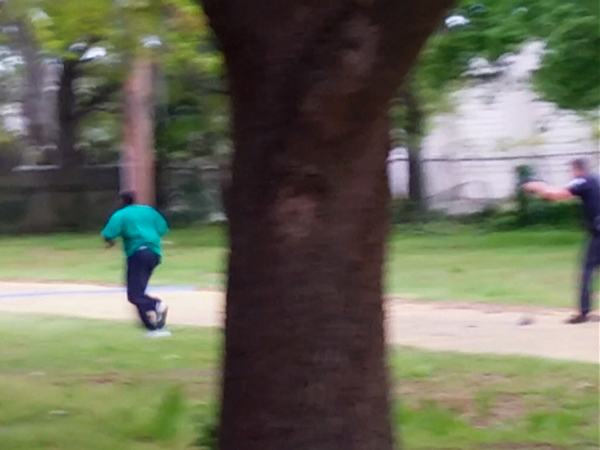
In this April 4, 2015, frame from video provided by Attorney L. Chris Stewart representing the family of Walter Lamer Scott, Scott appears to be running away from City Patrolman Michael Thomas Slager, right, in North Charleston, S.C. Slager was charged with murder Tuesday, hours after law enforcement officials viewed the dramatic video that appears to show Slager shooting a fleeing Scott several times in the back. (AP Photo/Courtesy of L. Chris Stewart)

Walter Lamar Scott was murdered in North Charleston, South Carolina, by white cop Michael T. Slager. Slager had pulled Scott over for a traffic violation, a broken tail-light, and when Scott fled, Slager initially tried to Taser him.

When that failed, Slager shot Scott dead, in cold blood, in the back, eight times. 

For a traffic stop. A traffic stop. A traffic stop.

Scott was not armed. Scott was not armed. Walter Scott. Was. Not. Armed.

Slager then apparently handcuffed the corpse of the man he had just killed and attempted to plant his Taser on him, with the apparent assistance of a fellow cop, a black man. Despite his attempted cover-up, a now-surfaced video belies it.

Unlike many cops in his position, he has been fired, and is being charged--though whether he will be prosecuted and convicted remains to be seen--with murder.

Again and again and again this keeps happening, because even though we repeat that "Black Lives Matter," in reality in this country, in this society, on this globe, what we see is that they do not.

As Jason Parham notes on Gawker, last month alone, 36 black people were killed by police, or roughly one every 21 hours. This approximates a slow and almost shameless form of genocide.

More Black Americans were killed by cops in 2014 than the total number of black people who died in the 9/11 attacks.

Like Parham I want to write something more thoughtful, more insightful, something illuminating, but I am exhausted. I really am. I have lived this reality all of my life, now approach 50 years. The foreground changes but the backdrop of racism, white supremacy, black disposability and social death, and state violence allied to elite social and economic interests are the same. Yes, things have improved, always as a result of sustained struggle, since I was a child, and they continue to improve, but we still have a long way to go.

These state murders are occurring as this country warehouses vast numbers of black and brown people in prisons, many of them privatized and providing cheap labor for corporations and earning dividends for investors. Countless black and brown people--children, adolescents, women, men--cycle through the failed penal system and its prison industrial complex annex, sometimes as a prelude to be murdered, at some point in their lives and usually with impunity, by the state, which does everything to protect elite interests, global corporations, and the billionaires who are destroying this country piece by piece.

It has to end. It MUST END.

No amount of telling black people how to behave, whether around officers or otherwise, no amount of "diversity training," no amount of explaining away the disparate ways that black americans (and brown americans who are treated like black americans by this system) are treated by the law and its officers, no amount of appeals to "black on black violence," divorced from the larger social context or not, no rationalizing away or ignoring all the ways in which black people in this society pay extensive social, political and economic taxes just for being black, is going to do it.

What has to happen is that cops have to stop killing unarmed black americans, and when they do they have to be prosecuted to the fullest extent of the law. Cops have to stop serving as the shock troops of white supremacy, neo-colonialism, the plutonomy and global capitalism. THEY MUST STOP KILLING US. What has to happen is that the entire foundation and edifice upon which this society has been built and developed has to be addressed, rethought, and remade. This is not an interpersonal issue. It is a systemic and structural problem. And it has to be addressed and redressed.

NOW.

Friday, August 15, 2014

On Michael Brown, St. Louis & Ferguson, & Black Disposability

On Saturday, August 9, 2014, in Ferguson, a predominantly black, inner-ring suburb in Saint Louis County, Missouri, under circumstances that remain murky but for which there are non-police witnesses who have spoken on the record, Michael Brown, an unarmed 18-year-old recent high school graduate who was heading to Vatterott College, was gunned down by a policeman. The Ferguson police force, which is predominantly white (50 of 53 officers), have alleged that Brown was shot repeatedly after a struggle with a white officer, whose name the police force initially would not release (It since has: Darren Wilson).

According to the Saint Louis County police chief, Joe Belmar, around noon on Saturday, after an alleged tussle in and beside Darren Wilson's police cruiser, during which Brown supposedly attempted to grab the policeman's gun, Brown was shot, several of the shots occurring over three feet from the police car. Several witnesses, including one, Dorian Johnson, who was with Brown right before the shooting, have disputed the police's account, however, attesting that Brown had his hands up when he was initially shot. After he was killed, Brown lay in the street for hours, as shocked local residents watched and photographed it, until his body was finally collected and taken to the morgue, where an autopsy on Sunday showed that he died from multiple gunshot wounds.

Brown's grieving parents retained attorney Benjamin Crump, who represented the parents of Trayvon Martin, the Florida teenager who was shot to death on February 26, 2012 by George Zimmerman after a scuffle in the gated community where Martin's parents lived. Brown's killing would been horrible enough, but following his death, which has both followed and preceded other widely reported killings by police forces of unarmed black people in the US, including Staten Islander Eric Garner's death by stranglehold on July 17, 2014, Ferguson residents and others in the St. Louis metropolitan area decided to hold a candlelight vigil.  The Sunday evening event then turned violent when some people, who may not even have been vigil participants, began attacking and looting local stores in Ferguson and a neighboring suburb, which resulted in over 30 arrests and injuries to two officers. For a number of US media outlets this turn of events became the focus, and not the tragic, unexplained murder of Brown, the fumbling response of the Ferguson police, or the specific and larger contexts in which Brown's death occurred.

On Monday protesters showed up outside the Ferguson police department to demand a full investigation of Brown's death, and shortly thereafter at a press conference Brown's parents, mother Lesley McSpadden and stepfather Louis Head, publicly called for an end to the violence, while also imploring local officials for justice for their deceased son; alongside the Ferguson police department's efforts the FBI announced that it would launch a parallel investigation to that of the St. Louis County Police Department. Monday evening the NAACP held a prayer meeting that brought together local leaders and residents. Afterwards, in a turn of events that caught the attention of a global audience, a subsequent peaceful vigil on West Florissant Avenue, one of the main strips through Ferguson, was met by the terrifying response of the militarized Saint Louis County police force, supplementing Ferguson's officers. The county forces, like an occupying army, used tear gas to disperse local residents, shooting canisters into front yards, and included snipers, officers on tanks, and machine guns that matched or exceeded the sophistication of weaponry used in the US's wars in Iraq and Afghanistan. Vigil participants were captured in photo after photo holding up both hands, as Brown was said to have done before being shot, with the police forces training their war-ready weapons upon them.

On Tuesday, justice seekers rallied in front of the Saint Louis County Police Department, in the county seat of Clayton (where Washington University is located), and the Rev. Al Sharpton arrived in Ferguson to meet with Brown's family and spark further national attention for the tragedy. It was also on Tuesday that President Barack Obama offered public comments on Brown's death, that the US Department of Justice announced it would launch a federal civil rights investigation, and that Missouri's Democratic governor, Jay Nixon, met with St. Louis City mayor Tom Slay and other local leaders to discuss the ongoing crisis. Yet the evening standoffs between the protesters and the hyper-armed police force continued. Because of these, on Wednesday morning Ferguson called for an end to evening vigils; when people sought to remember Brown's death peacefully at the end of the day, the police again responded violently, shooting rubber bullets and wooden plugs into the crowd, firing tear gas at them as well as reporters from Al-Jazeera covering the event, and going so far as to arrest a St. Louis City alderman, Antonio French, and two reporters, one from the Washington Post, Wesley Lowery, another from the Huffington Post, Ryan Reilly, after rousting them from a local McDonald's restaurant.

Finally, yesterday evening, Missouri's Democratic governor, Jay Nixon, having previously called for calm but without taking any concrete steps to ensure it, had the Missouri State Highway Patrol take over the policing of Ferguson's protests.  The person now in charge, Highway Patrol Captain Ron Johnson, a Ferguson native and resident of nearby Florissant, not only de-escalated the police response, but marched with protesters. One wonders what would have happened had this been the response five or even two days earlier. President Obama also delivered a public address on the crisis in Ferguson from his vacation redoubt, though he added little to the discourse beyond calling for the local police to be "open and transparent" in their investigation. Across the US and globe, silent rallies and marches, beginning at 7 pm and organized under the social media hashtag #NOMS1, took place; in New York, vigil participants filled Union Square and marched through Times Square.

Today, the Ferguson police released information that Brown had participated in the theft of cigars from a local convenience store; Dorian Johnson's attorney has acknowledged that Johnson was with Brown in the commission of this crime. If this is true, Johnson should and will be prosecuted, as Brown should have been; Missouri is not now nor has ever been known for letting black people alleged of criminal behavior, however light the crimes, off the hook. But even with this new information, the fact remains that Brown, like Garner, like Ramarley Graham in the Bronx, like Rekia Boyd in Chicago, like far too many black people, whether accused of a crime or not, did not deserve to be summarily shot dead. There is a structure, a system, and multiple well-defined processes for adjudicating alleged criminal behavior; vigilante state murder by "peace officers" is none of these.

***

As is probably well known to anyone who has read my work, let alone who knows me, I was born in the city of Saint Louis and spent roughly half my life up through the age of 18 in St. Louis County, in the suburb of Webster Groves. (It is the same suburb that Jonathan Franzen grew up in, and the home of two institutions of higher education, the Protestant Eden Theological Seminary and Roman Catholic Webster University). Webster Groves, like Ferguson and many Saint Louis suburbs, was and is divided geographically by race; north Webster, where we lived, was predominantly black, while south Webster was predominantly white (and much wealthier). In fact, one can draw a line through the middle of fan-shaped St. Louis City and the collar-like county, and quite reliably predict the race of who lives where. North of the city line is black; south is white, and the same holds true for the suburbs: north are the formerly white and integrated suburbs, some of which, like Ferguson, white flight has transformed into predominantly black suburban towns, and south are the mostly white suburbs, which are less wealthy. Fanning out westward are the wealthier suburbs, with larger non-white populations closer to the city, and smaller ones the further west you go. To put it simply, it is the case that over the last four decades as black people have moved from St. Louis City into its suburbs, white people have moved--fled?--further and further west, or south, or north, taking jobs and wealth with them, and have only recently returned to a revitalizing, gentrifying downtown area of the once-hollowed out core city.

One can find mirrors of this process all over the US (in Chicago, Detroit, Boston, Atlanta, Los Angeles, etc.), as well as analogues to the internal racial and spatial divisions. In St. Louis County as in suburban New York or New Jersey or Boston or Birmingham, or in many parts of the county, one can usually point not just to which suburbs are more or less white, but where in a given suburban area, as in the core cities, the races live. As has widely been reported, Ferguson's demographics have changed, but its power structure, the mayor, the city council, the police chief and department, and so forth, remain mostly white. Perhaps this reality predicted that at some point Ferguson would blow up, but I would imagine that if you asked most St. Louis-area residents where in the region what we have all witnessed over the last week would take place, Ferguson would not be high on the list. The City of St. Louis might be readily named, because St. Louis City has seen its share of violence over its 250-year-history, though it was spared the uprisings of the late 1960s (its sibling in Illinois, East St. Louis, was not so lucky, then or before). Perhaps you might hear people name some of the poorer suburban towns in North County, or some of the towns in the south suburbs where overt racism is not unknown. But, despite the problematic indicators, not Ferguson.

Our larger public discourse and visual culture still too seldom reflect the diversity, or the demographic shifts and attendant sociopolitical shifts, which have transformed American suburbs over the last four decades. Indeed, the images of Ferguson before and after Brown's murder belie the visual narratives we usually encounter; American suburbs have increasingly browned since the 1970s. My own family participated in this demographic shift, as have millions of African Americans and other people of color. In some places the John Cheever-John Updike-Richard Yates-A.M. Homes suburban world may still exist, but there are now many more Fergusons out there, as the last US Census made clear, than our news media or Hollywood ever deign to depict.

This conceptual blindness and indifference is particularly dangerous not only because it promotes ignorance about the reality of American life, but also because it helps to increase the possibility that what happened in Ferguson could happen all over the US; police beatings and killings of black Americans have sparked uprisings repeatedly through US history, as has been the case with numerous riots (1969, 1983, 1984, 1989, 1992!) in Miami, or the Los Angeles Uprisings after the videotaped beating of Rodney King in 1992, but suburbs could as easily become flashpoints as the urban areas that are now under economic and political contestation as gentrification and economic and social displacement work the perverse counter-magic of racial and ethnic partitioning and cleansing. Our political and social fabric in cities and suburbs across the US, well into the second term of President Obama, remains tinder for enraged responses by people who are still treated as second-class, not-fully-human, semi-citizens; who are viewed as superfluous, whose lives we still see daily are thought to have less value and importance; who have long been denied full participation in American, full access to humanity, in this society; who must move through their daily lives with the added tax and burden of racism and white supremacy underpinning every aspect of the world around them; who are not viewed as integral to what the country has ever claimed to mean by the word "Americans"; who are viewed, to invoke Keguro Macharia, and other theorists, as completely and utterly disposable.

***

You do not shoot someone in the back and let his body lie in the summer sun, no matter what he has done, unless you view him, and others like him, as disposable. You do not choke a person to death, when he is crying out that he cannot breathe, unless you view him as disposable. You do not empty your handgun's magazine twice, issuing more than thirty shots, into three men who are not armed. You do not mis-or-undereducate millions of people; you do not disinvest in and thereby eliminate opportunities for gainful employment from millions of people, starving them through incalculable, invisible legerdemains of austerity and greed; you do not provide zero or sub-standard health care to millions of people, and use their poor health to impoverish them further; you do not poison and destroy the environment in which millions of people live and work, again using this as a tool to extract every thing you can out of them; you do not perform a false pantomime of justice and equality, in courts of law, in places of employment, in stores, in the pews, everywhere, before millions of people for whom you do not want real justice and quality ever to be possible; you do not warehouse millions of people, whom you view as nothing more than commodities to provide jobs for others in whom you have disinvested, and mere bodies for cheap labor to enrich the bottom lines of privatized prison corporations, unless you view them as disposable.

You do not demonize and dehumanize an entire race people, through language and images, persistently and consistently for hundreds of years, changing the surface code and semantics as needed to maintain your power, and then appeal to your innocence and pretend that you have not. Indeed, you cannot appeal to any category of the human or human rights because you have systemically denied the humanity of the people all around you. You do not arm a police force as if it is an occupying army ready to slaughter everyone in its crosshairs, and train it on people living in your midst (or on other people across the globe, for that matter). Much of what I describe here applies not only to black people in this country, but to anyone who is not (considered fully) white, and to white people as well, especially poor ones. But the fact since before this country's founding is that black people bear the brunt of this logic of disposability, we are the ne plus ultra on which this logic, concomitant with anti-black racism and white supremacy, was established and perfected, and until this logic is completely overturned and dispelled,  so long as we remain here, and we will remain here, we will remain the most disposable of all.

This is the world Michael Brown and others like him, live in. This is the world that I, who have several degrees and teach at a university and have published and translated books, live in. This is the world that our President, the leader of the "free world," lives in. Until the economic, political, social, and juridical foundations on which this society has built its entire edifice truly and fully change, until we extirpate the structural and systemic racism and white supremacy that underpins everything, the kind of murder and the crazed response by state forces that we witnessed in Ferguson very well will continue to occur.

It was horrifying, but hardly a surprise.

It was a tragedy, but not unforeseen.

It will inspire some brilliant activism in a multiplicity of forms, as similar tragedies have; some introspection and soul-searching, among people who want things to change; some changes in the law, as we now see with Congressional efforts to demilitarize the police, and perhaps a prosecution or two;

But very likely almost nothing, beyond rhetoric and shadowplay, will transpire among those with real power, who have a vested interest in keeping things as they are.

We should feel disgust and horror at what has occurred in Ferguson, and Staten Island, and Beavercreek, Ohio, and Los Angeles, and Harlem, and everywhere a scenario like this unfolds.  But that is not enough. What must also occur, in as many ways as are possible, is to change the structures of this society so that the groundwork for what we have witnessed and continue to witness is not already laid, that this tragedy is not again foreordained. We cannot change our past, but we can reshape our future. NONE OF US is disposable. I know this will not be the last time I write about a tragedy of this sort, and I certainly will not forget Michael Brown, or Eric Garner, or John Crawford, or Ezell Ford, or Dante Parker, or Rekia Boyd, or Tarika Wilson, or Gabriella Nevarez, or Tyisha Miller, or Yvette Smith, or Ramarley Graham, or Oscar Grant, or Sean Bell, or Ousmane Zongo, or Amadou Diallo, or Eleanor Bumpurs...or Trayvon Martin. But what I do hope happens this time, as with every prior time, is we make even firmer our commitment, at every level, but especially as a society, to ensure that we will not have to relive a version of this story, with only the particulars changed, once again.

Sunday, May 20, 2012

HUMAN MICROPOEM @ Protest NATO Rally, Chicago

The 2012 NATO Summit is currently taking place in Chicago, and as I need not tell anyone, the city's and state response to dissent of any sort, by groups and people affiliated with the Occupy movement, longstanding peace and anti-war activists, veterans, union members, and others on the left and left-of-center who expressed a desire to assemble and march without confrontation, has been really over the top. From the militarization of the police forces surrounding the site of the summit, the McCormick Place Convention Center, near Soldier's Field, including restrictions on access to major roadways and north-south routes; to an early-morning raid on Zoe Sigman's home in Chicago's Bridgeport section, which resulted in the arrest of 3 people, with 2 others arrested on different charges today, though alternative reports suggest that the arrestees have been framed or the charges have been trumped up as a deterrence; to violent responses to marchers over the last few days, including a brutal showdown at McCormick Place this evening, the state reaction to Constitutionally-guaranteed dissent has been reactionary and violent.  I demurred for a moment, I must admit, but only for a moment, before deciding to participate in today's HUMAN MICROPOEM, performed by a loosely-affiliated group of poets and performers sponsored by and affiliated with the experimental Red Rover Series, who have supported the Occupy Chicago movement in its earlier Federal Reserve of Chicago encampment mode, commemorated Veterans Day with a march to the Vietnam Veteran's Memorial, and staged guerrilla readings at this year's Associated Writing Programs (AWP) conference in Chicago. More generally, "The Human Micropoem is a call and response choral form utilizing the human microphone at the occupy movements to amplify the speaker's words by those listening. The speaker says a line and then everyone who can hear repeats it."

I turned out to be the fourth of a quartet who convened as the HUMAN MICROPOEM from 11 am to a little after 12 pm, on the sidewalk at the southwest corner of Jackson & Columbus, just catercorner to the major March and Rally to Protest NATO in Grant Park (and directly across the street from the rump side of the Art Institute of Chicago), a legal, permitted rally at Petrillo Bandshell, in the park, to be followed by a march toward McCormick Place, with the Iraq Veteran's Against the War (IVAW) marching  in solidarity and culminating in IVAW members of IVAW conducting a closing ceremony in which they planned to return their medals to NATO.  We Human Micropoets performed original works, including declaiming from a collaborative poem by one of the poets, reading dictionary entries (cf. "revolution," "peace," "action," "silence," etc.), offering impromptu chants, and reciting poems by other, well-known writers (June Jordan, Czeslaw Milosz, Thomas Transtromer, Lorine Niedecker, and Siegfried Sassoon) writing anti-war, pro-peace poems.  We drew a decent number of onlookers and participants, who arrived on their way to the main rally in waves, leading poet and organizer Jen Karmin to astutely time the readings by the lights. Cagean, as she put it. (For longer poems, of course, this presents a little problem.) Well-wishers included a tyke heading towards the lake with his parents, and numerous ralliers who stopped to take pictures and record us, as well as others who wrote up the event. A reporter from AP Radio even took audio, while a young onlooker assured me he would post the video of us on his YouTube channel. (It's not there but when it is I'll add the link.)  After the event, several of us went and sat on the lawn under a cooling bower, and chatted and listened to the speakers at the rally, whose crowds grew larger by the hour.  I had schoolwork to attend to, so I couldn't attend any of the several marches that were to take place. I headed back north, and it wasn't until a few hours later, as I was walking to the train and passed flat screens in the open windows of bars on Clark Street in Wrigleyville, that I learned that there'd been a violent standoff between police and the marchers south of the rally ground, and that the medal-returning event had also ended with brutal state response. The ironies are too numerous to list.

I do hope to continue the Human Micropoeming over the summer in the New York/New Jersey area. Among the many things it has clarified for me are how important public, social performances of poetry can be; that any sort of text, not just a poem, can work under the correct conditions; and that certain poems, particular ones that can easily be broken down prosodically and syntactically, that have a looser rhythm and shorter lines, often work best.  June Jordan's poems were perfect in this regard, and their severity felt in perfect keeping with the gravity of what protesters have faced over the last few years. Nevertheless, performing Milosz's "Declaration," I had to catch myself several times not stopping at the sheer power of his language, which, even somewhat atomized, still bore so much beauty and force.  As always, a few photos:

At the Human Micropoem performance, Chicago Rally Against NATO Summit
A rally participant photographing Jen (article here)

At the Human Micropoem performance, Chicago Rally Against NATO Summit
Peace activists who joined the performance

At the Chicago Rally Against NATO Summit
Marchers heading toward the rally site

At the Chicago Rally Against NATO
Grant Park, near the Petrillo Bandshell (Chiscrapers in the background)

At the Chicago Rally Against NATO
Rally participants relaxing near us

At the Chicago Rally Against NATO
Peace activists

At the Chicago Rally Against NATO
People distributing newspapers and leaflets

Chicago Rally Against NATO Summit
Rally participants

At the Chicago Rally Against NATO
As the rally site began to fill up

Saturday, November 19, 2011

Occupy: Images Worth 99% of 300 Million's Words

"A picture shows me at a glance what it takes dozens of pages of a book to expound." - Ivan Turgenev, Fathers and Sons, 1862

Tuesday, Police assault on Zuccotti Park


Yesterday, Police attack on peaceful students at the University of California, Davis


UC Campus Police pepper-spraying peaceful students
UC Campus Police Pepper-spraying peaceful students

Today, Newt Gingrich: "Go get a job right after you take a bath."


Why are people protesting? Why can't they "get a job," Newtie?

Jesse LaGreca, on This Week, with Christiane Amanpour


In case they still don't get it, some facts:


Sunday, August 07, 2011

Violent Protests Rock North London Boroughs

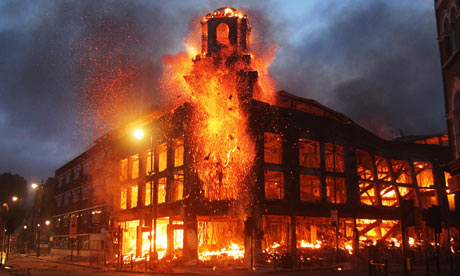
Fire rages in Tottenham, Saturday night (Lewis Whyld/PA)
This morning, buildings in the northern London borough of Tottenham were still smoldering after riots, arson and looting succeeded what began as a peaceful public protest against the killing this past Thursday, by Metropolitan police, of 29-year-old Londoner Mark Duggan, after he was stopped in a taxi near Tottenham Hale. According to the Guardian, on Saturday around 5:30 pm 120 or more marchers, organized by Duggan's family and friends and community leaders, and led by the mother of three of his children, Semone Lewis, wended their way from the Broadwater Farm area, the site of a popular uprising in 1985, towards Tottenham Police Station. They reportedly could not get the police to engage their concerns. Around 3 hours later, additional protesters with weapons allegedly appeared, and events escalated with a car being set on fire and some protesters breaking through barricades and attempting to storm the police station, "pelting police officers with bricks, bottles and eggs."  At various points thereafter people looted a number of shops in the borough, setting some ablaze, and police apprehended some looters as late as 5:00 am today. The photos tell part of the story, and it is an ugly one.  Thus far 55 people have been arrested, 26 police were injured with 8 hospitalized, and the physical toll includes 2 burnt police cars, a bus and several shops. 

The uprisings occur during a long year and several months of public distress at the "austerity" program the coalition Conservative-Liberal Democratic government, headed by Prime Minister David Cameron since May 2010, has continually imposed.  The Tory-Liberal Democratic economic approach, which has included government service cutbacks and reduced spending across a range of formerly state-funded projects, as well as hikes in state university tuitions and increased fees for other services, has thus far (and unsurprisingly) failed to reverse the British economy's contraction in the wake of the 2008 economic collapse.  The uprisings also come as London's police metropolitan police organization, headquartered at Scotland Yard, is under state investigation and public suspicion as a result of allegations that its officials, including its past leaders, aided and abetted Rupert Murdoch's News International's newspapers, including the now shuttered News of the World, in illegally accessing the personal information, via hacking, wiretapping and other means, of a vast array of Britons, ranging from members of the royal family to a kidnapping victim, and possibly of Americans including the families of those killed during the 9/11 bombings.

The unrest has since continued, with eruptions in other London-area districts such as Enfield, Edmonton, Dalton, Walthamstow, and Brixton, the last of which was the site of three of the most momentous British riots of the late 20th century, in 1981, 1985, and 1995. As today, in 1981, the predominantly Black Caribbean community in Brixton was disproportionately suffering from high unemployment, terrible housing, and an already high crime rate, and a series of confrontations with police culminated in riots confrontations between police and locals, of all races, between April 10-12, 1981. That burned into public consciousness the racial and ethnic and class crises that had long been festering in British society, worsened by the approach of the Conservative Thatcher government, and marked the beginning of a series popular uprisings, often turning on the axes of race and poverty, throughout Britain.  One result was a change, after the 1981 Scarman Report, in police search procedures, but only 4 years later, the shooting of Dorothy Groce, a Jamaican immigrant, by police sparked yet another violent uprising, which was followed a week later by the Broadwater Farm riot in Tottenham, after the death of Cynthia Jarrett, an Afro-Caribbean woman, during a police search of her home. And so it goes.
Tottenham uprisings, Saturday, August 6 (GoogleMaps/Guardian Online)
An early report in tomorrow's Guardian states that initial forensic tests may show that a bullet lodged in a police radio, alleged to have been fired by Duggan, may have come from a police weapon. Additionally, a Guardian editorial today talks about the rising sense of alienation the cuts in government services and rising unemployment have provoked. Previous London protests since the Tory-Liberal Democratic coalition took power a year and two months ago have included a November 2010 protest by the National Union of Students that culminated in some of the protesters shattering the glass façade of the Conservative Party Headquarters and reaching the roof, from which one hurled a fire extinguisher onto the street below, and a student protest last December against raised tuition that resulted in an attack on the car carrying Prince Charles and his wife Camilla as they were leaving their residence at Clarence House to attend a performance at Palladium House. Economic concerns, especially around persistent unemployment and gross inequalities based on financial and governmental élites' control of wealth and resources, have also been central to the protests that shook the Middle East this past spring and which are ongoing in countries such as Syria and Yemen.  Today New York Times reported on the ongoing protests in Israel, which has seen crowds of upwards of 200,000 people decrying the high costs of living and the failure of the government to address economic inequality.

It would be an intellectual failure to draw too simple conclusions about the situation in Britain, but it is clear that the government's broader approach to the economy has been a debacle, thus disparately disadvantaging the very people who live in boroughs like Tottenham and Brixton, as well as the working and middle-classes in general; that the axes of race and class profoundly inflect the still-ongoing unequal power relations between the still predominantly white state security forces (and British national and local governments) and many multiracial communities they serve; and that there will be no easy solutions if people, especially those without power or any sense of stake in a society's direction, have few viable channels to express their concerns and see mechanisms to address them.  From the reports I've seen, local governmental authorities are taking note of the exploding crises, but the solutions must to be horizontal and vertical, cutting across and deep into every layer of British--and every other--society, and must involve the people who not only feel but have been left out, economically, politically, socially, culturally. These solutions also have to start happening right away, or Tottenham could be just one of many boroughs to catch fire, and more than a few times, before the summer, and the year, are out.